


Abstract
Algae are sustainable sources of bioactive compounds widely used in health and wellness applications, though supporting evidence is limited. This study characterized and compared aqueous extracts and purified fractions from Fucus vesiculosus, Gracilaria sp., and Ulva sp. Total Phenolic Content (TPC) by the Folin–Ciocalteu method, antioxidant activity by the DPPH method, and the HPLC-DAD chromatographic profiles of extracts and fractions were compared. Fucus vesiculosus and Gracilaria sp. exhibited the highest TPC and antioxidant activity. Fractions without mucilage showed an enrichment in TPC and chromatographic profiles, particularly the polysaccharide-free extract of Gracilaria sp., highlighting its promising applications and the need for future studies.
1. Introduction
The oceans, the largest reserves of biodiversity, host marine algae, photosynthetic eukaryotes that play key roles in aquatic ecosystems, producing oxygen and supplying essential nutrients to coastal areas [1,2,3]. In addition, marine algae represent a sustainable, diverse, and still largely unexplored source of bioactive compounds, such as proteins and peptides, polysaccharides, lipids, vitamins, pigments, and phenolic compounds [1,4,5]. These metabolites have been associated with a range of beneficial biological properties. However, despite increasing interest, scientific evidence about many claimed properties and their bioactives remains scarce. Macroalgae are taxonomically divided in three main groups: brown (Phaeophyceae), red (Rhodophyta), and green (Chlorophyta). Their chemical composition and biological activity are influenced by both species and environmental/geographical factors [5].
Among the diversity of macroalgae, species of biotechnological interest stand out, such as Fucus vesiculosus (brown), Ulva sp. (green), and Gracilaria sp. (red). Fucus vesiculosus (bladderwrack) is rich in fucoidans, phlorotannins, and fucoxanthin, compounds with antioxidant, anti-inflammatory, anti-obesity, anti-aging, antimicrobial, anticancer, anticoagulant, and antidiabetic activities. Due to these properties, it has been extensively studied for applications in food products, biofertilizers, drugs, and cosmetics [5,6]. Gracilaria sp. (old woman’s hair) is widely valued for the production of agar, a polysaccharide used in the food, cosmetic, and pharmaceutical industries. Gracilaria sp. also contains compounds with high added value, such as proteins, lipids, phenolic compounds, and phycobiliproteins, displaying antioxidant, anti-inflammatory, anticancer, and antimicrobial activities, among others [7]. Ulva sp. (sea lettuce) contains ulvan as its main bioactive component, a polysaccharide associated with a wide variety of biological activities, including anti-inflammatory, anticoagulant, anticancer, antioxidant, and antihyperlipidemic properties, demonstrating high potential for applications in medicine, cosmetics, functional foods, and other industries [8].
Despite their potential as sources of health-promoting compounds, comparative studies across algal groups and evaluations of purification strategies remain scarce, limiting the validation of their potential applications. In this context, the present study aimed to characterize and compare aqueous extracts and purified fractions from representative brown (Fucus vesiculosus), red (Gracilaria sp.), and green (Ulva sp.) algae, with emphasis on total phenolic content (TPC), antioxidant activity, and chromatographic profiles of compounds, to provide insights into their potential for health and wellness applications.
2. Material and Methods
2.1. Chemical
The following were obtained: acetonitrile (≥99.9%) and methanol (≥99.9%) from Honeywell (Charlotte, NC, USA); ultrapure water from Merck KGaA (Darmstadt, Germany); trifluoroacetic acid (TFA) from PanReac (Barcelona, Spain); phloroglucinol, Folin–Ciocalteu reagent, and sodium carbonate from Sigma-Aldrich, Merck KGaA (Darmstadt, Germany); 2,2-diphenyl-1-picrylhydrazyl (DPPH) and absolute ethanol (>99.8%) from Thermo Fisher Scientific (Waltham, MA, USA); and distilled water. All other chemicals and reagents were of analytical grade.
2.2. Preparation of Marine Algae Extracts
Three species of macroalgae were used: Fucus vesiculosus (Batch F1MKG1.5– 8/F1.0181024, Expiration Date 30 September 2027, Ulva sp. (Batch U1MKG1.5–8/G1.0181024, Expiration Date 30 June 2026), and Gracilaria sp. (Batch G1MKG1.5–8/G1.0181024, Expiration Date 31 October 2027). The biomass was supplied in flakes by the company ALGAplus® (Ílhavo, Portugal; https://www.algaplus.pt/ (accessed on 3 September 2025)), which is certified for sustainable and organic macroalgae cultivation.
Aqueous extracts were prepared from the macroalgal biomass in distilled water at concentrations of 100 g/L for Fucus vesiculosus and 100 g/1.5 L for Gracilaria sp. and Ulva sp. The suspensions were autoclaved at 121 °C for 15 min, cooled and filtered to obtain the total extracts. An aliquot of each extract was frozen at −20 °C for subsequent purification. The remaining extracts were frozen at −20 °C and subsequently lyophilized. The dried extracts were stored at −20 °C until further analysis.
2.3. Purification of Extracts by Ethanol Precipitation
The aqueous extracts were purified to remove mucilages by ethanol precipitation. Absolute ethanol (99.8%) was added to the reserved aliquot of the aqueous extracts at a 4:1 ratio, and the mixture was kept on ice for 2 min. The solutions were centrifuged at 22,553× g for 15 min, yielding two fractions: a polysaccharide-free extract and a polysaccharide fraction. The polysaccharide-free extracts were dried by evaporation (40 °C, pressure of 175 mbar, and variable rotation) and subsequently stored at −20 °C until further use. The polysaccharide fractions were dried by lyophilization and also stored at −20 °C until further use.
2.4. Characterization of Marine Algae Extracts
For all analyses, stock solutions of the total aqueous extracts and purified fractions were prepared by dissolving 10 mg of extract in 1 mL of a solvent mixture of acetonitrile (ACN) and 0.05% trifluoroacetic acid (TFA) in water (50:50, v/v), obtaining a final concentration of 10 mg/mL.
2.4.1. Quantification of the Total Phenolic Content
The total phenolic content (TPC) was determined by the Folin–Ciocalteu colorimetric method, following an adapted protocol from Coelho et al. [5].
Results were expressed in phloroglucinol equivalents (PGEs) per g of dry extract (mg PGE/g of dry extract). For analysis, the prepared solutions were incubated under orbital shaking for 1 h at 4 °C, and the absorbance was measured at 760 nm in a UV–VIS spectrophotometer (JASCO Inc., Easton, MD, USA). Quantification was performed against a calibration curve (Abs760nm = 7.758 PGE + 0.006, R2 = 0.9918) using phloroglucinol as standards (0–2000 µg/mL). All assays were performed in duplicate.
2.4.2. Determination of Antioxidant Activity
The antioxidant activity (AA) was determined using the 2,2-diphenyl-1-picrylhydrazyl (DPPH) redial scavenging method, following an adapted protocol from Coelho et al. [5].
The solutions to be analyzed (10 mg/mL) were mixed with a 0.002% (w/v) DPPH solution in methanol and incubated for 30 min at room temperature in the dark. The decrease in absorbance was measured at 517 nm using a UV–VIS spectrophotometer. Antioxidant activity was expressed as the percentage of DPPH radical inhibition, calculated from the absorbance of the samples relative to a methanol control. All assays were performed in duplicate.
2.4.3. Analysis of the Chromatographic Profile of Extracts by High-Performance Liquid Chromatography
The chromatographic profile of compounds in the extracts and purified fractions was analyzed by High-Performance Liquid Chromatography (HPLC). The analysis was performed on an HPLC-DAD Elite LaChrom® system (HITACHI, VWR, Tokyo, Japan), equipped with a reverse phase column, ACE 3 C18 (150 × 4.6 mm (ACE-111-1546) from ACE), an L-2200 Autosampler, an L-2300 Column Oven, and an L2455 Diode Detector.
The analysis was performed by injecting 25 µL of the sample, and the separation was achieved using a gradient composed of ACN (solution A) and 0.05% TFA in water (solution B), as described: 0 min (100% B), 30 min (30% A, 70% B), 40 min (80% A, 20% B), 45 min (80% A, 20% B), 50 min (30% A, 70% B), 52 min (0% A, 100% B), 55 min (0% A, 100% B). The flow rate was set at 0.8 mL/min, and chromatograms were acquired between 200 and 600 nm using a diode array detector (DAD). The chromatographic profiles of the extracts and the purified fractions were represented as the maximum absorbance values at the scanned wavelengths.
3. Results
3.1. Yields of Total Extracts and Purified Fractions
Total extracts were obtained from the biomass of Fucus vesiculosus, Gracilaria sp., and Ulva sp., according to the procedure described in Section 2.2. After drying, the yields of the extracts were calculated and are summarized in Table 1. Among the studied species, Gracilaria sp. exhibited the highest yield of total extract (28.2%), followed by Ulva sp. (21.6%), and Fucus vesiculosus (18.7%).
Table 1.
Yields of dry total extracts obtained from algae biomass.
The total extracts were subsequently purified using ethanol precipitation to remove mucilage (Section 2.3), yielding two fractions: a polysaccharide-free extract and a polysaccharide fraction. The yields of these fractions are presented in Table 2 and Table 3.
Table 2.
Yields of dry polysaccharide-free extracts obtained from purification.
Table 3.
Yields of dry polysaccharide fractions obtained from purification.
3.2. Quantification of the Total Phenolic Content
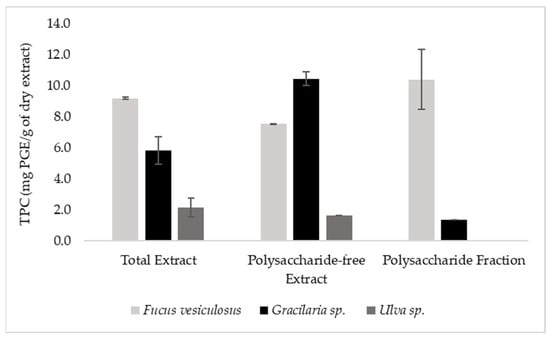
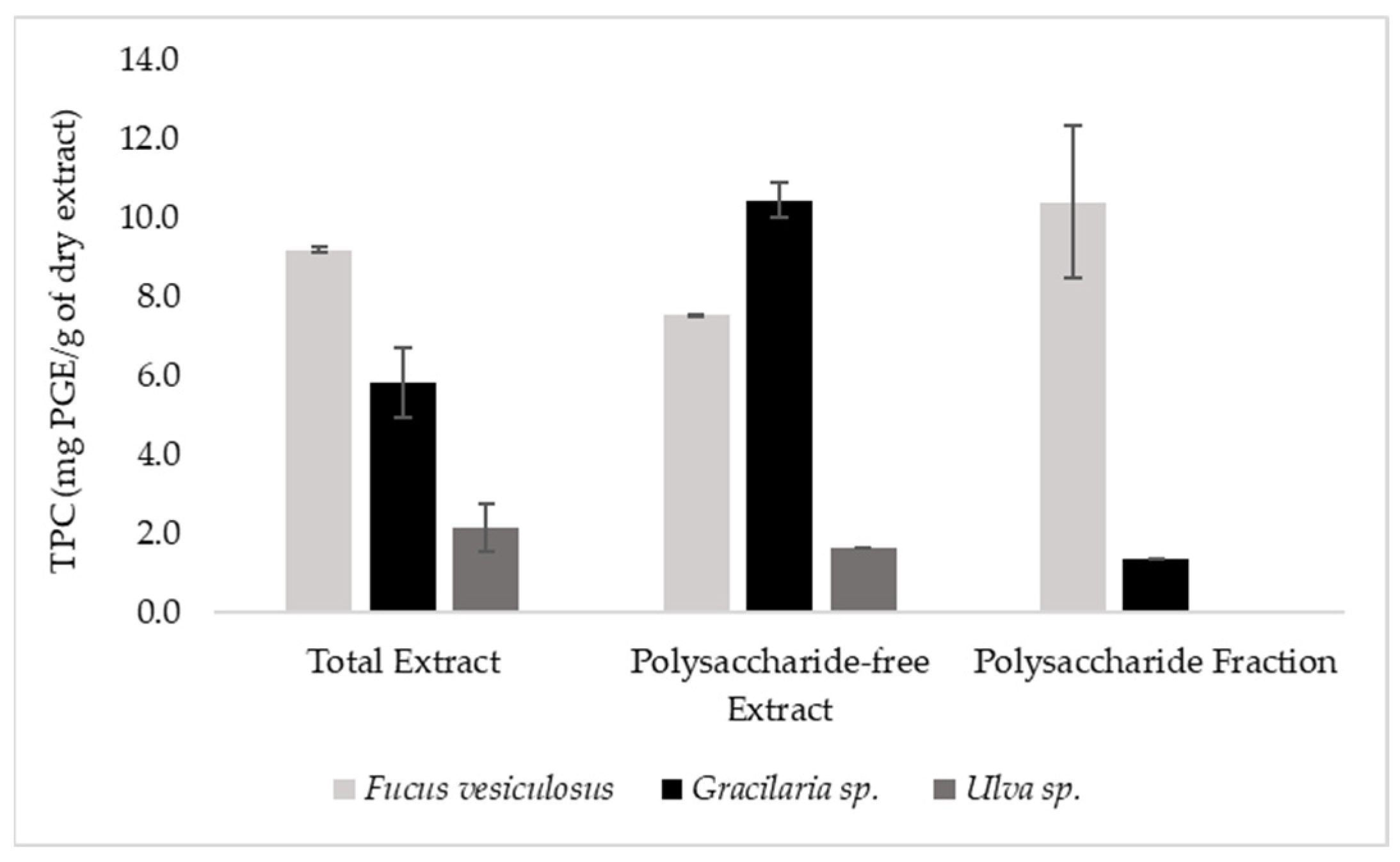
The total phenolic content was determined using the Folin–Ciocalteu method as describer in Section 2.4.1, and the results are expressed as mg of phloroglucinol equivalents (PGE) per g of dry extract (mg PGE/g of dry extract). TPC was seen to varied significantly between species and different types of extracts, with the results shown in Figure 1.
Figure 1.
Total phenolic content in mg PGE/g dry extract of total extracts, polysaccharide-free extracts, and polysaccharide fractions from Fucus vesiculosus, Gracilaria sp., and Ulva sp.
The polysaccharide-free extract of Gracilaria sp. exhibited the highest TPC (10.4 ± 0.4 mg PGE/g of dry extract). In Fucus vesiculosus, the highest TPC value was obtained in the polysaccharide fraction (10 ± 2 mg PGE/g of dry extract), while in Ulva sp., the TPC was very low or below the detection limit in all extracts and fractions analyzed.
3.3. Determination of Antioxidant Activity
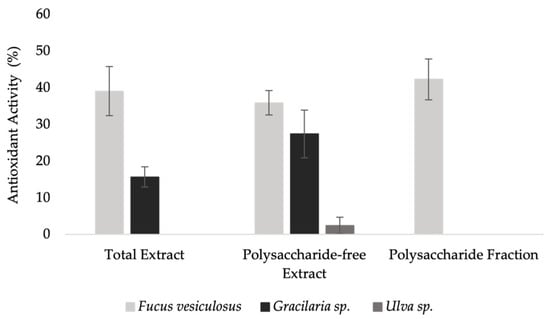
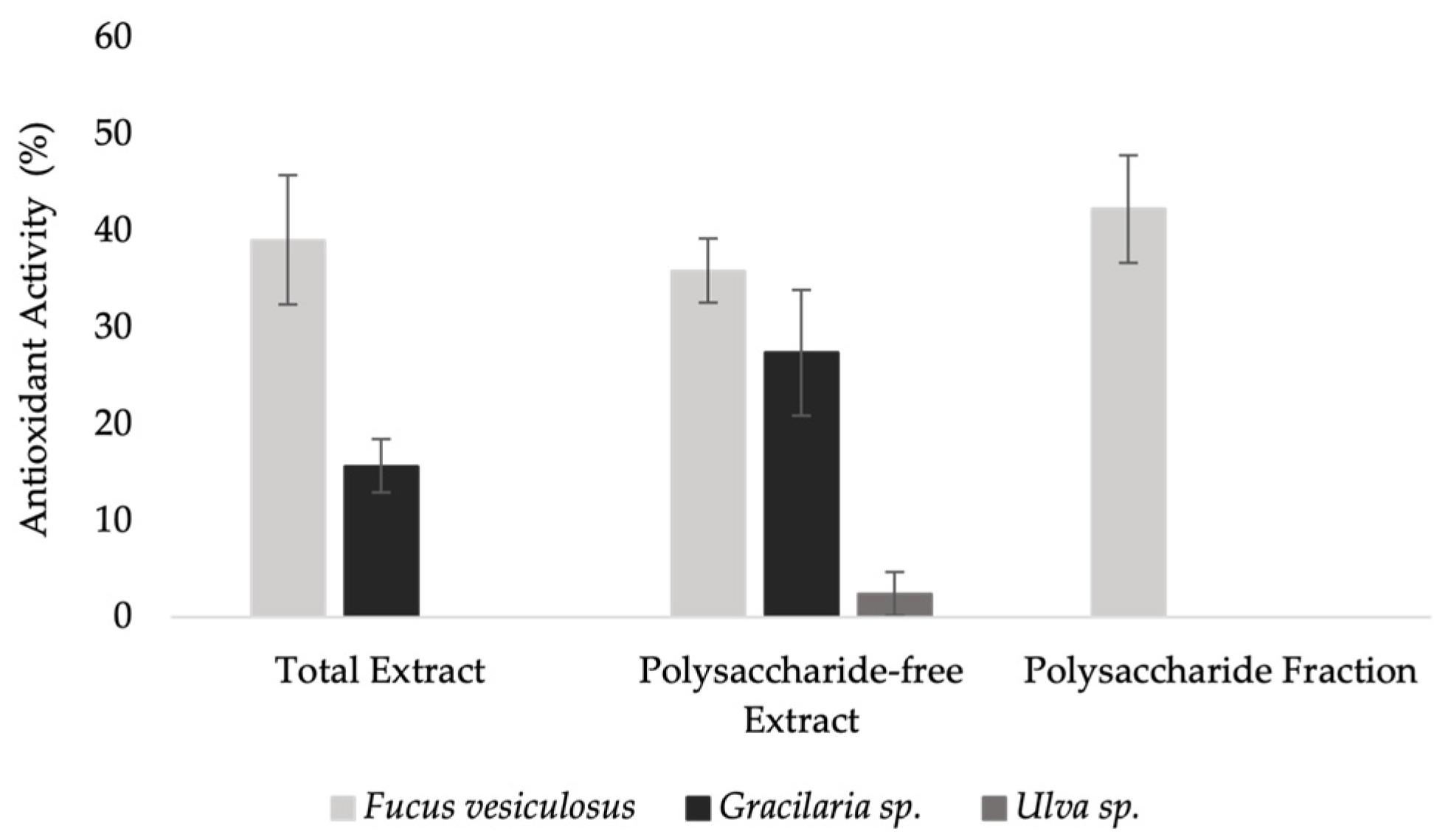
The antioxidant activity (AA) of the extracts and purified fractions was measured using the DPPH radical scavenging assay, as described in Section 2.4.2. AA varied significantly between species and different types of extract (Figure 2).
Figure 2.
Antioxidant activity of total extracts, polysaccharide-free extracts, and polysaccharide fractions from Fucus vesiculosus, Gracilaria sp., and Ulva sp.
The polysaccharide fraction of Fucus vesiculosus showed the highest antioxidant activity (42.25 ± 5.59%). For Gracilaria sp., the polysaccharide-free extract showed the highest AA (27.4 ± 6.51%). The extract and purified fractions from Ulva sp. displayed the lowest or undetectable AA.
These results are consistent with the TPC findings (Figure 1), since the extracts with the highest phenolic content in each species also demonstrated the greatest AA.
3.4. Analysis of the Chromatographic Profile of Extracts by HPLC-DAD
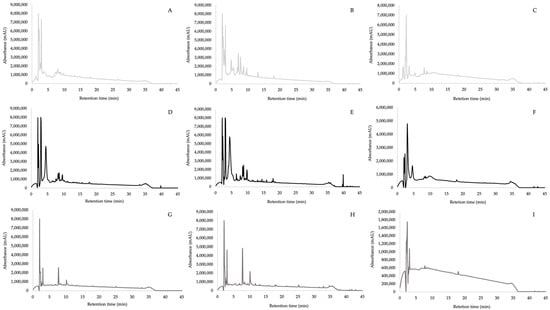
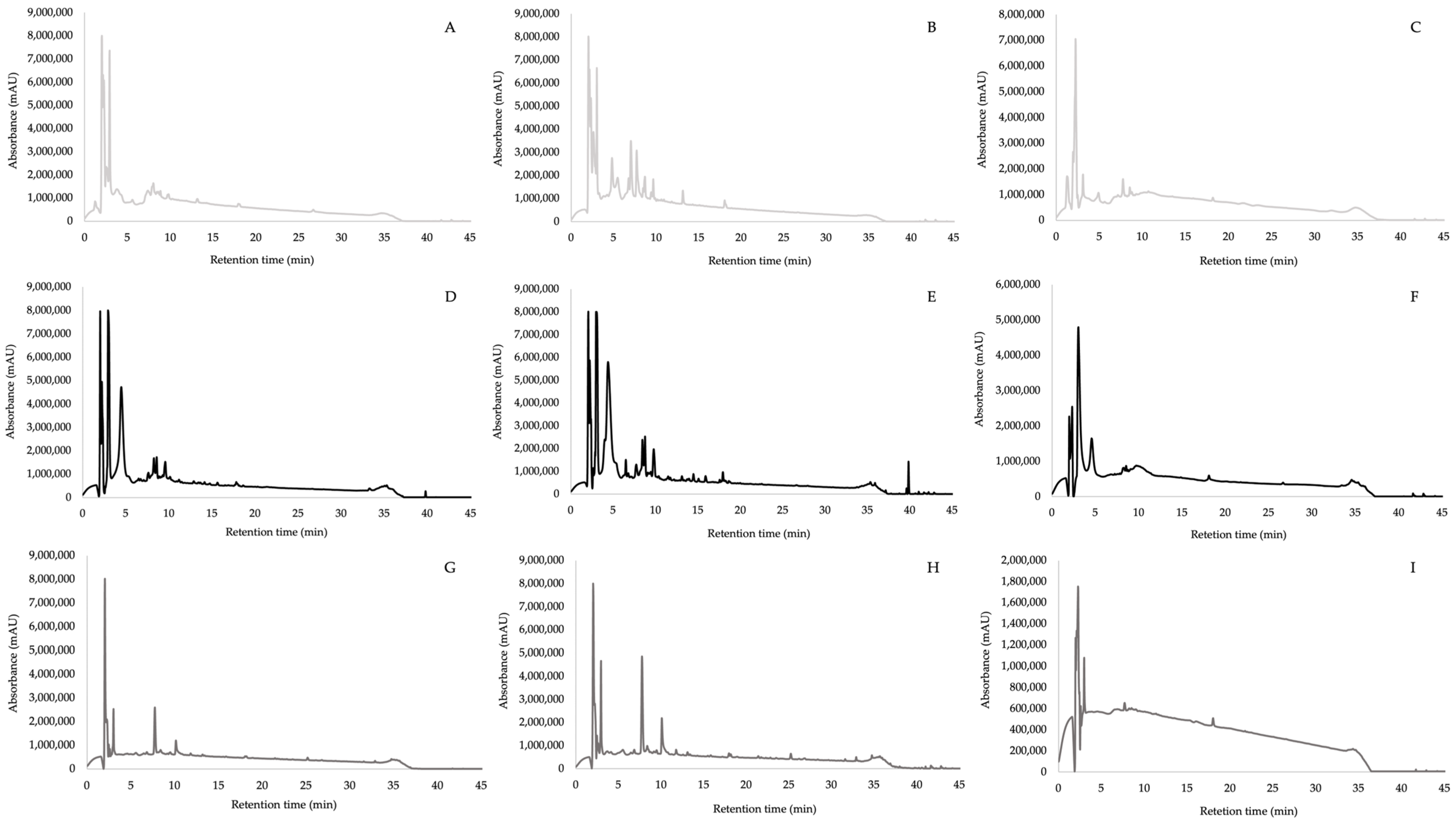
The chromatographic profiles of the extracts and purified fractions from Fucus vesiculosus, Gracilaria sp., and Ulva sp. (Figure 3), were obtained by HPLC-DAD. The profiles revealed distinct peaks corresponding to compounds with variations in peak number and intensity among the different types of extracts and macroalgae species.
Figure 3.
Chromatographic profile of (A) total extract, (B) polysaccharide-free extract, and (C) polysaccharide fraction of Fucus vesiculosus. Chromatographic profile of (D) total extract, (E) polysaccharide-free extract, and (F) polysaccharide fraction of Gracilaria sp. Chromatographic profile of (G) total extract, (H) polysaccharide-free extract, and (I) polysaccharide fraction of Ulva sp.
In general, the chromatographic profiles supported the TPC results obtained. For example, for Gracilaria sp. the polysaccharide-free extract (E), which had the highest TPC, displayed more intense peaks than the total extract (D) and the polysaccharide fraction (F). Ulva sp. extract (G) and purified fractions (H and I), with very low TPC, showed fewer or smaller peaks in the chromatographic profile. In Fucus vesiculosus both the extract (A) and the purification fractions, polysaccharide-free extract (B) and polysaccharide fraction (C), which exhibited high TPC and antioxidant activity, showed intense peaks. However, each displayed a distinct chromatographic pattern, reflecting the separation of different compound during purification process.
4. Discussion
This study investigated the extraction total phenolic composition and antioxidant potential of three macroalgae species, Fucus vesiculosus, Gracilaria sp., and Ulva sp. Extraction yields differed notably among species, with Gracilaria sp. providing the highest yield in both the total extract and polysaccharide-free extract, while Fucus vesiculosus and Ulva sp. yielded lower amounts. These variations likely reflect differences in the overall composition of compounds present in the macroalgal biomass. Parameters such as TPC, AA, and the chromatographic profile of total extracts and purified fractions were determined, allowing us to understand both variability in metabolite composition among species and the impact of different extraction and purification methods on their potential functionality. These findings demonstrate that both species and extraction/purification methods strongly influence the phenolic profile, with important implications for the bioactive potential of the extracts. The results for TPC are consistent with previous studies, which report higher TPC in red and brown algae extracts (Gracilaria sp. and Fucus vesiculosus, respectively) compared to green algae (Ulva sp.) [9]. Herein, the polysaccharide-free extract of Gracilaria sp. showed higher TPC than previously reported [9], indicating that the extraction and mucilage removal process used in this study was particularly effective in enriching phenolic compounds for this extract purified fraction. This enrichment likely contributed to the enhanced AA observed in the polysaccharide-free fraction from Gracilaria sp., highlighting the role of both phenolic content and composition in determining the bioactive potential of macroalgal extracts, as also reported in other studies [9]. In contrast, green algae showed insignificant or undetectable AA, in agreement with its lower TPC. In the results obtained for the AA, Fucus vesiculosus showed the highest value across all extracts, followed by Gracilaria sp., especially in the extract without polysaccharides. These observations reinforce the evidence of a positive correlation between AA and TPC, since extracts with higher TPC generally exhibited stronger AA [1].
The chromatographic profiles obtained are consistent with the TPC values. Notably, the polysaccharide-free extract of Gracilaria sp. showed both the highest TPC (10.4 mg PGE/g of dry extract) and an enrichment of compounds in the chromatogram compared to the total extract. These results highlight the importance of optimized and selective extraction processes capable of removing polysaccharides and concentrating bioactive metabolites.
Nevertheless, the data indicate that the relationship between TPC and AA is not strictly linear. For example, Gracilaria sp. exhibited higher TPC than Fucus vesiculosus but lower AA, suggesting that AA depends not only on the total amount of phenolic compounds, but also on their qualitative composition and structural diversity. Different classes of phenolic compounds display different reducing capacities and radical-scavenging efficiencies, which could explain the observed differences. These findings underscore the need for future studies to characterize the specific phenolic profiles and interactions that influence bioactivity in macroalgal extracts and purified fractions, in order to comprehensively evaluate their potential for applications in functional foods, nutraceuticals, or other bioactive formulations.
5. Conclusions
The brown alga Fucus vesiculosus, red alga Gracilaria sp., and green alga Ulva sp. revealed distinct profiles of TPC and AA, with Fucus vesiculosus and Gracilaria sp. exhibiting the highest TPC. Aqueous extraction followed by mucilage removal through ethanol precipitation effectively increased both TPC and AA, due to the enrichment of bioactive compounds in the polysaccharide-free extract, particularly in the red algae Gracilaria sp. This purified fraction represents a promising source of bioactive and antioxidant compounds to be further explored and evaluated for incorporation into dermatological formulations, food supplements, and other innovative health-related applications, as its high phenolic content and antioxidant activity may provide protective and preventive benefits for human health.
Author Contributions
Conceptualization, A.M.M., C.P.R. and R.P.; methodology, A.M.M., C.P.R. and R.P.; formal analysis and investigation, A.M.M.; writing—original draft preparation, A.M.M.; writing—review and editing, C.P.R. and R.P.; supervision, C.P.R. and R.P.; funding acquisition, C.P.R. and R.P. All authors have read and agreed to the published version of the manuscript.
Funding
The authors also thank the FCT for the essential financial support under project references UIDB/04138/2020, UIDP/04138/2020, UIDB/00645/2020 and UIDP/00645/2020. The authors acknowledge also the support of Polytechnic University of Lisbon through project IPL/IDI&CA2024/SeaCoats_ISEL, Centro de Química Estrutural is a Research Unit funded by the Fundação para a Ciência e Tecnologia (FCT) through projects UIDB/00100/2020 and UIDP/00100/2020. The Institute of Molecular Sciences is an Associate Laboratory funded by the FCT through project LA/P/0056/2020. Ana Marta Miranda acknowledgements financial support from IPL grant IPL/IDI&CA2024/SeaCoats_ISEL/BII/3M.
Institutional Review Board Statement
Not applicable.
Informed Consent Statement
Not applicable.
Data Availability Statement
No new data were created or analyzed in this study. Data sharing is not applicable.
Conflicts of Interest
The authors declare no conflicts of interest.
References
- Nova, P.; Pimenta-Martins, A.; Maricato, É.; Nunes, C.; Abreu, H.; Coimbra, M.A.; Freitas, A.C.; Gomes, A.M. Chemical Composition and Antioxidant Potential of Five Algae Cultivated in Fully Controlled Closed Systems. Molecules 2023, 28, 4588. [Google Scholar] [CrossRef] [Scilit] [PubMed]
- El-Manaway, I.M.; Rashedy, S.H. The ecology and physiology of seaweeds: An overview. In Sustainable Global Resources of Seaweeds Volume 1: Bioresources, Cultivation, Trade and Multifarious Applications; Ambati, R.R., Ravishankar, G.A., Eds.; Springer Nature: Cham, Switzerland, 2022; pp. 3–16. [Google Scholar] [CrossRef] [Scilit]
- Leandro, A.; Pereira, L.; Gonçalves, A.M.M. Diverse applications of marine macroalgae. Mar. Drugs 2020, 18, 17. [Google Scholar] [CrossRef] [Scilit] [PubMed]
- Teixeira, L.M.; Reis, C.P.; Pacheco, R. Marine-Derived Compounds Combined with Nanoparticles: A Focus on the Biomedical and Pharmaceutical Sector. Mar. Drugs 2025, 23, 207. [Google Scholar] [CrossRef] [Scilit] [PubMed]
- Coelho, M.; Duarte, A.P.; Pinto, S.; Botelho, H.M.; Reis, C.P.; Serralheiro, M.L.; Pacheco, R. Edible Seaweeds Extracts: Characterization and Functional Properties for Health Conditions. Antioxidants 2023, 12, 684. [Google Scholar] [CrossRef] [Scilit] [PubMed]
- Obluchinskaya, E.D.; Pozharitskaya, O.N.; Zakharov, D.V.; Flisyuk, E.V.; Terninko, I.I.; Generalova, Y.E.; Smekhova, I.E.; Shikov, A.N. The Biochemical Composition and Antioxidant Properties of Fucus vesiculosus from the Arctic Region. Mar. Drugs 2022, 20, 193. [Google Scholar] [CrossRef] [Scilit] [PubMed]
- Yahyaoui, K.; Traikia, M.; Rihouey, C.; Picton, L.; Gardarin, C.; Ksouri, W.M.; Laroche, C. Chemical characterization of polysaccharides from Gracilaria gracilis from Bizerte (Tunisia). Int. J. Biol. Macromol. 2024, 266, 131127. [Google Scholar] [CrossRef] [Scilit] [PubMed]
- Li, C.; Tang, T.; Du, Y.; Jiang, L.; Yao, Z.; Ning, L.; Zhu, B. Ulvan and Ulva oligosaccharides: A systematic review of structure, preparation, biological activities and applications. Bioresour. Bioprocess. 2023, 10, 66. [Google Scholar] [CrossRef] [Scilit] [PubMed]
- Silva, A.F.; Abreu, H.; Silva, A.M.; Cardoso, S.M. Effect of oven-drying on the recovery of valuable compounds from Ulva rigida, Gracilaria sp. and Fucus vesiculosus. Mar. Drugs 2019, 17, 90. [Google Scholar] [CrossRef] [Scilit]

Disclaimer/Publisher’s Note: The statements, opinions and data contained in all publications are solely those of the individual author(s) and contributor(s) and not of MDPI and/or the editor(s). MDPI and/or the editor(s) disclaim responsibility for any injury to people or property resulting from any ideas, methods, instructions or products referred to in the content. |
© 2025 by the authors. Licensee MDPI, Basel, Switzerland. This article is an open access article distributed under the terms and conditions of the Creative Commons Attribution (CC BY) license (https://creativecommons.org/licenses/by/4.0/).