


Abstract
Reverse micelles (RMs) are versatile nanostructures traditionally formed in low-polarity organic solvents, but the need for greener alternatives has limited their broader applicability. Here, we demonstrate for the first time that a hydrophobic Natural Deep Eutectic Solvent (NADES), prepared from a simple 1:1 mixture of camphor and menthol (CM), can act as the continuous external phase for RM formation. Remarkably, CM dissolves the benchmark surfactant sodium dioctyl sulfosuccinate (AOT) at concentrations up to 0.5 M without co-surfactants and supports water solubilization up to W0 = [H2O]/[AOT] = 5, yielding thermodynamically stable systems. 1H and DOSY NMR analyses reveal clear structural rearrangements of the micellar interface, confirm the encapsulation of water in the polar core, and provide quantitative evidence of size modulation as a function of W0. The resulting CM/AOT/water assemblies represent the first example of NADES-based reverse micelles, offering an easily prepared, sustainable, and biocompatible platform. This breakthrough opens new perspectives for the development of green self-assembled systems with promising applications in areas such as food technology, pharmaceuticals, and nanomedicine.
1. Introduction
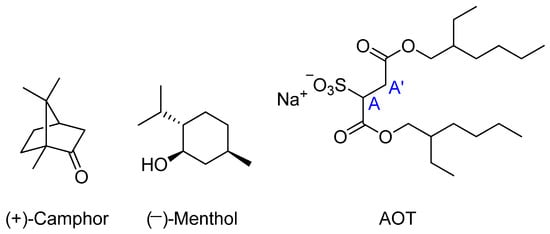
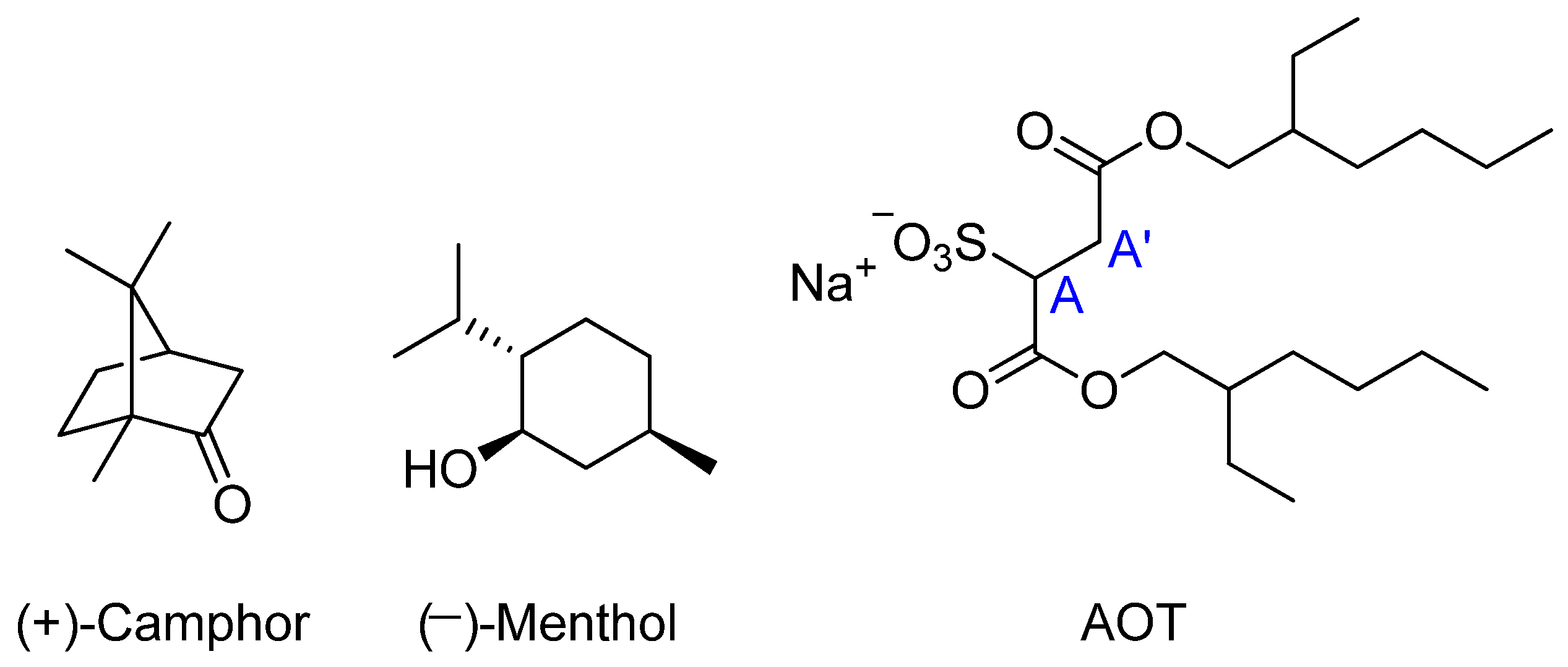
Reverse micelles (RMs) are nanostructures formed by dissolving surfactants in low-polarity organic solvents. A widely used anionic surfactant is AOT (sodium dioctyl sulfosuccinate, Sigma Aldrich, St. Louis, MO, USA), which forms aggregates capable of encapsulating water in their core [1]. The amount of solubilized water is expressed as W0 = [H2O]/[Surfactant]. In the context of green chemistry, Natural Deep Eutectic Solvents (NADESs), such as the 1:1 mixture of camphor and menthol (CM, Scheme 1), represent a sustainable alternative to conventional nonpolar solvents. Notably, CM exhibits a hydrophobic character, making it a promising candidate to serve as the continuous organic phase in reverse micelle systems.
Scheme 1.
Molecular structures of the NADES components (camphor and menthol) and the AOT surfactant. The most relevant hydrogen atoms on AOT are labeled.
In this study, we evaluate the potential formation of RMs using AOT (Scheme 1) as the surfactant, water as the polar component, and CM as the hydrophobic external phase. NMR technique was employed to assess the structural and dynamic features of the resulting systems [2].
2. Experimental Section
2.1. Materials
Sodium 1,4-bis(2-ethylhexyl) sulfosuccinate (AOT; Sigma, St. Louis, USA, >99% purity) was used without further purification and stored under vacuum over P2O5 to reduce moisture uptake. Water (HPLC grade) was obtained from Sintorgan (Buenos Aires, Argentina) and employed as received. The CM-based NADES was prepared by accurately weighing the appropriate amounts of each constituent into a 50 mL Elenmeyer flask (IVA S.A, Buenos Aires, Argentina), adjusting the quantities to achieve a 1:1 molar ratio. The flask was then sealed, and the mixture was heated at 60 °C for approximately 30 min to promote melting. Once liquefied, the system was vortex-mixed for 10 s to obtain a homogeneous liquid.
2.2. Methods
Preparation of CM/AOT Reverse Micellar Solutions: AOT stock solutions in CM were prepared using gravimetric and volumetric dilution methods. Portions of these stock solutions were subsequently employed to formulate individual reverse micellar systems containing varying water contents, expressed as the molar ratio W0 = [H2O]/[AOT]. Water was added to each micellar formulation using calibrated microsyringes. The mixtures were sonicated in an ultrasonic bath to achieve optically transparent solutions. All prepared samples were monophasic and visually clear and were directly used for NMR measurements. The W0 values explored ranged from 0 to 5 for CM/AOT reverse micelles; higher water loadings led to turbidity and phase instability. The condition W0 = 0 corresponds to systems without intentional water addition. It should be noted that the solubility of water in CM at ambient temperature is extremely limited.
1H NMR spectra were acquired using a Bruker Avance III 400 MHz spectrometer (Bruker, Ettlingen, Germany), with a digital resolution (Bruker, Ettlingen, Germany) of 0.06 Hz per data point. The probe temperature was maintained at 25 °C, as confirmed by the stability of the chemical shifts over time. Following a 10 min equilibration period, no significant drift in chemical shift was observed beyond the digital resolution of the instrument. For reverse micellar systems, a sealed capillary containing D2O was placed inside the NMR tube and served as an external frequency lock. Chemical shifts were referenced to the external D2O signal, with a reproducibility better than 0.01 ppm.
2D DOSY experiments were carried out on freshly prepared solutions of CM/AOT at different water contents. To ensure locking of the systems, a coaxial tube containing D2O was employed. For each sample, before running the 2D DOSY experiment, simple 1D DOSY spectra were recorded in order to optimize the magnetic field pulse gradients (δ) and diffusion time (Δ) values to ensure proper signal abatement during the 2D experiment. All NMR data were processed using MestReNova 12.0 software.
3. Results and Discussion
To assess the suitability of the new non-polar solvent as the continuous phase for reverse micelle formation, the solubility of the well-known surfactant AOT in CM was examined. The NADES was able to dissolve AOT up to 0.5 M without requiring the addition of a co-surfactant. Moreover, the system proved capable of solubilizing water, reaching a maximum W0 of 5, and yielding thermodynamically stable solutions.
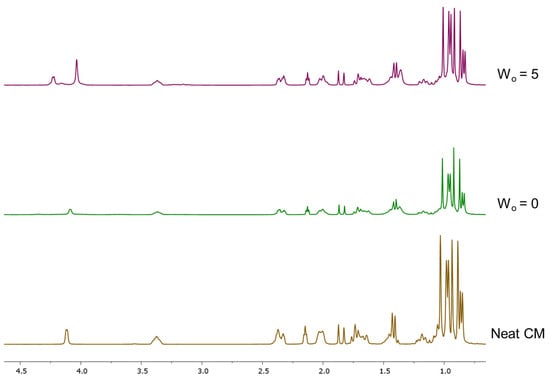
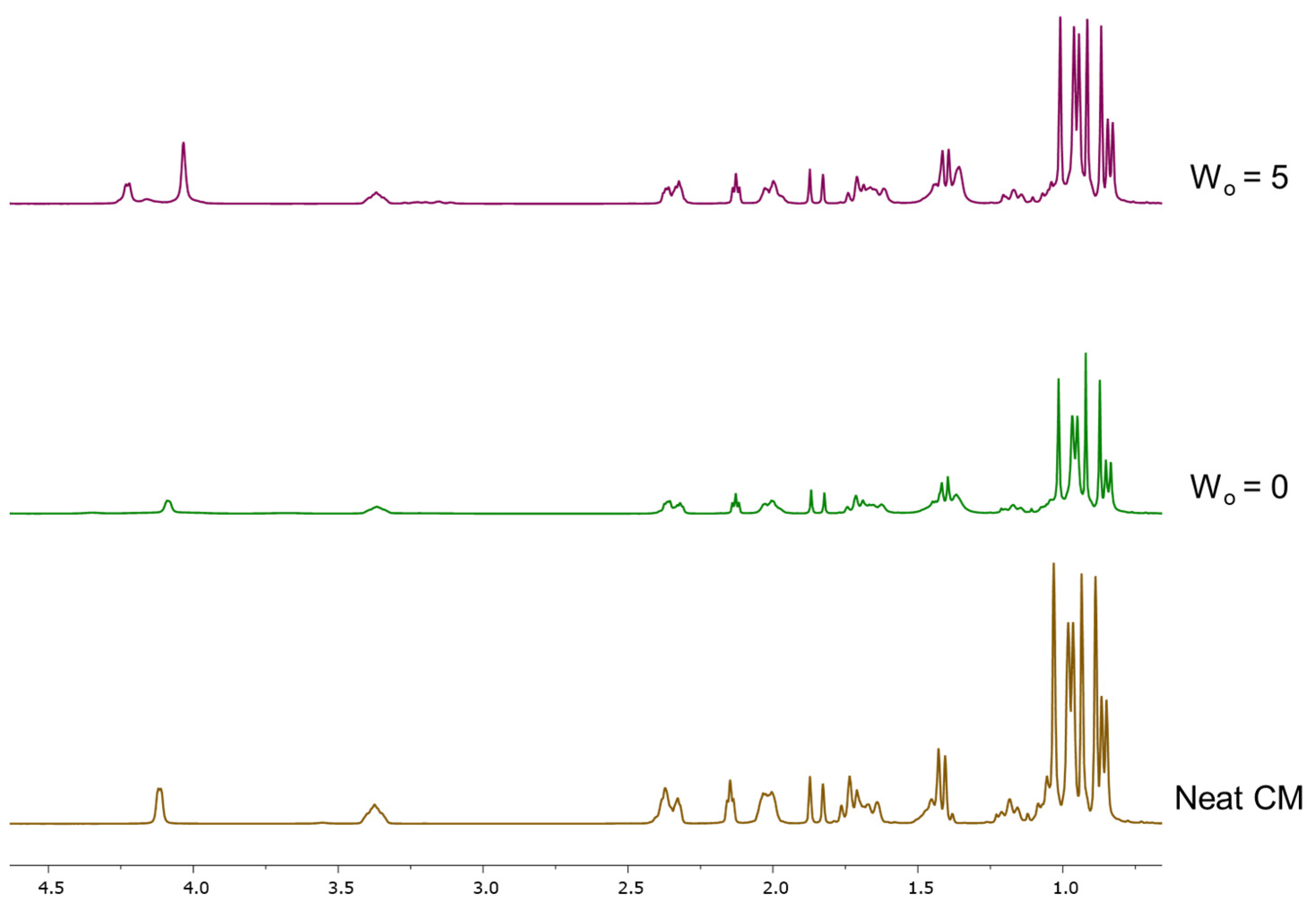
From the 1H NMR spectra shown in Figure 1, a decreasing trend in the chemical shifts in protons A and A′ of AOT (see Scheme 1) is observed as the water content of the system increases. For instance, proton A resonates at 4.35 ppm at W0 = 0, shifting to 4.26 ppm at W0 = 5. This upfield shift indicates that the environment of the sulfonate group becomes more polar upon water incorporation, likely due to group hydration and a rearrangement of micellar interfacial interactions. These findings highlight how the addition of water modulates different regions of the surfactant and provide further evidence for the formation of a micellar system [3].
Figure 1.
1H NMR spectra for neat CM and CM/AOT solutions at different W0. [AOT] = 0.5 M. T = 25 °C.
To further assess the ability of CM to promote AOT reverse micelle formation, DOSY-NMR experiments were performed [4]. Table 1 presents the diffusion coefficients obtained for proton A′ of the AOT surfactant, together with the micellar diameters calculated from these values using the Stokes–Einstein Equation (1). The measurements were carried out at 25 °C, with the viscosity of the CM medium determined to be 20.7 cP.
where k is the Boltzmann constant, T is the absolute temperature, and η is the solvent viscosity.
dapp = kT/3πηD
Table 1.
Diffusion coefficients (D) and micellar diameters (dapp) calculated by DOSY for the CM/AOT/water system.
The micellar diameter ranges from 1.17 nm in the absence of water to 3.41 nm at higher water contents, confirming the formation of larger aggregates. This increase in aggregate size is characteristic of reverse micellar systems, where the polar core expands as more water is incorporated. These results provide quantitative evidence of the self-assembly process in NADES-based RMs and demonstrate that micellar size can be tuned by adjusting W0.
As part of the characterization, we monitored the water protons entrapped in CM/AOT RMs as a function of W0. In neat CM, a low-intensity signal appears at 3.55 ppm, corresponding to residual water. Although this NADES is generally considered hydrophobic, this signal reveals that its precursors are capable of weakly interacting with water molecules through the hydroxyl group of menthol and the carbonyl group of camphor, thereby allowing trace amounts of water to be dispersed.
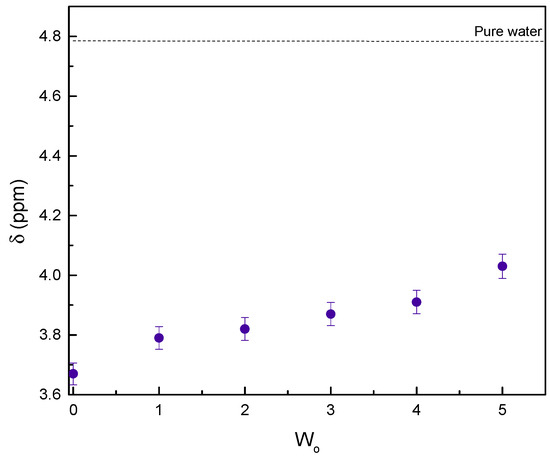
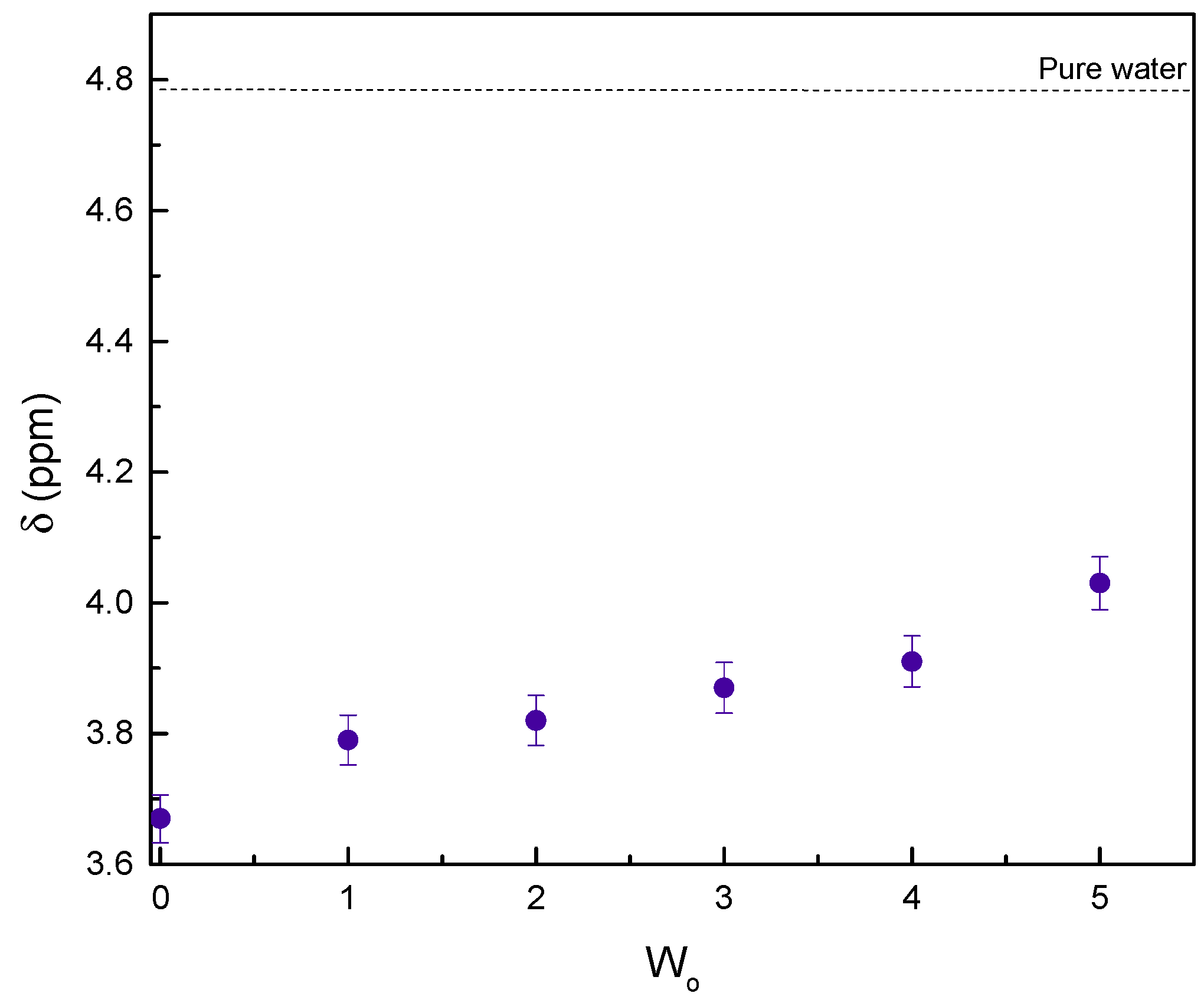
Upon addition of AOT without introducing extra water into the system (W0 = 0), the water signal shifts to 3.67 ppm, indicating a more polar or less shielded environment, likely due to structural rearrangements induced by the surfactant. As the water content increases (W0 = 1–5), the chemical shift in the water protons progressively shifts from 3.79 ppm to 4.03 ppm, suggesting strong interactions with the surfactant at the micellar interface (Figure 2).
Figure 2.
1H chemical shift values of entrapped water in CM/AOT RMs as a function of water content. [AOT] = 0.5 M. For comparison, the value of neat water (- - -) is also plotted.
Despite the presence of the hydroxyl group in menthol, no significant interaction with water was observed upon its addition. Both signals remain distinguishable (Figure 1), indicating that water is preferentially located in the polar core of the micelle, more distant from the NADES components, and therefore less available to interact with the hydroxyl group.
The results obtained from 1H and DOSY NMR allowed for a detailed characterization of the CM/AOT/water system. The chemical shifts in water protons, the hydroxyl group of menthol, and the surfactant protons provide clear evidence of structural and environmental changes associated with aggregate growth upon water incorporation. Moreover, the diffusion coefficients and micellar diameters confirm the formation of tunable RMs. The system’s ability to encapsulate water, alter its chemical environment, and adjust micellar size through W0 makes NADES-based RMs versatile platforms with potential applications in diverse fields.
4. Conclusions
This study demonstrates the formation of RMs and provides insights into the interface formed by CM/AOT at varying water contents. We show that RMs can be generated using a hydrophobic NADES, readily prepared, as the nonpolar continuous phase. This finding opens new avenues for the design of biocompatible organized systems, with promising perspectives for future applications in the food industry and medicine.
Author Contributions
A.G.H.: Data Curation, Formal Analysis, Investigation. N.M.C.: Formal Analysis, Investigation, Writing—Review and Editing, Supervision, Funding Acquisition, Resources. F.M.: Data Curation, Formal Analysis, Investigation, Writing—Review and Editing, Supervision. R.D.F.: Data Curation, Formal Analysis, Investigation, Writing—Original Draft, Writing—Review and Editing, Supervision. All authors have read and agreed to the published version of the manuscript.
Funding
This research was funded by Consejo Nacional de Investigaciones Científicas y Técnicas (CONICET), Universidad Nacional de Río Cuarto, and Agencia Nacional de Promoción Científica y Técnica (PICT-2019-2159, PICT-2019-543, and PICT-2021-112).
Institutional Review Board Statement
Not applicable.
Informed Consent Statement
Not applicable.
Data Availability Statement
Data available on request from the authors.
Acknowledgments
R.D.F., N.M.C., and F.M. hold research positions at CONICET. A.G.H. thanks CONICET for a research doctoral fellowship.
Conflicts of Interest
The authors declare no conflicts of interest.
References
- Correa, N.M.; Silber, J.J.; Riter, R.E.; Levinger, N.E. Nonaqueous Polar Solvents in Reverse Micelle Systems. Chem. Rev. 2012, 112, 4569–4602. [Google Scholar] [CrossRef] [Scilit] [PubMed]
- Falcone, R.D.; Baruah, B.; Gaidamauskas, E.; Rithner, C.D.; Correa, N.M.; Silber, J.J.; Crans, D.C.; Levinger, N.E. Layered Structure of Room-Temperature Ionic Liquids in Microemulsions by Multinuclear NMR Spectroscopic Studies. Chem.–Eur. J. 2011, 17, 6837–6846. [Google Scholar] [CrossRef] [Scilit] [PubMed]
- González Herrera, A.; Mariano Correa, N.; Dario Falcone, R.; Moyano, F. Unveiling Eco-Friendly Reverse Micelle Systems: Dimethyl Carbonate as a Novel Biocompatible Solvent. ChemPhysChem 2024, 25, e202400617. [Google Scholar] [CrossRef] [Scilit] [PubMed]
- Dumas, C.; Meledandri, C.J. Insights into the Partitioning Behavior of Secondary Surfactants in a Microemulsion-Based Synthesis of Metal Nanoparticles: A DLS and 2D NMR Spectroscopic Investigation. Langmuir 2015, 31, 7193–7203. [Google Scholar] [CrossRef] [Scilit] [PubMed]

Disclaimer/Publisher’s Note: The statements, opinions and data contained in all publications are solely those of the individual author(s) and contributor(s) and not of MDPI and/or the editor(s). MDPI and/or the editor(s) disclaim responsibility for any injury to people or property resulting from any ideas, methods, instructions or products referred to in the content. |
© 2025 by the authors. Licensee MDPI, Basel, Switzerland. This article is an open access article distributed under the terms and conditions of the Creative Commons Attribution (CC BY) license (https://creativecommons.org/licenses/by/4.0/).