
Proceeding Paper

Exploration of New Inhibitors as Anti-Alzheimer Agents Through Molecular Modeling †
1
Group of Computational and Medicinal Chemistry LMCE Laboratory, University of Mohamed Khider Biskra, Biskra 07000, Algeria
2
Department of Chemistry, Faculty of Sciences, University of Mohamed Khider Biskra, Biskra 07000, Algeria
3
Laboratory of Natural Substances and Bioactive (LASNABIO), University of Abou-BakrBelkaid, Tlemcen 13000, Algeria
*
Author to whom correspondence should be addressed.
Presented at the 29th International Electronic Conference on Synthetic Organic Chemistry, 14–28 November 2025; Available online: https://sciforum.net/event/ecsoc-29.
Chem. Proc. 2025, 18(1), 133; https://doi.org/10.3390/ecsoc-29-26898
Published: 13 November 2025

Abstract

Alzheimer’s disease (AD) is a neurodegenerative disease that accounts for more than 80% of dementia cases worldwide. This a neurological disorder that encompasses various stages of development (mild, moderate, or severe cognitive impairment), including certain psychological and behavioral syndromes such as depression, psychosis, and aggression. The main drug classes currently used to treat AD are acetylcholinesterase (AChE) and butyrylcholinesterase (BChE) inhibitors. Advancements in bioinformatics and chemometrics have positioned the in silico approach as a pivotal tool in identifying novel therapeutic compounds.Therefore, we conducted a study to evaluate the effects of various newly developed N-substituted 5-chloro-2(3H)-benzoxazolone derivatives on AchE. The aim of this research paper was to utilize in silico ADMET profiling to investigate the potential of natural analogs as inhibitors of AchE, using computational techniques such as swissadme. Analysis of selected ligands with the highest affinity for the target was performed to evaluate ADME properties. The calculation of ADME properties proved that these ligands follow the rules of Lipinski, Veber, and Egan and confirmed the docking results, indicating that they are probably the best inhibitors. Furthermore, they could be utilized to create novel pharmaceutical medicines with which to treat individuals with AD.

1. Introduction

Alzheimer’s disease (AD), the major form of dementia, is a progressive neurodegenerative disease [1]. The disease manifests itself as numerous cognitive deficits, such as memory loss, cognitive impairment, difficulty thinking, and language impairment. The pathophysiology of this disease is not fully understood. Most approved medications can only treat the disease by alleviating its symptoms. The disease is accompanied by impaired cholinergic neurotransmission in the basal forebrain [2], leading to reduced cholinergic signaling. This impairment can be corrected with acetylcholinesterase inhibitors. Inhibition of acetylcholine (AChE) is a well-established therapeutic strategy that increases acetylcholine levels in the brain, thereby improving cognitive and memory function. This increase in AChE levels potentially improves cognitive function in individuals with AD. AChE is a key enzyme primarily found in cholinergic brain synapses and neuromuscular junctions.
For a candidate compound to become a drug, it must demonstrate appropriate pharmacokinetics, good pharmacological activity, and a low toxicity profile. It is also beneficial for molecules subjected to advanced bioactivity testing to demonstrate high bioavailability in addition to good activity. This ensures that only compounds with high potential and acceptable pharmacokinetic properties are selected for drug development [3].
In the context of Alzheimer’s disease, pharmacokinetic properties were predicted using computational methods. This study examines a series of 2-hydroxy-N-phenylbenzamide derivatives as potential multitarget ligands for Alzheimer’s disease. Compounds selected from the docking results were further evaluated for their physicochemical properties and ADMET characteristics. ADMET is a key element in drug development, in which drug interactions with the body are assessed. A successful drug candidate should not only be effective against the therapeutic target but also exhibit appropriate ADMET properties at a therapeutic dose.

2. Materials and Methods

Many potential therapeutic agents are not subject to clinical trials due to their absorption, distribution, adverse metabolism, and elimination (ADME) parameters; moreover, they do not allow for verification of drug compatibility. Our study was based on the analysis of the properties of relevant pharmaceutical products. In particular, Lipinski’s rule of five [4], Veber’s rule [5], Egan’s rule [6], surface polarity (TPSA), BBB permeability [7], and gastrointestinal absorption [8] were calculated using the online property calculation tool SwissADME (http://www.swissadme.ch/, accessed on 30 September 2014) [9] by importing the chemical structure and then the SMILES format.

3. Results and Discussion

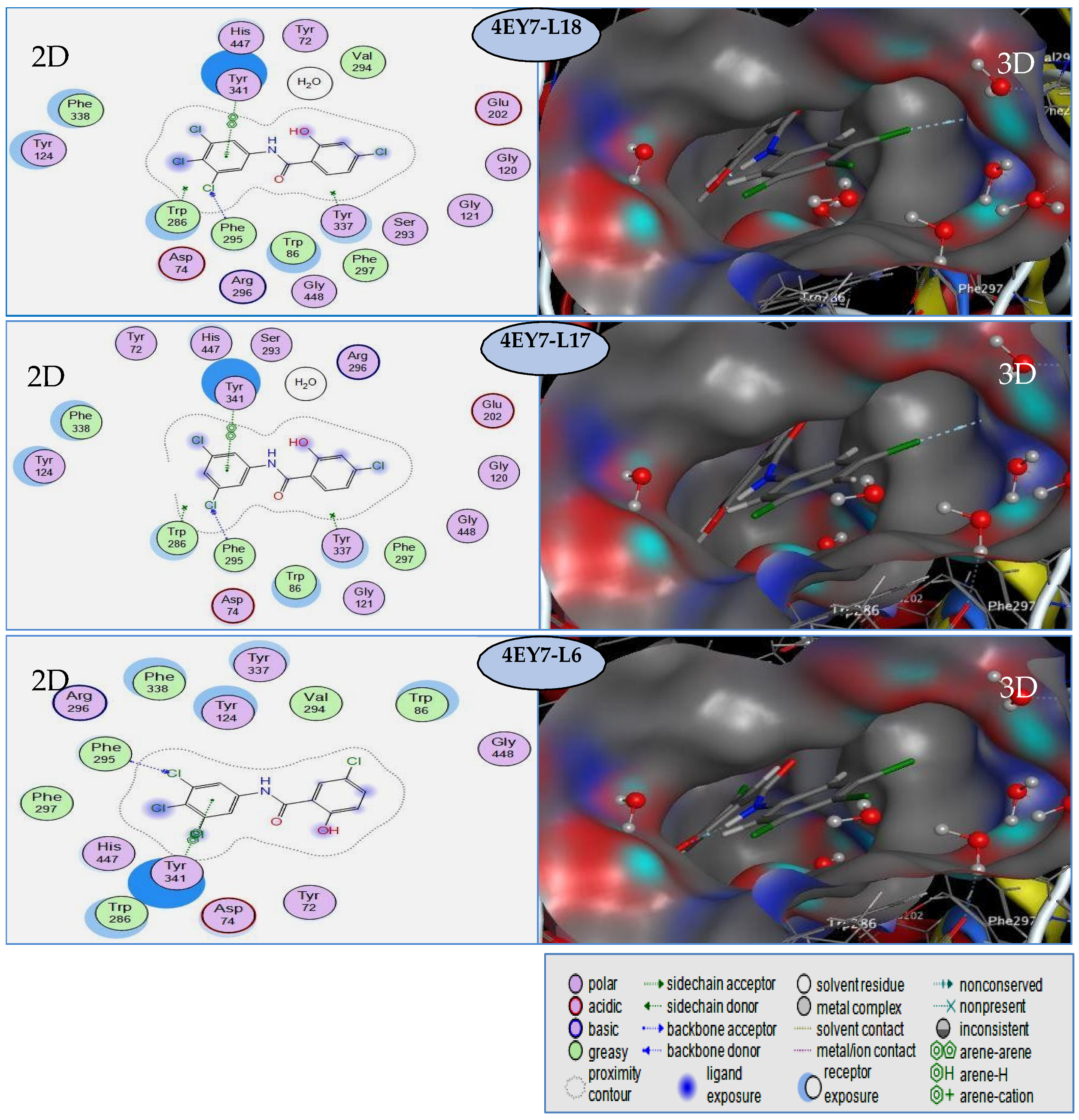
Based on the results obtained from molecular docking [10]. A computational study of three selected ligands with the highest affinity for the target (Figure 1) was carried out to evaluate the properties of ADME, and the results are shown in Table 1.
Lipophilicity is an important factor in the processes of solubility, absorption, distribution, metabolism, and excretion, as well as pharmacological activity. Hansch et al. [11] showed that highly lipophilic molecules are distributed and conserved within the lipid layers of cell membranes. For good oral bioavailability and optimal results, the log P must be 0 < log P < 3. When log P is too high, the drug has low solubility, and when log P is too low, the drug struggles to penetrate lipid membranes [12]. In the obtained results, all the ligands L17,L18, and L6 have values between 3.97 and log P 4.60. They possess positive log P values, which indicates that these ligands are very lipophilic but with low solubility and poor gastric tolerance [13].
According to the literature [14], in molecules, a surface area value (TPSA) of less than 140 Å2 is a good predictor of oral bioavailability and ensures better transport across biological membranes. However, if the surface area (TPSA) is greater than 140, poor transport through the membrane occurs (incomplete oral absorption). According to the values given in Table 1, it can be noted that all ligands have TPSA values = 49.33 Å2, which means that they support excellent absorption and brain penetration of CNS drugs. The number of rotating bonds is also a topological parameter and a measure of molecular flexibility (threshold 10). Oral bioavailability requires that these ligands, upon binding to a protein, change their conformation only slightly. This corresponds to the results in Table [15]. HBAs in large numbers lead to low permeability through a bilayer membrane. A smaller number leads to better permeability. From the results of Table 1, it can be observed that all ligands have hydrogen acceptor numbers of less than 10 (O, N) and hydrogen donor numbers of less than 5 (OH, NH). Lipophilicity and the number of hydrogen bond donors appear to be key properties, as they have remained essentially constant in oral drugs over time [16]. In addition, the selected ligands have molecular weight values of less than than 500 Da, so they can pass through cell membranes easily and have a high level of gastrointestinal absorption, which contributes to good oral bioavailability.
Furthermore, it can be observed that compound L17 has a zero violation number, and the other compounds (L18, L6) have a violation number equal to 1 for the Lipinski rule. This shows that all molecules tested align with the rules of Lipinski, Ghose, Veber, and Egan.

4. Conclusions

Based on these results, we can confirm that these compounds do not cause any oral bioavailability problems and exhibit good properties compared to the target drugs (native ligands). They can probably be used as active oral drugs in the treatment of this disease.

Author Contributions

Conceptualization, I.D.; methodology, F.H. and I.D.; software, F.H.; formal analysis, F.H.; investigation, F.H.; resources, I.D.; data curation, F.H.; writing—original draft preparation, F.H.; writing—review and editing, F.H., N.M. and I.D.; visualization, F.H.; supervision, I.D.; project administration, I.D.; interpretation of ADME studies, N.M. and I.D. All authors have read and agreed to the published version of the manuscript.

Funding

This research received no external funding.

Institutional Review Board Statement

Not applicable.

Informed Consent Statement

Not applicable.

Data Availability Statement

No new data were created or analyzed in this study.

Conflicts of Interest

The authors declare that they have no conflict of interest.

References

  1. Yoshita, M.; Taki, J.; Yamada, M. A clinical role for [123I] MIBG myocardial scintigraphy in the distinction between dementia of the Alzheimer’s-type and dementia with Lewy bodies. J. Neurol. Neurosurg. Psychiatry 2001, 71, 583–588. [Google Scholar] [CrossRef]
  2. Colovic, M.B.; Krstic, D.Z.; Lazarevic-Pasti, T.D.; Bondzic, A.M.; Vasic, V.M. Acetylcholinesterase inhibitors: Pharmacology and toxicology. Curr. Neuropharmacol. 2013, 11, 315–335. [Google Scholar] [CrossRef]
  3. Henchoz, Y.; Bard, B.; Guillarme, D.; Carrupt, P.A.; Veuthey, J.L.; Martel, S. Analytical tools for the physicochemical profiling of drug candidates to predict absorption/distribution. Anal. Bioanal. Chem. 2009, 394, 707–729. [Google Scholar] [CrossRef] [PubMed]
  4. Lipinski, C.A.; Lombardo, F.; Dominy, B.W.; Feeney, P.J. Experimental and computational approaches to estimate solubility and permeability in drug discovery and development settings. Adv. Drug Deliv. Rev. 2012, 64, 4–17. [Google Scholar] [CrossRef]
  5. Veber Daniel, F.; Johnson, S.R.; Cheng, H.Y.; Smith, B.R.; Ward, K.W.; Kopple, K.D. Molecular properties that influence the oral bioavailability of drug candidates. J. Med. Chem. 2002, 45, 2615–2623. [Google Scholar] [CrossRef] [PubMed]
  6. Egan, W.J.; Merz, K.M.; Baldwin, J.J. Prediction of drug absorption using multivariate statistics. J. Med. Chem. 2000, 43, 3867–3877. [Google Scholar] [CrossRef] [PubMed]
  7. Norinder, U.; Haeberlein, M. Computational approaches to the prediction of the blood–brain distribution. Adv. Drug Deliv. Rev. 2002, 54, 291–313. [Google Scholar] [CrossRef] [PubMed]
  8. Johnson, S.R.; Zheng, W. Recent progress in the computational prediction of aqueous solubility and absorption. AAPS J. 2006, 8, 4. [Google Scholar] [CrossRef] [PubMed]
  9. Daina, A.; Michielin, O.; Zoete, V. SwissADME: A free web tool to evaluate pharmacokinetics, drug-likeness and medicinal chemistry friendliness of small molecules. Sci. Rep. 2017, 7, 42717. [Google Scholar] [CrossRef] [PubMed]
  10. Hasni, F.; Daoud, I.; Melkemi, N. Study of Acetylcholinesterase and Butyrylcholinesterase (AChE/BuChE) Inhibition Using Molecular Modelling Methods. Chem. Proc. 2023, 14, 77. [Google Scholar]
  11. Pajouhesh, H.; Lenz, G.R. Medicinal chemical properties of successful central nervous system drugs. NeuroRx 2005, 2, 541–553. [Google Scholar] [CrossRef] [PubMed]
  12. Kerns, E.H.; Di, L. Drug-like Properties. Concepts, Structure Design and Methods: From ADME to Toxicity Optimization; Elsevier: Amsterdam, The Netherlands, 2008; pp. 43–47. [Google Scholar]
  13. Schultes, S.; de Graaf, C.; Haaksma, E.E.; de Esch, I.J.; Leurs, R.; Krämer, O. Ligand efficiency as a guide in fragment hit selection and optimization. Drug Discov. Today Technol. 2010, 7, e157–e162. [Google Scholar] [CrossRef] [PubMed]
  14. Durojaye, O.A.; Nwanguma, B.C.; Joshua, P.E.; Ogidigo, J.O.; Cosmas, S.; Asomadu, R.O.; Obeta, J.N. Evaluation of 6-Gingerol and its modified analogues as therapeutic candidates against Schistosoma mansoni phosphofructokinase. VacciMonitor 2019, 28, 38–47. [Google Scholar]
  15. Kalani, K.; Yadav, D.K.; Khan, F.; Srivastava, S.K.; Suri, N. Pharmacophore, QSAR, and ADME based semisynthesis and in vitro evaluation of ursolic acid analogs for anticancer activity. J. Mol. Model. 2012, 18, 3389–3413. [Google Scholar] [CrossRef] [PubMed]
  16. Leeson, P.D.; Springthorpe, B. The influence of drug-like concepts on decision-making in medicinal chemistry. Nat. Rev. Drug Discov. 2007, 6, 881–890. [Google Scholar] [CrossRef] [PubMed]
Figure 1. Two- and three-dimensional representations of the best posed interactions of the complexes using molecular docking simulation: 4EY7-L18, 4EY7-L17, and 4EY7-L6.
Chemproc 18 00133 g001
Table 1. ADME properties for the three best AChE ligands.
Physicochemical PropertiesLipophilicityPharmacokineticsDruglikeness
TPSA
Å2
MW
g/mol
Num.
Rotatable Bonds
Num.
H-Bond
Acceptors
Num.
H-Bond Donors
MLOGPWLOGPGI
Absorption
BBB
Permeant
LipinskiGhoseVeberEgan
AChE
L1849.33351.013224.485.07HighYesYes;
1 violation
YesYesYes
L1749.33316.573223.974.41HighYesYes;
0 violation
YesYesYes
L649.33351.013224.485.07HighYesYes;
1 violation
YesYesYes
Disclaimer/Publisher’s Note: The statements, opinions and data contained in all publications are solely those of the individual author(s) and contributor(s) and not of MDPI and/or the editor(s). MDPI and/or the editor(s) disclaim responsibility for any injury to people or property resulting from any ideas, methods, instructions or products referred to in the content.