


Abstract
The growing demand for sustainable energy carriers has intensified interest in hydrogen production from renewable resources and waste-derived substrates. In this context, microbial electrolysis cells (MECs) have emerged as a promising technology for the simultaneous treatment of organic waste and biohydrogen generation. This review provides an overview of recent advances in MEC systems, focusing on reactor configurations, performance indicators such as hydrogen production rate, coulombic efficiency, and chemical oxygen demand removal. Attention is given to the valorization of real waste streams, including municipal and agro-industrial effluents, highlighting the differences between laboratory- and pilot-scale applications. While numerous studies have demonstrated the technical feasibility of MECs, several bottlenecks still limit their large-scale implementation, including challenges associated with the use of complex substrates. In particular, untreated wastewater often leads to reduced process efficiency due to its variable composition and the occurrence of competing microbial pathways. To overcome these limitations, integrated approaches are also discussed, with emphasis on the coupling of dark fermentation, capable of enhancing substrate biodegradability through the production of volatile fatty acids, with MEC systems. Overall, MEC technology represents a promising pathway for sustainable hydrogen production within circular waste management frameworks, although further advancements are required to enable its practical application.
1. Hydrogen Production Overview
Global energy demand in the twenty-first century is still largely satisfied by fossil fuels, resulting in significant environmental impacts and the progressive depletion of natural resources. The extensive use of fossil-based energy sources, together with polluting industrial activities and unsustainable waste management practices, has led to a critical environmental and climatic situation. In recent decades, the increasing concentration of greenhouse gases (GHGs) in the atmosphere has intensified global warming, causing rising temperatures, altered weather patterns, and a growing frequency of extreme climatic events [1,2]. In response to this scenario, the international community has established ambitious targets to mitigate GHG emissions and promote the transition toward a more sustainable and low-carbon future with a comprehensive political and economic strategy, summarized in the European Green Deal 2019, aiming to achieve climate neutrality by 2050 through substantial reductions in greenhouse gas emissions and the promotion of renewable energy sources in a circular economy view [3,4,5].
In this context, hydrogen has emerged as a promising energy carrier for the transition toward low-carbon energy systems; it is widely considered a promising energy vector owing to its high gravimetric energy density and its emission-free utilization, becoming a key component of future sustainable energy infrastructures [6]. However, despite its potential, the need for the European Union for oil and gas remains high, accounting for approximately 58% of total energy consumption, while hydrogen currently supplies only about 2% of the overall energy demand [7]. Nevertheless, the environmental sustainability of hydrogen strongly depends on the pathway used for its production.
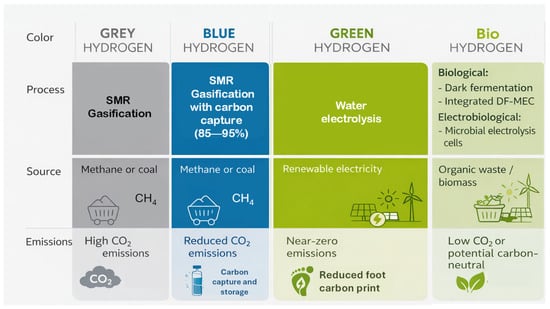
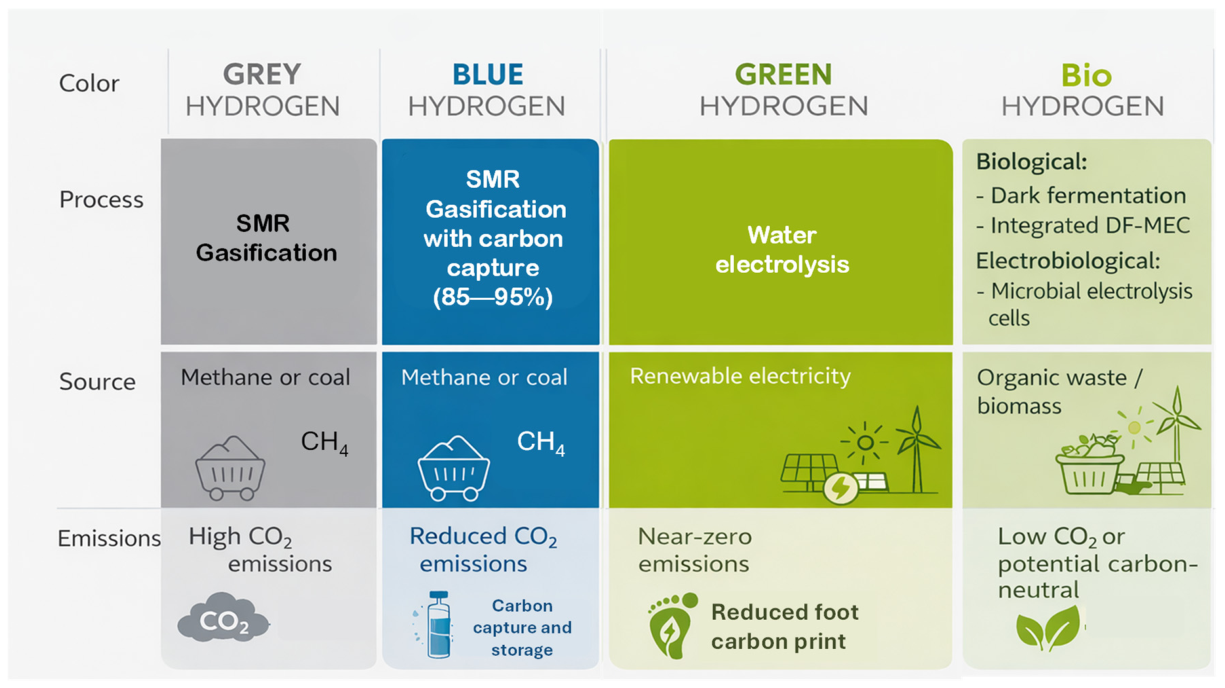
Hydrogen is commonly classified according to the production process into different categories [8]. Gray hydrogen is produced from fossil fuels, mainly through steam methane reforming, and is associated with significant carbon dioxide emissions. Blue hydrogen is also derived from fossil resources but incorporates carbon capture and storage technologies to reduce CO2 emissions. In contrast, green hydrogen is produced through low-carbon processes, such as water electrolysis powered by renewable energy sources or biohydrogen, a subcategory based on biomass and organic waste conversion through biological and bio-electrochemical systems (BES) with potentially net-zero emissions biological pathways [9,10,11].
A schematic representation of this classification is reported in Figure 1.
Figure 1.
Classification of hydrogen production pathways is defined on the color-based hydrogen taxonomy.
Among biological routes, dark fermentation (DF) has attracted considerable attention as a sustainable approach for biohydrogen production from biomass and organic waste streams [12]. In this process, anaerobic microorganisms convert carbohydrates and other organic substrates into hydrogen and fermentation by-products [13]. DF offers several advantages, including the ability to utilize a wide range of waste-derived substrates and operation under relatively mild conditions [14]. However, this process is inherently limited by relatively low hydrogen yields. During fermentation, only a fraction of electrons, contained in organic substrates, is recovered as hydrogen, while, depending also on the acidogenic fermentation degree of the substrate typology, a significant portion remains stored in intermediate metabolites such as volatile fatty acids (VFAs) [15,16].
To overcome these limitations, integrated bioelectrochemical systems have been proposed as an effective strategy to further recover the residual energy contained in fermentation effluents [17]. In particular, microbial electrolysis cells (MECs) have emerged as a promising technology for enhancing hydrogen production from organic substrates and fermentation by-products [18,19]. In MEC systems, electroactive microorganisms oxidize organic compounds at the anode, releasing electrons that are subsequently used to drive hydrogen evolution at the cathode with the assistance of a small external voltage [20]. When coupled with dark fermentation, MECs can convert residual organic acids into additional hydrogen, significantly improving the overall energy recovery from biomass and waste streams.
Thanks to their ability to simultaneously treat waste and produce valuable energy carriers, MECs are increasingly being investigated as a key technology for sustainable biohydrogen production. Nevertheless, several factors, including substrate type, reactor configuration, operational parameters, and electrode materials, strongly influence the efficiency and stability of hydrogen generation in these systems [21,22].
However, the performance of MECs fed with real wastewaters remains difficult to compare across studies because substrate composition, reactor scale, and reporting methods strongly influence the reported outcomes.
For this reason, although MECs have been investigated using a wide variety of organic substrates, this review intentionally focuses on real wastewaters and wastewater-derived streams, in accordance with its scope and objectives.
In addition, to strengthen how MEC evidence translates to practice, we restrict the synthesis to MEC studies fed exclusively with real wastewater-derived substrates (i.e., excluding synthetic media). Moreover, a cross-scale, quantitative comparison of laboratory and pilot systems using consistent indicators (including hydrogen production rate, COD removal, coulombic efficiencies, current density, and energy consumption) was performed to expose how engineering and economic constraints emerge at pilot scale (e.g., internal resistance, gas recovery, and materials/capital-cost dominance). Within this framework, the review evaluates DF–MEC integration as a targeted strategy to improve substrate biodegradability and hydrogen production from complex waste streams.
2. Principles of Hydrogen Production in MEC Systems
2.1. Fundamentals of Microbial Electrolysis Cells
MECs are bioelectrochemical systems that exploit the metabolic activity of electroactive microorganisms to convert organic substrates into biofuels [23]. In these systems, microorganisms growing on the anode oxidize biodegradable organic compounds, releasing electrons and protons as metabolic products. The electrons generated during substrate oxidation are transferred to the anode either directly through conductive biofilms, direct electron transfer (DET), or via soluble redox mediators, indirect electron transfer (IET), and subsequently flow through an external circuit toward the cathode [24]. In DET, microorganisms transfer electrons through outer-membrane redox-active proteins, such as multiheme c-type cytochromes, which bridge the insulating cell envelope to establish electrical contact with the electrode surface. In certain species, including Geobacter sulfurreducens and Shewanella oneidensis, DET is further enhanced by conductive pili or “nanowires,” which extend several microns and allow electron transport beyond the immediate cell surface [25,26]. This mechanism enables efficient and rapid electron transfer, often resulting in higher current densities and improved system performance. In contrast, IET relies on soluble redox mediators, either endogenously produced by microorganisms or externally added, which shuttle electrons between the cells and the electrode. While IET expands the effective surface area available for electron transfer, its efficiency can be limited by mediator stability, irreversibility of the shuttle reaction, and the potential loss of compounds to the bulk solution [27,28].
While at the cathode, with the goal of producing hydrogen, ions migrate through the electrolyte and combine with the electrons supplied through the external circuit.
Unlike microbial fuel cells (MFCs), hydrogen evolution in MECs is not thermodynamically spontaneous, thus requiring the application of an external voltage, typically in the range of 0.2–1.0 V, to overcome the activation and thermodynamic barriers associated with the hydrogen evolution reaction (HER) [29,30].
In MEC systems, however, the anodic oxidation of organic substrates occurs at a significantly lower potential than water oxidation. This result reduces overall cell potential difference compared to conventional water electrolysis, thereby lowering the external energy input required for hydrogen production. Consequently, MECs operate at applied voltages substantially lower than those of conventional electrolysis systems (typically 1.8–2.0 V). In many cases, MECs can achieve hydrogen production at applied voltages in the range of 0.2–1.0 V, depending on reactor configuration and operating conditions [31].
From an energy efficiency perspective, this difference translates into a significantly lower electrical energy demand per unit of hydrogen produced. While conventional water electrolysis typically requires around 4–5 kWh per Nm3 of H2, MEC systems can reduce the electrical energy input to values as low as 1–2 kWh per Nm3 of H2, as part of the energy is derived from the oxidation of organic substrates [32,33]. However, the overall efficiency of MECs is strongly influenced by factors such as hydrogen recovery and internal losses, which can limit the effective energy conversion. Therefore, despite their lower external energy demand, further optimization is required to fully realize the energetic advantages of MEC technology.
Nevertheless, one of the main advantages of MEC systems is their ability to utilize a wide range of organic substrates, including wastewater and fermentation by-products, enabling the simultaneous treatment of organic waste and the recovery of energy in the form of hydrogen [23,34,35]. For this reason, MECs have attracted increasing interest as a sustainable technology for biohydrogen production within waste valorization strategies.
2.2. Reactor Configuration
The performance of microbial electrolysis cells is strongly influenced by reactor design, electrode materials, and configuration [36,37,38,39]. MEC systems are generally classified into two main configurations: single-chamber and dual-chamber reactors.
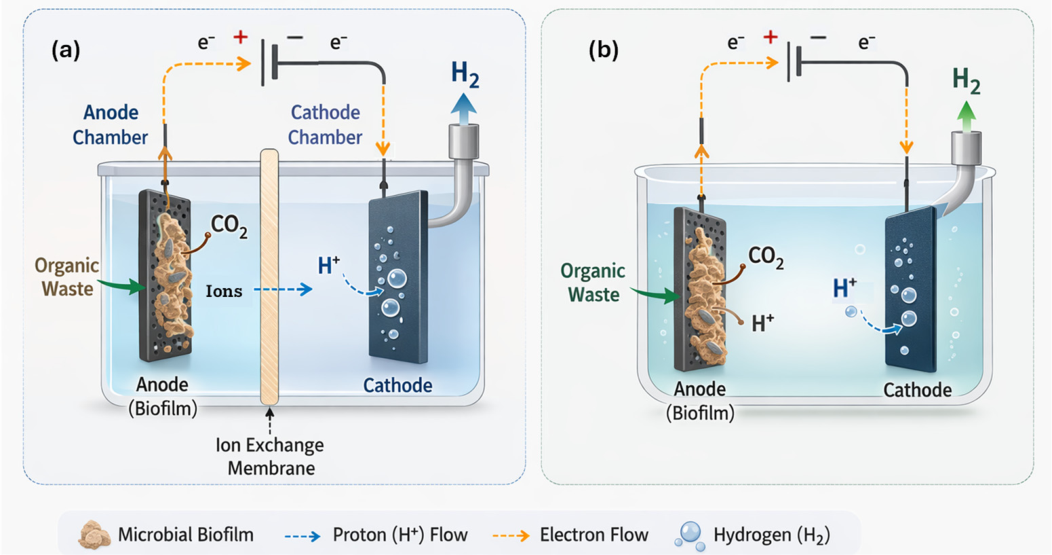
Single-chamber MECs consist of a single compartment in which both the anode and cathode are immersed in the same electrolyte without the use of a membrane separator [40]. This configuration offers several advantages, including simpler reactor design, lower internal resistance, and reduced construction cost [41], but may suffer from gas crossover and reduced hydrogen purity. Indeed, the absence of a membrane may lead to hydrogen loss due to diffusion or microbial consumption [42].
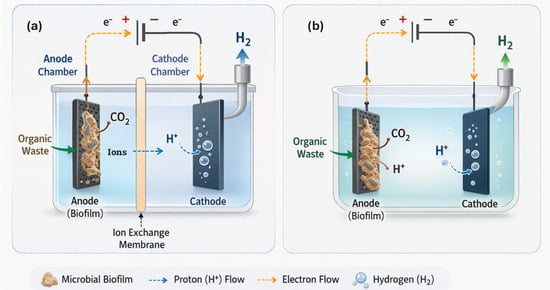
In contrast, dual-chamber MECs employ a membrane or ion exchange separator that physically divides the anodic and cathodic compartments [33]. This design allows better control of the electrochemical environment at each electrode and reduces hydrogen losses caused by microbial activity in the anode chamber [20,43]. However, the presence of a membrane and its related issues due to aging and fouling [44] may increase internal resistance, system complexity and operational costs, potentially affecting the overall energy efficiency of the system. A schematic representation of these two reactor configurations is reported in Figure 2.
Figure 2.
Schematic representation of the main MEC configurations with a bioanode and an abiotic cathode. (a) Dual-chamber MEC, in which anodic and cathodic compartments are separated by an ion exchange membrane (b) Single-chamber MEC, where both electrodes are immersed in the same electrolyte.
Beyond these conventional configurations, several alternative reactor designs have been proposed in recent years, including stacked and integrated systems, or even continuous-flow reactors, aimed at improving scalability and practical applicability for waste treatment and biohydrogen production [45,46,47]. Stacked configurations improve volumetric productivity but may suffer from uneven current distribution and higher internal resistance [48]. Continuous-flow reactors allow stable operation under realistic conditions, although biomass washout and operational complexity remain critical challenges [49]. Integrated systems enhance substrate utilization and overall efficiency, but they often require more complex designs, higher capital costs and advanced process control [50].
2.3. Key Operational Parameters Affecting Hydrogen Production
The efficiency of hydrogen production in MEC systems is governed by several operational parameters that influence microbial activity, electron transfer processes, and electrochemical reactions.
One of the most critical parameters is the applied voltage. Since hydrogen evolution in MECs requires an external energy input, the applied potential directly affects hydrogen production rates and overall system efficiency. However, excessively high voltages may increase energy consumption and reduce the sustainability of the process [51,52].
Substrate type and concentration also play a crucial role in determining system performance. Easily biodegradable substrates such as acetate or glucose generally support higher hydrogen production rates, whereas complex waste streams may require microbial adaptation or pre-treatment steps to enhance their biodegradability [53].
Other important parameters include pH, temperature, hydraulic retention time (HRT), and organic loading rate (OLR), which can significantly influence microbial community structure and electrochemical activity [54,55,56,57]. Additionally, electrode materials and surface properties strongly affect biofilm development and the prevalence of DET or IET pathways [58]. These pathways also depend on microbial community composition and operating conditions, impacting the overall hydrogen production performance of MEC systems.
2.4. Experimental Parameters
The performance of MECs is typically assessed using a set of key electrochemical and process indicators [31]. COD removal efficiency (ηCOD), anodic and cathodic coulombic efficiencies, and hydrogen production rate are commonly employed to quantify substrate conversion, electron recovery, and hydrogen generation.
Hence, to better understand the obtained performance of the different selected studies reported in the next sections, the equations used to calculate these parameters are reported below.
To define the ηCOD, the following equation was employed, where CODin and CODout (mg/L) represent the influent and effluent COD concentrations:
The bioanode coulombic efficiency (CE), in which meqi represents the cumulative charge that has passed in the circuit and meqCOD represents the theoretical cumulative charge which could have been generated by the oxidation of the removed COD, was determined according to the equation:
The cathodic coulombic efficiency (CCE) was determined as the ratio between the cumulative H2 produced, expressed in meq and the meqi:
The hydrogen production rate (rH2) was determined by the ratio between the produced volume of hydrogen (VH2) to the reactor volume (V) during the working period (t), as follows:
These parameters are commonly used to evaluate and compare MEC performance across different studies and operational conditions, as illustrated in the laboratory- and pilot-scale systems discussed in the following sections.
3. Wastewater and Derived Substrates for Hydrogen Production in MEC Systems
While several studies have investigated MEC performance using synthetic substrates, increasing attention has been directed toward the utilization of wastewaters, biomass-derived and waste-based feedstocks. These substrates represent a sustainable alternative for hydrogen production while simultaneously enabling waste valorization.
The following sections present and discuss a selection of laboratory- and pilot-scale studies in which the system was fed exclusively with real wastewater.
3.1. Laboratory-Scale MEC Studies: Influence of Reactor Configuration
Among laboratory-scale studies, reactor configuration plays a critical role in determining hydrogen production efficiency, coulombic efficiency, and system stability. Table 1 summarizes representative laboratory-scale studies investigating hydrogen production in microbial electrolysis cells (MECs) fed with waste-derived substrates under different operational configurations. Here, a quantitative synthesis of key performance indicators, along with system configurations, is provided, enabling a systematic comparison across different reactor designs and operating conditions. Most of the reported systems were evaluated under varying applied voltages (VAPPLIED) to identify the optimal electrochemical conditions for hydrogen generation. Xu et al. (2014) [59] investigated a cylindrical MEC treating municipal wastewater in batch mode and reported the best performance at an applied voltage of 0.9 V. The authors also compared two cathodic configurations, namely a platinum catalyst (Pt) and a biocathode. The Pt-based cathode achieved the highest hydrogen production rate (1.4 m3 m−3d−1), CE of 95%, and a CCE of 68%, the latter being 80% higher than that achieved using the biocathode (i.e., 37%). Such results highlighted a clear trade-off between catalytic performance and economic sustainability.
Table 1.
Overview of laboratory-scale MEC studies and reactor performance using waste-derived substrates for hydrogen production.
Similarly, Zhang et al. (2022) [60] evaluated a single-chamber MEC fed with fermented corn stalk effluent, showing a favorable increase in CCE values with the increase in applied voltage, from 73 ± 3% at 0.5 V to 81 ± 2% at 0.8 V, identifying this latter as the optimal applied potential. The study also demonstrated effective degradation of the main VFAs (e.g., acetate and butyrate), highlighting the ability of the system to treat complex fermentation effluents. Comparable operating conditions were reported by Gautam et al. (2024) [61], who employed heat-pretreated sugarcane bagasse as a substrate in a round single-chamber MEC, also operating at 0.8 V and reaching a CCE of 67.1%. Compared with the Pt-based cathodes employed by Xu et al. [59] and Zhang et al. [60], this performance was obtained using non-noble electrode materials, indicating the potential of lower-cost configurations, although differences in substrate prevent a direct comparison.
While single-chamber systems generally exhibit higher hydrogen production rates due to reduced internal resistance, as already discussed, they are also more susceptible to hydrogen losses, which can negatively affect CCE. Dual-chamber configurations have been investigated to improve process control and overcome this limit. Baía et al. (2025) [62] operated an H-type MEC treating winery wastewater at an applied potential of 0.2 V vs. standard hydrogen electrode (SHE), achieving hydrogen production rates of 0.7 m3 m−3 d−1 with a COD removal of approximately 55%. Although hydrogen production was lower compared to the single-chamber systems reported here, the dual-chamber configuration offers advantages in terms of product separation and reduced hydrogen consumption by hydrogenotrophic microorganisms, obtaining a high CCE equal to 87 ± 5%, close to values typically obtained with a synthetic acetate medium.
A further distinction emerges when considering the continuous operation mode. In contrast to batch-operated systems, Kim et al. (2024) [63] evaluated a continuously operated dual-chamber MEC fed with different mixtures of livestock wastewater (LW) and food wastewater (FW). Variations in substrate composition significantly affected the electrochemical performance of the system, resulting in hydrogen production rates ranging from 2.9 to 4.6 m3 m−3 d−1. However, CE values decreased significantly from >87% (acetate) to 25–42% when real substrates were used, indicating reduced electron recovery efficiency under complex feeding conditions. Although CCE remained relatively high (around 90% for all cases), the overall hydrogen yield was affected by competing metabolic pathways and substrate heterogeneity.
Another recent laboratory-scale study in a continuous-flow mode, Marchetti et al. (2026) [64], investigated the direct treatment of real brewery wastewater without any substrate pre-treatment. The system achieved stable hydrogen production throughout the operational period, with an average hydrogen purity of 65.5% and a cathodic coulombic efficiency of approximately 50%. COD mass balance revealed that most of the removed organic matter was recovered as electrical current and subsequently converted into hydrogen, while methane formation remained negligible. These results highlight the feasibility of coupling the valorization and treatment of high-strength agro-industrial wastewaters with biohydrogen production. Although the overall energy efficiency reached 43%, further improvements could still be achieved through strategies aimed at enhancing substrate biodegradability and energy recovery.
However, direct comparison among studies remains challenging due to the variability in reactor configurations, substrates, and operating conditions. Nevertheless, the wide range of MEC setups and wastewaters investigated highlights the growing interest and versatility of this technology, demonstrating that MECs can effectively convert a variety of organic wastes into hydrogen. Hence, to summarize, single-chamber systems may favor higher hydrogen production rates but are more prone to hydrogen losses, leading to lower CCE under certain conditions. Dual-chamber systems provide improved hydrogen recovery and stability, reflected in higher CCE values, but at the expense of increased internal resistance and reduced productivity. Real waste-derived substrates often introduce metabolic pathways competing with hydrogen evolution, thereby affecting coulombic efficiency and hydrogen recovery, confirming that substrate complexity remains a key limiting factor for practical MEC applications.
3.2. Pilot-Scale MEC Applications
While laboratory-scale studies demonstrate the technical feasibility of hydrogen production from waste-derived substrates, pilot-scale applications are essential to assess process stability, scalability, and operational performance under realistic conditions.
In this context, Table 2 summarizes representative MEC pilot-scale studies on hydrogen production treating real wastewater, reporting key performance indicators and system configurations. Compared with laboratory-scale experiments, pilot-scale MECs more clearly reveal the engineering constraints associated with reactor design, mass transfer, gas recovery, internal resistance, and capital cost.
Table 2.
Overview of pilot-scale MEC studies and pilot-plant performance using waste-derived substrates for hydrogen production.
Among the earliest demonstrations of MEC scale-up, Gil-Carrera et al. (2013) [65] evaluated the transition from small laboratory reactors (50 mL) to a pilot configuration consisting of two cylindrical MEC units connected in series with a total working volume of 10 L. The pilot-scale system was fed with real municipal wastewater and operated under different HRTs equal to 32, 24, 16 and 10 h, corresponding to OLRs of 0.13, 0.10, 0.23 and 0.66 g COD L−1 d−1. A staged reactor-in-series approach was proposed to maintain higher organic loading in the first compartments while allowing downstream polishing of the effluent. This design was intended to mitigate the decline in hydrogen production typically observed under low-substrate conditions during scale-up.
In this configuration, the electrodes were separated using a polyester cloth, while the cathode was positioned between the anodic chamber and the gas collection compartment. A key aspect of the study was the optimization of the applied potential in each anodic chamber using an online perturbation and observation algorithm, allowing the voltage to vary between 0.51 and 0.94 V depending on the applied OLR. Under optimized conditions, the 10 L reactor treating municipal wastewater showed substantially lower hydrogen production but acceptable ηCOD (60–76%) and low specific energy consumption (0.9 Wh g−1 COD removed), compared to smaller scale reactors. This adaptive control strategy enabled the reduction of overall energy consumption while maintaining stable hydrogen production rates, demonstrating the feasibility of coupling wastewater treatment with bioelectrochemical hydrogen recovery at a pilot scale.
However, process performance is strongly constrained by wastewater strength. Low-COD municipal wastewater leads to low volumetric hydrogen production and promotes a hydrogenotrophic methanogenesis trigger. Therefore, systems designed to meet wastewater treatment targets at low effluent COD may operate under conditions that are suboptimal for hydrogen recovery.
In Leicester et al. (2020) [66], a pilot-scale MEC treating return sludge liquor (RSL), a concentrated liquid stream derived from anaerobically digested sludge in wastewater treatment plants, was operated for six months to evaluate the influence of HRT on organic matter removal and hydrogen production. HRTs ranging from 0.015 to 18 days were investigated, and an optimum value of 0.5 d was identified, providing the best balance between treatment performance and energy consumption. Although higher current densities were observed at shorter HRTs, COD removal became negligible under these conditions, highlighting the need to optimize operational parameters beyond electrochemical performance alone. The study also demonstrated that energy demand strongly depended on both HRT and influent COD concentration, decreasing at lower influent COD concentrations and at HRT values above 2 d, indicating that MEC feasibility is closely linked to wastewater strength and operating conditions. These findings provide valuable guidance for the design and scale-up of MEC systems treating high-strength wastewater streams.
More recently, Guerrero-Sodric et al. (2025) [67] investigated a larger MEC pilot plant with a working volume of approximately 1 m3 integrated within a wastewater treatment facility and fed with real urban primary effluent. This study is particularly relevant because it moved beyond proof-of-concept scale and addressed long-term operation, reactor modularity, and techno-economic evaluation under real conditions. The anode pair and the cathode were separated with functionalized polystyrene anion exchange membranes (AEMs).
The study was conducted in two experimental stages, initially operating the system with three electrochemical cells and subsequently increasing the configuration to ten cells to further evaluate performance and operational stability. The results reported in Table 2 refer to the second experimental stage, during which the current density reached a maximum of 1.06 A m−2 and hydrogen production rates up to 0.042 m3 m−3 d−1 were observed. While CCE remained relatively stable between the two stages (around 65% for both), overall CE increased significantly during the second phase, suggesting improved microbial stability and electrochemical performance of the system. Although these values are lower than those commonly reported at laboratory scale, they are comparable to those obtained in previous pilot-scale MEC studies, indicating that the proposed configuration achieved a reasonable degree of scalability. However, the low organic strength and conductivity of urban primary effluent constrained electron transfer and current generation, thereby limiting hydrogen production. The internal resistance remained a major issue, while reducing the inter-electrode distance significantly improved current density and hydrogen production. Moreover, hydrogen recovery was affected by gas leakages, despite the use of a double-chamber configuration and high cathodic pH, which effectively minimized biological hydrogen consumption in the cathodic chamber. These results show that, at pilot scale, both electrochemical and engineering factors, including reactor design and gas management, play a key role in determining overall system performance.
In addition to the technical assessment, Guerrero-Sodric et al. also performed a preliminary techno-economic evaluation of the pilot plant. The analysis indicated that, despite the potential revenues associated with hydrogen production and reduced electricity consumption, the system would only be economically viable under very specific conditions. Capital costs associated with MEC components accounted for nearly 99% of the net present value of the prototype, largely outweighing the economic benefits derived from hydrogen recovery. These findings highlight that the high cost of materials and reactor components remains a major barrier to large-scale commercialization. In this sense, improving hydrogen yield alone may be insufficient to make MECs commercially viable unless accompanied by a substantial reduction in material and manufacturing costs.
These pilot-scale demonstrations represent important steps toward the practical implementation of MEC technology, confirming the scalability potential of this technology; however, several technical and economic challenges and comparison with established wastewater-to-energy technologies still need to be addressed before large-scale deployment can be achieved and are critically discussed in Section 4.2.
4. Limitations and Research Directions
4.1. Bottlenecks Overview in MEC Systems
Despite the promising potential of MECs for simultaneous wastewater treatment and hydrogen production, several technical and operational limitations still hinder their large-scale implementation. These span from material-related constraints to process inefficiencies and performance variability associated with the composition of real wastewater.
One of the primary constraints is associated with the cost and durability of electrode materials and catalysts [38,45]. While carbon-based materials such as carbon felt and carbon cloth are widely used as anodes due to their high surface area and biocompatibility, their long-term stability and susceptibility to fouling can affect system performance. On the cathode side, alternative economically sustainable catalysts based on nickel or stainless steel have been proposed, even if they generally exhibit lower catalytic activity or reduced durability compared with noble metal catalysts. This trade-off between cost and performance remains unresolved and represents a key barrier to large-scale deployment.
Another critical issue is related to reactor design and internal resistance. The distance between electrodes, the presence of separators or membranes, and the overall reactor architecture significantly influence ohmic losses and energy efficiency [68].
Hydrogen losses also represent an additional major bottleneck in MEC operation. Hydrogen produced at the cathode can be partially lost due to diffusion toward the anode, where it may be oxidized again, or consumed by hydrogenotrophic methanogens, leading to methane formation instead of hydrogen recovery [69]. This phenomenon not only decreases the overall hydrogen yield but may also negatively impact coulombic efficiency and process selectivity.
Furthermore, hydrogen recycling phenomena (i.e., the re-oxidation or biological consumption of produced hydrogen) may artificially sustain current generation without contributing to net hydrogen recovery, thus masking the actual performance of the system [70]. This effect is particularly relevant in single-chamber configurations, where the lack of physical separation between anodic and cathodic compartments enhances hydrogen crossover.
In addition, mass transfer limitations play a crucial role in hydrogen losses. The low solubility of hydrogen in aqueous solutions can promote its accumulation near the cathode surface, while insufficient mixing or suboptimal reactor design may limit its effective removal, thereby increasing the likelihood of microbial consumption or back-diffusion.
Inefficient gas collection and recovery further aggravate this issue, especially at larger scales, where reactor design, gas–liquid separation efficiency, and system sealing become critical factors [67]. Dissolved hydrogen losses may also be significant and are often underestimated, contributing to discrepancies between measured current generation and actual hydrogen recovery.
Due to the combination of these limitations, hydrogen recovery efficiencies in MEC systems are often significantly lower than theoretical values, with reported H2 recovery frequently below 60–70% [69]. Finally, the use of real waste-derived substrates introduces further complexity. Unlike synthetic media, real wastewaters are characterized by variable and heterogeneous composition. In addition, the presence of recalcitrant compounds and complex microbial interactions can hinder electroactive bacteria, triggering competing pathways such as methanogenesis [71,72]. Moreover, it is important to distinguish between total organic load and biodegradable organic fraction, as real wastewaters may exhibit high COD values that are not necessarily associated with a high content of readily biodegradable compounds, thereby affecting system performance significantly. As a result, MECs fed with untreated real substrates often exhibit lower hydrogen production rates, reduced coulombic efficiencies, and decreased operational stability when compared with the same systems but fed with synthetic media. Low-strength wastewaters may not provide sufficient organic load to sustain effective current generation, representing a fundamental limitation of MEC application in conventional urban wastewater treatment [65]. More broadly, these bottlenecks indicate that MEC performance is governed by the coupled interaction of biological, electrochemical, and engineering factors, and that improvements targeting a single aspect are unlikely to ensure successful scale-up without a systemic optimization approach.
4.2. Scale-Up Challenges
Scaling up MEC systems further amplifies these challenges. Issues such as non-uniform substrate distribution and operational instability can significantly reduce system performance when transitioning from lab-scale to pilot-scale reactors [70,73]. Internal resistance may be further aggravated by limitations in ionic transport across membranes or separator layers, particularly when their conductivity is low and their thickness increases, thereby reducing overall electrochemical efficiency.
Variations in microbial community development can significantly influence MEC performance, potentially leading to variability even under similar operating conditions [73], thus highlighting limitations in process reproducibility and control at larger scales. Operational factors such as insufficient mixing and suboptimal anodic configuration have also been directly linked to performance deterioration under continuous operation [70]. Furthermore, gas management becomes increasingly critical during scale-up, as inefficient hydrogen removal may exacerbate mass transfer limitations and promote hydrogen losses through diffusion or microbial consumption.
In addition to these technical challenges, economic feasibility remains a major barrier to large-scale implementation. The high capital costs associated with electrode materials, reactor construction, and auxiliary components may outweigh the economic benefits derived from hydrogen production and wastewater treatment [74]. Techno-economic analyses indicate that capital expenditure can represent the dominant cost contribution, while revenues from hydrogen recovery remain insufficient under current performance levels [67], making cost reduction a priority over marginal efficiency improvements.
When compared to established waste-to-energy technologies, such as anaerobic digestion (AD), MEC systems still face significant limitations in terms of technological maturity, scalability, and economic competitiveness. AD is a well-established and robust technology, widely implemented at full scale, capable of efficiently converting organic waste into biogas with relatively low operational complexity. From a quantitative perspective, anaerobic digestion typically achieves methane yields in the range of 0.20–0.35 m3 CH4 per kg COD removed, with well-established full-scale applications and relatively low specific treatment costs [75,76].
In contrast, MECs, while offering the potential to produce higher-value energy carriers such as hydrogen, typically require an electrical energy input of 2.0–3.2 kWh per Nm3 of H2 [77]. Moreover, the practical implementation of MECs is still constrained by complex reactor configurations, the need for external energy input, and stricter operational control requirements. Although several studies have reported promising energy performances, the limited availability of pilot-scale economic data currently hinders robust comparisons of operating and capital expenditures across different MEC configurations. Nevertheless, recent pilot-scale investigations have provided preliminary insights into the economic implications of MEC implementation. For example, Leicester et al. [66] reported a specific energy consumption of 0.59 kJ gCOD−1 at an HRT of 0.5 d, lower than the reference value commonly associated with conventional activated sludge treatment, from 0.7 to 2 kJ gCOD−1 [78]. However, the economic competitiveness of MECs remains strongly dependent on wastewater characteristics, reactor design, electrode materials, and system scale, highlighting the need for more comprehensive techno-economic assessments before large-scale deployment.
However, to mitigate the net energy demand, integrated MFC–MEC systems have been proposed, as they can maintain comparable hydrogen production rates (1.0–3.8 m3 H2/m3·day) while reducing external energy requirements, since the MFC can partially offset the applied voltage [77]. Biohydrogen production in these integrated systems has been projected to reach costs in the range of $2.5–3.5 per kg of H2, potentially offering a more cost-effective alternative compared to conventional grid-powered electrolysis, which typically falls within $4–6 per kg of H2 [26].
Among these limitations, the direct use of real waste-derived substrates without pre-treatment emerges as a key challenge, further emphasizing the need for integrated strategies aimed at improving substrate biodegradability, COD quality, and overall process performance. In this context, integrated process configurations have been increasingly proposed as a promising strategy to overcome these limitations. Coupling dark fermentation with MEC systems might offer the potential to enhance overall energy recovery, improve substrate utilization, and mitigate some of the scale-up and efficiency constraints discussed above.
4.3. Future Perspectives—DF-MEC Integrated System Case Study
Addressing the challenges highlighted in the previous section requires the development of integrated and cost-effective strategies capable of enhancing both the technical performance and the economic feasibility of microbial electrolysis cells. Among the various approaches proposed in the literature, process integration with upstream biological treatments, particularly dark fermentation (DF), represents one of the most promising solutions.
The integration of DF with MEC systems allows the conversion of complex organic substrates into VFAs, which are more readily biodegradable and serve as optimal electron donors for electroactive microorganisms. This approach can directly improve the performance of MEC technology when real waste-derived substrates are used without pre-treatment.
A clear demonstration of this strategy has been recently provided by Hussien et al. (2025) [79], who investigated the performance of a lab-scale dual-chamber MEC fed with untreated swine manure and food waste, comparing it with a DF–MEC integrated system; in the absence of pre-treatment, the MEC exhibited limited electrochemical performance, even at higher applied voltages. In contrast, the integration with a DF step significantly enhanced substrate quality, producing an effluent rich in VFAs, with acetic acid accounting for approximately 56% of the total composition, widely recognized as a preferred substrate for electroactive and hydrogen-producing microorganisms in MEC systems, as Clostridium, thereby promoting more efficient electron transfer and hydrogen generation [80,81].
When this VFA-rich effluent was used as feedstock, the MEC system showed a substantial improvement in performance, achieving higher current densities (up to 13.5 A m−2) at lower applied voltages (0.8 V) compared to the untreated substrate, which required higher potentials (1.2 V) to reach significantly lower current densities (5.5 A m−2). These results indicate that substrate composition plays a more critical role than the applied voltage in governing electron transfer and hydrogen production under such conditions.
Moreover, the integrated DF–MEC system enabled significantly higher hydrogen recovery at the cathode (111.5 mL) with high hydrogen purity (96%), alongside improved ηCOD (67%) and CE (81.1%) already at 0.8 V. In contrast, the MEC fed with untreated waste exhibited markedly lower efficiencies (12% and 39.8%, respectively) under comparable applied working potential. These findings highlight the enhanced biodegradability of DF effluents, which promote faster microbial metabolism and more efficient electron transfer.
Overall, by converting recalcitrant organic matter into readily utilizable intermediates, such as VFAs, DF not only boosts MEC performance but also enables operation at lower applied voltages, with an energy recovery efficiency of up to 30%, as reported in [79]. Although significant improvements in energy recovery were observed, no techno-economic assessment was provided in this study, and therefore, the economic feasibility of the integrated system remains to be demonstrated.
Furthermore, from a techno-economic standpoint, the use of alternative low-cost materials, including biochar-modified electrodes and porous carbon-based structures, and alternative catalysts to replace noble metals, as well as simplified reactor configurations, has been investigated in pilot-scale systems as a strategy to reduce capital costs [82]. Reported estimates suggest CAPEX values in the range of $250–500 per cubic meter of reactor volume, although these figures remain highly dependent on system configuration and operational conditions [82]. While these approaches may help lower upfront costs and improve component durability, further validation at larger scales is still required to ensure stable and efficient performance under real conditions.
5. Conclusions
Microbial electrolysis cells represent a promising technology for the simultaneous treatment and valorization of waste-derived substrates and sustainable hydrogen production. Laboratory- and pilot-scale studies have demonstrated the technical feasibility of MEC systems; however, their performance is strongly influenced by reactor configuration, operational parameters, and, most importantly, substrate composition.
Real waste streams still require improved management to avoid reduced hydrogen yields and process instability. In this context, the integration of MECs with upstream processes, such as dark fermentation, emerges as a key strategy to enhance the quality of the real substrate, thus improving electron recovery and increasing overall energy efficiency.
Future developments should focus on process integration, cost-effective materials, and optimized reactor designs to enable the transition of MEC technology from experimental systems to practical applications on a large scale within circular and sustainable waste management frameworks.
Author Contributions
Conceptualization, A.M. and M.Z.; methodology, A.M. and M.Z.; validation, M.Z. and S.M.; investigation, A.M.; resources, M.Z.; data curation, A.M.; writing—original draft preparation, A.M.; writing—review and editing, M.Z., S.M., G.S., D.C. and S.H.; supervision, M.Z.; project administration, M.Z.; funding acquisition, M.Z. All authors have read and agreed to the published version of the manuscript.
Funding
This work was conducted as part of the HUMANFORHYDRO project (20223W9KPM), funded under the framework of the National Recovery and Resilience Plan (PNRR), Mission 4 “Education and Research”—Component C2, Investment 1.1, “Fund for the National Research Program and Projects of National Relevance (PRIN)”.
Data Availability Statement
All the data of interest are shown in the main text of this article.
Acknowledgments
Mauro Majone is acknowledged for his fruitful suggestions on the topic discussed.
Conflicts of Interest
The authors declare no conflicts of interest.
Abbreviations
The following abbreviations are used in this manuscript:
| AD | Anaerobic Digestion |
| AEM | Anion Exchange Membrane |
| BES | Bio-Electrochemical Systems |
| CE | Coulombic Efficiency |
| CCE | Cathodic Coulombic Efficiency |
| CEM | Cation-Exchange Membranes |
| COD | Chemical Oxygen Demand |
| DET | Direct Electron Transfer |
| DF | Dark Fermentation |
| FW | Food Wastewater |
| GHGs | Greenhouse Gases |
| H2 | Hydrogen |
| HER | Hydrogen Evolution Reaction |
| HRT | Hydraulic Retention Time |
| IET | Indirect Electron Transfer |
| LW | Livestock Wastewater |
| MFCs | Microbial Fuel Cells |
| MECs | Microbial Electrochemical Cells |
| Ni | Nickel |
| OLRs | Organic Loading Rates |
| Pt | Platinum |
| rH2 | Hydrogen production rate |
| RSL | Return Sludge Liquor |
| SHE | Standard Hydrogen Electrode |
| SS | Stainless-Steel |
| Ti | Titanium |
| VFAs | Volatile Fatty Acids |
| ηCOD | COD removal efficiency |
References
- Chataut, G.; Bhatta, B.; Joshi, D.; Subedi, K.; Kafle, K. Greenhouse Gases Emission from Agricultural Soil: A Review. J. Agric. Food Res. 2023, 11, 100533. [Google Scholar] [CrossRef] [Scilit]
- Filonchyk, M.; Peterson, M.P.; Zhang, L.; Hurynovich, V.; He, Y. Greenhouse Gases Emissions and Global Climate Change: Examining the Influence of CO2, CH4, and N2O. Sci. Total Environ. 2024, 935, 173359. [Google Scholar] [CrossRef] [Scilit] [PubMed]
- Wolf, S.; Teitge, J.; Mielke, J.; Schütze, F.; Jaeger, C. The European Green Deal—More Than Climate Neutrality. Intereconomics 2021, 56, 99–107. [Google Scholar] [CrossRef] [Scilit] [PubMed]
- Matthews, C.; Moran, F.; Jaiswal, A.K. A Review on European Union’s Strategy for Plastics in a Circular Economy and Its Impact on Food Safety. J. Clean. Prod. 2021, 283, 125263. [Google Scholar] [CrossRef] [Scilit]
- Vuppala, S.; Marchetti, A.; Cianfrini, C.; Stoller, M. Continuous Removal of Cr(VI) by Lab-Scale Fixed-Bed Column Packed with Chitosan-Nanomagnetite Particles. Chem. Eng. Trans. 2019, 73, 193–198. [Google Scholar] [CrossRef] [Scilit]
- Mneimneh, F.; Ghazzawi, H.; Abu Hejjeh, M.; Manganelli, M.; Ramakrishna, S. Roadmap to Achieving Sustainable Development via Green Hydrogen. Energies 2023, 16, 1368. [Google Scholar] [CrossRef] [Scilit]
- Schwaegerl, C. Hydrogen: Applications in Active Distribution Systems. In Distributed Energy Resources in Active Distribution Networks; Springer: Cham, Switzerland, 2026; pp. 1–59. [Google Scholar] [CrossRef] [Scilit]
- Yu, M.; Wang, K.; Vredenburg, H. Insights into Low-Carbon Hydrogen Production Methods: Green, Blue and Aqua Hydrogen. Int. J. Hydrogen Energy 2021, 46, 21261–21273. [Google Scholar] [CrossRef] [Scilit]
- Zainal, B.S.; Ker, P.J.; Mohamed, H.; Ong, H.C.; Fattah, I.M.R.; Rahman, S.M.A.; Nghiem, L.D.; Mahlia, T.M.I. Recent Advancement and Assessment of Green Hydrogen Production Technologies. Renew. Sustain. Energy Rev. 2024, 189, 113941. [Google Scholar] [CrossRef] [Scilit]
- Shiva Kumar, S.; Lim, H. An Overview of Water Electrolysis Technologies for Green Hydrogen Production. Energy Rep. 2022, 8, 13793–13813. [Google Scholar] [CrossRef] [Scilit]
- Wang, M.; Wang, Z.; Gong, X.; Guo, Z. The Intensification Technologies to Water Electrolysis for Hydrogen Production—A Review. Renew. Sustain. Energy Rev. 2014, 29, 573–588. [Google Scholar] [CrossRef] [Scilit]
- Marchetti, A.; Palhas, M.; Villano, M.; Reis, M.A.M.; Fradinho, J. Unlocking the Potential of Food Industry By-Products: Sustainable Volatile Fatty Acids Production via Mixed Culture Acidogenic Fermentation of Reground Pasta. J. Clean. Prod. 2025, 526, 146633. [Google Scholar] [CrossRef] [Scilit]
- Argun, H.; Kargi, F. Bio-Hydrogen Production by Different Operational Modes of Dark and Photo-Fermentation: An Overview. Int. J. Hydrogen Energy 2011, 36, 7443–7459. [Google Scholar] [CrossRef] [Scilit]
- Jalil, A.; Ahmadi, H.; Ndayisenga, F.; Khan, S.; Ahmad, A.; Wang, X.; Yu, Z. Integrating Dark Fermentation and Electrohydrogenesis for Enhanced Biohydrogen Production from Food Waste. Sustain. Energy Fuels 2025, 9, 5432–5457. [Google Scholar] [CrossRef] [Scilit]
- Saratale, R.G.; Cho, S.K.; Saratale, G.D.; Kumar, M.; Bharagava, R.N.; Varjani, S.; Kadam, A.A.; Ghodake, G.S.; Palem, R.R.; Mulla, S.I.; et al. An Overview of Recent Advancements in Microbial Polyhydroxyalkanoates (PHA) Production from Dark Fermentation Acidogenic Effluents: A Path to an Integrated Bio-Refinery. Polymers 2021, 13, 4297. [Google Scholar] [CrossRef] [Scilit] [PubMed]
- Marzulli, F.; Musivand, S.; Arengi, M.; De Caprariis, B.; De Filippis, P.; Marchetti, A.; Majone, M.; Villano, M. Coupled Biological and Thermochemical Process for Plastic Waste Conversion into Biopolymers. Chem. Eng. Trans. 2023, 100, 2023. [Google Scholar] [CrossRef]
- Magdalena, J.A.; Pérez-Bernal, M.F.; Bernet, N.; Trably, E. Sequential Dark Fermentation and Microbial Electrolysis Cells for Hydrogen Production: Volatile Fatty Acids Influence and Energy Considerations. Bioresour. Technol. 2023, 374, 128803. [Google Scholar] [CrossRef] [Scilit] [PubMed]
- Saravanan, A.; Karishma, S.; Kumar, P.S.; Yaashikaa, P.R.; Jeevanantham, S.; Gayathri, B. Microbial Electrolysis Cells and Microbial Fuel Cells for Biohydrogen Production: Current Advances and Emerging Challenges. Biomass Convers. Biorefin. 2020, 13, 8403–8423. [Google Scholar] [CrossRef] [Scilit]
- Rago, L.; Baeza, J.A.; Guisasola, A. Bioelectrochemical Hydrogen Production with Cheese Whey as Sole Substrate. J. Chem. Technol. Biotechnol. 2017, 92, 173–179. [Google Scholar] [CrossRef] [Scilit]
- Sharma, A.; Hussain Mehdi, S.E.; Pandit, S.; Eun-Oh, S.; Natarajan, V. Factors Affecting Hydrogen Production in Microbial Electrolysis Cell (MEC): A Review. Int. J. Hydrogen Energy 2024, 61, 1473–1484. [Google Scholar] [CrossRef] [Scilit]
- Bora, A.; Mohanrasu, K.; Angelin Swetha, T.; Ananthi, V.; Sindhu, R.; Chi, N.T.L.; Pugazhendhi, A.; Arun, A.; Mathimani, T. Microbial Electrolysis Cell (MEC): Reactor Configurations, Recent Advances and Strategies in Biohydrogen Production. Fuel 2022, 328, 125269. [Google Scholar] [CrossRef] [Scilit]
- Alcaraz-Gonzalez, V.; Flores-Estrella, R.A.; Nolasco, M.; Cano, V.; González-Alvarez, V. Microbial Electrolysis Cells for Biohydrogen Generation and Wastewater Treatment—A Short Review and Current Trends. In Wastewater Management and Technologies; Springer: Cham, Switzerland, 2023; pp. 73–85. [Google Scholar] [CrossRef] [Scilit]
- Pirri, F.; Fuku, X.; Kamika, I.; Munonde, T.S. Microbial Fuel Cells and Microbial Electrolysis Cells for the Generation of Green Hydrogen and Bioenergy via Microorganisms and Agro-Waste Catalysts. Nanomanufacturing 2025, 5, 3. [Google Scholar] [CrossRef] [Scilit]
- Vassilev, I.; Hernandez, P.A.; Batlle-Vilanova, P.; Freguia, S.; Krömer, J.O.; Keller, J.; Ledezma, P.; Virdis, B. Microbial Electrosynthesis of Isobutyric, Butyric, Caproic Acids, and Corresponding Alcohols from Carbon Dioxide. ACS Sustain. Chem. Eng. 2018, 6, 8485–8493. [Google Scholar] [CrossRef] [Scilit]
- Ojha, R.; Dash, J.; Satpathy, S.S.; Ojha, P.C.; Pradhan, D. A Brief Review on Factors Affecting the Performance of Microbial Fuel Cell and Integration of Artificial Intelligence. Discov. Sustain. 2025, 6, 702. [Google Scholar] [CrossRef] [Scilit]
- Kadier, A.; Simayi, Y.; Abdeshahian, P.; Azman, N.F.; Chandrasekhar, K.; Kalil, M.S. A Comprehensive Review of Microbial Electrolysis Cells (MEC) Reactor Designs and Configurations for Sustainable Hydrogen Gas Production. Alex. Eng. J. 2016, 55, 427–443. [Google Scholar] [CrossRef] [Scilit]
- Gemünde, A.; Lai, B.; Pause, L.; Krömer, J.; Holtmann, D. Redox Mediators in Microbial Electrochemical Systems. ChemElectroChem 2022, 9, e202200216. [Google Scholar] [CrossRef] [Scilit]
- Hazzan, O.O.; Zhao, B.; Xiao, Y. Strategies for Enhancing Extracellular Electron Transfer in Environmental Biotechnology: A Review. Appl. Sci. 2023, 13, 12760. [Google Scholar] [CrossRef] [Scilit]
- Arun, J.; SundarRajan, P.S.; Grace Pavithra, K.; Priyadharsini, P.; Shyam, S.; Goutham, R.; Hoang Le, Q.; Pugazhendhi, A. New Insights into Microbial Electrolysis Cells (MEC) and Microbial Fuel Cells (MFC) for Simultaneous Wastewater Treatment and Green Fuel (Hydrogen) Generation. Fuel 2024, 355, 129530. [Google Scholar] [CrossRef] [Scilit]
- Santoro, C.; Arbizzani, C.; Erable, B.; Ieropoulos, I. Microbial Fuel Cells: From Fundamentals to Applications. A Review. J. Power Sources 2017, 356, 225–244. [Google Scholar] [CrossRef] [Scilit] [PubMed]
- Marchetti, A.; Cerrillo Moreno, M.; Lauri, R.; Zeppilli, M. Optimizing Hydrogen Production Through Efficient Organic Matter Oxidation Performed by Microbial Electrolysis Cells. Processes 2025, 13, 1231. [Google Scholar] [CrossRef] [Scilit]
- Simoes, S.G.; Catarino, J.; Picado, A.; Lopes, T.F.; di Berardino, S.; Amorim, F.; Gírio, F.; Rangel, C.M.; Ponce de Leão, T. Water Availability and Water Usage Solutions for Electrolysis in Hydrogen Production. J. Clean. Prod. 2021, 315, 128124. [Google Scholar] [CrossRef] [Scilit]
- Logan, B.E.; Call, D.; Cheng, S.; Hamelers, H.V.M.; Sleutels, T.H.J.A.; Jeremiasse, A.W.; Rozendal, R.A. Microbial Electrolysis Cells for High Yield Hydrogen Gas Production from Organic Matter. Environ. Sci. Technol. 2008, 42, 8630–8640. [Google Scholar] [CrossRef] [Scilit] [PubMed]
- Khan, M.Z.; Nizami, A.S.; Rehan, M.; Ouda, O.K.M.; Sultana, S.; Ismail, I.M.; Shahzad, K. Microbial Electrolysis Cells for Hydrogen Production and Urban Wastewater Treatment: A Case Study of Saudi Arabia. Appl. Energy 2017, 185, 410–420. [Google Scholar] [CrossRef] [Scilit]
- Shao, Q.; Li, J.; Yang, S.; Sun, H. Effects of Different Substrates on Microbial Electrolysis Cell (MEC) Anodic Membrane: Biodiversity and Hydrogen Production Performance. Water Sci. Technol. 2019, 79, 1123–1133. [Google Scholar] [CrossRef] [Scilit] [PubMed]
- Spiess, S.; Kucera, J.; Seelajaroen, H.; Sasiain, A.; Thallner, S.; Kremser, K.; Novak, D.; Guebitz, G.M.; Haberbauer, M. Impact of Carbon Felt Electrode Pretreatment on Anodic Biofilm Composition in Microbial Electrolysis Cells. Biosensors 2021, 11, 170. [Google Scholar] [CrossRef] [Scilit] [PubMed]
- Alcaraz-Gonzalez, V.; Rodriguez-Valenzuela, G.; Gomez-Martinez, J.J.; Dotto, G.L.; Flores-Estrella, R.A. Hydrogen Production Automatic Control in Continuous Microbial Electrolysis Cells Reactors Used in Wastewater Treatment. J. Environ. Manag. 2021, 281, 111869. [Google Scholar] [CrossRef] [Scilit] [PubMed]
- Kundu, A.; Narayan Sahu, J.; Redzwan, G.; Hashim, M.A. An Overview of Cathode Material and Catalysts Suitable for Generating Hydrogen in Microbial Electrolysis Cell. Int. J. Hydrogen Energy 2012, 38, 1745–1757. [Google Scholar] [CrossRef] [Scilit]
- Marchetti, A.; Stoller, M. On the Micromixing Behavior of a Spinning Disk Reactor for Metallic Cu Nanoparticles Production. Appl. Sci. 2019, 9, 3311. [Google Scholar] [CrossRef] [Scilit]
- Hu, H.; Fan, Y.; Liu, H. Hydrogen Production Using Single-Chamber Membrane-Free Microbial Electrolysis Cells. Water Res. 2008, 42, 4172–4178. [Google Scholar] [CrossRef] [Scilit] [PubMed]
- Cui, W.; Lu, Y.; Zeng, C.; Yao, J.; Liu, G.; Luo, H.; Zhang, R. Hydrogen Production in Single-Chamber Microbial Electrolysis Cell under High Applied Voltages. Sci. Total Environ. 2021, 780, 146597. [Google Scholar] [CrossRef] [Scilit] [PubMed]
- Lee, H.S.; Torres, C.I.; Parameswaran, P.; Rittmann, B.E. Fate of H2 in an Upflow Single-Chamber Microbial Electrolysis Cell Using a Metal-Catalyst-Free Cathode. Environ. Sci. Technol. 2009, 43, 7971–7976. [Google Scholar] [CrossRef] [Scilit] [PubMed]
- Zeppilli, M.; Simoni, M.; Paiano, P.; Majone, M. Two-Side Cathode Microbial Electrolysis Cell for Nutrients Recovery and Biogas Upgrading. Chem. Eng. J. 2019, 370, 466–476. [Google Scholar] [CrossRef] [Scilit]
- Stoller, M.; Marchetti, A.; Ochando Pulido, J.M. On the Effect of Specific Boundary Flux Parameters on Membrane Process Design. Chem. Eng. Trans. 2019, 74, 685–690. [Google Scholar] [CrossRef] [Scilit]
- Escapa, A.; Gómez, X.; Tartakovsky, B.; Morán, A. Estimating Microbial Electrolysis Cell (MEC) Investment Costs in Wastewater Treatment Plants: Case Study. Int. J. Hydrogen Energy 2012, 37, 18641–18653. [Google Scholar] [CrossRef] [Scilit]
- Hou, Y.; Luo, H.; Liu, G.; Zhang, R.; Li, J.; Fu, S. Improved Hydrogen Production in the Microbial Electrolysis Cell by Inhibiting Methanogenesis Using Ultraviolet Irradiation. Environ. Sci. Technol. 2014, 48, 10482–10488. [Google Scholar] [CrossRef] [Scilit] [PubMed]
- Yang, X.L.; Zang, L.; Chen, J.J.; Xu, H.; Yang, Y.J.; Song, H.L. Nitrogen Removal Enhanced by Its Migration and Transformation in a Three-Chamber Microbial Electrolysis Cell. J. Water Process Eng. 2023, 53, 103683. [Google Scholar] [CrossRef] [Scilit]
- Wang, L.; Long, F.; Liang, D.; Xiao, X.; Liu, H. Hydrogen Production from Lignocellulosic Hydrolysate in an Up-Scaled Microbial Electrolysis Cell with Stacked Bio-Electrodes. Bioresour. Technol. 2021, 320, 124314. [Google Scholar] [CrossRef] [Scilit] [PubMed]
- Cusick, R.D.; Bryan, B.; Parker, D.S.; Merrill, M.D.; Mehanna, M.; Kiely, P.D.; Liu, G.; Logan, B.E. Performance of a Pilot-Scale Continuous Flow Microbial Electrolysis Cell Fed Winery Wastewater. Appl. Microbiol. Biotechnol. 2011, 89, 2053–2063. [Google Scholar] [CrossRef] [Scilit] [PubMed]
- Pandit, C.; Srivastava, S.; Chang, C.T. Catalytic Innovations for High-Yield Biohydrogen Production in Integrated Dark Fermentation and Microbial Electrolysis Systems. Catalysts 2025, 15, 848. [Google Scholar] [CrossRef] [Scilit]
- Lim, S.S.; Fontmorin, J.M.; Ikhmal Salehmin, M.N.; Feng, Y.; Scott, K.; Yu, E.H. Enhancing Hydrogen Production through Anode Fed-Batch Mode and Controlled Cell Voltage in a Microbial Electrolysis Cell Fully Catalysed by Microorganisms. Chemosphere 2022, 288, 132548. [Google Scholar] [CrossRef] [Scilit] [PubMed]
- Roubaud, E.; Lacroix, R.; Da Silva, S.; Bergel, A.; Basséguy, R.; Erable, B. Catalysis of the Hydrogen Evolution Reaction by Hydrogen Carbonate to Decrease the Voltage of Microbial Electrolysis Cell Fed with Domestic Wastewater. Electrochim. Acta 2018, 275, 32–39. [Google Scholar] [CrossRef] [Scilit]
- Wang, Y.Z.; Zhang, L.; Xu, T.; Ding, K. Influence of Initial Anolyte PH and Temperature on Hydrogen Production through Simultaneous Saccharification and Fermentation of Lignocellulose in Microbial Electrolysis Cell. Int. J. Hydrogen Energy 2017, 42, 22663–22670. [Google Scholar] [CrossRef] [Scilit]
- Lim, S.S.; Fontmorin, J.M.; Izadi, P.; Wan Daud, W.R.; Scott, K.; Yu, E.H. Impact of Applied Cell Voltage on the Performance of a Microbial Electrolysis Cell Fully Catalysed by Microorganisms. Int. J. Hydrogen Energy 2020, 45, 2557–2568. [Google Scholar] [CrossRef] [Scilit]
- Xue, J.; Tang, H.; Shi, K.; Cheng, W.; Wang, F.; Lv, K.; Jiang, Q.; Liu, S. Impact of Chemical Oxygen Demand-to-Sulfate Ratio Changes on Spatial Heterogeneity Evolution of Microbial Communities in Cathode Biofilms and Sulfate Reduction Performance of Microbial Electrolysis Cells. Bioresour. Technol. 2025, 438, 133202. [Google Scholar] [CrossRef] [Scilit] [PubMed]
- Kanellos, G.; Tremouli, A.; Arvanitakis, G.; Lyberatos, G. Boosting Methane Production and Raw Waste Activated Sludge Treatment in a Microbial Electrolysis Cell-Anaerobic Digestion (MEC-AD) System: The Effect of Organic Loading Rate. Bioelectrochemistry 2024, 155, 108555. [Google Scholar] [CrossRef] [Scilit] [PubMed]
- Cristiani, L.; Zeppilli, M.; Villano, M.; Majone, M. Role of the Organic Loading Rate and the Electrodes’ Potential Control Strategy on the Performance of a Micro Pilot Tubular Microbial Electrolysis Cell for Biogas Upgrading. Chem. Eng. J. 2021, 426, 131909. [Google Scholar] [CrossRef] [Scilit]
- Sangeetha, T.; Guo, Z.; Liu, W.; Cui, M.; Yang, C.; Wang, L.; Wang, A. Cathode Material as an Influencing Factor on Beer Wastewater Treatment and Methane Production in a Novel Integrated Upflow Microbial Electrolysis Cell (Upflow-MEC). Int. J. Hydrogen Energy 2016, 41, 2189–2196. [Google Scholar] [CrossRef] [Scilit]
- Xu, Y.; Jiang, Y.; Chen, Y.; Zhu, S.; Shen, S. Hydrogen Production and Wastewater Treatment in a Microbial Electrolysis Cell with a Biocathode. Water Environ. Res. 2014, 86, 649–653. [Google Scholar] [CrossRef] [Scilit] [PubMed]
- Zhang, J.; Chang, H.; Li, X.; Jiang, B.; Wei, T.; Sun, X.; Liang, D. Boosting Hydrogen Production from Fermentation Effluent of Biomass Wastes in Cylindrical Single-Chamber Microbial Electrolysis Cell. Environ. Sci. Pollut. Res. 2022, 29, 89727–89737. [Google Scholar] [CrossRef] [Scilit] [PubMed]
- Gautam, R.; Steinberger Wilckens, R.; Ghosh, U.K. Hydrogen Production in Microbial Electrolysis Cell and Valorization of Reactor Effluent for Algal Biomass. ACS Sustain. Resour. Manag. 2024, 1, 1738–1749. [Google Scholar] [CrossRef] [Scilit]
- Baía, A.; Arroyo-Escoto, A.I.; Ramos, N.; Abdelkarim, B.; Pereira, M.; Fernandes, M.C.; Zhang, Y.; Fernandes, A. Hydrogen Production from Winery Wastewater Through a Dual-Chamber Microbial Electrolysis Cell. Energies 2025, 18, 3043. [Google Scholar] [CrossRef] [Scilit]
- Kim, H.J.; Nam, J.Y.; Kim, H.W.; Jwa, E. Evaluation of a Mixture of Livestock Wastewater and Food Waste as a Substrate in a Continuous-Flow Microbial Electrolysis Cell. Sci. Total Environ. 2024, 955, 176884. [Google Scholar] [CrossRef] [Scilit] [PubMed]
- Marchetti, A.; Berhouma, S.; Chouchane, H.; Zeppilli, M. Brewery Wastewater Treatment Coupled to Green Hydrogen Production through Microbial Electrolysis Cell. Chem. Eng. Trans. 2026, 124, 343–348. [Google Scholar] [CrossRef]
- Gil-Carrera, L.; Escapa, A.; Mehta, P.; Santoyo, G.; Guiot, S.R.; Morán, A.; Tartakovsky, B. Microbial Electrolysis Cell Scale-up for Combined Wastewater Treatment and Hydrogen Production. Bioresour. Technol. 2013, 130, 584–591. [Google Scholar] [CrossRef] [Scilit] [PubMed]
- Leicester, D.D.; Amezaga, J.M.; Moore, A.; Heidrich, E.S. Optimising the Hydraulic Retention Time in a Pilot-Scale Microbial Electrolysis Cell to Achieve High Volumetric Treatment Rates Using Concentrated Domestic Wastewater. Molecules 2020, 25, 2945. [Google Scholar] [CrossRef] [Scilit] [PubMed]
- Guerrero-Sodric, O.; Baeza, J.A.; Guisasola, A. Scaling up Microbial Electrolysis Cells (MECs) for Hydrogen Production: Design, Construction and Operation of a 1 M3 Pilot Plant in an Urban Wastewater Treatment Plant. Chem. Eng. J. 2025, 523, 168035. [Google Scholar] [CrossRef] [Scilit]
- DuChanois, R.M.; Mazurowski, L.; Fan, H.; Verduzco, R.; Nir, O.; Elimelech, M. Precise Cation Separations with Composite Cation-Exchange Membranes: Role of Base Layer Properties. Environ. Sci. Technol. 2023, 57, 6331–6341. [Google Scholar] [CrossRef] [Scilit] [PubMed]
- Mohamed Ashiq, N.; Juma Al Rahma Aldarmaki, A.A.; Saif Alketbi, M.S.; Abdullah Alshehhi, H.A.; Obaid Alkaabi, A.S.; Mubarak Saeed Alshamsi, N.S.; Aly Hassan, A. Challenges in Operating a Microbial Electrolysis Cell (MEC): Translating Biofilm Activity to Electron Flow and Hydrogen. Sustainability 2025, 17, 11216. [Google Scholar] [CrossRef] [Scilit]
- Escapa, A.; San-Martín, M.I.; Mateos, R.; Morán, A. Scaling-up of Membraneless Microbial Electrolysis Cells (MECs) for Domestic Wastewater Treatment: Bottlenecks and Limitations. Bioresour. Technol. 2015, 180, 72–78. [Google Scholar] [CrossRef] [Scilit] [PubMed]
- Wang, W.; Lee, D.J.; Lei, Z. Integrating Anaerobic Digestion with Microbial Electrolysis Cell for Performance Enhancement: A Review. Bioresour. Technol. 2022, 344, 126321. [Google Scholar] [CrossRef] [Scilit] [PubMed]
- Segundo-Aguilar, A.; Trejo, G.; Rivero, E.P.; Rivera, F.F.; Cercado, B. Bioelectrochemical Characterization of a Biogas-Producing Microbial Electrolysis Cell (MEC): Advantages and Limitations of Electroanalytical Techniques. Bioelectrochemistry 2026, 168, 109128. [Google Scholar] [CrossRef] [Scilit] [PubMed]
- Escapa, A.; Mateos, R.; Martínez, E.J.; Blanes, J. Microbial Electrolysis Cells: An Emerging Technology for Wastewater Treatment and Energy Recovery. From Laboratory to Pilot Plant and Beyond. Renew. Sustain. Energy Rev. 2016, 55, 942–956. [Google Scholar] [CrossRef] [Scilit]
- Cheng, D.; Ngo, H.H.; Guo, W.; Chang, S.W.; Nguyen, D.D.; Zhang, S.; Deng, S.; An, D.; Hoang, N.B. Impact Factors and Novel Strategies for Improving Biohydrogen Production in Microbial Electrolysis Cells. Bioresour. Technol. 2022, 346, 126588. [Google Scholar] [CrossRef] [Scilit] [PubMed]
- Negi, S.; Chai, J.Y.; Tjhin, A.C.T.; Pan, S.Y. Electro-Anaerobic Digestion as Carbon–Neutral Solutions. Chem. Biol. Technol. Agric. 2025, 12, 64. [Google Scholar] [CrossRef] [Scilit]
- Laiq Ur Rehman, M.; Iqbal, A.; Chang, C.; Li, W.; Ju, M. Anaerobic Digestion. Water Environ. Res. 2019, 91, 1253–1271. [Google Scholar] [CrossRef] [Scilit] [PubMed]
- Valde, D.; Nayak, A.K.; Sahu, S.; Jujjavarapu, S.E. Sustainable Biohydrogen Production from Agrifood Wastewater Using a MFC-Assisted MEC System: A Circular Bioelectrochemical Approach. J. Eng. 2025, 2025, 2393431. [Google Scholar] [CrossRef] [Scilit]
- Pant, D.; Singh, A.; Van Bogaert, G.; Gallego, Y.A.; Diels, L.; Vanbroekhoven, K. An Introduction to the Life Cycle Assessment (LCA) of Bioelectrochemical Systems (BES) for Sustainable Energy and Product Generation: Relevance and Key Aspects. Renew. Sustain. Energy Rev. 2011, 15, 1305–1313. [Google Scholar] [CrossRef] [Scilit]
- Hussien, M.; Mohamed, H.O.; Jadhav, D.A.; Bahaa, A.; Jo, S.M.; Jang, J.H.; Kim, J.H.; Kwon, J.Y.; Sayed, E.T.; Abdelkareem, M.A.; et al. Synergistic Integration of Dark Fermentation and Microbial Electrolysis Cells for Hydrogen Production and Sustainable Swine Manure Treatment. Int. J. Hydrogen Energy 2025, 115, 299–309. [Google Scholar] [CrossRef] [Scilit]
- Teymouri, M.; Shokravi, Z.; Moghimi, H. Dark Fermentation for Biohydrogen and Bioethanol Production. Transform. Liq. Waste Energy Methods Chall. Oppor. 2026, 2, 291–318. [Google Scholar] [CrossRef] [Scilit]
- Pal, R.; Pal, D.B.; Rathoure, A.K. Bio-Hydrogen Production from Biomass Feedstocks: Innovations and Sustainable Pathways. In Clean Energy Technologies: Status and Perspective of Next-Generation Fuels; Springer: Singapore, 2025; pp. 105–129. [Google Scholar] [CrossRef] [Scilit]
- Ganguly, A.; Sun, P.; Liu, X.; Delgado, H.E.; Sun, L.; Elgowainy, A. Techno-Economic and Life Cycle Analysis of Bio-Hydrogen Production Using Bio-Based Waste Streams through the Integration of Dark Fermentation and Microbial Electrolysis. Green Chem. 2025, 27, 6213–6231. [Google Scholar] [CrossRef] [Scilit]

Disclaimer/Publisher’s Note: The statements, opinions and data contained in all publications are solely those of the individual author(s) and contributor(s) and not of MDPI and/or the editor(s). MDPI and/or the editor(s) disclaim responsibility for any injury to people or property resulting from any ideas, methods, instructions or products referred to in the content. |
© 2026 by the authors. Licensee MDPI, Basel, Switzerland. This article is an open access article distributed under the terms and conditions of the Creative Commons Attribution (CC BY) license.