


Abstract
This work proposes the study of light-sensitive resistive sensors composed of dispersed heterojunctions (BHJs) in a poly(3,4-ethylenedioxythiophene):poly(4-styrenesulfonate) (PEDOT:PSS) matrix, fabricated from cobalt and palladium porphyrins (CoOEP and PdOEP), and mixed with ethylanthraquinone (EAQ). Topographical characterization was performed using atomic force microscopy. In addition, the BHJs were characterized by their transmittance and fluorescence, and their band gap of 3.6 eV was similar for both heterojunctions and independent of the metal in the porphyrin. However, transmittance and fluorescence are more strongly correlated with the metal of the macrocycle. With PdOEP-EAQ/PEDOT:PSS and CoOEP-EAQ/PEDOT:PSS films as active layers, sensitive resistive sensors were fabricated and optimized by embedding SnO2 and ZnO nanoparticles in PEDOT:PSS, as well as aluminum hydroxyquinoline, within the same polymer matrix. The devices fabricated on Tetra Pak and glass substrates were electrically characterized over a voltage range of −1.1 to 1.1 V under both white illumination and darkness. The results show that glass devices deposited with SnO2-PEDOT:PSS and ZnO-PEDOT:PSS exhibit improved linearity of electrical conduction under dark conditions. Furthermore, for the SnO2-PEDOT:PSS/CoOEP-EAQ device, the electron mobility and free carrier density were estimated, yielding values of and , respectively. The manufactured devices exhibited a light-dependent resistive response, suggesting their suitability for light-sensing applications.
1. Introduction
Semiconductors have unique properties that allow them to conduct electricity only under certain conditions, which is why they can be utilized in a variety of applications and industries, such as electronics, communications, renewable energy, and medical equipment [1,2]. The semiconductor sector has been growing rapidly; however, this growth involves the sustainability drawbacks associated with its production. Producing them requires large amounts of resources, energy, and chemicals, resulting in greenhouse gas emissions and other environmental pollution problems [3]. Additionally, conventional inorganic semiconductors like silicon, used in electronic devices, face challenges due to complex fabrication processes, high production costs, and high hardness [4]. Therefore, technological innovations, including materials design and molecular engineering, have been developed to produce organic or green semiconductors [5]. Organic semiconductors can combine the electronic properties of conventional semiconductors with the properties of some organic compounds [6]. The applications of organic semiconductors in electronic devices offer advantages such as sustainability, low production costs, molecular-level structural control, flexibility, optoelectronic properties, and diverse performance characteristics depending on the material [4]. Furthermore, they can be engineered via thin-film deposition techniques, thereby enhancing device efficiency and expanding the potential applications of organic semiconductors [5,6].
Among the variety of compounds, porphyrins have been crucial and widely studied as promising materials for the creation of organic semiconductors [7]. Porphyrins are organic compounds from a class of tetrapyrrole macrocyclic chromophores with great photophysical and electrochemical properties. One characteristic of these compounds is varying degrees of self-assembly, which allows control over the spatial arrangement, thereby enhancing or weakening their optical, electronic, and photophysical properties [8,9]. What makes porphyrins electronically relevant is that they can store and transfer charge, coordinate with metal ions, and influence molecular orbital energy [9]. Because of these properties, they have been used not only for semiconductor production but also for catalysis, sensing, tumor imaging, and photodynamic therapy [7,8]. Some examples of these porphyrins include 2,3,7,8,12,13,17,18-octaethyl-21H,23H-porphyrin cobalt(II) (C36H44CoN4) and 2,3,7,8,12,13,17,18-octaethyl-21H,23H-porphyrin palladium(II) (C36H44N4Pd), commonly referred to as CoOEP and PdOEP. Specifically, CoOEP has been used to develop a chemiresistive nanocomposite sensor for detecting p-nitrophenol vapors and composite semiconductor films for organic diodes [10,11,12]. PdOEP has been used to create composite films, as a sensitizer for triplet-exciton generation in a metal–organic framework-based upconversion system, as a light-activated photosensitizer to remove dissolved molecular oxygen from solutions, and in photolysis and photopharmacological applications [12,13,14,15]. The main drawback when working with porphyrins is their low solubility; to overcome this limitation, they can be processed in the solid state, specifically by forming thin films [16]. These compounds can be introduced into a polymer matrix to make polymer–porphyrin systems. These systems can be classified as physically fixed porphyrins and chemically bound porphyrins. Physically fixed porphyrins are systems where the compound is bound through nonspecific sorption forces, and these systems can be obtained by dispersion in a polymer solution, joint dissolution, or impregnation of a finished polymer with a porphyrin solution. Chemically bound porphyrins contain a tetrapyrrole macrocycle attached to the β- or meso-position in the side chain of the polymer [17].
Among polymeric materials, conducting polymers have been highly desirable since their discovery in 1978 due to their diverse applications [18]. Poly(3,4-ethylenedioxythiophene):poly(4-styrenesulfonate), better known as PEDOT:PSS, is considered the most efficient conducting polymer due to its diverse applications across several fields [18,19]. The advantages of PEDOT:PSS include high transparency, thermal stability, high optoelectronic performance, excellent processability, and environmental stability [18,19,20,21]. Since PSS (poly(4-styrenesulfonate)) is highly hydrophilic and potentially toxic, post-processing methods are often used to remove the excess PSS. These methods limit the incorporation of hydrophilic molecules into the polymer matrix and reduce environmental concerns about leaching in aquatic environments [22]. For optoelectronic applications, PEDOT:PSS is processed into thin films that can be easily obtained using techniques such as spin coating, spray pyrolysis, solution casting, and printing [12]. Additionally, the electrical conductivity of PEDOT:PSS films can be enhanced by different methods, such as the deposition of metal layers since they offer electron pathways [19], changing the benzoid structure of PEDOT to its quinoid structure [23], introducing nanoparticles such as those of ZnO [24] or adding organic solvents such as dimethyl sulfoxide, sorbitol, or ethylene glycol, to mention a few [24].
This work proposes using PEDOT:PSS in conjunction with CoOEP and PdOEP bulk-dispersed heterojunctions (BHJs) to fabricate hybrid films and employ them as components in light-sensitive resistive sensors. The relevance of this work lies in the development of new sustainable, lightweight, flexible, and easy-to-process devices. These resistive sensors combine the effects of porphyrins, which provide optical response and electronic control at the molecular level, with PEDOT:PSS, which facilitates macroscopic charge transport and provides stability to the hybrid films. Porphyrin presents low solubility; the apolar tetrapyrrolic ring structure means it is poorly soluble in most organic solvents and hardly water-soluble [25]. Therefore, studying it in the solid state for applications in organic electronics, as proposed in this work, is a viable option. It is important to consider that the porphyrin is treated with 2-ethylanthraquinone (EAQ) to enhance charge transport. EAQ is an anthraquinone derivative of interest as an electron-accepting molecule and as a modifier of the electronic and/or optical properties of organic systems [26]. Its structure consists of an extended π-conjugated system comprising three aromatic rings and two carbonyl groups, which modify the electron distribution of the π-system, along with an ethyl group at the 2-position. The interaction of EAQ with cobalt and palladium porphyrins can redistribute electron density within them and facilitate intramolecular electron transfer [26]. The present work provides different types of porphyrin-EAQ interactions, such as the formation of hydrogen bonds from distant palladium porphyrin to anthraquinone. In addition, light-sensitive resistive sensors were fabricated using PdOEP-EAQ/PEDOT:PSS and CoOEP-EAQ/PEDOT:PSS films, and their electrical performance was further modified through the inclusion of aluminum hydroxyquinoline, SnO2, and ZnO nanoparticles also embedded in a PEDOT:PSS matrix.
2. Materials and Methods
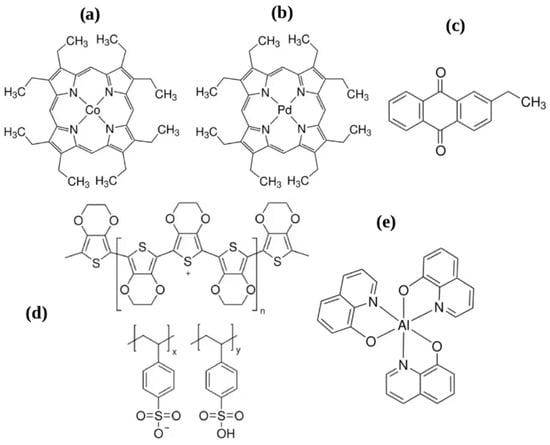
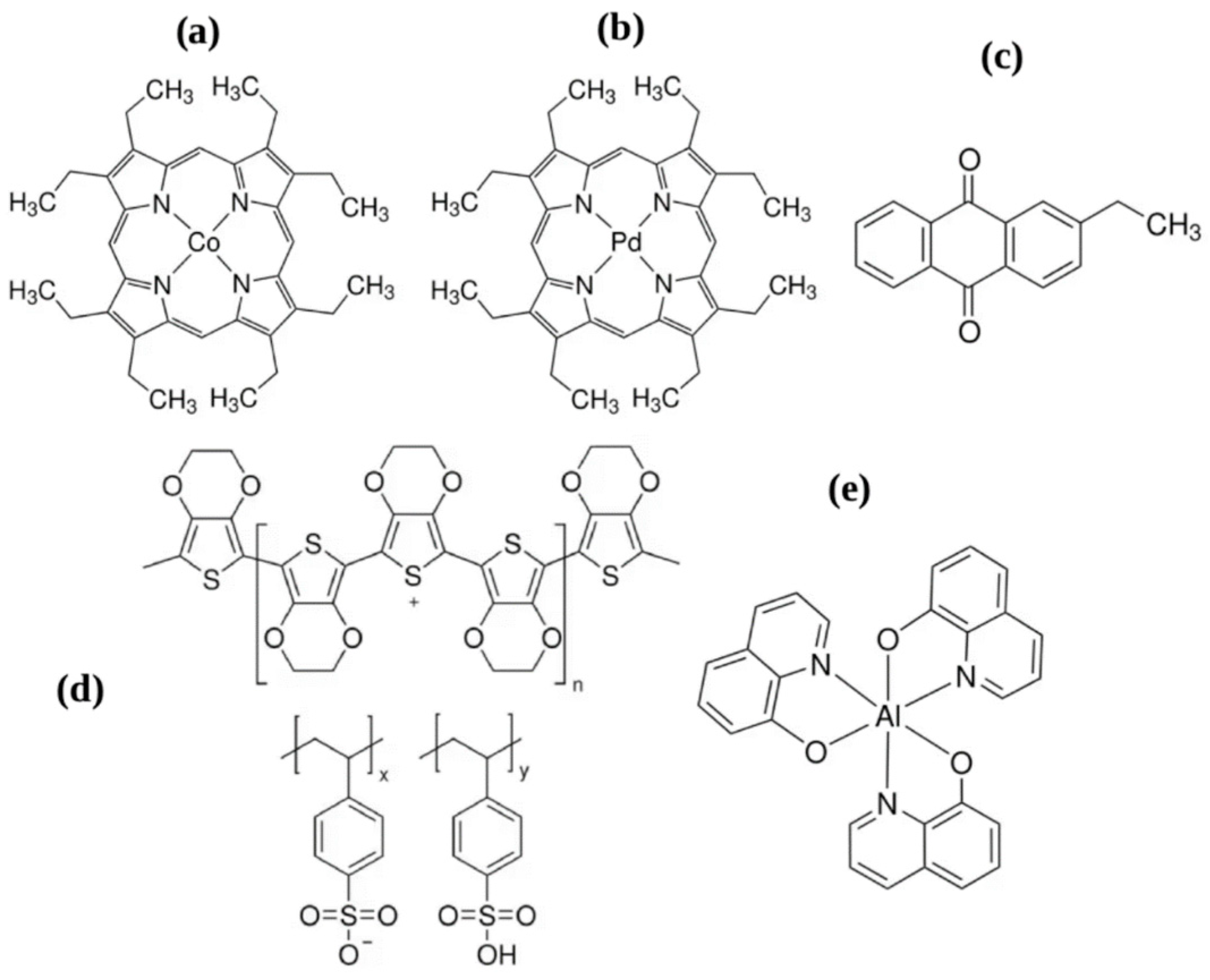
Figure 1 shows the structures of compounds CoOEP (2,3,7,8,12,13,17,18-octaethyl-21H,23H-porphyrin cobalt(II): C36H44CoN4), PdOEP (2,3,7,8,12,13,17,18-octaethyl-21H,23H-porphyrin palladium(II): C36H44N4Pd), EAQ (2-ethylanthraquinone: C16H12O2), PEDOT:PSS (poly(2,3-dihydrothieno-1,4-dioxin)-poly(styrenesulfonate)), Alq3 (tris-(8-hydroxyquinoline)aluminum: C27H18AlN3O3), tin oxide nanopowder (SnO2, ≤100 nm average particle size) and zinc oxide nanopowder (ZnO, <100 nm particle size) that were acquired from Sigma-Aldrich (St. Louis, MO, USA) and used without further purification.
Figure 1.
Structures of (a) CoOEP, (b) PdOEP, (c) EAQ, (d) PEDOT:PSS, and (e) Alq3.
2.1. Density Functional Theory (DFT) Details
All structures were geometrically optimized using the B3PW91 DFT functional [27,28] as implemented in the Gaussian package [29]. The 6-31g basis set [30,31] was used for all elements, except palladium, for which a pseudopotential LANL2DZ was applied [32], augmented with f-type polarization functions [33]. To confirm that the optimized structures were minima on the potential energy surface, frequency calculations were carried out at the same level of theory.
2.2. Preparation of Bulk Dispersed Heterojunctions and Films
The CoOEP-EAQ and PdOEP-EAQ were prepared at a 1:1 weight ratio using 100 mg of CoOEP or PdOEP and 100 mg of EAQ in 62.5 mL of chloroform (CHCl3). Both solutions were refluxed for 2.5 h. The CoOEP-EAQ solution was filtered; the residue was reduced to half the volume and filtered to obtain the compound material. For the PdOEP-EAQ solution, the same process was repeated 3 times, and then the solution was evaporated to dryness. Both compound materials were tested for their melting points using a MEL-TEMP apparatus (Thermo Fisher Scientific Inc., Waltham, MA, USA). PdOEP-EAQ melted at a temperature of 110 °C, whereas CoOEP-EAQ had a melting point above 200 °C. CoOEP-EAQ and PdOEP-EAQ were characterized by IR spectroscopy using the KBr pellet method on a Nicolet iS5 FTIR spectrometer (Thermo Fisher Scientific Inc., Waltham, MA, USA). For the preparation of the thin films, dispersions were initially prepared with 10 mg of PdOEP-EAQ or CoOEP-EAQ in 5 mL of an 8% aqueous PEDOT:PSS solution using a Vortex-Genie G650 shaker (Scientific Industries, Inc., Bohemia, NY, USA). This was done to oversaturate the PEDOT:PSS matrix. The dispersions were deposited onto glass and n-type silicon substrates by spin-coating in a Smart Coater 200 (Laurell Technologies, Corporation, North Wales, PA, USA) with an angular velocity of 500 rpm, a spin time of 20 s, and an acceleration of 60 rpm/s. The PdOEP-EAQ/PEDOT:PSS and CoOEP-EAQ/PEDOT:PSS films were dried on a hot plate at 100 °C. X-ray diffraction (XRD) was performed using a Bruker D8 Advance diffractometer (Bruker Corporation, Karlsruhe, Germany) with Mo Kα radiation (λ = 1.5406 Å) and a Zr filter at 50 kV and 50 mA, employing a continuous scan over a 2θ range of 3° to 40°. Topographical characterization was performed using a NANBEI AFM 1000 atomic force microscope (AFM) (NANBEI Instrument Limited, Zhengzhou, Henan, China), operating in tapping mode under ambient conditions, utilizing silicon nitride tips. The acquired height images were processed and analyzed using Gwyddion software (v. 2.7). UV-Vis spectroscopy of the films was performed using a Unicam UV300 UV-Vis spectrophotometer (Thermo Fisher Scientific Inc., Waltham, MA, USA) over the wavelength range 190–1100 nm. Film fluorescence was measured with an FP-8550 spectrofluorometer (Jasco International, Tokyo, Japan).
2.3. Fabrication of Light-Sensitive Resistive Sensors
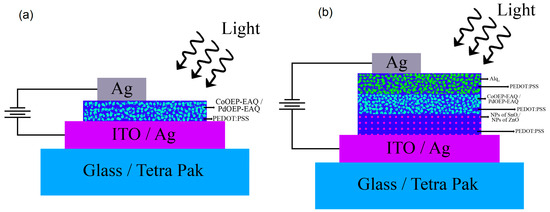
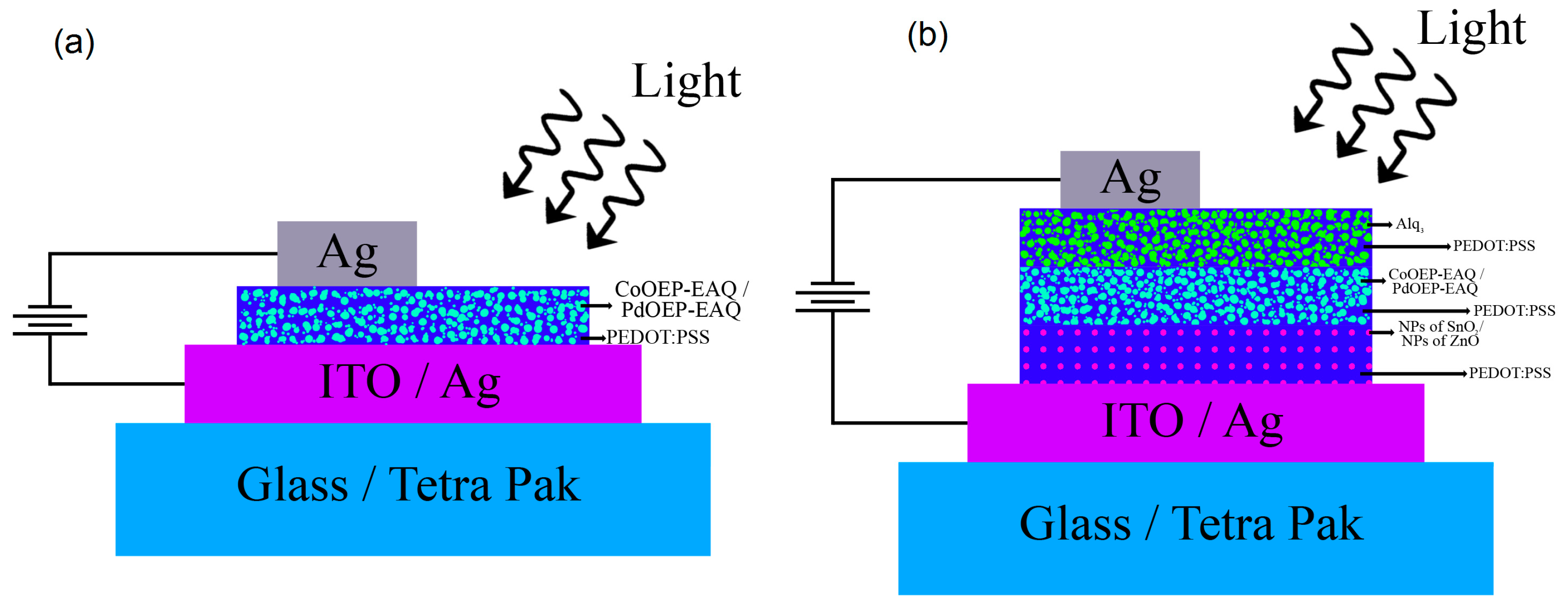
With PdOEP-EAQ/PEDOT:PSS and CoOEP-EAQ/PEDOT:PSS films as active layers, light-sensitive resistive sensors were fabricated by spin coating (see Figure 2a). It is important to consider that all devices were manufactured under the same operating conditions. Unpolished float glass passivated with SiO2 was used as a substrate for rigid devices, while Tetra Pak (TP) was used for flexible devices. The anode used in the rigid devices is indium tin oxide (ITO), and in the flexible devices, it is Ag with 63.6 nm Ra and 82.1 nm RMS. ITO is optically transparent and electrically conductive, serving as the hole injector from the source into the PdOEP-EAQ/PEDOT:PSS and CoOEP-EAQ/PEDOT:PSS devices. The ITO provides stable, low-resistance, and uniform electrical contact with the active layer. Ag possesses very high electrical conductivity, thereby lowering the device’s series resistance and reducing ohmic losses. Subsequently, the PdOEP-EAQ/PEDOT:PSS and CoOEP-EAQ/PEDOT:PSS films were deposited to determine their electrical behavior as organic semiconductors. If its performance as a semiconductor is adequate, it functions as the active layer within the device—where charge carriers are generated—and regulates the transport of holes and electrons via its HOMO and LUMO, respectively. Finally, Ag in both devices acts as the cathode and the collecting electrode. Additionally, modified resistive sensors were fabricated (see Figure 2b), with SnO2 and ZnO NPs embedded in PEDOT:PSS layers and a layer of Alq3 embedded in the same polymer. These layers were prepared by spin coating from suspensions containing 10 mg of SnO2 or ZnO NPs or 10 mg of Alq3, in 5 mL of an 8% aqueous PEDOT:PSS solution. The spin-coating parameters were an angular velocity of 500 rpm, a spin time of 20 s, and an acceleration of 60 rpm/s. These devices used the same substrate, anode, and cathode as the simple single-layer resistive sensors. The thicknesses of the layers are as follows: PdOEP-EAQ/PEDOT:PSS, 6.7 μm; CoOEP-EAQ/PEDOT:PSS, 6.8 μm; SnO2-PEDOT:PSS, 7.2 μm; ZnO-PEDOT:PSS, 7.4 μm; and Alq3-PEDOT:PSS, 7 μm.
Figure 2.
Schematic of the light-sensitive resistive sensor: (a) simple and (b) optimized.
Current-voltage (I–V) analysis was performed on rigid and flexible devices, and a Keithley 4200-SCS-PK1 auto-ranging picoammeter (Tektronix Inc., Beaverton, OR, USA) was used with the collinear four-point probe method and a lighting controller circuit from Next Robotix (Comercializadora KMox, S.A. de C.V., Mexico City, Mexico). The resistive sensors were evaluated at room temperature for their I–V characteristics under dark and irradiated conditions using an irradiation chamber specifically fabricated for the electrical evaluation of organic devices, employing a conventional white LED typically operating at a voltage between 1.8 and 2.8 V and a current of 18 mA as the illumination source, positioned at a fixed distance of 1 cm from the sensor surface. The LED served as a broadband visible light source.
3. Results
3.1. Computational Results
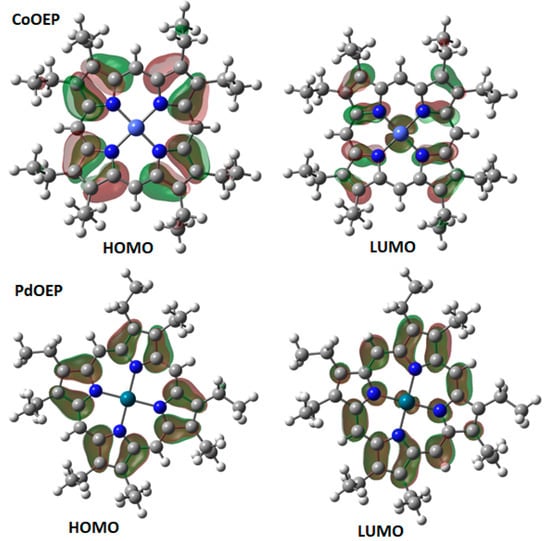
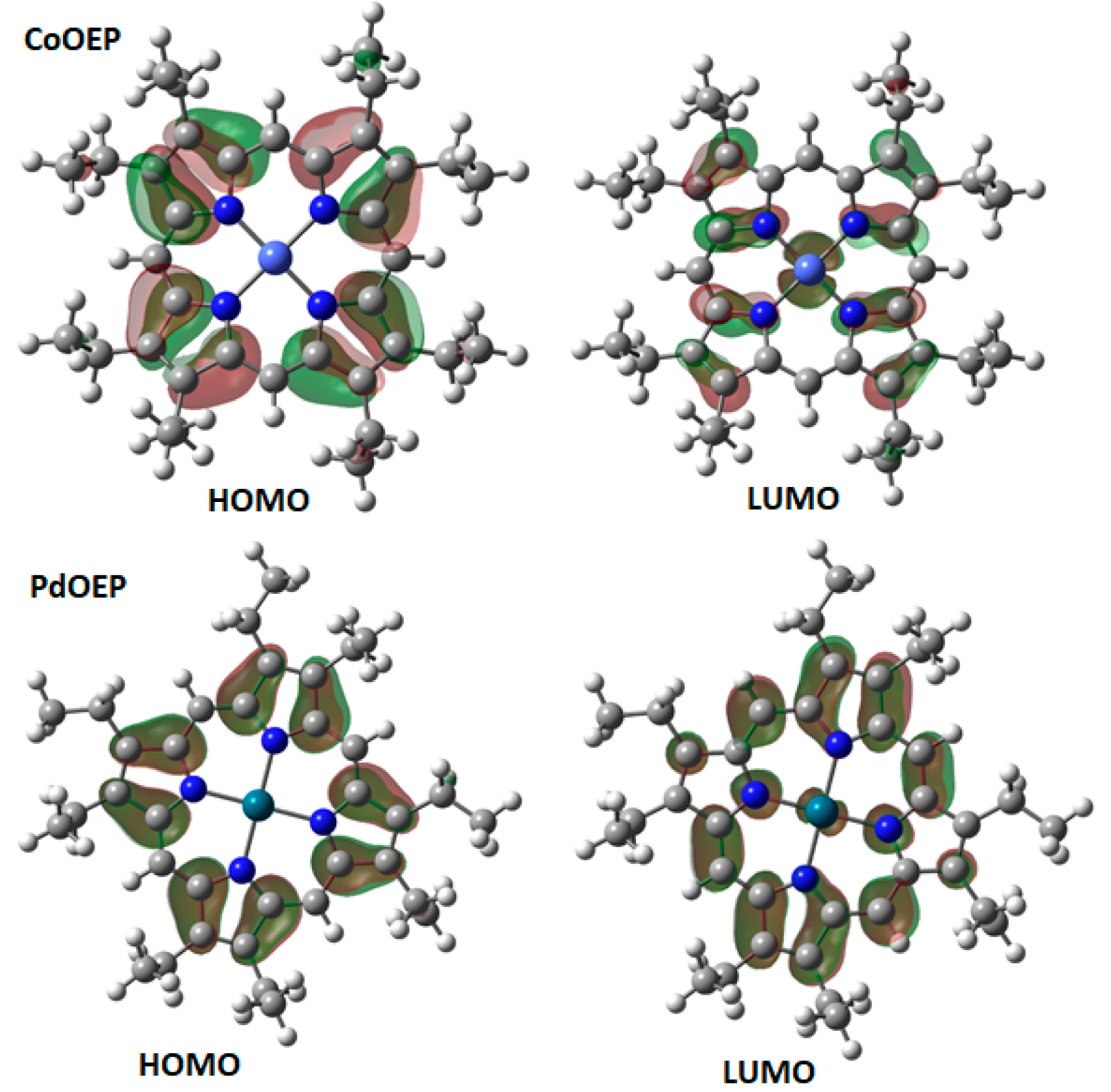
After performing the DFT calculations, CoOEP and PdOEP show very different characteristics. The porphyrin of cobalt tends to lose an electron to reach the more stable 3+ configuration; therefore, it is expected to have a very low LUMO value, and the calculation confirms this situation, showing a set of HOMO-LUMO levels with strongly negative values and a narrow gap (see Figure 3a and Table 1). The case of palladium porphyrin is very different: now there is a second-row element with a well-defined oxidation state (2+), which pushes the frontier molecular orbitals to high values and results in a wider band gap, making this species a borderline case (see Figure 3b). It is important to note that in both cases, the central metal atom does not participate in the HOMO. This suggests that the porphyrinic ring is the sole source of electrons, which can selectively populate the LUMO through the metal atom and the associated organic functions.
Figure 3.
Frontier molecular orbitals of (a) CoOEP and (b) PdOEP.
Table 1.
HOMO-LUMO energy gap for pristine and EAQ-optimized porphyrins.
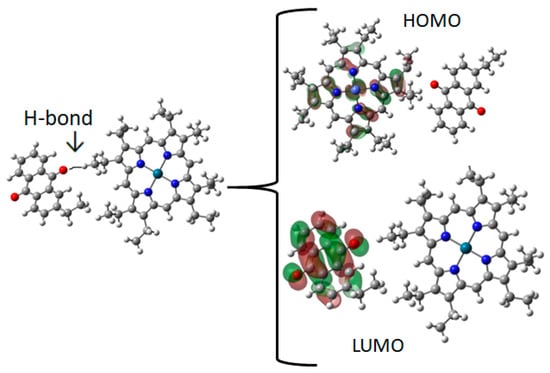
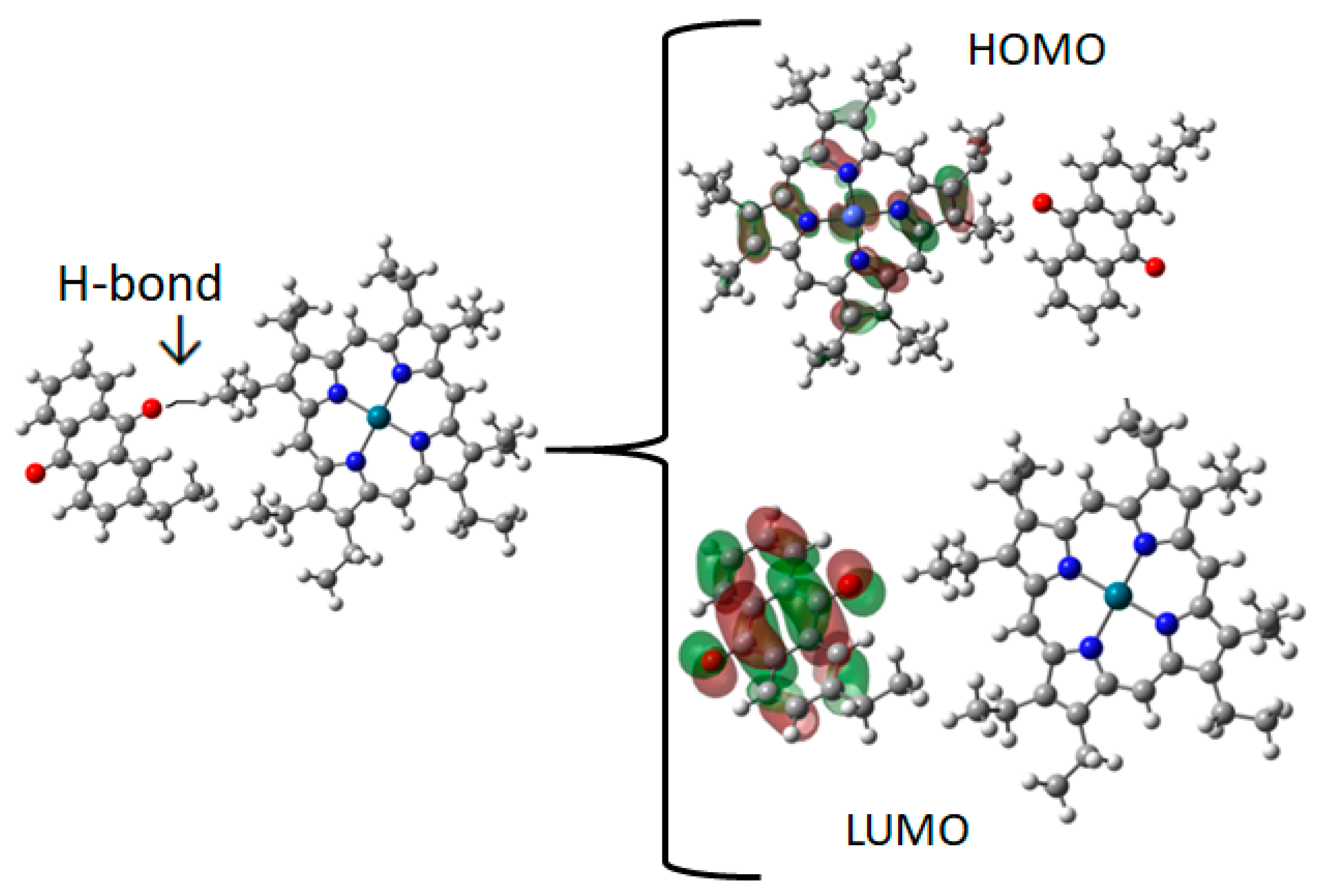
When calculating the interaction between PdOEP and EAQ, both species can form an association: the external oxygen atoms of the ethylanthraquinone species interact with the terminal hydrogen atoms of the ethyl groups of the metallic complex (see Figure 4), forming a hydrogen bond with a length of 2.33 Å. The calculation of the Grimme function [34] yields an energy value of 7.3 kcal/mol for this interaction. It is important to note that for both molecules, there is a unique set of frontier molecular orbitals, with the LUMO on the anthraquinone species and the HOMO on the porphyrin ring. The cluster exhibits strong semiconductor behavior, as shown in Table 1. The interaction of EAQ with the porphyrin and the formation of the hydrogen bond definitely favor a reduction in the energy gap and, consequently, enhance the organic semiconductor capability of the PdOEP-EAQ system.
Figure 4.
H-bond between PdOEP and EAQ molecules and frontier molecular orbitals of PdOEP-EAQ.
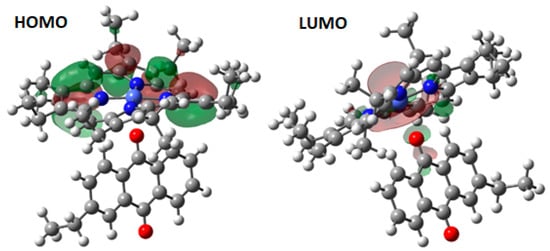
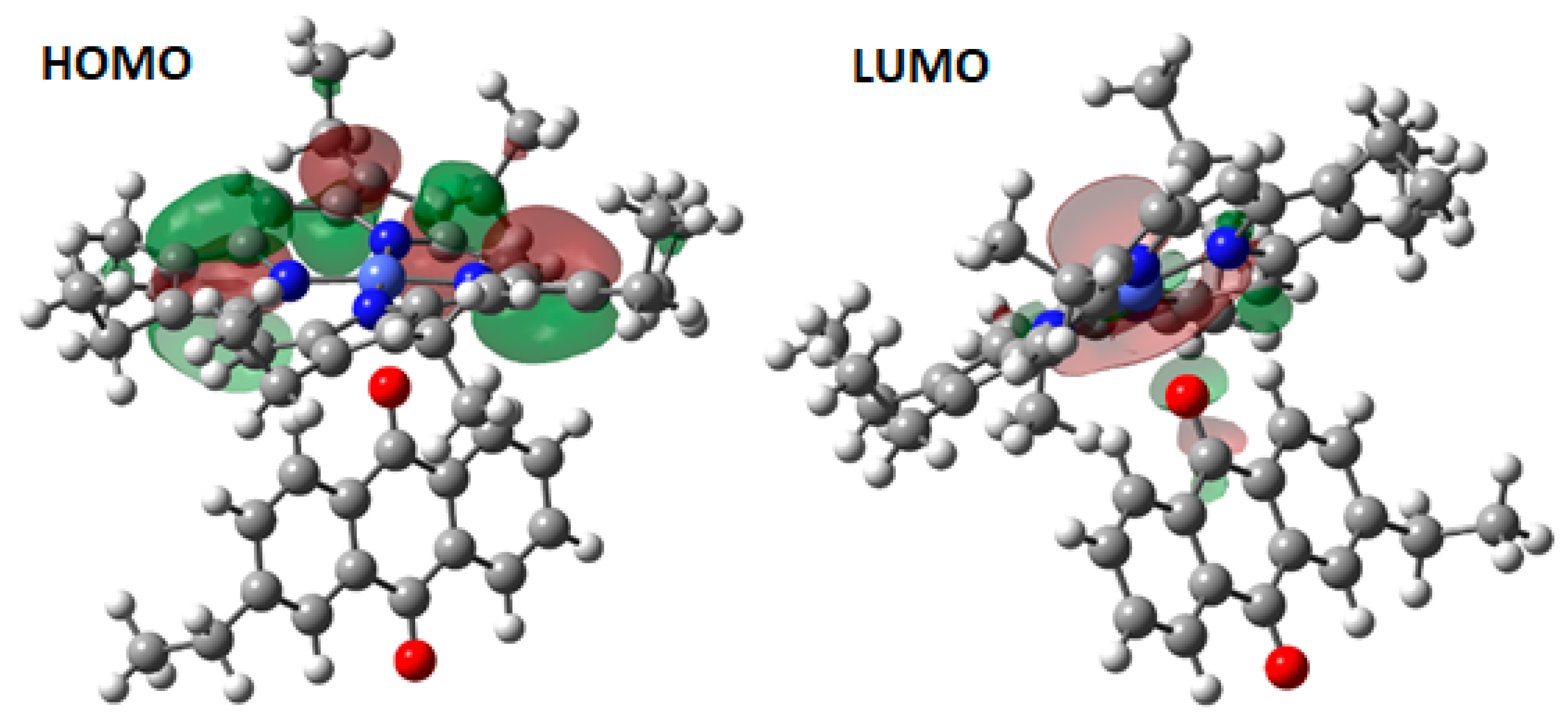
In other contexts, the interaction between the cobalt complex and methyl-anthraquinone is very different. In this case, the more electrophilic nature of the cobalt center compels one of the oxygen atoms of the anthraquinone moiety to form a kind of bond with it, but this bond is very weak; the bond length between cobalt and oxygen atom I is 2.3 Å. This situation suggests a weakly coordinated covalent bond. The Grimme analysis shows that this interaction has an energy value of 19.3 kcal/mol. The peculiar arrangement gives rise to a particular HOMO-LUMO behavior. Figure 5 shows the shapes of the frontier molecular orbitals, and Table 1 shows the energy differences between them. The 1.61 eV band gap confirms the semiconductor behavior. The HOMO is concentrated on the cobalt complex around the metal center, whereas the LUMO is found as an interaction between oxygen and cobalt atoms.
Figure 5.
Frontier molecular orbitals of CoOEP-EAQ.
3.2. Characterization of Bulk Dispersed Heterojunctions
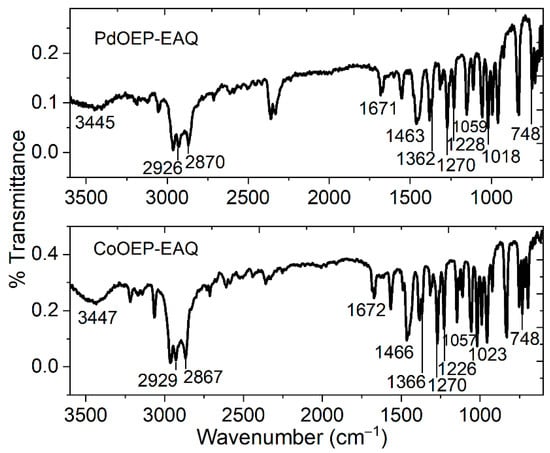
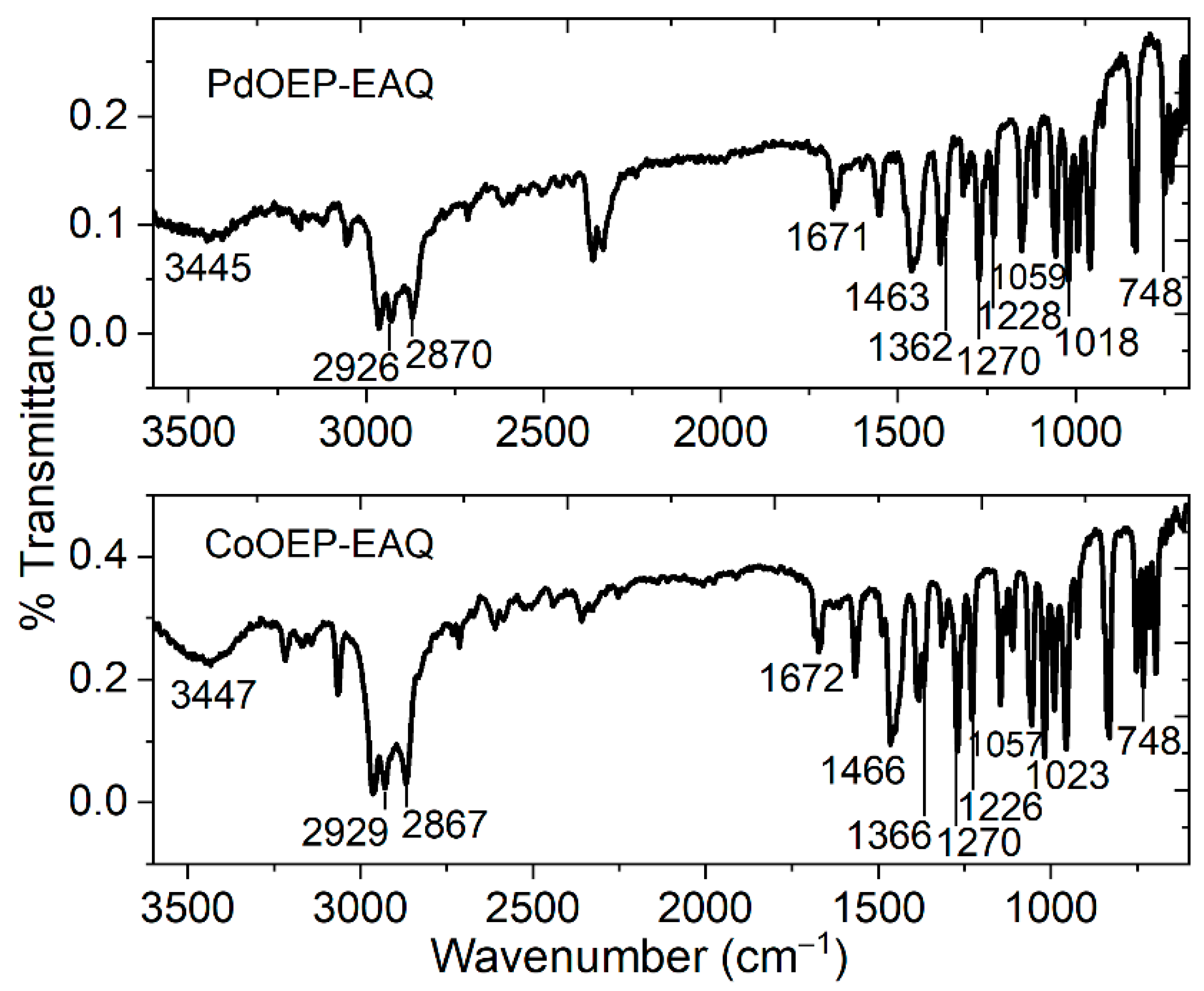
The advantages of using EAQ for cobalt and palladium porphyrins include improved charge transport in the porphyrin-EAQ system. Since EAQ is an efficient electron acceptor, it can, in combination with electron-donating porphyrins, form donor-acceptor pairs that facilitate charge separation and transport. Specifically, in the case of cobalt porphyrin, the metal is redox-active, and EAQ can stabilize certain oxidation states of Co. This could improve the operational stability of devices fabricated with CoOEP-EAQ films. On the other hand, Pd promotes spin–orbit coupling, generating the triplet state. EAQ can act as an electron trap from this triplet state, which can be valuable in OLEDs or oxygen sensors. Due to the spin-coating conditions used in the manufacture of CoOEP-EAQ and PdOEP-EAQ BHJ films, IR spectroscopy was performed to ensure that no decomposition occurred in any of the precursor compounds, and the spectra are illustrated in Figure 6. Regarding the presence of porphyrins, IR spectra are in good agreement with the literature [11,35,36,37,38,39]. The presence of C–H groups was indicated by the bands at 2868 ± 2 and 1227 ± 1 cm−1 (CH3 asymmetric stretching), at 2927 ± 2 cm−1 (symmetrical CH2), at 1364 ± 2 cm−1 (asymmetrical CH2), and at 748 cm−1 (out-of-plane bending of the C-H bonds of the phenyl group). In contrast, the presence of C-C in-plane bending was indicated by the band at 1462 ± 2 cm−1. Additionally, the band at 1020 ± 3 cm−1 indicated the presence of a pyrrole C-N bond, and the band at 1058 ± 1 cm−1 was assigned to an N-H vibration. On the other hand, the presence of EAQ is evident from the signal at 1670 ± 1 cm−1, which corresponds to the anthraquinone carbonyl groups (C = O) [40]. From the above results, it is evident that none of the precursors degraded during the preparation of the BHJ.
Figure 6.
IR spectra of CoOEP-EAQ and PdOEP-EAQ BHJs in films.
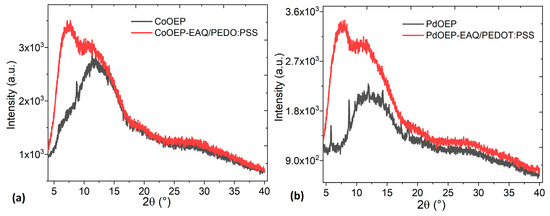
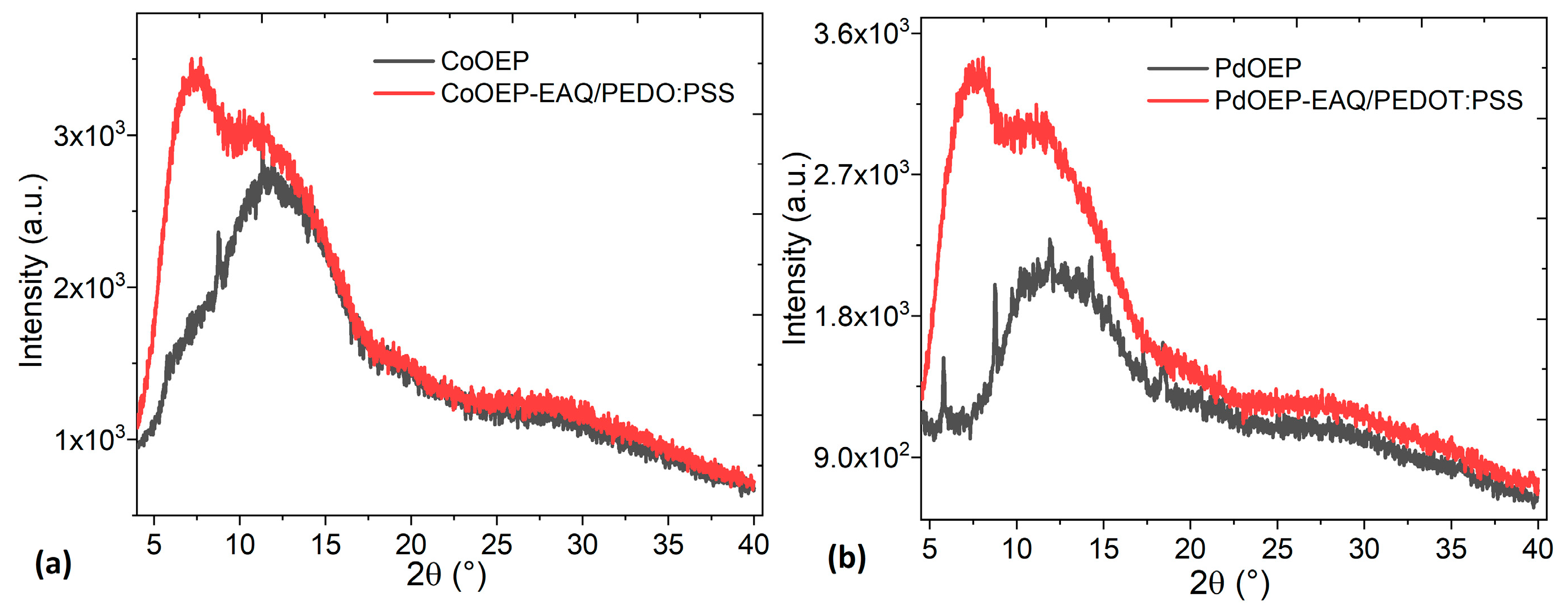
XRD analysis was performed, and the diffraction patterns are shown in Figure 7 for the CoOEP-EAQ/PEDOT:PSS and PdOEP-EAQ/PEDOT:PSS films, respectively, as well as for their precursor porphyrins. The absence of sharp diffraction peaks and the presence of humps between 2θ values of 5 and 16° characterize the films’ amorphous nature. XRD patterns of the CoOEP and PdOEP powders showed small diffraction patterns with peaks at 2θ = 8.68°, 11.25°, 11.89° and 2θ = 5.76°, 8.75°, 11.93°, 14.32°, 18.41°, respectively. These indicate that the powders consist of small crystalline aggregates embedded in an amorphous matrix [36].
Figure 7.
XRD patterns for (a) CoOEP and CoOEP-EAQ/PEDOT:PSS and (b) PdOEP and PdOEP-EAQ/PEDOT:PSS.
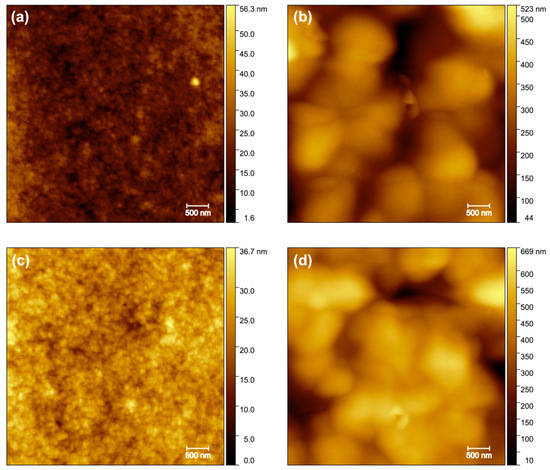
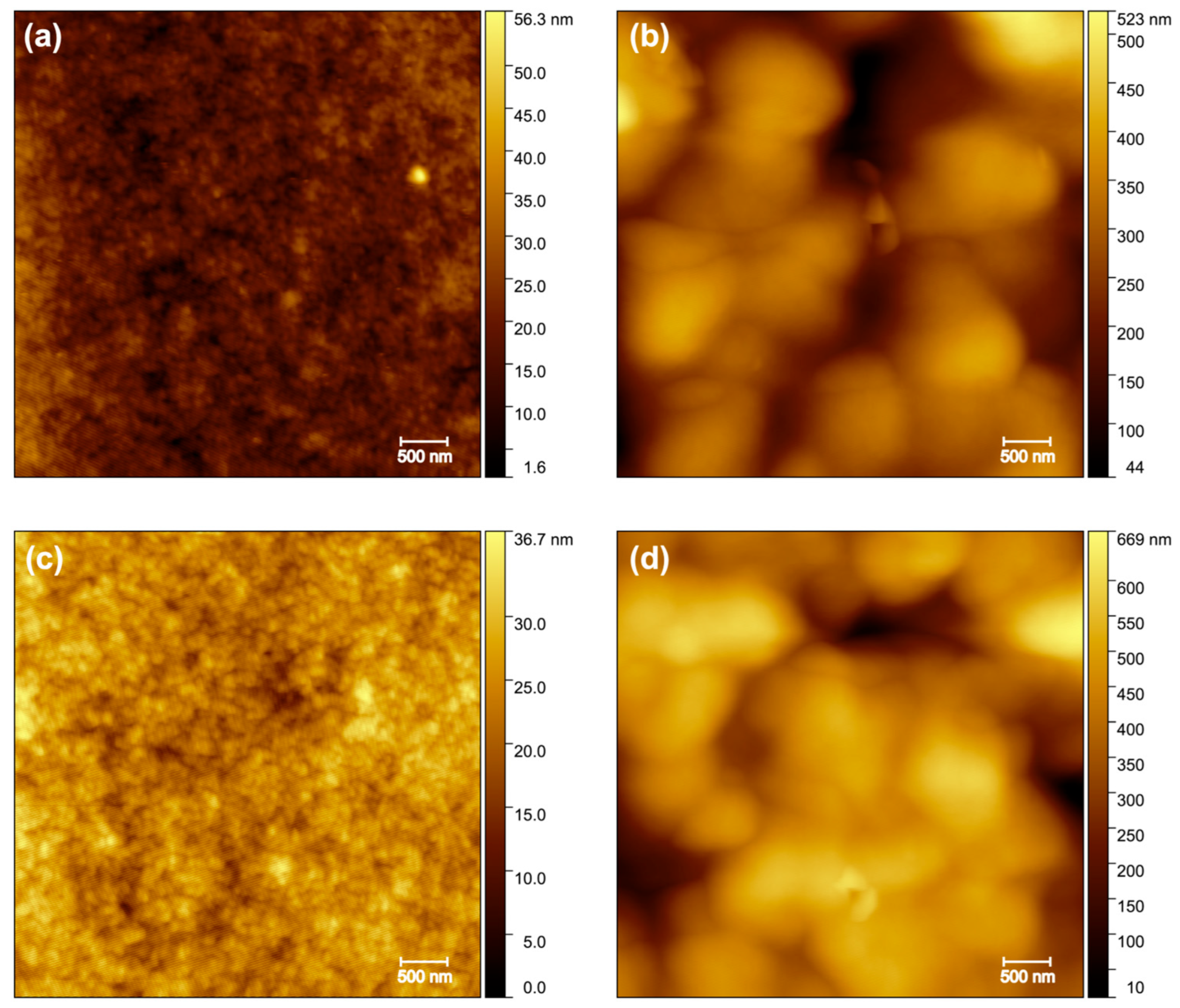
The surface topography of the films based on CoOEP-EAQ/PEDOT:PSS and PdOEP-EAQ/PEDOT:PSS was studied using AFM, evaluating the direct effect of the substrate’s nature (glass versus recycled Tetra Pak) on the morphology of the active layer (see Figure 8). For the films deposited on glass substrates, the topographical images reveal a predominantly flat surface constituted by a fine granular morphology. Quantitatively, the CoOEP-EAQ/PEDOT:PSS film registered an average roughness (Ra) of 3.7 ± 0.8 nm and a root-mean-square (RMS) roughness of 5.0 ± 1.3 nm (see Table 2). Meanwhile, the PdOEP-EAQ/PEDOT:PSS system exhibited an Ra of 4.9 ± 1.2 nm and an RMS of 7.8 ± 3.6 nm. These low roughness indices correspond to the high intrinsic flatness of the glass [41]. To complement this analysis, the statistical distribution of the surface heights was evaluated. The CoOEP-EAQ/PEDOT:PSS presented a surface skewness of 0.5 ± 0.3 and a kurtosis of 3.7 ± 2.2, indicating a symmetrical and mesokurtic topography. In contrast, the PdOEP-EAQ/PEDOT:PSS film on glass exhibited a skewness of 2.5 ± 1.8 and a markedly high kurtosis of 16.4 ± 15.7. This high kurtosis value reveals the presence of sharp peaks or ridges sporadically distributed over an otherwise flat base, a common phenomenon associated with the rapid nucleation of porphyrin compounds on hydrophilic surfaces [42].
Figure 8.
AFM images of (a) CoOEP-EAQ/PEDOT:PSS on glass, (b) CoOEP-EAQ/PEDOT:PSS on Tetra Pak, (c) PdOEP-EAQ/PEDOT:PSS on glass and (d) PdOEP-EAQ/PEDOT:PSS on Tetra Pak.
Table 2.
Morphological parameters from CoOEP-EAQ/PEDOT:PSS and PdOEP-EAQ/PEDOT:PSS films and their precursors deposited on glass and Tetra Pak substrates.
In contrast, depositing these same films on Tetra Pak substrates induced a drastic transformation in the supramolecular architecture. Images b and d in Figure 8 evidence the formation of large three-dimensional structures approximately 600 nm in diameter, which exhibit a smooth morphology and appear physically fused, forming an interconnected network. This reorganization increased the roughness by more than an order of magnitude compared to glass, reaching an RMS of 125.5 ± 35.4 nm and an Ra of 101.1 ± 32.2 nm for CoOEP-EAQ/PEDOT:PSS, and an RMS of 92.7 ± 41.6 nm and an Ra of 74.4 ± 36.8 nm for PdOEP-EAQ/PEDOT:PSS [43]. However, the statistical surface analysis reveals a highly favorable topographical panorama. Despite the drastic increase in global roughness, the PdOEP-EAQ/PEDOT:PSS films on Tetra Pak exhibited a negligible skewness of −0.1 ± 0.4 and a kurtosis of 0.0 ± 0.5. Concurrently, the CoOEP-EAQ/PEDOT:PSS system presented a skewness of 0.3 ± 0.2 and a low kurtosis of 1.5 ± 0.5.
This dual topographical behavior—high macroscopic roughness combined with excellent local symmetry parameters—is of vital importance for its application in optoelectronic devices. Scientifically, a skewness value close to zero conclusively indicates that the height distribution is symmetrical, ruling out deep valleys or pinholes that could cause electrical short circuits. Simultaneously, the drastic decrease in kurtosis toward values close to zero (platykurtic behavior) corroborates the visual observation in the AFM images: the 600 nm microparticles lack sharp peaks. Instead, they form rounded, smooth domains with flattened tops. This ridge-free morphology is fundamental for avoiding the concentration of intense electric fields that promote premature dielectric degradation of the device [44]. The physicochemical origin of this morphology stems from thermodynamic differences at the interface. The low surface energy of Tetra Pak’s polymeric layer alters the spreading dynamics; instead of extending flatly, the organic molecules self-assemble to minimize the interfacial area [41,45]. Nevertheless, the strong intermolecular interactions via π-π stacking among the porphyrins guarantee that these domains coalesce and fuse. Consequently, although the material’s adaptation dictates that the RMS roughness matches the macroroughness of the recycled substrate, the network of fused microparticles with smooth curvature (low kurtosis) ensures continuous percolation pathways for charge transport, thereby ratifying the viability and mechanical robustness of these films for flexible organic electronics [46].
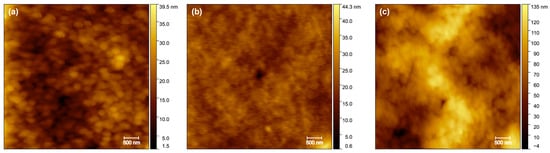
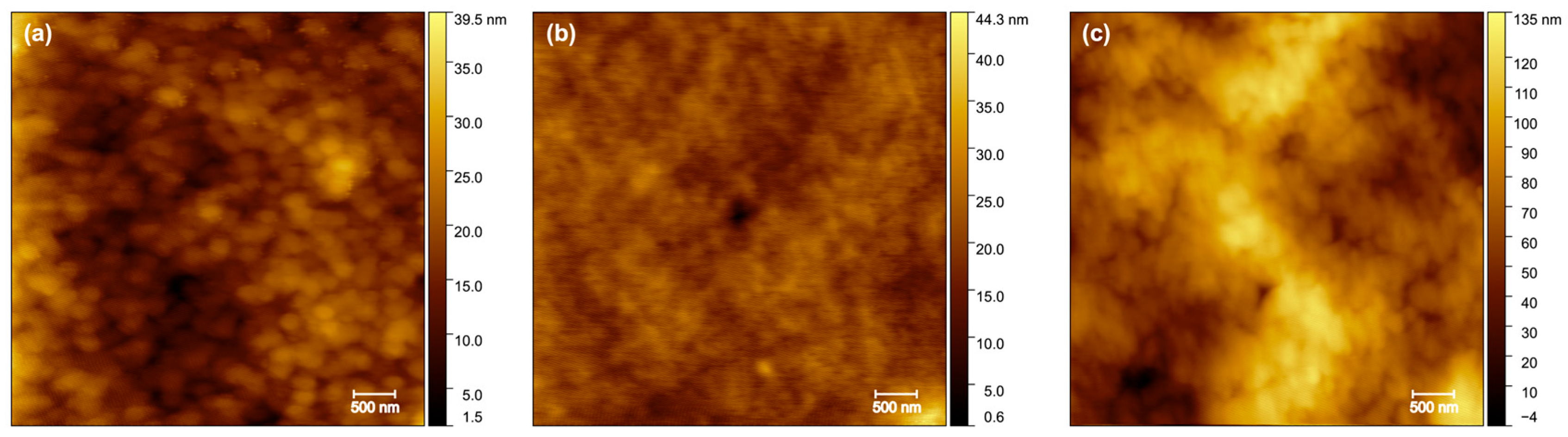
For the Alq3/PEDOT:PSS and SnO2/PEDOT:PSS thin films, the AFM topographical images (Figure 9a,b) reveal a predominantly flat and continuous surface where individual nanoparticle sizes cannot be laterally resolved, suggesting either high precursor coalescence or the consolidation of a densely packed layer covering the polymer. Quantitatively, the Alq3/PEDOT:PSS film recorded an average Ra roughness of 3.7 ± 0.8 nm and an RMS roughness of 5.0 ± 1.3 nm (Table 3). Concurrently, the SnO2/PEDOT:PSS system exhibited an Ra of 4.9 ± 1.2 nm and an RMS of 7.8 ± 3.6 nm. These low roughness values indicate highly conformal growth that closely replicates the inherent flatness of the underlying substrate. Nevertheless, statistical surface analysis of the height distribution uncovers critical morphological features: the Alq3/PEDOT:PSS system displayed a skewness of 1.9 ± 1.4 and a markedly elevated kurtosis of 9.1 ± 9.4, whereas the SnO2/PEDOT:PSS film exhibited a skewness of 1.1 ± 1.6 and a kurtosis of 9.5 ± 11.8. This pronounced leptokurtic behavior (kurtosis > 3), along with positive skewness, confirms that, atop a fundamentally smooth base matrix, sporadic agglomerates or pronounced sharp peaks project abruptly [23].
Figure 9.
AFM images of (a) Alq3-PEDOT:PSS, (b) SnO2-PEDOT:PSS and (c) ZnO-PEDOT:PSS.
Table 3.
Morphological parameters from Alq3/PEDOT:PSS, SnO2/PEDOT:PSS and ZnO/PEDOT:PSS.
In contrast, the configuration of the ZnO/PEDOT:PSS system induced a dramatic transformation in the supramolecular architecture, increasing the surface roughness by over an order of magnitude. This film reached an RMS roughness of 125.5 ± 35.4 nm and an Ra of 101.1 ± 32.2 nm (Table 3). This substantial increase suggests a fundamental shift in growth thermodynamics, favoring massive three-dimensional Volmer-Weber island growth [47], likely driven by the strong reactive affinity of zinc toward the acidic PEDOT:PSS interface [48]. Despite this extreme macroroughness, statistical surface evaluation presents a locally symmetrical topographical landscape. The ZnO/PEDOT:PSS film exhibited a virtually null skewness of 0.3 ± 0.4 and an exceptionally low kurtosis of 0.9 ± 1.6 [23].
This statistical and morphological duality holds profound physicochemical implications for integrating these films into optoelectronic devices. For the Alq3/PEDOT:PSS and SnO2-PEDOT:PSS systems, the presence of sharp peak topologies—reflected in elevated kurtosis—poses a critical challenge, as these pointed agglomerates can act as local centers of electric-field concentration, promoting leakage currents despite overall coating homogeneity. Conversely, in the ZnO/PEDOT:PSS system, the near-zero skewness and strongly platykurtic behavior (kurtosis < 3) mathematically demonstrate that the extensive three-dimensional structures entirely lack sharp crests [23]. Instead, zinc forms thick domains with rounded or flat-topped surface morphologies, exhibiting a statistically symmetric distribution between peak heights and valley depths. Collectively, surface metrology confirms that while individual grain sizes remain beyond lateral resolution limits, precursor coalescence generates a continuous matrix with sharp agglomerates for Alq3- and SnO2-containing systems, whereas the ZnO/PEDOT:PSS system promotes a macro-rough landscape with smooth curvature, thereby dictating the thickness requirements for any subsequent layer.
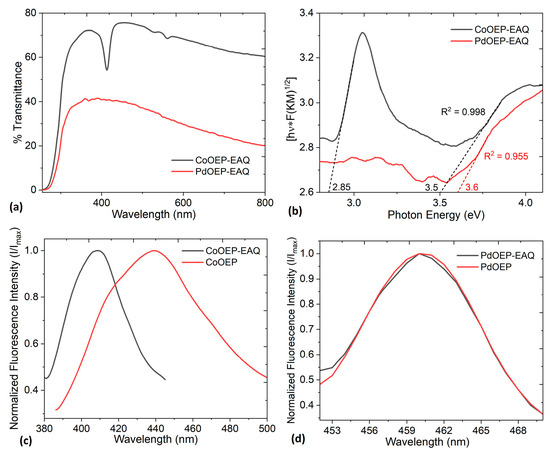
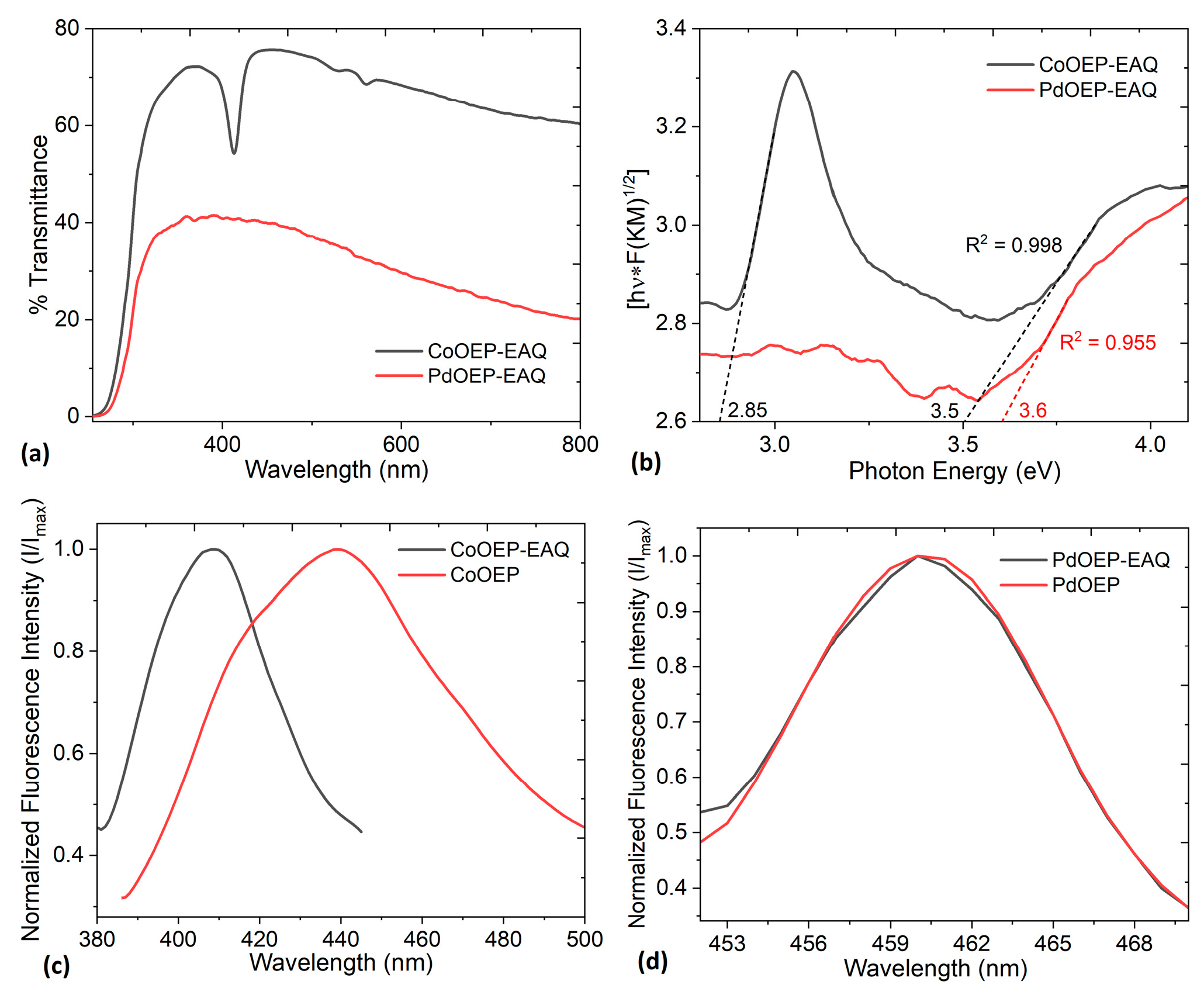
The films were analyzed by UV-vis spectroscopy to determine their transmittance; in Figure 10a, spectra of CoOEP-EAQ/PEDOT:PSS and PdOEP-EAQ/PEDOT:PSS are observed. Transmittance is an important optical parameter for these films used in light-sensitive resistive sensors, as its spectral response indicates which wavelength range the films allow or block. The difference between the two spectra is related to several aspects; the first to be mentioned is the central metal of the porphyrins. Both Co(II) and Pd(II) can alter the intensity and position of the Q and Soret bands through changes in the electronic structure and the metal–macrocycle coupling [25,36,49]. The maximum transmittance for the BHJ with cobalt porphyrin is around 78%, while for the BHJ with palladium porphyrin, it is around 40%. The lower transmittance of PdOEP-EAQ/PEDOT:PSS compared to CoOEP-EAQ/PEDOT:PSS is mainly due to the heavy atom effect of Pd, which activates more absorption transitions and enhances the interaction with EAQ. EAQ is an electron acceptor, and when mixed with porphyrins, charge transfer can occur between the porphyrins, which act as electron donors, and EAQ. This modifies the energy levels of the π-π system, suppressing or modifying the original electronic transitions of porphyrins. In the case of PdOEP-EAQ/PEDOT:PSS, the transitions have been eliminated, while in the case of CoOEP-EAQ/PEDOT:PSS, the spectrum is dominated by the π-π* transitions [49]. An intense band is present between 390 and 430 nm, corresponding to the Soret band of porphyrin, and two small bands are also observed between 510 and 535 nm and between 550 and 573 nm, corresponding to the Q band [25]. It can be noted that at λ > 575 nm, the two films become more transparent in the non-absorbing region; however, transparency, especially in the PdOEP film, remains low, so the Kubelka–Munk function, F(K-M), used for opaque films, was employed for the determination of the optical band gap (Eg). The Eg of semiconductor films is an important parameter used in the design of optoelectronic devices. According to Equation (1), F(K-M) is derived from a diffuse reflectance measurement R, which is useful when the sample is an opaque film [50].
Figure 10.
(a) Transmittance and (b) Kubelka–Munk function of CoOEP-EAQ/PEDOT:PSS and PdOEP-EAQ/PEDOT:PSS films. Normalized fluorescence of (c) CoOEP and CoOEP-EAQ/PEDOT:PSS and (d) PdOEP and PdOEP-EAQ/PEDOT:PSS films.
F(K-M) can be converted into a quantity proportional to the absorption coefficient (α) in Equation (2), and the Eg can be calculated according to the Tauc model in Equation (3) [51]. This model establishes a relationship between the material’s optical absorption and the energy of incident photons near the absorption edge.
where ν is the frequency obtained from the inverse of the wavelength of the spectrum, h is Planck’s constant, and B is a proportionality constant. The exponent P = 1/2 depends on the band structure and the electronic transition process of the organic semiconductors. In this case, all the films consist of BHJs formed between the porphyrin-anthraquinone and the polymer matrix; consequently, they are considered amorphous in nature (see Figure 7) and would exhibit indirect electronic transitions [50,51]. Equating Equations (2) and (3) yields Equation (4), which directly relates F(K-M) to the Tauc model.
(hν × F(K-M))P = B (hν − Eg)
The procedure consists of plotting [(hν) F(K-M)]1/2 as a function of photon energy (hν), fitting and extrapolating the linear portion of the plot, and determining the optical energy gap from the intersection with the abscissa. Figure 10b shows F(K-M); both films exhibit a similar optical energy gap (3.5–3.6 eV), corresponding to the energy gap between the π-band and the π*-band [52]. The coefficient of determination (R2) was calculated for each curve, as it indicates the precision with which the experimental data fit the linear regression line in the graph’s linear region. The R2 values obtained are 0.998 and 0.955 for CoOEP-EAQ/PEDOT:PSS and PdOEP-EAQ/PEDOT:PSS, indicating excellent and good linear correlations, respectively. The small difference in the optical band gap suggests that the incorporation or modification involved in the films does not produce a significant change in their optical band gap energy. Additionally, the CoOEP-EAQ/PEDOT:PSS film presents an onset gap (2.85 eV), which corresponds to the formation of a bound electron-hole pair, or Frenkel exciton [49,53]. The presence of the onset gap and the optical energy gap coincides with the results obtained by M.M. El-Nahass et al. [49] for tetrakis(methoxyphenyl)-porphyrin cobalt. For its part, the PdOEP-EAQ/PEDOT:PSS film exhibits a well-defined optical band gap dominated by π–π* transitions, with no significant contributions from intermediate-gap states. The similarity in optical band gap between CoOEP-EAQ/PEDOT:PSS and PdOEP-EAQ/PEDOT:PSS is due to the fact that, in porphyrins, the band gap is mainly governed by the conjugated π system of the macrocycle, not by the central metal. On the other hand, the obtained results are higher than the HOMO–LUMO gap values calculated via DFT (see Table 1). This is because, in theoretical calculations, the HOMO–LUMO gap corresponds to the energy separation of the orbitals of isolated, modeled molecules, whereas the Kubelka–Munk gap corresponds to the optical threshold of thin films involving interacting molecules, molecular packing, film defects, roughness variations, and the influence of the substrates upon which they were deposited.
Fluorescence measurements provide complementary information, enabling determination of the films’ potential for application in photosensitive devices. The normalized fluorescence spectra for CoOEP-EAQ/PEDOT:PSS and PdOEP-EAQ/PEDOT:PSS, as well as for their precursors CoOEP and PdOEP, are presented in Figure 10c and Figure 10d at excitation wavelengths of 360 and 434 nm, respectively. When comparing the spectra of CoOEP and CoOEP-EAQ/PEDOT:PSS, the former shows a shift to longer wavelengths and is much broader. For CoOEP, the maximum occurs at 439 nm, and the spectrum corresponds to a broad band, whereas for CoOEP-EAQ/PEDOT:PSS, the maximum occurs at 408 nm with a narrower band. This indicates that emission in CoOEP occurs at a lower energy than in CoOEP-EAQ/PEDOT:PSS, because the presence of EAQ modifies the porphyrin packing. According to DFT calculations, an interaction arises between the oxygen of the EAQ and the cobalt of the porphyrin (see Figure 5). In the case of PdOEP and PdOEP-EAQ/PEDOT:PSS, there is no appreciable shift in emission; both curves show the main emission at 460 nm. This indicates that the electronic transitions responsible for the emission do not change significantly and that the effect of the EAQ is minimal. The difference between the two curves lies in the region of maximum emission: PdOEP-EAQ/PEDOT:PSS exhibits a sharper peak, corresponding to a narrower emission distribution, whereas PdOEP shows a more rounded peak, corresponding to a broader emission distribution. This observation may be related to differences at the molecular level—such as the intermolecular hydrogen-bonding interaction identified via DFT calculations—or to structural disorder or film heterogeneity, as reflected in the XRD results. In general, the emission does not originate exclusively from the porphyrin ring, but rather there is a contribution from ethylanthraquinone and the generation of charge-transfer states formed between the porphyrin and the quinone [54,55]. On the other hand, differences in the fluorescence spectra between cobalt and palladium materials arise because the central metal atom is directly coordinated to the tetrapyrrole core, thereby modifying the metal atom’s orbitals. In metalloporphyrins, the electronic system is dominated by the π-conjugated macrocycle; however, the metal ion introduces d-orbitals that can interact with the porphyrin’s π-orbitals, thus altering its fluorescence behavior.
3.3. Electrical Evaluation of Light-Sensitive Resistive Sensors
Simple and optimized light-sensitive resistive sensors were manufactured according to the schemes presented in Figure 2a and Figure 2b, respectively. The active layers, PdOEP-EAQ/PEDOT:PSS or CoOEP-EAQ/PEDOT:PSS, absorb light, generate charge carriers, and modulate them. By forming the BHJ with porphyrins and EAQ embedded in PEDOT:PSS, a system is created in which charge generation, separation, and transport occur cooperatively—something none of the components could achieve on their own. In the BHJ, the phases mix at the nanoscale, thereby facilitating charge transfer from the donor porphyrin to the acceptor EAQ before recombination. PEDOT:PSS, for its part, is a conducting species that generates a continuous network within the matrix. The optimized resistive sensors include SnO2 and ZnO NPs embedded in PEDOT:PSS, and Alq3 embedded in the same polymer. In all layers, PEDOT:PSS was used as the matrix because it provides processability and electrical connectivity and participates in charge transport, while also serving as an interface between the photoactive materials and the electrodes [56,57]. The incorporation of the ZnO or SnO2 NP layer at the PdOEP-EAQ/PEDOT:PSS or CoOEP-EAQ/PEDOT:PSS interface was carried out to modify the charge transport mechanisms within the devices and to generate an electrical response dependent on the changes in illumination to which they would be subjected. ZnO and SnO2 are n-type semiconductors, whereas PEDOT:PSS exhibits predominantly p-type behavior [58,59]. Consequently, incorporating nanoparticles into PEDOT:PSS aims to create p–n interfaces that significantly modify charge transport under illumination [58,59]. The Alq3 layer in a PEDOT:PSS matrix can facilitate electron transport toward the Ag electrode. The ITO and Ag electrodes are primarily used to inject and collect charge carriers.
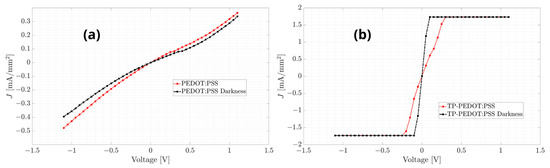
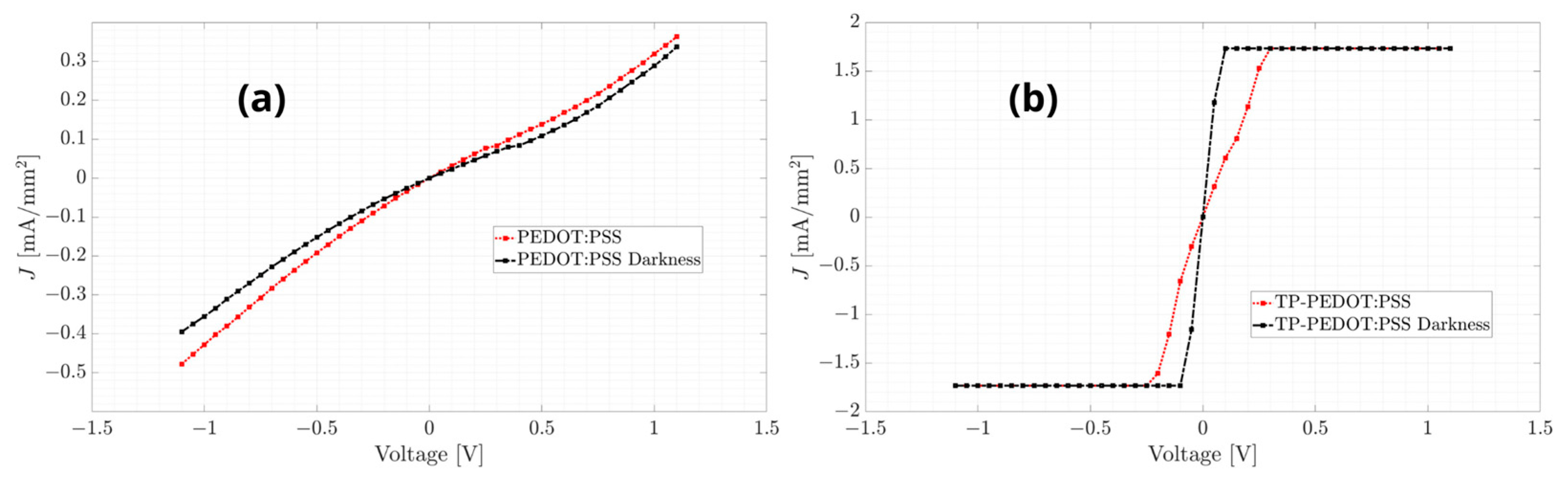
The fabricated devices were subjected to electrical testing by applying a voltage between –1.1 V and 1.1 V under two operating conditions: white illumination and darkness. The active area of all devices for electrical evaluation was 5.77 mm2. Figure 11 shows the current density as a function of the applied voltage for devices with only PEDOT:PSS deposited on glass and Tetra Pak substrates under natural light and darkness conditions. In all following graphs, devices fabricated on Tetra Pak are labeled with the prefix TP, while those on glass are not.
Figure 11.
The J–V curves of devices with PEDOT:PSS deposited on (a) glass and (b) Tetra Pak.
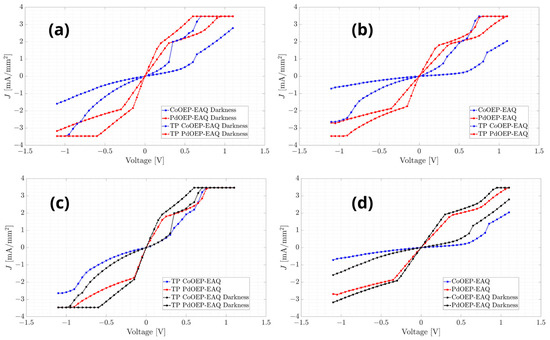
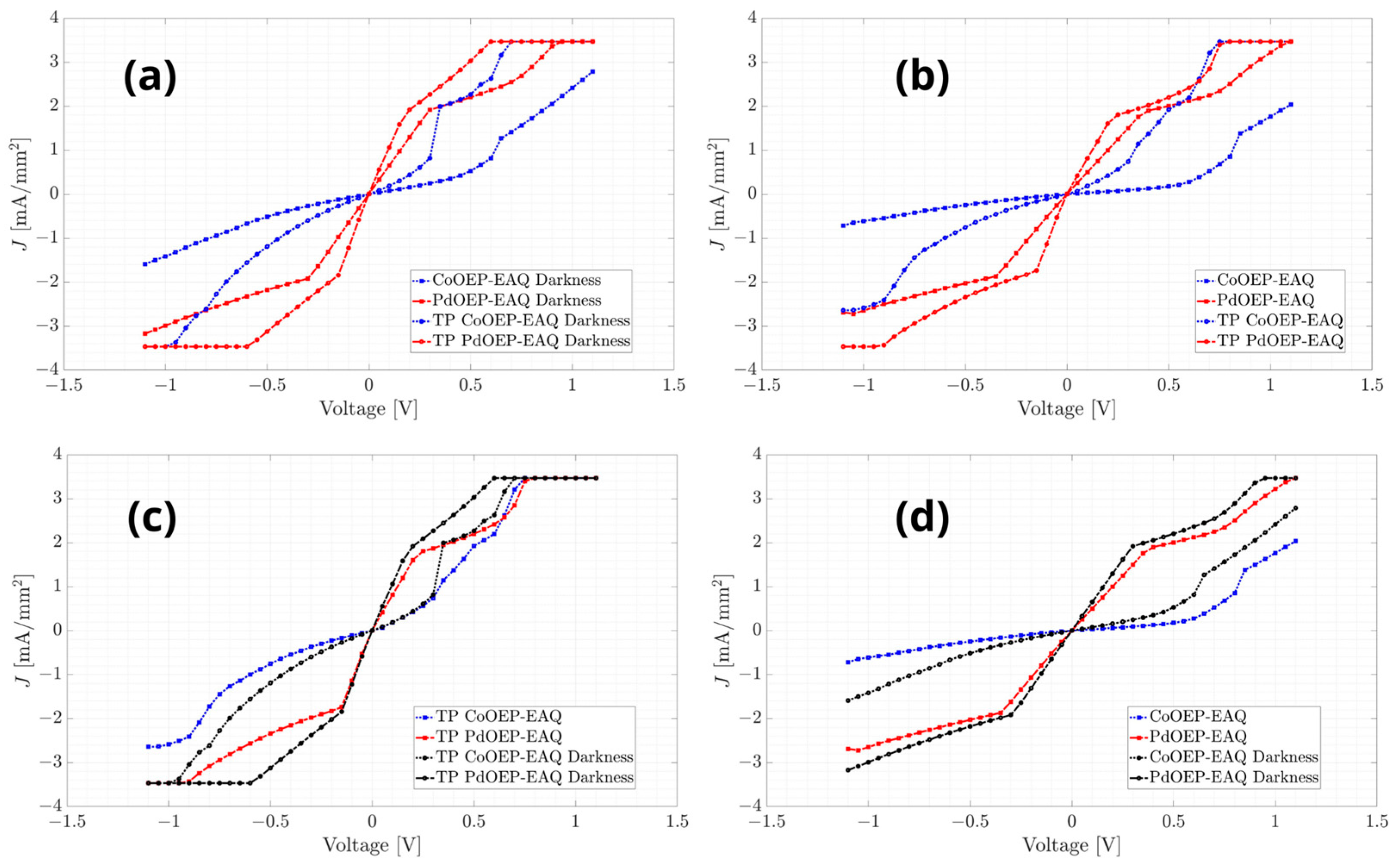
The results shown in Figure 11 indicate that, over the applied voltage range, the device fabricated on TP exhibits a higher current density than the device deposited on glass. Moreover, the TP-based device is the only one to exhibit current-density saturation, reaching 1.73 mA/mm2. As shown in Figure 11b, the illumination conditions affect the voltage at which saturation is reached. Under white light, current-density saturation occurs at approximately 0.3 V, whereas under darkness conditions, saturation is reached at approximately 0.1 V. On the other hand, for the devices deposited on glass and TP substrates, with PdOEP-EAQ and CoOEP-EAQ embedded in the PEDOT:PSS layer, the current density results obtained under darkness conditions and white light are shown in Figure 12a and Figure 12b, respectively.
Figure 12.
The J–V curves of devices deposited on glass and TP with PdOEP-EAQ and CoOEP-EAQ embedded in the PEDOT:PSS layer. (a) Under dark conditions, (b) under white light, (c) TP comparison, and (d) glass comparison.
When comparing the J–V curves in Figure 11 with those presented in Figure 12a,b, an increase in current density can be observed due to the incorporation of PdOEP-EAQ and CoOEP-EAQ. In some devices fabricated with these materials, a saturation current density of 3.4 mA/mm2 was achieved, approximately twice that observed in Figure 11b. On the other hand, Figure 12a,b show that the devices fabricated on TP exhibit higher current conduction rates than those on glass under both white light and darkness. Regarding the current conduction of the devices on TP, the device with PdOEP-EAQ exhibits higher conduction than the device with CoOEP-EAQ under both white light and darkness. Nevertheless, it is important to note that the current density of the device fabricated on glass with CoOEP-EAQ, under both white light and darkness, still does not reach the saturation current of 3.4 mA/mm2, unlike the other devices evaluated. On the other hand, when comparing only the devices on TP and glass under both white light and dark conditions (Figure 12c and Figure 12d, respectively), both devices exhibit changes in electrical resistance in response to illumination, with their conductivity increasing in darkness relative to white light. These results indicate that the devices manufactured behave as light-sensitive resistive sensors, making them promising candidates for low-cost light-sensing applications. Nevertheless, it is noteworthy that all devices on TP reached a saturation current density of 3.4 mA/mm2 within the 0–1.1 V test range (see Figure 12c). In contrast, not all devices on glass reached saturation (see Figure 12d). This behavior indicates that the devices on glass require a higher voltage to reach the saturation current density than those on TP.
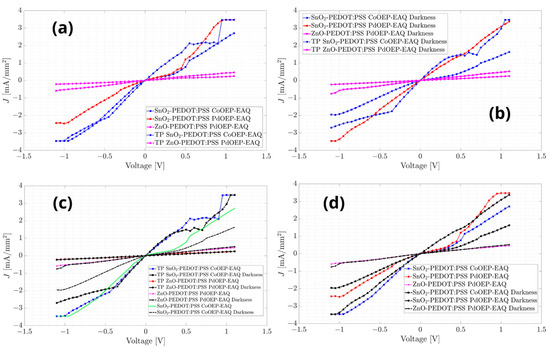
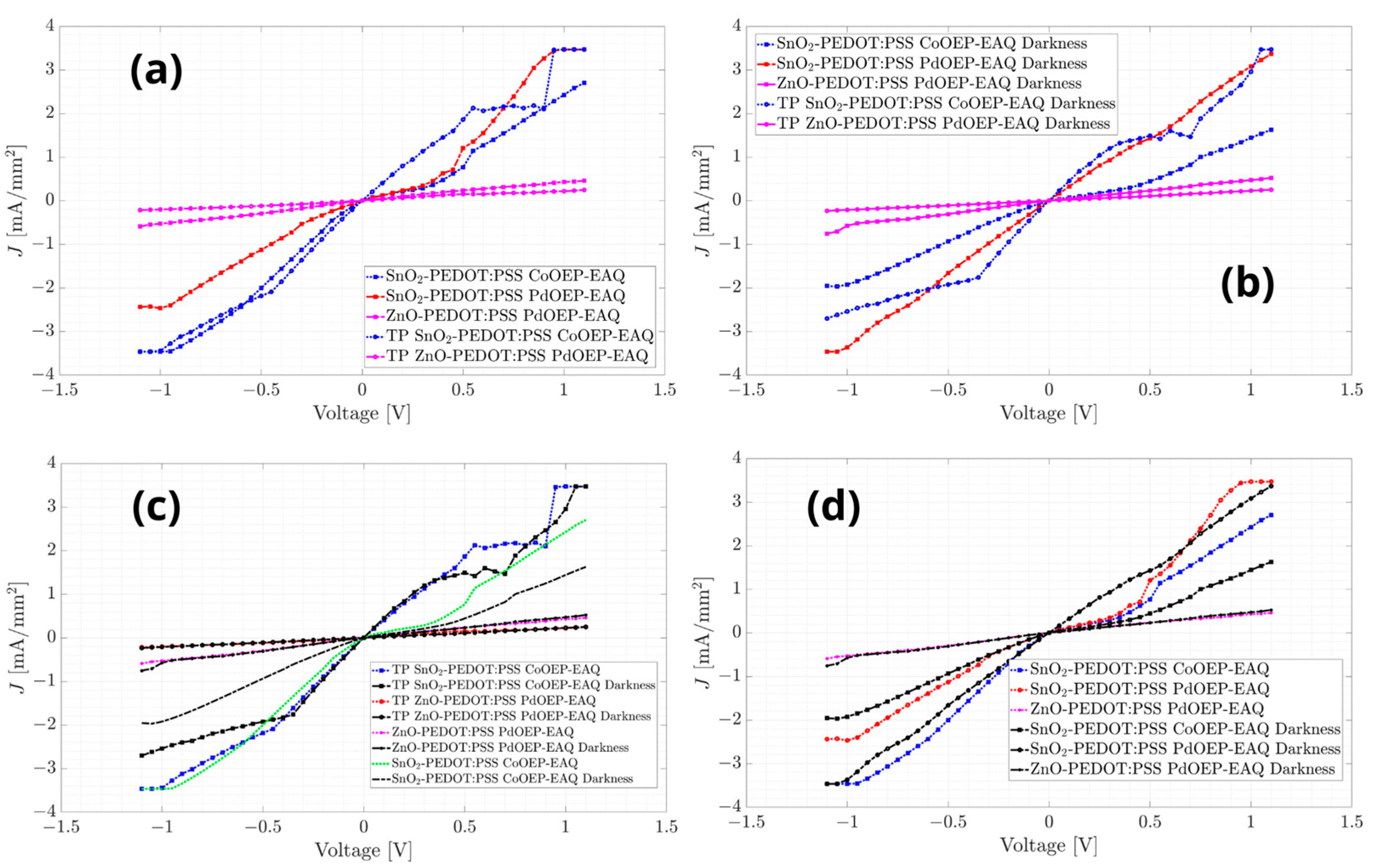
The J–V curves of optimized devices with SnO2-PEDOT:PSS and ZnO-PEDOT:PSS, deposited on glass and TP, under white light and darkness, are shown in Figure 13. In contrast, the devices with SnO2 exhibited similar behavior, reaching a saturation current density of 3.4 mA/mm2.
Figure 13.
The J–V curves of optimized devices with SnO2-PEDOT:PSS and ZnO-PEDOT:PSS, deposited on glass and TP: (a) under white light, (b) under dark conditions, (c) glass and TP comparison, and (d) glass comparison.
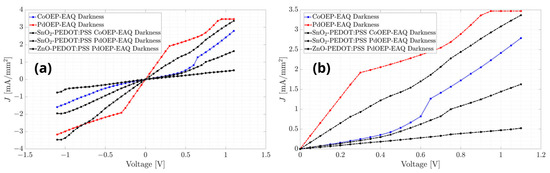
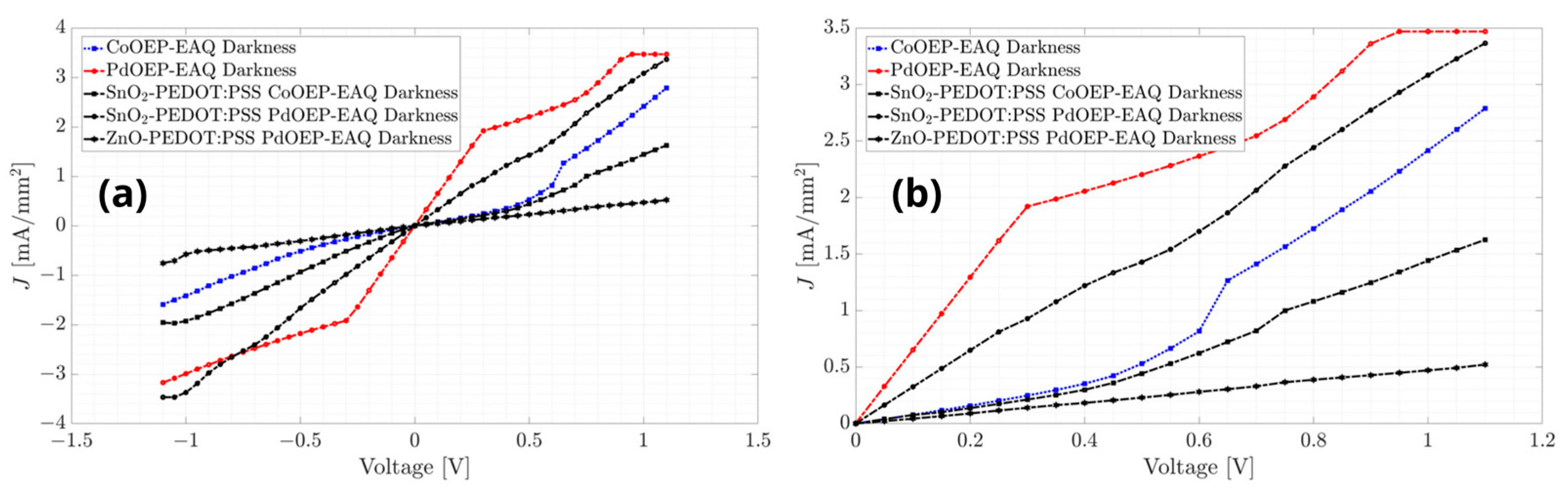
Furthermore, Figure 13c shows that the CoOEP-EAQ-based device on TP, with SnO2 NPs, exhibits the highest conductivity among the devices under both white light and darkness. It is noteworthy that this device exhibits linear behavior over the test range of –0.3 V to 0.3 V while maintaining its increased conductivity in darkness. On the other hand, it should be noted that the PdOEP-EAQ-based device on glass, with SnO2 NPs, in Figure 13d, exhibits the best behavior compared with the other devices, since, over the test range between –1.1 V and 1.1 V, under dark conditions, it exhibits linear behavior and reaches the saturation current density of 3.4 mA/mm2. It is worth noting that the devices deposited on glass exhibit linear behavior and higher current densities in the dark than those of the other devices studied. To analyze the effect of doping, Figure 14 compares the J–V curves of devices with and without SnO2-PEDOT:PSS and ZnO-PEDOT:PSS, both measured in the dark.
Figure 14.
Comparison of the J–V curves of devices with and without SnO2-PEDOT:PSS and ZnO-PEDOT:PSS, deposited on glass under dark conditions. (a) Voltage between –1.1 V and 1.1 V; (b) Voltage between 0 V and 1.1 V.
As shown in Figure 12b, SnO2-PEDOT:PSS and ZnO-PEDOT:PSS improve the electrical conduction of the devices under dark conditions, promoting ohmic behavior characterized by a linear relationship. Table 4 summarizes the slopes obtained from the linear fitting of the ohmic behavior exhibited by devices with SnO2-PEDOT:PSS and ZnO-PEDOT:PSS under dark conditions through the model [60].
where denotes the current density, is the electronic charge, is the free carrier density, is the electron mobility, is the applied voltage, and is the thickness of the sample, and note that is the slope of Equation (5). Table 4 also shows the Root Mean Square Error (RMSE) of the approximation and the respective conductivity values , which were computed using Equation (6).
with .
Table 4.
Ohmic-behavior approximation for doped devices in the darkness.
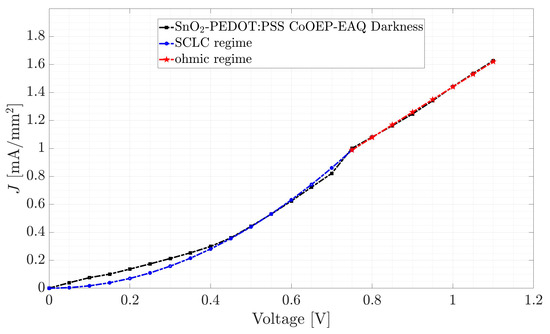
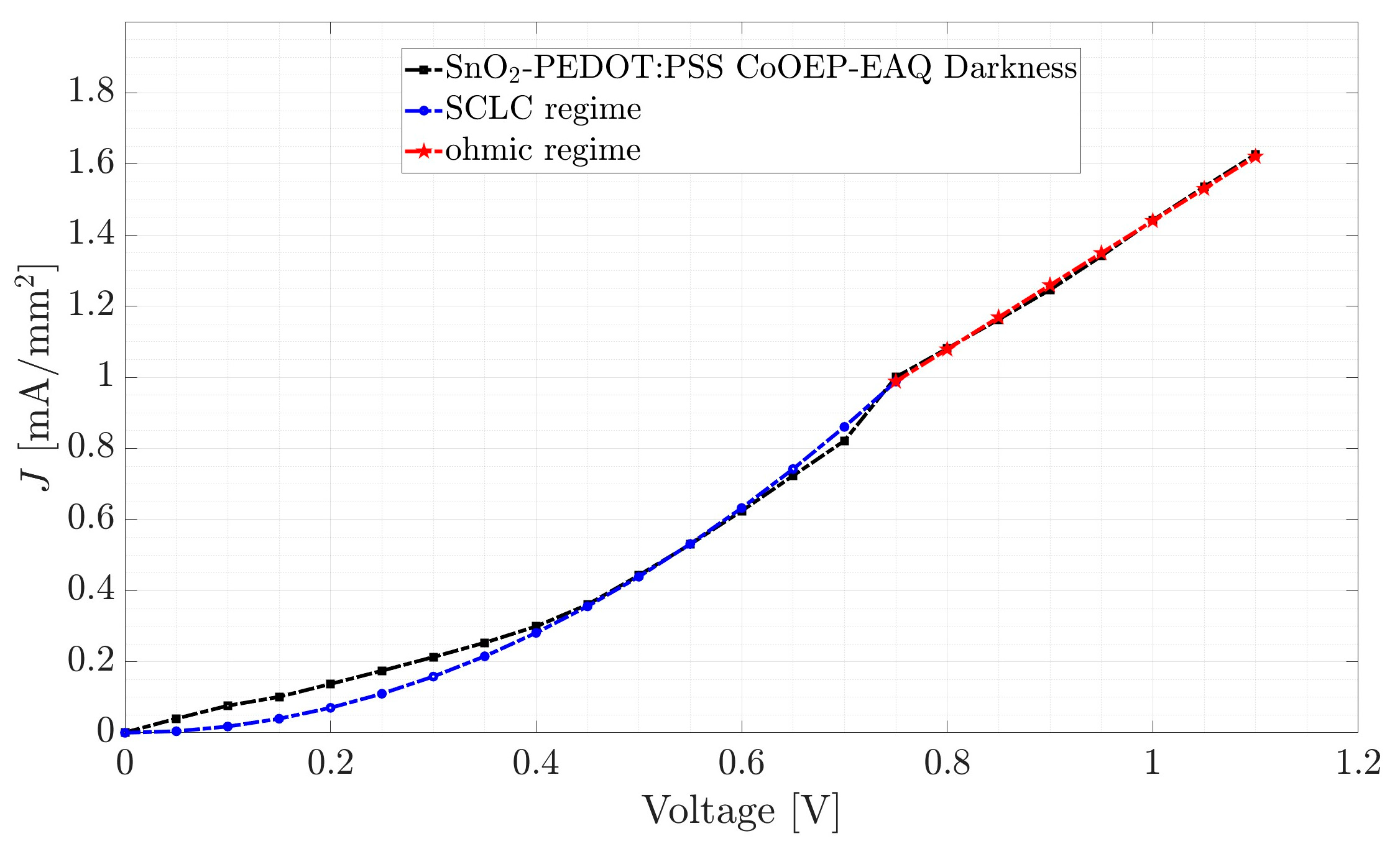
The RMSE results in Table 4 indicate that the ZnO-PEDOT:PSS/PdOEP-EAQ device yields the best linear fit, with the lowest RMSE. However, this device also shows the lowest conductivity among the evaluated devices. In contrast, the SnO2-PEDOT:PSS/PdOEP-EAQ device exhibits the highest conduction rate while maintaining a low RMSE value. On the other hand, the SnO2-PEDOT:PSS/CoOEP-EAQ device has the highest RMSE among the devices analyzed. This result suggests that its electrical response cannot be fully described by a linear model, indicating the coexistence of ohmic conduction and Space-Charge-Limited Current (SCLC) mechanisms. To illustrate this behavior, Figure 15 shows the J–V curve of the SnO2-PEDOT:PSS/CoOEP-EAQ device over the voltage range 0–1.1 V, along with the corresponding fittings for the different conduction regimes. Table 5 summarizes the parameters obtained from the SCLC and ohmic fittings of the devices, as well as the RMSE of the approximations. The SCLC model is given by Equation (7) [60].
where is the vacuum permittivity and is the dielectric constant.
Figure 15.
J–V curve of the SnO2-PEDOT:PSS/CoOEP-EAQ device and the fittings for the different conduction regimes between 0 V and 1.1 V.
Table 5.
SCLC and ohmic behavior approximation of SnO2-PEDOT:PSS/CoOEP-EAQ devices.
The RMSE values presented in Table 5 indicate that the fitting associated with the SCLC conduction regime exhibits a lower fitting error than the ohmic model presented. Then, the free carrier density and electron mobility of SnO2-PEDOT:PSS/CoOEP-EAQ can be approximated using Equations (5) and (7), respectively. From the approximations in Table 5, note that is the slope of Equation (5), whereas is the parameter of the quadratic Equation (7). Then, electron mobility and free carrier density can be determined by
Using Equations (8) and (9) with the parameters in Table 5, , and , the electron mobility in and the free carrier density in for the SnO2-PEDOT:PSS/CoOEP-EAQ device are and .
4. Conclusions
Cobalt and palladium porphyrins were doped with ethylanthraquinone, and dispersed heterojunctions (BHJs) were fabricated from these organic semiconductors using the PEDOT:PSS polymer as a matrix. The BHJ films were characterized by their topography and optical properties and subsequently used to fabricate optoelectronic devices. The maximum transmittance for the BHJ with cobalt porphyrin is around 78%, while that for the BHJ with palladium porphyrin is around 40%. Both films exhibited a similar optical band gap of approximately 3.55 eV, characteristic of broadband semiconductors with high transparency in the visible spectrum. The differences in the fluorescence spectra between cobalt and palladium materials arise because the central metal atom is directly coordinated to the tetrapyrrole core, thereby modifying its electronic orbitals. On the other hand, two types of sensors were fabricated: (i) those using CoOEP-EAQ/PEDOT:PSS and PdOEP-EAQ/PEDOT:PSS as active layers, and (ii) optimized devices using SnO2 and ZnO nanoparticles and aluminum hydroxyquinoline embedded in PEDOT:PSS. Another important aspect was the use of a recycled TP substrate in the devices as a sustainable, flexible, and low-cost alternative. Regarding the electrical characterization, the PdOEP-EAQ and CoOEP-EAQ devices embedded in the PEDOT:PSS layer, deposited on glass and TP, exhibited increasing conductivity in darkness. In contrast, devices modified with SnO2-PEDOT:PSS and ZnO-PEDOT:PSS altered their electrical properties, leading, in some cases, to reduced current conduction. Nevertheless, the glass-based devices doped with SnO2-PEDOT and ZnO-PEDOT exhibited improved linearity in current conduction under darkness conditions, indicating predominantly ohmic behavior. Furthermore, the glass-based device doped with SnO2-PEDOT/CoOEP-EAQ exhibited a transition between space-charge-limited current and ohmic conduction regimes. Based on the analysis of this behavior, the electron mobility and free carrier density were determined to be and , respectively.
Author Contributions
Conceptualization, M.E.S.V. and L.A.C.C.; methodology, M.E.S.V., J.N.B., R.S., L.A.C.C. and J.H.C.; software, M.E.S.V. and L.A.C.C.; validation, M.E.S.V., L.A.C.C., R.S., J.N.B. and J.H.C.; formal analysis, M.E.S.V., J.N.B., R.S., L.A.C.C. and J.H.C.; investigation, L.A.C.C. and J.H.C.; resources, M.E.S.V.; data curation, M.E.S.V., J.N.B., R.S., L.A.C.C. and J.H.C.; writing—original draft preparation, M.E.S.V., L.A.C.C. and J.H.C.; writing—review and editing, M.E.S.V., J.N.B., R.S. and L.A.C.C.; visualization, R.S., J.N.B., L.A.C.C. and M.E.S.V.; supervision, M.E.S.V.; project administration, M.E.S.V.; funding acquisition, R.S. and M.E.S.V. All authors have read and agreed to the published version of the manuscript.
Funding
M.E.S.V. acknowledges the financial support from Anahuac México University, project number PI0000068.
Institutional Review Board Statement
Not applicable.
Data Availability Statement
Data are contained within the article.
Acknowledgments
The authors acknowledge the technical support provided by Emilio I. Sandoval Plata and María Cecilia Salcedo Luna for the fluorescence and XRD measurements, respectively.
Conflicts of Interest
The authors declare no conflicts of interest.
References
- Au Liu, Y.-Z.; Lu, W.-M.; Tran, P.P.; Pham, T.A.K. Sustainable Energy and Semiconductors: A Bibliometric Investigation. Sustainability 2024, 16, 6548. [Google Scholar] [CrossRef] [Scilit]
- Li, L.; Wang, H.; Li, Z.; Hu, S. Analysis of the Structure and Robustness of the Global Semiconductor Trade Network. PLoS ONE 2025, 20, e0313162. [Google Scholar] [CrossRef] [Scilit] [PubMed]
- Yin, Y.; Yang, Y. Sustainable Transition of the Global Semiconductor Industry: Challenges, Strategies, and Future Directions. Sustainability 2025, 17, 3160. [Google Scholar] [CrossRef] [Scilit]
- Li, F.; Zhou, J.; Zhang, J.; Zhao, J. Research and Progress on Organic Semiconductor Power Devices. Materials 2024, 17, 3362. [Google Scholar] [CrossRef] [Scilit] [PubMed]
- He, Z.; Bi, S.; Asare-Yeboah, K. Hybrid System of Polystyrene and Semiconductor for Organic Electronic Applications. Processes 2024, 12, 1944. [Google Scholar] [CrossRef] [Scilit]
- Choi, W.; Kim, Y.E.; Yoo, H. Patterning of Organic Semiconductors Leads to Functional Integration: From Unit Device to Integrated Electronics. Polymers 2024, 16, 2613. [Google Scholar] [CrossRef] [Scilit] [PubMed]
- Savintseva, L.; Avdoshin, A.; Ignatov, S.; Novikov, A. Theoretical Study of Charge Mobility in Crystal Porphine and a Computer Design of a Porphine-Based Semiconductive Discotic Liquid Mesophase. Int. J. Mol. Sci. 2023, 24, 736. [Google Scholar] [CrossRef] [Scilit] [PubMed]
- Nikoloudakis, E.; Konidakis, I.; Stratakis, E. A Feasible Single-Solvent Nucleation and Growth Protocol for the Well-Defined Organization of Simple Porphyrins on Different Glass Composites. J. Compos. Sci. 2025, 9, 116. [Google Scholar] [CrossRef] [Scilit]
- Xie, M.; Li, J.; Dai, L.; Peng, H.; Xie, Y. Advances and Prospects of Porphyrin Derivatives in the Energy Field. RSC Adv. 2023, 13, 24699–24730. [Google Scholar] [CrossRef] [Scilit] [PubMed]
- Gupta, J.; Kandkuri, D.S.S.; Rattan, S. Rapid Chemiresistive Detection of p-Nitrophenol through Porphyrin-Functionalized 2D Materials: A Step toward Environmental Monitoring. J. Mater. Sci. 2024, 59, 3689–3710. [Google Scholar] [CrossRef] [Scilit]
- Sánchez Vergara, M.E.; Rocha Flores, J.M.; Cantera-Cantera, L.A.; Ballinas-Indilí, R.; Flores Huerta, A.; Álvarez-Toledano, C. Development of Composite Semiconductor Films Based on Organotin Complexes Doped with Cobalt Porphine for Applications in Organic Diodes. Materials 2025, 18, 45. [Google Scholar] [CrossRef] [Scilit] [PubMed]
- Sánchez-Vergara, M.E.; Hamui, L.; González-Verdugo, D.; Cosme, I. Efficient Film Fabrication and Characterization of Poly(3,4-ethylenedioxythiophene):Poly(styrenesulfonate) (PEDOT:PSS)-Metalloporphine Nanocomposite and Its Application as Semiconductor Material. Polymers 2021, 13, 4008. [Google Scholar] [CrossRef] [Scilit] [PubMed]
- Ha, D.G.; Wan, R.; Kim, C.A.; Lin, T.; Yang, L.; Van Voorhis, T.; Baldo, M.A.; Dincă, M. Exchange-Controlled Triplet Fusion in Metal–Organic Frameworks. Nat. Mater. 2022, 21, 1275–1281. [Google Scholar] [CrossRef] [Scilit] [PubMed]
- Golec, B.; Dutkiewicz, N.; Ostapko, J.; Waluk, J.; Gorski, A. Photoinduced Removal of Molecular Oxygen from Solutions. Phys. Chem. Chem. Phys. 2024, 26, 29496–29501. [Google Scholar] [CrossRef] [Scilit] [PubMed]
- Klimezak, M.; Chaud, J.; Brion, A.; Bolze, F.; Frisch, B.; Heurtault, B.; Kichler, A.; Specht, A. Triplet–Triplet Annihilation Upconversion-Based Photolysis: Applications in Photopharmacology. Adv. Healthc. Mater. 2024, 13, e2400354. [Google Scholar] [CrossRef] [Scilit] [PubMed]
- Sánchez Vergara, M.E.; Hernández Méndez, J.A.; González Verdugo, D.; Giammattei Funes, I.M.; Lozada Flores, O. Influence of the Polymeric Matrix on the Optical and Electrical Properties of Copper Porphine-Based Semiconductor Hybrid Films. Polymers 2023, 15, 3125. [Google Scholar] [CrossRef] [Scilit] [PubMed]
- Tertyshnaya, Y.V.; Lobanov, A.V.; Morokov, E.S.; Buzanov, G.A.; Abushakhmanova, Z.R. Polylactide—Meso-Substituted Arylporphyrin Composites: Structure, Properties and Antibacterial Activity. Polymers 2023, 15, 1027. [Google Scholar] [CrossRef] [Scilit] [PubMed]
- Vijaykumar, C.J.; Bulla, S.S.; Chavan, C.K.; Bajantri, R.F. Investigations on Impact of YSZ Nanoparticles on Morphology and Electrical Conductivity of PEDOT:PSS. IOP Conf. Ser. Mater. Sci. Eng. 2024, 1300, 012023. [Google Scholar] [CrossRef] [Scilit]
- Sujinnapram, S.; Wongrerkdee, S.; Lohawet, K.; Krobthong, S.; Moungsrijun, S.; Kaewprajak, A.; Kumnorkaew, P.; Wongrerkdee, S. Investigation of Structural, Optical, and Electrical Properties of PEDOT:PSS/Au/PEDOT:PSS Multilayer Films. J. Phys. Conf. Ser. 2023, 2653, 012048. [Google Scholar] [CrossRef] [Scilit]
- Ismail, A.A.A.; Bednarski, H.; Marcinkowski, A. Studies of Intra-Chain and Inter-Chain Charge Carrier Conduction in Acid-Doped Poly(3,4-ethylenedioxythiophene) Polystyrene Sulfonate Thin Films. Materials 2025, 18, 4569. [Google Scholar] [CrossRef] [Scilit] [PubMed]
- Ghali, M.; Ugwuoke, C.O.; El-Moneim, A.A. Solvent-Free Spray-Coated n-Type PEDOT:PSS Thin Film for High Performance Homojunction Diode. Sci. Rep. 2025, 15, 20275. [Google Scholar] [CrossRef] [Scilit] [PubMed]
- Killilea, J.; Lee, A.; Cuttaz, E.A.; Miceli, G.C.; Suquia, L.L.; Goding, J.A.; Chapman, C.A.R.; Green, R.A. “Spin-Rinse and Repeat”: Facile Processing to Improve Cytocompatibility of Poly(3,4-Ethylenedioxythiophene):Polystyrene Sulfonate Composites for Bioelectronics. Adv. NanoBiomed Res. 2025, 5, 2400149. [Google Scholar] [CrossRef] [Scilit]
- Sánchez Vergara, M.E.; Jimenez Correa, O.; Ballinas-Indilí, R.; Cosme, I.; Álvarez Bada, J.R.; Álvarez-Toledano, C. Innovative Application of Salophen Derivatives in Organic Electronics as a Composite Film with a Poly(3,4-Ethylenedioxythiophene)-poly(styrenesulfonate) Matrix. Polymers 2024, 16, 2622. [Google Scholar] [CrossRef] [Scilit] [PubMed]
- Lenz, A.; Kariis, H.; Pohl, A.; Persson, P.; Ojamäe, L. The Electronic Structure and Reflectivity of PEDOT:PSS from Density Functional Theory. Chem. Phys. 2011, 384, 44–51. [Google Scholar] [CrossRef] [Scilit]
- Senge, M.O.; Davis, M. Porphyrin (Porphine)—A Neglected Parent Compound with Potential. J. Porphyr. Phthalocyanines 2010, 14, 557–567. [Google Scholar] [CrossRef] [Scilit]
- Liu, L.-Z.; Meng, X.-F.; Liu, D.Z.; Zhou, X.Q. Ligand-Enhanced Electron Transfer from Zinc Tetraphenylporphyrin to Pyridine-Based Anthraquinone. Asian J. Chem. 2013, 25, 9857–9859. [Google Scholar] [CrossRef] [Scilit]
- Becke, A.D. Density-functional exchange-energy approximation with correct asymptotic behavior. Phys. Rev. A 1988, 38, 6. [Google Scholar] [CrossRef] [Scilit] [PubMed]
- Perdew, J.P.; Wang, Y. Accurate and simple analytic representation of the electron-gas correlation energy. Phys. Rev. B 1992, 45, 23. [Google Scholar] [CrossRef] [Scilit] [PubMed]
- Frisch, M.J.; Trucks, G.W.; Schlegel, H.B.; Scuseria, G.E.; Robb, M.A.; Cheeseman, J.R.; Scalmani, G.; Barone, V.; Mennucci, B.; Petersson, G.A.; et al. Gaussian 16, Revision A.1; Gaussian Inc.: Wallingford, CT, USA, 2009. [Google Scholar]
- Hehre, W.J.; Ditchfield, R.; Pople, J.A. Self-consistent molecular-orbital methods. XII. Further extensions of Gaussian-type basis sets for use in molecular-orbital studies of organic-molecules. J. Chem. Phys. 1972, 56, 2257–2261. [Google Scholar]
- Hariharan, P.C.; Pople, J.A. The influence of polarization functions on molecular orbital hydro-genation energies. Theor. Chem. Acc. 1973, 28, 213–222. [Google Scholar] [CrossRef] [Scilit]
- Hay, P.J.; Wadt, W.R. Ab initio effective core potentials for molecular calculations. Potentials for K to Au including the outermost core orbitals. J. Chem. Phys. 1985, 82, 299–310. [Google Scholar] [CrossRef] [Scilit]
- Ehlers, A.W.; Böhme, M.; Dapprich, S.; Gobbi, A.; Höllwarth, A.; Jonas, V.; Köhler, K.F.; Stegmann, R.; Veldkamp, A.; Frenking, G. A set of f-polarization functions for pseudo-potential basis sets of the transition metals Sc–Cu, Y–Ag and La–Au. Chem. Phys. Lett. 1993, 208, 111–114. [Google Scholar]
- Grimme, S.; Antony, J.; Ehrlich, S.; Krieg, H.J. A consistent and accurate ab initio parametrization of density functional dispersion correction (DFT-D) for the 94 elements H-Pu. J. Chem. Phys. 2010, 132, 154104–154119. [Google Scholar] [CrossRef] [Scilit] [PubMed]
- Alharbi, S.R.; Darwish, A.A.A.; Garni, S.E.A.; ElSaeedy, H.I.; El-Rahman, K.F.A. Influence of Thickness and Annealing on Linear and Nonlinear Optical Properties of Manganese (III) Chloride Tetraphenyl Porphine (MnTPPCl) Organic Thin Films. Infrared Phys. Technol. 2016, 78, 77–83. [Google Scholar] [CrossRef] [Scilit]
- Al-Muntaser, A.A.; El-Nahass, M.M.; Oraby, A.H.; Meikhail, M.S.; Zeyada, H.M. Structural and Optical Characterization of Thermally Evaporated Nanocrystalline 5,10,15,20-Tetraphenyl-21H,23H-Porphine Manganese (III) Chloride Thin Films. Optik 2018, 167, 204–217. [Google Scholar] [CrossRef] [Scilit]
- Sánchez-Vergara, M.E.; Rios, C.; Jiménez-Sandoval, O.; Salcedo, R. A Comparative Study of the Semiconductor Behavior of Organic Thin Films: TCNQ-Doped Cobalt Phthalocyanine and Cobalt Octaethylporphyrin. Molecules 2020, 25, 5800. [Google Scholar] [CrossRef] [Scilit] [PubMed]
- Thomas, D.W.; Martell, A.E. Metal Chelates of Tetraphenylporphine and of Some p-Substituted Derivatives. J. Am. Chem. Soc. 1959, 81, 5111–5119. [Google Scholar] [CrossRef] [Scilit]
- Kumolo, S.T.; Yulizar, Y.; Haerudin, H.; Kurniawaty, I.; Apriandanu, D.O.B. Identification of Metal Porphyrins in Duri Crude Oil. IOP Conf. Ser. Mater. Sci. Eng. 2019, 496, 012038. [Google Scholar] [CrossRef] [Scilit]
- Hsiao, S.-H.; Kung, Y.-R. Synthesis and Properties of New Aromatic Polyimides Containing Redox-Active Anthraquinone Moieties. Polym. Int. 2013, 62, 573–580. [Google Scholar] [CrossRef] [Scilit]
- Riera-Galindo, S.; Tamayo, A.; Mas-Torrent, M. Role of polymorphism and thin-film morphology in organic semiconductors processed by solution shearing. ACS Omega 2018, 3, 2329. [Google Scholar] [CrossRef] [Scilit] [PubMed]
- Chen, M.; Zhou, S.; Guo, L.; Wang, L.; Yao, F.; Hu, Y.; Li, H.; Hao, J. Morphological transitions in organic ultrathin film growth imaged by in situ step-by-step atomic force microscopy. Langmuir 2019, 35, 6939–6949. [Google Scholar] [CrossRef] [Scilit] [PubMed]
- Vergara, M.E.S.; Esquivel, E.A.S.; Ballinas-Indilí, R.; Lozada-Flores, O.; Miranda-Ruvalcaba, R.; Álvarez-Toledano, C. Organic semiconductor devices fabricated with recycled Tetra Pak-based electrodes and para-quinone methides. Coatings 2024, 14, 998. [Google Scholar] [CrossRef] [Scilit]
- Coropceanu, V.; Cornil, J.; da Silva Filho, D.A.; Olivier, Y.; Silbey, R.; Brédas, J.-L. Charge transport in organic semiconductors. Chem. Rev. 2007, 107, 926–952. [Google Scholar] [CrossRef] [Scilit] [PubMed]
- de Menezes, L.C.W.; Renzi, W.; Marchiori, C.F.D.N.; de Oliveira, C.K.B.Q.M.; von Kieseritzky, F.; Duarte, J.L.; Roman, L.S. Nonradiative energy transfer between porphyrin and copolymer in films processed by organic solvent and water-dispersible nanoparticles with photovoltaic applications. J. Phys. Chem. C 2018, 122, 4758–4767. [Google Scholar] [CrossRef] [Scilit]
- Mengistie, D.A.; Wang, P.C.; Chu, S.Y. Bendable ITO-free organic solar cells with highly conductive and flexible PEDOT:PSS electrodes on plastic substrates. ACS Appl. Mater. Interfaces 2015, 7, 18038–18045. [Google Scholar] [CrossRef] [Scilit] [PubMed]
- Jang, J.; Choi, J.-W. Silver alloy-based metal matrix composites: A potential material for reliable transparent thin film heaters. J. Mater. Chem. C 2021, 9, 4670–4681. [Google Scholar] [CrossRef] [Scilit]
- Calabia Gascón, N.; Revilla, R.I.; Wouters, B.; Terryn, H.; Hubin, A. On the Interaction between PEDOT:PSS Dispersions and Aluminium Electrodes for Solid State Electrolytic Capacitors. Inorganics 2024, 12, 104. [Google Scholar] [CrossRef] [Scilit]
- El-Nahass, M.M.; Ammar, A.H.; Farag, A.A.M.; Atta, A.A.; El-Zaidia, E.F.M. Effect of Heat Treatment on Morphological, Structural and Optical Properties of CoMTPP Thin Films. Solid State Sci. 2011, 13, 596–600. [Google Scholar] [CrossRef] [Scilit]
- Ajayi, D.I.; Chahrour, K.M.; Chahul, H.F.; Danladi, E.; Igbawua, T.; Jubu, P.R.; Landi, S., Jr.; Muhammad, A.; Obaseki, O.S.; Yam, F.K. Considerations about the Determination of Optical Bandgap from Diffuse Reflectance Spectroscopy Using the Tauc Plot. J. Opt. 2024, 53, 5054–5064. [Google Scholar] [CrossRef] [Scilit]
- Tauc, J.; Menth, A. States in the Gap. J. Non-Cryst. Solids 1972, 8–10, 569–585. [Google Scholar] [CrossRef] [Scilit]
- Zhokhavets, U.; Goldhahn, R.; Gobsch, G.; Schliefke, W. Dielectric Function and One-Dimensional Description of the Absorption of Poly(3-octylthiophene). Synth. Met. 2003, 138, 491–495. [Google Scholar] [CrossRef] [Scilit]
- Tsiper, E.V.; Soos, Z.G.; Gao, W.; Kahn, A. Electronic Polarization at Surfaces and Thin Films of Organic Molecular Crystals: PTCDA. Chem. Phys. Lett. 2002, 360, 47–52. [Google Scholar] [CrossRef] [Scilit]
- Kano, K.; Sato, T.; Yamada, S.; Ogawa, T. Fluorescence Quenching of Water-Soluble Porphyrins. A Novel Fluorescence Quenching of Anionic Porphyrin by Anionic Anthraquinone. J. Phys. Chem. 1983, 87, 566–569. [Google Scholar] [CrossRef] [Scilit]
- Li, L.; Shen, S.; Yu, Q.; Zhou, Q.; Xu, H. Photoinduced Electron Transfer and Charge Separation in Anthraquinone-Substituted Porphyrin–Phthalocyanine Heterodimer. J. Chem. Soc. Chem. Commun. 1991, 110, 619–620. [Google Scholar] [CrossRef] [Scilit]
- Shi, H.; Liu, C.; Jiang, Q.; Xu, J. Effective Approaches to Improve the Electrical Conductivity of PEDOT:PSS: A Review. Adv. Electron. Mater. 2015, 1, 1500017. [Google Scholar] [CrossRef] [Scilit]
- Gueyea, P.M.N.; Carella, A.; Faure-Vincent, J.; Demadrille, R.; Simonato, J.-P. Progress in understanding structure and transport properties of PEDOT-based materials: A critical review. Prog. Mater. Sci. 2020, 108, 100616. [Google Scholar] [CrossRef] [Scilit]
- Nguyen, X.H.; Luong, H.N.; Pham, H.A.; Nguyen, N.M.; Dang, V.Q. Visible photodetector based on transition metal-doped ZnO NRs/PEDOT:PSS hybrid materials. RSC Adv. 2021, 11, 36340. [Google Scholar] [CrossRef] [Scilit] [PubMed]
- Koushik, P.P.; Kalita, J.M. Synthesis and performance optimization of p-PEDOT:PSS/n-SnO2 visible-blind UVA photodetector. Mater. Sci. Semicond. Process. 2026, 215, 111006. [Google Scholar] [CrossRef] [Scilit]
- Cantera Cantera, L.A.; Sánchez Vergara, M.E.; Hamui, L.; Mejía Prado, I.; Flores Huerta, A.; Martínez Plata, T.L. Analysis of a Flexible Photoconductor, Manufactured with Organic Semiconductor Films. Micromachines 2024, 15, 446. [Google Scholar] [CrossRef] [Scilit] [PubMed]

Disclaimer/Publisher’s Note: The statements, opinions and data contained in all publications are solely those of the individual author(s) and contributor(s) and not of MDPI and/or the editor(s). MDPI and/or the editor(s) disclaim responsibility for any injury to people or property resulting from any ideas, methods, instructions or products referred to in the content. |
© 2026 by the authors. Licensee MDPI, Basel, Switzerland. This article is an open access article distributed under the terms and conditions of the Creative Commons Attribution (CC BY) license.