You are currently viewing a new version of our website. To view the old version click .

Fire, Volume 7, Issue 2

February 2024 - 27 articles

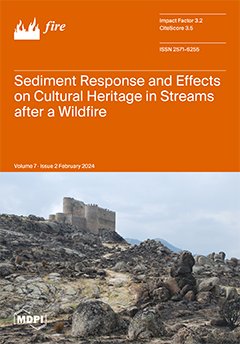
Cover Story: In the Navalacruz wildfire, the loss of vegetation associated with the fire was responsible for a high rate of sedimentation in the rivers. The burned area affected up to 60 cultural heritage sites. We analyze the post-fire evolution based on a field survey of infiltration rates, hydrodynamic modeling, and channel morphological changes. The first post-fire rains caused the mobilization and transport of ashes, hydrophobicity in the soils and large transported sediments to rivers by subsequent low-magnitude storms. These trends are a consequence of a post-fire increase in flow rates for similar rainfall scenarios resulting in an increase in sediment transport capacities associated with this increase in flow rates. The combination of steep slopes with high severity and a deep regolith resulted in a series of cascading responses. View this paper
  • Issues are regarded as officially published after their release is announced to the table of contents alert mailing list .
  • You may sign up for email alerts to receive table of contents of newly released issues.
  • PDF is the official format for papers published in both, html and pdf forms. To view the papers in pdf format, click on the "PDF Full-text" link, and use the free Adobe Reader to open them.

Articles (27)

  • Article
  • Open Access
3,183 Views
21 Pages

The Spatially Adaptable Filter for Error Reduction (SAFER) Process: Remote Sensing-Based LANDFIRE Disturbance Mapping Updates

  • Sanath Sathyachandran Kumar,
  • Brian Tolk,
  • Ray Dittmeier,
  • Joshua J. Picotte,
  • Inga La Puma,
  • Birgit Peterson and
  • Timothy D. Hatten

8 February 2024

LANDFIRE (LF) has been producing periodic spatially explicit vegetation change maps (i.e., LF disturbance products) across the entire United States since 1999 at a 30 m spatial resolution. These disturbance products include data products produced by...

  • Review
  • Open Access
20 Citations
6,892 Views
22 Pages

Flame Retardant Additives Used for Polyurea-Based Elastomers—A Review

  • W. Dukarski,
  • I. Rykowska,
  • P. Krzyżanowski and
  • M. Gonsior

7 February 2024

The growing interest in modern polymer materials has targeted research on complex plastic coatings and the possibilities of modifying their features and properties during manufacturing. Today’s modern coatings, including polyurea and polyuretha...

  • Article
  • Open Access
3 Citations
2,566 Views
19 Pages

Research on Sequential Decision-Making of Major Accidents with Incomplete Information

  • Dengyou Xia,
  • Changlin Chen,
  • Ce Zheng,
  • Jing Xin and
  • Yi Zhu

6 February 2024

In order to solve the problem of emergency decision-making with incomplete information and deal with the accident information in different time series at the scenes of major accidents, this paper proposes a method of sequential decision-making by uti...

  • Article
  • Open Access
4 Citations
3,160 Views
11 Pages

Flame Stabilisation Mechanism for Under-Expanded Hydrogen Jets

  • Keiji Takeno,
  • Hikaru Kido,
  • Hiroki Takeda,
  • Shohei Yamamoto,
  • Volodymyr Shentsov,
  • Dmitriy Makarov and
  • Vladimir Molkov

6 February 2024

A hydrogen under-expanded jet released from a high-pressure vessel or equipment into the atmosphere through a 0.53 mm diameter orifice results in a sustained lifted flame for pressures above 4 MPa and flame blow-out at pressures below 3 MPa. Knowledg...

  • Article
  • Open Access
3 Citations
5,559 Views
14 Pages

6 February 2024

A workshop, as a crowded place, is quite easy to cause serious casualties and economic losses once there is a fire. In this paper, Pathfinder software was used to simulate fire emergency evacuation in a workshop of a large factory with building struc...

  • Review
  • Open Access
1 Citations
4,221 Views
26 Pages

Review and Statistical Analysis of U.S. Structural Firefighting Injuries: Their Causes and Effects

  • Juliana Garcia,
  • Michael C. F. Bazzocchi,
  • Kevin Fite,
  • Juan D. Ocampo and
  • Marcias Martinez

2 February 2024

Safety and prevention of injuries should always be considered in a firefighting environment due to the hazardous conditions experienced on the fireground. These hazardous environmental conditions lead to an increased risk of contracting job-related i...

  • Article
  • Open Access
5 Citations
2,674 Views
23 Pages

31 January 2024

A two-way coupled model between polydisperse particle phases with compressible gases and a density-based coupling implicit solution method, combining the third-order MUSCL with QUICK spatial discretization scheme and the second-order temporal discret...

  • Communication
  • Open Access
3 Citations
3,965 Views
9 Pages

Reproduction of a Serotinous Conifer, the Giant Sequoia, in a Large High-Severity Fire Area

  • Chad T. Hanson,
  • Tonja Y. Chi,
  • Maya Khosla,
  • Bryant C. Baker and
  • Craig Swolgaard

31 January 2024

Giant sequoia groves, located on the western slope of the central and southern Sierra Nevada mountains in California, USA, have been experiencing regeneration failure for more than a century due to the exclusion of wildfires. Giant sequoias are serot...

  • Article
  • Open Access
2 Citations
5,098 Views
12 Pages

Ignition Delay and Reaction Time Measurements of Hydrogen–Air Mixtures at High Temperatures

  • Yauhen Baranyshyn,
  • Vyacheslav Kuzmitski,
  • Oleg Penyazkov and
  • Kirill Sevrouk

30 January 2024

Induction and reaction times of hydrogen–air mixtures (ϕ = 0.5–2) have been measured behind reflected shock waves at temperatures of 1000–1600 K, pressures of 0.1, 0.3, 0.6 MPa in the domain of the extended second explosion lim...

  • Article
  • Open Access
3 Citations
4,746 Views
13 Pages

Activation Energy of Hydrogen–Methane Mixtures

  • Anastasia Moroshkina,
  • Alina Ponomareva,
  • Vladimir Mislavskii,
  • Evgeniy Sereshchenko,
  • Vladimir Gubernov,
  • Viatcheslav Bykov and
  • Sergey Minaev

29 January 2024

In this work, the overall activation energy of the combustion of lean hydrogen–methane–air mixtures (equivalence ratio φ = 0.7−1.0 and hydrogen fraction in methane α=0, 2, 4) is experimentally determined using thin-filamen...

of 3

Get Alerted

Add your email address to receive forthcoming issues of this journal.

XFacebookLinkedIn
Fire - ISSN 2571-6255