

You are currently viewing a new version of our website. To view the old version click .

Journal of Fungi, Volume 9, Issue 5

May 2023 - 95 articles

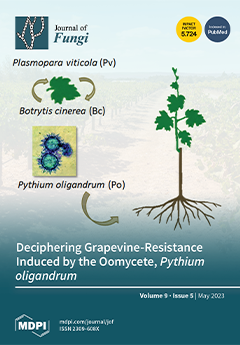
Cover Story: The oomycete, Pythium oligandrum, is used to control two major diseases that affect grapevine leaves and berries: Botrytis cinerea (the necrotrophic fungus of gray mold) and Plasmopara viticola (the biotrophic oomycete of downy mildew) on two grapevine cultivars with different susceptibilities to these two pathogens. Further to P. oligandrum-root inoculation, P. viticola and B. cinerea infections were significantly reduced on the leaves of the two cultivars, but with differences that could be attributed to the pathogens’ lifestyles.  The different levels of defense against B. cinerea and P. viticola could explain the difference in cultivar susceptibility to these pathogens. View this paper
  • Issues are regarded as officially published after their release is announced to the table of contents alert mailing list .
  • You may sign up for email alerts to receive table of contents of newly released issues.
  • PDF is the official format for papers published in both, html and pdf forms. To view the papers in pdf format, click on the "PDF Full-text" link, and use the free Adobe Reader to open them.

Articles (95)

  • Article
  • Open Access
2 Citations
2,433 Views
20 Pages

Soil Fungal Community Characteristics at Timberlines of Sejila Mountain in Southeast Tibet, China

  • Fei Cheng,
  • Mingman Li,
  • Yihua Ren,
  • Lei Hou,
  • Tan Gao,
  • Peng He,
  • Xiangsheng Deng and
  • Jie Lu

21 May 2023

Soil fungal community characteristics of alpine timberlines are unclear. In this study, soil fungal communities in five vegetation zones across timberlines on the south and north slopes of Sejila Mountain in Tibet, China were investigated. The result...

  • Article
  • Open Access
13 Citations
5,458 Views
16 Pages

Establishment of a CRISPR/Cas9-Mediated Efficient Knockout System of Trichoderma hamatum T21 and Pigment Synthesis PKS Gene Knockout

  • Ning Luo,
  • Zeyu Li,
  • Jian Ling,
  • Jianlong Zhao,
  • Yan Li,
  • Yuhong Yang,
  • Zhenchuan Mao,
  • Bingyan Xie,
  • Huixia Li and
  • Yang Jiao

19 May 2023

Trichoderma hamatum is a filamentous fungus that serves as a biological control agent for multiple phytopathogens and as an important resource promising for fungicides. However, the lack of adequate knockout technologies has hindered gene function an...

  • Article
  • Open Access
14 Citations
8,721 Views
11 Pages

Neuroimaging of Cryptococcal Meningitis in Patients without Human Immunodeficiency Virus: Data from a Multi-Center Cohort Study

  • Seher H. Anjum,
  • John E. Bennett,
  • Owen Dean,
  • Kieren A. Marr,
  • Dima A. Hammoud and
  • Peter R. Williamson

19 May 2023

Background: A clearer understanding is needed about the use of brain MRI in non-HIV patients with cryptococcal meningitis. Methods: Cerebral CT and MRI were studied in 62 patients in a multicenter study of cryptococcal meningitis in non-HIV patients....

  • Article
  • Open Access
1 Citations
2,378 Views
15 Pages

The Novel Effector Ue943 Is Essential for Host Plant Colonization by Ustilago esculenta

  • Shuqing Wang,
  • Wenqiang Xia,
  • Yani Li,
  • Yuyan Peng,
  • Yafen Zhang,
  • Jintian Tang,
  • Haifeng Cui,
  • Lisi Qu,
  • Tongfu Yao and
  • Zetao Yu
  • + 1 author

19 May 2023

The smut fungus Ustilago esculenta obligately parasitizes Zizania latifolia and induces smut galls at the stem tips of host plants. Previous research identified a putative secreted protein, Ue943, which is required for the biotrophic phase of U. escu...

  • Review
  • Open Access
13 Citations
5,165 Views
25 Pages

19 May 2023

The incidence rate of invasive mucormycosis (IM) in patients with hematological malignancies (HMs) is increasing year by year, ranging from 0.07% to 4.29%, and the mortality rate is mostly higher than 50%. With the ongoing pandemic of COVID-19, COVID...

  • Review
  • Open Access
22 Citations
6,043 Views
22 Pages

19 May 2023

Organisms have developed different features to capture or sense sunlight. Vertebrates have evolved specialized organs (eyes) which contain a variety of photosensor cells that help them to see the light to aid orientation. Opsins are major photorecept...

  • Article
  • Open Access
9 Citations
5,179 Views
20 Pages

Phenotypic and Genotypic Characterization and Antifungal Susceptibility of Sporothrix schenckii sensu stricto Isolated from a Feline Sporotrichosis Outbreak in Bangkok, Thailand

  • Kanokporn Yingchanakiat,
  • Orawan Limsivilai,
  • Supita Sunpongsri,
  • Waree Niyomtham,
  • Kittitat Lugsomya and
  • Chompoonek Yurayart

18 May 2023

Sporotrichosis, an invasive fungal infection caused by Sporothrix schenckii, has emerged in Southeast Asia, affecting cats and posing a potential zoonotic risk to humans. We evaluated 38 feline sporotrichosis cases in and around Bangkok, Thailand, fr...

  • Case Report
  • Open Access
4 Citations
3,043 Views
12 Pages

Case Series of Rare Fungal Keratitides: Experiences from a Quaternary Eye Hospital in Sydney, Australia

  • Rachel Xuan,
  • Sheng Chiong Hong,
  • Tanya Trinh,
  • Minas T. Coroneo and
  • Constantinos Petsoglou

18 May 2023

The present article reports on the management of six different and rare cases of fungal keratitides, two of which have never been documented in previous literature. This is a case series of six patients with rare fungal keratitides managed at a quate...

  • Article
  • Open Access
6 Citations
2,070 Views
15 Pages

Influence of Mycorrhiza on C:N:P Stoichiometry in Senesced Leaves

  • Shan-Wei Wu,
  • Zhao-Yong Shi,
  • Ming Huang,
  • Shuang Yang,
  • Wen-Ya Yang and
  • You-Jun Li

18 May 2023

Senesced leaves play a vital role in nutrient cycles in the terrestrial ecosystem. The carbon (C), nitrogen (N) and phosphorus (P) stoichiometries in senesced leaves have been reported, which are influenced by biotic and abiotic factors, such as clim...

  • Review
  • Open Access
26 Citations
9,416 Views
35 Pages

18 May 2023

Soybean (Glycine max) acreage is increasing dramatically, together with the use of soybean as a source of vegetable protein and oil. However, soybean production is affected by several diseases, especially diseases caused by fungal seed-borne pathogen...

of 10

Get Alerted

Add your email address to receive forthcoming issues of this journal.

XFacebookLinkedIn
J. Fungi - ISSN 2309-608X