

You are currently viewing a new version of our website. To view the old version click .

Inorganics, Volume 11, Issue 10

October 2023 - 44 articles

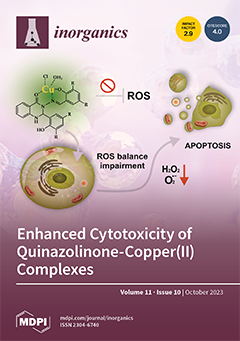
Cover Story: Two Cu(II) complexes derived from 2,3-substituted quinazolinone Schiff base ligands were prepared and fully characterized via spectroscopic and theoretical methods. Their anticancer activity, evaluated on cancer cell lines (breast—MCF-7, lung—A549) and untransformed cells (keratinocytes—HaCaT), revealed the high cytotoxicity of copper complexes (IC50 in the low micromolar range). Quinazoline ligands remained inactive in inhibiting cell proliferation. Both complexes exhibited enhanced DPPH free radical scavenging efficiency compared to free ligands. An evaluation of oxidative stress in vitro showed reduced production of O2•– and H2O2 after the treatment of cells with copper complexes. Such a negative impact on ROS formation in cells can lead to cellular redox imbalance and subsequent cell death, among other things, by inducing apoptosis and/or necrosis. View this paper
  • Issues are regarded as officially published after their release is announced to the table of contents alert mailing list .
  • You may sign up for email alerts to receive table of contents of newly released issues.
  • PDF is the official format for papers published in both, html and pdf forms. To view the papers in pdf format, click on the "PDF Full-text" link, and use the free Adobe Reader to open them.

Articles (44)

  • Article
  • Open Access
7 Citations
2,671 Views
15 Pages

23 October 2023

Three Eu3+ complexes containing a neutral tripodal ligand possessing a predictable coordination mode have been obtained and studied. The trispyrazolylmethane complexes have an aqua ligand in the coordination sphere, forming both the mononuclear speci...

  • Article
  • Open Access
3 Citations
3,489 Views
16 Pages

Synthesis, X-ray Structures and Hirshfeld Analysis of Two Novel Thiocyanate-Bridged Ag(I) Coordination Polymers

  • Mezna Saleh Altowyan,
  • Eman M. Fathalla,
  • Jörg H. Albering,
  • Morsy A. M. Abu-Youssef,
  • Taher S. Kassem,
  • Assem Barakat,
  • Matti Haukka,
  • Ahmed M. A. Badr and
  • Saied M. Soliman

23 October 2023

Two novel silver(I) coordination polymers, [Ag(4BP)(SCN)]n (1) and {(4BPH)+[Ag(SCN)2]−}n (2) (4BP = 4-benzoyl pyridine), have been synthesized. The two complexes were prepared using almost the same reagents, which were AgNO3, 4BP and NH4SCN. Th...

  • Article
  • Open Access
5 Citations
2,847 Views
14 Pages

22 October 2023

In recent years, there have been intense studies on hybrid organic–inorganic compounds (HOIPs) due to their tunable and adaptable features. This present study reports the vibrational, structural, and elastic properties of mixed halide single cr...

  • Article
  • Open Access
1 Citations
3,043 Views
13 Pages

Synthesis, Photophysical Properties, and Toxicity of o-Xylene-Bridged Porphyrin Dimers

  • Kseniya A. Zhdanova,
  • Andrey A. Zaytsev,
  • Margarita A. Gradova,
  • Oleg V. Gradov,
  • Anton V. Lobanov,
  • Alexander S. Novikov and
  • Natal’ya A. Bragina

19 October 2023

In this work, a number of new porphyrin dimers coupled with spacers based on α,α’-dibromo-o-xylene were synthesized and characterized by 1H, 13C NMR, 1H-1H COSY NMR, UV-vis-spectroscopy, and MALDI-TOF mass spectrometry. The initial...

  • Article
  • Open Access
1 Citations
2,012 Views
12 Pages

Heavy-Fermion Properties of Yb2Pd2SnH≈2

  • Silvie Maskova-Cerna,
  • Ernst Bauer,
  • Mauro Giovannini and
  • Ladislav Havela

18 October 2023

A hydride of Yb2Pd2Sn could be synthesized with approximately 2 H atoms per f.u. The hydrogenation leads to a volume expansion while preserving the tetragonal symmetry (P4/mbm). The lattice reaction is strongly anisotropic, and the 5% expansion in c...

  • Article
  • Open Access
2 Citations
2,647 Views
15 Pages

18 October 2023

A mixture of nonlabeled (14N2H4) and 15N labeled hydrazine (15N2H4) in an aqueous solution is oxidized to 15N2, 14N2, and 14N15N molecules, indicating the intermediate existence of the 14NH2-14NH-15NH-15NH2 with subsequent hydrogen transfers and spli...

  • Article
  • Open Access
6 Citations
4,091 Views
16 Pages

Metal Complexes of Schiff Bases Prepared from Quinoline-3-Carbohydrazide with 2-Nitrobenzaldehyde, 2-Chlorobenzaldehyde and 2,4-Dihydroxybenzaldehyde: Structure and Biological Activity

  • Mahmoud Sunjuk,
  • Lana Al-Najjar,
  • Majed Shtaiwi,
  • Bassam I. El-Eswed,
  • Kamal Sweidan,
  • Paul V Bernhardt,
  • Hiba Zalloum and
  • Luay Al-Essa

17 October 2023

Three Schiff base ligands, NQ, CQ and HQ, were prepared from the reaction of quinoline-3-carbohydrazide with 2-nitrobenzaldehyde, 2-chlorobenzaldehyde and 2,4-dihydroxybenzaldehyde, respectively, and were investigated for their coordination to Cu (II...

  • Article
  • Open Access
2,191 Views
26 Pages

Cytotoxic Impact of Fluorinated Ligands in Equatorial Position of Trans-Configured Diam(m)inetetracarboxylatoplatinum(IV) Complexes

  • Yvonne Lerchbammer-Kreith,
  • Michaela Hejl,
  • Dominik Wenisch,
  • Michael A. Jakupec,
  • Mathea S. Galanski and
  • Bernhard K. Keppler

17 October 2023

A series of thirty novel tetracarboxylatoplatinum(IV) complexes in trans-configuration featuring combinations of mixed ammine, methylamine, dimethylamine, and cyclopentylamine ligands as well as acetato/propanoato and trifluoropropanoato ligands was...

  • Article
  • Open Access
3 Citations
2,736 Views
11 Pages

Purification of Lithium Carbonate from Radioactive Contaminants Using a MnO2-Based Inorganic Sorbent

  • Olga Gileva,
  • Pabitra Aryal,
  • JunSeok Choe,
  • Yena Kim,
  • Yeongduk Kim,
  • Eunkyung Lee,
  • Moo Hyun Lee,
  • Vitaly Milyutin,
  • KeonAh Shin and
  • Hyojin Yeon

16 October 2023

The possibility of deep radiochemical purification of Li2CO3 has been examined in the context of the purification program of the AMoRE collaboration. In this experiment, commercial Li2CO3 was converted into LiNO3. Co-precipitation with inorganic salt...

  • Feature Paper
  • Review
  • Open Access
8 Citations
4,723 Views
17 Pages

16 October 2023

Silver nanowires (AgNWs) are a potential alternative to conventional transparent conductive materials for various applications, such as flexible and transparent electrodes in optoelectronic devices, including touch screens, solar cells, and flexible...

of 5

Get Alerted

Add your email address to receive forthcoming issues of this journal.

XFacebookLinkedIn
Inorganics - ISSN 2304-6740