You are currently viewing a new version of our website. To view the old version click .

Biomedicines, Volume 9, Issue 7

July 2021 - 147 articles

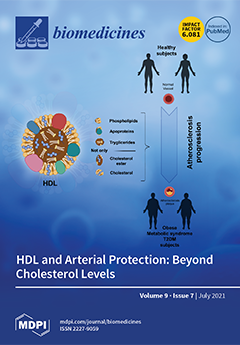
Cover Story: High-density lipoproteins (HDLs) can protect against atherosclerosis through multiple mechanisms, including reverse cholesterol transport, antioxidant, anti-inflammatory, antithrombotic and vasodilatory actions. The function of HDLs does not depend on the levels of a single component, such as cholesterol, but on the total chemical composition. Clinical conditions, such as obesity, metabolic syndrome and type 2 diabetes mellitus (T2DM), can cause an alteration in the chemical composition and consequently in atheroprotective properties of HDLs. View this paper
  • Issues are regarded as officially published after their release is announced to the table of contents alert mailing list .
  • You may sign up for email alerts to receive table of contents of newly released issues.
  • PDF is the official format for papers published in both, html and pdf forms. To view the papers in pdf format, click on the "PDF Full-text" link, and use the free Adobe Reader to open them.

Articles (147)

  • Article
  • Open Access
10 Citations
3,651 Views
16 Pages

Biphasic Effects of Blue Light Irradiation on Human Umbilical Vein Endothelial Cells

  • Kejia Kan,
  • Yifei Mu,
  • Marielle Bouschbacher,
  • Carsten Sticht,
  • Natalia Kuch,
  • Martin Sigl,
  • Nuh Rahbari,
  • Norbert Gretz,
  • Prama Pallavi and
  • Michael Keese

Blue light regulates biological function in various cells, such as proliferation, oxidative stress, and cell death. We employed blue light illumination on human umbilical vein endothelial cells utilizing a LED device at 453 nm wavelength and revealed...

  • Feature Paper
  • Article
  • Open Access
17 Citations
3,444 Views
18 Pages

The pulmonary endothelium is dysfunctional in chronic obstructive pulmonary disease (COPD), a known risk factor for lung cancer. The pulmonary endothelium is altered in emphysema, which is disproportionately affected by cancers. Gene and microRNA exp...

  • Article
  • Open Access
35 Citations
4,879 Views
18 Pages

IL-17A Damages the Blood–Retinal Barrier through Activating the Janus Kinase 1 Pathway

  • Eimear M. Byrne,
  • María Llorián-Salvador,
  • Miao Tang,
  • Andriana Margariti,
  • Mei Chen and
  • Heping Xu

Blood–retinal barrier (BRB) dysfunction underlies macular oedema in many sight-threatening conditions, including diabetic macular oedema, neovascular age-related macular degeneration and uveoretinitis. Inflammation plays an important role in BRB dysf...

  • Article
  • Open Access
11 Citations
3,301 Views
10 Pages

Glucose-Dependent Insulinotropic Polypeptide Suppresses Foam Cell Formation of Macrophages through Inhibition of the Cyclin-Dependent Kinase 5-CD36 Pathway

  • Michishige Terasaki,
  • Hironori Yashima,
  • Yusaku Mori,
  • Tomomi Saito,
  • Yoshie Shiraga,
  • Raichi Kawakami,
  • Makoto Ohara,
  • Tomoyasu Fukui,
  • Tsutomu Hirano and
  • Yuichiro Yamada
  • + 2 authors

Glucose-dependent insulinotropic polypeptide (GIP) has been reported to have an atheroprotective property in animal models. However, the effect of GIP on macrophage foam cell formation, a crucial step of atherosclerosis, remains largely unknown. We i...

  • Article
  • Open Access
16 Citations
9,082 Views
17 Pages

Stable Gastric Pentadecapeptide BPC 157 Therapy for Monocrotaline-Induced Pulmonary Hypertension in Rats Leads to Prevention and Reversal

  • Mario Udovicic,
  • Marko Sever,
  • Lovro Kavur,
  • Kristina Loncaric,
  • Ivan Barisic,
  • Diana Balenovic,
  • Gordana Zivanovic Posilovic,
  • Dean Strinic,
  • Sandra Uzun and
  • Lovorka Batelja Vuletic
  • + 7 authors

Background. Monocrotaline selectively injures the lung’s vascular endothelium and induces pulmonary arterial hypertension. The stable gastric pentadecapeptide BPC 157 acts as a prototype cytoprotective agent that maintains endothelium, and its applic...

  • Article
  • Open Access
10 Citations
3,385 Views
18 Pages

Glia Not Neurons: Uncovering Brain Dysmaturation in a Rat Model of Alzheimer’s Disease

  • Ekaterina A. Rudnitskaya,
  • Tatiana A. Kozlova,
  • Alena O. Burnyasheva,
  • Natalia A. Stefanova and
  • Nataliya G. Kolosova

Sporadic Alzheimer’s disease (AD) is a severe disorder of unknown etiology with no definite time frame of onset. Recent studies suggest that middle age is a critical period for the relevant pathological processes of AD. Nonetheless, sufficient data h...

  • Article
  • Open Access
33 Citations
4,584 Views
19 Pages

Elastomeric Cardiowrap Scaffolds Functionalized with Mesenchymal Stem Cells-Derived Exosomes Induce a Positive Modulation in the Inflammatory and Wound Healing Response of Mesenchymal Stem Cell and Macrophage

  • Juan Carlos Chachques,
  • Chiara Gardin,
  • Nermine Lila,
  • Letizia Ferroni,
  • Veronique Migonney,
  • Celine Falentin-Daudre,
  • Federica Zanotti,
  • Martina Trentini,
  • Giulia Brunello and
  • Tiberio Rocca
  • + 2 authors

A challenge in contractile restoration of myocardial scars is one of the principal aims in cardiovascular surgery. Recently, a new potent biological tool used within healing processes is represented by exosomes derived from mesenchymal stem cells (MS...

  • Article
  • Open Access
14 Citations
2,953 Views
10 Pages

Numerous studies have demonstrated the ability of isoflurane conditioning to provide multifaceted protection against aneurysmal subarachnoid hemorrhage (SAH)-associated delayed cerebral ischemia (DCI); however, preclinical studies have not yet examin...

  • Review
  • Open Access
8 Citations
9,019 Views
16 Pages

Dual Roles of the Activin Signaling Pathway in Pancreatic Cancer

  • Wanglong Qiu,
  • Chia-Yu Kuo,
  • Yu Tian and
  • Gloria H. Su

Activin, a member of the TGF-β superfamily, is involved in many physiological processes, such as embryonic development and follicle development, as well as in multiple human diseases including cancer. Genetic mutations in the activin signaling pathwa...

  • Article
  • Open Access
6 Citations
3,421 Views
19 Pages

Delayed Contralateral Nephrectomy Halted Post-Ischemic Renal Fibrosis Progression and Inhibited the Ischemia-Induced Fibromir Upregulation in Mice

  • Beáta Róka,
  • Pál Tod,
  • Tamás Kaucsár,
  • Éva Nóra Bukosza,
  • Imre Vörös,
  • Zoltán V. Varga,
  • Balázs Petrovich,
  • Bence Ágg,
  • Péter Ferdinandy and
  • Gábor Szénási
  • + 1 author

(1) Background: Ischemia reperfusion (IR) is the leading cause of acute kidney injury (AKI) and results in predisposition to chronic kidney disease. We demonstrated that delayed contralateral nephrectomy (Nx) greatly improved the function of the IR-i...

of 15

Get Alerted

Add your email address to receive forthcoming issues of this journal.

XFacebookLinkedIn
Biomedicines - ISSN 2227-9059