You are currently viewing a new version of our website. To view the old version click .

Biomedicines, Volume 9, Issue 7

July 2021 - 147 articles

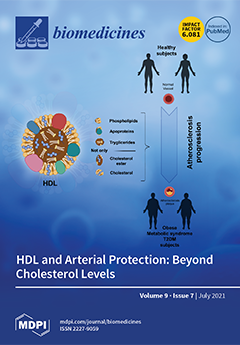
Cover Story: High-density lipoproteins (HDLs) can protect against atherosclerosis through multiple mechanisms, including reverse cholesterol transport, antioxidant, anti-inflammatory, antithrombotic and vasodilatory actions. The function of HDLs does not depend on the levels of a single component, such as cholesterol, but on the total chemical composition. Clinical conditions, such as obesity, metabolic syndrome and type 2 diabetes mellitus (T2DM), can cause an alteration in the chemical composition and consequently in atheroprotective properties of HDLs. View this paper
  • Issues are regarded as officially published after their release is announced to the table of contents alert mailing list .
  • You may sign up for email alerts to receive table of contents of newly released issues.
  • PDF is the official format for papers published in both, html and pdf forms. To view the papers in pdf format, click on the "PDF Full-text" link, and use the free Adobe Reader to open them.

Articles (147)

  • Article
  • Open Access
14 Citations
3,635 Views
11 Pages

Relationship between Circulating PCSK9 and Markers of Subclinical Atherosclerosis—The IMPROVE Study

  • Daniela Coggi,
  • Beatrice Frigerio,
  • Alice Bonomi,
  • Massimiliano Ruscica,
  • Nicola Ferri,
  • Daniela Sansaro,
  • Alessio Ravani,
  • Palma Ferrante,
  • Manuela Damigella and
  • Fabrizio Veglia
  • + 15 authors

(1) Background and purpose: circulating proprotein convertase subtilisin/kexin type 9 (PCSK9) is one of the key regulators of cholesterol metabolism. Despite this, its role as a player in atherosclerosis development is still matter of debate. Here, w...

  • Review
  • Open Access
33 Citations
7,147 Views
21 Pages

Molecular Mechanisms of Resistance to Immune Checkpoint Inhibitors in Melanoma Treatment: An Update

  • Sonja Vukadin,
  • Farah Khaznadar,
  • Tomislav Kizivat,
  • Aleksandar Vcev and
  • Martina Smolic

Over the past decade, immune checkpoint inhibitors (ICI) have revolutionized the treatment of advanced melanoma and ensured significant improvement in overall survival versus chemotherapy. ICI or targeted therapy are now the first line treatment in a...

  • Review
  • Open Access
23 Citations
4,970 Views
13 Pages

High-Density Lipoprotein Subfractions: Much Ado about Nothing or Clinically Important?

  • Knut Tore Lappegård,
  • Christian Abendstein Kjellmo and
  • Anders Hovland

High-density lipoproteins (HDL) are a heterogenous group of plasma molecules with a large variety in composition. There is a wide specter in lipid content and the number of different proteins that has been associated with HDL is approaching 100. Give...

  • Article
  • Open Access
10 Citations
4,557 Views
9 Pages

Pitavastatin Ameliorates Lipopolysaccharide-Induced Blood-Brain Barrier Dysfunction

  • Takashi Fujimoto,
  • Yoichi Morofuji,
  • Andrej Kovac,
  • Michelle A. Erickson,
  • Mária A. Deli,
  • Masami Niwa and
  • William A. Banks

Statins have neuroprotective effects on neurological diseases, including a pleiotropic effect possibly related to blood–brain barrier (BBB) function. In this study, we investigated the effects of pitavastatin (PTV) on lipopolysaccharide (LPS)-induced...

  • Review
  • Open Access
30 Citations
6,672 Views
17 Pages

Role of PITRM1 in Mitochondrial Dysfunction and Neurodegeneration

  • Dario Brunetti,
  • Alessia Catania,
  • Carlo Viscomi,
  • Michela Deleidi,
  • Laurence A. Bindoff,
  • Daniele Ghezzi and
  • Massimo Zeviani

Mounting evidence shows a link between mitochondrial dysfunction and neurodegenerative disorders, including Alzheimer Disease. Increased oxidative stress, defective mitodynamics, and impaired oxidative phosphorylation leading to decreased ATP product...

  • Article
  • Open Access
22 Citations
4,474 Views
22 Pages

Alginate-Agarose Hydrogels Improve the In Vitro Differentiation of Human Dental Pulp Stem Cells in Chondrocytes. A Histological Study

  • María Oliver-Ferrándiz,
  • Lara Milián,
  • María Sancho-Tello,
  • José Javier Martín de Llano,
  • Fernando Gisbert Roca,
  • Cristina Martínez-Ramos,
  • Carmen Carda and
  • Manuel Mata

Matrix-assisted autologous chondrocyte implantation (MACI) has shown promising results for cartilage repair, combining cultured chondrocytes and hydrogels, including alginate. The ability of chondrocytes for MACI is limited by different factors inclu...

  • Article
  • Open Access
11 Citations
4,823 Views
14 Pages

Environmental Enrichment Rescues Endocannabinoid-Dependent Synaptic Plasticity Lost in Young Adult Male Mice after Ethanol Exposure during Adolescence

  • Irantzu Rico-Barrio,
  • Sara Peñasco,
  • Leire Lekunberri,
  • Maitane Serrano,
  • Jon Egaña-Huguet,
  • Amaia Mimenza,
  • Edgar Soria-Gomez,
  • Almudena Ramos,
  • Ianire Buceta and
  • Inmaculada Gerrikagoitia
  • + 4 authors

Binge drinking (BD) is a serious health concern in adolescents as high ethanol (EtOH) consumption can have cognitive sequelae later in life. Remarkably, an enriched environment (EE) in adulthood significantly recovers memory in mice after adolescent...

  • Review
  • Open Access
6 Citations
4,229 Views
17 Pages

Dyslipidaemia in Type 1 Diabetes: Molecular Mechanisms and Therapeutic Opportunities

  • Stephen T. O’Brien,
  • Orla M. Neylon and
  • Timothy O’Brien

Cardiovascular disease (CVD) is the leading cause of death in Type 1 Diabetes (T1D). The molecular basis for atherosclerosis in T1D is heavily influenced by hyperglycaemia and its atherogenic effects on LDL. Ongoing research into the distinct pathoph...

  • Review
  • Open Access
7 Citations
4,188 Views
14 Pages

Many microRNAs exist in clusters that share comparable sequence homology and may target genes in a common pathway. The miR-379/miR-656 (C14MC) cluster is imprinted in the DLK1-Dio3 region of 14q32.3 and contains 42 miRNAs. It plays a functional role...

  • Article
  • Open Access
13 Citations
4,499 Views
23 Pages

Antibody Protection against Long-Term Memory Loss Induced by Monomeric C-Reactive Protein in a Mouse Model of Dementia

  • Elisa García-Lara,
  • Samuel Aguirre,
  • Núria Clotet,
  • Xenia Sawkulycz,
  • Clara Bartra,
  • Lidia Almenara-Fuentes,
  • Cristina Suñol,
  • Rubén Corpas,
  • Peter Olah and
  • Florin Tripon
  • + 3 authors

Monomeric C-reactive protein (mCRP), the activated isoform of CRP, induces tissue damage in a range of inflammatory pathologies. Its detection in infarcted human brain tissue and its experimentally proven ability to promote dementia with Alzheimer’s...

of 15

Get Alerted

Add your email address to receive forthcoming issues of this journal.

XFacebookLinkedIn
Biomedicines - ISSN 2227-9059