You are currently viewing a new version of our website. To view the old version click .

Universe, Volume 7, Issue 1

January 2021 - 20 articles

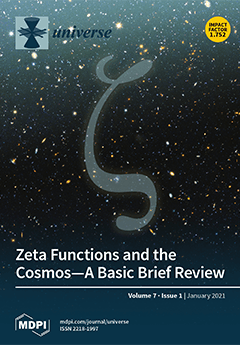
Cover Story: This is basic review of zeta functions and the zeta-regularization method, starting from the notions of harmonic series and of divergent sums. By way of simple examples, it is shown how these powerful methods are used for the regularization of physical quantities, such as quantum vacuum fluctuations in various contexts. Specifically, in Casimir effect setups—with a note on the dynamical Casimir effect—and mainly concerning its application in quantum theories in curved spaces, used in gravity theories and cosmology. A brief introduction to large scale cosmology leads then to the FLRW model, and to the cosmological constant problem. A concise summary of all these interrelated subjects and applications involving zeta functions and the cosmos, and an updated list of the pioneering and more influential works (in terms of citation counts) published on all those matters up to now, are provided. View this paper.
  • Issues are regarded as officially published after their release is announced to the table of contents alert mailing list .
  • You may sign up for email alerts to receive table of contents of newly released issues.
  • PDF is the official format for papers published in both, html and pdf forms. To view the papers in pdf format, click on the "PDF Full-text" link, and use the free Adobe Reader to open them.

Articles (20)

  • Article
  • Open Access
14 Citations
3,414 Views
14 Pages

Gravitational Waves in Scalar–Tensor–Vector Gravity Theory

  • Yunqi Liu,
  • Wei-Liang Qian,
  • Yungui Gong and
  • Bin Wang

In this paper, we study the properties of gravitational waves in the scalar–tensor–vector gravity theory. The polarizations of the gravitational waves are investigated by analyzing the relative motion of the test particles. It is found th...

  • Article
  • Open Access
3 Citations
4,156 Views
20 Pages

7 January 2021

The solar system is populated with, other than planets, a wide variety of minor bodies, the majority of which are represented by asteroids. Most of their orbits are comprised of those between Mars and Jupiter, thus forming a population named Main Bel...

  • Article
  • Open Access
11 Citations
3,437 Views
18 Pages

Statistical Estimates of the Pulsar Glitch Activity

  • Alessandro Montoli,
  • Marco Antonelli,
  • Brynmor Haskell and
  • Pierre Pizzochero

A common way to calculate the glitch activity of a pulsar is an ordinary linear regression of the observed cumulative glitch history. This method however is likely to underestimate the errors on the activity, as it implicitly assumes a (long-term) li...

  • Article
  • Open Access
10 Citations
3,798 Views
44 Pages

Neutrino Oscillations in Neutrino-Dominated Accretion Around Rotating Black Holes

  • Juan David Uribe,
  • Eduar Antonio Becerra-Vergara and
  • Jorge Armando Rueda

In the binary-driven hypernova model of long gamma-ray bursts, a carbon–oxygen star explodes as a supernova in the presence of a neutron star binary companion in close orbit. Hypercritical (i.e., highly super-Eddington) accretion of the ejecta...

  • Article
  • Open Access
6 Citations
2,461 Views
11 Pages

31 December 2020

We have studied the possible isospin corrections on the skewness and kurtosis of net-baryon and net-charge fluctuations in the isospin asymmetric matter formed in relativistic heavy-ion collisions at RHIC-BES energies, based on a 3-flavor Polyakov-lo...

  • Article
  • Open Access
5 Citations
5,385 Views
33 Pages

28 December 2020

Ever since Eddington’s analysis of the gravitational redshift a century ago, and the arguments in the relativity community that it produced, fine details of the roles of proper time and coordinate time in the redshift remain somewhat obscure. W...

  • Communication
  • Open Access
3 Citations
3,369 Views
8 Pages

Comparison of Gravitational and Light Frequency Shifts in Rubidium Atomic Clock

  • Alexey Baranov,
  • Sergey Ermak,
  • Roman Lozov and
  • Vladimir Semenov

24 December 2020

The article presents the results of an experimental study of the external magnetic field orientation and magnitude influence on the rubidium atomic clock, simulating the influence of the geomagnetic field on the onboard rubidium atomic clock of navig...

  • Article
  • Open Access
1 Citations
2,621 Views
12 Pages

22 December 2020

Short timescale variability is often associated with a black hole system. The consequence of an electromagnetic outflow suddenly generated near a Kerr black hole is considered assuming that it is described by a solution of a force-free field with a n...

  • Article
  • Open Access
59 Citations
3,546 Views
17 Pages

22 December 2020

Classical black holes contain a singularity at their core. This has prompted various researchers to propose a multitude of modified spacetimes that mimic the physically observable characteristics of classical black holes as best as possible, but that...

of 2

Get Alerted

Add your email address to receive forthcoming issues of this journal.

XFacebookLinkedIn
Universe - ISSN 2218-1997