


Abstract
The brewing process generates substantial by-products rich in potentially bioactive compounds (e.g., polyphenols and fermentation metabolites), providing a sustainable and appealing source of cosmetic ingredients. Oil-in-water (O/W) emulsions containing 20% (w/w) aqueous extracts from Bionda Triplo Malto beer, wort, and key brewing by-products (hops, yeast, and spent grain) were developed and evaluated using a combined in vitro–in vivo approach. Aqueous extracts were first screened on human immortalized dermal fibroblasts (BJ-5ta) at 0.25–1 mg/mL for cytocompatibility and antioxidant activity. Within this concentration range, no significant changes in cell viability or intracellular antioxidant capacity under UV stress were detected, suggesting cytocompatibility but limited inherent activity. When incorporated into O/W emulsions and tested at an active-equivalent concentration of 10 mg/mL, the formulations increased fibroblast metabolic activity and antioxidant response. In contrast, free extracts at 10 mg/mL showed concentration-dependent cytotoxicity for some matrices, with beer- and yeast-based emulsions demonstrating the strongest effects. The emulsions exhibited good physicochemical stability (pH ~5.7–6.2; viscosity 4750–5150 mPa·s), passed the ISO 11930:2012 challenge test, and were well tolerated in patch testing. In a double-blind, randomized split-forearm study on 50 healthy volunteers over 30 days, beer, yeast, and spent grain-based formulations improved skin parameters versus baseline. TEWL decreased (e.g., beer: 16.22 ± 5.12 to 10.77 ± 2.22 mg·m−2·h−1; yeast: 16.29 ± 5.66 to 10.18 ± 1.08; spent grain: 14.45 ± 4.34 to 11.66 ± 2.28), hydration increased (beer: 35.15 ± 5.93 to 42.26 ± 3.78; yeast: 33.27 ± 4.87 to 42.92 ± 2.48; spent grain: 34.22 ± 5.19 to 41.16 ± 3.17, and elasticity improved for beer and yeast formulations (62.33 ± 3.27 to 70.24 ± 2.12 N/m) and yeast (61.21 ± 4.72 to 72.13 ± 5.55 N/m). Based on these findings, brewing-derived ingredients demonstrate potential as cosmetic actives, with formulation critically determining their clinical efficacy.
1. Introduction
Skin aging is a multifaceted biological process arising from interactions between intrinsic factors, such as genetic predisposition and cellular senescence, and extrinsic stressors, including ultraviolet (UV) radiation, environmental pollution, and lifestyle-related factors. Many of these alterations primarily target the dermal layer, in which dermal fibroblasts are key regulators of structural integrity and tissue homeostasis. They achieve this by synthesizing extracellular matrix components, maintaining redox homeostasis, and modulating inflammatory and apoptotic signaling pathways. When fibroblast activity is impaired, the skin loses its elasticity, transepidermal water loss (TEWL) increases, and visible signs of aging appear [1,2,3].
Among natural compounds investigated for cosmetic and dermatological applications, polyphenols have attracted considerable attention due to their antioxidant, anti-inflammatory, photoprotective, and anti-aging properties [4,5,6]. Numerous plant-derived polyphenols have been shown to protect skin cells from oxidative stress, modulate intracellular signaling pathways, and preserve dermal matrix integrity, making them valuable ingredients in modern cosmetic formulations [7]. However, increasing evidence suggests that the biological efficacy of polyphenol-rich extracts is strongly influenced by their chemical stability, bioavailability, and interaction with the cosmetic vehicle, highlighting the critical role of formulation design [8,9,10].
Recent years have seen a shift in cosmetic industry trends toward sourcing environmentally conscious ingredients derived from agri-food by-products [11,12]. Brewing by-products are a plentiful and underutilized source of bioactive compounds, including phenolic acids, flavonoids, proteins, polysaccharides, and minerals, that may benefit skin health [11,13,14]. Numerous studies indicate that beer composition and antioxidant capacity are influenced by raw materials, fermentation conditions, and brewing processes, with darker, malt-rich beers typically exhibiting elevated phenolic content and antioxidant potential [15,16,17]. Additionally, hop- and yeast-derived fractions have been shown to modulate the body’s response to oxidative stress and inflammation, further supporting their potential use in cosmetics [1].
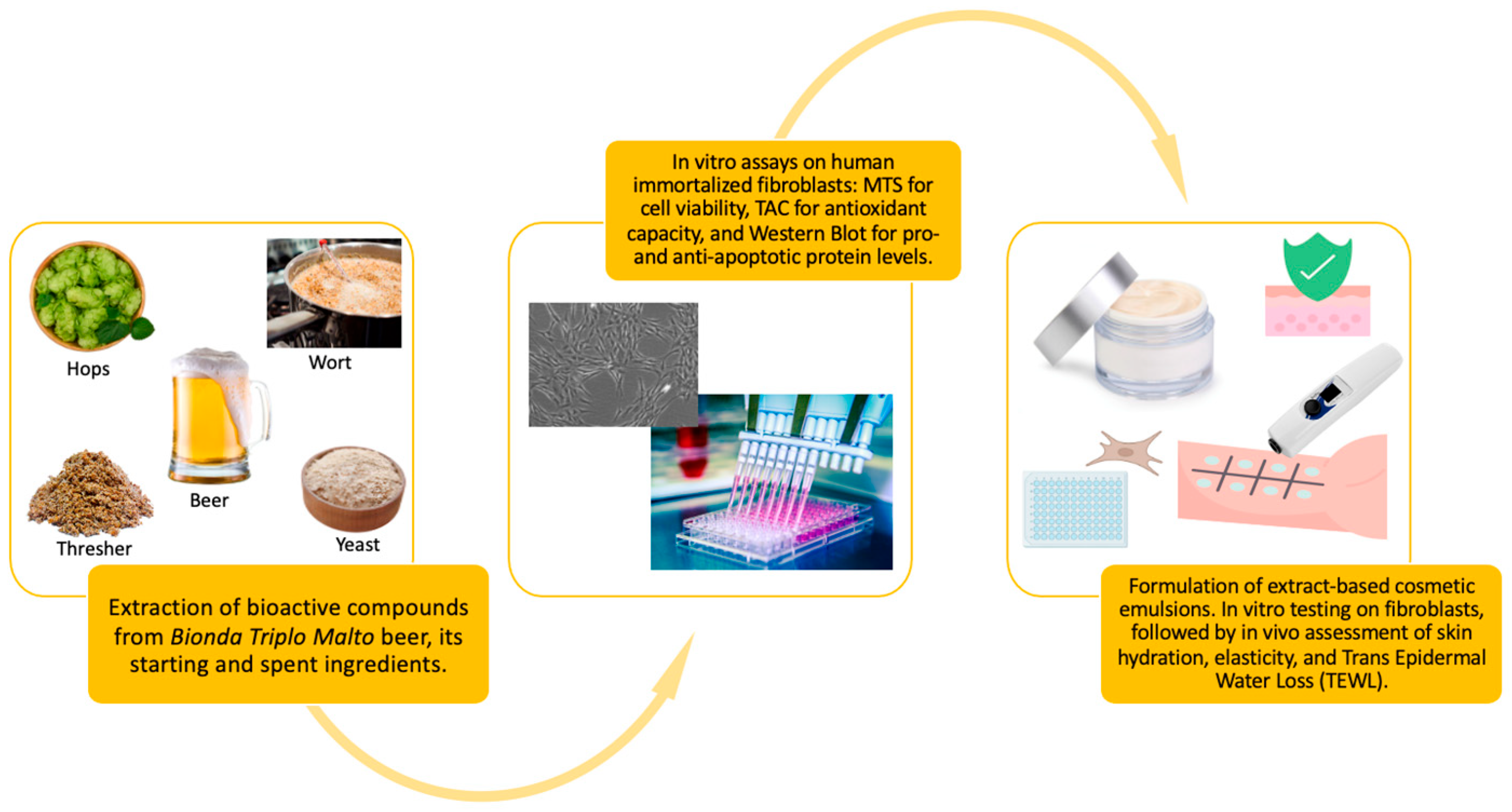
Previous work conducted by our team has established that beers and brewing by-products are abundant in phenolic compounds and possess substantial antioxidant capacity, suggesting their potential application as functional ingredients in dietary supplements and cosmetic formulations [18]. Handcrafted beer by-products exhibited anti-aging activity in human keratinocytes, highlighting their potential as cosmetic actives [18]. Triplo Malto beer had the highest phenolic content and antioxidant activity among the beers tested. Based on these findings, the current study aimed to further explore the cosmetic potential of Bionda Triplo Malto beer, its initial wort, and specific brewing by-products (yeast, hops, and spent grain), concentrating on dermal fibroblasts as a pertinent cellular model for skin aging. This study investigates the impact of formulation-driven effects on the cosmetic efficacy of brewing-derived ingredients by integrating in vitro cellular assays with clinical skin measurements, offering new insights into their potential as sustainable and effective cosmetic actives (Figure 1).
Figure 1.
Depiction of the experimental approach of the study.
2. Materials and Methods
2.1. Materials and Samples
Deionized water was produced in-house with a G3 RO CUBIC-S2 demineralizer (Gamma3, Castelverde, Italy). All chemicals were purchased from Merck (Steinheim, Germany).
Five different brewing-derived samples were investigated: Bionda Triplo Malto beer (BB), its starting wort (W), and three brewing by-products, namely hops (H), yeast (Y), and spent grain (T), that are residues obtained after the mashing and filtration stages of the beer brewing process. All samples were kindly provided by Birrificio Artigianale Collesi (Apecchio, PU, Italy). Reference compounds with known antioxidant or biological activity were included as controls for in vitro experiments: açai dry extract (previously characterized by our group [19]), Trolox (6-hydroxy-2,5,7,8-tetramethylchroman-2-carboxylic acid), and prostaglandin E2 (PGE2).
2.2. Cell Culture
Human immortalized dermal fibroblasts BJ-5ta (ATCC® CRL-4001™, male diploid) [20] were used for all in vitro assays. Cells were cultured in Dulbecco’s Modified Eagle Medium/MED 199 (3:1, v/v) supplemented with 10% heat-inactivated fetal calf serum, penicillin (100 U/mL), and streptomycin (100 µg/mL) (Life Technologies, Milan, Italy). Cells were maintained at 37 °C in a humidified atmosphere containing 5% CO2 and routinely subcultured at 70–80% confluence.
2.3. Preparation of Aqueous Extracts
The extraction procedure was performed under strictly controlled and standardized conditions. The starting materials, beer, hop, wort, yeast, and spent grain, were subjected to different processes according to their physical state, which could be dried solid, humid solid, or turbid liquid, according to a previously developed method [21]. In detail, humid solids and liquids were first subjected to lyophilization at a temperature of −50 °C and a pressure of 0.03 bar (FreeZone 1 Liter Benchtop Series 77400 freeze-dryer, LABCONCO, Kansas City, MO, USA). Dried solids were subjected to milling in a cutter mill. Next, all the samples were subjected to extractions. Each extraction was performed in independent replicates using the same starting materials. A weighed amount was carefully dispersed in water (1 g in 10 mL). The resulting liquid was placed in an Erlenmeyer flask, which was then closed carefully. Samples were magnetically stirred for 24 h at room temperature using a temperature-controlled magnetic stirrer (RCT Basic ETS-D5, IKA, Staufen, Germany), then centrifuged at 12,000 rpm at 20 °C for 10 min to remove undissolved particles (Zetalab CNZ-140H-E, Padova, Italy). Samples were lyophilized and handled according to a standardized procedure by collecting powders immediately after completion of the freeze-drying cycle, transferring them to airtight containers (polyethylene vials with screw caps, BD Falcon™, BD Biosciences, Bedford, MA, USA), and storing them at −20 °C in 50 mL in order to ensure optimal storage conditions. All subsequent extractions and biological assays were performed using dry-weight-normalized material, thereby minimizing variability related to residual water content.
Extraction yields were calculated as the percentage of recovered dry extract relative to the initial dry material and are reported in the Results section as mean ± SD.
2.4. Cell Viability Assay (MTS)
Cell viability and metabolic activity were evaluated using the MTS assay, based on the reduction of the tetrazolium salt [3-(4,5-dimethylthiazol-2-yl)-5-(3-carboxymethoxyphenyl)-2-(4-sulfophenyl)-2H-tetrazolium] to a colored formazan product by metabolically active cells.
BJ-5ta fibroblasts were seeded at a density of 5 × 10³ cells/well in 96-well plates and allowed to adhere overnight. Cells were then treated for 24 h with aqueous extracts at concentrations of 0.25, 0.5, and 1 mg/mL as a screening range to evaluate cytocompatibility and potential biological activity under standard culture conditions. Higher concentrations of complex natural matrices may alter medium properties and increase nonspecific assay interference; therefore, the lower range was selected for the primary extract-only evaluation.
For experiments involving cosmetic formulations, emulsions containing 20% (w/w) dry extract were diluted in complete culture medium to obtain a final extract concentration of 10 mg/mL. A reference emulsion (Emulsion WE) with identical composition but without extracts was included as a vehicle control. Preliminary controls confirmed the absence of interference between the emulsion matrix and the MTS reagent under the experimental conditions used.
Açai extract and Trolox were used as reference antioxidants (0.5 mg/mL), while PGE2 was tested at 10−6 M.
After treatment, cells were incubated with MTS reagent (20 µL/well) for 1 h at 37 °C. Absorbance was measured at 490 nm using a microplate reader (Infinite F200, Tecan, Männedorf Switzerland). Recorded values of absorbance at 490 nm were converted to cell viability and expressed as a percentage relative to untreated control cells (control set to 100%) within each experiment.
2.5. Total Antioxidant Capacity (TAC) Assay
The intracellular antioxidant capacity was evaluated using a commercial Total Antioxidant Capacity (TAC) colorimetric assay kit (BioVision, K274-100), based on the reduction of Cu2+ to Cu+ by low-molecular-weight antioxidants, with protein interference masked.
Fibroblasts were treated with aqueous extracts (0.25, 0.5, and 1 mg/mL) or with cosmetic formulations (10 mg/mL). Oxidative stress was induced using a UVB lamp (peak emission at 312 nm) positioned at a fixed distance from the cell monolayer [22]. Cells were exposed for 5 min under non-lethal conditions, followed by incubation for 24 h prior to TAC measurement. Post-UV cell viability was confirmed by the MTS assay to exclude irradiation-related effects.
Cells were incubated for 24 h before TAC measurement, which was performed according to the manufacturer’s instructions. Absorbance was read at 570 nm, and the recorded values were converted to antioxidant capability by means of the Trolox standard calibration curve and expressed as Trolox equivalents.
2.6. Preparation of Cosmetic Emulsions
Six oil-in-water (O/W) cosmetic emulsions were prepared: one reference (Emulsion WE) formulation without active ingredients and five formulations containing 20% (w/w) of each dry extract (beer (Emu 1), wort (Emu 2), hops (Emu 3), yeast (Emu 4), and spent grain (Emu 5)). The formulations consisted of an oily phase (Phase A), an aqueous phase (Phase B), and a preservative/chelating phase (Phase C) (Table 1). Due to industrial confidentiality, a range of quantitative compositions is reported.
Table 1.
Ingredients used for O/W emulsion.
2.7. Physicochemical Characterization and Stability
Emulsion density was determined gravimetrically, while pH was determined with a Jenway 3510 pH meter (Bibby Scientific Limited, Stone, UK), and viscosity was determined with a Mettler Toledo viscometer. Accelerated stability was evaluated under centrifugation (4000 rpm, 30 min, 20 °C) and thermal treatment at both 4 and 40 °C. Long-term stability was assessed under ambient conditions for up to 12 months.
Colorimetric stability was evaluated using a colorimeter (CR-400, Konica Minolta, Cinisello Balsamo (MI), Italia ) according to the CIELAB color space. Overall color differences (ΔE*ab) were calculated to monitor potential changes over time [23] by applying Equation (1):
2.8. Microbiological Challenge Test
The challenge test was evaluated according to ISO 11930:2012, Criterion A. Emulsions were tested with standard microbial strains (Escherichia coli, Staphylococcus aureus, Pseudomonas aeruginosa, Candida albicans, and Aspergillus brasiliensis), and viable counts (CFU) were monitored over 28 days at the ISO-recommended time points (Day 0, 7, 14, and 28) under controlled storage conditions. According to Criterion A, acceptance requirements were ≥3 log reduction for bacteria within 7 days with no subsequent increase at Day 14 and Day 28, and ≥1 log reduction for yeasts and molds within 14 days with no increase at Day 28. Initial inoculum levels were 105–106 CFU for E. coli, S. aureus, and P. aeruginosa, and 104–105 CFU for C. albicans and A. brasiliensis.
2.9. In Vivo Skin Compatibility and Efficacy Studies
Skin compatibility was assessed using a patch test conducted on healthy volunteers, in accordance with the Declaration of Helsinki and COLIPA guidelines. Irritant reactions were evaluated at 15 min and 24 h after patch removal.
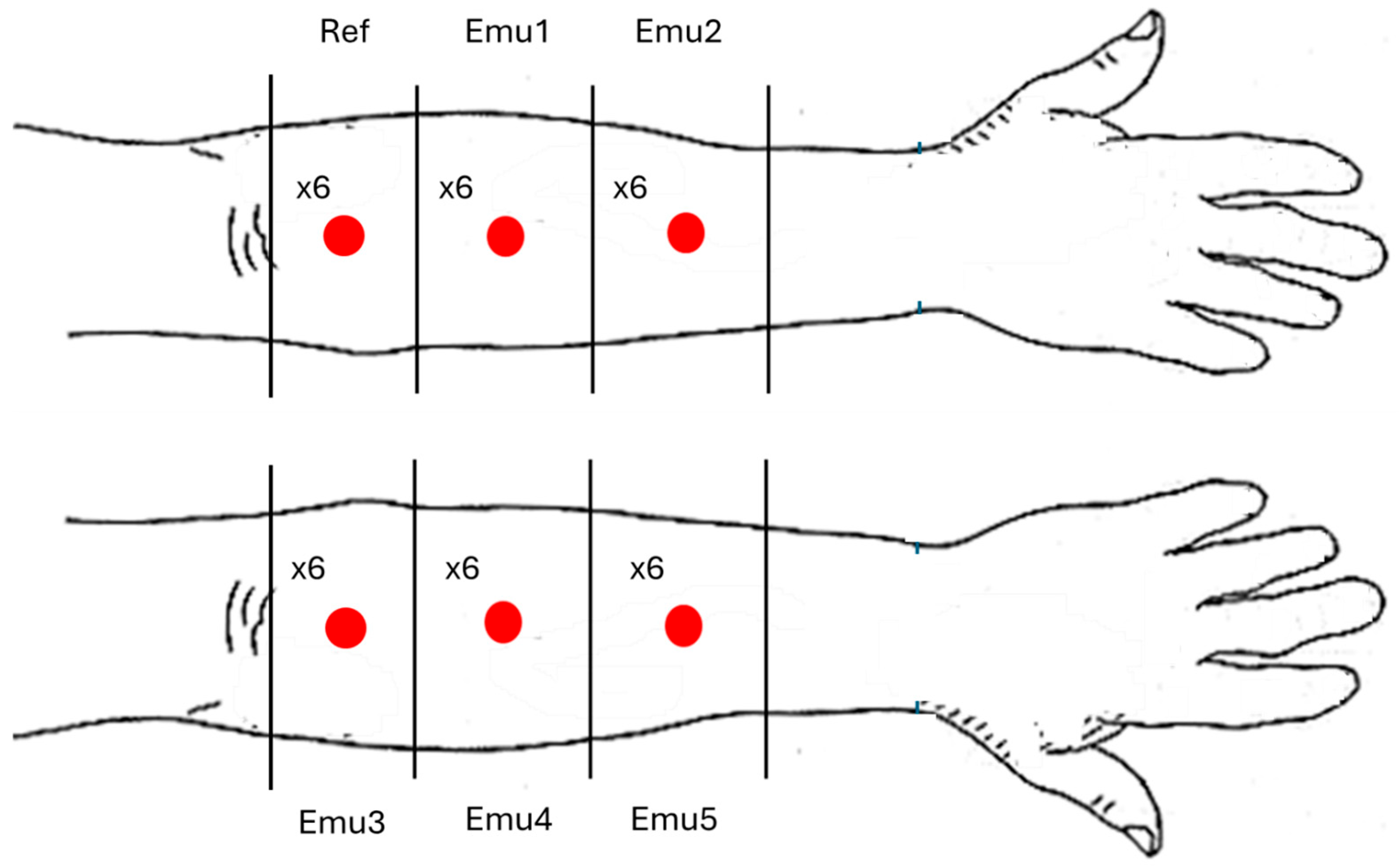
For in vivo efficacy evaluation, fifty healthy volunteers (phototype III, male and female, age 27 ± 4 years) participated in a 30-day study. TEWL, skin hydration, and elasticity were measured under controlled environmental conditions using validated non-invasive instruments (VapoMeter®, MoistureMeterSC®, and ElastiMeter®, Delfin Technologies, Kuopio, Finland). Measurement points are indicated in Figure 2. To minimize bias, a randomized split-forearm design was implemented. The allocation of products to the predefined forearm areas was performed by an independent staff member not involved in data collection. Both the volunteers and the investigator performing the instrumental measurements remained blinded to treatment assignment throughout the study (double-blind design).
Figure 2.
Measurement points for trans-epidermal water loss (TEWL), skin hydration, and elasticity. A randomized split-forearm design was implemented. As an example, here we report the situation in which the right forearm received Ref, which is the emulsion with any active ingredient, emulsion with beer (Emu1), and emulsion with wort (Emu2), while the left forearm was treated again with Ref, emulsion with hop (Emu3), emulsion with yeast (Emu4), and emulsion with spent grain (Emu5).
2.10. Statistical Analysis
GraphPad Prism 9 (GraphPad Software, San Diego, CA, USA) was used for data visualization and statistical analyses. Data are presented as mean ± SD. For in vitro assays, experiments were performed in triplicate (n = 3 independent experiments). Differences among multiple groups were assessed by one-way ANOVA followed by appropriate post hoc multiple-comparison procedures (e.g., Dunnett’s test when comparing treatments to a single control or Tukey’s test for all pairwise comparisons), as specified in each figure/table legend.
For in vivo efficacy, measurements (TEWL, skin hydration, and elasticity) were obtained at baseline (T0) and after 30 days of treatment (T30) in 50 subjects (n = 50). Changes over time were analyzed using two-way repeated-measures ANOVA with factors treatment (formulation) and time (T0 vs. T30). When post hoc comparisons were required, multiplicity-adjusted testing was applied (Holm–Bonferroni correction) to compare each extract-based formulation versus the Emulsion WE. Statistical significance was set at p < 0.05.
To explore the relationship between in vitro and in vivo outcomes, an exploratory rank-based correlation analysis (Spearman’s correlation) was performed using in vitro activity indices for the formulated creams and the corresponding in vivo changes (Δ or ΔΔ vs. vehicle), as described in Section 3 and Section 4.
3. Results
3.1. Extraction Yield
For this study, water was selected as the primary extraction solvent over ethanol because previous research [21] showed that ethanol-based extracts did not offer significantly greater biological activity to justify their substantially higher cost. Aqueous extracts were successfully obtained from all brewing-derived materials. Extraction yields were high for beer and wort (approximately 97%), while solid by-products showed yields of 78.0 ± 2.5%, 92.0 ± 5.3%, and 65.0 ± 3.4% for hops, yeast, and spent grain, respectively. These values indicate an efficient recovery of water-soluble components, consistent with the high content of polar bioactive compounds reported for brewing matrices [24].
Once prepared, the creams were left to stabilize for 24 h, after which the pH was adjusted to 6.0 with triethanolamine to minimize effects on cells.
3.2. Phytochemical Profiling of the Same Extract Batches Used in This Study (Published Data)
For biological interpretation, the brewing-derived extracts tested here—beer, wort, hops, yeast, and spent grain—were prepared from the same production lots previously characterized by our group. In particular, we reported total phenolic content and antioxidant capacity for these batches using complementary spectrophotometric assays (Folin–Ciocalteu; DPPH/ABTS/FRAP) [21]. We also performed targeted quantitative profiling by a validated HPLC–MS/MS method, measuring 20 representative phenolic compounds (phenolic acids, flavonoids, bitter acids, and prenylflavonoids) across beer, wort, starting ingredients, and spent materials [25].
Matrix-dependent compositional differences were observed across these batch-matched datasets. Malt-derived phenolic acids (notably trans-p-coumaric acid) were identified as major contributors in malt and were transferred to wort during mashing, supporting a malt-driven phenolic signature in wort. Conversely, hop-related bitter acids and prenylated flavonoids (e.g., humulone/cohumulone, lupulone/colupulone, xanthohumol/isoxanthohumol, and 8-prenylnaringenin) were characteristic of hop matrices and decreased in spent hops, consistent with transfer and/or processing-related depletion. Spent yeast enriched several phenolic markers, highlighting its capacity to concentrate phenolics from the brewing medium [26].
These biological outcomes align with the compositional profiles of the extract batches, with beer- and yeast-based formulations showing stronger effects due to their richer fermentation-derived phenolics and yeast bioactives. To ensure transparency and avoid duplication, readers are referred to the cited studies for full quantitative tables and analytical details while drawing on these batch-matched compositional data to inform the mechanistic discussion.
3.3. Effect of Brewing-Derived Extracts on Fibroblast Viability
A single immortalized human dermal fibroblast cell line (BJ-5ta) was selected for in vitro experiments. This model offers high reproducibility and is suitable for comparative screening of cosmetic formulations, even if it does not fully reflect the cellular complexity of human skin. More physiologically relevant systems, such as primary fibroblasts, keratinocytes, or reconstructed skin models, would allow the investigation of epidermal–dermal interactions and barrier-related mechanisms. This limitation is partially offset by an in vivo study in human volunteers, providing clinically relevant confirmation of the formulation-dependent effects seen in vitro.
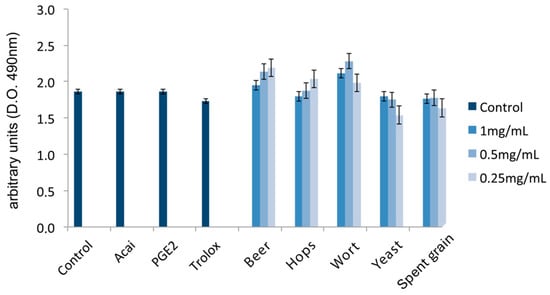
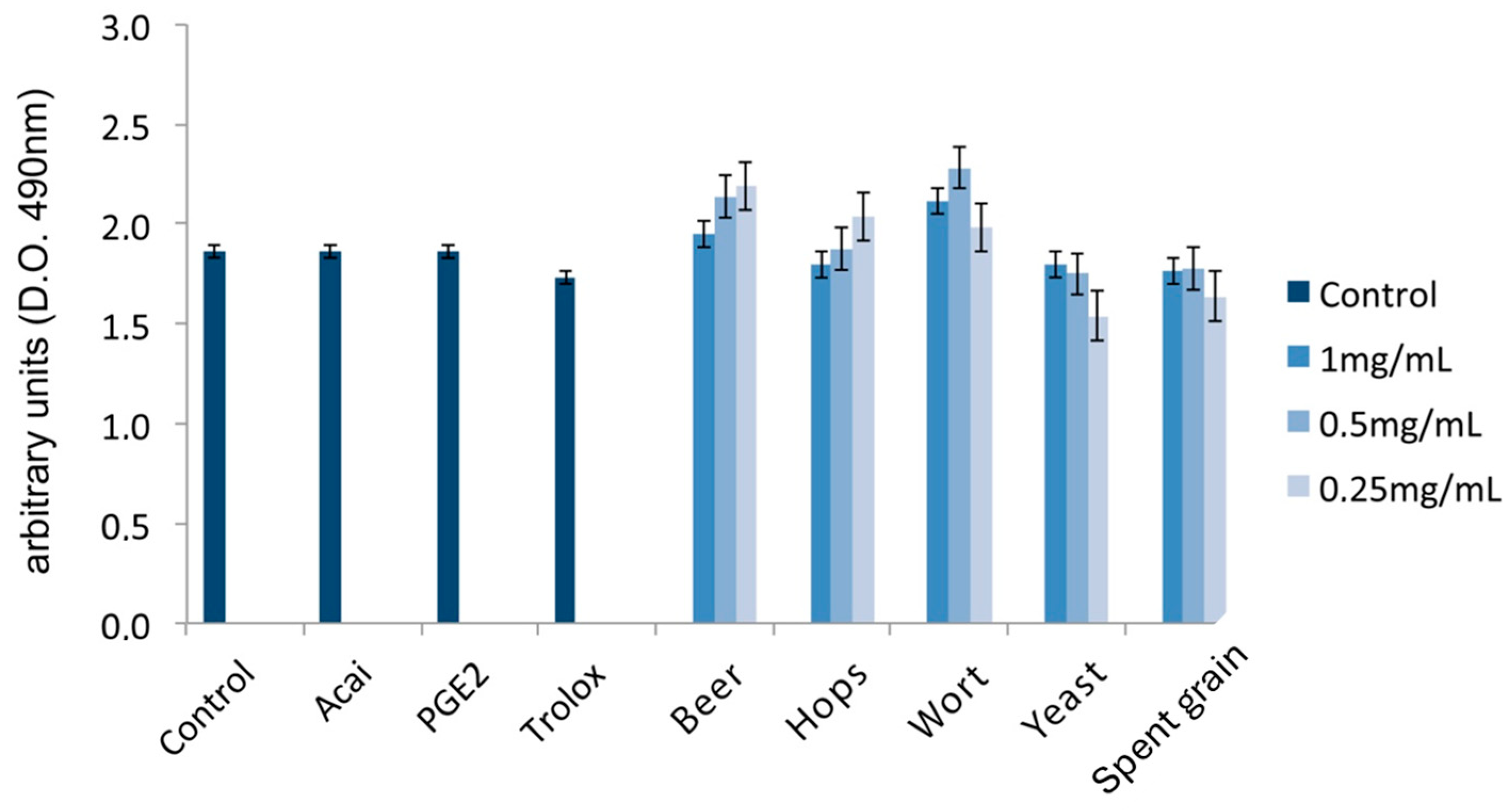
We used the MTS assay to assess fibroblast viability after exposure to aqueous extracts for 24 h at concentrations of 0.25, 0.5, and 1 mg/mL (Figure 3). None of the tested extracts caused statistically significant changes in cell viability compared to untreated control cells at any concentration. A minor, statistically insignificant elevation in metabolic activity was observed in cultures treated with Bionda Triplo Malto beer and wort at a concentration of 0.5 mg/mL. Notably, no cytotoxic effects were detected, confirming the cytocompatibility of all extracts across the tested concentration range. Under the experimental conditions employed, the brewing-derived extracts showed no direct proliferative or cytotoxic effects on dermal fibroblasts, affirming their suitability for cosmetic use.
Figure 3.
MTS assay results. Data are expressed as mean ± SD (n = 3 independent experiments). Arbitrary unit (AU) values correspond to background-corrected absorbance and are expressed as fold-change relative to the corresponding untreated control (AU control = 1).
3.4. Antioxidant Activity of Extracts Under UV-Induced Oxidative Stress
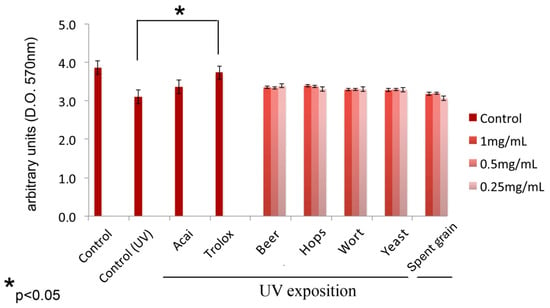
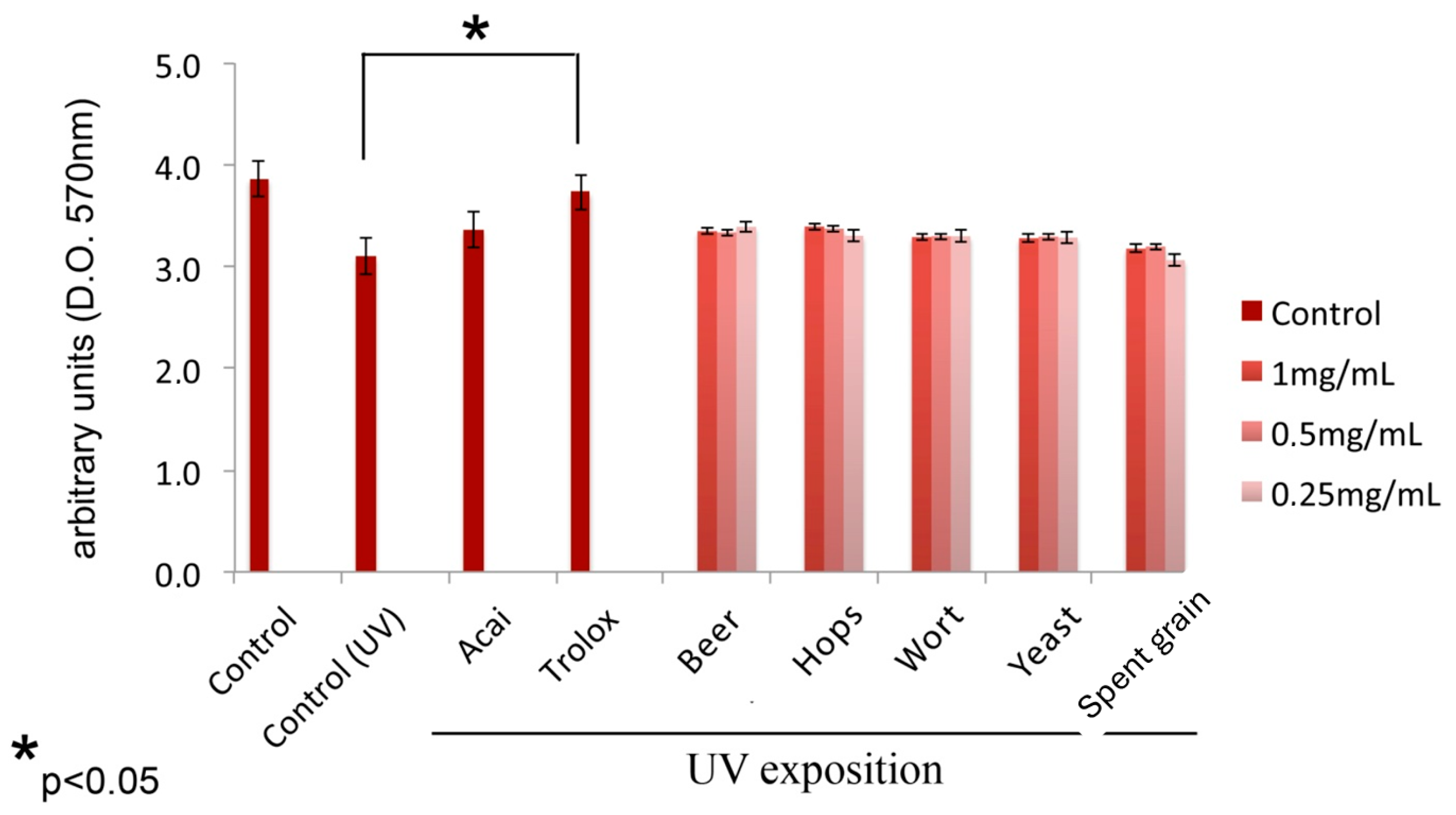
The intracellular antioxidant potential of brewing-derived extracts was assessed using the TAC assay following UV-induced oxidative stress. Fibroblasts were treated with extracts at 0.25, 0.5, and 1 mg/mL, exposed to UV irradiation, and analyzed after 24 h (Figure 4).
Figure 4.
TAC assay results. Data are expressed as mean ± SD (n = 3 independent experiments). Statistics: two-way ANOVA (treatment × concentration) followed by Dunnett’s post hoc test vs. control; adjusted p-values are reported as * p < 0.05. Arbitrary unit (AU) values correspond to background-corrected absorbance and are expressed as fold change relative to the corresponding untreated control (AUcontrol = 1).
No statistically significant differences in total antioxidant capacity were observed between treated and untreated cells at any concentration. Similarly, antioxidant reference compounds such as açai extract and Trolox did not cause significant changes in the experimental conditions used.
These results suggest that the aqueous extracts, when administered alone at moderate concentrations, do not significantly enhance intracellular antioxidant defenses in fibroblasts following acute UV exposure.
While suitable for comparative screening, this assay does not capture rapid or pathway-specific ROS fluctuations and may underestimate subtle antioxidant effects under mild oxidative stress conditions. The absence of complementary ROS-sensitive assays (e.g., DCFH-DA) represents a limitation of the study and will be addressed in future investigations aimed at mechanistic characterization.
3.5. Formulation of Cosmetic Emulsions and Rationale for Concentration Increase
Cosmetic emulsions were formulated to investigate whether incorporation into a cosmetic vehicle could enhance biological activity. Five oil-in-water emulsions containing 20% (w/w) dry extract were prepared, corresponding to a final extract concentration of approximately 10 mg/mL during in vitro testing.
The concentration expressed as mg/mL in culture medium does not directly reflect real-life topical exposure, which is typically described as the amount applied per skin area (mg/cm2) and further influenced by residence time, barrier function, and formulation-dependent dermal delivery. In our study, the 10 mg/mL condition was used as a high-dose screening level to increase assay sensitivity and to compare free extracts and emulsions at the same nominal active-equivalent concentration. The reduced cytotoxicity observed for emulsions compared to free extracts at equal nominal concentrations likely reflects formulation-controlled bioavailability/partitioning and exposure kinetics, rather than evidence of absolute safety under all use conditions.
3.6. Effect of Cosmetic Formulations on Fibroblast Viability
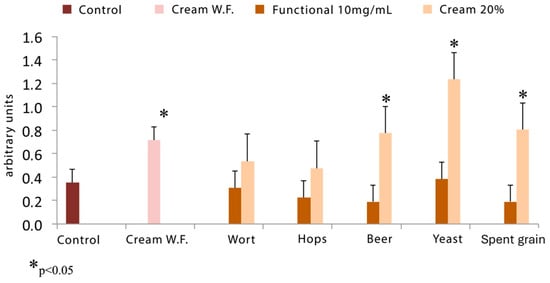
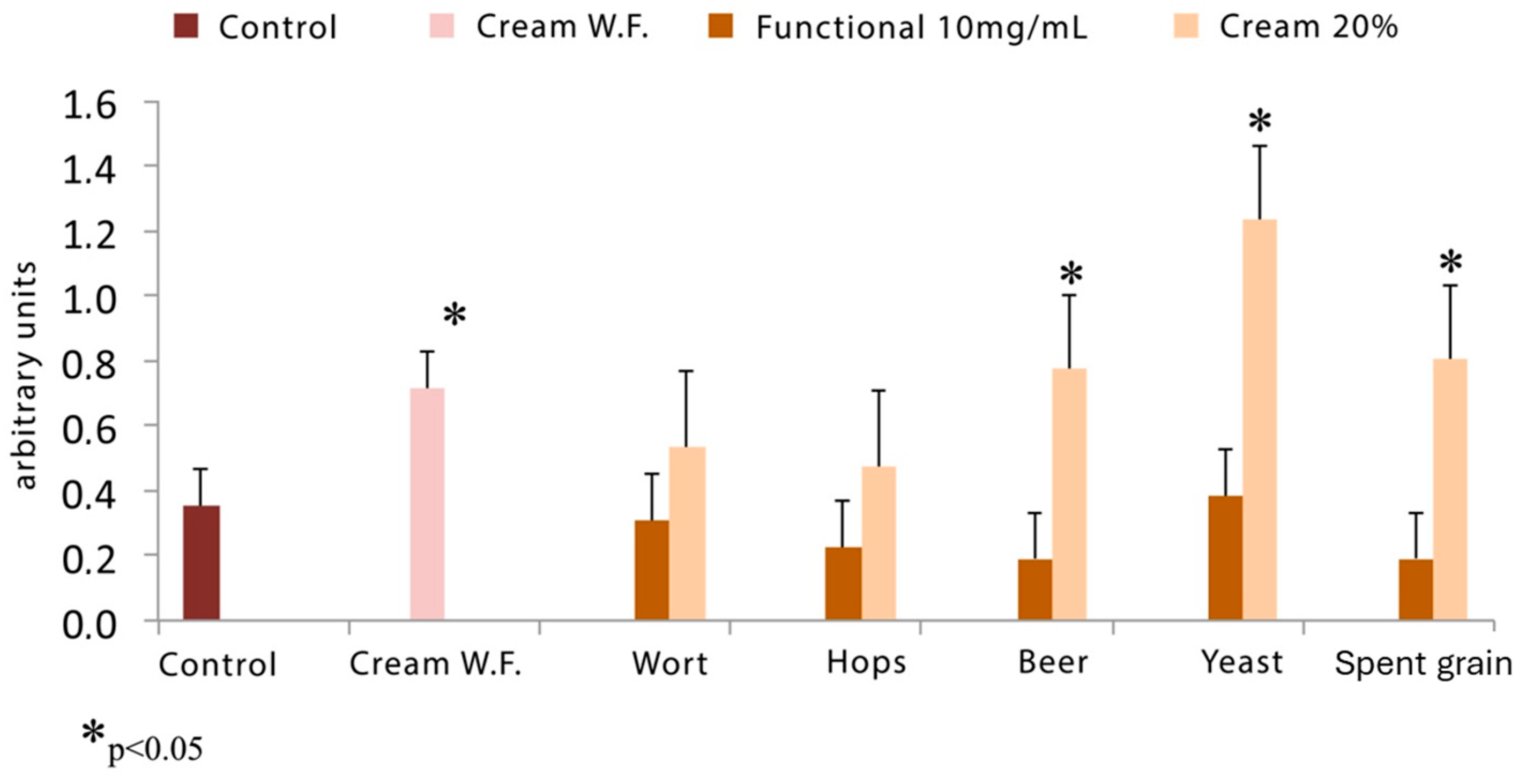
The effects of cosmetic formulations on fibroblast viability were evaluated using an MTS assay and compared with untreated cells and cells treated with the corresponding free extracts at 10 mg/mL (Figure 5).
Figure 5.
MTS assay with cream results. Data are expressed as mean ± SD (n = 3 independent experiments). Statistics: two-way ANOVA (treatment × concentration) followed by Dunnett’s post hoc test vs. control; adjusted p-values are reported as * p < 0.05. Arbitrary unit (AU) values correspond to background-corrected absorbance and are expressed as fold change relative to the corresponding untreated control (AUcontrol = 1).
When tested alone at 10 mg/mL, beer, hops, and spent grain extracts reduced cell viability, indicating a concentration-dependent cytotoxic effect. In contrast, when incorporated into cosmetic emulsions, all formulations significantly enhanced cell viability compared to untreated controls and to the corresponding free extracts.
Emulsions with beer, yeast, and spent grain extracts significantly enhanced fibroblast metabolic activity, whereas WF showed a moderate proliferative effect, emphasizing the vehicle’s protective and modulatory role in mitigating cytotoxicity and improving cellular responsiveness.
3.7. Antioxidant Activity of Cosmetic Formulations
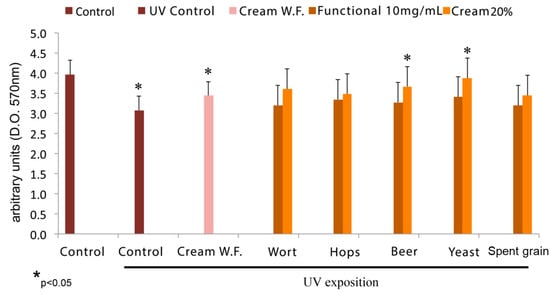
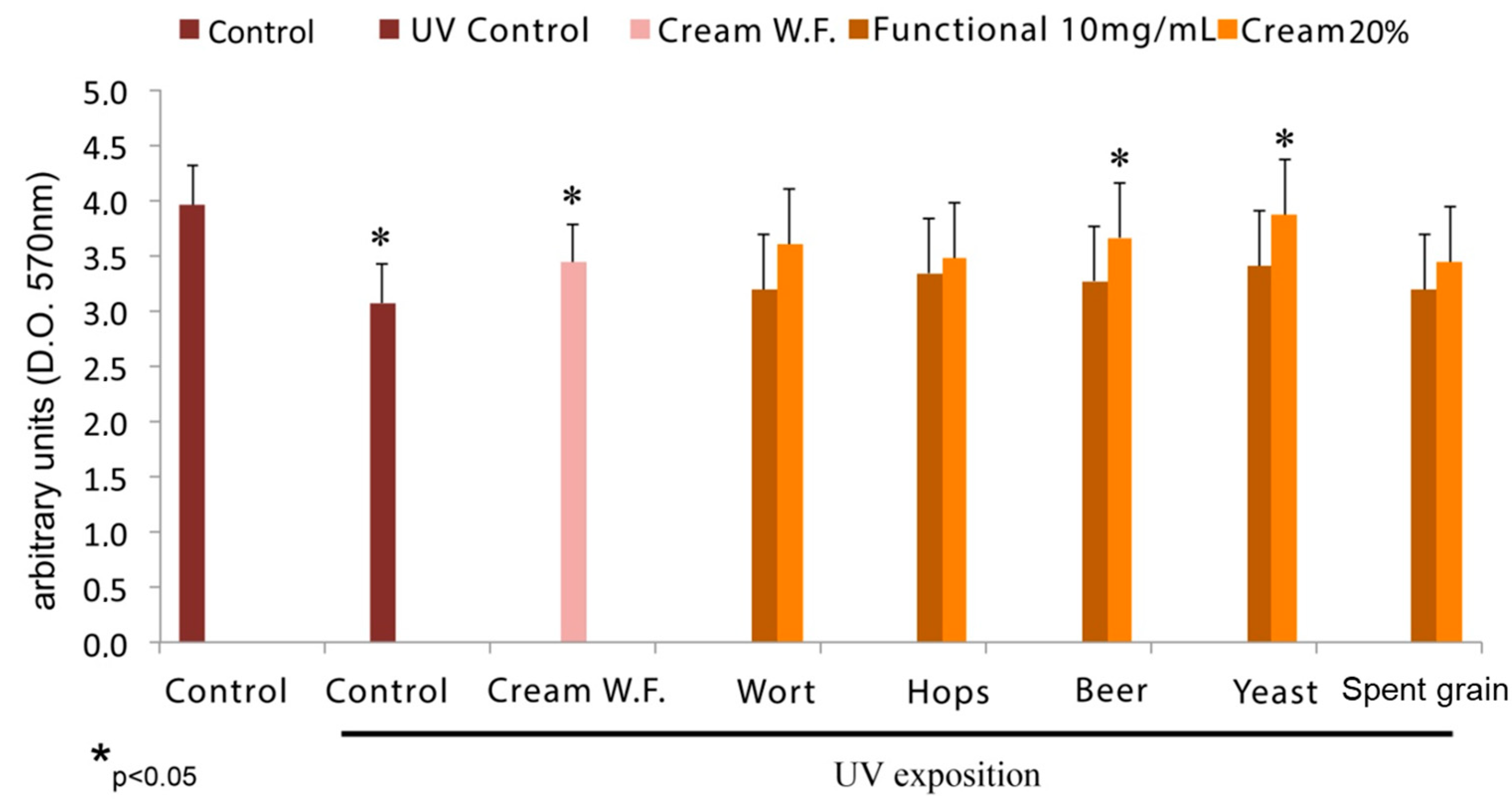
The antioxidant effects of cosmetic formulations were further evaluated using the TAC assay following UV-induced oxidative stress (Figure 6).
Figure 6.
TAC assay with cream results. Data are expressed as mean ± SD (n = 3 independent experiments). Statistics: two-way ANOVA (treatment × concentration) followed by Dunnett’s post hoc test vs. control; adjusted p-values are reported as * p < 0.05. Arbitrary unit (AU) values correspond to background-corrected absorbance and are expressed as fold change relative to the corresponding untreated control (AUcontrol = 1).
While free extracts tested at 10 mg/mL did not show significant antioxidant activity, emulsions containing beer and yeast extracts significantly increased total antioxidant capacity compared to untreated cells and to Emulsion WE. The remaining formulations exhibited a trend toward an increased antioxidant response, although not reaching statistical significance. The apparent discrepancy between the lack of antioxidant activity observed for free aqueous extracts and the enhanced response detected when the same extracts were incorporated into cosmetic emulsions can be explained by several formulation-dependent mechanisms rather than by intrinsic differences in chemical antioxidant capacity. First, when tested as free extracts, brewing-derived matrices are directly and immediately exposed to cells at the nominal concentration, which may result in limited cellular uptake, rapid extracellular degradation, or nonspecific interactions with the culture medium. Under these conditions, phenolic compounds may not effectively contribute to intracellular antioxidant buffering, particularly in a robust cell model such as immortalized dermal fibroblasts. In contrast, incorporation into an oil-in-water emulsion can modulate the bioavailability and exposure kinetics of the active compounds. Cosmetic vehicles may act as a reservoir, promoting controlled release, improved solubilization of amphiphilic components, and reduced acute cellular stress associated with high nominal concentrations. This formulation-mediated modulation of exposure is consistent with the observed prevention of cytotoxicity at 10 mg/mL and with the enhanced TAC response detected for selected emulsions, particularly those containing beer and yeast extracts. It is also important to emphasize that the TAC assay reflects the global intracellular antioxidant buffering capacity rather than direct radical scavenging activity. Therefore, the increased TAC observed for formulated systems may result not only from enhanced intracellular delivery of antioxidant molecules but also from indirect effects such as improved cellular metabolic status or reduced oxidative burden due to formulation-mediated protection.
3.8. Physicochemical Stability and Safety of Cosmetic Emulsions
The physicochemical stability of Emulsion WE and extract-based emulsions was evaluated under accelerated stress (centrifugation: 4000 rpm, 30 min, 20 °C) and under long-term storage conditions (4 °C for 6 months, 40 °C for 6 months, and room temperature for 12 months) by monitoring pH, density, and viscosity (Table 2). Overall, the formulations exhibited only minor variations in the parameters investigated, indicating good physicochemical stability.
Table 2.
Physicochemical stability of Emulsin WE and extract-based emulsions under accelerated and long-term storage conditions. pH, density (g·mL−1), and viscosity (mPa·s; measured at 25 °C) were determined after an accelerated stress test (centrifugation: 4000 rpm, 30 min, 20 °C) and after storage at 4 °C (6 months), 40 °C (6 months), and room temperature (12 months). Values are reported as mean ± SD (n = 3).
pH values remained close to neutrality across all conditions, ranging approximately between 5.7 and 6.2. Only small fluctuations were observed depending on formulation and storage condition, with the largest deviation being a decrease of 0.3 pH units for the yeast formulation after 12 months at room temperature (6.0 ± 0.1 to 5.7 ± 0.1). Two-way ANOVA (factors: formulation and condition) indicated no significant main effect of storage condition on pH (F(3,48) = 1.961, p = 0.132) and no significant formulation × condition interaction (F(15,48) = 1.020, p = 0.452), while a significant main effect of formulation was detected (F(5,48) = 4.941, p = 0.001), reflecting small baseline differences among matrices rather than storage-driven instability.
Density values were similarly stable and fell within a narrow range (0.95–0.99 g·mL−1) for all emulsions and conditions. Two-way ANOVA showed no significant effect of storage condition (F(3,48) = 0.260, p = 0.854) and no significant interaction (F(15,48) = 0.819, p = 0.652), whereas a modest but significant effect of formulation was observed (F(5,48) = 2.704, p = 0.031), consistent with small formulation-dependent differences (e.g., slightly lower density for the hop emulsion) that were maintained over time.
Viscosity (measured at 25 °C) remained within 4750–5150 mPa·s across all samples and conditions, indicating preserved rheological behavior and structural integrity during storage. Two-way ANOVA confirmed that viscosity was not significantly affected by storage condition (F(3,48) = 0.286, p = 0.835), did not differ significantly among formulations (F(5,48) = 1.136, p = 0.354), and showed no formulation × condition interaction (F(15,48) = 0.162, p = 0.9998).
Overall, the absence of significant condition effects and interactions across all three parameters indicates that accelerated stress and long-term storage did not induce relevant physicochemical changes, supporting the stability of the emulsions under the tested conditions.
Colorimetric analysis showed high stability of all formulations over the storage period. As reported in Table 3, ΔE*ab values calculated between t0 and t1 were always ≤1.1, indicating no perceptible or only minimal color changes after 3 months of storage. These results confirm the good colorimetric stability of the extract-based emulsions under the tested conditions. ΔE*ab values below the commonly accepted perceptibility threshold further support the suitability of the formulations for cosmetic applications.
Table 3.
Results of the measurement of colorimetric coordinates. t0 corresponds to the measurements immediately after the preparation of the emulsion, and t1 after 3 months of preparation.
All formulations successfully passed the microbiological challenge test, meeting the acceptance criteria for preservative efficacy. The results demonstrated effective control of microbial growth over the test period, confirming the microbiological stability of the formulations.
Patch testing showed no erythema, edema, or irritation, demonstrating that all formulations were well tolerated under the applied conditions.
3.9. In Vivo Evaluation of Cosmetic Efficacy
The in vivo efficacy of cosmetic formulations was evaluated over 30 days by measuring TEWL, skin hydration, and elasticity (Table 4).
Table 4.
Evaluation of in vivo efficacy of cosmetic emulsions. Data are expressed as mean ± SD (n = 50 independent experiments). Statistics: two-way ANOVA (treatment × concentration) followed by Dunnett’s post hoc test vs. control.
Baseline values (t0) were comparable across all treated areas, confirming the reliability of the experimental design. After 30 days of daily application, formulations containing beer, yeast, and spent grain extracts induced a statistically significant reduction in TEWL, corresponding to approximately one-third of the initial values, while Emulsion WE and Emu3 showed no significant changes.
Skin hydration consistently improved significantly in areas treated with formulations based on beer, yeast, and spent grain. A comparable trend was observed for skin elasticity, with these formulations showing the greatest enhancements. In general, the in vivo results support the in vitro findings, indicating that certain brewing-derived cosmetic formulations can improve the skin’s barrier function, hydration, and elasticity.
3.10. In Vitro–In Vivo Concordance
To strengthen the link between the cellular assays and the clinical endpoints, an exploratory in vitro–in vivo concordance analysis was performed, focusing on the formulated creams (Figure 5 and Figure 6) and the corresponding in vivo outcomes (Table 4; n = 50 subjects). Because the concordance analysis was conducted at the formulation level (i.e., one summary value per formulation), the effective sample size for correlation corresponds to the number of formulations rather than the number of subjects.
Across formulations, higher in vitro activity of the creams (combined MTS/TAC relative score) was associated with greater in vivo improvements, particularly for elasticity (Spearman’s ρ ≈ 0.94, p ≈ 0.0048) and, to a lesser extent, hydration (ρ ≈ 0.83, p ≈ 0.0416), while TEWL showed a consistent trend (ρ ≈ 0.77) that did not reach statistical significance at the formulation level. Yeast- and beer-based emulsions (Emu4 and Emu1) consistently outperformed others in vitro and in vivo, while wort- and hop-based emulsions showed limited effects beyond the vehicle; these concordant findings are exploratory.
4. Discussion
The growing demand for sustainable, effective, and scientifically validated cosmetic ingredients has stimulated interest in agri-food by-products as sources of bioactive compounds. Brewing by-products represent an abundant yet underutilized resource, rich in phenolic compounds, proteins, and other functional molecules with potential benefits for skin health; however, their biological efficacy depends strongly on formulation strategies and experimental conditions.
In the current study, aqueous extracts from Bionda Triplo Malto beer, its initial wort, and specific brewing by-products were first assessed in vitro utilizing human immortalized dermal fibroblasts. At concentrations up to 1 mg/mL, the extracts did not cause significant changes in cell viability, antioxidant capacity, or the expression of proteins related to apoptosis. These results align with earlier studies showing that polyphenol-rich extracts often exhibit reduced cellular activity when assessed in isolation at moderate concentrations, especially in resilient cell models such as fibroblasts [27,28,29]. Importantly, the absence of cytotoxic effects confirms the safety profile of these extracts, a key property for cosmetic applications.
The results of the TAC assay showed no significant enhancement of intracellular antioxidant defenses following acute UV-induced oxidative stress when free extracts were used. This observation aligns with increasing evidence that antioxidant effects observed in chemical assays do not necessarily translate into cellular efficacy, owing to limited cellular uptake, instability, or rapid metabolism of phenolic compounds [7,30]. These results highlight the intrinsic limitations of testing natural extracts as free agents and underscore the importance and the added value of formulation design in cosmetic research.
A key finding of this study was that identical extracts were successfully formulated into oil-in-water cosmetic emulsions at increased effective concentrations. Cosmetic formulations, particularly those containing beer (Emu 1) and yeast extracts (Emu 4), significantly enhanced fibroblast viability and antioxidant response compared to free extracts. Incorporating free extracts at 10 mg/mL into the emulsion matrix fully prevented cell death, highlighting the protective and regulatory role of the cosmetic vehicle.
This phenomenon arises from formulation-driven factors such as controlled release, mitigated cellular exposure, and synergy with emollient or emulsifying components. [15,31]. The moderate biological activity seen in Emulsion WE supports this theory even more, since cosmetic bases are known to improve skin cell metabolism and barrier-related functions by giving the skin lipids and humectants that act like real skin components [32].
Although emulsions improved cellular outcomes (e.g., higher viability and TAC response versus free extracts at the same nominal active-equivalent concentration), suggesting formulation-driven changes in bioavailability and exposure kinetics, the underlying mechanisms, such as controlled release, emulsion partitioning, and altered cellular exposure, remain hypothetical without direct measurements. Formulations Emu 1 and 4 consistently outperformed the blank emulsion, demonstrating that the observed effects cannot be attributed to the vehicle alone. It is known that yeast-derived ingredients contain β-glucans, peptides, and minerals that can help the skin heal and boost its antioxidant defenses. Beer-derived fractions, on the other hand, contain a complex mix of phenolic acids and fermentation-derived metabolites that work together to have biological effects [26,33,34].
The in vivo results strongly corroborate the in vitro findings, representing one of the key strengths of the study. Emulsions containing beer, yeast, and spent grain extracts significantly improved skin barrier function after 30 days of daily application, as shown by lower TEWL, higher hydration, and higher elasticity. These parameters are closely related and are widely regarded as reliable indicators of skin health and anti-aging efficacy [35,36]. The reduction in TEWL observed for selected formulations suggests reinforcement of the stratum corneum barrier, consistent with improved hydration and mechanical properties of the skin. As a result, the 20–38% TEWL reductions and ~20–29% increases in hydration observed with beer, yeast, and spent grain emulsions fall within published benchmark ranges, representing meaningful cosmetic improvements rather than marginal effects. The improved biological activity shown in extract-based emulsions relative to free extracts can be explained by the same formulation-mediated mechanisms that are often seen in topical cosmetic vehicles. It is well established that emulsion systems can retain active ingredients and release them slowly and in a controlled manner, rather than all at once, which may reduce acute cytotoxic effects while maintaining biological activity over time. This controlled-release characteristic has been well documented in cosmetic and dermal delivery systems based on emulsions and nanoemulsions. In these systems, the actives are split between the dispersed and continuous phases, which changes how available they are to biological targets [37].
In addition, cosmetic emulsions can enhance skin penetration and local bioavailability by improving the solubilization of poorly water-soluble compounds, increasing formulation–skin contact, and transiently interacting with the lipid structure of the stratum corneum. These effects have been extensively documented for conventional emulsions, nanoemulsions, and emulgel systems, which promote penetration through intercellular lipid pathways and hydration-mediated barrier modulation [11,14]. Although skin permeation was not directly assessed in the present study, these mechanisms are relevant for contextualizing the cosmetic applicability of the formulations [38].
At the cellular level, formulation vehicles may also influence apparent bioactivity by modulating cellular exposure and uptake. Encapsulation or solubilization of bioactives within colloidal systems can reduce direct membrane damage while facilitating sustained interaction with cells, resulting in improved functional responses compared to free compounds at equivalent nominal concentrations. Similar formulation-dependent differences in cytotoxicity and biological efficacy have been reported for emulsion- and nanoemulsion-based systems in in vitro models, where reduced acute toxicity is attributed to controlled bioavailability rather than masking of intrinsic activity [39].
Overall, these findings indicate that the cosmetic vehicle influences the biological response by modulating release kinetics, local availability, and cellular exposure of the extracts, although these mechanistic insights remain inferential and should be confirmed by targeted skin permeation and uptake studies.
5. Conclusions
The study concludes that beer and selected brewing by-products can serve as sustainable cosmetic ingredients, provided they are incorporated through appropriate delivery formulations. When tested as free aqueous extracts on dermal fibroblasts at moderate concentrations (0.25–1 mg/mL), all matrices were cytocompatible but did not elicit significant changes in cellular metabolic activity or intracellular antioxidant capacity following UV-induced stress. In contrast, incorporating the same extracts into oil-in-water emulsions (20% w/w) markedly altered their biological profile: at an active-equivalent concentration of 10 mg/mL, emulsified systems enhanced fibroblast metabolic activity and antioxidant response while mitigating the concentration-dependent effect on viability observed with some free extracts.
From a product-development perspective, the emulsions showed a favorable safety and quality profile, including physicochemical stability under accelerated and long-term storage, compliance with preservative efficacy requirements (ISO 11930), and excellent skin tolerability in patch testing. Importantly, an in vivo study in 50 healthy volunteers demonstrated that extract-based emulsions, especially those with beer, yeast, and spent grain, enhanced clinically relevant skin parameters over 30 days, reducing TEWL and increasing hydration and elasticity.
Overall, these findings highlight that the efficacy of complex natural matrices in cosmetics depends not only on the activity of free extracts but also on formulation-driven modulation of bioavailability and exposure kinetics. The present work supports brewing-derived matrices as functional cosmetic actives, aligning with circular-economy principles. Future studies should include post-treatment follow-up to assess the persistence of benefits and incorporate mechanistic endpoints (e.g., penetration, uptake, and pathway-specific oxidative stress markers) to better substantiate formulation-driven effects.
Author Contributions
Conceptualization, P.D.M., S.Z., and M.R.G.; methodology, C.E.D.B., D.V.P., M.G.S., D.A., P.D.M., and M.R.G.; software, D.V.P., M.G.S., D.A., and M.R.G.; validation, E.H., D.V.P., M.G.S., D.A., P.D.M., and M.R.G.; formal analysis, D.V.P., M.G.S., and D.A.; investigation, E.H., M.G.S., D.A., P.D.M., and M.R.G.; resources, D.V.P., M.G.S., D.A., and P.D.M.; data curation, E.H., D.V.P., M.G.S., D.A., P.D.M., and M.R.G.; writing—original draft preparation, E.H. and P.D.M.; writing—review and editing, E.H., S.H., M.G.S., D.A., P.D.M., and M.R.G.; visualization, C.E.D.B., S.H., S.Z., and M.R.G.; supervision, P.D.M.; project administration, P.D.M.; funding acquisition, P.D.M. All authors have read and agreed to the published version of the manuscript.
Funding
This research received no external funding.
Institutional Review Board Statement
The in vivo study was conducted in accordance with the ethical principles outlined in the Declaration of Helsinki and the COLIPA guidelines for the assessment of cosmetic products. All participants were fully informed about the study procedures and provided written informed consent prior to inclusion. The study protocol was reviewed and conducted under the supervision of a qualified medical doctor specialized in dermatology.
Informed Consent Statement
Informed consent was obtained from all subjects involved in the study.
Data Availability Statement
The data presented in this study are available on request from the corresponding author.
Conflicts of Interest
Camilla Elena Di Bella and Dolores Vargas Peregrina are employed by Recusol Srl. All authors declare that the research was conducted in the absence of any commercial or financial relationships that could be construed as a potential conflict of interest.
References
- Mussatto, S.I. Brewer’s spent grain: A valuable feedstock for industrial applications. J. Sci. Food Agric. 2014, 94, 1264–1275. [Google Scholar] [CrossRef] [Scilit]
- Lynch, K.M.; Steffen, E.J.; Arendt, E.K. Brewers’ spent grain: A review with an emphasis on food and health. J. Inst. Brew. 2016, 122, 553–568. [Google Scholar] [CrossRef] [Scilit]
- Masiello, L.; Adiletta, G.; Amendola, C.; Di Renzo, M.; Preti, R.; Russo, P.; Tarola, A.M. Phenolic composition, antioxidant activity and physicochemical characterization of Italian craft beers. Br. Food J. 2025, 127, 4530–4545. [Google Scholar] [CrossRef] [Scilit]
- Guido, L.F. Brewing and Craft Beer. Beverages 2019, 5, 51. [Google Scholar] [CrossRef] [Scilit]
- Tapia-Quirós, P.; Montenegro-Landívar, M.F.; Reig, M.; Vecino, X.; Cortina, J.L.; Saurina, J.; Granados, M. Recovery of Polyphenols from Agri-Food by-Products: The Olive Oil and Winery Industries Cases. Foods 2022, 11, 362. [Google Scholar] [CrossRef] [Scilit]
- Michalak, M. Plant-Derived Antioxidants: Significance in Skin Health and the Ageing Process. Int. J. Mol. Sci. 2022, 23, 585. [Google Scholar] [CrossRef] [Scilit]
- Kammeyer, A.; Luiten, R.M. Oxidation events and skin aging. Ageing Res. Rev. 2015, 21, 16–29. [Google Scholar] [CrossRef] [Scilit] [PubMed]
- Elmore, S. Apoptosis: A Review of Programmed Cell Death. Toxicol. Pathol. 2007, 35, 495–516. [Google Scholar] [CrossRef] [Scilit] [PubMed]
- Shahidi, F.; Samarasinghe, A. How to assess antioxidant activity? Advances, limitations, and applications of in vitro, in vivo, and ex vivo approaches. Food Prod. Process. Nutr. 2025, 7, 50. [Google Scholar] [CrossRef] [Scilit] [PubMed]
- Brudzyńska, P.; Kurzawa, M.; Sionkowska, A.; Grisel, M. Antioxidant Activity of Plant-Derived Colorants for Potential Cosmetic Application. Cosmetics 2022, 9, 81. [Google Scholar] [CrossRef] [Scilit]
- Costa, R.; Santos, L. Delivery systems for cosmetics—From manufacturing to the skin of natural antioxidants. Powder Technol. 2017, 322, 402–416. [Google Scholar] [CrossRef] [Scilit]
- Ahmad, J. Lipid Nanoparticles Based Cosmetics with Potential Application in Alleviating Skin Disorders. Cosmetics 2021, 8, 84. [Google Scholar] [CrossRef] [Scilit]
- Barnes, T.M.; Mijaljica, D.; Townley, J.P.; Spada, F.; Harrison, I.P. Vehicles for Drug Delivery and Cosmetic Moisturizers: Review and Comparison. Pharmaceutics 2021, 13, 2012. [Google Scholar] [CrossRef] [Scilit]
- Kovács, A.; Péter-Héderi, D.; Perei, K.; Budai-Szűcs, M.; Léber, A.; Gácsi, A.; Csányi, E.; Berkó, S. Effects of Formulation Excipients on Skin Barrier Function in Creams Used in Pediatric Care. Pharmaceutics 2020, 12, 729. [Google Scholar] [CrossRef] [Scilit] [PubMed]
- Lodén, M. Effect of moisturizers on epidermal barrier function. Clin. Dermatol. 2012, 30, 286–296. [Google Scholar] [CrossRef] [Scilit] [PubMed]
- Ganceviciene, R.; Liakou, A.I.; Theodoridis, A.; Makrantonaki, E.; Zouboulis, C.C. Skin anti-aging strategies. Derm.-Endocrinol. 2012, 4, 308–319. [Google Scholar] [CrossRef] [Scilit] [PubMed]
- Costa, E.M.; Oliveira, A.S.; Silva, S.; Ribeiro, A.B.; Pereira, C.F.; Ferreira, C.; Casanova, F.; Pereira, J.O.; Freixo, R.; Pintado, M.E.; et al. Spent Yeast Waste Streams as a Sustainable Source of Bioactive Peptides for Skin Applications. Int. J. Mol. Sci. 2023, 24, 2253. [Google Scholar] [CrossRef] [Scilit]
- Chen, Y.-Y.; Tzeng, S.-Y.; Yen, Y.-Y.; Cheng, N.-Y.; Tseng, S.-H. Non-invasive assessment of skin hydration and sensation with diffuse reflectance spectroscopy. Sci. Rep. 2023, 13, 20149. [Google Scholar] [CrossRef] [Scilit]
- Fluhr, J.W.; Moore, D.J.; Lane, M.E.; Lachmann, N.; Rawlings, A.V. Epidermal barrier function in dry, flaky and sensitive skin: A narrative review. J. Eur. Acad. Dermatol. Venereol. 2024, 38, 812–820. [Google Scholar] [CrossRef] [Scilit]
- COLIPA. Guidelines for the Assessment of Cosmetic Products; Colipa: Brussels, Belgium, 2008. [Google Scholar]
- Censi, R.; Vargas Peregrina, D.; Gigliobianco, M.R.; Lupidi, G.; Angeloni, C.; Pruccoli, L.; Tarozzi, A.; Di Martino, P. New Antioxidant Ingredients from Brewery by-Products for Cosmetic Formulations. Cosmetics 2021, 8, 96. [Google Scholar] [CrossRef] [Scilit]
- EU. Regulation (EC) No. 1223/2009 on Cosmetic Products; European Union: Brussels, Belgium, 2009. [Google Scholar]
- Viton, A.; Coatmeur, R.; Anthouard, B.; Claeys-Bruno, M.; Piccerelle, P. Anticipating cosmetic emulsion stability using a novel multi-analytical approach. Int. J. Cosmet. Sci. 2025. [Google Scholar] [CrossRef] [Scilit]
- Furger, C. Live Cell Assays for the Assessment of Antioxidant Activities of Plant Extracts. Antioxidants 2021, 10, 944. [Google Scholar] [CrossRef] [Scilit]
- Cortese, M.; Gigliobianco, M.R.; Peregrina, D.V.; Sagratini, G.; Censi, R.; Di Martino, P. Quantification of phenolic compounds in different types of crafts beers, worts, starting and spent ingredients by liquid chromatography-tandem mass spectrometry. J. Chromatogr. A 2020, 1612, 460622. [Google Scholar] [CrossRef] [Scilit] [PubMed]
- Di Bella, C.E.; Censi, R.; Zara, S.; Di Martino, P.; Gigliobianco, M.R. Activation of polyphenolic compounds as new ingredients for sustainable cosmetic formulation. J. Drug Deliv. Sci. Technol. 2025, 108, 106918. [Google Scholar] [CrossRef] [Scilit]
- Addor, F.A.S. Antioxidants in dermatology. An. Bras. Dermatol. 2017, 92, 356–362. [Google Scholar] [CrossRef] [Scilit]
- Jesus, A.; Ratanji, S.; Cidade, H.; Sousa, E.; Cruz, M.T.; Oliveira, R.; Almeida, I.F. Phenolics as Active Ingredients in Skincare Products: A Myth or Reality? Molecules 2025, 30, 1423. [Google Scholar] [CrossRef] [Scilit]
- Puglia, C.; Lauro, M.R.; Tirendi, G.G.; Fassari, G.E.; Carbone, C.; Bonina, F.; Puglisi, G. Modern drug delivery strategies applied to natural active compounds. Expert Opin. Drug Deliv. 2017, 14, 755–768. [Google Scholar] [CrossRef] [Scilit] [PubMed]
- Ratz-Lyko, A.; Arct, J.; Pytkowska, K. Methods for evaluation of cosmetic antioxidant capacity. Ski. Res. Technol. 2012, 18, 421–430. [Google Scholar] [CrossRef] [Scilit] [PubMed]
- Polaskova, J.; Pavlackova, J.; Egner, P. Effect of vehicle on the performance of active moisturizing substances. Ski. Res. Technol. 2015, 21, 403–412. [Google Scholar] [CrossRef] [Scilit]
- Klotz, T.; Ibrahim, A.; Maddern, G.; Caplash, Y.; Wagstaff, M. Devices measuring transepidermal water loss: A systematic review of measurement properties. Ski. Res. Technol. 2022, 28, 497–539. [Google Scholar] [CrossRef] [Scilit]
- Zeng, Y.; Ahmed, H.G.M.; Li, X.; Yang, L.; Pu, X.; Yang, X.; Yang, T.; Yang, J. Physiological Mechanisms by Which the Functional Ingredients in Beer Impact Human Health. Molecules 2024, 29, 3110. [Google Scholar] [CrossRef] [Scilit] [PubMed]
- Avramia, I.; Amariei, S. Spent Brewer’s Yeast as a Source of Insoluble β-Glucans. Int. J. Mol. Sci. 2021, 22, 825. [Google Scholar] [CrossRef] [Scilit]
- Pavlačková, J.; Egner, P.; Slavík, R.; Mokrejš, P.; Gál, R. Hydration and Barrier Potential of Cosmetic Matrices with Bee Products. Molecules 2020, 25, 2510. [Google Scholar] [CrossRef] [Scilit]
- Hibino, S.; Hamada, U.; Takahashi, H.; Watanabe, M.; Nozato, N.; Yonei, Y. Effects of Dried Brewer’s Yeast on Skin and QOL. Anti-Aging Med. 2010, 7, 18–25. [Google Scholar] [CrossRef] [Scilit]
- Patel, N.K.; Romanowski, J.M. Heterogeneous Systems II: Influence of Partitioning and Molecular Interactions on in vitro BiologicActivity of Preservatives in Emulsions. J. Pharm. Sci. 1970, 59, 372–376. [Google Scholar] [CrossRef] [Scilit] [PubMed]
- Kim, B.; Cho, H.-E.; Moon, S.H.; Ahn, H.-J.; Bae, S.; Cho, H.-D.; An, S. Transdermal delivery systems in cosmetics. Biomed. Dermatol. 2020, 4, 10. [Google Scholar] [CrossRef] [Scilit]
- Alghananim, A.; Özalp, Y.; Mesut, B.; Serakinci, N.; Özsoy, Y.; Güngör, S. A Solid Ultra Fine Self-Nanoemulsifying Drug Delivery System (S-SNEDDS) of Deferasirox for Improved Solubility: Optimization, Characterization, and In Vitro Cytotoxicity Studies. Pharmaceuticals 2020, 13, 162. [Google Scholar] [CrossRef] [Scilit]



Disclaimer/Publisher’s Note: The statements, opinions and data contained in all publications are solely those of the individual author(s) and contributor(s) and not of MDPI and/or the editor(s). MDPI and/or the editor(s) disclaim responsibility for any injury to people or property resulting from any ideas, methods, instructions or products referred to in the content. |
© 2026 by the authors. Licensee MDPI, Basel, Switzerland. This article is an open access article distributed under the terms and conditions of the Creative Commons Attribution (CC BY) license.