Abstract
The increasing use of natural ingredients such as essential oils (EOs) and natural extracts (NEs) in cosmetics is an analytical and legislative challenge due to their complex composition, which includes recognized allergenic compounds. In this work, 17 EOs and NEs have been characterized by gas chromatography coupled to mass spectrometry (GC-MS) of dilutions of the original samples. Additionally, solid phase microextraction (SPME) was applied for the analysis of volatile components. The results obtained allowed the identification of more than 90 compounds, including 20 allergens, in the analyzed samples and the study of potential phytomarkers of the addition of EOs and ENs in cosmetics.
1. Introduction
The widespread use of cosmetic and personal care products has raised some social concerns about the harmful effects that some ingredients used in the formulations may have on the consumer’s health. Current trends are focused both on natural products as “greener” or “safer” than conventional ones [1] and also on the avoidance of certain chemical compounds in products, commonly called “free-from” cosmetics. However, it is true that all cosmetic formulations are complex mixtures of multiple components with very different origins, chemical natures, and functions.
Most cosmetic products can be easily degraded by microorganisms, and microbial contamination represents a major health risk for consumers [2]. Preservatives play a crucial antimicrobial role since their addition is mainly aimed at inhibiting this deterioration due to microbial growth, thus ensuring the stability of cosmetic formulations over time. Different preservation strategies are available to ensure the microbiological safety of cosmetic products [3]. Over the last few decades, the most common way was to use synthetic preservatives. According to the predominant functional group in their molecular structure, they can be classified into alcohols and derivatives, halogenated, organic acids, esters, and salts, among others [4].
Although the benefits and positive protective effects of preservatives are undeniable, since the main modes of exposure are inhalation or absorption through the skin, possible negative health effects have also been described, as excessive exposure can lead to irritation, contact allergy, or skin dermatitis [5]. For this reason, the safety of these chemical ingredients has been questioned, which leads to further restrictions in the regulations of application. In the EU framework, there is a limited number of permitted preservatives listed in Annex V of Regulation 1223 [6], where limitations, requirements, label warnings, and maximum permitted concentrations in ready-to-use products are established. The positive list of preservatives [7] includes more than 50 different substances or chemical families, and it is continuously undergoing legislative changes.
The negative public perception of traditional preservatives is prompting the cosmetic industry to search for alternative approaches to the preservation of cosmetic products, developing self-preserving cosmetics and even preservative-free products. In some of these formulations, traditional synthetic preservatives are replaced by antimicrobial substances, mainly of natural origin, which are generally considered multifunctional agents. Multifunctional additives are molecules providing more than one beneficial effect to the formulation or to the skin, e.g., glycols, glycerol ethers, essential oils, plant-based extracts, and fragrance ingredients. In this field, the demand for products containing natural extracts and mixtures of natural ingredients that are marketed with a preservative function is growing. So, by carefully selecting these ingredients, it is possible to reduce or eliminate the use of traditional preservatives. However, these multifunctional antimicrobial ingredients are not regulated for this function in Annex V. In this sense, a great number of natural extracts (NEs) and essential oils (EOs) are added to cosmetics with other traditional functions, e.g., as fragrance ingredients. In addition, due to their recognized antioxidant and antimicrobial properties [8,9,10], they can act in formulations in combination with chemical preservatives or alone as natural preservatives in preservative-free format cosmetics. Therefore, the use of these nature-based ingredients and their several functions in the production of cosmetics and related personal care products provides several advantages, such as improving the dermo-cosmetic and preservative properties, as well as the marketing image of the final product in view of current consumer demands. While synthetic preservatives are more affordable, the high prices of many NEs and EOs and their increasing demand make adulteration a frequent practice [11,12], meaning that there are other natural compounds and even other EOs that are cheaper and easier to acquire. Therefore, their authentication is crucially important for both consumers and companies.
Both NEs and EOs are complex mixtures of chemical substances whose major components are allergenic fragrances, and therefore, require analytical control. For many years, the Scientific Committee for Consumer Safety (SCCS) [13] has cataloged a total of 82 substances, including natural extracts and oils, as established human contact allergens. While only 26 allergenic fragrances in cosmetics were regulated by the EU [6], the new regulation [14] has extended the list of 26 regulated ingredients by a further 56 new allergens, making it mandatory to label a total of 82 substances identified as allergens in the coming years. The list comprises 28 natural extracts (NE28) and 54 individual chemical (IC54) compounds, making their analysis difficult in complex matrices such as cosmetics.
For now, cosmetics manufacturers are obliged to label only the presence of the 26 allergens in the finished product when their concentration is higher than 0.001% for leave-on cosmetics or higher than 0.01% in rinse-off products [6]. However, they often only consider for this calculation the allergens contributed by fragrance substances, as they have traditionally been the main and sometimes the only source of allergens in cosmetics. With the new trend towards the use of these multifunctional antimicrobial ingredients, this labeling will probably have to be revised upwards.
Over the last few years, a considerable number of articles have significantly contributed to improving the challenge of the analysis of traditional preservatives in cosmetics. New trends in the preparation and extraction procedures for cosmetic ingredients in general [15] have been sought in recent years, with inclinations towards simple, sustainable, and environmentally friendly methodologies. For preservatives, this includes procedures based on solid phase extraction (SPE), matrix solid phase dispersion (MSPD) [16], and additionally advanced microextraction techniques such as solid phase microextraction (SPME) and liquid–liquid microextraction (LLME), among others, combined with chromatographic techniques. Regarding the alternative options, different techniques have been applied for the analysis of essential oils and natural extracts, some of which are easy to handle, such as the measurement of physicochemical parameters. But considering that adulteration occurs at low concentration levels to avoid detection by common methods and the need to analyze their constituents, other analytical methods need to be improved to achieve these objectives. In this sense, adequate methodology for the analysis of these complex mixtures will allow the characterization of the new natural preservatives and the determination of the total allergen content. Gas chromatography coupled to mass spectrometry is the most commonly used analytical method for the analysis of allergenic fragrances, while liquid chromatography is used less frequently. Some published studies have been conducted for the analysis of certain individual chemical compounds listed [17,18,19,20]. Analytical techniques are crucial for the quality control of an ingredient or product, especially when the factors surrounding the natural raw materials, as in the case of essential oils and natural extracts, can affect their composition. In addition, cosmetics manufacturers must also guarantee their compliance with current regulations and ensure the absence of fraud among their products. Cosmetic companies have a significant challenge regarding analytical techniques to identify and quantify fragrances in the final cosmetic products. However, no analytical tools have been described to assess the NE28 and, consequently, the extended list of fragrance allergens. Thus, the aim of this work is to search for selective phytomarkers to determine the presence of NE28 in cosmetic formulations. In addition, an estimation of the real allergen levels in cosmetic products containing Nes and Eos would be possible by a prior assessment of the allergen content in those NE and EO pure original products, establishing groups based on the expected affinities due to a close botanical origin. To characterize the composition of the selected pure samples of Eos and Nes, direct injection of sample dilutions and solid-phase microextraction (SPME) were applied, followed by gas chromatography coupled to mass spectrometry (GC-MS) analysis. After the identification of allergens, potential phytomarker compounds were examined. The results obtained are useful to prevent and regulate fraud and thus contribute to improving the safety of users of cosmetics that include NEs and EOs in their formulation.
2. Materials and Methods
2.1. Chemicals, Reagents, and Materials
Ethyl acetate was supplied by Scharlab (Barcelona, Spain) and was of analytical grade. The SPME manual holders and fibers were supplied by Supelco (Bellefonte, PA, USA). The commercial fiber coating used throughout the present work was 65 μm polydimethylsiloxane/divinylbenzene (PDMS/DVB). Prior to first use, the fiber was conditioned as recommended by the manufacturer, inserting in the GC injector under helium flow at 250 °C for 30 min.
2.2. Samples
In the choice of samples, the 28 ENs highlighted as contact allergens by the SCCS of the European Commission [13] are used as references. Samples from two different origin groups were selected, allowing the search for frequently occurring substances exclusive to each group that act as markers. Fifteen pure EOs and two NEs (Jasmine Absolute and Rose Absolute) were commercially acquired, comprising eight obtained from flowers and nine from trees.
Table 1 lists the 17 samples divided into groups, indicating their CAS numbers and the solubility indicated by the safety data sheets (SDS).
Table 1.
Characteristics of the analyzed samples: sample code, CAS numbers and solubility indicated by the safety data sheets.
The constituent substances of these complex samples of EOs and NEs include recognized allergens, which in turn have specific functions and properties that are transferred to the final product. Table 2 lists the individual allergenic substances included in the SDS of the purchased samples and details their use and function as ingredients in cosmetics [21,22]. The chemical formulas and structures of these compounds are included in Supplementary Table S1.
Table 2.
Compounds declared as allergens [13]: CAS numbers, their function or use in cosmetics, and samples in which their presence is detailed in the safety data sheets.
2.3. Sample Preparation
First, sample preparation was kept as simple as possible, including simple dilution. After preliminary tests, pure samples were diluted 1:100 in ethyl acetate for direct injection in the GC-MS.
For SPME, 10 µL of the sample was placed in a 10 mL vial. After sealing with an aluminum cap furnished with PTFE-faced septa, samples were left to equilibrate for 30 min, and then the SPME fiber (PDMS/DVB) was exposed to the headspace (HS-SPME) for 15 min at 25 °C. Once the exposure period had finished, the fiber was retracted into the needle of the holder syringe and immediately inserted into the GC injection port. The desorption time was set at 5 min, and the desorption temperature was kept at 260 °C. To avoid potential contamination and memory effects on the fiber, blanks were periodically run. Two replicates of each sample were processed for analysis.
2.4. GC-MS Analysis
The GC-MS analysis was performed using an Agilent 7890A chromatograph coupled to an Agilent 5975C inert mass spectra detector (MSD) with a triple-axis detector and an Agilent 7693 autosampler from Agilent Technologies (Palo Alto, CA, USA). Two chromatographic columns were used. The first column was a low-polarity ZB-Semivolatiles (30 m × 0.25 mm i.d., 0.25 µm film thickness) from Phenomenex (Torrance, CA, USA), operated with an oven temperature program that applies 50 °C (held 3 min) to 200 °C at 4 °C min−1, and a final ramp to 290 °C at 20 °C min−1 (held 3 min) (total run time: 50 min); the second column was a polar J&W Scientific DB-WAX 128-7052 (50 m × 0.20 mm i.d., 0.2 µm film thickness) from Agilent Technologies, applying an oven program from 50 °C (held 3 min) to 240 °C at 4 °C min−1 (held 5.5 min), with a total run time of 56 min. Helium (purity 99.999%) was employed as carrier gas at a constant flow of 1.0 mL min−1 (first column) and 0.8 mL min−1 (second column), and the injection temperature was 270 °C and 240 °C, respectively. The injection volume was 1 µL for direct injection. The mass spectrometer detector (MSD) was operated in the electron impact (EI) ionization positive mode (+70 eV). The ion source temperature was 150 °C. The temperature of the transfer line was set at 290 °C and 240 °C for the first and second columns, respectively.
Full Scan (FS) acquisition mode was employed, monitoring mass/charge (m/z) fragments between 30 and 800. The tentative identification of the compounds was performed by comparison of the experimental MS spectra and those provided by the spectral library database (NIST MS Search 2.0).
3. Results and Discussion
The analysis of the diluted samples using the two columns, shows a large number of compounds present in each sample. The overall data were examined by comparing the identified compounds using both columns, evaluating their concordance with the information contained in the SDS, and, as a final objective, seeking to identify group phytomarkers (trees and flowers). All this, considering the extended list of 82 substances in the Cosmetics EU regulation and highlighted as contact allergens by SCCS [13].
Despite the widespread use of low-polarity columns in the analysis by GC-MS of EOs/NEs, the higher-polarity column allowed a better separation of sample components.
A minimum of 28 compounds in the clove buds and Indian sandalwood EOs and a maximum of 85 compounds in the laurel leaf EO were identified. The group of flower EOs is characterized by sharing more than 50 components common to all of them, while the group of tree EOs presents a more differentiated composition according to their origin.
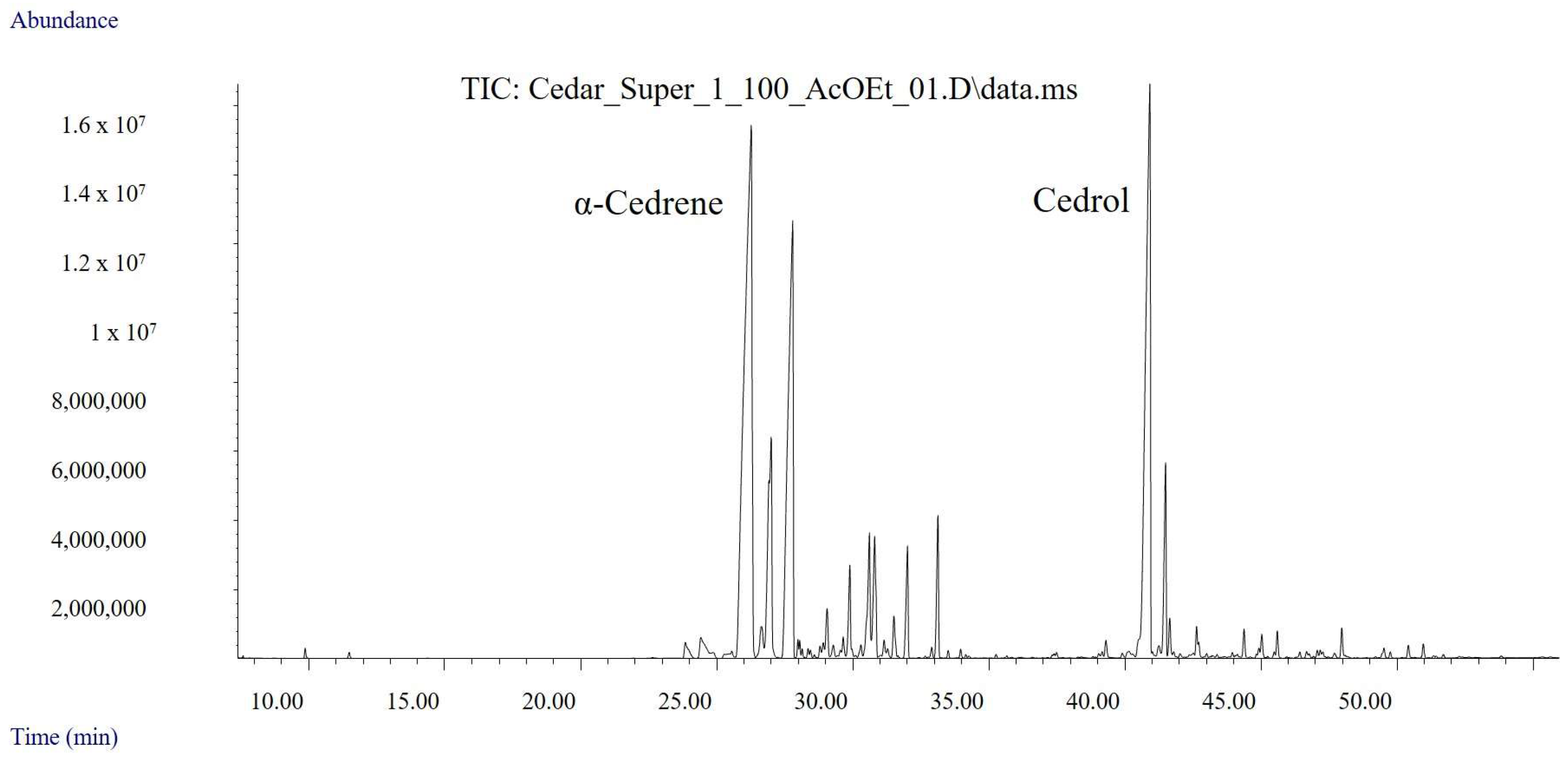
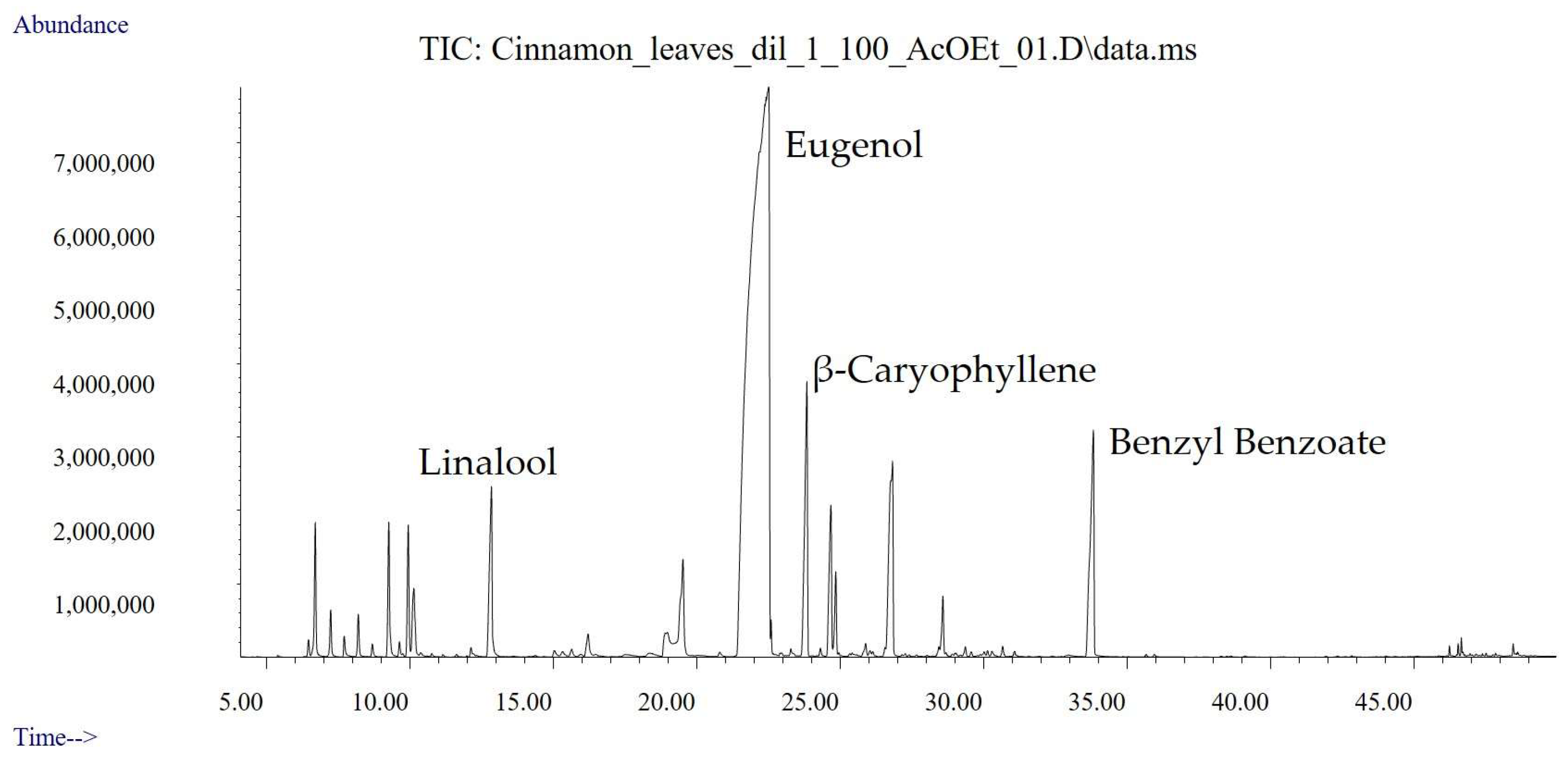
The allergenic content among the EOs and NEs varies notably, ranging from apparently innocuous essential oils such as cedar super (with zero allergens present, Figure 1) to others such as Ylang ylang extra, which contains 14 allergens. The number of allergens varies according to the sample and is independent of the flower or tree origin. In this way, although more allergens were found in the flower EOs, some EOs from trees contained a large number of allergenic substances, as was the case for the cinnamon leaf EO (Figure 2).
Figure 1.
Example of a polar column chromatogram for the cedar super sample, indicating two major compounds.
Figure 2.
Example of a non-polar column chromatogram for the cinnamon leaves sample, indicating some fragrance allergens.
The use of phytomarkers for the presence of a certain EO can greatly facilitate the quality control of cosmetic products containing this EO in their ingredients. Some compounds were identified in a single sample and could therefore be used as unique markers for the presence of a certain EO in a cosmetic product with a label indicating the content of that EO in its composition, facilitating the detection of fraud in the case of its absence. Other compounds could act as origin group markers if they are present only in EOs extracted from trees or flowers.
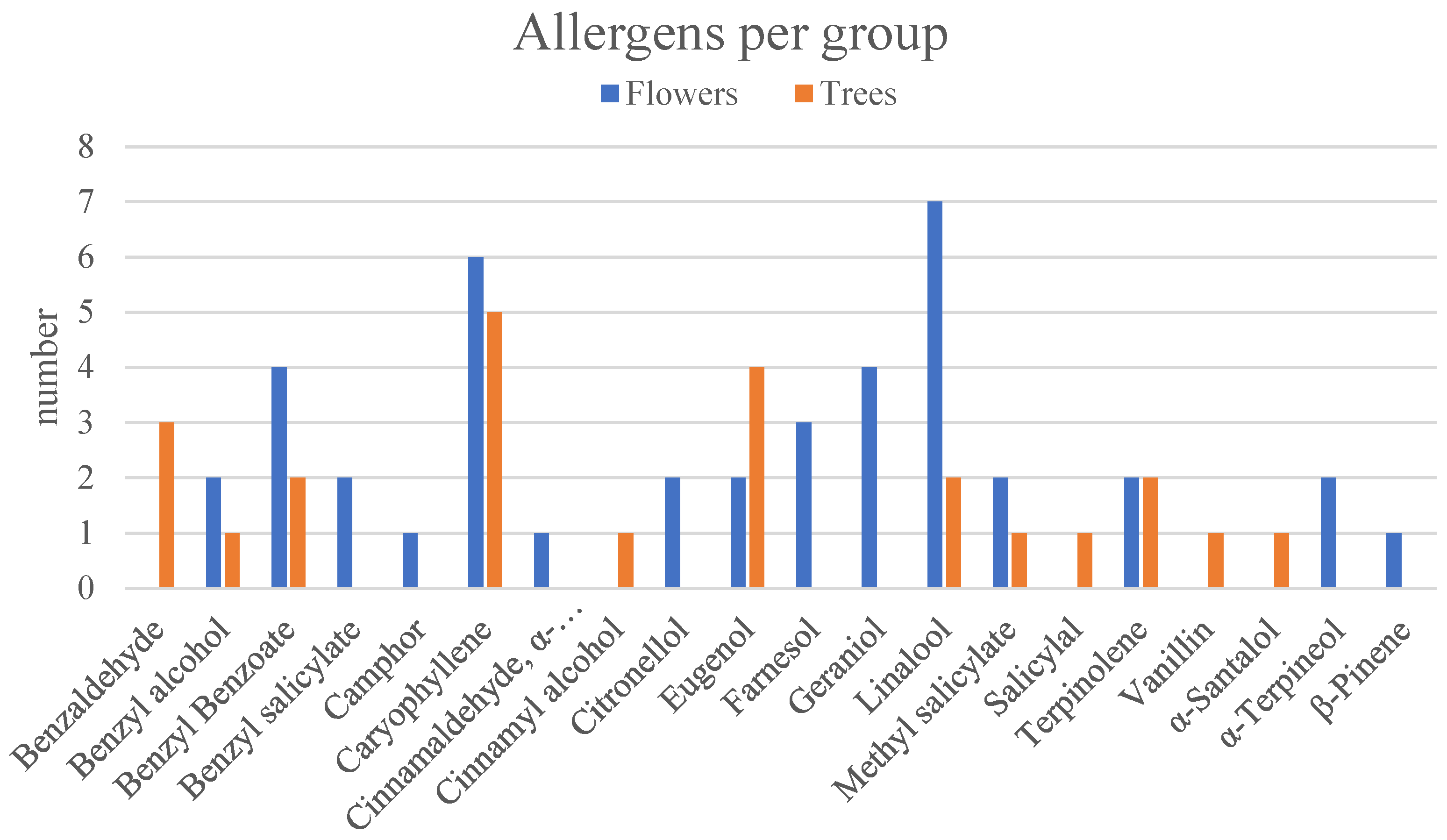
A higher proportion of compounds unique to the species have been identified in samples from the flower group, so they are not useful as markers for the flower group. In addition, most of these compounds are not recognized allergens and therefore do not require follow-up monitoring. Therefore, it seems more interesting to look for group phytomarkers among the compounds whose control is necessary because they are recognized allergens [13]. Figure 3 depicts the occurrence of several allergens according to their origin (flowers or trees).
Figure 3.
Distribution of allergens by the group of origin: flowers (blue) and trees (orange).
The figure shows the abundance of allergens in the analyzed EOs/NEs and also shows that most of the allergens found are ubiquitous substances that do not allow differentiation between the origin groups. The most common allergens are caryophyllene (appearing five times in the tree group and seven times in the flower group), while others are present only once (camphor and cinnamaldehyde in flowers; vanillin and α-santalol in trees). This fact, in addition to supporting the need to characterize the allergenic composition and regulate the use of EOs as natural preservatives due to their possible adverse effects, identifies those allergens with greater validity as sample or group markers.
Allergens found exclusively in the flower group were β-pinene, α-terpineol, geraniol, farnesol, citronellol, α-hexyl-cinnamaldehyde, benzyl salycilate, and camphor, while those exclusive to the tree group were α-santalol, vanillin, salycilal, cinnamyl alcohol, and benzaldehyde. Allergen markers found for specific NEs/EOs were salicylal and cinnamaldehyde in cassia oil, vanillin in Perú oil, α-santalol in Indian sandalwood, levomenthol in geranium Egypt oil, α-hexyl-cinnamaldehyde in jasmine absolute, and citral in rose absolute.
Table 3 shows the allergen composition of the samples and its agreement with the sample SDS. It is important to highlight the discordance between the SDS composition and the results found experimentally.
Table 3.
Allergens identified in the samples. Italics indicate agreement with the safety data sheets.
The fact that natural ingredients are complex mixtures of many chemical constituents, the precise nature of which is often unknown, presents problems regarding their allergic behavior [23]. As a result, their allergenic potency is also unclear. Several natural substances have caused contact allergies [24,25], and most contact fragrance allergens have been classified as moderate skin sensitizers [26]. The mechanisms of action of these substances include skin penetration and autoxidation (prehaptenes). For example, in the case of contact allergy caused by the fragrance terpenes limonene and linalool (identified in the samples considered in this work), both are prehaptenes, which means that pure fragrance chemicals with a low sensitizing power are modified outside the skin by air oxidation, resulting in a higher allergenic potential [27]. For both linalool and limonene, specific compounds formed during their oxidation have been identified as the main causes of sensitization.
Depending on the quality of the starting plant material and the extraction method used, the composition of these volatile natural complex mixtures can be different. These factors will determine their allergenic potential and are also important to ensure their safe use in personal care products. However, other papers listed specific substances studied in the present work as compounds identified in certain essential oils, such as linalool, α-terpineol, and camphor in lavender essential oil [28] or as citronellol, geraniol, citral, and farnesol in rose essential oil [29]. Regarding individual fragrances, eugenol is the main component in clove essential oil; geraniol also occurs naturally in geranium essential oil in lower concentrations, and linalool in cinnamon oil [29]. For cinnamon species, cinnamyl alcohol is commonly found [30].
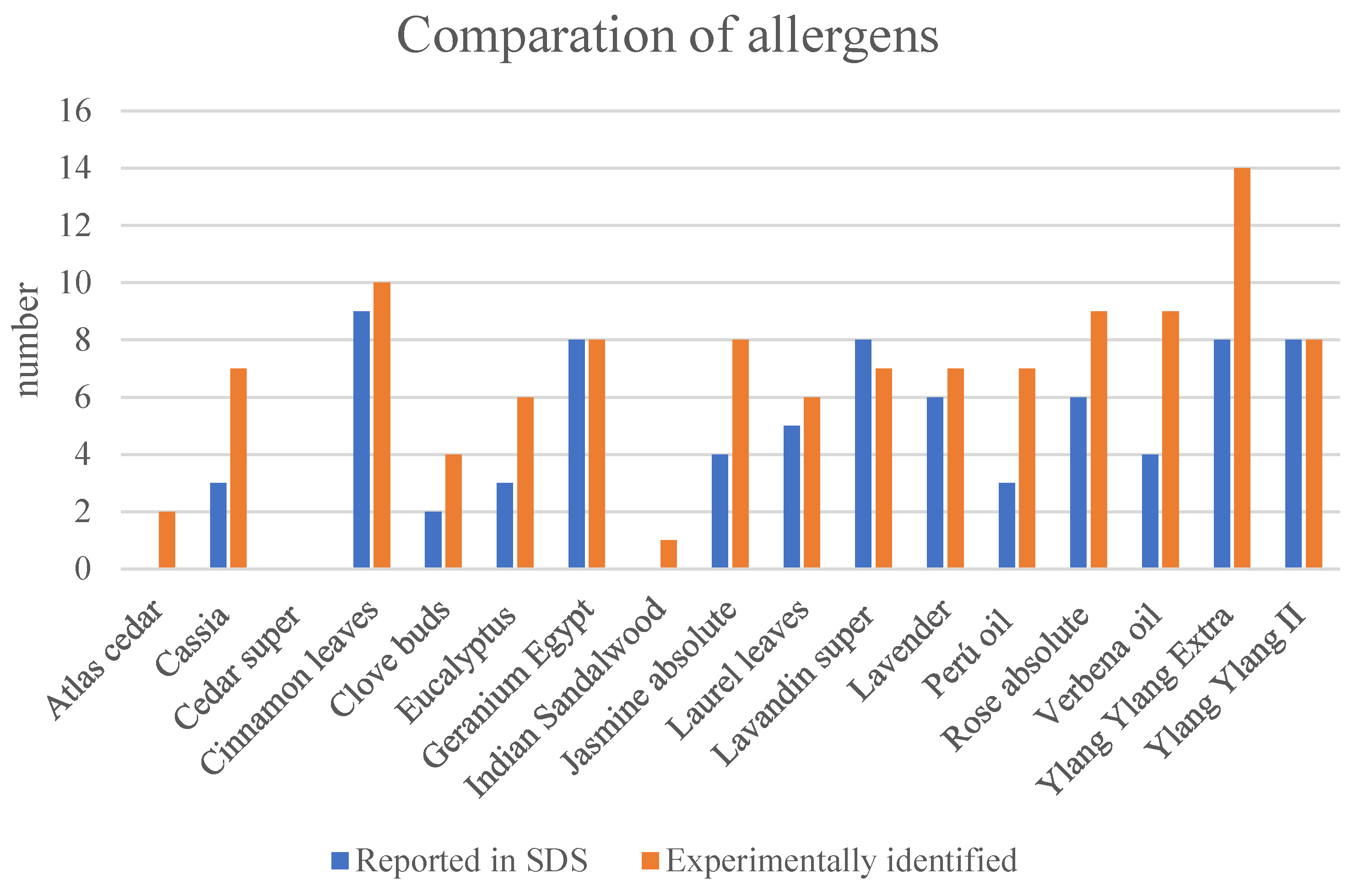
As can be seen in Figure 4, samples generally contain more allergens than declared. The most pronounced difference in allergenic compounds identified experimentally compared to those reported in the SDS is found in the samples, namely Ylang ylang extra and verbena oil, with a difference of six and five, respectively. In other cases, the difference is smaller, as is the case with cinnamon leaves, laurel leaves, and lavender, in which one less compound is reported. In addition, there are some examples, like EOs of Atlas cedar or Indian sandalwood, whose data sheets do not mention any allergens and in whose samples L-α-terpineol and limonene, and α-santalol, respectively, were identified.
Figure 4.
Number of allergens reported in the Eos/Nes corresponding SDS (blue) and identified in this work (orange).
On the contrary, four allergens (linalyl acetate, α-pinene, coumarin, and isoeugenol) are listed in the SDS, but their presence was not detected in the samples. In some cases, this may be because the CAS indicated by the SDS may actually correspond to a racemic mixture, but in others, it was not found in the sample’s analysis.
Fewer compounds were identified using HS-SPME-GC-MS than by direct injection of the diluted samples, but still more compounds were identified than those listed in the SDS for each sample. In terms of the volatile allergenic substances present, cinnamon leaf EO stands out with 14 substances.
Regardless, as demonstrated throughout this study, individual samples of both essential oils and natural extracts contain numerous contact allergens. This poses an added problem, since research has previously demonstrated that exposure to a combination of two contact fragrance allergens has a synergistic effect compared to the expected response by testing with each substance alone [31]. Furthermore, a mixture of contact fragrance allergens has a higher potency with respect to the risk of sensitization compared to exposure to individual sensitizing fragrance substances [32]. Hence the importance of quality control of these innovative natural ingredients in order to ensure the safety of cosmetic and personal care products that incorporate such ingredients.
4. Conclusions
This work provides the basis for the identification of AEs and NEs in cosmetic products, applicable both to the quality control of raw materials and to the detection of possible fraud in procurement and/or labeling. The identification of the allergenic content of 17 samples of AEs and NEs revealed that all samples contained more allergenic substances than those declared in the corresponding safety data sheet. Although the list of samples to be considered could be extended, the results obtained support the creation of a list of specific plant markers for samples obtained from trees or flowers.
Supplementary Materials
The following supporting information can be downloaded at: https://www.mdpi.com/article/10.3390/cosmetics11030084/s1, Table S1: Compounds declared as allergens [13]: chemical formulas and structures.
Author Contributions
Conceptualization, L.R. and M.L.; methodology, L.R.; software, A.P. and L.R.; validation, L.R. and M.L.; formal analysis, L.R.; investigation, A.P. and L.R.; resources, C.G.-J. and M.L.; data curation, L.R. and M.L.; writing—original draft preparation, L.R.; writing—review and editing, C.G.-J. and M.L.; visualization, M.L.; supervision, C.G.-J. and M.L.; project administration, C.G.-J. and M.L.; funding acquisition, C.G.-J. and M.L. All authors have read and agreed to the published version of the manuscript.
Funding
This research was supported by the project ED431B 2023/04 (Galician Competitive Research Groups, Xunta de Galicia, Spain) and was based upon work from the Sample Preparation Study Group and Network, supported by the Division of Analytical Chemistry of the European Chemical Society. All these programs are co-funded by FEDER (EU).
Institutional Review Board Statement
Not applicable.
Informed Consent Statement
Not applicable.
Data Availability Statement
All the reported data are available in the manuscript.
Conflicts of Interest
The authors declare no conflicts of interest.
References
- Klaschka, U. Natural personal care products-analysis of ingredient lists and legal situation. Environ. Sci. Eur. 2016, 28, 8. [Google Scholar] [CrossRef] [Scilit]
- Lundov, M.D.; Moesby, L.; Zachariae, C.; Johansen, J.D. Contamination versus preservation of cosmetics: A review on legislation, usage, infections, and contact allergy. Contact Dermat. 2009, 60, 70–78. [Google Scholar] [CrossRef] [Scilit] [PubMed]
- Halla, N.; Fernandes, I.P.; Heleno, S.A.; Costa, P.; Boucherit-Otmani, Z.; Boucherit, K.; Rodrigues, A.E.; Ferreira, I.C.F.R.; Barreiro, M.F. Cosmetics Preservation: A Review on Present Strategies. Molecules 2018, 23, 1571. [Google Scholar] [CrossRef] [Scilit] [PubMed]
- Alvarez-Rivera, G.; Llompart, M.; Lores, M.; Garcia-Jares, C. Preservatives in cosmetics: Regulatory aspects and analytical methods. In Analysis of Cosmetic Products, 2nd ed.; Elsevier: Amsterdam, The Netherlands, 2018; pp. 175–224. [Google Scholar]
- Schwensen, J.F.; White, I.R.; Thyssen, J.P.; Menné, T.; Johansen, J.D. Failures in risk assessment and risk management for cosmetic preservatives in Europe and the impact on public health. Contact Dematitis 2015, 73, 133–141. [Google Scholar] [CrossRef] [Scilit]
- European Union. Regulation (EC) No 1223/2009 of the European Parliament and of the Council of 30 November 2009 on Cosmetic Products. Eur. Off. J. 2009, L342, 59–209. Available online: https://eur-lex.europa.eu/legal-content/EN/TXT/HTML/?uri=OJ:L:2009:342:FULL&from=EN (accessed on 26 January 2024).
- Lores, M.; Llompart, M.; Alvarez-Rivera, G.; Guerra, E.; Vila, M.; Celeiro, M.; Lamas, J.P.; Garcia-Jares, C. Positive lists of cosmetic ingredients: Analytical methodology for regulatory and safety controls—A review. Anal. Chim. Acta 2016, 915, 1–26. [Google Scholar] [CrossRef] [Scilit] [PubMed]
- Antignac, E.; Nohynek, G.J.; Re, T.; Clouzeau, J.; Toutain, H. Safety of botanical ingredients in personal care products/cosmetics. Food Chem. Toxicol. 2011, 49, 324–341. [Google Scholar] [CrossRef] [Scilit]
- Mahesh, S.K.; Fathima, J.; Veena, V.G. Cosmetic Potential of Natural Products: Industrial Applications. In Natural Bio-Active Compounds; Swamy, M.K., Akhtar, M.S., Eds.; Springer: Berlin/Heidelberg, Germany, 2019; Volume 2, pp. 215–250. [Google Scholar]
- Teixeira, B.; Marques, A.; Ramos, C.; Neng, N.; Nogueira, J.; Saraiva, J.A.; Nunes, M.L. Chemical composition and antibacterial and antioxidant properties of commercial essential oils. Ind. Crops. Prod. 2013, 43, 587–595. [Google Scholar] [CrossRef] [Scilit]
- Sell, C. Perfumery Materials of Natural Origin. In The Chemistry of Fragrances, 2nd ed.; RSC: London, UK, 2006. [Google Scholar]
- Tiên, D.; Francis, H.; Sylvain, A.; Fernandez, X. Authenticity of essential oils. TrAC Trends Anal. Chem. 2014, 66, 146–157. [Google Scholar]
- SCCS (Scientific Committee on Consumer Safety): Opinion on Fragrance Allergens in Cosmetic Products, 26–27 June 2012. Available online: https://ec.europa.eu/health/scientific_committees/consumer_safety/docs/sccs_o_102.pdf (accessed on 26 January 2024).
- European Union. Commission Regulation (EU) 2023/1545 of 26 July 2023 amending Regulation (EC) No 1223/2009 of the European Parliament and of the Council as Regards Labelling of Fragrance Allergens in Cosmetic Products. Eur. Off. J. 2023, L188, 1–23. Available online: https://eur-lex.europa.eu/legal-content/EN/TXT/HTML/?uri=CELEX:32023R1545 (accessed on 26 January 2024).
- Celeiro, M.; Garcia-Jares, C.; Llompart, M.; Lores, M. Recent advances in sample preparation for cosmetics and personal care products analysis. Molecules 2021, 26, 4900. [Google Scholar] [CrossRef] [Scilit] [PubMed]
- Sanchez-Prado, L.; Alvarez-Rivera, G.; Lamas, J.P.; Lores, M.; Garcia-Jares, C.; Llompart, M. Analysis of multi-class preservatives in leave-on and rinse-off cosmetics by matrix solid-phase dispersion. Anal. Bioanal. Chem. 2011, 401, 3293–3304. [Google Scholar] [CrossRef] [Scilit] [PubMed]
- Belhassen, E.; Bressanello, D.; Merle, P.; Raynaud, E.; Bicchi, C.; Chaintreau, A.; Cordero, C. Routine quantification of 54 allergens in fragrances using comprehensive two-dimensional gas chromatography-quadrupole mass spectrometry with dual parallel secondary columns. Part I: Method development. Flavour Fragr. J. 2018, 33, 63–74. [Google Scholar] [CrossRef] [Scilit]
- Rey, A.; Corbi, E.; Pérès, C.; David, N. Determination of suspected fragrance allergens extended list by 2DGC-MS in ready-to-inject samples. J. Chromatogr. A 2015, 1404, 95–103. [Google Scholar] [CrossRef] [Scilit] [PubMed]
- Desmedt, B.; Canfyn, M.; Pype, M.; Baudewyns, S.; Hanot, V.; Courselle, P.; De Beer, J.O.; Rogiers, V.; De Paepe, K.; Deconinck, E. HS-GC-MS method for the analysis of fragrance allergens in complex cosmetic matrices. Talanta 2015, 131, 444–451. [Google Scholar] [CrossRef] [Scilit]
- Tranchida, P.Q.; Maimone, M.; Franchina, F.A.; Bjerk, T.R.; Zini, C.A.; Purcaro, G.; Mondello, L. Four-stage (low-)flow modulation comprehensive gas chromatography-quadrupole mass spectrometry for the determination of recently-highlighted cosmetic allergens. J. Chromatogr. A 2016, 1439, 144–151. [Google Scholar] [CrossRef] [Scilit] [PubMed]
- Cosmetic Ingredient Database. Available online: https://ec.europa.eu/growth/sectors/cosmetics/cosmetic-ingredient-database_en (accessed on 26 January 2024).
- European Commision (EC). No 2006/257/CE: Commission Decision of 9 February 2006 Amending Decision 96/335/EC Establishing an Inventory and a Common Nomenclature of Ingredients Employed in Cosmetic Products. Available online: https://op.europa.eu/en/publication-detail/-/publication/db30de80-11f8-4358-b1d6-e38d6cf96625 (accessed on 26 January 2024).
- Goossens, A. Les allergies de contact aux produits naturels des cosmétiques. Rev. Fr. Allerg. 2015, 55, 171–173. (In French) [Google Scholar] [CrossRef] [Scilit]
- Corazza, M.; Borghi, A.; Gallo, R.; Schena, D.; Pigatto, P.; Lauriola, M.M.; Guarneri, F.; Stingeni, L.; Vincenzi, C.; Foti, C.; et al. Topical botanically derived products: Use, skin reactions, and usefulness of patch tests. A multicenter Italian study. Contact Dermat. 2014, 70, 90–97. [Google Scholar] [CrossRef] [Scilit]
- Jack, A.R.; Norris, P.L.; Storrs, F.J. Allergic Contact Dermatitis to Plant Extracts in Cosmetics. Semin. Cutan. Med. Surg. 2013, 32, 140–146. [Google Scholar] [CrossRef] [Scilit]
- Uter, W.; Johansen, J.D.; Börje, A.; Karlberg, A.-T.; Lidén, C.; Rastogi, S.; Roberts, D.; White, I.R. Categorization of fragrance contact allergens for prioritization of preventive measures: Clinical and experimental data and consideration of structure-activity relationships. Contact Dermat. 2013, 69, 196–230. [Google Scholar] [CrossRef] [Scilit]
- Karlberg, A.T.; Börje, A.; Duus Johansen, J.; Lidén, C.; Rastogi, S.; Roberts, D.; Uter, W.; White, I.R. Activation of non-sensitizing or low-sensitizing fragrance substances into potent sensitizers—Prehaptens and prohaptens. Contact Dermat. 2013, 69, 323–334. [Google Scholar] [CrossRef] [Scilit] [PubMed]
- Sarkic, A.; Stappen, I. Essential oils and their single compounds in cosmetics-A critical review. Cosmetics 2018, 5, 11. [Google Scholar] [CrossRef] [Scilit]
- Verma, R.S.; Padalia, R.C.; Chauhan, A.; Singh, A.; Yadav, A.K. Volatile constituents of essential oil and rose water of damask rose (Rosa damascena Mill.) cultivars from North Indian hills. Nat. Prod. Res. 2011, 25, 1557–1584. [Google Scholar] [CrossRef] [Scilit]
- Wang, R.; Wang, R.; Yang, B. Extraction of essential oils from five cinnamon leaves and identification of their volatile compound compositions. Innov. Food. Sci. Emerg. Technol. 2009, 10, 289–292. [Google Scholar] [CrossRef] [Scilit]
- Johansen, J.D.; Skov, L.; Volund, A.; Andersen, K.; Menné, T. Allergens in combination have a synergistic effect on the elicitation response: A study of fragrance-sensitized individuals. Br. J. Dermatol. 1998, 139, 264–270. [Google Scholar] [CrossRef] [Scilit]
- Bonefeld, C.M.; Nielsen, M.M.; Rubin, I.M.C.; Vennegaard, M.T.; Dabelsteen, S.; Gimenéz-Arnau, E.; Lepoittevin, J.-P.; Geisler, C.; Johansen, J.D. Enhanced sensitization and elicitation responses caused by mixtures of common fragrance allergens. Contact Dermat. 2011, 65, 336–342. [Google Scholar] [CrossRef] [Scilit] [PubMed]
Disclaimer/Publisher’s Note: The statements, opinions and data contained in all publications are solely those of the individual author(s) and contributor(s) and not of MDPI and/or the editor(s). MDPI and/or the editor(s) disclaim responsibility for any injury to people or property resulting from any ideas, methods, instructions or products referred to in the content. |
© 2024 by the authors. Licensee MDPI, Basel, Switzerland. This article is an open access article distributed under the terms and conditions of the Creative Commons Attribution (CC BY) license (https://creativecommons.org/licenses/by/4.0/).