


Abstract
Ageing significantly affects the long-term durability of asphalt pavements, yet quantitative correlations between laboratory ageing protocols and actual field ageing remain insufficiently defined. This study investigates the ageing behaviour of an 80/100 penetration-grade bitumen at binder, mixture, and field levels to establish equivalence relationships among different ageing pathways. Binder samples were subjected to RTFO, PAV (20–60 h), and coupled thermal–photo-oxidative ageing (RTFO + PAV + UV, 6–18 d). Asphalt mixtures were oven-aged at 85 °C for 5–10 d, followed by binder extraction and recovery, and field-aged binders were obtained from a 12-year-old pavement in Xinjiang, China. Rheological properties were characterised using frequency sweep and multiple stress creep and recovery tests, from which ageing index (AI), low-temperature ageing index (LAI), Glover–Rowe (G–R) parameter, and nonrecoverable compliance (Jnr) were derived. AI increased from 1.00 for virgin binder to 1.12 under coupled ageing, while G–R increased from near zero to 318 kPa after 60 h PAV ageing and exceeded 400 kPa under coupled ageing. UV exposure increased G–R by approximately 20%–65% relative to thermal ageing alone. Nonlinear growth models described property evolution with high reliability (R2 = 0.995–0.999). Equivalent ageing analysis showed that RTFO + PAV required over 50 h to reproduce field ageing, whereas coupled ageing and mixture oven ageing achieved comparable states within shorter durations. These results demonstrate that photo-oxidation and mixture-scale interactions significantly influence ageing pathways and should be considered in laboratory simulations of field ageing.
1. Introduction
Ageing is one of the most critical contributors to the performance deterioration of bitumen and asphalt pavements [1]. Owing to the ageing of bitumen, asphalt pavements get more susceptible to distresses such as thermal cracking, map cracking, ravelling, and moisture damage [2]. Subsequently, pavements need to be milled, repaired, and reconstructed. Globally, there are millions of tons of waste pavement materials, termed reclaimed asphalt pavement (RAP) materials, being generated annually. For example, around 230 million tons in China, 95 million tons in the United States, 17 million tons in Italy, 14 million tons in Germany, and 5 million tons in the United Kingdom are produced [3,4,5]. These materials cause significant demands for recycling and landfilling, inducing serious environmental and financial pressures for the public and authorities [6].
Oxidation is the primary attribute of ageing, involving a chemical reaction between the atmospheric oxygen and bitumen. This reaction results in two major changes: a large difference in the ratio between molecule sizes and the ratio of polar and non-polar compounds, which reduces solubility and ductility, consequently diminishing the bitumen’s performance [7,8]. Steric hardening is the secondary contributing factor to bitumen ageing, occurring within the long-term ageing. The process is a slow-developing, heat-reversible hardening that impacts the molecular structure of the binder, building the asphaltenes’ structure over time. This phenomenon causes densification of the molecules within bitumen, hence reducing the free volume, resulting in an increased stiffness of the material. In addition to impacting the molecular structure of bitumen, steric hardening can alter the chemical composition, tending to increase asphaltenes and decrease maltenes [9,10]. The four fractions (saturates, aromatics, resins, and asphaltenes, termed SARA) of bitumen evidently change in a predictable manner: a consistent increase in asphaltenes and a minor but still consistent increase in resins. The aromatics saw a sharp decrease, and the only exception to the consistency of the results is the saturates, as they seem to fluctuate slightly. The decline in content of aromatics contributes to a reduction in ductility and other elastic properties, eventually leading to cracking and failure [11,12,13,14].
The viscoelastic properties are mainly impacted during the ageing process. One of the prominent viscoelastic properties of bitumen is phase angle, which is a measure of the lag between the stress and the corresponding strain response in the bitumen [15]. Ageing undesirably increases the phase angle, hindering the bitumen’s ability to dissipate energy. This inability to efficiently dissipate energy further impacts the bitumen by reducing its capacity to recover from creep. Hence, constant loading has an increased impact on the pavement, leading to earlier failure. Other viscoelastic properties impacted are both elasticity and viscosity, which are decreased and increased respectively, in turn increasing hardness and likelihood of cracking [16,17,18].
As the field ageing of bitumen is normally very slow, researchers have developed some standardised and bespoke methods and protocols for accelerating ageing processes for research purposes. Such methods include rolling thin film oven (RTFO) for simulating short-term ageing during mixing, transferring, and paving processes, and pressure ageing vessel (PAV) for simulating ageing during the lifespan of an asphalt pavement. Some more advanced technologies are also employed to incorporate more factors into the ageing process, such as UV, ozone and other reactive oxidative species [19,20,21]. In terms of ageing of asphalt mixtures, generally researchers follow the AASHTO R30 standard, involving two hours of oven ageing of loose mixtures at 135 °C for short-term ageing, followed by several days of oven ageing of loose mixtures or compacted specimens at 85 or 95 °C for long-term ageing, with exact parameters being determined in accordance with local climate [22,23,24]. Moreover, the field ageing of asphalt mixtures and extracted are also investigated to identify the differences between field ageing and laboratory ageing [25].
Overall, ageing behaviours and mechanisms of bitumen are well investigated and understood. However, a critical research gap is the correlations between binder ageing, mixture ageing, and field ageing. The current research mainly focuses on a single scale of ageing while overlooking its mutual connections. Lacking correlation investigation results in a mismatch of laboratory and field results, making the laboratory research a poor representation of real-world situations. In relation to this, the work described in this paper aims to investigate the ageing behaviour of bitumen throughout scales to reveal the correlation between varying ageing protocols. Bitumen will first be subjected to laboratory ageing for both thermal and photo-oxidative protocols. After that, the same binders will be employed to produce asphalt mixtures, and the specimens will be subjected to ageing as well. Subsequently, bitumen will be extracted from the mixtures and subjected to testing. Lastly, asphalt samples will be collected from fields, and the binders will be extracted as well to investigate the properties of real-world aged binders. This study will provide a comprehensive understanding of the representativeness of laboratory investigations and real-world situations, providing robust evidence for bitumen ageing research and potentially guiding the revisions and modifications of current standards and specifications.
2. Materials and Methods
2.1. Materials
The bitumen employed in this study was a penetration-grade 80/100 binder, with a penetration of 85 (0.1 mm), penetration index of −0.85, and softening point of 46.5 °C. Both coarse aggregates and fine aggregates were limestone, and the filler was limestone powder. For the manufacturing of the asphalt mixture, the binder was identical to that employed in binder ageing. Moreover, both binder and aggregates were identical to those used in the site surveyed in this study, which is in Xinjiang, China.
2.2. Testing Procedures
2.2.1. Laboratory Ageing of Bitumen
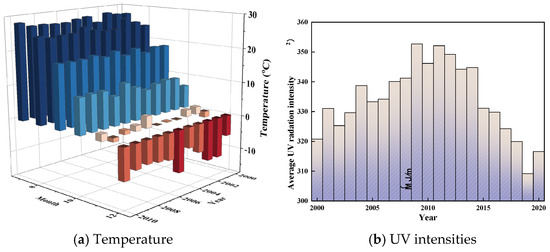
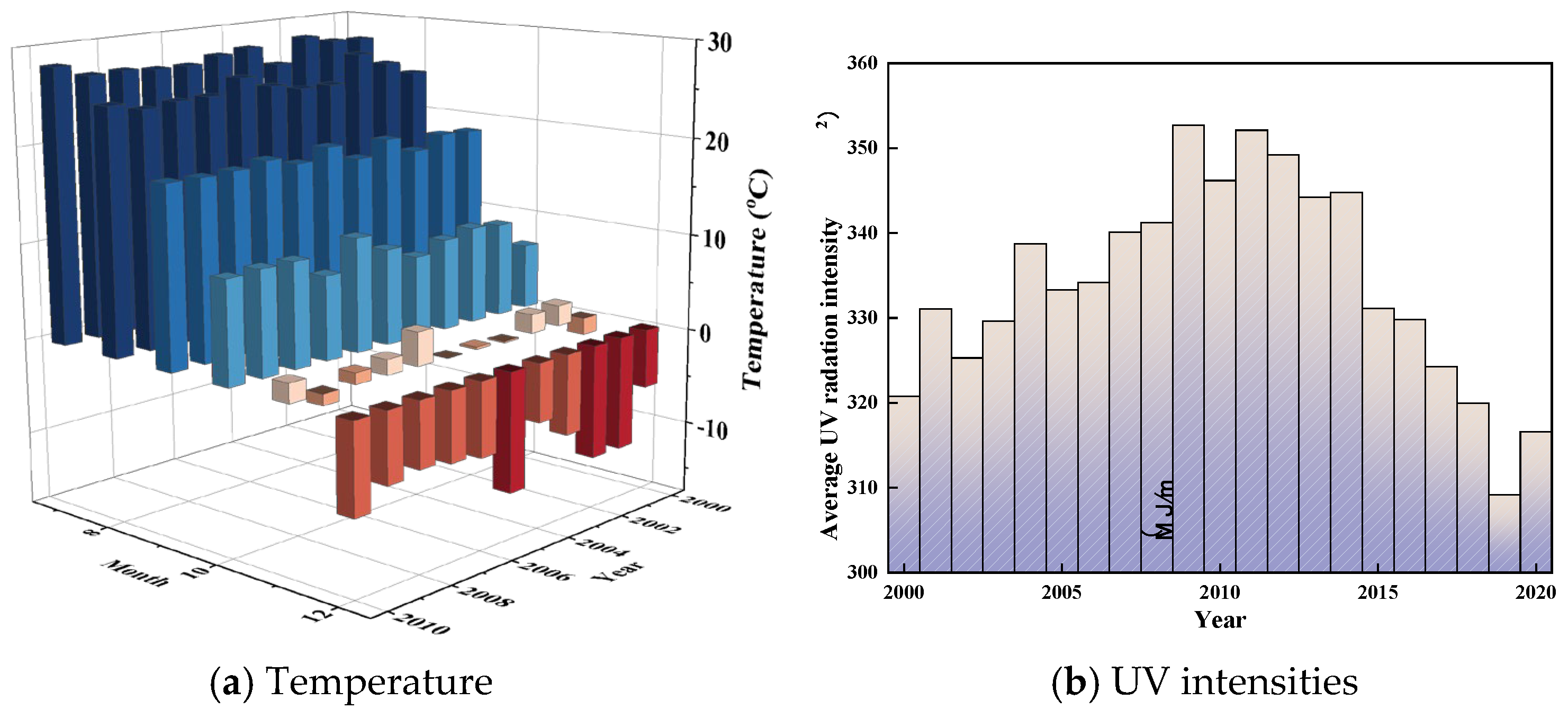
Bitumen was subjected to both thermal and photo-oxidative ageing in this study. Firstly, the bitumen was subjected to short-term ageing using a rolling thin film oven (RTFO) (Matest, Treviolo, Italy) for 85 min at 163 °C, following the ASTM D2872-22 standard [26]. Afterwards, the short-term aged binders were subjected to long-term ageing using a pressure ageing vessel (PAV) at 2.1 MPa and 100 °C for 20 h, 40 h, and 60 h, respectively, following the ASTM D6521-22 standard [27]. To simulate photo-oxidative ageing, UV lamps within a bespoke UV chamber were employed in this study. Before determining the UV intensity of the lamps, a meteorological investigation was carried out to ensure that the laboratory experiments were good representations of field situations. The climate information of the site location during past 20 years is illustrated in Figure 1.
Figure 1.
Climate information (temperature and UV intensities) of the site location.
Based on the capacity of the UV chamber, it has been determined that averagely 1.5-day of laboratory UV ageing could represent 1-year of natural ageing in the field. Moreover, it has been reported that 20 h of PAV ageing in the laboratory could induce a similar effect as appropriately 4-year field ageing [28,29]. To match the thermal ageing with photo-oxidative ageing, 6 days of UV ageing was coupled with every 20 h of PAV ageing; for instance, couple ageing 1 (CA1) stands for 85 min of RTFOT plus 20 h of PAV plus 6 days of UV ageing. The configuration of testing samples is summarised in Table 1.
Table 1.
Configuration of testing samples.
2.2.2. Laboratory Ageing of Asphalt Mixtures
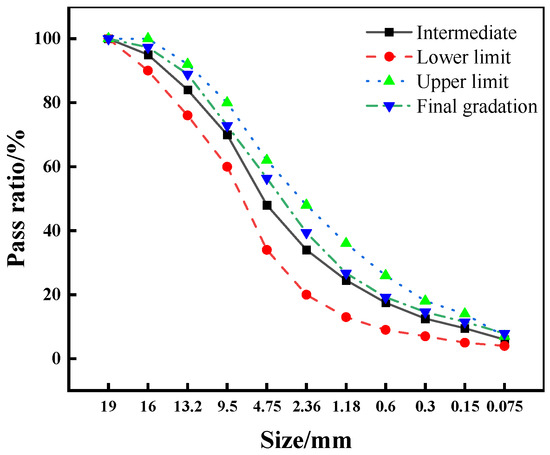
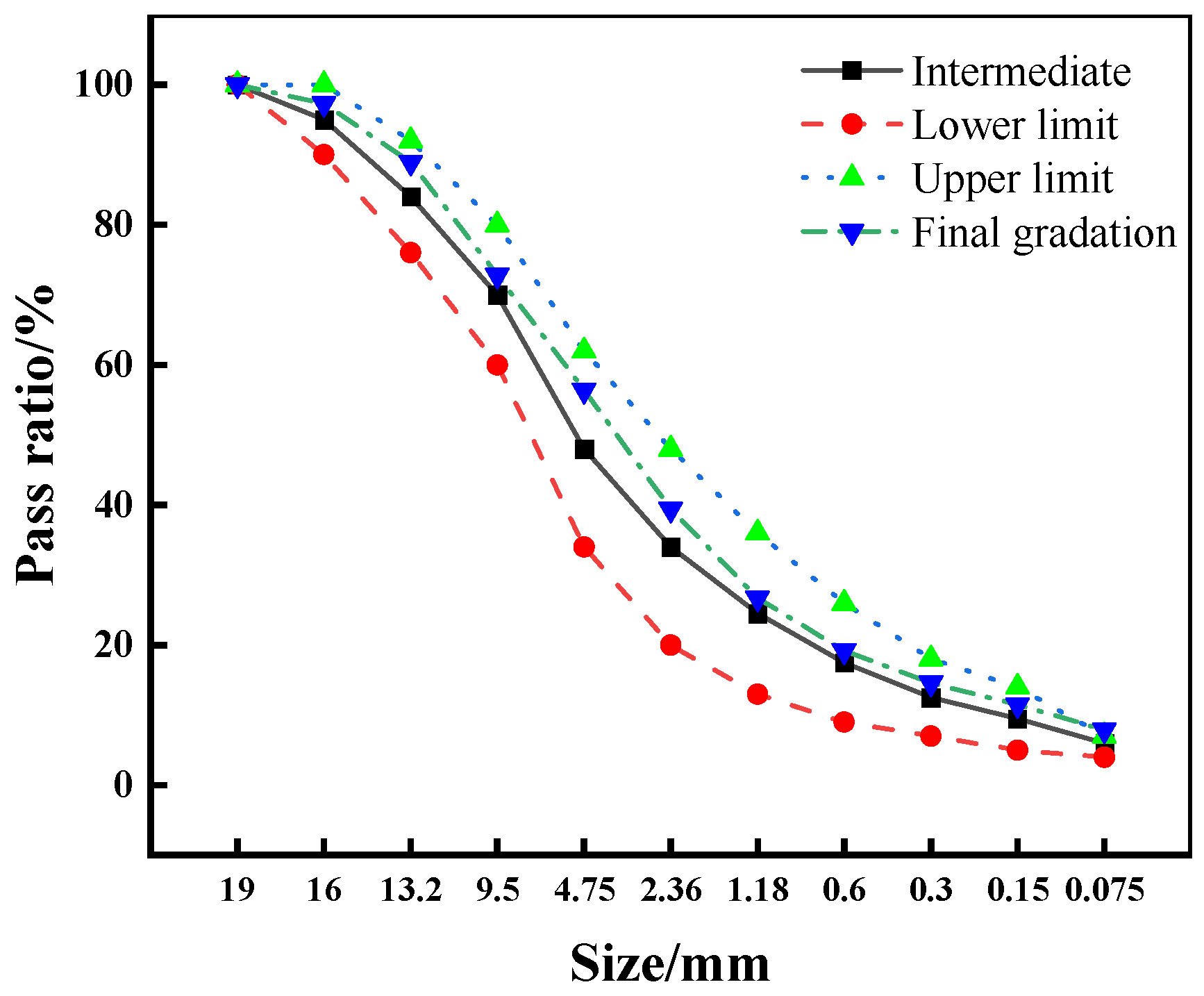
Based on preliminary tests, the optimal binder-to-aggregate ratio was determined to be 4.4%, which means that the mass of the bitumen was 4.4% of that of the aggregates. The gradation of the mixtures is shown in Figure 2.
Figure 2.
Gradation of asphalt mixtures.
For the short-term ageing, loose asphalt mixtures were subjected to a draft oven at 135 °C for two hours, in accordance with the AASHTO R30-22 standard [22]. Afterwards, the loose asphalt mixtures were compacted to cylindrical specimens using a Marshall compactor, following ASTM D6926-20 standard [30]. Subsequently, the compacted specimens were subjected to long-term ageing using a draft oven at 85 °C for 120 h, 180 h, and 240 h, respectively.
2.2.3. Filed Extraction and Sampling
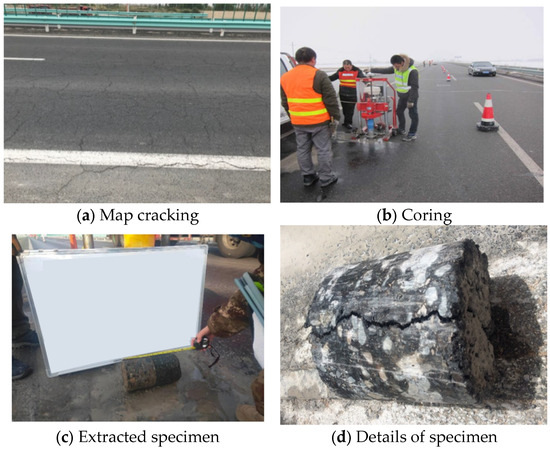
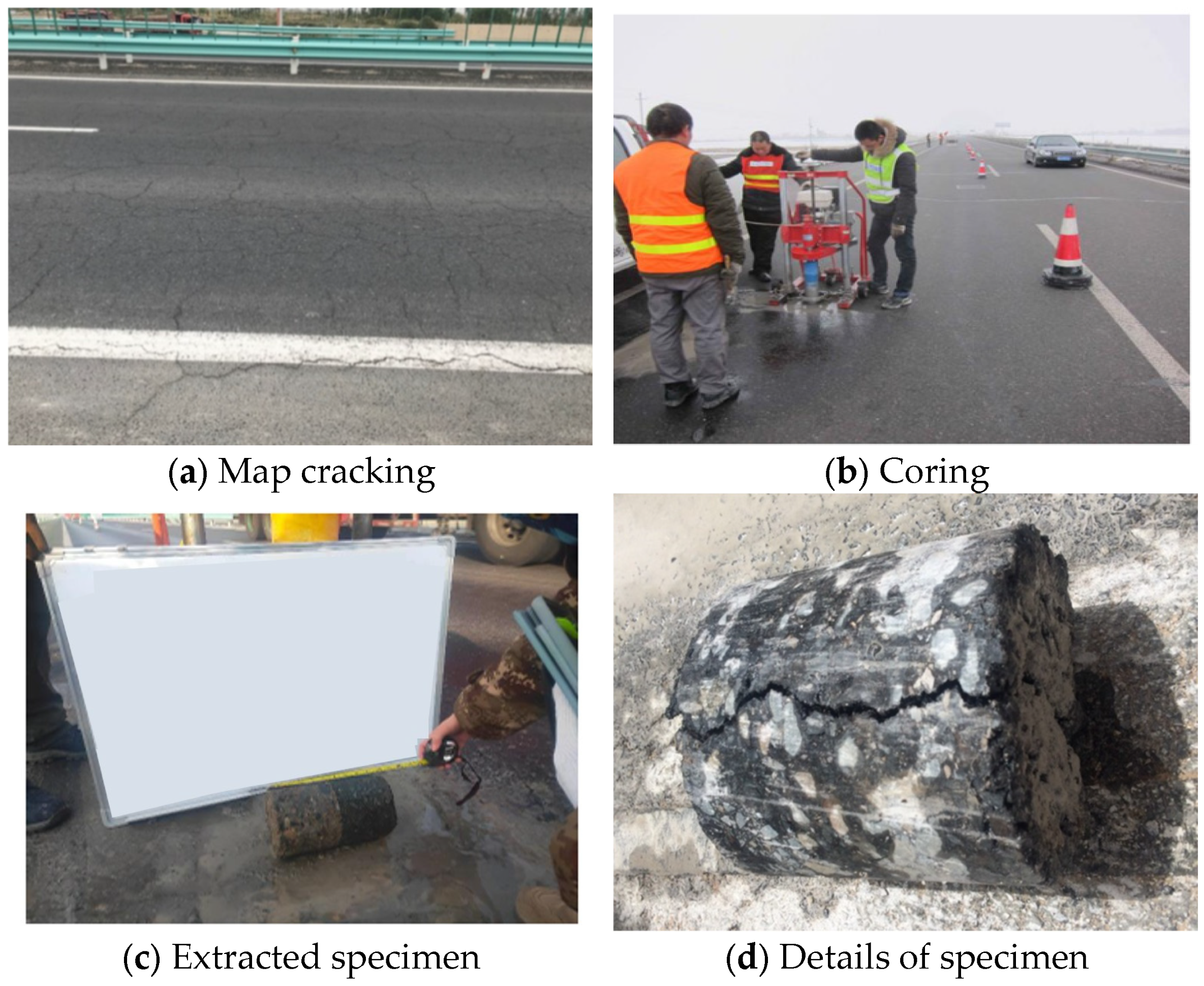
Samples were cored and extracted from field sites to evaluate the ageing behaviour of bitumen. The samples were collected from a 12-year-old asphalt pavement in Xinjiang, China. The pavement had a semi-rigid base structure and a 4 cm SMA-13 wearing course and was located at an altitude of approximately 1500 m. The sample collection process is illustrated in Figure 3.
Figure 3.
Sampling of specimens at site.
2.2.4. Binder Recovery
For the laboratory-aged asphalt mixtures and field-collected samples, the specimens were broken into small pieces after mechanical tests. Afterwards, they were dried at 110 °C to remove moisture, especially for the field-collected samples. Subsequently, the bitumen was dissolved using trichloroethylene solvent for 30 min, and then aggregates and fillers were separated from the bitumen solution by centrifuging and filtering, as described in the ASTM D2171M-24 standard [31]. Finally, the solvent from the solution was evaporated by the Abson method and binders were recovered following ASTM D1856-25 standard [32].
2.2.5. Rheological Properties Characterisation
Multiple stress creep recovery (MSCR) tests and frequency sweep tests were carried out to assess the rheological properties of bitumen. For the MSCR tests, the testing temperature was 64 °C, which was identical to its high-temperature performance grade (PG), as specified in the ASTM D7405-24 standard [33]. For the frequency sweep tests, the testing temperatures ranged from 10 °C to 70 °C, with increments of 10 °C. The frequencies ranged from 0.1 Hz to 10 Hz, with 10 data points per decade (21 data points in total at each temperature). Based on preliminary amplitude sweep test, the strain level for the unaged bitumen was 0.5%, and for the aged and recovered binders was 0.1%, to ensure that all the samples were in the linear viscoelastic range throughout all the testing temperatures.
2.3. Data Processing Methods
2.3.1. Multiple Stress Creep Recovery
The strain was measured and collected from the tests. Based on the value, nonrecoverable compliance (Jnr) and recovery percentage (%R) could be calculated, as specified in the ASTM D7405 standard. Moreover, Jnr-slope (in kPa−1), which represents the stress sensitivity of bitumen, can be calculated using Equation (1).
2.3.2. Frequency Sweep
One of the benefits of frequency sweep tests is using limited measured values to predict unlimited data of interest. Based on the results, master curves could be built using the 2S2P1D model (2 springs, 2 parabolic elements, and 1 dashpot) [34,35]. In this study, 25 °C was selected as the reference temperature, and then the measured data was shifted horizontally based on the William–Landel–Ferry (WLF) equation, as shown in Equation (2).
where αT is the shifting factor, dimensionless; T is the testing temperature, in °C; Tref is the reference temperature, which is 25 °C in this study; and C1 and C2 are fitting parameters which could be determined using the Solver function built into Excel software.
Based on the 2S2P1D model and the WLF equation, the master curves of complex modulus of bitumen could be constructed, as illustrated in Equation (3).
where G0 is the static modulus, which equals 0 when Ꞷ approaches 0, and equals the glassy modulus when Ꞷ approaches ∞. h and k are exponents, with the relationship of 0 < k < h < 1; δ is a dimensionless constant; and i is the complex number, i.e., i2 = −1; and τ is the characteristic time, varying with temperature.
The complex modulus (G*, in Pa) consists of real (storage) modulus (G’) and imaginary (loss) modulus (G’’), respectively, as defined in Equation (4).
Subsequently, Equation (3) can be rewritten as Equation (5) with the incorporation of Equation (4):
where parameters A and B were simplified factors, with their true values being calculated in accordance with Equations (6) and (7).
Based on the definition of phase angle, in degrees, the lag between the stress and strain, and the relationship between real and imaginary moduli, the master curves of phase angle can be calculated using Equation (8).
It is recognised that the Glover–Rowe (G-R) parameter (in Pa) can be employed to represent the ductility and durability of bitumen at intermediate temperature during the lifespan of asphalt pavements. The G-R parameter can be calculated based on the results of frequency sweep and shifted master curves, as per Equation (9). It should be noted that the reference temperature for the G-R parameter is 15 °C, and the frequency should be 0.005 rad/s [36,37].
2.3.3. Ageing Indices
Bitumen is a temperature-sensitive material. At high temperatures, the main concern is permanent deformation resistance, also named rutting resistance. MSCR was employed to assess the high-temperature performance by means of nonrecoverable compliance (Jnr) and recovery percentage (%R). Lower values of Jnr and Jnr-slope, and higher values of %R are preferable, as they represent stronger capacity to resist deformation, and stronger capacity to recover after deformation [38,39].
Fatigue performance of bitumen is closely related to the durability of asphalt pavements. In this study, the G-R parameter was employed to characterise the intermediate-temperature-related fatigue performance. A G-R parameter lower than 180 kPa suggests that the binders are durable and free of cracking-related distress. A G-R parameter between 180 kPa and 600 kPa suggests that the binders initiate microcracking and are subject to significant cracking risk. Once the G-R parameter exceeds 600 kPa, significant cracking is expected [40,41].
As master curves cover the whole temperature range of the rheological properties of bitumen, they can be employed to assess the comprehensive ageing degrees of bitumen. Moreover, based on the time–temperature superposition principle, low-temperature frequency range reflects the high-temperature performance of binders, while high-temperature frequency range reflects the low-temperature performance [42]. On this basis, the low-temperature performance can be evaluated by the high-frequency range master curves. As ageing significantly deteriorates the low-temperature performance of bitumen, the low-temperature ageing index (LAI) was specifically evaluated, together with the comprehensive ageing index (AI) covering the complete range. The calculations of two ageing indices are shown in Equations (10) and (11) [43,44].
3. Results and Discussion
3.1. Surface Morphological Properties of Bitumen
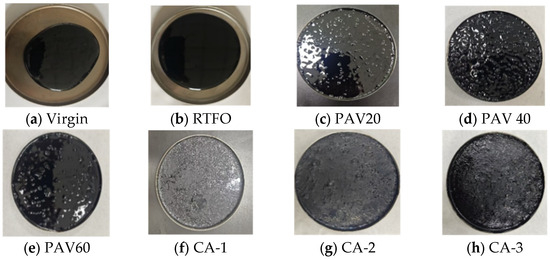
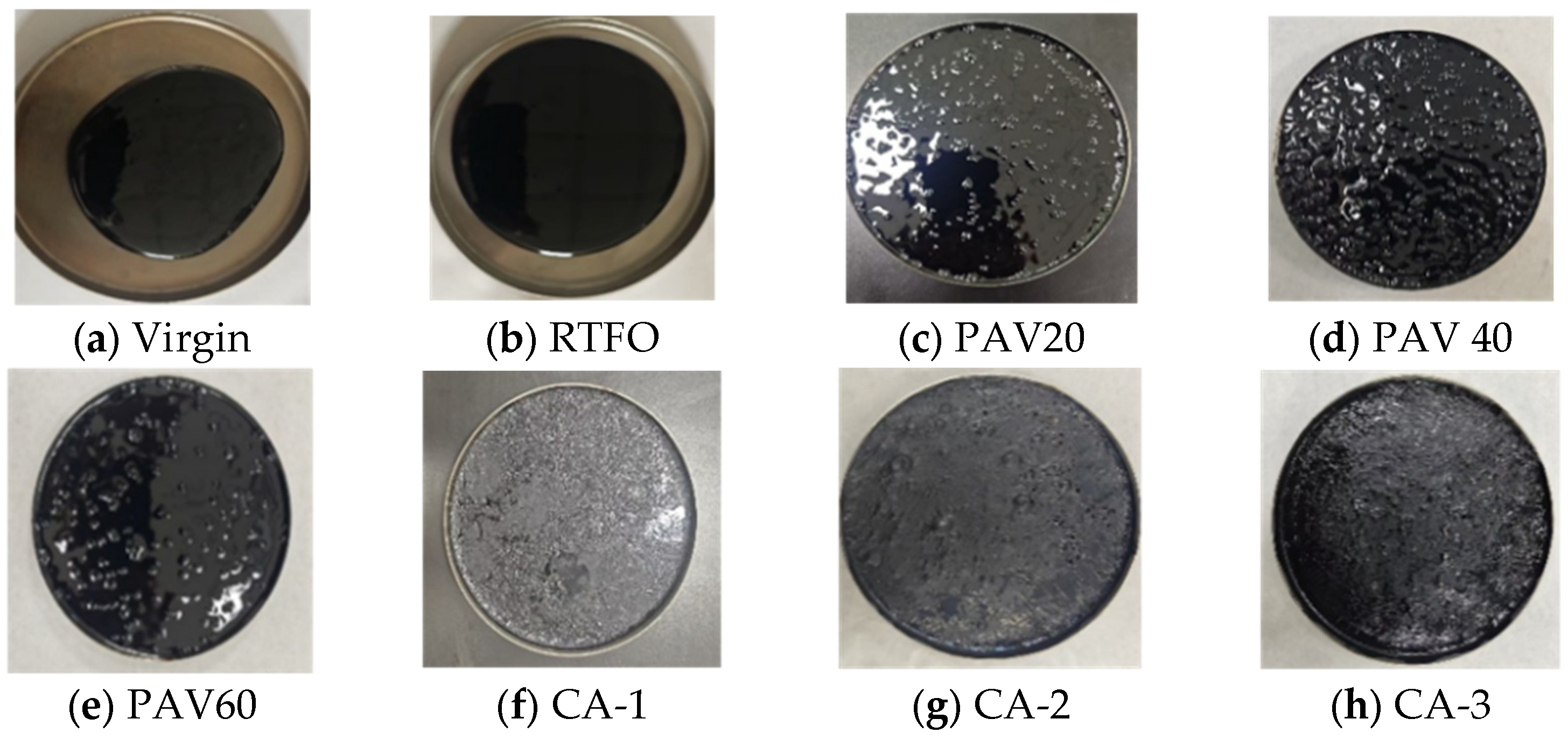
The pictures of all the samples with varying ageing situations are shown in Figure 4. Before ageing and after short-term ageing, the surfaces of binders were flat and smooth. After long-term ageing by PAV, there were some bubbles being generated on the surfaces, but the texture was shiny and bright. However, after the incorporation of UV, the bubbles disappeared, and there was a very “dry” thin film on the surface of the binders. The morphological structures of the binders suggested that the incorporation of photo-oxidation altered ageing pathways of the binders, which will be analysed in the following sections.
Figure 4.
Images of laboratory-aged binders with different ageing protocols.
3.2. Performance Evolution of Laboratory-Aged Binders
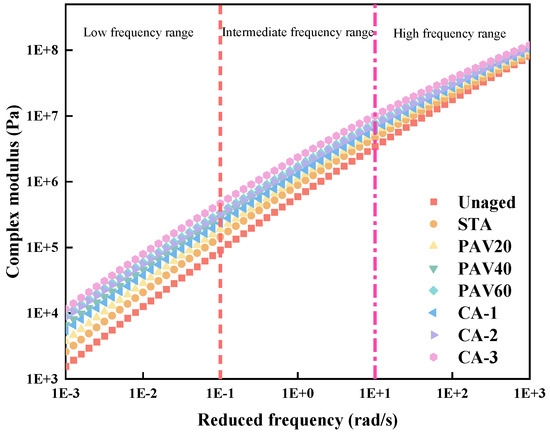
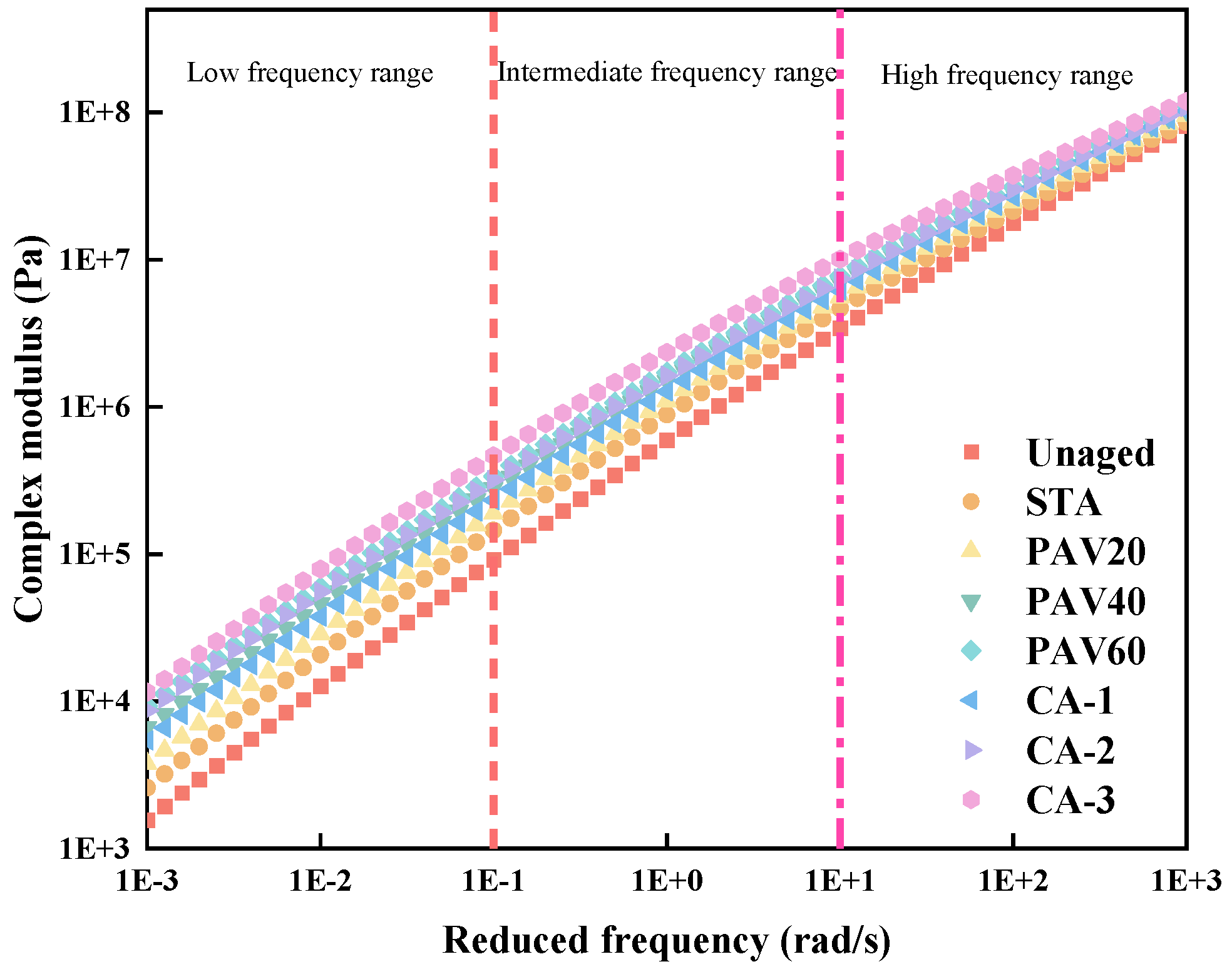
The master curves of the complex modulus of the binders are shown in Figure 5.
Figure 5.
Master curves of complex modulus.
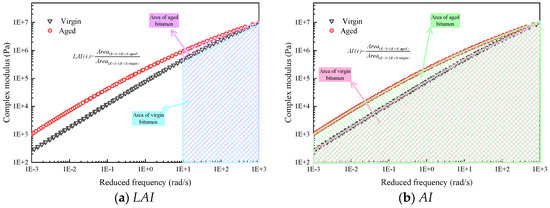
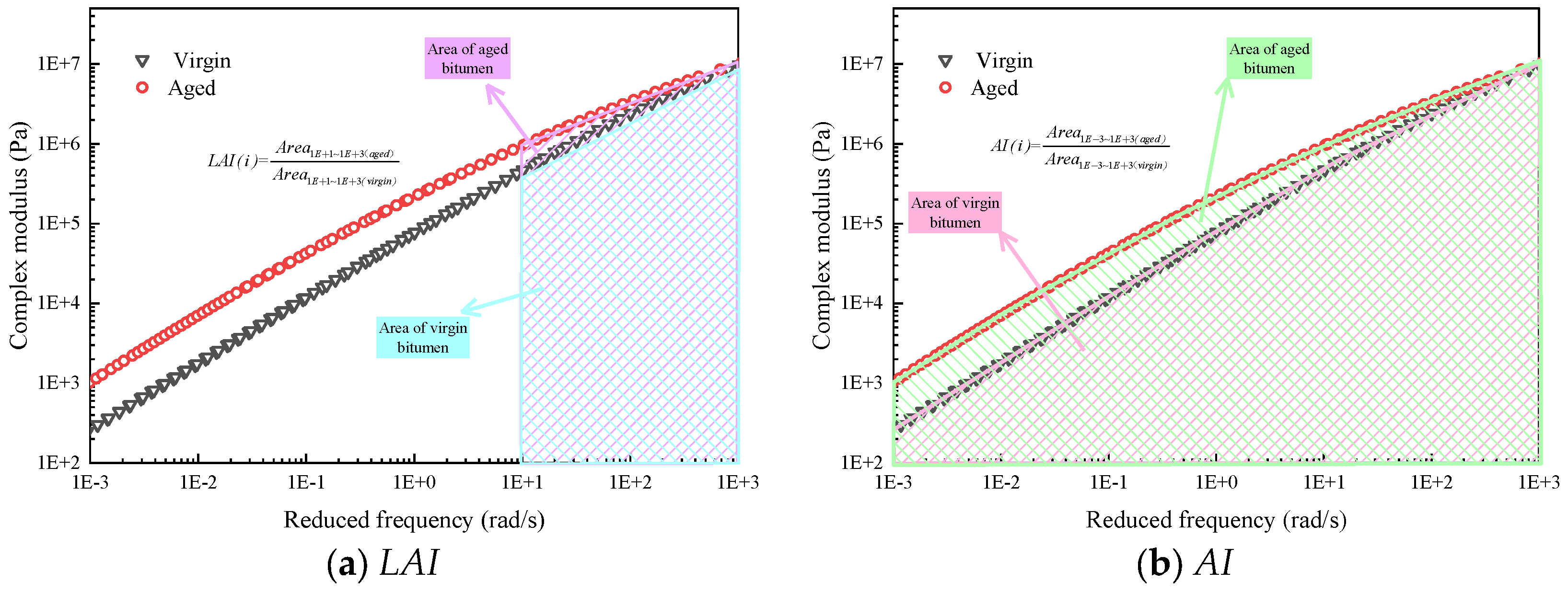
Clearly, it can be seen from Figure 5 that the master curves of the laboratory-aged binders were following the same trend. With increasing frequency, the modulus of the binders increased nearly linearly in double-log scale, suggesting the temperature-dependent properties of the binders. Specifically, with deepening ageing levels, the master curves moved upwards, reflecting the stiffening effect caused by ageing, which was quantitatively evaluated using ageing indices. It is noteworthy that UV ageing had a significant impact on the stiffness of the binders, indicated by a more severe increase in modulus compared to the reference thermal-aged binders. To quantitatively characterise the ageing degrees of bitumen, ageing indices for both the complete temperature range and the low-temperature range were calculated. The schematic for calculating these parameters is shown in Figure 6.
Figure 6.
Temperature-related ageing indices.
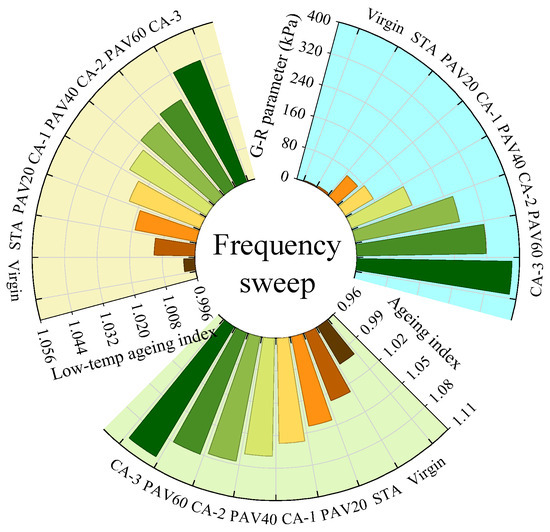
Figure 7 presents the ageing index, low-temperature ageing index, and G-R parameters. All these results were calculated based on the frequency sweep tests.
Figure 7.
Parameters determined by frequency sweep.
As illustrated in Figure 7, the frequency sweep results showed a clear and systematic evolution of rheological behaviour with increasing ageing severity. Compared with the virgin binder, all the aged binders exhibited higher complex modulus across the entire frequency range, confirming progressive stiffening due to ageing. This stiffening is more pronounced at low frequencies, indicating a reduced ability of the binder to relax stresses under long loading times and a shift towards more elastic, brittle-dominated behaviour [41]. Such a trend is consistent with oxidation-driven compositional changes, including maltene depletion, asphaltene generation and aggregation, and enhanced molecular association [1].
Ageing increased the cracking susceptibility of bitumen significantly, and UV ageing contributed to the susceptibility considerably. For the G-R parameters, they are approximately zero for the unaged and short-term aged samples, suggesting a very low risk of non-loading-related cracking at this stage. Afterwards, the G-R parameters increased gradually with deepening ageing degrees, almost doubled with every 20 h of PAV ageing, and reached 69 kPa, 158 kPa and 318 kPa, respectively after 20 h, 40 h and 60 h of PAV ageing. Notably, UV ageing remarkably magnified the increase in G-R parameters, especially for the prolonged ageing durations.
Statistical analysis was conducted to evaluate the effect of UV ageing on the evolution of the G-R parameter by comparing the binders subjected to thermal–oxidative ageing only with those exposed to coupled thermal–oxidative and UV ageing. Given the experimental design, the CA binders were treated as paired counterparts of the corresponding PAV-aged binders, namely PAV20 versus CA1, PAV40 versus CA2, and PAV60 versus CA3. This pairing reflects the fact that UV ageing was applied on top of an equivalent level of PAV ageing, and therefore, a paired comparison was considered more appropriate than an unpaired analysis.
Descriptive statistics were first used to examine the direction and magnitude of the UV ageing effect. At all ageing levels, the G-R parameter increased after the introduction of UV ageing, with relative increases of approximately 20% for PAV20 to CA1, 65% for PAV40 to CA2, and 20% for PAV60 to CA3. This consistent trend indicates a systematic increase in G-R induced by UV exposure rather than random experimental variability.
To further assess statistical significance, a paired t-test was applied to the G-R values of the PAV and CA binders. The test showed an increase in the mean G-R parameter after UV ageing. However, the resulting p-value did not reach the conventional significance threshold of 0.05. This outcome is primarily attributed to the limited sample size (n = 3 paired observations), which restricts statistical power and reduces the ability of hypothesis testing to detect significance despite the large and consistent effect size.
Therefore, the statistical results were interpreted in conjunction with effect magnitude and trend consistency. The uniform increase in G-R across all the ageing levels and the substantial differences observed between the PAV-aged and UV-coupled aged binders provide strong evidence that UV ageing has a pronounced influence on the G-R parameter. These findings suggest that UV ageing accelerates binder ageing beyond what can be achieved by extending PAV ageing duration alone, and that reliance solely on thermal–oxidative ageing may underestimate the severity of rheological degradation under field-relevant ageing conditions.
The frequency sweep results were further interpreted using ageing indices, where AI represents the overall ageing index, and LAI represents the low-temperature ageing index corresponding to the high-frequency range, as illustrated in Figure 6. Both indices increased progressively with ageing severity, confirming the cumulative hardening effect induced by thermal–oxidative and photo-oxidative ageing. For the PAV-aged binders, AI increased markedly from PAV20 to PAV40, while the increment from PAV40 to PAV60 became less pronounced, indicating a reduced ageing sensitivity at extended PAV durations. A similar trend was observed for LAI, suggesting that prolonged PAV ageing beyond 40 h contributed limited additional stiffening in the high-frequency domain, which is typically associated with low-temperature performance [45].
In contrast, the incorporation of UV ageing in the CA series led to a substantial increase in both AI and LAI compared with their PAV-only counterparts at equivalent thermal ageing levels. The increase in AI demonstrated that UV exposure significantly accelerated the overall ageing process, while the pronounced rise in LAI indicated a strong deterioration in low-temperature-related rheological behaviour, such as thermal cracking resistance. Notably, CA-1 already exhibited AI and LAI values comparable to those of PAV60, highlighting that even short-term UV exposure can induce ageing effects equivalent to extensive thermal–oxidative ageing. Furthermore, the disproportionately larger increase in AI relative to LAI for the most severely aged binders suggests that coupled ageing particularly amplified long-time stiffness while still causing substantial embrittlement in the high-frequency range [46].
Overall, the combined analysis of the frequency sweep results confirmed that thermal–oxidative ageing alone is insufficient to reproduce the full extent of rheological degradation observed under coupled ageing conditions. The increased LAI values for the CA binders indicate an increased susceptibility to low-temperature cracking, while the high AI values reflect an advanced ageing state associated with reduced stress relaxation and enhanced brittleness [46]. These results provide quantitative evidence that UV ageing plays a critical role in accelerating binder ageing and should be explicitly considered when simulating long-term field ageing and evaluating durability-related performance.
Based on previous studies, the ageing rate of bitumen follows a nonlinear trend, namely the Verhulst ageing model [47,48], as expressed in Equation (12).
where x(t) is the specific properties (such as compliance, modulus, and ageing index) of bitumen at time t, x’(t) is the changing rate, and a and k are ageing-degree-related parameters.
Resolving Equation (12) using the initial values of x(t), it can be written as Equation (13).
Making Lx0 = k and incorporating it into Equation (13), Equation (14) can be obtained.
where L is the ratio of properties between aged samples and virgin samples, and a is the changing rate of bitumen properties.
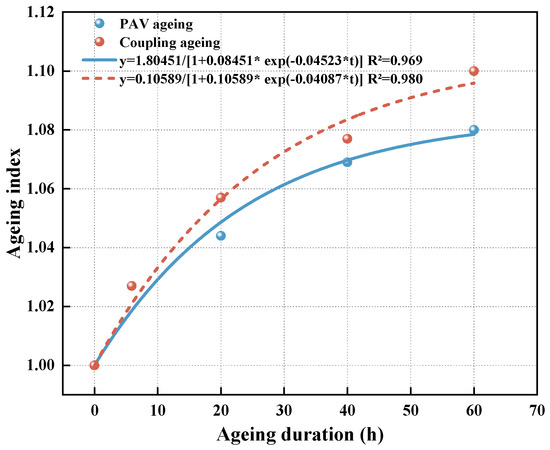
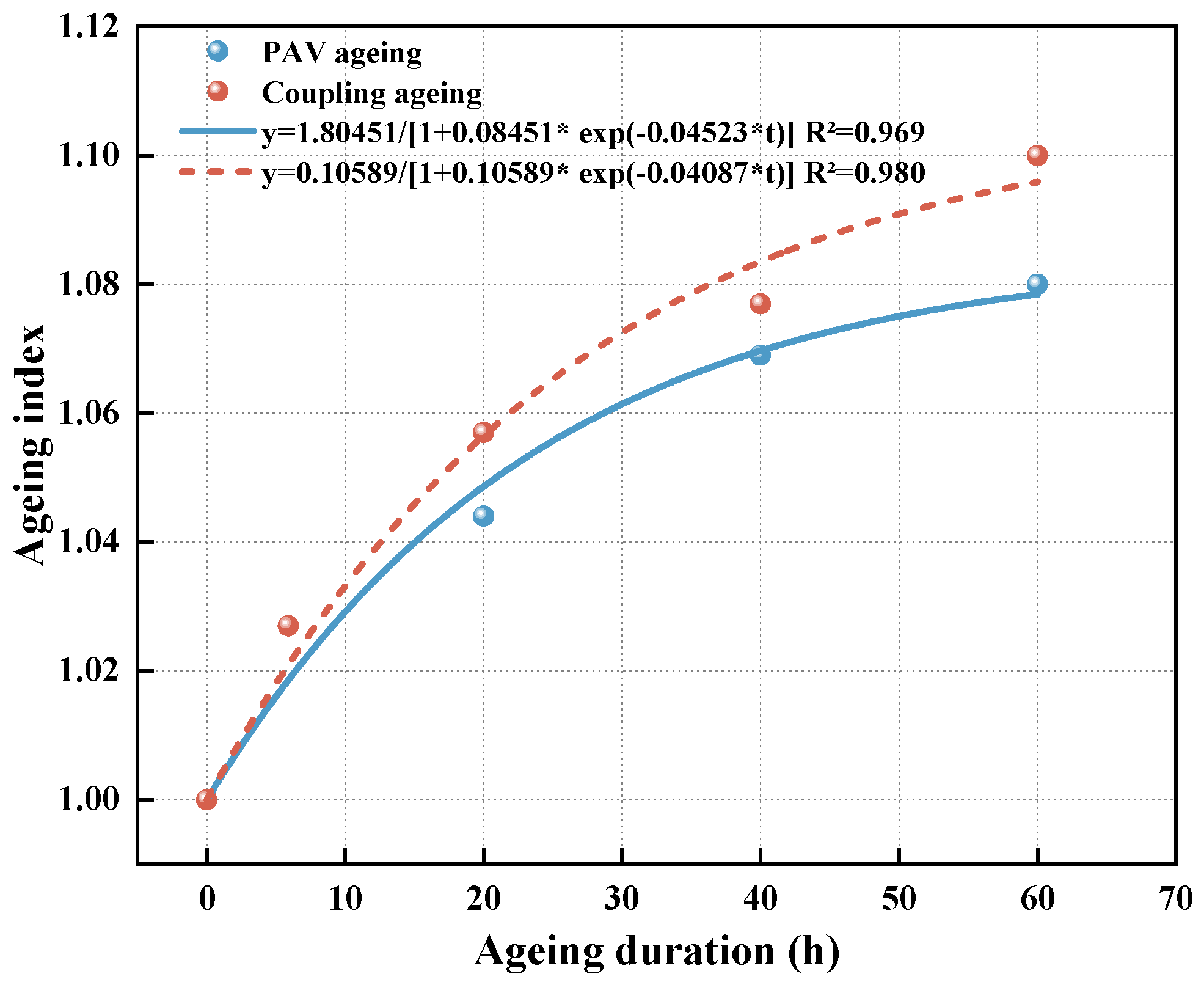
Based on the equations, the evolution trend of bitumen properties could be modelled, as shown in Figure 8, with the ageing index as a representative.
Figure 8.
Correlation between ageing index and ageing duration.
As seen in Figure 8, at the early stage of ageing, the AI increased rapidly, suggesting fast oxidative ageing. Afterwards, the ageing rate tended to slow down after around 40 h of long-term ageing, and then stabilised at around 60 h. It is also observed that UV had a considerable impact on the ageing severity of bitumen throughout the ageing process. Compared to the thermal-only ageing protocol, UV ageing consistently induced more damage to binders and stabilised at more severe ageing levels. Therefore, current standards and procedures cannot fully represent real-world situations, and UV should be incorporated into consideration for laboratory accelerated ageing procedures.
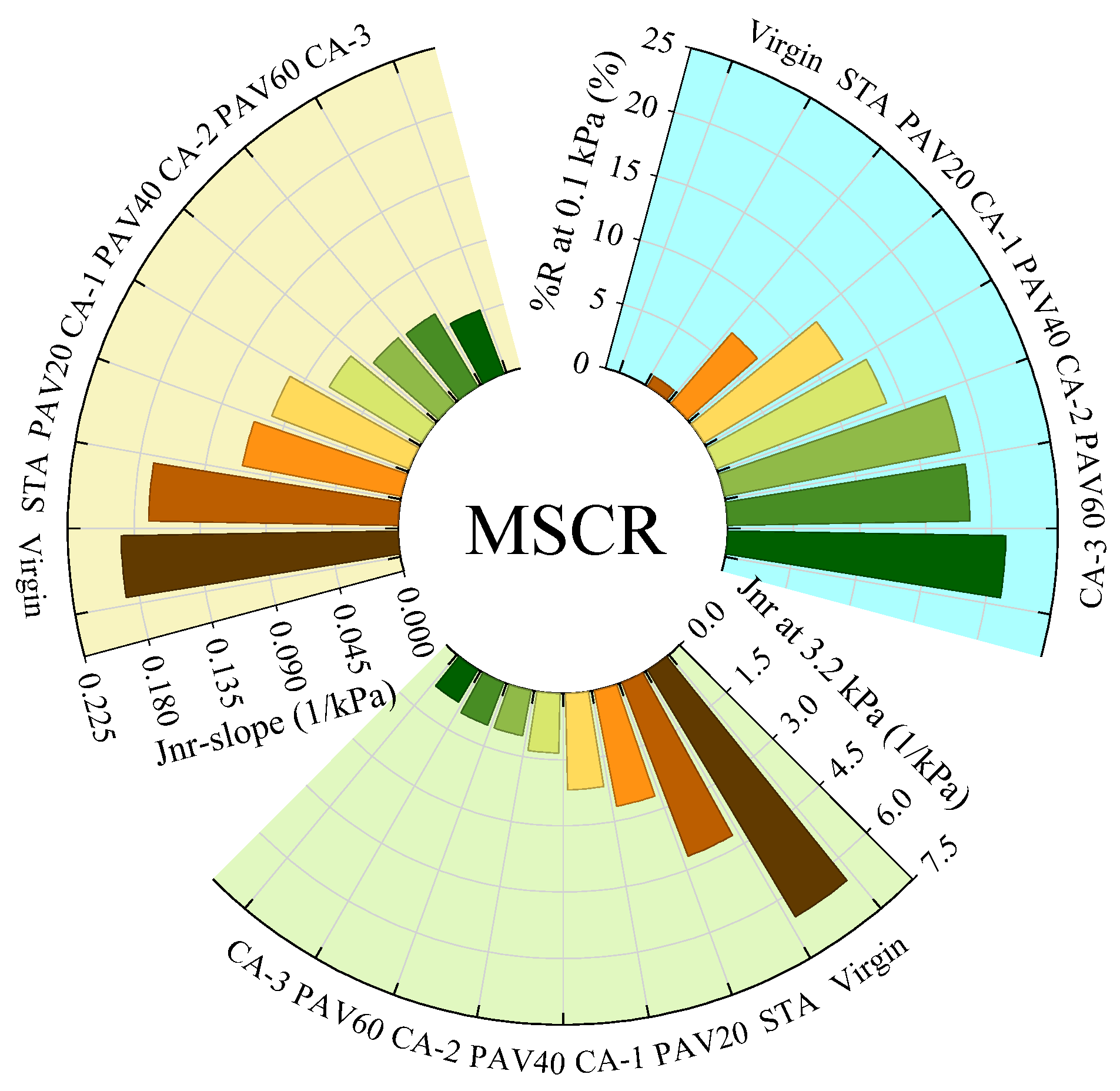
For other properties, they normally followed identical trends. The MSCR-related parameters are shown in Figure 9.
Figure 9.
Parameters determined by MSCR tests.
As illustrated in Figure 9, the MSCR results revealed a systematic evolution of high-temperature viscoelastic and permanent deformation behaviour with increasing ageing severity. The recovery percentage at 0.1 kPa (%R0.1) increased progressively from the virgin binder to the most severely aged conditions, indicating an enhanced elastic response induced by ageing. This increase was relatively moderate for PAV-only ageing from 20 h to 40 h, with a smooth increment from 40 h to 60 h, suggesting that the development of elastic recovery tended to stabilise under prolonged thermal–oxidative ageing. In contrast, the CA binders exhibited substantially higher %R0.1 values than their corresponding PAV-aged binders, demonstrating that UV coupling significantly accelerated the formation of elastic structures within the binder.
The nonrecoverable compliance (Jnr) showed an opposite trend, decreasing consistently with increasing ageing severity. Lower Jnr values indicate a reduced susceptibility to permanent deformation under repeated loading. Similar to the %R0.1 results, the reduction in Jnr was pronounced when ageing progressed from PAV20 to PAV40, while further reduction from PAV40 to PAV60 was less significant, again implying a stabilisation effect for PAV-only ageing. However, the CA series exhibited markedly lower Jnr values than the PAV series at comparable thermal ageing levels, confirming that UV ageing enhances stiffness and elastic recovery to an extent that cannot be achieved by thermal ageing alone.
When %R and Jnr are considered together, a clear transition in deformation mechanism is observed. Ageing shifts the binder response from a viscous-dominated behaviour in the virgin state towards an elastic-dominated response in the aged states, particularly for CA binders [45]. Although the reduced Jnr suggested improved rutting resistance at high service temperatures, the concurrently high %R values for severely aged binders indicated excessive elastic recovery associated with advanced ageing. This behaviour reflects increased molecular association, oxidation-induced structuring, and potential gel-like network formation, which, while beneficial for resisting permanent deformation, may be accompanied by a loss of ductility and an increased risk of cracking under thermal or fatigue loading [23].
Overall, the MSCR results confirm that PAV ageing alone leads to a gradual improvement in high-temperature rutting resistance, with limited additional benefit beyond 40 h of ageing, whereas the incorporation of UV ageing in the CA series produces a disproportionately strong effect on both recovery and nonrecoverable compliance. These findings demonstrate that coupled thermal–oxidative and photo-oxidative ageing significantly alters the balance between elastic recovery and permanent deformation, resulting in binders that appear highly rutting-resistant but may be overly stiff and brittle in long-term field conditions.
3.3. Performance Evolution of Extracted Binders
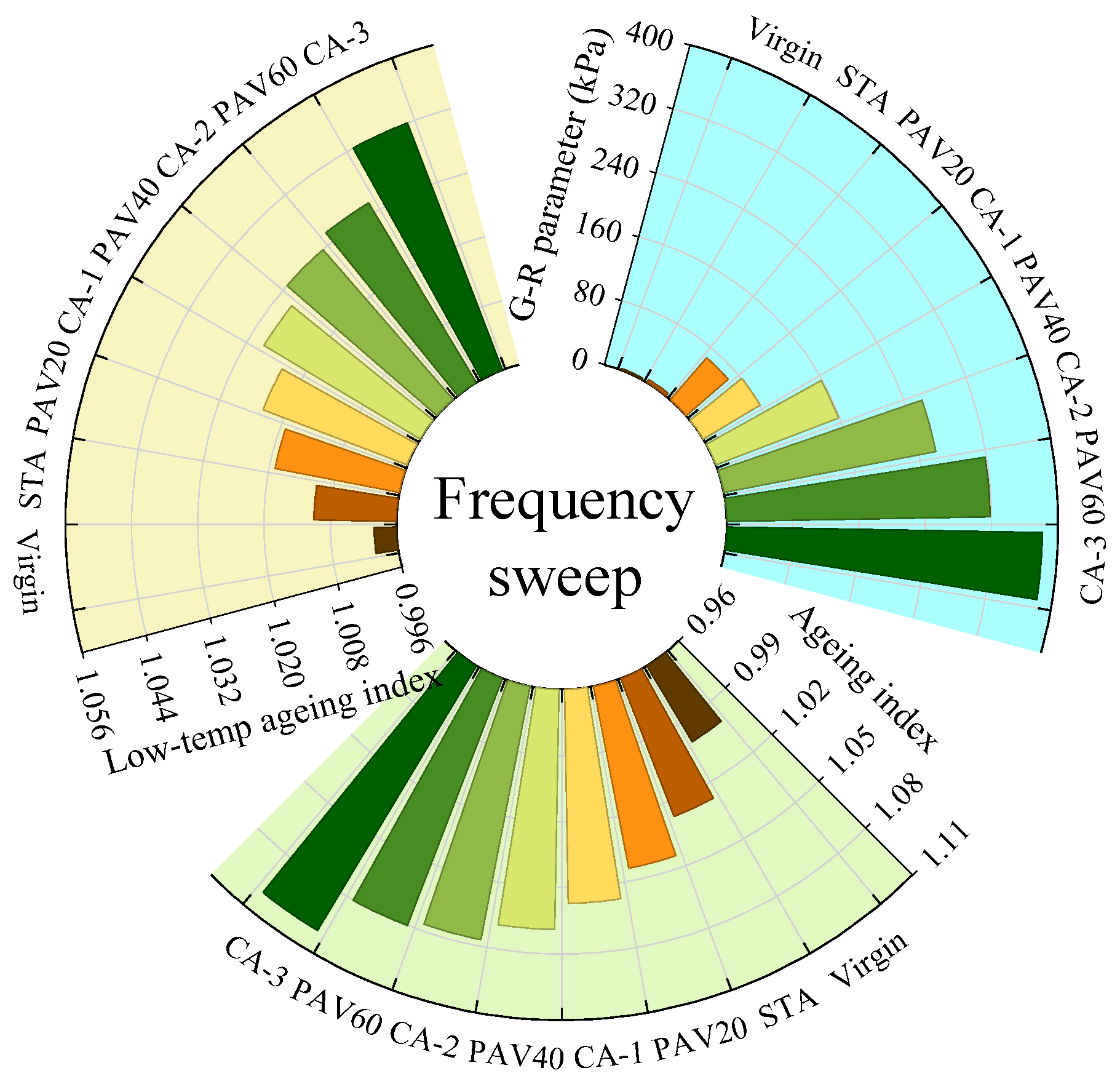
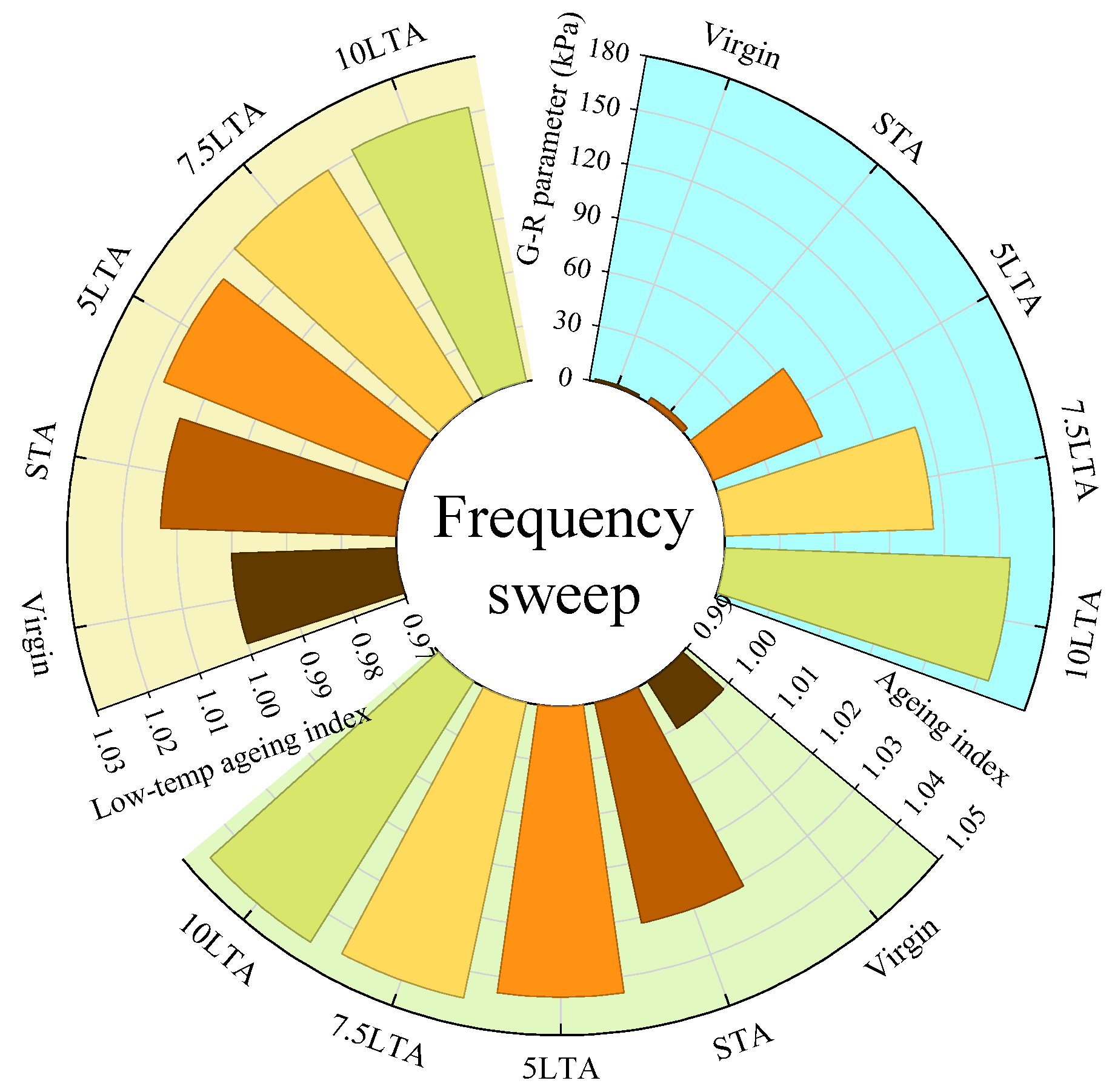
The G-R parameters and ageing indices of the laboratory-aged-mixture-recovered binders are shown in Figure 10.
Figure 10.
G-R parameters and ageing indices of mixture-recovered binders.
As shown in Figure 10, the frequency sweep results demonstrate a systematic and ageing-driven evolution of the viscoelastic behaviour of bitumen extracted from asphalt mixtures subjected to different ageing histories. Compared with the virgin binder, short-term ageing (STA) already led to a clear increase in stiffness across the frequency range, indicating that even limited thermal exposure during mixture production is sufficient to alter the internal structure of the binder [10]. This stiffening became progressively more pronounced as ageing advanced into the long-term period, with 5LTA, 7.5LTA, and 10LTA (extracted binders from long-term oven-aged mixtures for 5 days, 7.5 days and 10 days respectively) binders exhibiting substantially higher rheological responses. Oven ageing of asphalt mixtures reduced the ability of binders to relax stresses over loading times, highlighting a transition from a more viscous-dominated response in the virgin state towards an increasingly elastic and brittle behaviour with ageing [49].
Furthermore, the progression from 5LTA to 10LTA reveals a nonlinear ageing effect. Although stiffness continued to increase with ageing duration, the incremental change between successive long-term ageing levels became less pronounced, suggesting that the binder gradually approached an advanced ageing state in which additional thermal exposure produced diminishing rheological changes. This behaviour implies that ageing severity is governed not only by exposure time but also by the evolving chemical and physical state of the binder, which constrains further oxidation and structural rearrangement at later stages [45].
The frequency sweep results provide clear evidence that long-term oven ageing of asphalt mixtures fundamentally transformed the rheological properties of bitumen, driving a continuous shift towards higher stiffness, reduced stress relaxation capacity, and increased elastic dominance. The observed trends confirmed that long-term ageing of the asphalt mixtures led to advanced binder ageing that cannot be adequately represented by short-term ageing alone. These changes are critical for pavement performance, as the pronounced stiffening associated with advanced ageing is directly linked to an increased susceptibility to cracking-related distresses during long-term service.
Overall, in terms of the frequency sweep tests, it can be concluded that the extracted binders from oven-aged asphalt mixtures generally followed a similar property evaluation trend with binders aged by RTFO and PAV.
The MSCR results generally suggested similar findings. Table 2 summarises the fitted evolution trend of key properties of binders with ageing durations for both the laboratory-aged binders and those extracted and recovered from laboratory-aged asphalt mixtures.
Table 2.
Fitting model and parameters for key properties.
Based on the fitting parameters listed in Table 2, any properties of interest could be predicted. The measured properties of the extracted and recovered bitumen from the field-collected samples are listed in Table 3.
Table 3.
Properties of bitumen extracted from field-collected asphalt mixture.
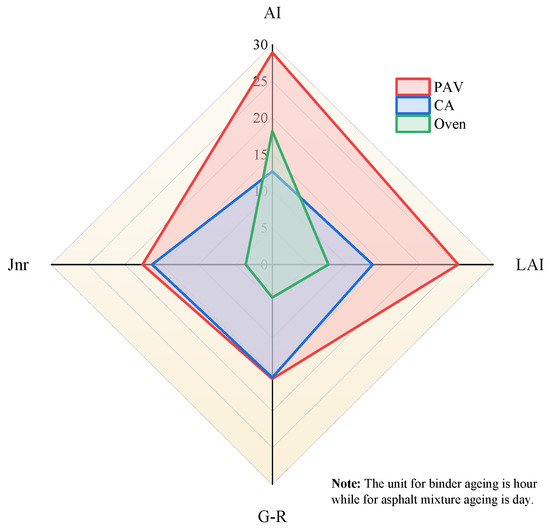
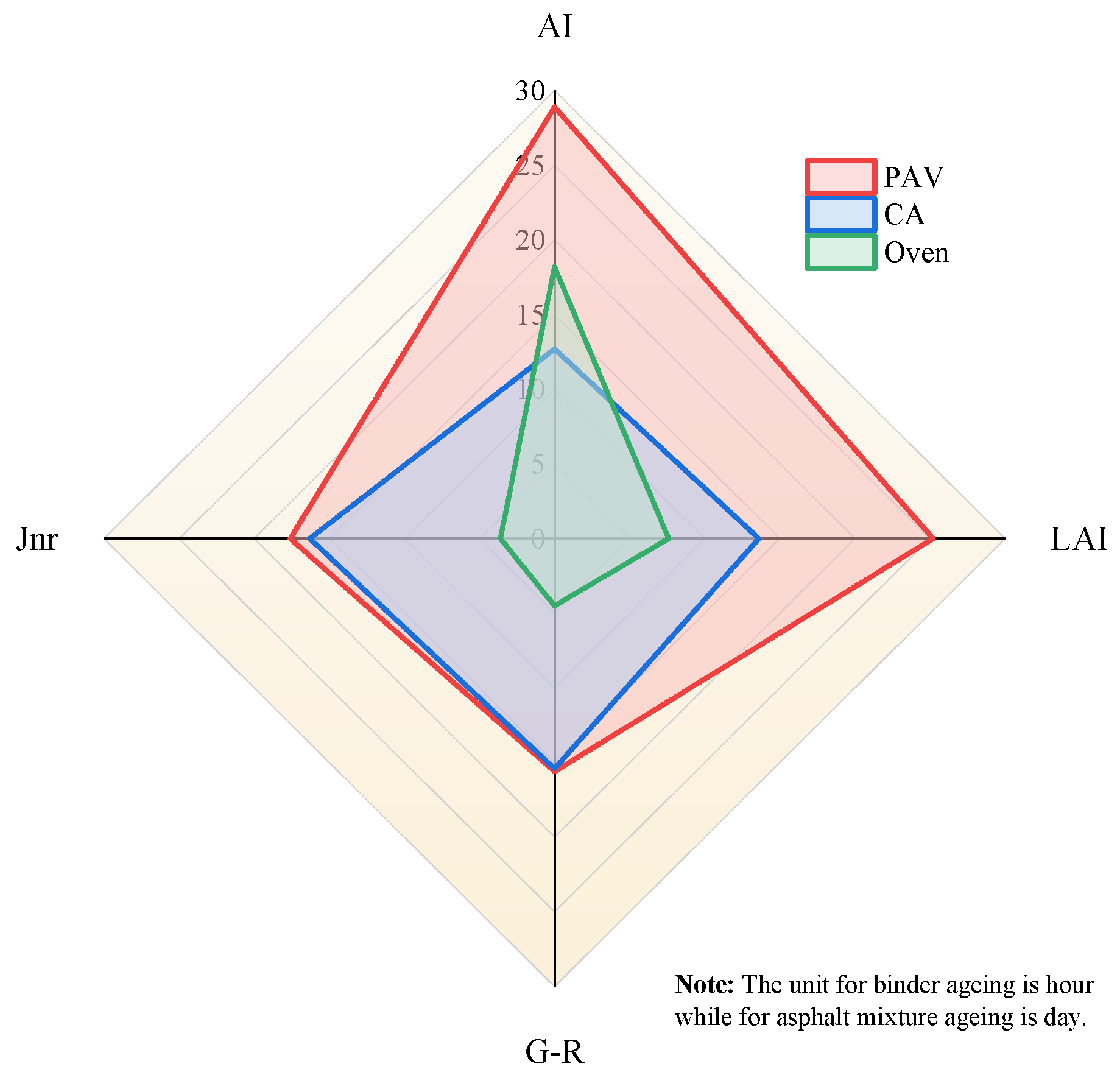
Based on the measured results and fitting parameters, the ageing durations of different protocols (thermal–oxidative and coupled thermal–photo-oxidative) could be back-calculated to reach equivalent properties of field-aged samples. The results are summarised in Figure 11.
Figure 11.
Equivalent laboratory ageing time.
Figure 11 presents the equivalent laboratory ageing time required to reproduce the ageing characteristics of the field-collected and recovered binders, evaluated using multiple ageing indices (AI, LAI, Jnr, and G-R parameter). Three laboratory ageing routes are compared, namely RTFO + PAV ageing of binders (PAV), RTFO + PAV + UV ageing of binders (CA), and oven ageing of asphalt mixtures followed by binder extraction and recovery (Oven). It should be emphasised that the equivalent ageing time for PAV and CA is expressed in hours, whereas that for oven ageing is expressed in days, and therefore, direct numerical comparison across these protocols is not appropriate.
For binder-level ageing, PAV consistently requires the longest equivalent ageing time across all indices to match the field ageing state, indicating that conventional RTFO + PAV ageing alone is relatively inefficient in reproducing the severity and rate of field ageing. This reflects the limitation of purely thermo-oxidative ageing in simulating in-service exposure, particularly for surface binders that experience additional environmental impacts.
Incorporating UV exposure through the CA protocol markedly reduced the equivalent ageing time compared with PAV for all the ageing indices. The reduction is most pronounced for AI and LAI, confirming that photo-oxidation plays a critical role in the chemical ageing and stiffening of binders. This demonstrated that field ageing cannot be adequately captured by thermal oxidation alone and that UV radiation substantially accelerates binder ageing processes relevant to stiffness evolution and cracking susceptibility.
For oven ageing of asphalt mixtures (Oven), the equivalent ageing time should be interpreted exclusively in days, representing the duration of mixture-level ageing required to reproduce field binder properties after extraction and recovery. The oven ageing results indicated that field-equivalent ageing responses can be achieved within a limited number of days, depending on the selected ageing index. It represents a distinct ageing pathway operating at a different material scale and time unit. The observed index-dependent oven ageing equivalence suggested that mixture-level ageing effectively captures the combined effects of oxygen diffusion and binder–aggregate interactions, which were not reproduced in binder-level ageing.
Overall, Figure 11 highlights that RTFO + PAV ageing alone is insufficient to represent field ageing, both in terms of the required ageing time and underlying mechanisms. The inclusion of UV ageing significantly improves binder-level equivalence for chemically driven ageing, while mixture oven ageing provides a complementary, day-based framework for reproducing field ageing signatures arising from mixture-scale interactions. Consequently, field-relevant ageing simulation requires mechanism-based selection and calibration of laboratory ageing protocols rather than reliance on a single standardised binder ageing duration.
4. Conclusions
Bitumen ageing is a critical factor governing long-term pavement durability and sustainability, particularly in the context of recycled and long-life asphalt systems. This study investigated the ageing behaviour of an 80/100 penetration-grade bitumen at binder, mixture, and field levels using laboratory thermal–oxidative ageing (RTFO + PAV), coupled thermal–photo-oxidative ageing (RTFO + PAV + UV), long-term mixture oven ageing, and field sampling from a 12-year-old pavement. Rheological characterisation was performed using frequency sweep and MSCR tests, from which AI, LAI, G–R parameter, and Jnr were derived. Based on the experimental results and fitting analysis, the following conclusions are drawn:
- (1)
- Thermal–oxidative ageing alone led to progressive stiffening and embrittlement of bitumen, as reflected by increases in AI (up to 1.09) and G–R parameter (up to 318 kPa), and reductions in Jnr. The incorporation of UV radiation significantly modified ageing pathways, increasing G–R by approximately 20–65% relative to PAV-only ageing and accelerating low-temperature and fatigue-related deterioration. This demonstrates that photo-oxidation is a critical contributor to field-relevant ageing and cannot be neglected in laboratory simulations.
- (2)
- The frequency sweep and MSCR results showed that ageing shifts binder behaviour from viscous-dominated to elastic-dominated response. Recovery percentage increased systematically, while Jnr decreased with ageing severity. Although rutting resistance improved, excessive elastic recovery and high G–R values for severely aged binders indicate increased cracking susceptibility. Prolonged PAV ageing beyond 40 h produced diminishing additional changes, suggesting a stabilisation of thermo-oxidative ageing effects.
- (3)
- The evolution of AI, LAI, G–R parameter, and Jnr with ageing duration was described using nonlinear Verhulst-type growth models, with coefficients of determination ranging from 0.995 to 0.999. These models provide reliable and interpretable tools for predicting rheological properties under specified ageing conditions and for estimating field-equivalent ageing durations.
- (4)
- Binders recovered from oven-aged asphalt mixtures exhibited similar evolutionary trends to laboratory-aged binders but followed a distinct ageing pathway influenced by oxygen diffusion and binder–aggregate interactions. Mixture ageing produced advanced stiffening within 5–10 d, highlighting that mixture-scale processes cannot be fully reproduced by binder-level ageing alone.
- (5)
- Equivalent ageing analysis showed that RTFO + PAV required the longest duration (>50 h) to reproduce field properties, indicating limited efficiency in simulating in-service ageing. Coupled thermal–photo-oxidative ageing achieved equivalence within approximately 25–35 h, while mixture oven ageing required 6–8 d, depending on the selected index. These results confirm that reliance on a single ageing protocol leads to underestimation of field ageing severity.
- (6)
- The combined experimental and fitting results demonstrate that field-relevant ageing is governed by multiple interacting mechanisms. Accurate durability assessment, therefore, requires mechanism-based calibration of laboratory ageing protocols. The proposed framework provides quantitative guidance for selecting ageing methods and durations in performance-based binder evaluation and supports the development of more sustainable and resilient asphalt pavement systems.
Author Contributions
Conceptualization, D.A. and W.S.; methodology, D.A. and J.Z.; formal analysis, D.A., J.Z. and Z.W.; investigation, Z.W., Y.L., J.W. and H.M.; resources, J.Z. and W.S.; data curation, J.W. and H.M.; writing—original draft preparation, D.A., J.Z., Z.W. and Y.L.; writing—review and editing, J.W., H.M. and W.S.; supervision, W.S.; project administration, J.Z. and W.S.; funding acquisition, J.Z. and W.S. All authors have read and agreed to the published version of the manuscript.
Funding
This research was funded by Science and Technology Projects of Xinjiang Communications Investment Group Co., Ltd. under grant number [ZKXFWCG2024080484], and Science and Technology Projects of Xizang Autonomous Region, China, under grant numbers [XZ202401ZY0047] and [XZ202501ZY0134].
Data Availability Statement
The original contributions presented in this study are included in the article. Further inquiries can be directed to the corresponding author(s).
Conflicts of Interest
D.A. is employed by Xinjiang Transportation Investment Construction Management Co., Ltd.; J.Z., Z.W. and Y.L. are employed by Xinjiang Transportation Science Research Institute Co., Ltd. The remaining authors declare that the research was conducted in the absence of any commercial or financial relationships that could be construed as a potential conflict of interest. The funders had no role in the design of the study; in the collection, analyses, or interpretation of data; in the writing of the manuscript; or in the decision to publish the results.
References
- Hu, Y.; Yin, Y.; Sreeram, A.; Liu, J.; Si, W.; Tang, D.; Airey, G.D. Nano-aggregation of asphaltenes and its influence on the multiscale properties of bitumen recycled through multiple ageing and rejuvenation cycles. Chem. Eng. J. 2025, 512, 162348. [Google Scholar] [CrossRef] [Scilit]
- Ren, S.; Liu, X.; Lin, P.; Jing, R.; Erkens, S. Toward the long-term aging influence and novel reaction kinetics models of bitumen. Int. J. Pavement Eng. 2022, 24, 2024188. [Google Scholar] [CrossRef] [Scilit]
- Shi, K.; Ma, F.; Falchetto, A.C.; Fu, Z.; Yuan, D.; Song, R.; Dai, J.; Wang, H. Comprehensive review on the composition, influence, and inhibition of asphalt fumes. J. Traffic Transp. Eng. 2025, 12, 926–964. [Google Scholar] [CrossRef] [Scilit]
- NAPA. The Asphalt Pavement Industry Fast Facts; National Asphalt Pavement Association: Greenbelt, MD, USA, 2020. [Google Scholar]
- EAPA. Asphalt in Figures 2023; European Asphalt Pavement Association: Brussels, Belgium, 2025. [Google Scholar]
- Si, W.; Zhang, B.; Zhang, X.; Xia, W.; Cheng, X.; Luo, X.; Hu, Y. Maximizing the circularity of asphalt pavements by improving the RAP content in recycled asphalt mixtures. Constr. Build. Mater. 2024, 438, 137316. [Google Scholar] [CrossRef] [Scilit]
- Hu, Y.; Wang, H.; Zhou, L.; Airey, G.D. Towards an enhanced understanding of the functional groups within bitumen during ageing processes. In Advances in Functional Pavements; CRC Press: Boca Raton, FL, USA, 2024; pp. 83–87. [Google Scholar]
- Zhu, H.; Hu, M.; Zhang, Y.; Abudurahman, A.; Zhu, Y.; Cui, J. Microwave-functionalized sustainable lignin to enhance asphalt oxidation resistance: An oxygen quenching and VOCs adsorption perspective. Fuel 2026, 410, 137855. [Google Scholar] [CrossRef] [Scilit]
- Zhang, F.; Falchetto, A.C.; Wang, D.; Li, Z.; Sun, Y.; Lin, W. Prediction of asphalt rheological properties for paving and maintenance assistance using explainable machine learning. Fuel 2025, 396, 135319. [Google Scholar] [CrossRef] [Scilit]
- Sun, Y.; Zhang, F.; Wang, D.; Chen, W.; Falchetto, A.C. Study on the multiple recycling limit of asphalt binders containing high RAP content based on chemical and rheological properties. Fuel 2026, 405, 136708. [Google Scholar] [CrossRef] [Scilit]
- Mirwald, J.; Maric, B.; Primerano, K.; Hofko, B. Evaluating the combined effect of photooxidation and thermal ageing of bitumen. Road Mater. Pavement Des. 2025, 1–14. [Google Scholar] [CrossRef] [Scilit]
- Pipintakos, G.; Sreeram, A.; Mirwald, J.; Bhasin, A. Engineering bitumen for future asphalt pavements: A review of chemistry, structure and rheology. Mater. Des. 2024, 244, 113157. [Google Scholar] [CrossRef] [Scilit]
- Mirwald, J.; Werkovits, S.; Camargo, I.; Maschauer, D.; Hofko, B.; Grothe, H. Investigating bitumen long-term-ageing in the laboratory by spectroscopic analysis of the SARA fractions. Constr. Build. Mater. 2020, 258, 119577. [Google Scholar] [CrossRef] [Scilit]
- Hu, Y.; Yin, Y.; Sreeram, A.; Si, W.; Airey, G.D.; Li, B.; Singh, B.; Kaya Özdemir, D.; Zhou, L. Atomic Force Microscopy (AFM) based microstructural and micromechanical analysis of bitumen during ageing and rejuvenation. Constr. Build. Mater. 2025, 467, 140387. [Google Scholar] [CrossRef] [Scilit]
- Hu, Y.; Hejazi, S.; Patel, D.; Jahan, H.; Özdemir, D.K.; Yin, Y.; Airey, G.D.; Sreeram, A. Comprehensive characterisation of lignin-based bio-bitumen as a sustainable paving material. Constr. Build. Mater. 2025, 502, 144455. [Google Scholar] [CrossRef] [Scilit]
- Si, W.; Xia, M.; Zhang, B.; Danzeng, G.A.; Wang, X.; Hu, Y.; Li, X.; Zhong, M.; Yin, Y. Study on the preparation and performance optimization of wear-resistant asphalt pavement composite functional material reflective cooling coatings. Constr. Build. Mater. 2026, 508, 145055. [Google Scholar] [CrossRef] [Scilit]
- Hu, Y.; Ryan, J.; Allanson, M.; Wang, H.; Zhou, L.; Airey, G.D. Efficiency of Sustainable Rejuvenation of Bitumen Using Bio-based Rejuvenators and Waste Oils. In Proceedings of the ISAP 2024 Conference, Montreal, QC, Canada, 2–6 June 2024. [Google Scholar]
- Wang, X.; Ma, B.; Yu, M.; Mao, W.; Si, W. Testing and modeling of incomplete phase change heat storage and release of epoxy resin/microcapsule composite phase change materials for asphalt pavement. J. Energy Storage 2025, 105, 114672. [Google Scholar] [CrossRef] [Scilit]
- Stüwe, S.; Primerano, K.; Li, B.; Mortier, L.; Mirwald, J.; Grothe, H.; Hofko, B. Influence of reactive oxygen species and humidity on binder aging under direct and indirect exposure. Mater. Struct. 2025, 58, 342. [Google Scholar] [CrossRef] [Scilit]
- Ma, B.; Wei, K.; Huang, X.F.; Shi, W.S.; Chen, S.S.; Hu, Y.P.; Shi, H.T. Preparation and Investigation of NiTi Alloy Phase-Change Heat Storage Asphalt Mixture. J. Mater. Civil Eng. 2020, 32, 04020250. [Google Scholar] [CrossRef] [Scilit]
- Hu, Y.; Sreeram, A.; Airey, G.D.; Li, B.; Si, W.; Wang, H. Comparative analysis of time sweep testing evaluation methods for the fatigue characterisation of aged bitumen. Constr. Build. Mater. 2024, 432, 136698. [Google Scholar] [CrossRef] [Scilit]
- AASHTO R30-22; Standard Practice for Laboratory Conditioning of Asphalt Mixtures. American Association of State Highway and Transportation Officials: Washington, DC, USA, 2022.
- Hu, Y.; Cheng, X.; Sreeram, A.; Si, W.; Li, B.; Pipintakos, G.; Airey, G.D. Enhancing fatigue resistance and low-temperature performance of asphalt pavements using antioxidant additives. Mater. Struct. 2025, 58, 46. [Google Scholar] [CrossRef] [Scilit]
- Sreeram, A.; Masad, A.; Sootodeh Nia, Z.; Maschauer, D.; Mirwald, J.; Hofko, B.; Bhasin, A. Accelerated aging of loose asphalt mixtures using ozone and other reactive oxygen species. Constr. Build. Mater. 2021, 307, 124975. [Google Scholar] [CrossRef] [Scilit]
- Werkovits, S.; Bacher, M.; Mirwald, J.; Theiner, J.; Rosenau, T.; Hofko, B.; Grothe, H. The impact of field ageing on molecular structure and chemistry of bitumen. Fuel 2023, 343, 127904. [Google Scholar] [CrossRef] [Scilit]
- ASTM D2872-22; Standard Test Method for Effect of Heat and Air on a Moving Film of Asphalt Binder (Rolling Thin-Film Oven Test). ASTM International: West Conshohocken, PA, USA, 2022.
- ASTM D6521-22; Standard Practice for Accelerated Aging of Asphalt Binder Using a Pressurized Aging Vessel (PAV). ASTM International: West Conshohocken, PA, USA, 2022.
- Zhou, S.; Long, K.; Zhang, Z.; Li, S.; Ai, C.; Yan, C. Development of sustainable Lignin-Based coatings for layered double Hydroxides: Enhancing synergistic Anti-Aging properties in bitumen. Fuel 2025, 380, 133166. [Google Scholar] [CrossRef] [Scilit]
- Xu, X.; Peng, Y.; Liu, Y.; Pei, J.; Liu, J.; Sreeram, A. Toward circular asphalt materials: Rheological and microstructural insights into the rejuvenation of SBS-modified binders. Sustain. Mater. Technol. 2026, 47, e01787. [Google Scholar] [CrossRef] [Scilit]
- ASTM D6926-20; Standard Practice for Preparation of Asphalt Mixture Specimens Using Marshall Apparatus. ASTM International: West Conshohocken, PA, USA, 2020.
- ASTM D2172M-24; Standard Test Methods for Quantitative Extraction of Asphalt Binder from Asphalt Mixtures. ASTM International: West Conshohocken, PA, USA, 2024.
- ASTM D1856-25; Standard Test Method for Recovery of Asphalt from Solution by Abson Method. ASTM International: West Conshohocken, PA, USA, 2025.
- ASTM D7405-24; Standard Test Method for Multiple Stress Creep and Recovery (MSCR) of Asphalt Binder Using a Dynamic Shear Rheometer. ASTM International: West Conshohocken, PA, USA, 2024.
- Yusoff, N.I.M.; Mounier, D.; Marc-Stephane, G.; Hainin, M.R.; Airey, G.D.; Di Benedetto, H. Modelling the rheological properties of bituminous binders using the 2S2P1D Model. Constr. Build. Mater. 2013, 38, 395–406. [Google Scholar] [CrossRef] [Scilit]
- Di Benedetto, H.; Olard, F.; Sauzéat, C.; Delaporte, B. Linear viscoelastic behaviour of bituminous materials: From binders to mixes. Road Mater. Pavement Des. 2004, 5, 163–202. [Google Scholar] [CrossRef] [Scilit]
- Rowe, G.M.; King, G.; Anderson, M. The Influence of Binder Rheology on the Cracking of Asphalt Mixes in Airport and Highway Projects. J. Test. Eval. 2014, 42, 1063–1072. [Google Scholar] [CrossRef] [Scilit]
- Ogbo, C.; Kaseer, F.; Oshone, M.; Sias, J.E.; Martin, A.E. Mixture-based rheological evaluation tool for cracking in asphalt pavements. Road Mater. Pavement Des. 2019, 20, S299–S314. [Google Scholar] [CrossRef] [Scilit]
- Shi, K.; Ma, F.; Fu, Z.; Lou, B.; Barbieri, D.M.; Li, J.; Song, R.; Yuan, D. Comprehensive evaluation of sulfur content and curing duration effects on the rheological performance of sulfur-extended bitumen. Fuel 2025, 393, 134979. [Google Scholar] [CrossRef] [Scilit]
- Zhang, F.; Zhu, J.; Sun, Y.; Mariam Benny, C.; Wang, D.; Cannone Falchetto, A. Effect analysis of using tall oil pitch (TOP) to partially extend bitumen in asphalt pavements: Comparison of different TOPs. Road Mater. Pavement 2025, 26, 361–380. [Google Scholar] [CrossRef] [Scilit]
- Airey, G.D.; Rowe, G.M.; Sias, J.E.; Di Benedetto, H.; Sauzeat, C.; Dave, E.V. Black Space Rheological Assessment of Asphalt Material Behavior. J. Test. Eval. 2022, 50, 770–787. [Google Scholar] [CrossRef] [Scilit]
- Patel, D.; Jahan, H.; Hu, Y.; Hejazi, S.; Roja, K.L.; Airey, G.; Sreeram, A. Incorporating bio-based lignin as a sustainable fine aggregate in asphalt mixtures: Comprehensive analysis of long-term performance. Sustain. Mater. Technol. 2025, 46, e01734. [Google Scholar] [CrossRef] [Scilit]
- Omairey, E.; Hughes, D.; Hu, Y.; Airey, G. Feasibility evaluation of bio-waste derived, plastic-waste modified binder rejuvenators. In Advances in Functional Pavements; CRC Press: Boca Raton, FL, USA, 2024; pp. 58–61. [Google Scholar]
- Hu, Y.; Ryan, J.; Sreeram, A.; Allanson, M.; Pasandín, A.R.; Zhou, L.; Singh, B.; Wang, H.; Airey, G.D. Optimising the dosage of bio-rejuvenators in asphalt recycling: A rejuvenation index based approach. Constr. Build. Mater. 2024, 433, 136761. [Google Scholar] [CrossRef] [Scilit]
- Cavalli, M.C.; Zaumanis, M.; Mazza, E.; Partl, M.N.; Poulikakos, L.D. Effect of ageing on the mechanical and chemical properties of binder from RAP treated with bio-based rejuvenators. Compos. Part B Eng. 2018, 141, 174–181. [Google Scholar] [CrossRef] [Scilit]
- Hu, Y.; Xia, W.; Xue, Y.; Zhao, P.; Wen, X.; Si, W.; Wang, H.; Zhou, L.; Airey, G.D. Evaluating the Ageing Degrees of Bitumen by Rheological and Chemical Indices. Road Mater. Pavement Des. 2023, 24, 19–36. [Google Scholar] [CrossRef] [Scilit]
- Shi, K.; Ma, F.; Fu, Z.; Song, R.; Yuan, D.; Ogbon, A.W. Enhancing aged SBS-modified bitumen performance with unaged bitumen additives. Constr. Build. Mater. 2024, 412, 134768. [Google Scholar] [CrossRef] [Scilit]
- Omairey, E.L.; Gu, F.; Zhang, Y. An equation-based multiphysics modelling framework for oxidative ageing of asphalt pavements. J. Clean. Prod. 2021, 280, 124401. [Google Scholar] [CrossRef] [Scilit]
- Guan, M.; Guo, M.; Liu, X.; Du, X.; Tan, Y. Effect of Multifactor Coupling Aging on Rheological Properties of Asphalt Binders and Correlations between Various Rheological Indexes. J. Mater. Civil. Eng. 2024, 36, 04024088. [Google Scholar] [CrossRef] [Scilit]
- Luo, L.; Yang, S.-H.; Oeser, M.; Liu, P. Moisture damage mechanism of asphalt mixtures containing reclaimed asphalt pavement binder: A novel molecular dynamics study. J. Clean. Prod. 2024, 475, 143711. [Google Scholar] [CrossRef] [Scilit]

Disclaimer/Publisher’s Note: The statements, opinions and data contained in all publications are solely those of the individual author(s) and contributor(s) and not of MDPI and/or the editor(s). MDPI and/or the editor(s) disclaim responsibility for any injury to people or property resulting from any ideas, methods, instructions or products referred to in the content. |
© 2026 by the authors. Licensee MDPI, Basel, Switzerland. This article is an open access article distributed under the terms and conditions of the Creative Commons Attribution (CC BY) license.