


Abstract
Calcium carbide slag and silica fume was used as a cement replacement material, combined with excavated soil and EPS (expanded polystyrene) particles, to develop a new green and low-carbon lightweight fluid solidified soil (LFSS). Focusing on the performance regulation of LFSS, this study adopted the paste volume ratio (PV, defined as the volume ratio of paste to total mixture) and the water–binder ratio (w/b) to systematically construct a mix ratio design system and proposed EPS particle interface modification and shell formation technology to improve the weak interface bonding between EPS and the matrix. Firstly, based on the paste volume method, the effects of PV and w/b on the flowability and strength of LFSS were analyzed, and a linear correlation model between the water–solid volume ratio and flowability, as well as a quadratic function prediction model for 28-day strength, was established. Secondly, the “core–shell structure” of EPS particles was constructed by combining EVA (ethylene-vinyl acetate) modification with the coating of calcium carbide slag–silica fume paste. Considering the influence of the coating method, w/b, and material mass ratio on interface bonding comprehensively, the optimal process parameters were determined to achieve the interface reinforcement of EPS particle. The results showed that the water–solid volume ratio was significantly linearly correlated with the flowability of LFSS. PV and w/b respectively controlled the framework formation and pore structure evolution of LFSS, with optimal overall performance at PV = 0.55 and w/b = 2.5. The modification shell formation significantly reduced the shell loss rate of EPS particles and increased the 28-day compressive strength of LFSS by 21.7%. SEM (scanning electron microscope) and EDS (energy-dispersive spectroscopy) analysis further revealed that the shell-formation technique promoted the densification of the interface transition zone, enhanced the deposition of hydration products, and strengthened the synergistic effect of Na and Ca elements, thereby significantly improving interface bonding and overall structural stability. This study established a “mix ratio optimization-modification and shell formation” dual-regulation mechanism, providing an effective technical approach and theoretical basis for the engineering application of calcium carbide slag–silica fume-based LFSS.
1. Introduction
With the continuous advancement of infrastructure construction in China, municipal pipeline renovation, road widening, and other projects generate a large amount of excavated soil. The traditional disposal of this excavated soil not only occupies land resources but also poses potential environmental risks [1]. In order to address both the disposal of excavated soil and the resource consumption of construction materials, utilizing excavated soil to produce fluid solidified soil has become a promising resource recovery approach. Fluid solidified soil, as an engineering material with both self-leveling and self-compacting properties, is widely used in pipe trench backfilling, underground void filling, and soft foundation treatment due to its simple construction process and easy control of backfilling quality. Traditionally, cement has been the primary binder in fluid solidified soil; however, cement production has high energy consumption and carbon emissions, and excessive use increases material costs and environmental burdens. Meanwhile, the relatively high self-weight of traditional fluid solidified soil limits its application in projects that are sensitive to additional loads or space-constrained. To reduce material weight, decrease dependence on cement, and expand engineering applicability, researchers have developed lightweight fluid solidified soil (LFSS) by substituting cement with industrial solid waste and incorporating lightweight components, achieving both environmental and lightweight development. LFSS not only maintains good flowability and self-compacting properties but also effectively reduces system density while meeting necessary mechanical performance requirements, showing good application potential in backfilling and load-reduction projects [2].
Many industrial waste materials, such as construction waste, slag, red mud, calcium carbide slag, and silica fume, can serve as raw materials for LFSS [3,4]. Among these, calcium carbide slag and silica fume possess hydration activity under specific activation conditions, generating cementitious gel products that can replace traditional cementitious material [5,6]. Calcium carbide slag, an alkaline industrial waste rich in Ca(OH)2, has also attracted attention for its potential as an alkali activator. Studies by Yu et al. [7] and Liu et al. [8] have shown that calcium carbide slag can synergistically enhance the mechanical properties of fluid solidified soil when combined with red mud and silica fume. Silica fume, primarily composed of SiO2, has high pozzolanic activity. Wang et al. [9] and Lin et al. [10] pointed out that an increase in the silica fume content significantly impacts the rheological properties of the paste, accelerates the hydration reaction, and improves stability and compressive strength. Although previous studies have shown that calcium carbide slag and silica fume can effectively improve the mechanical and working properties of materials under various conditions, there is still a lack of in-depth research on the combination of the two as a binder for LFSS, particularly in terms of mix design, microstructural evolution, and their comprehensive impact on macroscopic properties.
The mix design of LFSS is crucial for optimizing its performance. Wei et al. [11] proposed a mix design process based on the volume method for construction waste-based backfilling materials. Alizadeh [12,13], on the other hand, proposed a new mix design method based on relative proportion parameters such as paste volume ratio and water-binder ratio. Research has shown that the paste volume ratio has a significant effect on flowability and can be used as an independent parameter for design. This provides solid theoretical support for the systematic study using the paste volume method in this research.
To further improve the lightweight and strength performance of LFSS, the use of expanded polystyrene (EPS) particles as lightweight aggregates has become another important research direction. Fu et al. [14] conducted experimental studies on the factors influencing the flowability of EPS particles in premixed lightweight soil. However, the interface bond between EPS particles and the binder is weak, and segregation problems are easily encountered, which limits their application in LFSS. Du et al. [15] noted in their review that surface modification of EPS particles (such as modification and shell formation) is an effective solution to this problem, Pang et al. [16] further investigated the reinforcing effect of interface modifiers such as sodium silicate on the interface performance of binder–EPS, confirming that surface modification can promote the formation of hydration products on the EPS surface, effectively enhancing the interface density and mechanical properties. Recent studies have shown that EPS modification not only improves interfacial bonding and mechanical properties, but also has a significant impact on the long-term durability of LFSS. Zhang et al. [17] pre-coated EPS particles with EVA emulsion modification combined with MgO–cement composite coating materials. They found that the optimized shell-forming process could increase the 28-day compressive strength of LFSS by 41%, and after nine dry and wet cycles, the strength of the pre-coated EPS-LFSS was still 0.349 MPa higher than that of the uncoated group. It indicates that the modified shell-making technology can effectively enhance the durability of LFSS. Furthermore, Law et al. [18] pointed out that after the early mechanical properties of alkali-activated cementitious materials meet the standards, their long-term resistance to carbonization, resistance to chloride ion erosion, and volume stability still need to be systematically evaluated, which provides an important reference for the durability research of LFSS systems. In this study, EPS particles were first surface-modified with EVA emulsion to improve their hydrophilicity. This treatment transforms the EPS surface from hydrophobic to hydrophilic, enhancing its adhesion to the calcium carbide slag–silica fume paste and enabling the subsequent formation of a dense shell layer. The modification and shell formation process is expected to strengthen the interfacial transition zone and improve the overall performance of LFSS.
Current research is mostly focused on the use of individual solid waste or the development of conventional lightweight materials, and there is limited research on the combination of calcium carbide slag–silica fume composite binder with surface-modified EPS particles. To address this gap, this study utilized calcium carbide slag–silica fume as a binder, combined with modified EPS particles, to focus on the mix design and performance regulation of LFSS. Initially, based on the paste volume method, the effects of the paste volume ratio and water–binder ratio on the working and mechanical properties of LFSS were investigated, and corresponding mix design methods were developed. Secondly, the surface coating modification process of EPS particles and its impact on the performance of the mixture were studied. The modification process of EPS particles could enhance their bonding ability in the composite system, thereby improving the working and mechanical properties of LFSS. Finally, scanning electron microscopy (SEM) and other techniques were used to analyze the composition of hydration products and the microstructural characteristics of LFSS, revealing the strengthening mechanism of the modification and shell formation. This research was dedicated to providing new approaches for the high-value-added resource utilization of calcium carbide slag, silica fume, and EPS particles and offering a new type of green material with controllable performance for high-quality backfilling projects under special working conditions.
2. Materials and Methods
2.1. Raw Materials
In this study, excavated soil was used as the fine aggregate, with calcium carbide slag, silica fume, and sodium silicate as the primary binder. The excavated soil was collected from a construction site in Yantai, Shandong Province. Particle size distribution tests and basic physical property tests of the excavated soil were conducted according to the “Test Methods of Soils for Highway Engineering” (JTG 3430-2020) [19], with the test results provided in Table 1 and Table 2.
Table 1.
Particle size distribution of soil.
Table 2.
Physical properties of soil.
The binder used in the experiment included calcium carbide slag supplied by Shandong Hua’an New Materials Co., Ltd. (Zibo, China), primarily composed of calcium hydroxide; high-activity silica fume containing 96% silicon dioxide, produced by Zhengzhou Hengnuo Filter Materials Co., Ltd. (Zhengzhou, China); and liquid sodium silicate (water glass) produced by Jiaxing Yourui Refractory Materials Co., Ltd. (Jiaxing, China). For the preparation of LFSS, expanded polystyrene (EPS) particles produced by Kunshan Greenpack Packaging Technology Co., Ltd. (Kunshan, China), were selected as the lightweight material. The particle sizes are classified into two specifications, 2–3 mm and 3–5 mm, with natural bulk densities of 19.1 kg/m3 and 10.4 kg/m3, respectively. Furthermore, DA102-type ethylene-vinyl acetate copolymer emulsion was used as the surface modifier for EPS particles in the experiment. The chemical composition of the primary raw materials is provided in Table 3.
Table 3.
Chemical compositions of soil, calcium carbide slag and silica fume.
2.2. Experimental Scheme
The experimental design in this study focuses on the mix design of calcium carbide slag–silica fume-based LFSS and the EPS particle modification and shell formation process. Initially, in the mix design of lightweight fluid solidified soil, the paste volume ratio (PV, volume fraction) and water–binder ratio (w/b, mass fraction) are considered key parameters affecting both working and mechanical properties. PV is defined as the ratio of the volume of binder and water to the total volume of the mixture, representing the proportion of paste volume, while w/b is defined as the mass ratio of water to binder, serving as a crucial indicator for controlling hydration reactions and pore structure in the system. Secondly, the study systematically examines the effects of various coating methods, coating paste water–binder ratios, and the amount of coating material on the bonding performance at the EPS particle–paste interface. Lastly, the impact of these factors on the overall workability and mechanical performance of the material is evaluated.
In the mix design experiments, three levels of PV (0.50, 0.55, 0.60) and three levels of w/b (2.3, 2.5, 2.7) were selected to form a 3 × 3 matrix, consisting of 9 experimental groups, as shown in Table 4. The design aims to fully evaluate the effects of PV and w/b on the workability and mechanical properties of LFSS and to provide the necessary data foundation for developing flowability prediction models and strength fitting equations.
Table 4.
Mix design of LFSS.
To address the weak interface between EPS particles and the binder paste, a modification and shell formation process was designed. Initially, the modified EPS particles (denoted as Pre-EPS) prepared by three different methods were compared by observing their shell morphology and evaluating their performance in LFSS, in order to select the optimal modification process. The three preparation methods are listed in Table 5.
Table 5.
Shell-forming methods for EPS particle modification.
To optimize the quality of shell formation, two key process parameters were further studied: the water–binder ratio of the coating paste and the mass ratio of coating material to EPS. The water–binder ratio of the coating paste was set at five levels (1.0, 1.5, 2.0, 2.5, and 3.0), and the coating material to EPS mass ratios were set at 2, 3, 4, 5, and 6, in order to investigate the effects of paste consistency and material dosage on the uniformity, density, and stability of the shell formation.
Finally, a performance comparison test was conducted to comprehensively evaluate the effect of EPS modification and shell formation. The Pre-EPS particles prepared by the optimal modification and shell formation process and the untreated original EPS particles were mixed into the fluid solidified soil prepared based on the key ratio to form two groups of comparison samples, namely pre-EPS-LFSS and EPS-LFSS. The workability and mechanical properties of the two groups of samples were systematically tested and compared. The role of the modification and shell formation in the interface structure was further explored at the microscopic level. This process was used to validate the effectiveness and engineering applicability of the modification and shell formation technique.
2.3. Sample Preparation and Testing Methods
2.3.1. Sample Preparation
Cubed specimens measuring 70.7 mm × 70.7 mm × 70.7 mm were prepared following the “Standard for test method of performance on building mortar “ (JGJ/T 70-2009) [20]. The experiment employed a binder based on calcium carbide slag and silica fume, developed by the research team. The proportion was determined through systematic optimization in the early stage: the mass ratio of calcium carbide slag to silica fume is 1:1, which allows the generation amount of the hydration product C-S-H to reach the optimal balance. Both too high and too low will lead to a decrease in strength. A 25% sodium silicate dosage can provide an appropriate source of alkalinity and early strength for the system. Exceeding this value will hinder the hydration process due to the formation of a dense coating layer caused by excessive excitation. A 20% EPS content can ensure that the flowability and 28-day compressive strength meet the specification requirements while achieving a good lightweight effect of reducing the density to 1.42 g/cm3. Initially, the dry materials, including excavated soil, calcium carbide slag, and silica fume, were placed in the mixing pot and dry-mixed for 30 s. To reduce the viscosity of the sodium silicate solution and improve the mixing uniformity, it was pre-mixed with a portion of the water and then added to the dry-mixed materials along with the remaining water. EPS particles were subsequently added, and mixing continued until the mixture reached a uniform flowable state. For each mix design, six parallel specimens were prepared to test the unconfined compressive strength at both 7-day and 28-day curing ages. Once molded, the specimens were pre-cured at room temperature for 24 h, then demolded and moved to a standard curing chamber set at 20 °C and 90% relative humidity until the specified testing age was reached.
2.3.2. Flowability Test
The flowability test was conducted according to the ASTM D-6103/D6103M-17 standard [21]. The freshly mixed mixture was loaded into a cylindrical mold with an inner diameter of 75 mm and a height of 150 mm. After the mold was lifted vertically, the diffusion diameter was measured. Each mix design was tested in parallel twice, and the average value was taken as the final flowability.
2.3.3. Unconfined Compressive Strength Test
The unconfined compressive strength test was performed using a comprehensive pavement material strength tester, at a constant loading rate of 1 mm/min [22]. All of the pressure-bearing surfaces of the specimens were inspected to be flat and parallel, and were placed centered on the lower pressure plate of the testing machine. The stress calculation adopted the nominal cross-sectional area (70.7 mm × 70.7 mm = 4998.49 mm2). The test results were obtained by calculating the arithmetic mean of three valid specimens for each group. If the deviation of a specimen from the average exceeded 15%, it was excluded, ensuring that at least two valid specimens were used in each group.
2.3.4. SEM Test
The microscopic structure was analyzed using a Zeiss GeminiSEM 300 scanning electron microscope (Carl Zeiss, Oberkochen, Germany). Representative fragments from the compressive strength-tested specimens were selected and cut into block samples no larger than 1 cm. These samples were gold-coated to enhance conductivity, and then adhered to the testing stage for scanning analysis.
3. Results and Discussion
3.1. Mix Design of Lightweight Fluid Solidified Soil
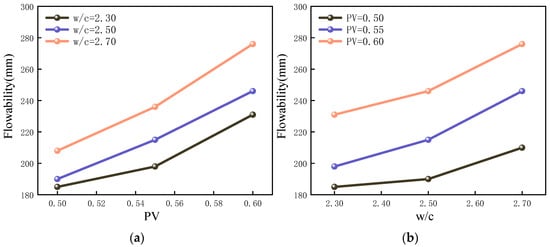
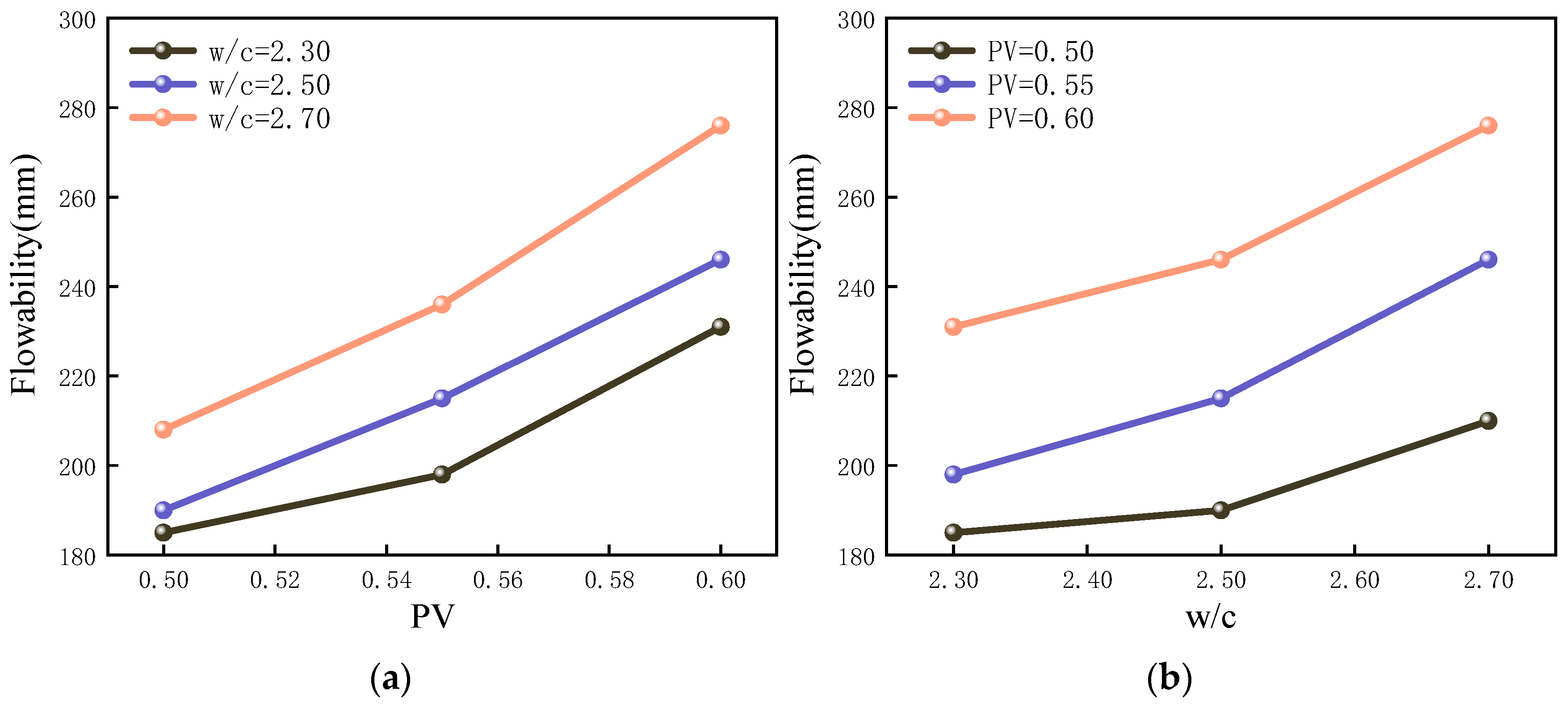
The experimental results show that increasing both the paste volume ratio (PV) and the water–binder ratio (w/b) improves the flowability, with the effect of the paste volume ratio being more significant. For instance, under the condition of w/b = 2.7, when PV increases from 0.50 to 0.55 and 0.60, the flowability increases by 7.6% and 41.0%, respectively. This indicates that increasing the paste volume ratio can reduce the volume fraction of fine aggregates, release more free water to participate in lubrication, and thereby significantly improve the flowability of the system. The specific effect pattern is illustrated in Figure 1.
Figure 1.
Effect of paste volume ratio and water–binder ratio on the flowability of LFSS. (a) flowability versus PV under different w/b ratios; (b) flowability versus w/b under different PV levels.
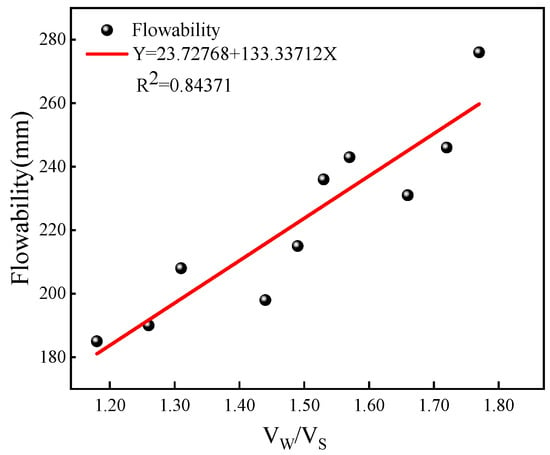
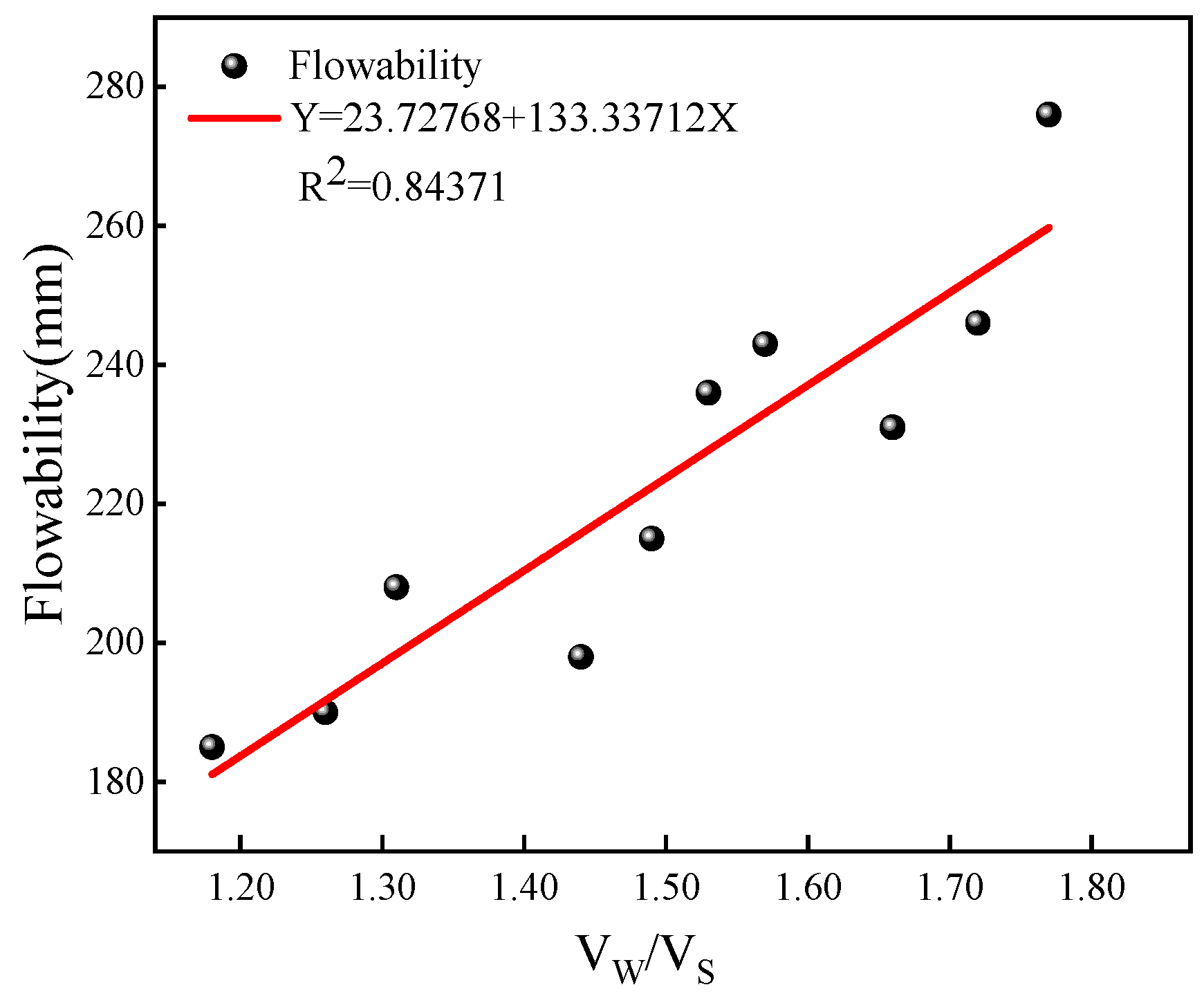
To quantify the relationship between flowability and the mix parameters, the water–solid volume ratio (Vw/Vs), which is the ratio of the water volume to the total volume of solid materials, was introduced. As shown in Figure 2, with an increase in the water–solid volume ratio, the flowability of LFSS also increases. To further examine the quantitative relationship between flowability and the water-to-solid volume ratio, the experimental data were fitted. The results demonstrate a linear positive correlation, with a correlation coefficient of 0.84371. The fitting formula is presented in Equation (1).
where is the flowability (mm) of lightweight LFSS, and is the water–solid volume ratio of LFSS.
Figure 2.
Effect of water–solid volume ratio on the flowability of LFSS.
This formula suggests that the water–solid volume ratio can be used as an independent design parameter to control flowability, offering a theoretical foundation for future mix design optimization.
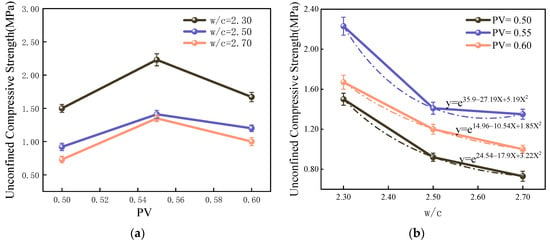
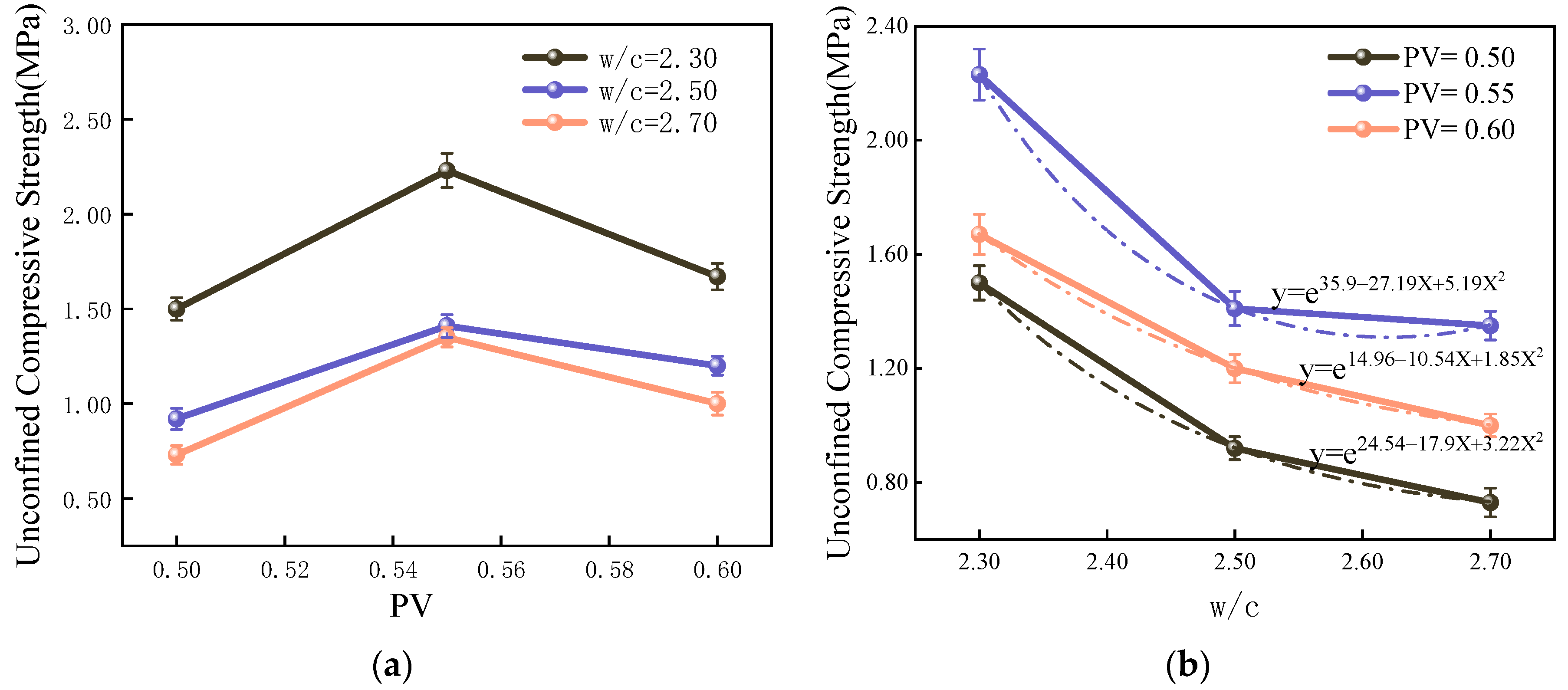
Figure 3 illustrates the effect of PV and w/b on the 28-day compressive strength of LFSS. As shown in Figure 3a, under different water–binder ratios, the compressive strength first increases and then decreases with the increase in the slurry volume ratio, and there exists an optimal slurry volume ratio (0.55 in this study). This occurs because the paste initially fills the voids in the fine aggregates, then surrounds the particles to form a composite skeleton, leading to peak strength. However, excessive paste weakens the supporting role of the aggregate skeleton and leaves more voids due to water evaporation, causing strength to decrease. At a high water–binder ratio, the evaporation of excess water leads to the formation of larger capillary pores, thereby reducing the strength. Luo et al. reported that the porosity of high w/b concrete is 37%–49% higher than that of low w/b concrete. This phenomenon is directly related to the mix design and further exacerbates the reduction in porosity and strength [23]. The optimal paste volume ratio identified in this study is 0.55, approximately 1.4 times the pore volume of the fine aggregates (39.66%). This finding aligns well with the empirical relationship between the optimal paste volume ratio and the pore volume of fine aggregates suggested in previous studies [24].
Figure 3.
Effect of paste volume ratio (PV) and water–binder ratio (w/b) on the compressive strength of LFSS: (a) Variation in 28-day compressive strength with PV under different w/b ratios. (b) Variation in 28-day compressive strength with w/b under different PV levels.
Figure 3b shows that, under a fixed slurry volume ratio, the compressive strength monotonically decreases with the increase in the water–binder ratio. This is because the evaporation of excess water will increase the capillary pores and weaken the adhesion between particles. The relationship between compressive strength and water–binder ratio was fitted through a quadratic function to obtain a high-precision relationship. The fitting parameters under each PV are shown in Table 6, and the fitting relationship is presented in Equation (2).
where is the compressive strength (MPa) of lightweight LFSS at 28 days of curing; is the water–binder mass ratio.
Table 6.
Fitting parameters corresponding to different paste volume ratios.
Based on the above principles, a systematic four-step mix design method is proposed:
1. Determine the initial paste volume ratio (PV):
Based on the experimental findings, it is recommended to set the paste volume ratio at or greater than 1.4 times the pore volume of fine aggregates to provide higher strength for the mixture. According to the absolute volume method, it is assumed that the lightweight fluidized solidified soil only contains fine aggregates and binder paste. The mass of fine aggregates per unit volume is calculated according to Equation (3).
where is the mass of fine aggregates per unit volume (kg/m3); is the specific gravity of the fine aggregates; PV is the paste volume ratio.
2. Determine the water–solid volume ratio (Vw/Vs) and water–binder ratio (w/b) based on the target flowability:
The water–solid volume ratio (Vw/Vs) corresponding to the target flowability is determined using Equation (4), and the water–binder ratio (w/b) is calculated from Equation (4).
where is the water–binder ratio; is the water–solid volume ratio; is the specific gravity of the binder; is the paste volume ratio.
3. Calculate the amount of binder and water required:
Once the water–binder ratio is determined, the amount of binder and water per unit volume is calculated using Equations (5) and (6).
where is the mass of binder per unit volume (kg/m3); is the density of water (kg/m3); is the water content per unit volume (kg/m3).
4. If the strength needs to be adjusted, the initial paste volume ratio can be gradually increased, and the above steps can be repeated to calculate the amounts of each raw material:
In this study, PV = 0.55 and w/b = 2.5 are selected, The calculation shows that the fine aggregate used in the experiment is 930.24 kg/m3, the binder amount is 192.1 kg/m3, and the water content is 480.3 kg/m3. At this point, the binder content is 21%, the water–solid mass ratio is 0.43, the theoretical flowability is 215 mm, and the 28-day compressive strength is 1.41 MPa. Related experiments were carried out to verify the theoretical values. The flowability of the LFSS was found to be 220 mm, and the 28-day compressive strength was 1.57 MPa. The errors in flowability and compressive strength were 2.3% and 11.3%, respectively.
3.2. EPS Modification and Shell Formation
EPS particles have smooth surfaces and strong hydrophobicity, leading to weak bonding with the binder interface, which can cause layering, segregation, and interface defects in lightweight LFSS [25,26]. To improve the interface performance, this study adopted three methods to modify and shell-form EPS particles and quantitatively evaluated the coating effect through the shell loss rate. The results are shown in Table 7 [17].
Table 7.
Coating performance of EPS particles prepared by different shell-forming methods.
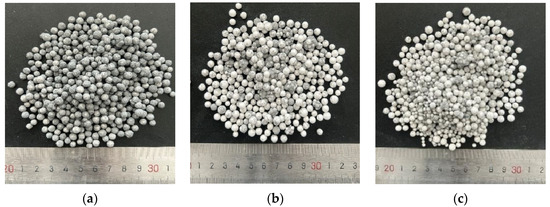
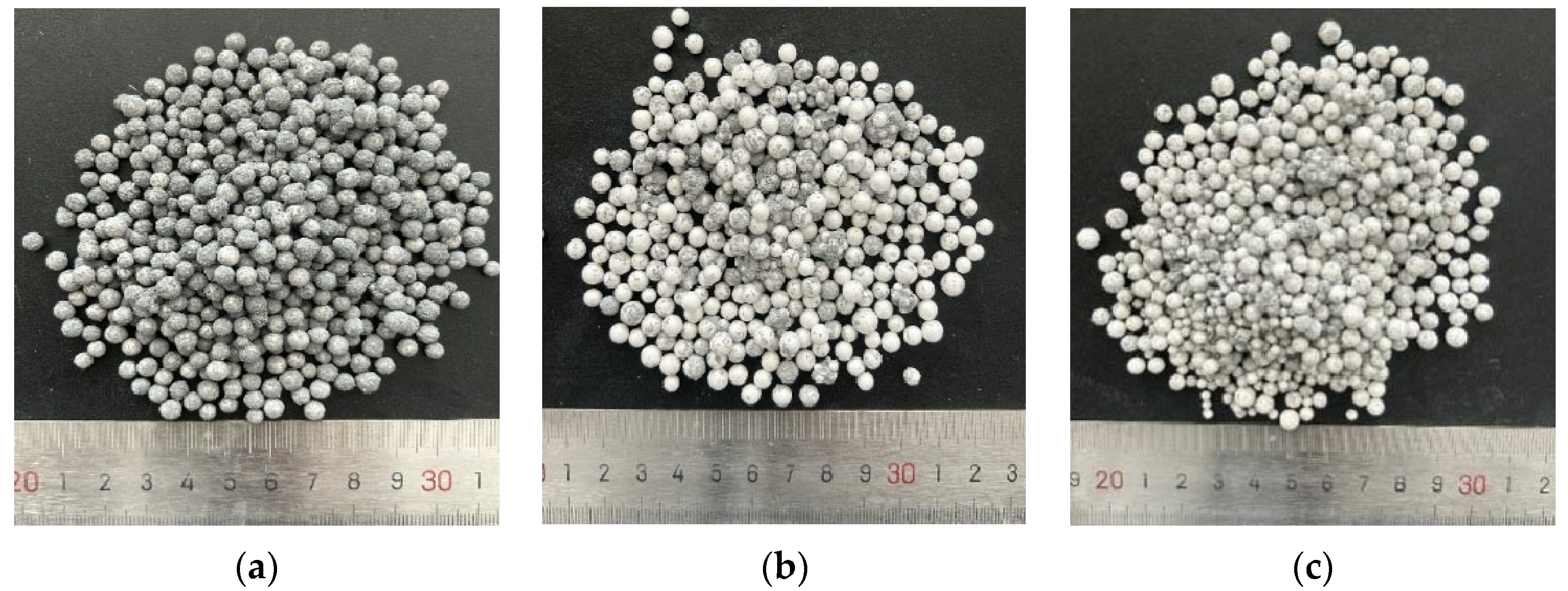
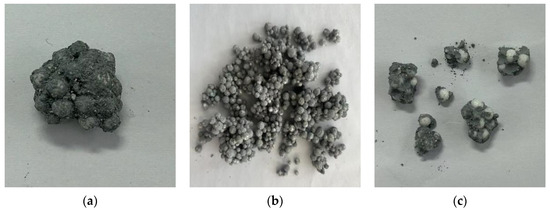
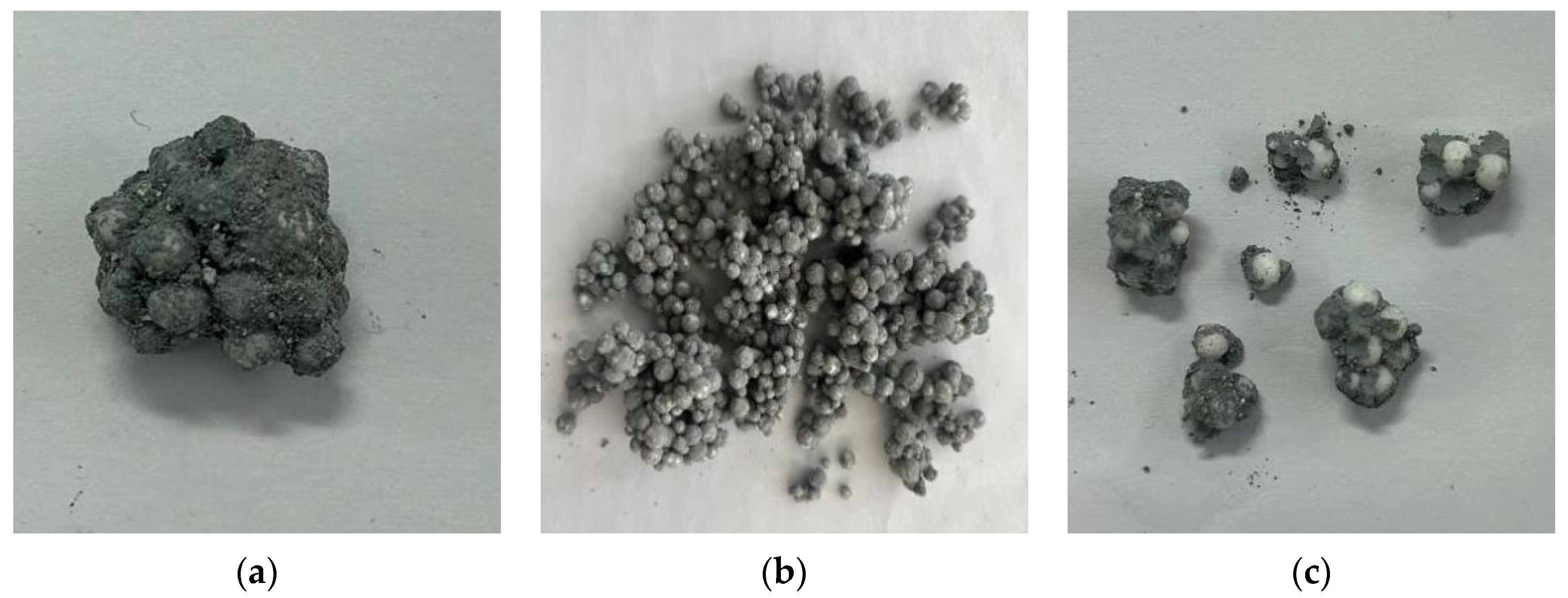
As shown in Table 7, Method (c) exhibited the highest shell loss rate due to the lack of modifiers, causing difficulty in the paste adhering to the EPS surface and resulting in significant particle exposure. Although Method (b) uses modifiers, due to the lack of a hydration environment and effective binder, the strength of the coating layer is insufficient. Method (a) demonstrated the lowest shell loss rate. The reason for this is that the modifier transformed the EPS surface from hydrophobic to hydrophilic, enhancing its adhesion. The calcium carbide slag–silica fume paste formed a continuous shell, and after dry material dispersion, a dense and stable coating layer was formed, significantly improving the interfacial adhesion performance [25]. The particle morphologies after coating by different methods are shown in Figure 4.
Figure 4.
EPS particles coated by different shell-forming methods: (a) EPS particles coated using Method (a) (EVA modification, paste coating, and dry powder dispersion). (b) EPS particles coated using Method (b) (EVA modification and direct dry powder coating). (c) EPS particles coated using Method (c) (no modifier, paste coating, and dry powder dispersion).
After determining the optimal coating method (Method a), further research was conducted to examine how the water–binder ratio of the coating paste affects the quality of the coating. As the water–binder ratio increased from 1.0 to 3.0, the shell loss rate consistently decreased. When the water–binder ratio is too low, the fluidity of the paste is insufficient and the EPS particles are unevenly coated, leading to clumping and localized exposure, as shown in Figure 5a,c. When the water–binder ratio was too high, the paste becomes too diluted, leading to an insufficient coating layer thickness. After mixing, the layer is easily damaged and clumping occurs, as shown in Figure 5b. The measured shell loss rates are presented in Table 8.
Figure 5.
Effect of coating slurry water–binder ratio on EPS particle coating quality: (a) Clumping and localized exposure at low w/b. (b) Clumping due to insufficient coating thickness at high w/b. (c) Detailed view of exposed EPS surface at low w/b.
Table 8.
Shell loss ratio under different water–binder ratios of coating slurry.
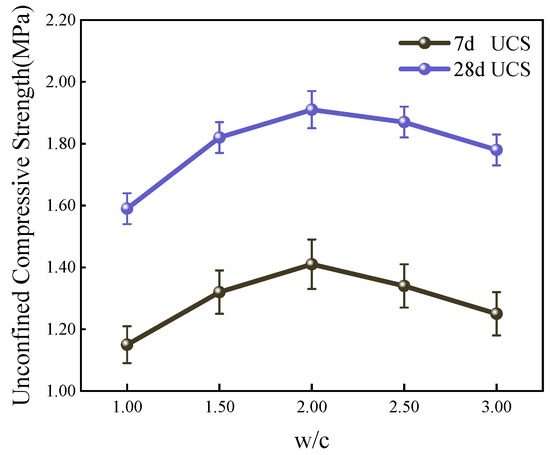
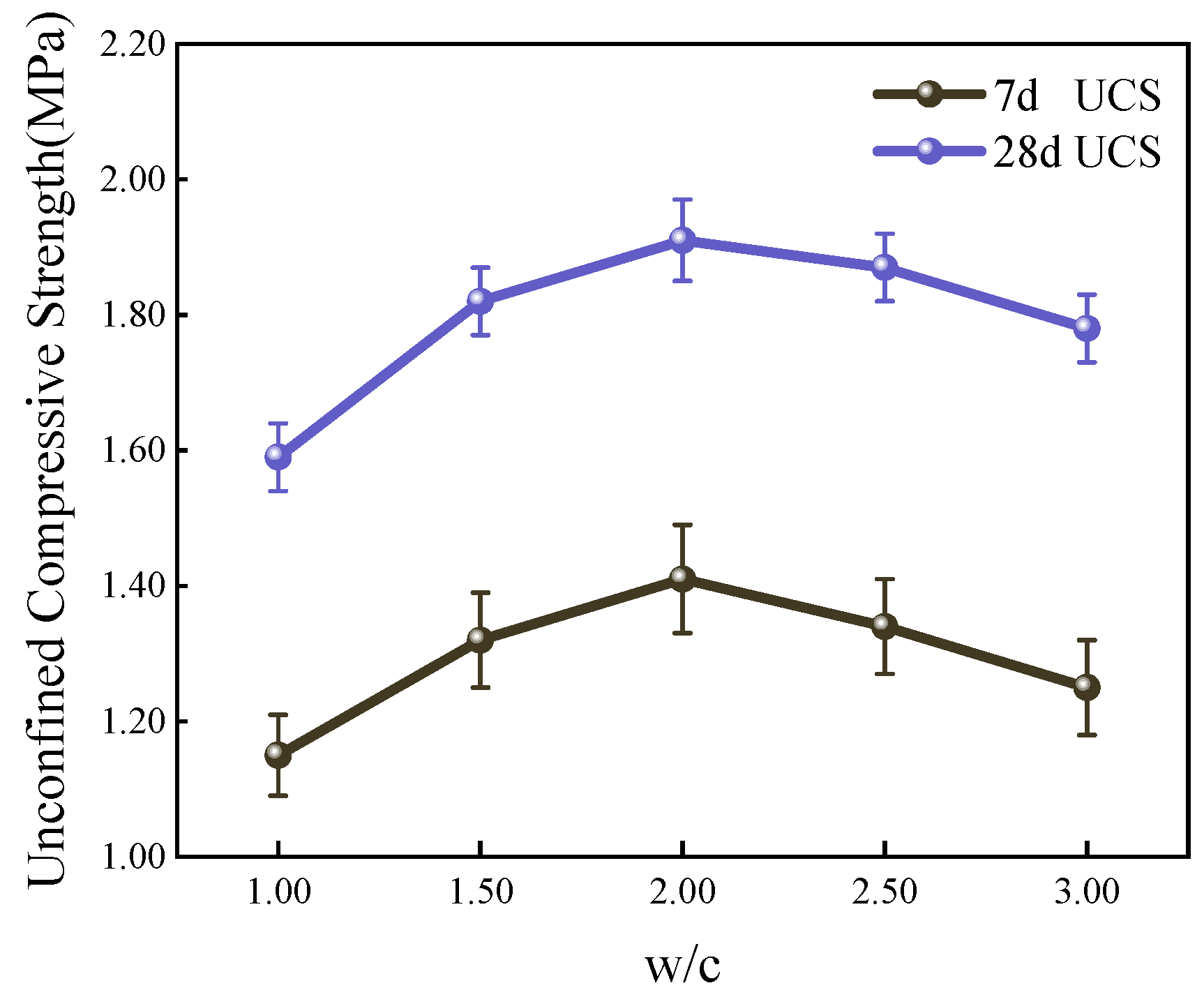
After incorporating EPS particles coated with different water–binder ratios into LFSS, the influence on the compressive strength at 7 days and 28 days was analyzed. The strength variation is shown in Figure 6. The strength curve shows an initial increase followed by a decrease. When the water–binder ratio reached 2.0, the coating layer was intact, and the strength was optimal. As the water–binder ratio continued to increase, the coating layer became thinner or damaged, leading to a decrease in strength. Therefore, a water–binder ratio of 1.5 was selected as the optimal parameter for further experiments.
Figure 6.
Effect of coating slurry water–binder ratio on the mechanical properties of LFSS.
Table 9 shows the shell loss rate of EPS particles under different coating material to EPS mass ratios. When the mass ratio of the coating material to EPS (Mc:MEPS) is too low, the paste cannot uniformly cover the EPS surface, causing local exposure and a thin coating layer. However, at this time, the paste adsorbed and wetted by the particles does not easily fall off, so the shell loss rate remains low. At a mass ratio of 4, the shell loss rate significantly increased to 8.40%, and when it increased to 6, the loss rate further rose to 10.78%. Therefore, an excessively high mass ratio will lead to a decrease in the adhesive strength of the outer layer of the shell, and the shell loss rate will increase accordingly.
Table 9.
Shell loss ratio under different coating material to EPS mass ratios.
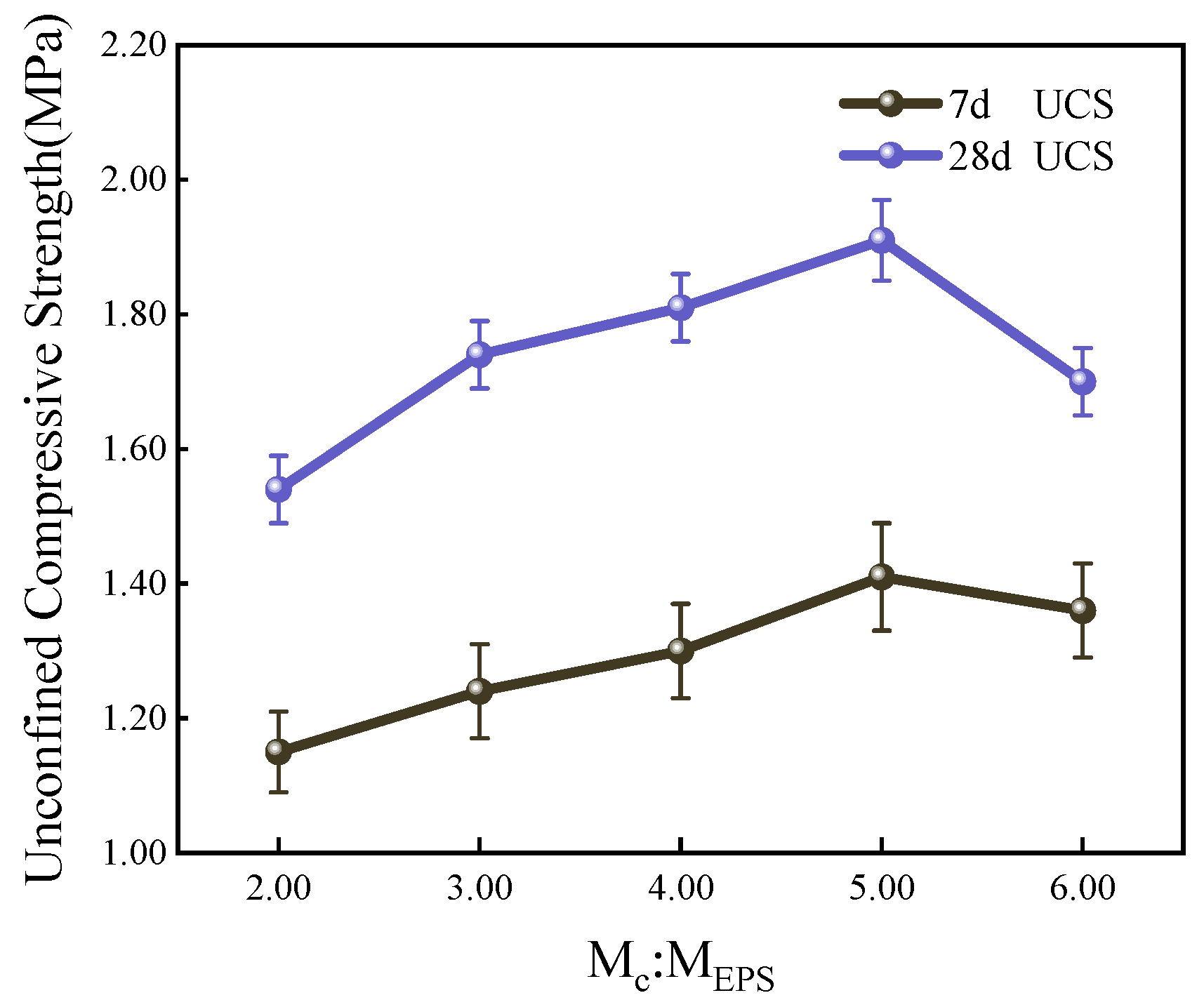
The compressive strengths of LFSS under different qualities of coating materials are shown in Figure 7. The strength initially increases and then decreases with the amount of coating material, indicating that the coating material needs to avoid excessive accumulation while ensuring the thickness and continuity of the shell layer. After considering both the shell loss rate and compressive strength, the optimal coating material mass ratio is determined to be five times the mass of EPS.
Figure 7.
Effect of coating material dosage on the mechanical properties of LFSS.
3.3. Effect of EPS Modification and Shell Formation on Performance
After determining the optimal coating method for EPS particles, the water–binder ratio of the coating paste, and the amount of coating material, further experimental studies were conducted to assess its adaptability in lightweight fluid solidified soil by investigating the flowability and compressive strength of LFSS.
First, in terms of flowability, to evaluate the effect of EPS modification and shell formation on LFSS flowability, the flowability of unmodified EPS-LFSS and Pre-EPS-LFSS was measured, with the results presented in Table 10.
Table 10.
Flowability of LFSS with different EPS treatment methods.
As shown in Table 10, the flowability of Pre-EPS-LFSS decreased by about 5.5% compared to EPS-LFSS which is unmodified. This is mainly because, after modification and shell formation, the EPS surface was coated with calcium carbide slag–silica fume paste, which increased surface roughness and exhibited hydrophilic characteristics. During mixing, it easily adsorbed some of the free water from the paste, which increased cohesion and weakened flowability. However, the reduction in flowability was limited, and the material still maintained good workability, indicating that modification and shell formation can improve the interfacial properties between EPS and the paste without significantly reducing the flowability
In terms of mechanical properties, the strength differences between the two were compared through 7-day and 28-day compressive strength tests, and the results are shown in Table 11.
Table 11.
Mechanical properties of LFSS under different EPS treatment schemes.
According to Table 11, the 7-day and 28-day strengths of Pre-EPS-LFSS were significantly higher than those of unmodified EPS-LFSS, with the 28-day compressive strength showing a particularly notable increase of 21.7%. The strength increase is mainly due to the formation of the “core–shell structure,” which enhanced the interfacial bonding between the EPS surface and the soil; the porosity is reduced, and the area of interface weakening is decreased, which improves the overall load-bearing capacity of the system. Additionally, the presence of the shell constrained the deformation of the EPS under load, enhancing the macroscopic stability of the material. The 28-day compressive strengths achieved (1.57 MPa for EPS-LFSS and 1.91 MPa for Pre-EPS-LFSS) comply with ACI 229R-13 [27] requirements for excavatable controlled low-strength materials, which specify an upper limit of 2.1 MPa. This confirms the material’s suitability for backfill applications where future re-excavation may be necessary, such as utility trenches and foundation voids, while providing adequate load-bearing capacity.
3.4. Interfacial Strengthening Mechanism of EPS Modification and Shell Formation
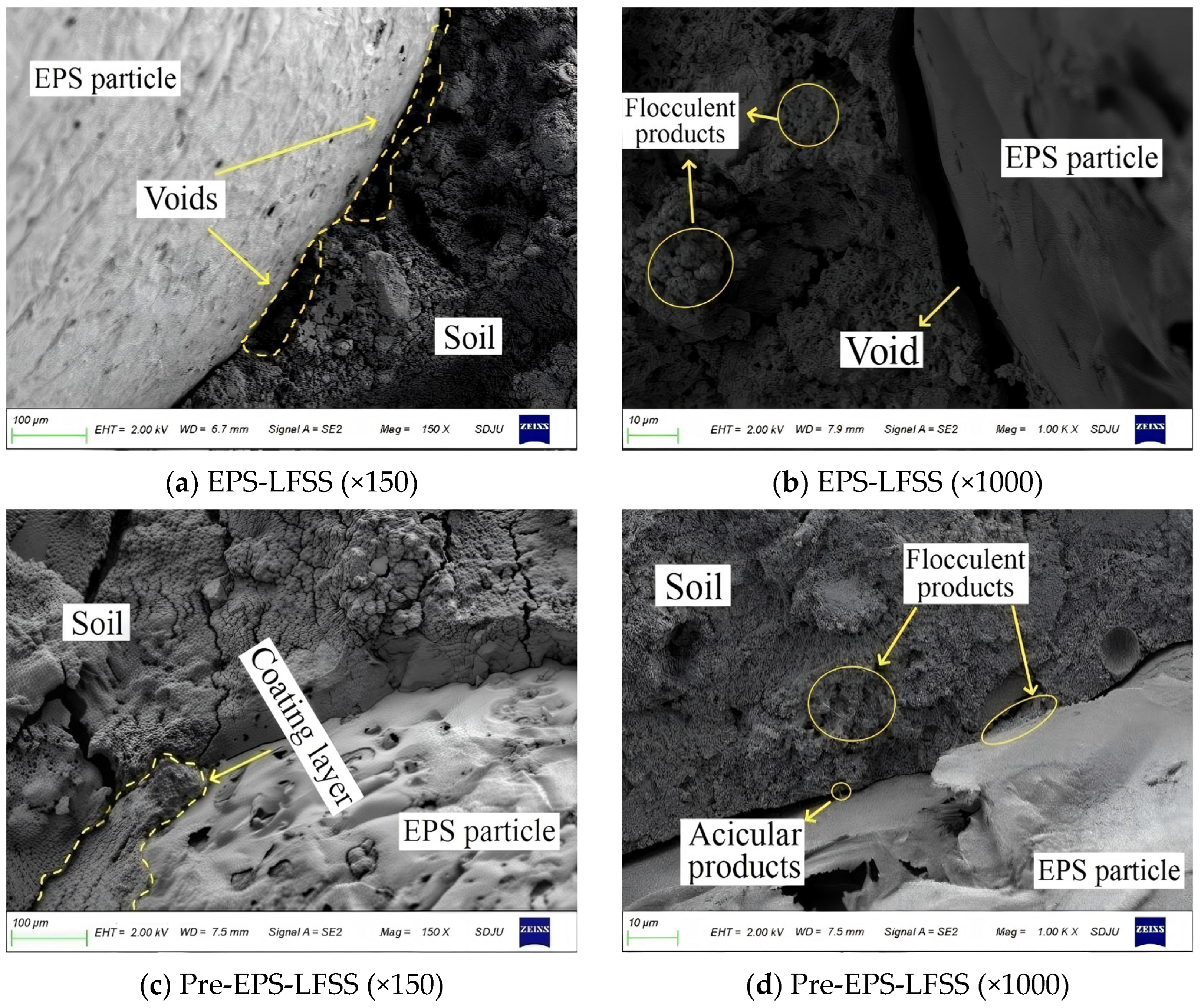
To further reveal the mechanism of modification and shell formation in the interface structure, a scanning electron microscope (SEM) was used to compare and observe the interfaces of LFSS unmodified and modified shell formation. The results are shown in Figure 8.
Figure 8.
Microstructure of LFSS interfaces: (a) EPS-LFSS (150×); (b) EPS-LFSS (1000×); (c) Pre-EPS-LFSS (150×); (d) Pre-EPS-LFSS (1000×).
From the observation results in Figure 8, it can be seen that in unmodified EPS-LFSS, the EPS particles have smooth surfaces with no hydration products attached, and there are noticeable cracks at the interface, showing weak contact between the particles and the soil. In Pre-EPS-LFSS, the EPS surface is coated to form a rough and dense shell. A large amount of flocculent and acicular hydration products can be seen at the interface, filling the pores around the particles and causing the previously distinct weak interface zone to disappear. The hydration products intertwine with the shell, forming a continuous and stable transition zone, which significantly enhances the interfacial bonding strength. This explains from a microscopic perspective why modification and shell formation improves compressive strength.
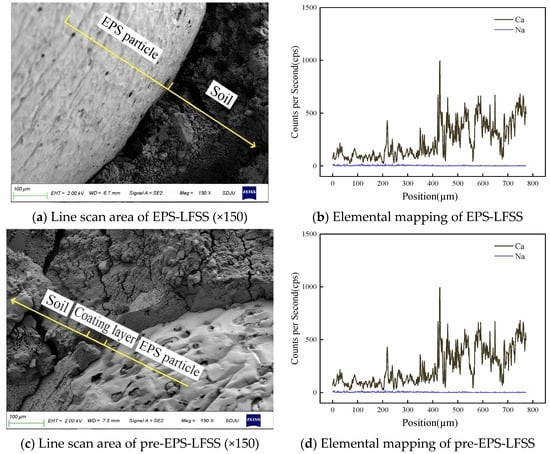
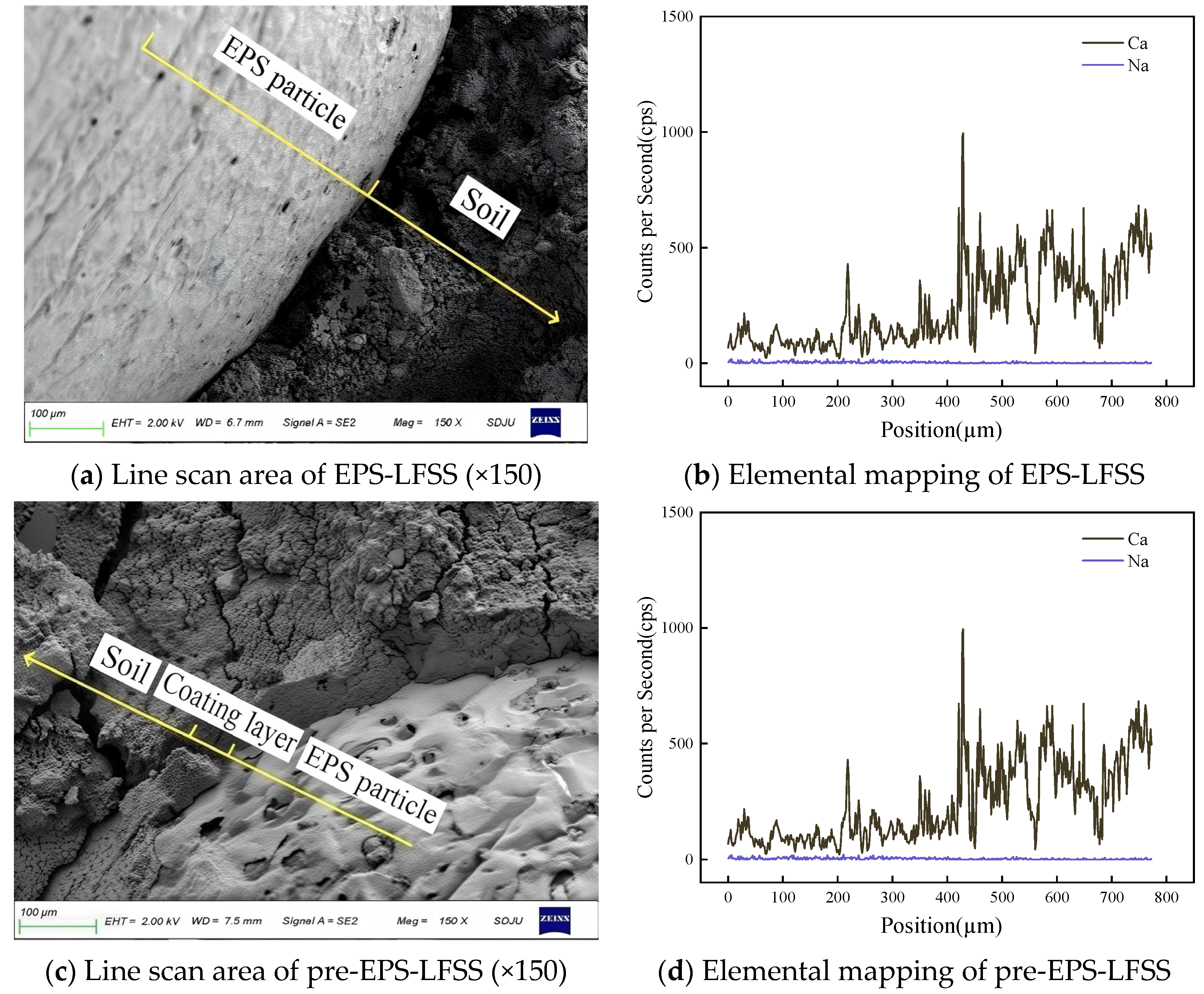
In order to further analyze the chemical bonding between the shell layer and the surrounding soil, energy-dispersive spectroscopy (EDS, Oxford Instruments, Abingdon, UK) line scanning analysis was conducted on the interface between EPS-LFSS and Pre-EPS-LFSS, and the results are shown in Figure 9.
Figure 9.
EDS analysis of LFSS interfaces: (a) EPS-LFSS line scan; (b) EPS-LFSS elemental mapping; (c) Pre-EPS-LFSS line scan; (d) Pre-EPS-LFSS elemental mapping.
Figure 9 shows that the Na element signal of the unmodified EPS-LFSS is extremely weak, while the Ca element is mainly distributed in the soil area, indicating poor interface transition and the inability of the binder to adhere to the EPS surface. In contrast, in Pre-EPS-LFSS, both Na and calcium Ca elements show distinct peaks in the shell region, and sodium Na diffuses into the surrounding soil region. This suggests that sodium silicate is involved in shell formation and migrates outward during the reaction, working with calcium ions from calcium carbide slag to form hydration products like C-S-H, which further enhances the density and stability of the interfacial transition zone. Thus, it can be concluded that modification and shell formation not only change the physical properties of the EPS surface but also enhance interfacial bonding through chemical interactions, significantly improving the structural integrity and load-bearing capacity of LFSS.
In conclusion, EPS modification and shell formation significantly enhance the mechanical properties of LFSS at both macroscopic and microscopic levels by improving flowability, enhancing interfacial bonding, constructing a stable core–shell structure, and promoting the deposition of hydration products at the interface. This method offers an effective approach for lightweighting and performance regulation for practical engineering applications.
4. Conclusions
This study took lightweight fluid solidified soil based on calcium carbide slag–silica fume as the object and constructed a dual regulation system of “mix design optimization-EPS modification and shell formation”, systematically revealing the influence mechanisms of paste volume ratio, water–binder ratio, and EPS modification and shell formation on fluidity, strength, and interface structure. The research proposed a flowability and strength prediction method suitable for this system, clarified the key role of modification and shell formation technology in improving interfacial bonding and enhancing overall performance, and provided a reliable technical basis for lightweight and engineering applications. The main conclusions are as follows:
- (1)
- A mix proportion design system for lightweight fluid solidified soil based on calcium carbide slag–silica fume was established. The research indicates that the paste volume ratio and water–binder ratio are the main controlling parameters affecting flowability and mechanical properties. An increase in the paste volume ratio can significantly enhance flowability and improve the system strength within a moderate range, but if it is too high, it will reduce the soil skeleton’s support. Although an increase in the water–binder ratio enhances flowability, it leads to an increase in porosity and a decrease in strength. There is a linear positive correlation between flowability and the water–solid volume ratio (R = 0.84371), providing a reliable theoretical basis for the quantitative prediction of flowability. Based on these findings, a four-step mix design method suitable for the calcium carbide slag–silica fume system was established, and the high precision of flowability and strength prediction was confirmed.
- (2)
- A process for EPS particle interface modification and shell formation has been proposed and optimized. By comparing the three coating methods, it was found that EVA modification combined with paste coating (Method a) can effectively improve the surface wettability and adhesion of EPS, minimizing the shell loss rate. The water–binder ratio of the coating paste significantly affects the integrity of the shell layer. When the water–binder ratio is 2.0, the coating is uniform and dense with the least clumping. When the coating material to EPS mass ratio is 5:1, the continuity and adhesion of the shell layer are optimal. Process optimization established the optimal technical path for EPS shell formation under the calcium carbide slag–silica fume system.
- (3)
- Modification and shell formation significantly improve the macroscopic performance of lightweight fluid solidified soil. Modification and shell formation caused a slight decrease in flowability by 5.5%, but the material still maintained good workability. The 28-day compressive strength increased from 1.57 MPa to 1.91 MPa, with an increase of 21.7%, indicating that shell formation effectively enhances the EPS–paste interface bonding, reduces the weak interface region, and improves the overall load-bearing capacity.
- (4)
- Microstructural analysis revealed the strengthening mechanism of shell formation. SEM shows that in the unmodified system, the surface of EPS is smooth and the interface cracks are obvious, while after shell formation, a rough and dense shell layer is formed at the interface, accompanied by the deposition of flocculent and acicular hydration products. EDS results confirmed that the Na and Ca elements were distributed synergistically in the shell layer and diffused into the interfacial transition zone, promoting the formation of C-S-H and other cementitious products, significantly improving the interface density and structural stability.
- (5)
- This study has limitations: environmental benefits were not quantified, long-term durability was not experimentally evaluated, and failure modes were not analyzed. Future research should conduct life-cycle assessment, durability testing, and failure mechanism analysis to validate engineering applicability.
Author Contributions
Conceptualization, X.K. and Y.W.; methodology, Q.J. and J.F. (Jikai Fu); validation, L.L., Y.L. and M.W.; formal analysis, Y.L.; investigation, J.F. (Jiaxiang Fang); resources, X.K. and Y.W.; data curation, M.W.; writing original draft, X.K. and Q.J.; writing review, L.L.; supervision, J.F. (Jikai Fu). All authors have read and agreed to the published version of the manuscript.
Funding
This research was funded by Shandong Hi-Speed Group Co., Ltd. Science and Technology Plan Project (Grant No. HS2025B092).
Institutional Review Board Statement
Not applicable.
Informed Consent Statement
Not applicable.
Data Availability Statement
The data presented in this study are available on request from the corresponding author.
Conflicts of Interest
Authors Yongkang Wang, Jikai Fu, Jiaxiang Fang, Lipeng Lu, Maolin Wang and Yilong Li were employed by the company Shandong Hi-Speed Infrastructure Construction Co., Ltd. and Shandong Hi-Speed Shenyang-Haikou Expressway Co., Ltd. The remaining authors declare that the research was conducted in the absence of any commercial or financial relationships that could be construed as a potential conflict of interest.
Abbreviations
| Abbreviation | Full Meaning |
| EDS | Energy-Dispersive Spectroscopy |
| EPS | Expanded Polystyrene |
| EVA | Ethylene-Vinyl Acetate |
| LFSS | Lightweight Fluid Solidified Soil |
| PV | Paste Volume Ratio (volume fraction) |
| SD | Standard Deviation |
| SEM | Scanning Electron Microscope |
| UCS | Unconfined Compressive Strength |
| w/b | Water–Binder Mass Ratio (mass fraction) |
References
- Kong, X.; Wang, G.; Rong, S.; Liang, Y.; Liu, M.; Zhang, Y. Utilization of Fly Ash and Red Mud in Soil-Based Controlled Low Strength Materials. Coatings 2023, 13, 893. [Google Scholar] [CrossRef] [Scilit]
- Salini, U.; Parayil, A. Behavior of controlled low-strength material incorporating industrial by-products fly ash, quarry waste and concrete waste. Constr. Build. Mater. 2024, 447, 138057. [Google Scholar] [CrossRef] [Scilit]
- Lu, J.; Yang, X.; Lai, Y.; Feng, Z.; Hu, X.; Wang, X. Mechanical and microscopic properties of concretes made with municipal solid waste incinerator bottom ash (MSWIBA) exposed to freeze-thaw cycles. Constr. Build. Mater. 2024, 452, 138864. [Google Scholar] [CrossRef] [Scilit]
- Kong, X.; Yan, Z.; Rong, S.; Zhang, J. Preparation and Properties of Flowable Silt Backfill Materials Containing Industrial Solid Waste Red Mud. J. Yangtze River Sci. Res. Inst. 2020, 37, 86–91. [Google Scholar]
- Kong, X.; Yan, Z.; Sun, R.; Yu, Y.; Wang, G. Study on Application and Performance of Solid Waste Materials in Fluidized Treatment of Clay. Subgrade Eng. 2021, 3, 59–64. [Google Scholar]
- Zhang, J.; Tan, H.; He, X.; Yang, W.; Deng, X. Utilization of carbide slag-granulated blast furnace slag system by wet grinding as low carbon cementitious materials. Constr. Build. Mater. 2020, 249, 118763. [Google Scholar] [CrossRef] [Scilit]
- Yu, B.; Liu, Z.; Feng, Y.; Zhang, T.; Laba, J.; Jiang, W.; Fu, Y. Synergistic Self-Activation in Multi-Solid Waste Mortar: Mix Design Optimization Based on Mechanical Properties. Mater. Rep. 2020, 37, 1–16. Available online: https://link.cnki.net/urlid/50.1078.TB.20251208.1256.024 (accessed on 15 February 2026).
- Liu, Y.; Chen, X.; Wang, B.; Lu, N.; Xiao, X.; Luo, D. Preparation and Strength Mechanism of Alkali-Activated Fly Ash-Slag-Carbide Slag Based Geopolymer. Bull. Chin. Ceram. Soc. 2023, 42, 1353–1362. [Google Scholar]
- Wang, K.; Guo, S.Y.; Yuan, H.; Zou, J. Influence of cement particle size, ultra-fine fly ash, and ultra-fine silica fume on the physical and microscopic properties of slurry. Case Stud. Constr. Mater. 2025, 22, e04337. [Google Scholar] [CrossRef] [Scilit]
- Lin, Y.; He, T.; Da, Y.; Ma, X.; Yang, R.; Qu, Q. Improvement of mineral admixtures on the properties of fluoroaluminic acid shotcrete and fluoride ion leaching behavior. Constr. Build. Mater. 2025, 477, 141384. [Google Scholar] [CrossRef] [Scilit]
- Wei, J.; Zhang, J.; Han, D.; Xing, J. Mixture Design Method of Flowable Backfill Materials Using Recycled Fine Aggregates of Brick and Concrete Waste. Highway 2023, 68, 283–288. Available online: https://link.cnki.net/urlid/11.1668.U.20230508.1407.091 (accessed on 15 February 2026).
- Alizadeh, V. New approach for proportioning of controlled low strength materials. Constr. Build. Mater. 2014, 201, 871–878. [Google Scholar] [CrossRef] [Scilit]
- Alizadeh, V. Influence of Cementing Paste Volume on Properties of Controlled Low Strength Materials. J. Mater. Civ. Eng. 2018, 30, 031802. [Google Scholar] [CrossRef] [Scilit]
- Fu, R.; Feng, L.; Jiang, K. Experimental Study on the Flowability of Pre-mixed Fluid EPS Lightweight Soil. Highway 2023, 68, 397–402. [Google Scholar]
- Du, L.; Chen, H.; Hao, J.; Deng, Z.; Li, Z.; Zhu, H. Status and Development of EPS Granules Concrete Modification. Concrete 2024, 5, 178–184. [Google Scholar]
- Pang, C.; Zhang, C.; Li, P. Improvement of Core–Shell Lightweight Aggregate by Modifying the Cement–EPS Interface. Materials 2023, 16, 2827. [Google Scholar]
- Zhang, F.; Kong, X.; Liang, Y.; Wan, J.; Feng, X.; Xu, H. Application of Precoated EPS Particles in Fluid Lightweight Soil: Influencing Factors, Performance Enhancement, and Micro-Mechanisms. Arab. J. Sci. Eng. 2025. [Google Scholar] [CrossRef] [Scilit]
- Law, D.W.; Adam, A.A.; Molyneaux, T.K.; Patnaikuni, I.; Wardhono, A. Long Term Durability Properties of Class F Fly Ash Geopolymer. Concrete. Mater. Struct. 2015, 48, 721–731. [Google Scholar] [CrossRef] [Scilit]
- JTG 3430-2020; Test Methods of Soils for Highway Engineering. Ministry of Transport of the People’s Republic of China: Beijing, China, 2020.
- JGJ/T 70-2009; Standard for Test Method of Basic Properties of Construction Mortar. Ministry of Housing and Urban-Rural Development of the People’s Republic of China: Beijing, China, 2009.
- ASTM D-6103/D6103M-17; Standard Test Method for Flow Consistency of Controlled Low Strength Material (CLSM). S. Commonwealth of Pennsylvania, ASTM International: West Conshohocken, PA, USA, 2017.
- JTG E51-2009; Test Methods of Materials Stabilized with Inorganic Binders for Highway Engineering. Ministry of Transport of the People’s Republic of China: Beijing, China, 2009.
- Luo, D.; Niu, D. Influences of Water-to-Cement Ratio and Curing Condition on Water Absorption of Internal Curing Concrete. J. Build. Struct. 2019, 40, 165–173. [Google Scholar]
- Yurdakul, E.; Taylor, P.C.; Ceylan, H.; Bektas, F. Effects of paste-to-voids volume ratio on the performance of concrete mixtures. J. Mater. Civ. Eng. 2013, 25, 1840–1851. [Google Scholar] [CrossRef] [Scilit]
- Ma, B.; Hu, P.; Jin, Z.; Su, Y.; Lu, W.; Sun, Z. Performance Optimization of EPS-Phosphogypsum Composite System. Bull. Chin. Ceram. Soc. 2020, 39, 477–484. [Google Scholar]
- Wu, Y.; Pan, D.; Liu, X.; Dan, J.; Bian, S.; Li, Y.; Wang, J.; Yang, X. Effect of shell-modified EPS particles on foam geopolymer properties. J. Build. Eng. 2024, 96, 110582. [Google Scholar] [CrossRef] [Scilit]
- ACI 229R-13; Report on Controlled Low-Strength Materials. American Concrete Institute: Farmington Hills, MI, USA, 2013.

Disclaimer/Publisher’s Note: The statements, opinions and data contained in all publications are solely those of the individual author(s) and contributor(s) and not of MDPI and/or the editor(s). MDPI and/or the editor(s) disclaim responsibility for any injury to people or property resulting from any ideas, methods, instructions or products referred to in the content. |
© 2026 by the authors. Licensee MDPI, Basel, Switzerland. This article is an open access article distributed under the terms and conditions of the Creative Commons Attribution (CC BY) license.