


You are currently on the new version of our website. Access the old version .

Membranes, Volume 11, Issue 3

2021 March - 72 articles

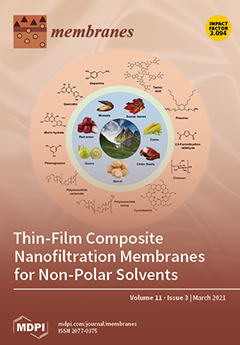
Cover Story: The organic solvent nanofiltration (OSN) membrane process has been recognized as a green separation technology with low energy consumption and mild operation conditions. To effectively separate solutes from organic solvent phase, it is fundamental to design membrane structures and materials and to control the physico-chemical properties of the membranes involved. The aim of this review is to understand the promising candidate materials for high-permeable thin film composite (TFC) membranes against non-polar solvents. In particular, the well-designed selective layer of TFC membranes is required for enhancing the solubility and permeability of non-polar solvents, which could lead to the application expansion of the OSN membrane process in both academic and industrial fields. View this paper.
  • Issues are regarded as officially published after their release is announced to the table of contents alert mailing list .
  • You may sign up for email alerts to receive table of contents of newly released issues.
  • PDF is the official format for papers published in both, html and pdf forms. To view the papers in pdf format, click on the "PDF Full-text" link, and use the free Adobe Reader to open them.

Articles (72)

  • Article
  • Open Access
41 Citations
5,387 Views
19 Pages

Permselectivity of Cation Exchange Membranes Modified by Polyaniline

  • Irina Falina,
  • Natalia Loza,
  • Sergey Loza,
  • Ekaterina Titskaya and
  • Nazar Romanyuk

This work discusses the applicability of polyaniline-modified cation exchange membranes for the separation of monovalent/divalent cations by electrodialysis. A novel method of membrane modification directly in the electrodialysis unit is used to prep...

  • Article
  • Open Access
33 Citations
5,691 Views
13 Pages

A high-silica chabazite (CHA) type zeolite membrane was prepared on the porous α-Al2O3 support tube by the secondary growth of seed particles. The dehydration performances of the membrane were determined using methanol, ethanol, 2-propanol, acetone,...

  • Article
  • Open Access
9 Citations
4,404 Views
19 Pages

The hydrophobic membranes have been widely explored to meet the membrane characteristics for the membrane distillation (MD) process. Inorganic metal oxide nanoparticles have been used to improve the membrane hydrophobicity, but limited studies have u...

  • Article
  • Open Access
15 Citations
3,978 Views
18 Pages

Electrodeposited Hybrid Biocathode-Based CO2 Reduction via Microbial Electro-Catalysis to Biofuels

  • Abdul Hakeem Anwer,
  • Nishat Khan,
  • Mohammad Faisal Umar,
  • Mohd Rafatullah and
  • Mohammad Zain Khan

Microbial electrosynthesis is a new approach to converting C1 carbon (CO2) to more complex carbon-based products. In the present study, CO2, a potential greenhouse gas, was used as a sole carbon source and reduced to value-added chemicals (acetate, e...

  • Article
  • Open Access
9 Citations
3,485 Views
13 Pages

Composite Polymer Anion Exchange Membranes with Sandwich Structure and Improved Performance for Zn–Air Battery

  • Xiaoxia Cai,
  • Yuansong Zhang,
  • Cong Li,
  • Guotao Zhang,
  • Xiaotao Wang,
  • Xian Zhang,
  • Qiang Wang and
  • Fuzhong Wang

In this study, we fabricated a composite polymer anion exchange membrane (AEM) with a sandwich structure. This prepared AEM demonstrated high ionic conductivity (0.25 Scm−1), excellent alkali resistance (8 M KOH), and good mechanical properties (tens...

  • Review
  • Open Access
35 Citations
16,063 Views
17 Pages

Physiological Basis of Extracorporeal Membrane Oxygenation and Extracorporeal Carbon Dioxide Removal in Respiratory Failure

  • Barbara Ficial,
  • Francesco Vasques,
  • Joe Zhang,
  • Stephen Whebell,
  • Michael Slattery,
  • Tomas Lamas,
  • Kathleen Daly,
  • Nicola Agnew and
  • Luigi Camporota

Extracorporeal life support (ECLS) for severe respiratory failure has seen an exponential growth in recent years. Extracorporeal membrane oxygenation (ECMO) and extracorporeal CO2 removal (ECCO2R) represent two modalities that can provide full or par...

  • Article
  • Open Access
12 Citations
3,593 Views
14 Pages

The membrane bioreactor (MBR), as one of the promising technologies, has been widely applied for treatments of wastewater. However, serious membrane fouling and low microbial activity have been reported as major problems hindering the development of...

  • Article
  • Open Access
29 Citations
5,972 Views
18 Pages

Ultrafiltration Process in Disinfection and Advanced Treatment of Tertiary Treated Wastewater

  • Rafał Tytus Bray,
  • Katarzyna Jankowska,
  • Eliza Kulbat,
  • Aneta Łuczkiewicz and
  • Aleksandra Sokołowska

The paper presents the results of research on the use of ultrafiltration, using membranes of 200 and 400 kDa separation, for disinfection of municipal treated wastewater. The research was conducted on a fractional technical scale using real municipal...

  • Review
  • Open Access
6 Citations
4,786 Views
21 Pages

In highly organized multicellular organisms such as humans, the functions of an individual cell are dependent on signal transduction through G protein-coupled receptors (GPCRs) and subsequently heterotrimeric G proteins. As most of the elements belon...

of 8

Get Alerted

Add your email address to receive forthcoming issues of this journal.

XFacebookLinkedIn
Membranes - ISSN 2077-0375