



Vaccines, Volume 14, Issue 5 (May 2026) – 96 articles
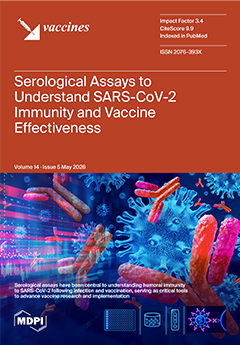
Cover Story (view full-size image):
Serological assays have been central to understanding humoral immunity to SARS-CoV-2 following infection and vaccination. This review summarizes major antibody-binding and neutralization platforms, including ELISA, multiplex assays, live-virus and pseudovirus neutralization assays, and surrogate neutralization tests. We discuss their principles, strengths, limitations, and roles in vaccine evaluation and immune monitoring, with an emphasis on assay standardization. By comparing these complementary approaches, this article provides a practical framework to guide the selection and interpretation of humoral immune assays in SARS-CoV-2 immunological research. View this paper
- Issues are regarded as officially published after their release is announced to the table of contents alert mailing list.
- You may sign up for e-mail alerts to receive table of contents of newly released issues.
- PDF is the official format for papers published in both, html and pdf forms. To view the papers in pdf format, click on the "PDF Full-text" link, and use the free Adobe Reader to open them.
Previous Issue
Next Issue
