



Vaccines, Volume 14, Issue 2 (February 2026) – 88 articles
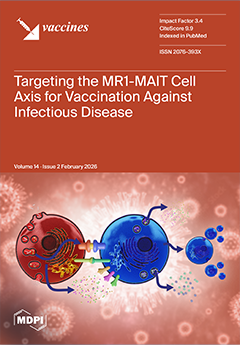
Cover Story (view full-size image):
Mucosal-associated invariant T (MAIT) cells are innate-like T lymphocytes that recognise microbial vitamin B2 metabolites, and other ligands, presented by the non-polymorphic molecule MR1. MAIT cells can be universally activated across diverse human populations, with MR1-MAIT interactions triggering cytokine production and cytotoxic and immunomodulatory responses that help coordinate immune responses against numerous pathogens. In this article, we review MAIT cell biology and emerging strategies to harness MR1 ligands as vaccine adjuvants—either by using MR1 ligands as stand-alone antigens for pan-vaccination approaches or by pairing MR1 ligands with more conventional T cell antigens for pathogen-specific vaccine development. Insights into the challenges of targeting the MR1-MAIT cell axis for vaccine development are also presented. View this paper
- Issues are regarded as officially published after their release is announced to the table of contents alert mailing list.
- You may sign up for e-mail alerts to receive table of contents of newly released issues.
- PDF is the official format for papers published in both, html and pdf forms. To view the papers in pdf format, click on the "PDF Full-text" link, and use the free Adobe Reader to open them.
Previous Issue
Next Issue