

You are currently viewing a new version of our website. To view the old version click .

Antioxidants, Volume 10, Issue 2

February 2021 - 196 articles

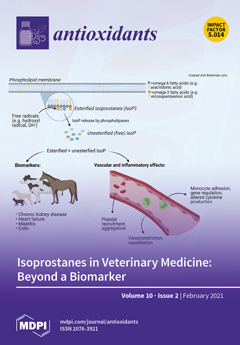
Cover Story: Oxidative stress is a cornerstone of numerous human and animal pathologies. Damage to tissue components such as lipids is a defining feature of oxidative stress and can lead to the generation of many oxidized products, including isoprostanes (IsoP). Isoprostanes are highly regarded as biomarkers of lipid peroxidation due to their sensitive and specific nature, along with chemical stability and presence in a variety of fluid and tissue samples. However, there are many remaining opportunities to detail the biological actions of IsoP, particularly in veterinary species. If realized, IsoP may be useful in clinical applications of veterinary medicine as biomarkers to guide treatment recommendations or as novel therapeutic targets for inflammatory diseases. View this paper
  • Issues are regarded as officially published after their release is announced to the table of contents alert mailing list .
  • You may sign up for email alerts to receive table of contents of newly released issues.
  • PDF is the official format for papers published in both, html and pdf forms. To view the papers in pdf format, click on the "PDF Full-text" link, and use the free Adobe Reader to open them.

Articles (196)

  • Review
  • Open Access
86 Citations
9,877 Views
24 Pages

Polyphenols in the Mediterranean Diet: From Dietary Sources to microRNA Modulation

  • Roberto Cannataro,
  • Alessia Fazio,
  • Chiara La Torre,
  • Maria Cristina Caroleo and
  • Erika Cione

23 February 2021

It is now well established that polyphenols are a class of natural substance that offers numerous health benefits; they are present in all plants in very different quantities and types. On the other hand, their bioavailability, and efficacy is are no...

  • Article
  • Open Access
11 Citations
4,342 Views
20 Pages

Fine-Tuning the Biological Profile of Multitarget Mitochondriotropic Antioxidants for Neurodegenerative Diseases

  • Daniel Chavarria,
  • Ophelie Da Silva,
  • Sofia Benfeito,
  • Sandra Barreiro,
  • Jorge Garrido,
  • Fernando Cagide,
  • Pedro Soares,
  • Fernando Remião,
  • Xavier Brazzolotto and
  • Florian Nachon
  • + 3 authors

23 February 2021

Neurotransmitter depletion and mitochondrial dysfunction are among the multiple pathological events that lead to neurodegeneration. Following our previous studies related with the development of multitarget mitochondriotropic antioxidants, this study...

  • Feature Paper
  • Review
  • Open Access
114 Citations
11,928 Views
36 Pages

Essential Oils in Livestock: From Health to Food Quality

  • Ralph Nehme,
  • Sonia Andrés,
  • Renato B. Pereira,
  • Meriem Ben Jemaa,
  • Said Bouhallab,
  • Fabrizio Ceciliani,
  • Secundino López,
  • Fatma Zohra Rahali,
  • Riadh Ksouri and
  • David M. Pereira
  • + 1 author

23 February 2021

Using plant essential oils (EOs) contributes to the growing number of natural plants’ applications in livestock. Scientific data supporting the efficacy of EOs as anti-inflammatory, antibacterial and antioxidant molecules accumulates over time; howev...

  • Article
  • Open Access
14 Citations
5,216 Views
22 Pages

Oxidatively Modified LDL Suppresses Lymphangiogenesis via CD36 Signaling

  • Bhupesh Singla,
  • Hui-Ping Lin,
  • WonMo Ahn,
  • Joseph White and
  • Gábor Csányi

23 February 2021

Arterial accumulation of plasma-derived LDL and its subsequent oxidation contributes to atherosclerosis. Lymphatic vessel (LV)-mediated removal of arterial cholesterol has been shown to reduce atherosclerotic lesion formation. However, the precise me...

  • Review
  • Open Access
38 Citations
6,346 Views
14 Pages

The Oxidative Paradox in Low Oxygen Stress in Plants

  • Chiara Pucciariello and
  • Pierdomenico Perata

23 February 2021

Reactive oxygen species (ROS) are part of aerobic environments, and variations in the availability of oxygen (O2) in the environment can lead to altered ROS levels. In plants, the O2 sensing machinery guides the molecular response to low O2, regulati...

  • Article
  • Open Access
11 Citations
3,995 Views
15 Pages

23 February 2021

Diabetic nephropathy (DN) is one of the causes of end-stage renal failure, featuring renal fibrosis. However, autophagy, a vital process for intracellular homeostasis, can counteract renal fibrosis. Moreover, NAD(P)H: quinone dehydrogenase 1 (NQO1) m...

  • Article
  • Open Access
26 Citations
7,645 Views
25 Pages

Signal Transducer and Activator of Transcription 3 (STAT3) Suppresses STAT1/Interferon Signaling Pathway and Inflammation in Senescent Preadipocytes

  • Aisha Y. Madani,
  • Yasser Majeed,
  • Houari B. Abdesselem,
  • Maha V. Agha,
  • Muneera Vakayil,
  • Nour K. Al Sukhun,
  • Najeeb M. Halabi,
  • Pankaj Kumar,
  • Shahina Hayat and
  • Mohamed A. Elrayess
  • + 3 authors

23 February 2021

Obesity promotes premature aging and dysfunction of white adipose tissue (WAT) through the accumulation of cellular senescence. The senescent cells burden in WAT has been linked to inflammation, insulin-resistance (IR), and type 2 diabetes (T2D). The...

  • Perspective
  • Open Access
49 Citations
4,643 Views
9 Pages

Roles of mTOR in Diabetic Kidney Disease

  • Mako Yasuda-Yamahara,
  • Shinji Kume and
  • Hiroshi Maegawa

22 February 2021

Diabetic kidney disease (DKD) is the leading cause of end-stage renal disease and the number of patients affected is increasing worldwide. Thus, there is a need to establish a new treatment for DKD to improve the renal prognosis of diabetic patients....

  • Article
  • Open Access
14 Citations
5,287 Views
25 Pages

Actin Cytoskeleton Regulation by the Yeast NADPH Oxidase Yno1p Impacts Processes Controlled by MAPK Pathways

  • Manuela Weber,
  • Sukanya Basu,
  • Beatriz González,
  • Gregor P. Greslehner,
  • Stefanie Singer,
  • Danusa Haskova,
  • Jiri Hasek,
  • Michael Breitenbach,
  • Campbell W.Gourlay and
  • Paul J. Cullen
  • + 1 author

22 February 2021

Reactive oxygen species (ROS) that exceed the antioxidative capacity of the cell can be harmful and are termed oxidative stress. Increasing evidence suggests that ROS are not exclusively detrimental, but can fulfill important signaling functions. Rec...

  • Article
  • Open Access
17 Citations
4,363 Views
14 Pages

Determination of the Antioxidant Activity of Samples of Tea and Commercial Sources of Vitamin C, Using an Enzymatic Biosensor

  • Danilo Braga Ribeiro,
  • Gabriela Santos Silva,
  • Djanira Rubim dos Santos,
  • Andressa Rose Castro Costa,
  • Eliane Braga Ribeiro,
  • Mihaela Badea and
  • Gilvanda Silva Nunes

22 February 2021

Antioxidants are synthetic or natural compounds capable of preventing or delaying oxidative damage caused by chemical species that can oxidize cell biomolecules, such as proteins, membranes, and DNA, leading to the development of various pathologies,...

of 20

Get Alerted

Add your email address to receive forthcoming issues of this journal.

XFacebookLinkedIn
Antioxidants - ISSN 2076-3921