

You are currently viewing a new version of our website. To view the old version click .

Brain Sciences, Volume 13, Issue 9

September 2023 - 126 articles

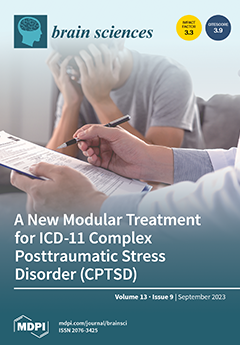
Cover Story: ICD-11 Complex Posttraumatic Stress Disorder (CPTSD) is a relatively new condition; therefore, there is limited available evidence for its treatment. Prior to the recognition of CPTSD as a separate trauma condition, people who met the associated criteria were often diagnosed with multiple co-morbid conditions such as PTSD, anxiety, depression, and emotional dysregulation difficulties. In the absence of a coherent evidence base, treatment tended to involve multiple treatments for these multiple conditions or lengthy phase-based interventions, often delivered in an integrative fashion, which was not standardized. In this paper, we present Enhanced Skills Training in Affective and Interpersonal Regulation (ESTAIR), a new flexible multi-modular approach for the treatment of CPTSD and its transdiagnostic symptoms. View this paper
  • Issues are regarded as officially published after their release is announced to the table of contents alert mailing list .
  • You may sign up for email alerts to receive table of contents of newly released issues.
  • PDF is the official format for papers published in both, html and pdf forms. To view the papers in pdf format, click on the "PDF Full-text" link, and use the free Adobe Reader to open them.

Articles (126)

  • Article
  • Open Access
3 Citations
3,268 Views
13 Pages

19 September 2023

Human mastication is a complex and rhythmic biomechanical process regulated by the central nervous system (CNS). Muscle synergies are a group of motor primitives that the CNS may combine to simplify motor control in human movement. This study aimed t...

  • Article
  • Open Access
4 Citations
3,141 Views
16 Pages

Lexical Access Restrictions after the Age of 80

  • Carlos Rojas,
  • Bernardo Riffo,
  • Marilyn San Martín and
  • Ernesto Guerra

19 September 2023

Background: During the fourth age (80+ years), cognitive difficulties increase. Although language seems to resist the advancement of age, an older person without pathological developments in cognition may exhibit deficits in lexical access. This stud...

  • Article
  • Open Access
3 Citations
2,282 Views
13 Pages

Association between Daytime Sleepiness, Fatigue and Autonomic Responses during Head-Up Tilt Test in Multiple Sclerosis Patients

  • Monika Zawadka-Kunikowska,
  • Łukasz Rzepiński,
  • Mirosława Cieślicka,
  • Jacek J. Klawe and
  • Małgorzata Tafil-Klawe

19 September 2023

We aimed to assess dynamic changes in hemodynamic and autonomic function in response to the head-up tilt test (HUTT) in patients with multiple sclerosis (MS) compared to healthy controls (HCs) and evaluate its relationship with the patients’ re...

  • Article
  • Open Access
1,737 Views
17 Pages

19 September 2023

The current study investigated how temporarily induced paresthesia in the moving limb affects the performance of a goal-directed target aiming task. Three-dimensional displacement data of 14 neurotypical participants were recorded while they pointed...

  • Article
  • Open Access
14 Citations
3,123 Views
19 Pages

18 September 2023

Electroencephalography (EEG) signals offer invaluable insights into diverse activities of the human brain, including the intricate physiological and psychological responses associated with mental stress. A major challenge, however, is accurately iden...

  • Article
  • Open Access
1,718 Views
21 Pages

18 September 2023

The present paper, in the framework of a search for a computer-aided method to detect depression, deals with experimental data of various types, with their correlation, and with the way relevant information about depression delivered by different set...

  • Article
  • Open Access
2 Citations
2,927 Views
21 Pages

17 September 2023

Purpose: Student audiology training in tinnitus evaluation and management is heterogeneous and has been found to be insufficient. We designed a new clinical simulation laboratory for training students on psychoacoustic measurements of tinnitus: one s...

  • Article
  • Open Access
5 Citations
2,708 Views
19 Pages

Neuroimmune Support of Neuronal Regeneration and Neuroplasticity following Cerebral Ischemia in Juvenile Mice

  • Ricaurte A. Marquez-Ortiz,
  • Vesna Tesic,
  • Daniel R. Hernandez,
  • Bilkis Akhter,
  • Nibedita Aich,
  • Porter M. Boudreaux,
  • Garrett A. Clemons,
  • Celeste Yin-Chieh Wu,
  • Hung Wen Lin and
  • Krista M. Rodgers

17 September 2023

Ischemic damage to the brain and loss of neurons contribute to functional disabilities in many stroke survivors. Recovery of neuroplasticity is critical to restoration of function and improved quality of life. Stroke and neurological deficits occur i...

  • Review
  • Open Access
5 Citations
3,235 Views
12 Pages

Inflammatory Mechanisms in a Neurovascular Disease: Cerebral Cavernous Malformation

  • Ying Li,
  • Abhinav Srinath,
  • Roberto J. Alcazar-Felix,
  • Stephanie Hage,
  • Akash Bindal,
  • Rhonda Lightle,
  • Robert Shenkar,
  • Changbin Shi,
  • Romuald Girard and
  • Issam A. Awad

17 September 2023

Cerebral cavernous malformation (CCM) is a common cerebrovascular malformation causing intracranial hemorrhage, seizures, and focal neurologic deficits. A unique CCM lesional inflammatory microenvironment has been shown to influence the clinical cour...

  • Systematic Review
  • Open Access
9 Citations
4,825 Views
12 Pages

A Systematic Review and Meta-Analysis of Cognitive Effects of rTMS in Caucasian Patients with Mild Cognitive Impairment

  • Christiane Licht,
  • Swetlana Herbrandt,
  • Carmen van Meegen,
  • Hartmut Lehfeld,
  • Thomas Hillemacher and
  • Kneginja Richter

17 September 2023

In recent years, repetitive transcranial magnetic stimulation (rTMS) has received much attention as a non-invasive, effective treatment modality for mild cognitive impairment (MCI). Although several meta-analyses have reported that rTMS can improve c...

of 13

Get Alerted

Add your email address to receive forthcoming issues of this journal.

XFacebookLinkedIn
Brain Sci. - ISSN 2076-3425