


Abstract
Broccoli by-products represent an underutilized source of dietary fiber and bioactive compounds with potential as functional food ingredients. This study evaluated the effect of enzymatic treatment with Viscozyme® L on broccoli by-products and their incorporation into gluten-free (GF) sourdough breads. Three GF bread formulations were developed: a control bread (BCT), a bread enriched with untreated broccoli by-products (BBC), and a bread enriched with enzymatically treated broccoli by-products (BBE), using a commercial GF bread (COM) as reference. Nutritional composition, antioxidant activity, starch digestibility, and sensory characteristics were evaluated. The incorporation of broccoli by-products significantly improved protein, total dietary fiber, and antioxidant activity compared with COM, with all reformulated breads meeting the EU “high fiber” claim. Enzymatic treatment with Viscozyme® L further enhanced these properties, with BBE reaching 2.66 g 100 g−1 soluble dietary fiber and 13.51 µM TE g−1 in FRAP, while exhibiting the highest slowly digestible starch content (20.39 g 100 g−1), suggesting a potentially more favorable starch digestibility profile. Sensory evaluation confirmed that these nutritional improvements were achieved without significantly compromising consumer acceptability. Overall, Viscozyme® L-treated broccoli by-products represent a sustainable, clean-label ingredient for nutritionally enhanced GF bakery products, supporting agri-food by-product valorization within a circular economy framework.
1. Introduction
The gluten-free (GF) market has experienced substantial growth in recent years, driven not only by the increasing prevalence and diagnosis of celiac disease, which affects approximately 1–2% of the global population [1], but also by a growing consumer perception that GF products are healthier alternatives to conventional foods [2]. As a result, the demand for GF bakery products has expanded beyond individuals requiring a strict GF diet for medical reasons, with an estimated annual growth rate of 7.6% between 2020 and 2027 [3]. Despite this growing popularity, most commercially available GF products are characterized by limited nutritional value, often containing high amounts of refined starches and fats while providing low levels of dietary fiber, vitamins, minerals, and bioactive compounds [4]. Moreover, the absence of gluten, a key structural protein responsible for dough viscoelasticity, negatively affects breadmaking performance, leading to reduced volume, poor texture, and lower sensory acceptance compared with traditional wheat-based products [5].
In this context, considerable research efforts have focused on developing strategies to enhance both the nutritional value and technological performance of GF bakery products. Among them, sourdough fermentation has emerged as a promising biotechnological approach due to its ability to enhance texture, flavor, shelf life, mineral bioavailability, and nutritional value through the metabolic activity of lactic acid bacteria and yeasts [6]. Furthermore, fermented GF cereal-based foods have a long tradition in several regions of the world, particularly in Asia, highlighting the broad consumer acceptance and market potential of fermented GF products [7]. Additionally, the incorporation of plant-based ingredients and agro-industrial by-products rich in dietary fiber and phytochemicals has gained increasing attention as a sustainable strategy to develop functional GF foods. Previous studies have reported the successful incorporation of ingredients such as cereal by-products [8], tomato pomace [9], or lime peels [10] into GF bread formulations, resulting in improved nutritional profiles and enhanced antioxidant properties.
Among vegetable by-products, broccoli (Brassica oleracea var. italica) residues represent an abundant and underutilized source of valuable bioactive compounds. During broccoli production and processing, approximately 85% of the total plant biomass is discarded as by-products, including leaves and stems, despite their high nutritional value [11]. Broccoli leaves are particularly rich in phenolic compounds, especially flavonoids and coumarins, which are strongly associated with antioxidant activity and other potential health-promoting effects [12]. In contrast, broccoli stems are mainly characterized by high dietary fiber content and significant levels of glucosinolates, sulfur-containing compounds whose hydrolysis products have been associated with antioxidant, anti-inflammatory, and chemoprotective activities [13]. Due to their valuable composition, broccoli by-products have attracted increasing interest as functional ingredients in food systems. Several studies have reported their successful incorporation into bakery products [14], pasta [15], and meat products [16], contributing to improved nutritional quality, enhanced antioxidant properties, and the valorization of agro-industrial residues.
Among the available valorization strategies, enzymatic treatment has emerged as an environmentally friendly and efficient approach to improving the functionality of plant by-products. Enzymatic valorization involves the application of hydrolytic enzymes, such as cellulases, hemicellulases, and pectinases, to break down cell wall polysaccharides and facilitate the release of bioactive compounds [17]. Enzymatic hydrolysis can increase the soluble dietary fiber content and promote the release of phenolic compounds trapped within the plant matrix, thereby enhancing their bioaccessibility and antioxidant potential [18]. This strategy has been successfully applied to several fruit and vegetable by-products, improving their nutritional and functional properties and supporting their use as value-added food ingredients [19].
In this study, enzymatically treated broccoli by-products were incorporated into GF sourdough bread as a strategy to enhance its nutritional and functional value while promoting the valorization of vegetable processing residues. The effect of broccoli by-product incorporation on the physicochemical, nutritional, antioxidant, and sensory properties of the breads was analyzed. This investigation aims to contribute to the development of nutritionally improved GF bakery products while supporting the sustainable utilization of broccoli by-products as value-added food ingredients.
2. Materials and Methods
2.1. Broccoli Extract Preparation
Broccoli by-products of the “Brassica oleracea var. italica” consisted of stems and were supplied by Cricket (Lorca, Spain). Broccoli by-product powder (BC) was prepared as described by Ayuso et al. [19]. The broccoli stems were dried at 50 °C in a forced-air oven for 24 h. Once dehydrated, the material was ground in a coffee mill and sieved to obtain a fine powder with a particle size of 500 µm.
A portion of these by-product powders was subjected to enzymatic pre-treatment with Viscozyme® L (Novozymes, Bagsværd, Denmark) following the methodology described by Ayuso et al. [19] with slight modifications. Viscozyme® L (enzyme activity ≥ 100 FBGU/g) is a multi-enzyme complex containing cellulase, arabinase, β-glucanase, and xylanase activities derived from Aspergillus aculeatus. The enzymatic treatment was performed by incubating diluted broccoli (1:5 v/w, in distilled water) with 1% (v/w) enzyme, at 45 °C and pH 4.5 in an orbital shaker at 600 rpm for 24 h. After incubation, the enzyme was inactivated by cooling the mixtures in an ice bath for 20 min. The hydrolyzed mixtures were dried in a forced-air oven at 60 °C and subsequently milled again to obtain the same particle size as the untreated powder, yielding the enzymatically treated broccoli by-products (BE).
2.2. Sourdough Preparation
Before GF bread elaboration, an amaranth sourdough was prepared by mixing flour and water at a 1:1 (w/v) ratio and then subjected to spontaneous fermentation at room temperature (25–26 °C) following the protocol of Peñalver et al. [6]. The pH was measured daily, and the mixture was refreshed regularly by adding equal amounts of flour and water until a pH range of 3.8–4.2 was reached. Then, the sourdough was used in the GF bread formulation.
2.3. Gluten-Free Bread Formulation
The GF sourdough breads were formulated using the ingredients detailed in Table 1, all purchased at a local supermarket (Murcia, Spain). Three different formulations were prepared: a control bread (BCT), a bread enriched with broccoli by-products (BBC), and a bread enriched with enzymatically treated broccoli by-products (BBE). The incorporation percentage of BC and BE was set at 5% (w/w) of the total flour used in the formulation, based on previous findings in GF broccoli-enriched breads [20].
Table 1.
Formulation of gluten-free sourdough breads.
First, ground flaxseeds, sugar, water, and amaranth sourdough were mixed and allowed to stand for 2 h at 25 °C to promote an initial fermentation and form the flaxseed gel, thereby improving the dough cohesion. Then the remaining ingredients were added and mixed until a homogeneous dough was obtained. The doughs were then allowed to ferment for 5 h at 25 °C under controlled conditions. Then, the dough was baked first at 250 °C for 15 min and then at 200 °C for 15 min. Finally, the loaves were allowed to cool at room temperature, aerated, sliced, and stored at −20 °C for further analysis.
Additionally, a commercial GF bread (COM) was purchased from a local supermarket for comparison purposes. According to the product label, it contains maize starch, water, sourdough (rice flour, water), buckwheat flour, rice flour, rice syrup, psyllium, rice starch, sunflower oil, soy protein, sorghum flour, thickener: hydroxypropyl methylcellulose; yeast, salt, and sugar. The visual appearance of the different GF breads is presented in Figure 1.
Figure 1.
Visual appearance of the sourdough gluten-free breads. BCT: Control gluten-free bread; BBC: Gluten-free bread enriched with BC; BBE: Gluten-free bread enriched with BE; BC: Broccoli by-products; BE: Enzymatically treated broccoli by-products; COM: commercial bread.
2.4. Chemical Composition
Moisture (964.22), ash (923.03), protein (955.04), fat (920.39), and dietary fiber fractions (insoluble, soluble, and total) (991.43) contents of broccoli by-products and GF breads were analyzed following the procedures of the Association of Official Analytical Chemists (AOAC) [21]. Carbohydrate content was calculated by difference, and caloric value was estimated with standard conversion factors for proteins, carbohydrates, and lipids, in accordance with the recommendations established by the Food and Agriculture Organization of the United Nations (FAO) [22]. All the analyses were performed in triplicate. Results for GF breads are expressed on a fresh-weight basis, whereas results for broccoli by-products are expressed on a dry-weight basis.
2.5. Antioxidant Capacity and Total Phenolic Content (TPC) Analysis
Before analysis, to extract bioactive compounds, 2 g of the sample were mixed with 8 mL of aqueous methanol (80%, v/v) solution. Then, the mixtures were kept in the dark at 4 °C for 24 h and subsequently centrifuged (4500 rpm, 25 min, 4 °C) using a FC5718R centrifuge (OHAUS Corp., Parsippany, NJ, USA). Resulting supernatants were finally filtered through 0.45 µm nylon syringe filters and stored at −20 °C.
Three complementary spectrophotometric assays were employed to determine the antioxidant capacity of the broccoli by-products and the different GF breads. The ferric reducing antioxidant power (FRAP) assay was performed following the protocol described by Benzie & Strain (1996) [23]. For this, the FRAP reagent was prepared by mixing acetate buffer, FeCl3·6H2O solution, and a 2,4,6-tripyridyl-s-triazine (TPTZ) solution, in a 10:1:1 (v/v/v) ratio. Then, 100 µL of the extracted sample was mixed with 1 mL of this reagent, and after 4 min of incubation, the absorbance was measured at 593 nm. The 2,2-diphenyl-1-picrylhydrazyl (DPPH) radical scavenging activity assay was performed by homogenizing 100 µL of the extracted sample with 3.9 mL of a 0.064 mM DPPH solution [24]. After 30 min of incubation in darkness, the decrease in absorbance was measured at 515 nm. Finally, the radical cation scavenging capacity of the 2,2-azinobis (3-ethylbenzothiazolin)-6-sulphonic acid (ABTS) assay was conducted following the method described by Re et al. (1999) [25]. After 2 min of incubation of 100 µL of the extracted sample with 1 mL of 7 mM ABTS working solution, absorbance was measured at 734 nm. These spectrophotometric assays quantified antioxidant activity using a Trolox standard curve, and the results were expressed as µM Trolox equivalents (TE) per 100 g of sample.
Total phenolic content (TPC) of the extracted samples was quantified according to Singleton et al. (1999) [26], by mixing 100 µL of the sample with 500 µL of the Folin–Ciocalteu reagent and 400 µL of a Na2CO3 solution. After 1 h of incubation, absorbance was measured at 750 nm. TPC results were expressed as mg of gallic acid equivalents (GAE) per 100 g of sample, based on a gallic acid calibration curve. Antioxidant activity and TPC assays were carried out with three independent replicates using a UV21 spectrophotometer (ONDA, Carpi, Italy).
2.6. Physicochemical Properties Determination
Color, pH, and total titratable acidity (TTA) were measured to determine the physicochemical properties of the broccoli by-products and the GF breads. Color measurements were obtained using a Konica Minolta CR-400 colorimeter (Konica Minolta, Tokyo, Japan) in accordance with the CIEL*a*b* system. Lightness (L*), redness (a*), yellowness (b*), chroma (C), and hue (h) parameters were recorded in triplicate on 16 mm-thick slices from each sample. The total color differences (ΔE*) of each formulation compared to the Control bread were calculated with the following equation:
where s and c indicate the samples and control.
The pH of the samples was measured using a sensION+ PH31 pH meter (Hach-Lange, Barcelona, Spain). For the analysis, samples were homogenized with distilled water at a ratio of 1:10 (w/v), and pH was determined directly in the resulting suspension. Subsequently, total titratable acidity (TTA) was evaluated in the same homogenate by titration with 0.1 M NaOH until reaching a pH of 8.5. Results were expressed as mL of NaOH required to neutralize 10 g of sample. All determinations were carried out in triplicate.
2.7. Digestible and Resistant Starch
Starch content of the different GF breads was quantified using the enzymatic Digestible and Resistant Starch Assay Kit (Megazyme International, Bray, Ireland) based on the method described by Englyst et al. (1992) [27]. The procedure involves controlled enzymatic hydrolysis and subsequent colorimetric determination of released glucose, measured at 510 nm. Samples were subjected to in vitro digestion at 37 °C for 240 min using a combination of pancreatic α-amylase and amyloglucosidase (PAA/AMG). At 20, 120, and 240 min, aliquots were collected to determine rapidly digestible starch (RDS), slowly digestible starch (SDS), and total digestible starch (TDS) and resistant starch (RS), respectively, according to their respective digestion intervals. All analyses were performed with three independent replicates, and results were expressed as g of starch per 100 g of sample.
2.8. Sensory Analysis
To assess the organoleptic characteristics of the different GF sourdough breads, a hedonic sensory evaluation was conducted using an untrained panel of 29 consumers of both genders, aged 18 to 60 years. Therefore, the evaluation was limited to consumer perception and did not aim to provide a descriptive sensory characterization of the breads. Participants evaluated appearance, aroma, texture, taste, overall color, juiciness, overall acceptability, and purchase intention with a 5-point scale ranging from 1 (extremely dislike) to 5 (extremely like). The evaluation was conducted in accordance with the International Organization for Standardization (ISO) guidelines [28] in individual sensory booths. Samples were cut into 3 cm3 portions and presented to the panelists with randomly assigned three-digit codes, and mineral water was provided for palate cleansing between samples. The study protocol was approved by the Bioethics Committee of the University of Murcia (M10/2024/444). All participants were informed about the study and signed the corresponding informed consent form. Exclusion criteria included medical conditions, smoking, and food allergies that could affect sensory perception.
2.9. Statistical Analysis
Statistical differences between GF bread formulations were evaluated by one-way analysis of variance (ANOVA) followed by Tukey’s honestly significant difference (HSD) post hoc test. Differences between broccoli by-products were assessed using Student’s t-test. Statistical significance was set at p < 0.05. All analyses were performed in triplicate (n = 3), and data were presented as mean ± standard deviation (SD). All statistical analyses were performed using version 28.0 of SPSS Statistics (IBM Corp., Armonk, NY, USA).
To explore relationships among the measured variables, Pearson correlation coefficients were calculated and visualized as a heatmap using the pheatmap package (version 2.5.0) in R software (version 4.5.0; R Foundation for Statistical Computing, Vienna, Austria). Finally, principal component analysis (PCA) was also performed using the prcomp function in the R software. The PCA biplot reduced the dimensionality of the dataset and visualized patterns of similarity among samples based on the first two principal components, which represent sample distribution and variable loadings.
3. Results and Discussion
3.1. Proximal Composition and Antioxidant Profile
Table 2 presents the chemical composition of the different broccoli by-products and the GF sourdough bread formulations. Enzymatic treatment significantly modified the nutritional composition of broccoli extracts, increasing moisture and ash content, and decreasing fat and protein content of BE relative to BC. Moreover, a significant increment in SDF was also observed in BE. These effects can be attributed to the action of Viscozyme® L, a multi-enzyme complex, which catalyzes the hydrolysis of β-1,4 and β-1,3 glycosidic bonds in plant cell wall polysaccharides, promoting the depolymerization and solubilization of structural components in lower-molecular-weight soluble fractions [19,29]. Considering that broccoli IDF is mainly composed of insoluble polysaccharides such as cellulose, hemicelluloses, and pectins [30], the increase in SDF observed in BE likely reflects the enzymatic conversion of these structural components into more soluble carbohydrates. Similar increases in SDF have been reported in broccoli by-products treated with Viscozyme® L [19,20], whereas studies using broccoli by-products or different gluten-free formulations have reported more moderate improvements, likely due to differences in the plant matrix and processing conditions. Similarly, Saroj et al. [31] reported a significant increase in the SDF content of wheat bran after treatment with a cellulase-containing enzyme preparation, attributed to comparable cell wall hydrolysis mechanisms.
Table 2.
Proximate composition, antioxidant activity, total phenolic content (TPC), and physicochemical properties of broccoli by-products and gluten-free breads.
With respect to GF bread formulations, comparative analyses were performed using BCT as a reference to assess the impact of by-products incorporation, while comparisons with commercial GF bread were used to evaluate the nutritional differences relative to market-available products. The incorporation of broccoli by-products into reformulated GF breads led to significant increases in protein and a decrease in fat. This reduction in fat content may be explained by the ability of dietary fiber to interact with and retain lipids within the food matrix, reducing their extraction during analytical procedures [32]. Significant increments were observed in dietary fiber content in BBC and BBE compared to BCT, consistent with the higher fiber content in the broccoli by-products (Table 2). Similar findings have been reported in breads enriched with broccoli stalk powder, where increasing the level of broccoli stalk incorporation resulted in a progressive increase in the TDF content of the final products [33]. Comparable effects have been observed in bakery products enriched with other vegetable by-products, particularly peel powders such as potato and apple peel, where their incorporation has consistently been associated with increased TDF content [34,35]. Moreover, BBE exhibited the highest SDF content, reflecting the effectiveness of the enzymatic treatment of broccoli by-products. This finding is consistent with the increased SDF content observed in BE, indicating that the enzymatic conversion of insoluble cell wall polysaccharides into soluble carbohydrates was retained after incorporation into the bread formulation. Overall, all reformulated breads contained more than 6 g of TDF per 100 g, thereby meeting the requirements for the “high fiber” nutrition claim established by Regulation (EC) No 1924/2006 [36]. On the other hand, all reformulated sourdough breads exhibited higher protein and dietary fiber content, along with reduced fat content compared with COM. These improvements can be attributed to the replacement of refined ingredients in the commercial formulation with buckwheat, chickpea, and quinoa flours, together with amaranth sourdough and flaxseeds, which contribute to a clearly superior nutritional and functional profile [37,38].
Moreover, the antioxidant activity (FRAP, ABTS, and DPPH) and TPC of broccoli by-products and GF breads are presented in Table 2. BC and BE were characterized as they correspond to the two ingredient forms incorporated into the bread formulations. Both showed high antioxidant activity and TPC, which can be associated with the natural richness of broccoli by-products in phenolic compounds, flavonoids, and glucosinolates [39]. In addition, enzymatic treatment significantly enhanced all antioxidant parameters and TPC in BE relative to BC. This enhancement confirms the promoting effect of enzymatic hydrolysis on the release of antioxidant-related compounds by disruption of cell wall polysaccharides [40,41]. Since BC and BE were prepared under comparable and relatively mild drying conditions, the observed differences in antioxidant capacity are mainly attributable to the enzymatic pre-treatment rather than to the preparation process itself. This high antioxidant potential of BC and BE was reflected differently in the corresponding bread formulations. Although BC exhibited high antioxidant activity as an individual ingredient, its incorporation into bread resulted in only limited improvements in antioxidant capacity. This may be explained by the fact that a considerable proportion of phenolic compounds in untreated broccoli by-products remains bound to the plant cell wall matrix, limiting their extractability and availability after incorporation into the bread matrix [42,43]. Consequently, the amount of readily extractable antioxidants transferred to the final product may have been insufficient to produce consistent increases across all antioxidant assays. In addition, FRAP, ABTS, DPPH, and TPC are based on different analytical principles and therefore do not necessarily exhibit identical trends within the same sample [44]. In contrast, the incorporation of BE resulted in consistently higher FRAP, DPPH, ABTS, and TPC values than BCT. These findings support the role of enzymatic treatment in promoting the release of antioxidant compounds from the broccoli by-product matrix, thereby increasing their availability for extraction and detection in the GF bread [40,41]. Similar improvements in antioxidant activity have been reported in GF breads enriched with Viscozyme® L-treated broccoli stalks, confirming that enzymatic treatment enhances the transfer of antioxidant compounds from broccoli by-products to the final baked product [20]. Finally, all reformulated breads exhibited significantly higher antioxidant activity and TPC than COM. Given the marked differences in formulation between commercial and experimental breads, these results likely reflect the combined contribution of the reformulated recipe, including pseudocereal flours, amaranth sourdough, flaxseeds, and broccoli by-products [38].
3.2. Physicochemical Profile
The physicochemical properties of the different broccoli by-products and GF bread formulations are presented in Table 3.
Table 3.
Physicochemical properties of broccoli by-products and gluten-free breads.
Regarding the broccoli by-products, enzymatic treatment with Viscozyme® L significantly reduced the pH and increased the TTA, thereby acidifying the sample. These results may be associated with the enzymatic degradation of cell wall polysaccharides, which promotes the release of previously bound organic acids and phenolic compounds within the plant matrix [45]. However, incorporating these extracts did not result in significant differences in pH among the fortified GF breads, which values are consistent with the range typically reported for sourdough GF breads, where organic acids generated during fermentation produce a characteristic acidity to the final product [46]. In contrast, TTA showed significant differences among the GF bread formulations (p < 0.05). All the reformulated breads (BCT, BBC, and BBE) exhibited markedly higher TTA values than COM, suggesting a greater accumulation of titratable acids despite their comparable pH values. These differences may be related to variations in sourdough composition, fermentation conditions, or organic acid production during breadmaking. Among the experimental formulations, incorporating BC and BE resulted in a slight decrease relative to BCT. This behavior may be associated with the release of phenolic compounds and soluble fiber during enzymatic treatment, which can contribute to the buffering capacity of the matrix and influence titratable acidity measurements [47].
In terms of color, the enzymatic treatment of broccoli by-products markedly altered the appearance of BE, which exhibited lower L* and higher a* and b*, leading to a darker color and a shift towards reddish-brown tones. These changes may be attributed to the release of compounds during the enzymatic degradation of cell wall structures and their subsequent oxidation by endogenous polyphenol oxidase and peroxidase enzymes, resulting in brown pigments [48]. In GF breads, all reformulated formulations showed lower L* values than COM, mainly due to the use of amaranth sourdough and pseudocereal flours, which contain naturally pigmented compounds compared to the commercial formulation with rice starch and refined ingredients. Moreover, the incorporation of BC and BE into GF bread produced only minor changes in color compared with BCT. The slightly higher values of a* observed in both enriched formulations, together with the increase in b* in BBE, reflect the transfer of the pigments and browning products generated during the enzymatic treatment of broccoli by-products to the bread matrix. Previous studies on GF bakery products enriched with broccoli stems [20] and broccoli leaves [49,50] reported similar color changes, including darker products and shifts towards reddish and yellowish tones after broccoli incorporation. This consistent behavior across different broccoli fractions and GF bakery products suggests that the intrinsic pigments of broccoli tissues are the main drivers of these color modifications. Finally, color differences relative to BCT (ΔE*) ranged from 0.51 in BBC to 2.26 in BBE and remained below the threshold of visual perceptibility (ΔE* = 3) [51]. This indicates that despite the observed changes in individual color parameters, incorporating BC and BE did not produce perceptible color differences from a consumer perspective.
3.3. Digestible and Resistant Starch Content
The results for the digestible starch and resistant starch of GF breads are presented in Table 4.
Table 4.
Digestible and resistant starch content of gluten-free breads (g 100 g−1).
Among the experimental bread formulations, incorporating broccoli by-products significantly modified starch digestibility. A progressive reduction in RDS from BCT to BBC and BBE was observed, with the effect more pronounced for BBE. In parallel, SDS exhibited an opposite behavior, increasing progressively across formulations from BCT to BBC and reaching the highest values in BBE. Together, these results reflect a modulation of the starch hydrolysis profile towards slower digestion in the experimental breads, with the effect more pronounced with the enzymatic treatment. These changes are nutritionally relevant, as lower RDS and increased SDS are associated with a slower glucose release and improved glycemic response [52]. Moreover, these effects are consistent with previous studies reporting similar shifts in starch digestibility, incorporating plant-based ingredients into GF bakery products [53,54], where reductions in RDS and increases in SDS were associated with the presence of dietary fibers and phenolic compounds. The observed shifts may be attributed to complementary mechanisms reported in the literature. Firstly, the dietary fiber present in broccoli by-products may act as a physical barrier, limiting water availability and enzyme accessibility to starch granules, thereby delaying starch gelatinization and hydrolysis [55,56]. Moreover, phenolic compounds released from broccoli by-products, particularly in BBE following enzymatic treatment, have been reported to interact with starch and digestive enzymes, reducing starch accessibility and partially inhibiting enzymatic hydrolysis [57,58]. Consequently, the greater availability of these bioactive compounds after enzymatic treatment may explain the more pronounced reduction in RDS and increase in SDS observed in BBE. Finally, the RS presented comparable values, with no significant differences among the formulations, with the highest value for BBE. However, these RS values obtained may be influenced by sourdough fermentation, which has been associated with starch retrogradation and the formation of less digestible starch structures during processing and storage [59].
Conversely, COM exhibited the highest RDS values and lowest SDS and RS levels. This digestibility profile reflects a predominance of starch fractions rapidly hydrolyzed during the initial phase of digestion and a limited capacity to sustain starch hydrolysis over time. This profile is consistent with the digestibility profiles reported by Giuberti and Gallo for GF products formulated mainly with refined starches, which are characterized by rapid starch hydrolysis and higher glycemic responses [60].
3.4. Sensory Evaluation
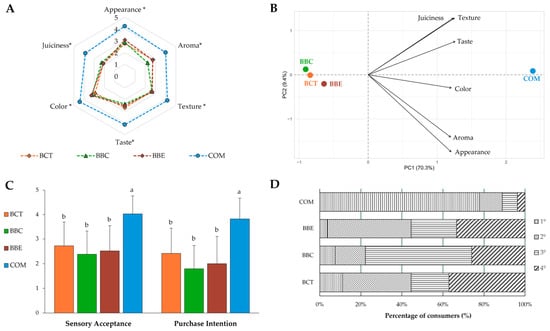
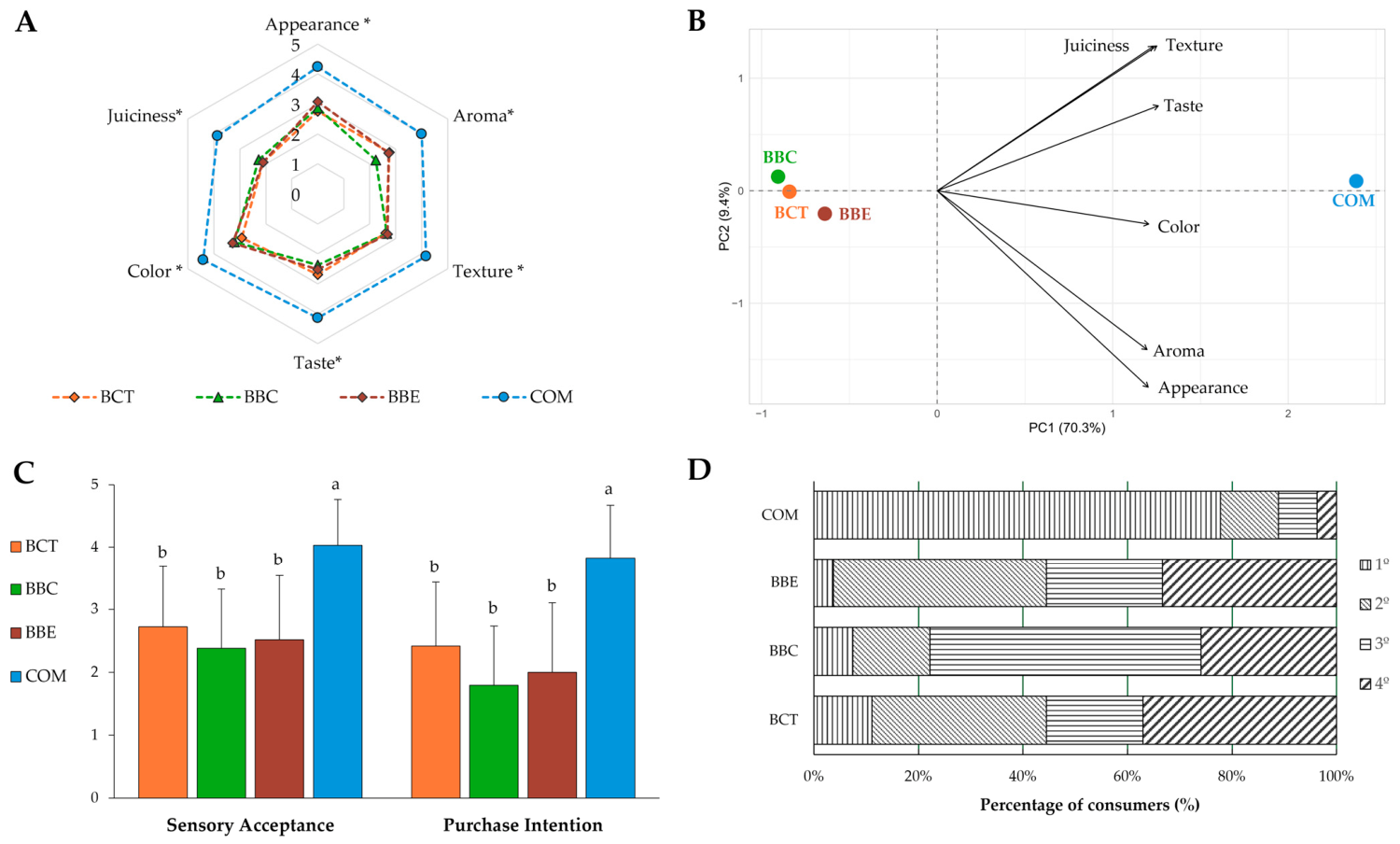
The results of the sensory evaluation of the four different GF breads assessed by the panelists are presented in Figure 2.
Figure 2.
Sensory evaluation of the different gluten-free breads. (A) Radar plots represent the intensity scores of the evaluated sensory attributes for each formulation. (B) PCA biplot showing sample clustering based on sensory characteristics and the relative contribution of individual attributes to sample discrimination. (C) Consumer acceptance and purchase intention scores. (D) Ranking test results showing the preference order of gluten-free bread formulations. Different letters (a, b) indicate statistically significant differences between samples (* p < 0.05). BCT: Control gluten-free bread; BBC: Gluten-free bread enriched with BC; BBE: Gluten-free bread enriched with BE; BC: Broccoli by-products; BE: Enzymatically treated broccoli by-products; COM: commercial bread.
In the sensory attribute radar plot (Figure 2A), significant differences (p < 0.05) were observed between formulations. Both broccoli-enriched formulations, BBC and BBE, exhibited sensory profiles comparable to those of BCT across all evaluated attributes. In contrast, COM obtained the highest scores for all evaluated attributes. For a deeper understanding of how sensory attributes contributed to the differentiation among formulations, a PCA plot was generated based on the sensory scores, as shown in Figure 2B. PCA explained 70.3% of the variance on PC1 and 9.4% on PC2, revealing two distinct groups among samples. COM was separated from the other formulations along PC1, clustering with the positively rated sensory attributes, indicating higher consumer appreciation of these characteristics. In contrast, BCT, BBC, and BBE clustered closer together on the opposite side of the plot, reflecting their similar sensory behavior and their lower scores in the main quality attributes.
Regarding consumer response, overall acceptance and purchase intention are presented in Figure 2C. These results exhibited the same trend, with COM achieving the highest values and the experimental breads remaining at lower and comparable levels without significant differences between them. The preference ranking analysis (Figure 2D) further supported these findings, showing a clear shift in preference towards COM with the highest percentage in the top positions. Conversely, BCT, BBC and BBE displayed more dispersed distributions and a greater proportion of lower preference rankings.
These results suggest that the incorporation of broccoli by-products, even after enzymatic treatment, did not negatively affect consumer acceptance of the experimental breads. Likewise, the comparable sensory profiles of BBC and BBE indicate that the enzymatic pre-treatment of the broccoli by-products did not produce perceptible changes in the sensory quality of the final breads. In contrast, the better sensory profile of COM may be attributed to its formulation, which includes rice syrup, psyllium, and hydroxypropyl methylcellulose, which are widely used in commercial GF breads to improve flavor, moisture retention, crumb structure, and overall sensory quality [61,62]. Moreover, all experimental formulations contain buckwheat, chickpea, and quinoa flours, which, despite their nutritional benefits, have been associated with lower sensory acceptance scores compared with rice-based formulations such as COM [63]. Nevertheless, the comparable sensory profiles observed among BCT, BBC, and BBE, together with their substantially superior nutritional and functional properties, support the viability of the reformulation strategy for developing GF breads with improved health benefits without significantly compromising consumer acceptability, as assessed by an untrained consumer panel.
3.5. Multivariate Statistical Analysis
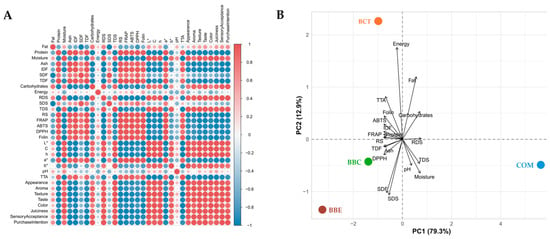
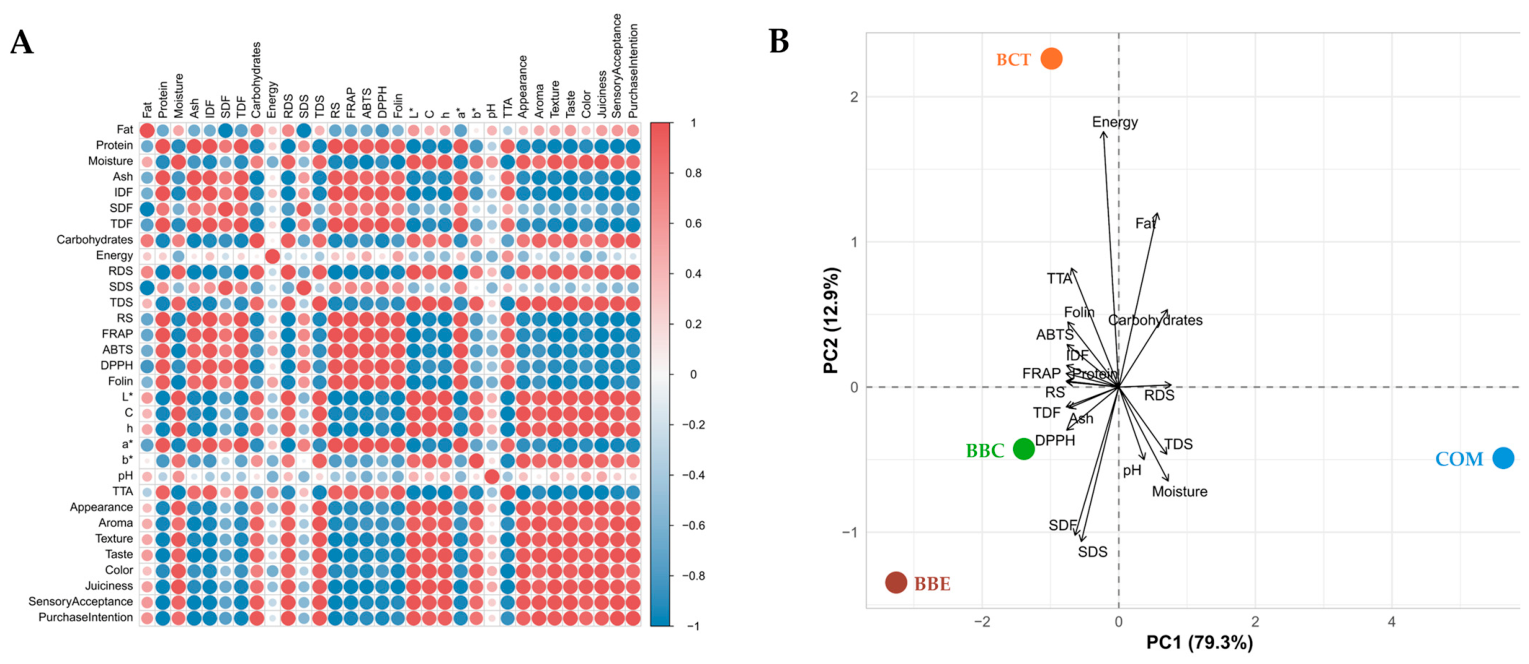
To further explore the relationships among the nutritional, physicochemical, and sensory parameters evaluated in this study, Pearson correlation analysis and PCA were performed (Figure 3).
Figure 3.
Multivariate analysis of gluten-free bread formulations based on the different measured parameters. (A) Pearson correlation matrix showing the relationships among the evaluated variables. Circle size and color intensity represent the strength of the correlation coefficient, with larger circles indicating stronger correlations. Red and blue denote positive and negative correlations, respectively. (B) PCA biplot illustrating sample distribution according to the evaluated parameters and the contribution of each variable to sample differentiation. BCT: Control gluten-free bread; BBC: Gluten-free bread enriched with BC; BBE: Gluten-free bread enriched with BE; BC: Broccoli by-products; BE: Enzymatically treated broccoli by-products; COM: commercial bread; IDF: insoluble dietary fiber; SDF: soluble dietary fiber; TDF: total dietary fiber; RDS: Rapidly digestible starch; SDS: Slowly digestible starch; TDS: Total digestible starch; RS: Resistant starch; TTA: total titratable acidity.
The Pearson correlation matrix (Figure 3A) revealed a strong positive association between the dietary fiber fractions (IDF, SDS, and TDF) and the antioxidant activity assays (FRAP, ABTS, and DPPH) as well as TPC. These observed correlations suggest that GF breads with higher fiber content also present increased concentrations of phenolic compounds, indicating that the incorporation of broccoli by-products contributed simultaneously to the enrichment of both the fiber and the phenolic profiles of the GF breads. Moreover, this association can be attributed to the recognized capacity of dietary fiber to interact with phenolic compounds, forming a carrier matrix that facilitates the retention of antioxidant molecules through covalent and non-covalent interactions [64,65]. In addition, protein content showed a strong positive correlation with ash content and a strong negative correlation with carbohydrates and moisture. This reflects the compositional differences between the nutrient-dense reformulated breads and the starch-based commercial product. Similarly, SDS was positively correlated with SDF and antioxidant activity, supporting the role of SDF and phenolic compounds in promoting the formation of less RDS by their interaction with the starch matrix [56]. Finally, sensory acceptance and purchase intention were positively associated with juiciness, texture, and taste, suggesting that consumer perception was primarily driven by sensory attributes rather than by nutritional parameters.
PCA of the nutritional parameters evaluated (Figure 3B) supported these findings, explaining 92.2% of the total variance (PC1: 79.3%; PC2: 12.9%). PC1 clearly separated COM from the reformulated breads, with COM associated with moisture, carbohydrates, RDS, and TDS. Conversely, the reformulated breads clustered on the opposite side, associated with protein, ash, IDF, TDF, TPC, and antioxidant capacities, supporting the improved nutritional profile of the reformulated samples. Moreover, PC2 further differentiated the experimental breads, with BBE associated with SDS and SDF. Overall, BBE was clearly different from the other formulations, indicating that the enzymatic treatment with Viscozyme® L produced a unique nutritional and functional profile.
4. Conclusions
The incorporation of broccoli by-products into GF sourdough bread formulations represents a sustainable strategy to develop nutritionally improved GF bakery products, highlighting the feasibility of incorporating these agri-food by-products into clean-label GF products within a circular economy framework. The incorporation of broccoli by-product extracts significantly improved the protein, ash, and total dietary fiber content of the reformulated breads, with all formulations meeting the EU criteria for “high fiber” claim, as well as exhibiting significantly higher antioxidant activity and TPC than the commercial GF product. These improvements are attributed to the rich bioactive composition of broccoli by-products, including phenolic compounds, flavonoids, and glucosinolates, which contributed simultaneously to the nutritional and functional enrichment of the final product. Furthermore, the incorporation of broccoli extracts progressively reduced RDS and increased SDS fractions, suggesting a more favorable glycemic profile compared to the commercial formulation. Sensory evaluation confirmed that broccoli by-product incorporation did not significantly compromise consumer acceptability. Although COM achieved superior sensory scores, it exhibited lower nutritional and functional properties than the reformulated breads, highlighting the challenge of balancing sensory quality with nutritional value in GF bakery products. Future formulation strategies should aim to narrow this gap through the incorporation of natural sweeteners or texture-improving hydrocolloids.
Enzymatic treatment with Viscozyme® L further maximized the functional potential of the broccoli by-products by promoting a significant conversion of IDF into SDF and enhancing phenolic content and antioxidant activity through the hydrolysis of cell wall polysaccharides and the release of bound bioactive compounds. Consequently, BBE exhibited the most favorable overall profile among the experimental breads, combining the highest SDF content, TPC, and antioxidant activity, with the greatest shift towards slower starch digestibility. In contrast, the untreated extract showed a more limited effect, highlighting enzymatic treatment as a key strategy for maximizing the value of broccoli by-products as functional food ingredients.
Overall, these findings support the use of Viscozyme® L-treated broccoli by-products as sustainable, clean-label functional ingredients for the development of nutritionally improved GF breads within a circular economy framework. Future research should focus on optimizing sensory quality while preserving the nutritional advantages of the formulations, as well as evaluating the technical and economic feasibility of industrial implementation. Attention should be paid to enzyme cost, the availability and seasonal variability of broccoli by-products, and the integration of the enzymatic treatment into existing food processing lines. Addressing these aspects will facilitate the translation of broccoli by-product valorization from laboratory-scale research to commercially viable circular food production systems.
Author Contributions
Conceptualization, G.N.; Formal analysis, J.Q., R.P. and P.A.; Investigation, J.Q., R.P. and G.N.; Data curation, J.Q.; Writing—original draft, J.Q. and P.A.; Writing—review & editing, R.P. and G.N.; Visualization, P.A.; Supervision, G.N.; Project administration, G.N.; Funding acquisition, G.N. All authors have read and agreed to the published version of the manuscript.
Funding
This study forms part of the Agroalnext program and was supported by MCIU with funding from European Union Next Generation EU (PRTR-C17.I1) and by Comunidad Autónoma de la Región de Murcia—Fundación Séneca. Jhazmin Quizhpe, Rocio Peñalver, and Pablo Ayuso thank the financial support through the Research Project PID2021-123628OB-C44.
Institutional Review Board Statement
The sensory evaluation study involving human participants was approved by the Bioethics Committee of the University of Murcia (approval code: 444/2024 and date of approval: 11 December 2024).
Informed Consent Statement
Informed consent was obtained from all subjects involved in the study.
Data Availability Statement
All data supporting the findings of this study are contained within the article. For additional information, please contact the corresponding author.
Conflicts of Interest
The authors declare no conflict of interest.
References
- Iversen, R.; Sollid, L.M. The Immunobiology and Pathogenesis of Celiac Disease. Annu. Rev. Pathol. Mech. Dis. 2023, 18, 47–70. [Google Scholar] [CrossRef] [Scilit] [PubMed]
- Zhang, L.; Chan, E. Why Go Gluten-Free? How the Feeling of Low Power Increases Preferences for Free-from Products. Psychol. Mark. 2025, 42, 279–291. [Google Scholar] [CrossRef] [Scilit]
- Fiormarkets. Gluten-Free Products Market by Types (Pasta and Rice, Prepared Foods, Desserts & Ice Creams, Condiments, Seasonings, Spreads, Meats/Meats Alternatives, Dairy/Dairy Alternatives, Bakery Products), Distribution Channel (Drug Stores, Club Stores, Health Food Store, Mass Merchandiser, Grocery Stores), Region, Global Industry Analysis, Market Size, Share, Growth, Trends, and Forecast 2020 to 2027. 2020. Available online: https://www.fiormarkets.com/report/gluten-free-products-market-by-types-pasta-and-rice-418071.html (accessed on 15 June 2026).
- Hassan, H.F.; Mourad, L.; Khatib, N.; Assi, R.; Akil, S.; El Khatib, S.; Hteit, R. Perceptions towards Gluten Free Products among Consumers: A Narrative Review. Appl. Food Res. 2024, 4, 100441. [Google Scholar] [CrossRef] [Scilit]
- Cappelli, A.; Oliva, N.; Cini, E. A Systematic Review of Gluten-Free Dough and Bread: Dough Rheology, Bread Characteristics, and Improvement Strategies. Appl. Sci. 2020, 10, 6559. [Google Scholar] [CrossRef] [Scilit]
- Peñalver, R.; Ros, G.; Nieto, G. Development of Functional Gluten-Free Sourdough Bread with Pseudocereals and Enriched with Moringa Oleifera. Foods 2023, 12, 3920. [Google Scholar] [CrossRef] [Scilit] [PubMed]
- Tamang, J.P.; Cotter, P.D.; Endo, A.; Han, N.S.; Kort, R.; Liu, S.Q.; Mayo, B.; Westerik, N.; Hutkins, R. Fermented Foods in a Global Age: East Meets West. Compr. Rev. Food Sci. Food Saf. 2020, 19, 184–217. [Google Scholar] [CrossRef] [Scilit] [PubMed]
- Egea, M.B.; De Sousa, T.L.; Dos Santos, D.C.; De Oliveira Filho, J.G.; Guimarães, R.M.; Yoshiara, L.Y.; Lemes, A.C. Application of Soy, Corn, and Bean By-Products in the Gluten-Free Baking Process: A Review. Food Bioprocess Technol. 2023, 16, 1429–1450. [Google Scholar] [CrossRef] [Scilit]
- Pasini, G.; Arp, C.G.; de Leo, S.; Brandolini, A.; Estivi, L.; Hidalgo, A. Technological and Nutritional Characteristics of Gluten-Free Pasta Enriched with Tomato and Linseed By-Products. Food Sci. Nutr. 2025, 13, e71105. [Google Scholar] [CrossRef] [Scilit] [PubMed]
- Mariño-Cortegoso, S.; Tolve, R.; Marangoni, S.; Sportiello, L.; Rodríguez Bernaldo de Quirós, A.; Sendón, R.; Simonato, B.; Barbosa-Pereira, L.; Favati, F. Valorisation of Lime By-Products in Gluten-Free Vegan Pancakes: Functional, Sensory, and Bioaccessibility Assessment. Future Foods 2026, 13, 101038. [Google Scholar] [CrossRef] [Scilit]
- Quizhpe, J.; Ayuso, P.; de los Ángeles Rosell, M.; Peñalver, R.; Nieto, G. Brassica oleracea var. italica and Their By-Products as Source of Bioactive Compounds and Food Applications in Bakery Products. Foods 2024, 13, 3513. [Google Scholar] [CrossRef] [Scilit] [PubMed]
- Zhao, Y.; Zhang, Y.; Yang, H.; Xu, Z.; Li, Z.; Zhang, Z.; Zhang, W.; Deng, J. A Comparative Metabolomics Analysis of Phytochemcials and Antioxidant Activity between Broccoli Floret and By-Products (Leaves and Stalks). Food Chem. 2024, 443, 138517. [Google Scholar] [CrossRef] [Scilit] [PubMed]
- Sharma, S.; Rani, H.; Kaur, G.; Kumar, S.; Sheikh, S.; Samota, M.K. Comprehensive Overview of Glucosinolates in Crucifers: Occurrence, Roles, Metabolism, and Transport Mechanisms—A Review. Phytochem. Rev. 2025, 24, 2417–2444. [Google Scholar] [CrossRef] [Scilit]
- Bayram, H.M.; Ozkan, K.; Yildirim, G.; Yilmaz, M.Y.; Ozturkcan, A.; Sagdic, O. In Vitro Glycemic Index, Antioxidant Capacity, and Sensorial Properties of Breads Enriched with Broccoli Sprouts. Nutr. Food Sci. 2025, 55, 720–733. [Google Scholar] [CrossRef] [Scilit]
- Drabińska, N.; Nogueira, M.; Szmatowicz, B. Valorisation of Broccoli By-Products: Technological, Sensory and Flavour Properties of Durum Pasta Fortified with Broccoli Leaf Powder. Molecules 2022, 27, 4672. [Google Scholar] [CrossRef] [Scilit] [PubMed]
- Ayuso, P.; Quizhpe, J.; Marín-Sánchez, J.; Zhang, L.; García-Pérez, P.; Lucini, L.; Nieto, G. Inclusion of Pulsed Electric Fields-Treated Broccoli by-Products to Improve Pork Frankfurters: Evidence at the Nutritional, Metabolomic and Functional Levels. Food Res. Int. 2026, 224, 117951. [Google Scholar] [CrossRef] [Scilit] [PubMed]
- Chakraborty, D.; Chatterjee, S.; Althuri, A.; Palani, S.G.; Venkata Mohan, S. Sustainable Enzymatic Treatment of Organic Waste in a Framework of Circular Economy. Bioresour. Technol. 2023, 370, 128487. [Google Scholar] [CrossRef] [Scilit] [PubMed]
- Leite, P.; Belo, I.; Salgado, J.M. Enhancing Antioxidants Extraction from Agro-Industrial By-Products by Enzymatic Treatment. Foods 2022, 11, 3715. [Google Scholar] [CrossRef] [Scilit] [PubMed]
- Ayuso, P.; Peñalver, R.; Quizhpe, J.; de los Ángeles Rosell, M.; Nieto, G. Broccoli, Artichoke, Carob and Apple By-Products as a Source of Soluble Fiber: How It Can Be Affected by Enzymatic Treatment with Pectinex® Ultra SP-L, Viscozyme® L and Celluclast® 1.5 L. Foods 2025, 14, 10. [Google Scholar] [CrossRef] [Scilit] [PubMed]
- Quizhpe, J.; Peñalver, R.; Ayuso, P.; Nieto, G. Nutritionally Improved Gluten-Free Breads Fortified with Soluble Fiber and Bioactive Compounds from Artichoke and Broccoli By-Products. Molecules 2026, 31, 152. [Google Scholar] [CrossRef] [Scilit] [PubMed]
- AOAC International. Official Methods of Analysis of AOAC International, 19th ed.; AOAC International: Gaithersburg, MD, USA, 2012. [Google Scholar]
- Charrondière, U.R.; Rittenschober, D.; Nowak, V.; Wijesinha-Bettoni, R.; Stadlmayr, B.; Haytowitz, D.; Persijn, D. FAO/INFOODS Guidelines for Converting Units, Denominators and Expressions, Version 1.0; FAO: Rome, Italy, 2012. [Google Scholar]
- Benzie, I.F.F.; Strain, J.J. The Ferric Reducing Ability of Plasma (FRAP) as a Measure of “Antioxidant Power”: The FRAP Assay. Anal. Biochem. 1996, 239, 70–76. [Google Scholar] [CrossRef] [Scilit] [PubMed]
- Brand-Williams, W.; Cuvelier, M.E.; Berset, C. Use of a Free Radical Method to Evaluate Antioxidant Activity. LWT Food Sci. Technol. 1995, 28, 25–30. [Google Scholar] [CrossRef] [Scilit]
- Re, R.; Pellegrini, N.; Proteggente, A.; Pannala, A.; Yang, M.; Rice-Evans, C. Antioxidant Activity Applying an Improved ABTS Radical Cation Decolorization Assay. Free Radic. Biol. Med. 1999, 26, 1231–1237. [Google Scholar] [CrossRef] [Scilit] [PubMed]
- Singleton, V.L.; Orthofer, R.; Lamuela-Raventós, R.M. Analysis of Total Phenols and Other Oxidation Substrates and Antioxidants by Means of Folin-Ciocalteu Reagent. Methods Enzymol. 1999, 299, 152–178. [Google Scholar] [CrossRef] [Scilit]
- Englyst, H.N.; Kingman, S.M.; Cummings, J.H. Classification and Measurement of Nutritionally Important Starch Fractions. Eur. J. Clin. Nutr. 1992, 46, S33–S50. [Google Scholar] [PubMed]
- ISO 8586:2023; Sensory Analysis: General Guidelines for the Selection, Training and Monitoring of Selected Assessors and Expert Sensory Assessors. International Organization for Standardization: Geneva, Switzerland, 2012.
- Pappu J, S.M.; Kumar, K.; Kumari, R. Cellulases and Hemicellulases in Lignocellulose Degradation: A Comparative Analysis of Wild-Type and Recombinant Systems. Biochem. Biophys. Res. Commun. 2026, 815, 153675. [Google Scholar] [CrossRef] [Scilit] [PubMed]
- Houben, K.; Jolie, R.P.; Fraeye, I.; Van Loey, A.M.; Hendrickx, M.E. Comparative Study of the Cell Wall Composition of Broccoli, Carrot, and Tomato: Structural Characterization of the Extractable Pectins and Hemicelluloses. Carbohydr. Res. 2011, 346, 1105–1111. [Google Scholar] [CrossRef] [Scilit] [PubMed]
- Saroj, R.; Malik, M.A.; Kaur, D. Enzymatic Modification of Wheat Bran: Effect on Functional and Physicochemical Properties. Bioact. Carbohydr. Diet. Fibre 2025, 33, 100472. [Google Scholar] [CrossRef] [Scilit]
- Uebelhack, R.; Busch, R.; Alt, F.; Beah, Z.M.; Chong, P.W. Effects of Cactus Fiber on the Excretion of Dietary Fat in Healthy Subjects: A Double Blind, Randomized, Placebo-Controlled, Crossover Clinical Investigation. Curr. Ther. Res. Clin. Exp. 2014, 76, 39–44. [Google Scholar] [CrossRef] [Scilit] [PubMed]
- Margarit, E.R.; Georgescu, A.A.; Popescu, E.C.; Tüğen, A.; Buruleanu, C.L. Application of Broccoli Stalk Powder in Bread Formulations. Molecules 2026, 31, 1414. [Google Scholar] [CrossRef] [Scilit] [PubMed]
- Nakov, G.; Brandolini, A.; Hidalgo, A.; Ivanova, N.; Jukić, M.; Komlenić, D.K.; Lukinac, J. Influence of Apple Peel Powder Addition on the Physico-Chemical Characteristics and Nutritional Quality of Bread Wheat Cookies. Food Sci. Technol. Int. 2020, 26, 574–582. [Google Scholar] [CrossRef] [Scilit] [PubMed]
- Nazir, A. Development and Sensory Evaluation of Potato (Solanum Tuberosum) Peel Powder Incorporated Muffins for Health. Pure Appl. Biol. 2022, 11, 129–134. [Google Scholar] [CrossRef] [Scilit]
- European Parliament and Council of the European Union. Regulation (EC) No. 1924/2006 of the European Parliament and of the Council of 20 December 2006 on nutrition and health claims made on foods. Off. J. Eur. Union 2006, L404, 9–25. [Google Scholar]
- Peñalver, R.; Nieto, G. Developing a Functional Gluten-Free Sourdough Bread by Incorporating Quinoa, Amaranth, Rice and Spirulina. LWT 2024, 201, 116162. [Google Scholar] [CrossRef] [Scilit]
- Aguiar, E.V.; Santos, F.G.; Krupa-Kozak, U.; Capriles, V.D. Nutritional Facts Regarding Commercially Available Gluten-Free Bread Worldwide: Recent Advances and Future Challenges. Crit. Rev. Food Sci. Nutr. 2023, 63, 693–705. [Google Scholar] [CrossRef] [Scilit] [PubMed]
- Liu, M.; Zhang, L.; Ser, S.L.; Cumming, J.R.; Ku, K.M. Comparative Phytonutrient Analysis of Broccoli By-Products: The Potentials for Broccoli By-Product Utilization. Molecules 2018, 23, 900. [Google Scholar] [CrossRef] [Scilit] [PubMed]
- Stanek-Wandzel, N.; Zarębska, M.; Wasilewski, T.; Hordyjewicz-Baran, Z.; Krzyszowska, A.; Gębura, K.; Tomaka, M. Enhancing Phenolic Compound Recovery from Grape Pomace Residue: Synergistic Approach of Ultrasound- and Enzyme-Assisted Extraction. ACS Omega 2025, 10, 23129–23138. [Google Scholar] [CrossRef] [Scilit] [PubMed]
- Streimikyte, P.; Viskelis, P.; Viskelis, J. Enzymes-Assisted Extraction of Plants for Sustainable and Functional Applications. Int. J. Mol. Sci. 2022, 23, 2359. [Google Scholar] [CrossRef] [Scilit] [PubMed]
- Shahidi, F.; Hossain, A. Importance of Insoluble-Bound Phenolics to the Antioxidant Potential Is Dictated by Source Material. Antioxidants 2023, 12, 203. [Google Scholar] [CrossRef] [Scilit] [PubMed]
- Jia, H.; Ren, F.; Liu, H. Innovative Non-Thermal Processing: Unraveling Structural and Functional Transformations in Food Macromolecules—Starch, Proteins, and Lipids. Food Res. Int. 2025, 212, 116500. [Google Scholar] [CrossRef] [Scilit] [PubMed]
- Apak, R.; Özyürek, M.; Güçlü, K.; Çapanoğlu, E. Antioxidant Activity/Capacity Measurement. 1. Classification, Physicochemical Principles, Mechanisms, and Electron Transfer (ET)-Based Assays. J. Agric. Food Chem. 2016, 64, 997–1027. [Google Scholar] [CrossRef] [Scilit] [PubMed]
- Sikodia, N.; Battan, B.; Chahal, S.; Sharma, J. Efficient Extraction and Clarification of Fruit Juices Using Concurrently Produced Xylano-Pectinolytic Enzymes. J. Microbiol. Biotechnol. Food Sci. 2024, 13, e10260. [Google Scholar] [CrossRef] [Scilit]
- Graça, C.; Lima, A.; Raymundo, A.; Sousa, I. Sourdough Fermentation as a Tool to Improve the Nutritional and Health-Promoting Properties of Its Derived-Products. Fermentation 2021, 7, 246. [Google Scholar] [CrossRef] [Scilit]
- Czajkowska–González, Y.A.; Alvarez–Parrilla, E.; del Rocío Martínez–Ruiz, N.; Vázquez–Flores, A.A.; Gaytán–Martínez, M.; de la Rosa, L.A. Addition of Phenolic Compounds to Bread: Antioxidant Benefits and Impact on Food Structure and Sensory Characteristics. Food Prod. Process. Nutr. 2021, 3, 25. [Google Scholar] [CrossRef] [Scilit]
- Tilley, A.; McHenry, M.P.; McHenry, J.A.; Solah, V.; Bayliss, K. Enzymatic Browning: The Role of Substrates in Polyphenol Oxidase Mediated Browning. Curr. Res. Food Sci. 2023, 7, 100623. [Google Scholar] [CrossRef] [Scilit] [PubMed]
- Krupa-Kozak, U.; Drabińska, N.; Baczek, N.; Šimková, K.; Starowicz, M.; Jeliński, T. Application of Broccoli Leaf Powder in Gluten-Free Bread: An Innovative Approach to Improve Its Bioactive Potential and Technological Quality. Foods 2021, 10, 819. [Google Scholar] [CrossRef] [Scilit] [PubMed]
- Krupa-Kozak, U.; Drabińska, N.; Rosell, C.M.; Fadda, C.; Anders, A.; Jeliński, T.; Ostaszyk, A. Broccoli Leaf Powder as an Attractive By-Product Ingredient: Effect on Batter Behaviour, Technological Properties and Sensory Quality of Gluten-Free Mini Sponge Cake. Int. J. Food Sci. Technol. 2019, 54, 1121–1129. [Google Scholar] [CrossRef] [Scilit]
- Altmann, B.A.; Gertheiss, J.; Tomasevic, I.; Engelkes, C.; Glaesener, T.; Meyer, J.; Schäfer, A.; Wiesen, R.; Mörlein, D. Human Perception of Color Differences Using Computer Vision System Measurements of Raw Pork Loin. Meat Sci. 2022, 188, 108766. [Google Scholar] [CrossRef] [Scilit] [PubMed]
- Kim, M.K.; Park, J.; Kim, D.M. Resistant Starch and Type 2 Diabetes Mellitus: Clinical Perspective. J. Diabetes Investig. 2024, 15, 395–401. [Google Scholar] [CrossRef] [Scilit] [PubMed]
- Melini, V.; Melini, F.; Salvati, A.; Luziatelli, F.; Ruzzi, M. Effect of Artichoke Outer Bract Powder Addition on the Nutritional Profile of Gluten-Free Rusks. Foods 2025, 14, 2395. [Google Scholar] [CrossRef] [Scilit] [PubMed]
- Santamaria, M.; Ruiz, M.; Garzon, R.; Rosell, C.M. Comparison of Vegetable Powders as Ingredients of Flatbreads: Technological and Nutritional Properties. Int. J. Food Sci. Technol. 2024, 59, 7203–7212. [Google Scholar] [CrossRef] [Scilit]
- Chi, C.; Shi, M.; Zhao, Y.; Chen, B.; He, Y.; Wang, M. Dietary Compounds Slow Starch Enzymatic Digestion: A Review. Front. Nutr. 2022, 9, 1004966. [Google Scholar] [CrossRef] [Scilit] [PubMed]
- Zhang, H.; Sun, S.; Ai, L. Physical Barrier Effects of Dietary Fibers on Lowering Starch Digestibility. Curr. Opin. Food Sci. 2022, 48, 100940. [Google Scholar] [CrossRef] [Scilit]
- Carvalho, H.J.M.; Pereira, D.T.V.; Barcia, M.T.; Schmiele, M. Current Advances in the Interaction Mechanisms, Nutritional Role and Functional Properties of Phenolic Compound-Starch Complexes. Food Res. Int. 2025, 202, 115744. [Google Scholar] [CrossRef] [Scilit] [PubMed]
- Meng, R.; Feng, R.; Wu, S.J.; Ji, Q.Y.; Tao, H.; Zhang, B. New Insights into the Regulation Mechanism of Starch Digestibility by Polyphenol Structures in Starch-Polyphenol-Protein Ternary System. Food Chem. 2025, 492, 145551. [Google Scholar] [CrossRef] [Scilit] [PubMed]
- Verdonck, C.; Lambrechts, E.; Pradal, I.; De Vuyst, L.; Verté, F.; Hellemans, T.; Delannoy, F.; Duijsens, D.; Verkempinck, S.; Grauwet, T.; et al. Sourdough Starter Culture and Breadmaking Process Impact Wholemeal Bread Characteristics Associated with Starch Digestibility. Curr. Res. Food Sci. 2025, 11, 101208. [Google Scholar] [CrossRef] [Scilit] [PubMed]
- Giuberti, G.; Gallo, A. Reducing the Glycaemic Index and Increasing the Slowly Digestible Starch Content in Gluten-Free Cereal-Based Foods: A Review. Int. J. Food Sci. Technol. 2017, 53, 50–60. [Google Scholar] [CrossRef] [Scilit]
- Belorio, M.; Gómez, M. Effect of Hydration on Gluten-Free Breads Made with Hydroxypropyl Methylcellulose in Comparison with Psyllium and Xanthan Gum. Foods 2020, 9, 1548. [Google Scholar] [CrossRef] [Scilit] [PubMed]
- Torres-Pérez, R.; Martínez-García, E.; Siguero-Tudela, M.M.; García-Segovia, P.; Martínez-Monzó, J.; Igual, M. Enhancing Gluten-Free Bread Production: Impact of Hydroxypropyl Methylcellulose, Psyllium Husk Fiber, and Xanthan Gum on Dough Characteristics and Bread Quality. Foods 2024, 13, 1691. [Google Scholar] [CrossRef] [Scilit] [PubMed]
- Burešová, I.; Tokár, M.; Mareček, J.; Hřivna, L.; Faměra, O.; Šottníková, V. The Comparison of the Effect of Added Amaranth, Buckwheat, Chickpea, Corn, Millet and Quinoa Flour on Rice Dough Rheological Characteristics, Textural and Sensory Quality of Bread. J. Cereal Sci. 2017, 75, 158–164. [Google Scholar] [CrossRef] [Scilit]
- Zheng, S.; Zhang, Y.; Chen, Q.; Fu, X.; Huang, Q.; Zhang, B.; Dong, H.; Li, C. Exploring the Synergistic Benefits of Insoluble Dietary Fiber and Bound Phenolics: Unveiling the Role of Bound Phenolics in Enhancing Bioactivities of Insoluble Dietary Fiber. Trends Food Sci. Technol. 2024, 149, 104554. [Google Scholar] [CrossRef] [Scilit]
- Rocchetti, G.; Gregorio, R.P.; Lorenzo, J.M.; Barba, F.J.; Oliveira, P.G.; Prieto, M.A.; Simal-Gandara, J.; Mosele, J.I.; Motilva, M.J.; Tomas, M.; et al. Functional Implications of Bound Phenolic Compounds and Phenolics–Food Interaction: A Review. Compr. Rev. Food Sci. Food Saf. 2022, 21, 811–842. [Google Scholar] [CrossRef] [Scilit] [PubMed]



Disclaimer/Publisher’s Note: The statements, opinions and data contained in all publications are solely those of the individual author(s) and contributor(s) and not of MDPI and/or the editor(s). MDPI and/or the editor(s) disclaim responsibility for any injury to people or property resulting from any ideas, methods, instructions or products referred to in the content. |
© 2026 by the authors. Licensee MDPI, Basel, Switzerland. This article is an open access article distributed under the terms and conditions of the Creative Commons Attribution (CC BY) license.