


Abstract
Open innovation has become a central framework for explaining how firms access, integrate, and exploit knowledge beyond organizational boundaries. However, the conditions shaping its adoption by small- and medium-sized enterprises remain insufficiently understood, particularly in Latin American contexts. This study examines the determinants of open innovation adoption in Colombian SMEs and develops an analytical model that integrates six explanatory dimensions: external partnership and cooperation, government support, rules and regulatory factors, market and customer factors, organizational and human resource factors, and technological factors. Empirically, the study combines an exploratory qualitative phase, based on semi-structured interviews with SME managers in Bogotá, D.C., with a quantitative phase using survey data from 319 SMEs operating in ISIC 6201 and 6202. The hypotheses were tested using partial least squares structural equation modeling. The results show that technological factors have the strongest direct association with open innovation adoption, followed by government support and external partnership and cooperation. Market and customer factors, as well as organizational and human resource factors, also exert positive and significant effects, whereas rules and regulatory factors do not show a significant direct effect. Additional analyses indicate that organizational and human resource factors partially mediate the relationship between technological factors and open innovation adoption, while a complementary moderation test does not support an interaction-based effect. These findings suggest that open innovation adoption in SMEs is technologically enabled, partially translated through organizational and human resource capabilities, and shaped by a configuration of relational, institutional, market-based, and internal conditions rather than by any single determinant.
1. Introduction
Open innovation has become a central framework for understanding how firms generate and exploit knowledge. Although it is now a well-developed field, this does not signal exhaustion; rather, it reflects a process of conceptual maturation that has shifted attention toward the mechanisms, capabilities, contexts, and specific conditions that enable adoption (Ballesteros-Ballesteros & Zárate-Torres, 2025b). Since Chesbrough’s (2003) seminal formulation, the literature has shown that the value of openness does not lie simply in intensifying collaboration, but in expanding the organization’s cognitive base, accessing complementary assets, redistributing exploration risks, and multiplying the channels through which knowledge can be translated into economic outcomes. In this sense, open innovation has ceased to be conceived as a peripheral strategy and has instead become a central lens through which to analyze how organizations respond to contexts in which innovation depends increasingly less on self-contained capabilities and increasingly more on the ability to articulate resources, competencies, and knowledge distributed beyond formal organizational boundaries. Yet as the field has matured, a persistent analytical asymmetry has also become more visible: we know considerably more about the effects of openness than about the conditions that explain its adoption.
This asymmetry is particularly consequential in the case of small- and medium-sized enterprises. In SMEs, open innovation is not merely a strategic choice among equivalent alternatives, but an organizational response to persistent resource constraints, lower levels of functional specialization, heterogeneous internal capabilities, and limitations in sustaining closed innovation trajectories in competitive and technologically demanding environments (Carrasco-Carvajal et al., 2023a; Marzi et al., 2023). Even so, much of the literature on open innovation in SMEs has concentrated on outcomes, specific practices, or partial configurations of openness, while the question of its antecedents continues to be treated in a fragmented manner and, often, through isolated variables (Rhaiem & Doloreux, 2024). Even when the debate acknowledges the relevance of dimensions such as external cooperation, public support, organizational capabilities, strategic orientation, or digitalization, these factors are typically examined separately, rather than integrated into an explanatory architecture capable of clarifying how they converge to make the adoption of open innovation viable, or unviable, in small- and medium-sized organizations (Al Nuaimi et al., 2024; Bekata & Kero, 2025).
This limitation becomes even more salient in emerging and middle-income economies, where organizational openness unfolds under greater institutional heterogeneity, unequal access to support instruments, uneven technological capabilities, and less stable coordination mechanisms. Recent bibliometric and TCCM evidence on open innovation in emerging economies reinforces this concern by showing that the field remains insufficiently systematized and that firms face persistent resource, capability, and temporal constraints when attempting to convert openness into performance gains (Majumdarr et al., 2025). In such contexts, adoption can hardly be assumed to represent a homogeneous response to environmental signals or the direct consequence of a favorable regulatory framework. Rather, it appears to depend on situated configurations in which relational dynamics, institutional supports, competitive pressures, organizational capabilities, and technological enablers combine in variable ways. This is particularly pertinent in Colombia, where SMEs occupy a central position in the productive structure but often face capability gaps, unequal network access, limited support density, and strong pressure to respond to changing demand and technological opportunities.
Against this background, this article asks: what factors explain the adoption of open innovation in Colombian SMEs? To address this question, we propose and test an analytical model in which open innovation adoption is explained through six dimensions that jointly capture both external conditions and internal firm capabilities: external partnership and cooperation, government support, rules and regulatory factors, market and customer factors, organizational and human resource factors, and technological factors. This conceptual architecture starts from the premise that openness does not respond to a unidimensional logic, but rather to the convergence of institutional arrangements, relational dynamics, competitive signals, organizational capabilities, and technical supports that, together, expand or constrain the firm’s disposition to mobilize external knowledge. Empirically, the study adopts a two-phase design. First, an exploratory stage based on semi-structured interviews with managers and executives from SMEs located in Bogotá, D.C., made it possible to specify how firms conceptualize and operationalize open innovation and under what conditions they decide to adopt practices of external knowledge search and interorganizational collaboration. Second, we test the hypotheses using PLS-SEM based on a survey administered to 319 SMEs in the subsectors of (i) Computer programming activities (ISIC 6201) and (ii) Computer consultancy and computer facilities management activities (ISIC 6202), as defined by the International Standard Industrial Classification of All Economic Activities, Revision 4 (United Nations, 2008), a context that is particularly relevant given its technological intensity, high level of interaction with external actors, and constant need for adaptation.
The article makes three contributions. First, it shifts the focus of the literature from the effects of openness toward its determinants and conceptualizes adoption not as a binary decision, but as a multidimensional organizational phenomenon whose viability depends on the interplay among internal capabilities, relational dynamics, institutional supports, competitive pressures, and technological enablers. Second, it provides evidence from a Latin American context that remains underrepresented in the mainstream open innovation literature, thereby allowing us to examine the contextual reach of arguments developed primarily in other organizational and institutional settings. Third, it offers evidence on the relative importance of different antecedents of adoption, showing that, in the context examined here, technological factors exhibit the strongest association with open innovation adoption, followed by government support and external cooperation; market and customer factors and organizational and human resource factors also display positive and significant effects, whereas regulatory factors do not show a statistically significant direct effect. In addition, the article extends the baseline direct-effects model by examining whether organizational and human resource factors operate as a mechanism through which technological factors are translated into open innovation adoption. Taken together, these findings suggest that openness depends less on abstract normative pressures than on enabling capabilities and effective articulation arrangements that allow technological resources and external relationships to be converted into sustained processes of learning and innovation.
The remainder of the article is organized as follows. Section 2 develops the theoretical framework and formulates the hypotheses, including the proposed indirect mechanism linking technological factors, organizational and human resource factors, and open innovation adoption. Section 3 presents the methodological design, the data, the measurement of the constructs, and the analytical strategy. Section 4 reports and discusses the empirical findings, including the baseline structural model and the complementary analyses of mediation and interaction effects. Finally, Section 5 concludes by outlining the study’s main theoretical and practical implications, its limitations, and possible avenues for future research.
2. Theoretical Framework and Hypothesis Development
2.1. Open Innovation Adoption in SMEs
Open innovation can be understood as an approach through which valuable ideas may originate both inside and outside the firm and reach the market through internal or external pathways, thereby challenging the closed logic that assumed innovation had to be generated, developed, and commercialized exclusively within organizational boundaries (Chesbrough, 2003). In SMEs, this perspective is particularly relevant because these firms usually operate under resource constraints, limited specialization, fragile managerial structures, and uneven technological capabilities, which reduce the feasibility of relying exclusively on closed innovation trajectories (Carrasco-Carvajal et al., 2023a). Contemporary research has therefore moved beyond a generic view of openness as simple collaboration with external actors. Open innovation in SMEs is increasingly understood as a multidimensional and capability-dependent process whose intensity, direction, sequencing, and outcomes vary according to firm structure, knowledge needs, managerial cognition, absorptive capacity, and competitive conditions (Marzi et al., 2023). This distinction is important because SMEs do not merely decide whether to adopt open innovation; rather, they configure different degrees of inbound, outbound, and coupled openness according to their internal capabilities and external constraints (Malodia et al., 2025). Evidence from Ecuadorian SMEs supports this view by showing that strategy formalization shapes both inbound and outbound openness in developing economies (Madrid-Guijarro & Garcés-Torres, 2023), while recent international research suggests that SMEs in resource-constrained environments often use open innovation to compensate for knowledge, cost, market, and managerial limitations (Fu et al., 2024).
From this perspective, open innovation adoption in SMEs can be defined as the process through which the organization incorporates, structures, and sustains mechanisms of external collaboration to access knowledge, technologies, markets, or complementary assets that it does not fully control internally (Rhaiem & Doloreux, 2024). This definition emphasizes that adoption is not exhausted by the existence of alliances, partnerships, or occasional cooperation. Rather, it involves the firm’s capacity to identify external knowledge, assess its strategic value, assimilate it into internal routines, and reconfigure it according to its objectives, constraints, and innovation trajectory. Organizational microfoundations are therefore central to this process, particularly those associated with knowledge absorption, recombination, coordination, and mobilization, since they help explain why openness does not produce homogeneous outcomes across apparently comparable firms (Al Nuaimi et al., 2024). Recent evidence from Argentine SMEs similarly suggests that human, structural, and relational capital condition open innovation trajectories, reinforcing the role of internal capabilities as enabling mechanisms for effective openness (Beltramino et al., 2026). This internal capability argument is also consistent with recent studies on the human side of open innovation, which show that HRM practices, organizational trust, developmental culture, high-performance work systems, and innovative work behavior can strengthen SMEs’ ability to absorb, share, and use external knowledge productively (Çera et al., 2024, 2025).
Accordingly, studying open innovation adoption in SMEs requires recognizing its contingent and sequential character, as well as its exposure to implementation failures. Dynamic capabilities and strategic orientation strengthen SMEs’ willingness to commit to more consistent and sustained openness trajectories over time because they enable firms to sense external opportunities, seize collaborative possibilities, and reconfigure internal routines as innovation conditions evolve (Bekata & Kero, 2025). In a similar vein, the Dynamic Open Innovation Funnel suggests that openness can support SME resilience when firms connect ideation, development, commercialization, and learning through dynamic capabilities rather than treating collaboration as an isolated event (Vasi et al., 2024). This sequential interpretation is particularly relevant in developing economies, where strategy formalization and management control condition the performance effects of inbound and outbound openness (Madrid-Guijarro & Garcés-Torres, 2023). However, the same literature also cautions that many open innovation practices fail not because external opportunities are absent, but because firms lack resources, management processes, and internal coordination capabilities, limitations that are especially salient in SMEs (Almeida, 2024). This interpretation is reinforced by research on the limits of open innovation during organizational change, which indicates that openness can generate tensions when firms are unable to align external knowledge flows with internal transformation processes (Shahzad et al., 2024). Complementary evidence from Brazilian startups further shows that performance management practices are associated with inbound and outbound open innovation, suggesting that managerial systems help firms organize collaboration, reduce ambiguity, and appropriate value from external knowledge (Frare & Akroyd, 2023).
The international literature also indicates that SME openness is shaped by the interaction between relational, institutional, market-based, regulatory, organizational, and technological conditions. External partnership and cooperation provide SMEs with access to knowledge, technologies, markets, and complementary resources that they cannot easily develop internally, but their value depends on the quality, diversity, and strategic configuration of innovation networks. Recent evidence on EU-funded open innovation networks shows that SME participation depends on technological, organizational, and locational conditions, which suggests that openness is not merely a matter of being connected, but of occupying a meaningful position within collaborative arrangements (Marullo et al., 2024). Government support may also facilitate open innovation adoption by reducing financial and non-financial barriers to experimentation, technological upgrading, and interorganizational collaboration, particularly when public instruments provide access to networks, training, technical assistance, and innovation infrastructure (Perez-Alaniz et al., 2025). Market and customer factors, in turn, orient external knowledge search toward demand-side signals, early validation, co-creation, and adaptation to changing competitive conditions. Rules and regulatory factors may shape the institutional environment in which openness occurs by defining how knowledge can be shared, protected, reused, or commercialized. Nevertheless, these regulatory conditions should not be assumed to operate mechanically as direct drivers of adoption, since their influence may be contextual, indirect, or contingent on firms’ capacity to understand and use them strategically.
Technological factors occupy an increasingly central place in the contemporary open innovation debate because digital tools, data infrastructures, platforms, artificial intelligence, and analytical capabilities expand the possibilities for searching, processing, combining, and exploiting external knowledge. However, technology does not produce openness by itself. Digital transformation in SMEs often involves managerial tensions and requires deliberate organizational action to connect technological resources with strategic objectives, collaborative routines, and innovation processes (Appio et al., 2024). Similarly, big data capabilities may influence both the breadth and depth of open innovation by expanding external knowledge-processing capacity, but their effects depend on whether firms can integrate data, people, and routines into coherent innovation practices (Ferrigno et al., 2025). Open innovation may also operate as an adaptive strategy through which SMEs confront the challenges associated with digital innovation and big data analytics (Ayamga et al., 2025). These insights are consistent with evidence on digital technology adoption in innovative SMEs, where technological, organizational, and environmental factors interact rather than operate independently (Faiz et al., 2024). Therefore, technological factors should not be understood only as infrastructure, equipment, or software availability, but as capability-enhancing conditions that may facilitate external knowledge search, partner coordination, information processing, experimentation, and innovation scaling.
This technological argument clarifies the role of organizational and human resource factors in the proposed model. If technological factors expand the potential for openness, organizational and human resource factors help explain whether that potential is actually converted into collaborative innovation practices. Internal routines, managerial capabilities, employee skills, digital competencies, absorptive capacity, organizational culture, and coordination mechanisms allow SMEs to translate technological resources into knowledge sharing, experimentation, partner integration, and value capture. In this sense, organizational and human resource factors operate not only as a direct antecedent of open innovation adoption but also as an internal translation mechanism through which technological factors are converted into openness. This logic is consistent with the argument that open innovation depends on microfoundations of absorption, recombination, and coordination (Al Nuaimi et al., 2024), and with evidence showing that human, structural, and relational capital shape open innovation trajectories in SMEs (Beltramino et al., 2026). The model, therefore, specifies organizational and human resource factors as a mediating mechanism between technological factors and open innovation adoption. At the same time, it includes a complementary moderation test to assess whether these organizational and human resource factors also condition the intensity of the technological effect. This interaction test is treated as exploratory and complementary, not as the core theoretical contribution, because the central theoretical expectation is that technology is translated into openness through organizational and human capabilities.
More recently, scholars have suggested that innovation ecosystems, experimental devices, and the sequencing of partners and value-capture mechanisms may foster more robust adoption trajectories, provided that organizations transform collaborative experiences into cumulative learning and reproducible capabilities (Oliveira & Rua, 2025; Azzolini et al., 2025; Livieratos et al., 2026). However, ecosystem participation should not be romanticized. Evidence on SME integration into innovation ecosystems suggests that openness can both impel and impede development, since collaboration may generate access to knowledge and complementary assets, but also coordination costs, dependency risks, appropriation problems, and diminishing returns when firms lack sufficient dynamic capabilities (Jiang & Wang, 2024). This argument is particularly relevant in Latin America, where recent evidence indicates that co-innovation collaborations and digitalization processes can strengthen product innovation in SMEs when digital transformation is embedded in organizational routines rather than treated as an isolated technological investment (Faith & Martínez, 2026). In this sense, analyzing the determinants of open innovation adoption in Colombian SMEs is both theoretically and empirically pertinent. Colombia offers a setting in which external cooperation, government support, regulatory conditions, market pressures, organizational capabilities, and technological factors converge unevenly, allowing us to examine how openness emerges from the interaction between institutional conditions, relational mechanisms, market demands, technological readiness, and firm-level capabilities.
Figure 1 presents the analytical model guiding this study and synthesizes the explanatory logic derived from the theoretical framework. In its baseline specification, the model includes six direct antecedents of open innovation adoption: external partnership and cooperation, government support, rules and regulatory factors, market and customer factors, organizational and human resource factors, and technological factors. These dimensions capture the relational, institutional, market-based, organizational, and technological conditions that shape SMEs’ willingness and capacity to open their knowledge and collaboration boundaries. The model further specifies H7, which positions organizational and human resource factors as a mediating mechanism between technological factors and open innovation adoption. This hypothesis reflects the argument that technological resources are not converted into openness by their mere availability, but through organizational routines, human capabilities, coordination mechanisms, absorptive capacity, and collaborative work practices. In addition, the model includes a complementary moderation test to examine whether organizational and human resource factors also condition the intensity of the relationship between technological factors and open innovation adoption. Thus, Figure 1 represents open innovation adoption as a multidimensional process involving direct relationships, an indirect organizational translation mechanism, and an additional interaction test, positioning the Colombian SME context as an empirical extension of the international debate on how openness is adopted under uneven institutional, technological, organizational, and market conditions.
Figure 1.
Research framework.
2.2. External Partnership and Cooperation (EPC)
Open innovation adoption depends, to a significant extent, on the organization’s ability to build external partnerships that expand its knowledge base, distribute risks, and connect internal resources with complementary assets located beyond its boundaries. In SMEs, this relationship is particularly relevant because innovation is often constrained by limited R&D capacity, scarce specialized talent, weaker technological infrastructure, and restricted access to market and scientific knowledge. External partnership and cooperation should therefore not be understood merely as the existence of ties with external actors, but as the firm’s capacity to identify, configure, govern, and learn from relationships with customers, suppliers, universities, competitors, public agencies, platforms, and ecosystem actors. Recent evidence shows that collaboration with customers and suppliers improves SMEs’ innovation performance, both directly and through absorptive capacity, confirming that external cooperation broadens knowledge search and strengthens the assimilation and exploitation of resources acquired through interaction with the environment (Sang et al., 2024). This argument is reinforced by recent international evidence showing that open innovation helps firms operating under constraints respond to knowledge, cost, managerial, and market barriers when internal resources are insufficient to sustain innovation alone (Fu et al., 2024).
The value of external cooperation, however, depends not only on the number of partners involved but also on the type, location, complementarity, and governance of those relationships. Convergent evidence further suggests that partner type and geographical proximity influence innovation performance, such that collaboration with suppliers, customers, and universities may generate differentiated benefits depending on the territorial scale and relational density within which the relationship is structured (Audretsch et al., 2023). More recent research on EU-funded open innovation networks involving SMEs extends this argument by showing that collaborative success is shaped by technological, organizational, and locational characteristics, rather than by network participation alone (Marullo et al., 2024). This distinction is important because SMEs do not benefit from openness in the abstract; they benefit when external relationships provide access to relevant knowledge, credible experimentation opportunities, complementary capabilities, and partners whose resources can be absorbed and recombined internally. Thus, external partnership and cooperation operate as an antecedent of open innovation adoption because they make distributed knowledge accessible, but their contribution depends on whether firms can translate relational access into usable innovation inputs.
University–industry collaboration is especially relevant within this relational architecture because universities can provide scientific expertise, technical capabilities, talent, methodological support, and problem-oriented knowledge transfer. In Colombia, recent evidence on academic engagement shows that university–industry collaboration mobilizes scientific and technical expertise toward external use and problem-oriented knowledge transfer, reinforcing universities as relevant partners within open innovation ecosystems (Ballesteros-Ballesteros & Zárate-Torres, 2026). This local evidence resonates with recent international research that conceptualizes universities as keystone orchestrators during innovation ecosystem nascence, particularly because universities can connect regional needs, knowledge dissemination, entrepreneurial activity, and ecosystem-building functions more explicitly than actors driven primarily by private appropriation (Mbitse et al., 2024). For SMEs, this role is especially important because universities and knowledge institutions may compensate for internal limitations in research capacity, specialized expertise, technological learning, and access to advanced knowledge infrastructures. Therefore, partnerships with universities should not be interpreted as peripheral collaborative arrangements, but as mechanisms through which SMEs may access knowledge resources that are difficult to develop internally.
However, openness supported by diverse partners does not automatically generate results. Its effectiveness depends on whether the firm can align objectives, coordinate expectations, establish relatively stable mechanisms of interaction, and connect external relationships with organizational capabilities for appropriation, coordination, and interorganizational learning, since only under such conditions can collaboration be translated into sustained innovation outcomes (Ballesteros-Ballesteros & Zárate-Torres, 2025a). External cooperation, moreover, yields greater benefits when it is structured through arrangements that make continuous coordination, the distribution of responsibilities, and the reasonable appropriation of outcomes viable. The recent literature on open innovation ecosystems shows that partner affiliation matters: collaborating with actors from different ecosystems, and even with competitors, can expand innovation efforts when the organization possesses sufficient adaptability to manage interdependencies and strategic tensions (Heaton & Min, 2025). Thus, the value of external partnership lies not only in access to external actors, but in the firm’s capacity to govern, absorb, and use distributed knowledge.
The growing relevance of platforms and digitally mediated ecosystems further expands this argument. In technology-intensive and B2B markets, external cooperation increasingly occurs through platform-based architectures, digital interfaces, consortia, application marketplaces, solution-enabling arrangements, and interorganizational infrastructures that structure how actors create, share, and capture value. Recent research on platform design and governance in industrial markets shows that B2B platforms operate as meta-organizational arrangements in which governance choices shape participation, coordination, value creation, and value capture among heterogeneous actors (Springer et al., 2025). This insight is relevant for open innovation adoption because SMEs increasingly collaborate not only through traditional bilateral partnerships, but also through platform-based and ecosystem-mediated arrangements where knowledge access, interoperability, partner selection, and appropriation mechanisms are shaped by governance architectures. In such settings, external partnership and cooperation involve more than relational openness; they require the capacity to participate in distributed innovation systems where coordination routines, technological interfaces, and governance mechanisms condition the usability of external knowledge.
Customer and user relationships also constitute a strategic component of external partnership because they connect openness with demand-side knowledge, validation, customization, and co-creation. Recent research on customization and co-creation shows that user engagement strategies can promote product innovation success, although their effects depend on the type of user involved and on how firms organize participation across product development, market positioning, commercialization, and implementation processes (Stojčić et al., 2024). This is particularly important for SMEs because customers and users often provide early signals about emerging needs, technical requirements, adoption barriers, and value propositions. Cooperation with customers should therefore be understood not only as a channel for accessing market information, but also as a mechanism for experimentation, learning, and joint problem solving. In open innovation adoption, these relationships can reduce uncertainty and help firms evaluate whether external knowledge can be converted into viable products, services, or process improvements.
By contrast, when openness is not supported by clear mechanisms of governance, evaluation, and coordination, coordination costs, relational frictions, and ambiguity regarding outcomes may constrain its effectiveness (Abhari & McGuckin, 2023). This limitation is especially salient for SMEs, which often lack specialized legal, technological, and managerial capacities to manage complex collaborative arrangements. It is compounded by evidence showing that, in dynamic environments, organizational learning culture and relational trust strengthen openness by buffering the adverse effects of uncertainty and facilitating deeper knowledge exchanges among partners (Zahoor & Adomako, 2023). Even in recent studies on SMEs, open innovation appears as a mechanism that stimulates interorganizational cooperation and helps overcome typical constraints of scale and resources (Rodrigues & Rua, 2025). In this sense, external partnership and cooperation should be understood not merely as the presence of ties with external actors, but as the organizational capacity to structure, coordinate, govern, and learn from those ties so that externally distributed knowledge can be transformed into usable innovation inputs sustainably over time.
Taken together, these arguments support the inclusion of external partnership and cooperation as a direct antecedent of open innovation adoption in Colombian SMEs. The original literature reviewed in this section shows that cooperation with customers, suppliers, universities, and other ecosystem actors can expand SMEs’ knowledge base, strengthen absorptive capacity, and facilitate interorganizational learning. The more recent international literature further extends this view by showing that open innovation is increasingly organized through SME innovation networks, university-based ecosystem orchestration, platform governance, user co-creation, and collaborative arrangements developed under resource constraints. The Colombian context provides a relevant empirical setting for examining this relationship because SMEs face capability constraints, unequal access to knowledge networks, and growing pressure to articulate external knowledge with internal innovation processes. Therefore, external partnership and cooperation are expected to strengthen open innovation adoption insofar as they enable firms to access complementary knowledge, reduce uncertainty, coordinate with external actors, and transform relational ties into sustained innovation inputs. On this basis, the analytical model proposes the following hypothesis:
H1.
External partnership and cooperation are positively associated with the adoption of open innovation in Colombian SMEs.
2.3. Government Support (GS)
Government support constitutes an important antecedent of open innovation adoption insofar as it can relax resource constraints, reduce the uncertainty associated with experimentation, and create more favorable conditions for firms to engage with external sources of knowledge. This argument is particularly relevant for SMEs because these firms often lack the internal financial slack, specialized personnel, technological infrastructure, and market access required to sustain innovation through their own resources alone. Public support can therefore operate not only as a source of funding, but also as an institutional mechanism that helps firms access knowledge networks, experimentation spaces, technical assistance, and collaborative opportunities. Recent evidence suggests that public support may directly strengthen open innovation and, in turn, amplify its contribution to ambidexterity and organizational performance, particularly in contexts where firms face structural constraints in simultaneously exploring and exploiting technological and commercial opportunities (Huynh et al., 2025). More broadly, the literature on public support for innovation shows that government intervention has increasingly been analyzed from an open innovation perspective, especially because public instruments may facilitate R&D financing, development through innovation, sectoral programs, and university–industry–government collaboration (Jugend et al., 2020). This broader perspective is central to the present study because open innovation adoption in SMEs depends not only on firm-level willingness to collaborate, but also on the availability of institutional conditions that lower the cost and risk of external knowledge search.
At the same time, government support does not generate uniform effects across firms or contexts. When well calibrated, subsidies and public programs can stimulate learning, technological upgrading, experimentation, and new product development; when excessive, poorly targeted, or insufficiently connected to firms’ capabilities, they may introduce inefficiencies or generate dependence on external resources. This suggests that the impact of government support depends not only on the instrument itself, but also on the organization’s capacity to deploy the resources received effectively (Liu et al., 2024). Recent international evidence reinforces this point by showing that public financial support can help firms address both financial and non-financial obstacles to research and innovation, but its effectiveness depends on the type of obstacles faced and on how support interacts with firms’ innovation activities (Perez-Alaniz et al., 2025). This is especially relevant for SMEs in emerging economies, where public support may reduce entry barriers to innovation but may also remain underused when firms lack the managerial capacity to identify appropriate instruments, comply with requirements, or transform support into sustained innovation routines. Public programs may also generate relational additionalities and reinforce more entrepreneurial orientations toward innovation, suggesting that support instruments can influence not only the availability of resources, but also firms’ disposition to search for opportunities, collaborate, and assume innovation-related risks (Tlacuilo-Parra et al., 2025).
Government support is also more likely to foster open innovation adoption when it extends beyond financial transfers and incorporates intermediation, training, coordination, and clear rules for organizing cooperation. In this regard, instruments designed to stimulate external knowledge search can lower exploration costs and enable SMEs to access partners, solutions, and capabilities that they would be unlikely to identify on their own (Franzò et al., 2023). This is consistent with recent evidence from EU-funded open innovation networks, which shows that the success of SME participation in collaborative innovation depends on technological, organizational, and locational conditions, as well as on the capacity of public programs to connect firms with complementary knowledge and credible partners (Marullo et al., 2024). Accordingly, government support should not be reduced to subsidies or grants. It can also function as an enabling infrastructure that connects firms to universities, intermediaries, suppliers, clients, technology providers, and other ecosystem actors. Relatedly, recent work on public support, intermediary organizations, and knowledge transfer highlights that the most effective instruments are those that articulate macro-, meso-, and micro-levels and provide functional mechanisms through which firms can connect to networks, complementary assets, and external capabilities (Chatzinikolaou & Vlados, 2025).
A further issue concerns how SMEs navigate public support landscapes. Even when support instruments are available, firms must decide which programs to pursue, how to combine funding sources, and whether the expected benefits justify application costs, compliance demands, and coordination requirements. Luan et al. (2026) show that SMEs’ choices among innovation funding sources are shaped by experiential, contextual, contingent, and stage-specific factors; emerging SMEs may behave more reactively and intuitively, whereas more mature SMEs tend to approach funding decisions more strategically. This insight is important for the present study because it suggests that government support can foster open innovation adoption only when firms are able to recognize, access, and use public instruments in ways that are consistent with their capabilities and innovation trajectories. Likewise, when government support is translated into resources, institutional capacities, and effective implementation mechanisms, it can create more favorable conditions for open innovation and for the coordination of external actors (Cheah & Ho, 2020). Thus, government support should be understood as a multidimensional enabling condition that combines financial resources, policy instruments, intermediation mechanisms, knowledge infrastructures, and implementation capacities.
Taken together, these arguments support the inclusion of government support as a direct antecedent of open innovation adoption in Colombian SMEs. The international literature suggests that public support can reduce financial and non-financial barriers, facilitate access to innovation networks, stimulate external knowledge search, and strengthen the institutional conditions under which SMEs engage in collaboration. However, this effect is unlikely to be automatic. It depends on policy design, implementation quality, intermediary capacity, firm-level absorptive capacity, and the ability of SMEs to convert support into learning, cooperation, and innovation routines. In the Colombian context, where SMEs often face resource constraints, uneven access to knowledge networks, and heterogeneous institutional support, government support may play a critical role in making open innovation adoption more viable. On this basis, the analytical model proposes the following hypothesis:
H2.
Government support is positively associated with the adoption of open innovation in Colombian SMEs.
2.4. Rules and Regulatory Factors (RF)
Rules and regulatory factors constitute a relevant antecedent for understanding open innovation adoption because they shape the institutional conditions under which knowledge can be accessed, exchanged, protected, recombined, and commercialized beyond organizational boundaries. In SMEs, this dimension extends beyond the formal allocation of intellectual property rights and includes a wider set of arrangements concerning disclosure, licensing, data access, interoperability, technical standards, contractual safeguards, and the allocation of responsibilities among collaborating actors. This broader understanding is important because open innovation exposes firms to both opportunities and vulnerabilities: it expands access to external knowledge, but it also increases uncertainty regarding appropriation, data circulation, technological compatibility, liability, and the distribution of benefits. When regulatory frameworks are clearer, more consistent, and more predictable, the risks of misappropriation decline, coordination frictions are reduced, and expectations regarding the costs and benefits of external collaboration become more stable. In this sense, regulation should not be understood solely as a constraint on organizational behavior, but as an institutional infrastructure that can make openness more governable and, by the same token, more viable for firms operating with limited resources (Kerber, 2023).
This institutional role is particularly important because open innovation requires heterogeneous actors to coordinate around shared rules, technical interfaces, and expectations of legitimate conduct. In innovation ecosystems, regulation does not merely define what firms are allowed to do; it also influences how technologies converge, how actors coordinate, how uncertainty is distributed, and how new forms of value creation become feasible. Siaw and Amankwah-Amoah (2026) show that regulatory frameworks can shape whether sustainable technologies converge or remain fragmented within innovation ecosystems, suggesting that regulation is connected to the evolution of collaborative technological systems rather than being an external condition added after innovation occurs. This argument is especially relevant for SMEs because these firms often lack the legal, technical, and administrative capacity to resolve coordination problems on a case-by-case basis. Clearer rules can therefore reduce the costs of participating in collaborative innovation by providing a more stable institutional environment for knowledge exchange, experimentation, partner coordination, and technological articulation.
The enabling role of rules becomes especially visible when regulatory arrangements are coupled with technical standards and interoperability conditions. In such contexts, the interaction between regulation and standardization can facilitate coordination among heterogeneous actors, reduce entry barriers, and support convergence across technologies, processes, and organizational capabilities. For SMEs, this is particularly important because interoperable environments allow firms to integrate components, data, and solutions developed by third parties without relying exclusively on bilateral agreements designed from scratch. Standardization strengthens system modularity and expands the possibilities for recombination across knowledge bases, technologies, and applications, thereby lowering articulation costs and supporting more distributed and scalable forms of innovation. Shared rules, therefore, do not merely order interaction among multiple actors; they also reduce part of the complexity that often discourages openness in organizations with limited coordination and absorptive capacities (Blind & Münch, 2024; Nylund & Brem, 2023). From this perspective, rules and standards operate as coordination devices that help SMEs participate in innovation systems whose technical and organizational complexity would otherwise exceed their internal capabilities.
The growing importance of platform-based and digitally mediated collaboration further expands the relevance of regulatory and governance arrangements. In industrial and B2B contexts, open innovation increasingly occurs through platforms, digital infrastructures, application marketplaces, consortia, and ecosystem-based architectures in which participation, access, interoperability, and value capture are shaped by governance rules. Springer et al. (2025) show that platform design and governance in industrial markets operate through a meta-organizational logic, where governance choices influence participation, coordination, value creation, and appropriation among heterogeneous actors. This insight is directly relevant for open innovation adoption because SMEs do not enter collaborative arrangements as fully autonomous actors operating in neutral spaces. Rather, they participate in rule-based environments where platform architectures, access conditions, participation criteria, data-sharing protocols, and appropriation mechanisms shape what kinds of collaboration are possible and what risks firms must assume. Consequently, rules and regulatory factors should be understood not only as formal state regulation, but also as a broader governance architecture that structures interorganizational openness.
Complementarily, the relationship between regulation and open innovation adoption also operates through data governance. As external collaboration becomes increasingly digital, the value of open innovation depends on the possibility of accessing, sharing, combining, and reusing data across organizational boundaries. However, this process requires clarity regarding data ownership, quality, security, traceability, consent, interoperability, accountability, and responsibilities for use. Volz et al. (2025) show that firms operating in digital ecosystems must move from fragmented “data jungle” conditions toward more explicit governance arrangements capable of organizing data access, accountability, quality, and coordination across actors. This is particularly consequential for SMEs because weak data governance can turn openness into a source of operational, legal, and reputational risk rather than a mechanism for innovation. When rules governing data access, sharing, and reuse are understandable, credible, and relatively stable, firms are better able to assess which resources can circulate, under what conditions, and with what safeguards. Thus, data governance becomes part of the institutional foundation of open innovation adoption, especially in technology-intensive sectors where knowledge flows are increasingly mediated by digital infrastructures.
Intellectual property management provides another mechanism through which rules and regulatory factors influence open innovation adoption. In closed innovation models, intellectual property is often treated primarily as a defensive mechanism for protecting internal inventions. In open innovation, however, intellectual property becomes a strategic capability that shapes how firms disclose, negotiate, protect, license, share, and capture value while collaborating with external actors. This distinction is crucial because SMEs may be willing to collaborate, but still refrain from open innovation when they perceive excessive risks of misappropriation or when they lack clear mechanisms to document ownership and contribution. Wagner et al. (2025) suggest that blockchain-based mechanisms for intellectual property protection can strengthen digital traceability and reduce uncertainty by creating more reliable records of existence, integrity, and ownership of knowledge assets. Although these technologies do not eliminate all appropriation risks, they illustrate how regulatory, contractual, and technological safeguards can make openness more manageable. Under these conditions, open innovation is more likely to be perceived less as uncontrolled exposure and more as an organizational option that can be governed strategically (Lohrey & Willoughby, 2025).
At the same time, the effect of rules and regulatory factors on open innovation adoption should not be assumed to be automatic, uniform, or linear. Regulatory frameworks can create enabling conditions, but they may also introduce administrative burdens, compliance costs, interpretive uncertainty, or asymmetries in access to legal and technical expertise. This ambivalence is especially relevant for SMEs in emerging economies, where formal rules may coexist with uneven implementation, limited awareness of institutional instruments, bureaucratic complexity, and weak intermediation. In such settings, regulation may shape the broader environment for collaboration without necessarily operating as a direct driver of adoption. This theoretical nuance is important because it prevents the framework from treating all institutional conditions as uniformly positive. Instead, rules and regulatory factors should be understood as potential enablers whose influence depends on clarity, adaptability, enforceability, accessibility, and the firm’s capacity to interpret and use them strategically.
Finally, the recent literature on innovation governance suggests that the quality of the regulatory environment depends not only on the existence of rules, but also on their capacity to adapt to technological change and reduce uncertainty associated with emerging collaborative arrangements. In complex ecosystems, ambiguity regarding future obligations, compliance criteria, interoperability requirements, data-sharing conditions, or the validity of new institutional arrangements may discourage openness, especially among firms with weaker legal, administrative, and financial capacities. By contrast, regulatory frameworks that are more agile, coherent, and learning-oriented tend to create more favorable conditions for experimentation, sustained coordination, and articulation among multiple actors. From this perspective, regulation does not merely define limits; it structures an environment of greater certainty within which SMEs can engage in collaborative innovation practices, manage appropriation risks, and coordinate knowledge exchange with external partners. Accordingly, at the theoretical level, it is reasonable to expect that clearer, more adaptive, and more functional rules will strengthen the institutional viability of open innovation and foster its adoption in Colombian SMEs (Ahern, 2025). On this basis, the analytical model proposes the following hypothesis:
H3.
Rules and regulatory factors are positively associated with the adoption of open innovation in Colombian SMEs.
2.5. Market and Customer Factors (MC)
Market and customer factors constitute a central antecedent for understanding open innovation adoption because they orient the firm’s external knowledge search toward problems, opportunities, and solutions whose relevance has been validated through demand, competition, and interaction with concrete users. Under conditions of technological turbulence, shifting preferences, competitive pressure, and shorter product life cycles, SMEs cannot rely exclusively on internally generated ideas or closed development routines. They need to expose their innovation initiatives to customers, lead users, commercial partners, suppliers, and other market-facing actors capable of providing credible signals about usability, performance, adoption barriers, willingness to pay, and emerging value propositions. Customer involvement enhances innovation performance when firms align appropriate coordination mechanisms with their external collaboration strategies, which suggests that demand-side knowledge becomes valuable only when it is deliberately organized rather than treated as informal feedback (Li Pira et al., 2025). Likewise, customization and co-creation can strengthen innovation success when organizations adjust their engagement strategies to the type of user and to the stage of the innovation process, indicating that customers may act not only as buyers, but also as sources of learning, validation, and collaborative problem solving (Stojčić et al., 2024). From this perspective, market and customer factors can stimulate open innovation adoption by making external knowledge search more necessary, more focused, and more commercially meaningful.
This demand-side logic is especially relevant for SMEs because these firms usually operate with limited slack resources and cannot sustain long innovation cycles disconnected from market validation. Feedback derived from actual or potential use enables firms to refine prototypes, pilots, proofs of concept, and minimum viable solutions, while also providing stronger criteria for deciding whether to internalize capabilities, collaborate with external partners, license assets, adapt technologies, or structure new opportunities for commercialization. In digital and technology-intensive environments, market interaction increasingly takes place through interorganizational relationships in which value is co-created with customers, suppliers, and commercial partners. Virtual governance can support these relationships by complementing relational and contractual arrangements, thereby facilitating coordination, information exchange, and innovation-oriented collaboration (Zhou et al., 2025). In this sense, customer and market factors do not merely influence what firms innovate; they also affect how firms organize innovation, which partners they involve, which knowledge sources they prioritize, and which external contributions they consider legitimate and useful.
At the same time, market-oriented openness is not free from tensions. External cooperation may generate conflicts around priorities, timelines, appropriation, technical requirements, and the distribution of benefits. This is particularly relevant when customer participation, supplier involvement, or commercial partnership affects the direction, timing, and outcomes of the innovation process. The quality of interorganizational relationships conditions both the intensity and the outcomes of open cooperation, which means that market and customer factors operate through relational mechanisms rather than through demand pressure alone (Xu & Felzensztein, 2025). Therefore, customer interaction, supplier collaboration, and commercial partnership may stimulate open innovation adoption, but they also require relational capabilities, conflict management, and governance mechanisms that prevent openness from becoming a source of fragmentation. Market and customer factors should thus be understood as demand-side triggers of openness whose effects depend on the firm’s ability to interpret, prioritize, and integrate external signals into its innovation routines.
Platform and ecosystem dynamics further reinforce the relevance of market and customer factors. In platform-mediated environments, SMEs do not interact only with individual customers; they also engage with users, complementors, platform sponsors, service providers, and digital communities that shape demand, diffusion, and value capture. Industrial platform governance structures participation, coordination, value creation, and appropriation across heterogeneous actors, showing that market-facing relationships are increasingly embedded in broader ecosystem architectures rather than limited to dyadic buyer–seller exchanges (Springer et al., 2025). Similarly, autonomous digital co-creation extends value creation beyond firm-controlled interaction by allowing users and complementors to participate in distributed, cooperative, and emergent innovation processes (Leong et al., 2026). These developments are relevant for SMEs because they show that market and customer factors no longer operate only through direct demand signals, but also through ecosystem expectations, complementary assets, platform rules, and user communities that may encourage firms to open their innovation processes.
Taken together, these arguments suggest that market and customer factors can increase the likelihood of open innovation adoption in Colombian SMEs by strengthening the perceived need to access external knowledge, engage users, validate solutions, collaborate with commercial partners, and adapt offerings to changing market conditions. In contexts marked by resource constraints, technological change, and uncertain demand, market interaction may push SMEs to search outside their boundaries, while customer and user participation can help transform external knowledge into commercially viable products, services, or process improvements. However, the theoretical relevance of MC does not lie simply in market pressure, but in the way demand-side interaction makes openness more necessary, more selective, and more actionable. On this basis, the analytical model proposes the following hypothesis:
H4.
Market and customer factors are positively associated with the adoption of open innovation in Colombian SMEs.
2.6. Organizational and Human Resource Factors (OH)
Open innovation adoption depends, to a considerable extent, on organizational and human resource factors because openness requires firms to convert external knowledge into internal learning, coordinated action, and innovation routines. This condition is particularly relevant in SMEs, where limited specialization, informal structures, resource constraints, and lower managerial slack may make external collaboration difficult to sustain. Openness does not become an organizational practice merely because external knowledge is available; it requires absorptive capacity, coordination mechanisms, managerial commitment, employee participation, and routines that allow the firm to identify, assimilate, transform, and exploit knowledge originating beyond its boundaries. In this regard, absorptive capacity constitutes a key antecedent because it strengthens the organization’s ability to recognize the value of external knowledge and incorporate it into innovation processes, thereby making open innovation adoption more viable (De la Gala-Velásquez et al., 2025). This argument is consistent with Aslam et al. (2024), who show that formal and informal knowledge governance mechanisms improve innovation speed and quality through absorptive capacity, suggesting that externally sourced knowledge becomes useful only when organizations possess internal mechanisms for interpreting, circulating, and applying it.
The relevance of OH also lies in its capacity to connect knowledge exploration with knowledge exploitation. Open innovation requires firms to search beyond their boundaries, but also to transform what they acquire into products, services, processes, or business model adjustments. Recent work on knowledge management and SMEs’ digital transformation shows that external actors, knowledge networks, intermediaries, customers, suppliers, and coopetitive arrangements influence transformation processes, but their contribution depends on the firm’s capacity to organize knowledge exploration and exploitation internally (Hafeez et al., 2025). This insight is important for the present study because it clarifies that organizational and human resource factors are not secondary supports for openness; they are the internal infrastructure through which external collaboration becomes actionable. Without routines for knowledge sharing, evaluation, integration, and recombination, open innovation may remain episodic, fragmented, or dependent on isolated managerial initiative rather than becoming a sustained organizational capability.
These capabilities translate into effective implementation only when concrete organizational supports are in place. Open innovation projects benefit from adaptive governance structures, strong commitment from the top management team, and specialized integration roles that connect strategic orientation with operational flexibility (Helm et al., 2026). This organizational layer is especially important in SMEs because the absence of formal R&D departments, boundary-spanning roles, or codified innovation routines may make collaboration fragile and difficult to scale. In small and open economies, insufficient SME innovativeness has been linked to underdeveloped knowledge-oriented leadership, weak absorptive capacity, limited R&D structures, and insufficiently trained human resources, which limit firms’ ability to assess and use knowledge from external sources (Ćirović et al., 2026). In a similar vein, open innovation adoption in SMEs is fostered by integrative culture, managerial ties, and strategic arrangements that reduce internal frictions and improve the organization’s disposition toward openness (Annamalah et al., 2025).
The human side of open innovation is equally important because openness requires employees and managers to engage with ideas that originate outside the firm, share knowledge across boundaries, and accept that valuable solutions may emerge from actors that the organization does not fully control. Collaborative human resource management practices support shared knowledge and externally sourced knowledge while strengthening relational leadership and a mindset conducive to openness (Engelsberger et al., 2023). Recent evidence from SMEs further shows that high-performance work systems foster open innovation through innovative work behavior, confirming that HR practices shape the behavioral conditions through which employees engage with external knowledge and collaborative innovation processes (Çera et al., 2025). This argument is reinforced by Maden Eyiusta and Esen (2025), who show that innovation-based HRM practices and empowering leadership foster employee innovative behavior through a supportive organizational climate for innovation. Thus, OH should not be reduced to the availability of qualified personnel; it includes the organizational climate, leadership signals, incentives, and behavioral routines that make employees willing and able to participate in open innovation.
This perspective also highlights the configurational nature of organizational and human resource factors. SMEs do not need isolated HR practices, but coherent bundles of leadership, incentives, training, knowledge sharing, collaboration, and external orientation. Menzies et al. (2025) show that commitment-based HRM systems are closely aligned with multiple forms of innovation in internationally operating SMEs, while collaboration-based HRM systems are especially relevant for organizational and process innovation. Some SMEs combine these systems to develop an internally committed and creative workforce while also building external relationships, collaborative networks, and strategic partnerships. This finding is directly relevant to open innovation adoption because SMEs must simultaneously strengthen their internal knowledge base and remain capable of engaging with external actors. In this sense, OH operates as a bridge between internal capability formation and external knowledge mobilization.
At the same time, organizational and human resource factors shape how firms interpret the benefits, costs, and tensions of interorganizational collaboration. SMEs’ willingness to adopt open innovation is conditioned by managerial cognitive configurations, perceived barriers and benefits, and organizational resistances such as the NIH and NSH syndromes (Marzi et al., 2023). These resistances are not merely attitudinal; they affect whether managers value external ideas, whether employees trust external partners, and whether the organization is willing to share, absorb, or recombine knowledge across boundaries. Implementation-oriented studies further emphasize that openness requires prepared ecosystems, user participation, alliances, and internal coordination mechanisms that connect capabilities, processes, and business models (Turoń, 2025). Accordingly, OH should be understood as a set of organizational, managerial, behavioral, and cultural conditions that reduce resistance to openness and help firms convert external interaction into structured innovation activity.
Taken together, these arguments support the inclusion of organizational and human resource factors as a direct antecedent of open innovation adoption in Colombian SMEs. The international literature suggests that openness depends not only on access to external knowledge but also on the firm’s internal ability to absorb, govern, coordinate, and mobilize that knowledge through leadership, HRM systems, employee behavior, organizational climate, knowledge governance, and integration routines. In the Colombian SME context, where firms often face resource constraints, uneven managerial formalization, and heterogeneous technological capabilities, OH may be particularly important for transforming external knowledge opportunities into actual open innovation practices. On this basis, the analytical model proposes the following hypothesis:
H5.
Organizational and human resource factors are positively associated with the adoption of open innovation in Colombian SMEs.
2.7. Technological Factors (TF)
Technological factors constitute a central antecedent of open innovation adoption because they shape the organization’s capacity to search for, access, process, integrate, and exploit knowledge located beyond its boundaries. In SMEs, this role is particularly important because technological resources can compensate, at least partially, for limitations in scale, specialized personnel, R&D infrastructure, and access to formal innovation networks. However, technology should not be understood merely as the availability of software, equipment, digital platforms, or information systems. Its relevance for open innovation lies in the extent to which digital resources expand the firm’s capacity to interact with external actors, coordinate knowledge flows, experiment with solutions, and connect external inputs with internal processes of development, adaptation, and scaling. Recent evidence on innovative SMEs shows that digital transformation contributes to new product development performance when it is supported by dynamic managerial capabilities, suggesting that technological resources require managerial sensing, seizing, and reconfiguring capacities to be converted into innovation outcomes (Merín-Rodrigáñez et al., 2025). This argument is consistent with research on digital technology adoption in innovative SMEs, which indicates that technological, organizational, and environmental conditions interact rather than operate independently, making digital adoption a capability-building process rather than a purely technical decision (Faiz et al., 2024).
From an open innovation perspective, technological factors are relevant because they increase the scope, speed, and granularity of external knowledge search. Digital tools allow firms to identify partners, monitor customer needs, access distributed expertise, coordinate with suppliers, process market information, and participate in platform-based or ecosystem-mediated forms of collaboration. In this respect, digital interfaces and, in particular, APIs do not merely facilitate technical interoperability across heterogeneous systems; they also structure digital innovation ecosystems by defining how actors connect, exchange resources, combine functionalities, and co-produce solutions in a coordinated manner (Pujadas et al., 2024). This is especially relevant for SMEs in technology-intensive sectors, where innovation depends on the ability to integrate third-party components, data, services, and applications without developing every capability internally. Thus, technological factors foster open innovation adoption by reducing the transaction and coordination costs associated with external collaboration and by making external knowledge more accessible, modular, and actionable.
Artificial intelligence further extends this argument by strengthening the organization’s capacity to search, evaluate, classify, recombine, and apply external knowledge. AI capabilities can support opportunity identification, partner screening, customer insight generation, idea evaluation, risk anticipation, and the coordination of complex innovation projects. Sahoo et al. (2024) show that artificial intelligence capabilities strengthen open innovation practices by expanding the search, evaluation, and integration of external knowledge, thereby improving the articulation between technological exploration and business performance. In parallel, Prasetyo et al. (2025) suggest that incorporating artificial intelligence into open innovation project management requires technical preparedness, integration with existing systems, data availability, and capabilities to document and coordinate external contributions. These findings are important for the present study because they indicate that AI-enabled openness is not simply a matter of adopting advanced tools; it requires digital infrastructure, data readiness, managerial interpretation, and organizational routines capable of translating technological potential into collaborative innovation practices.
Big data and analytics provide another mechanism through which technological factors can support open innovation adoption. Open innovation increasingly depends on the ability to transform large, heterogeneous, and rapidly changing information flows into usable knowledge for decision-making, experimentation, and collaboration. Ferrigno et al. (2025) show that big data characteristics influence SMEs’ open innovation breadth by increasing the range of external collaborations, although their effect on depth is more limited and varies across the specific dimensions of big data. This distinction is theoretically relevant because it suggests that technological factors may initially expand the number and variety of external knowledge relationships before they necessarily deepen the intensity of those relationships. For SMEs, such an effect is consequential: digital and analytical capabilities may help firms overcome informational constraints, identify new partners, and broaden their exposure to external knowledge, but sustained adoption of open innovation still requires complementary organizational capabilities, absorptive capacity, and coordination mechanisms.
Technological factors also matter because open innovation increasingly depends on digital intermediation. Platforms, crowdsourcing mechanisms, digital communities, and other technology-enabled intermediaries broaden the possibilities for brokering knowledge, scaling collaboration, and accelerating the adoption of technologies in open contexts. Colovic et al. (2024) show that emerging digital technologies are transforming innovation intermediaries and enabling non-human forms of intermediation, such as crowdsourcing platforms, which expand how firms identify problems, mobilize external contributors, and access distributed solutions. This insight is particularly relevant for SMEs because digital intermediaries can reduce search costs and provide access to innovation inputs that would otherwise remain outside their immediate networks. However, these mechanisms also require firms to develop internal capacities for selecting, evaluating, integrating, and appropriating externally generated contributions. Therefore, technological factors enable open innovation adoption not only by connecting firms to external actors, but also by changing the architecture through which external knowledge is discovered, filtered, and incorporated.
Open innovation adoption further depends on infrastructures capable of sustaining digital trust, traceability, data integration, and continuous coordination among heterogeneous actors. As collaboration becomes increasingly mediated by digital systems, firms must be able to share information and coordinate externally without creating excessive risks of opportunism, data misuse, knowledge leakage, or operational fragmentation. Chen et al. (2025) show that digital trust reinforces open innovation through knowledge sharing and that digital orientation strengthens the effect of digital trust on openness. This suggests that technological factors foster open innovation adoption when firms perceive digital collaboration as sufficiently reliable, secure, and strategically useful. In a related way, digital transformation and open innovation may jointly support business model transition when firms rely on effectual logic to mobilize available resources, experiment with emerging opportunities, and reconfigure collaboration under uncertain technological and market conditions (Alshibani et al., 2026). Thus, technological factors contribute to openness not only through efficiency or connectivity but also by enabling trust-based knowledge exchange, experimentation, and adaptive reconfiguration.
At the same time, the effect of technological factors should not be interpreted as automatic. Digital tools, AI systems, APIs, platforms, and data infrastructures create possibilities for openness, but they do not guarantee adoption unless the firm has the managerial, organizational, and human capabilities needed to use them. More broadly, sophisticated technological systems, including artificial intelligence solutions and information systems, can strengthen open innovation by improving organizational connectivity and converting digital interaction into market outcomes, but this effect depends on whether firms can embed technology in their innovation routines (Johri et al., 2025). This point is particularly important for SMEs, where digital resources may remain underexploited if firms lack internal coordination, trained personnel, data governance, absorptive capacity, and strategic clarity. Consequently, technological factors should be understood as enabling conditions that make open innovation adoption more feasible by expanding connectivity, interoperability, external knowledge search, data processing, digital trust, and collaborative experimentation.
Taken together, these arguments support the inclusion of technological factors as a direct antecedent of open innovation adoption in Colombian SMEs. The international literature suggests that digital transformation, APIs, artificial intelligence, big data, platforms, digital intermediaries, and trust-based digital infrastructures are reshaping how firms access and integrate external knowledge. For SMEs, these technologies are especially relevant because they can reduce knowledge-search costs, broaden access to external actors, support experimentation, facilitate coordination, and accelerate the translation of external knowledge into innovation activities. In the Colombian context, where SMEs often face capability constraints and uneven access to advanced innovation networks, technological factors may become a particularly important condition for making openness viable. On this basis, the analytical model proposes the following hypothesis:
H6.
Technological factors are positively associated with the adoption of open innovation in Colombian SMEs.
2.8. From Technological Readiness to Open Innovation Adoption: The Mediating Role of Organizational and Human Resource Factors
The preceding hypotheses conceptualize technological factors and organizational and human resource factors as direct antecedents of open innovation adoption. However, their relationship may also involve an indirect organizational mechanism. Digital platforms, artificial intelligence tools, APIs, data infrastructures, interoperable systems, and analytics capabilities can expand firms’ access to external knowledge, but they do not, by themselves, produce openness. Their contribution depends on whether firms are able to transform technological potential into routines for external knowledge search, evaluation, coordination, experimentation, recombination, and appropriation. Sahoo et al. (2024) show that artificial intelligence capabilities strengthen open innovation practices and that these practices subsequently contribute to business performance, suggesting that technological resources require organizational processes through which external knowledge can be identified, assessed, and integrated. Similarly, artificial intelligence capabilities in new product development influence performance through decision-making agility, which operates as an organizational mechanism connecting technological capability with innovation outcomes (Kyriakopoulos et al., 2025). This suggests that technological readiness creates the conditions for openness, whereas organizational and human resource capabilities help convert those conditions into actual collaborative innovation practices.
This mediation logic is particularly relevant in SMEs, where technological adoption often unfolds under conditions of limited functional specialization, scarce managerial slack, resource constraints, and uneven digital capabilities. In these firms, technology may increase access to external knowledge, but open innovation adoption still requires employee skills, absorptive capacity, coordination routines, managerial interpretation, and internal knowledge governance. Evidence on digital technology adoption in innovative SMEs indicates that technological, organizational, and environmental factors interact rather than operate independently, and that organizational conditions such as top management support, human resources, digital culture, and partner pressures shape adoption behavior (Faiz et al., 2024). Appio et al. (2024) similarly emphasize that SMEs’ digital transformation involves managerial paradoxes that require deliberate organizational action, reinforcing the idea that digital tools must be oriented toward collaboration, learning, and innovation through managerial and organizational capabilities. Accordingly, the effect of technological factors on open innovation adoption is unlikely to be fully direct, because digital resources become meaningful for openness only when firms possess the internal conditions needed to use them.
The same argument applies to data-intensive forms of openness. Big data, analytics, and digital infrastructures may broaden the firm’s external knowledge base by improving its capacity to detect patterns, identify partners, process customer information, and coordinate knowledge flows. Ferrigno et al. (2025) show that big data characteristics influence SMEs’ open innovation breadth, although their effects on depth are more contingent. This distinction is theoretically important because digital resources may first expand the range of external knowledge relationships without necessarily ensuring deeper collaborative integration. Ayamga et al. (2025) further conceptualize open innovation as an adaptive strategy through which SMEs respond to the challenges associated with digital innovation and big data analytics. These contributions reinforce the proposed mediation: technological factors may increase exposure to external knowledge, but organizational and human resource factors are required to transform that exposure into sustained adoption. Without internal routines for knowledge sharing, evaluation, coordination, and appropriation, digital technologies may intensify information flows without producing a stable open innovation capability.
Organizational and human resource factors, therefore, operate as the internal translation mechanism through which technological readiness is converted into open innovation adoption. This mechanism can be specified through three complementary channels. First, absorptive capacity enables firms to identify, assimilate, transform, and exploit knowledge acquired from external sources. Evidence from Chilean SMEs shows that absorptive capacity favors both inbound and outbound open innovation practices and that innovation strategy mediates part of this relationship, reinforcing the view that internal capabilities shape the conversion of external knowledge into innovation outcomes (Carrasco-Carvajal et al., 2023b). Second, knowledge governance mechanisms structure how knowledge is accessed, circulated, interpreted, and applied. Aslam et al. (2024) show that formal and informal knowledge governance mechanisms influence innovation speed and quality through absorptive capacity, suggesting that externally available knowledge becomes valuable only when firms can govern its use internally. Third, collaborative human resource management supports relational leadership, knowledge-sharing and knowledge-sourcing behaviors, and an open innovation mindset among employees (Engelsberger et al., 2023). Together, these channels explain why technological readiness may influence open innovation adoption partly through organizational and human resource capabilities.
This indirect mechanism is also consistent with recent evidence on intellectual capital, dynamic capabilities, and HRM systems in SMEs. Makki et al. (2026) suggest that intellectual capital, including human, structural, and relational capital, helps transform digital capabilities and opportunity recognition into open innovation outcomes under AI adoption. Jie et al. (2025) show that digital maturity influences dynamic capabilities and innovation performance in high-tech SMEs, with dynamic capabilities mediating the relationship between digital resources and innovation outcomes. From a human resource perspective, high-performance work systems foster open innovation through innovative work behavior, indicating that employee-level behaviors connect organizational practices with inbound and outbound openness (Çera et al., 2025). Menzies et al. (2025) further show that HRM systems in internationally operating SMEs are associated with different innovation activities, which suggests that the organization of human resources shapes how firms mobilize internal commitment and external collaboration. These studies support the argument that technological readiness becomes more consequential for open innovation adoption when it is accompanied by people-management systems, organizational routines, and dynamic capabilities that convert digital potential into collaborative action.
At the same time, the proposed mediation should not be interpreted as a deterministic or purely technical sequence. Managerial cognition affects how SMEs perceive the benefits and risks of openness, how they evaluate external knowledge, and whether they overcome organizational resistances such as the NIH and NSH syndromes (Marzi et al., 2023). This point is important because similar technological resources may lead to different adoption outcomes depending on how managers and employees interpret external ideas, coordinate with partners, and decide whether knowledge should be absorbed, shared, protected, or recombined. Organizational and human resource factors mediate the relationship between technological factors and open innovation adoption, not because they mechanically transmit a technological effect, but because they provide the interpretive, behavioral, and organizational conditions through which technology-enabled knowledge access becomes a viable open innovation practice.
Accordingly, the model specifies organizational and human resource factors as a mediating mechanism between technological factors and open innovation adoption. This extension does not replace the baseline direct-effects model; rather, it complements it by examining whether technological factors operate both directly and indirectly through the organizational and human resource capabilities that enable knowledge absorption, coordination, employee engagement, and collaborative integration. In theoretical terms, the mediation hypothesis reflects the idea that technology enables openness, but organizations and people translate technological readiness into actual adoption. Given the cross-sectional design of the study, this relationship is interpreted as an indirect association rather than definitive causal mediation.
H7.
Organizational and human resource factors mediate the relationship between technological factors and the adoption of open innovation in Colombian SMEs.
3. Research Design and Analytical Procedure
This study follows an empirically grounded design that combines contextual interpretation with quantitative hypothesis testing. The empirical strategy was structured to move from the contextual understanding of open innovation adoption in SMEs to the statistical estimation of the proposed relationships among latent constructs. To test the hypotheses, we estimated a partial least squares structural equation model (PLS-SEM) using R software, version 4.5.1, for data processing and analysis. PLS-SEM was selected because it is well-suited to studies that seek both to explain relationships among constructs and to assess predictive capability (Hair et al., 2021). It is also appropriate for empirical settings characterized by moderate sample sizes, multiple latent variables, and complex model specifications (Hair et al., 2019). Its methodological relevance for this study rests on three additional considerations: it does not require strict assumptions of multivariate normality (Gefen et al., 2000), it allows the simultaneous estimation of multiple relationships among independent and dependent variables (Tenenhaus et al., 2005), and it performs satisfactorily in the presence of small samples and potential multicollinearity among predictors (Hair et al., 2011). Accordingly, the methodological section presents the research design in a sequential and replicable manner, covering qualitative exploration and construct contextualization, population and sampling frame definition, sample size estimation and survey administration, sample quality checks, construct measurement, and PLS-SEM estimation procedures.
3.1. Data and Sample Size
Data collection followed a two-stage design that linked contextual exploration with quantitative hypothesis testing. In the first stage, we conducted semi-structured interviews with five managers and executives from SMEs located in Bogotá, D.C. The purpose was to clarify how firms understand and operationalize open innovation and, more specifically, to identify the conditions under which they engage in external knowledge search and interorganizational collaboration. The interviews revealed recurrent adoption patterns, including cooperation with suppliers and customers to co-develop solutions, interaction with universities and training centers to access talent and technical capabilities, participation in business networks and clusters to expand learning opportunities, and the use of intermediaries or platforms to structure collaborative agreements. These insights helped ground the study in the language and decision-making routines of SME managers, ensuring that the subsequent measurement strategy captured organizational practices that were recognizable, contextually relevant, and empirically observable in the firms under analysis during fieldwork.
Building on these qualitative insights, and in dialogue with the relevant literature, we designed a questionnaire to measure the organizational, institutional, technological, and market-related determinants that may facilitate or constrain open innovation adoption. In the second stage, the instrument was administered to selected SMEs to collect quantifiable and comparable information for model estimation. This sequence allowed the research design to move from construct contextualization to statistical testing in a transparent and replicable manner. First, the exploratory interviews clarified the empirical meaning of the constructs in the Bogotá SME context. Second, the questionnaire translated those constructs into measurable indicators. Third, the resulting survey data were analyzed using PLS-SEM. This design was appropriate because open innovation adoption in SMEs is shaped by heterogeneous capabilities, uneven access to support mechanisms, and different degrees of exposure to external sources of knowledge, all of which require both contextual sensitivity and analytical consistency across the research process.
Fieldwork was concentrated in business and industrial areas of Bogotá selected for their high density of productive units and for the presence of actors that facilitate knowledge flows. These actors included specialized suppliers, corporate clients, business associations, support entities, and organizations within the science, technology, and innovation system. Within this setting, we prioritized knowledge-intensive sectors in which open innovation tends to depend on systematic interaction with external agents, the co-creation of solutions, and the adoption of technologies or practices originating in the surrounding environment. More specifically, the study focused on SMEs associated with IT-related activities, namely Computer programming activities, ISIC 6201, and Computer consultancy and computer facilities management activities, ISIC 6202. Firms in these subsectors frequently coordinate projects with clients, integrators, and technology suppliers, while managing short development cycles that require external knowledge to reduce uncertainty, accelerate market launches, sustain competitive advantages, and adapt to changing technical requirements across projects.
The population frame was defined using the Commercial Registry of the Bogotá Chamber of Commerce, accessed on 5 August 2025. According to this source, the population comprised 1023 active SMEs operating in ISIC 6201 and ISIC 6202. The sampling frame was constructed from the same registry and, where relevant, complemented with sectoral directories to verify economic activity and update contact information. Business units were selected using random sampling, since this procedure assigns an equivalent probability of inclusion to each unit in the population and helps reduce selection bias (Neyman, 1992). This strategy was appropriate because the study sought to obtain a sample that reflected the subsectoral structure of the population frame while preserving transparency and replicability in the selection process. After defining the population and sampling frame, and before administering the final questionnaire, the minimum sample size for the quantitative stage was estimated formally using the Yamane (1967) formula below:
where n denotes the required sample size, N represents the total population, and e is the desired level of precision (margin of error) set at 0.05, yielding the following equation:
Accordingly, the minimum required sample size was rounded up to 288 firms. Based on this threshold, we set a planned sample size of 300 firms to preserve a margin of safety for record cleaning and potential non-response, without compromising the precision of the study.
Operationally, the survey was sent to 600 firms, from which 347 completed questionnaires were obtained, yielding a response rate of 57.8%. After record cleaning and consistency checks, 319 observations met the predefined quality criteria and were retained for analysis. The effective sample, therefore, exceeded the minimum required by the Yamane formula, strengthening the empirical adequacy of the study for estimating the PLS-SEM model and testing the determinants of open innovation adoption. The questionnaire was addressed to informants with decision-making authority and direct knowledge of internal practices and external linkages, mainly general managers, directors, heads of units, and those responsible for key functional areas. Priority was given to roles related to technology and innovation, operations, and business development, since these functions provide relevant evidence on external knowledge search, alliance management, interorganizational coordination, and the integration of learning into organizational routines and processes in the firms studied during the fieldwork period.
The quality of the achieved sample was assessed through two complementary checks designed to evaluate possible response-related and subsectoral distortions. First, potential non-response bias was examined by comparing early and late respondents, using late respondents as a proxy for non-respondents. Early respondents were defined as the first 30% of completed questionnaires received, whereas late respondents corresponded to the last 30%. The comparison included mean scores for the main latent constructs and observable firm-level characteristics, namely firm age, firm size, ISIC subsector, and respondent profile. The tests revealed no statistically significant differences between early and late respondents in either construct scores or observable characteristics, and the associated effect sizes were small. Second, subsector representativeness was assessed by comparing the final sample distribution with the population distribution of SMEs in ISIC 6201 and ISIC 6202. The sample included 50.2% of firms from ISIC 6201 and 49.8% from ISIC 6202, respectively, in the final dataset.
These sample proportions were compared with the corresponding population shares of 55.0% for ISIC 6201 and 45.0% for ISIC 6202. The chi-square goodness-of-fit test was not statistically significant, χ2 = 3.067, df = 1, p = 0.080, indicating no statistical evidence that the sample distribution differs from the population distribution. Taken together, these checks suggest that non-response bias is unlikely to pose a substantive threat to the validity of the findings and that the final sample broadly reflects the subsectoral structure of the population frame. This assessment is important because the empirical design depends not only on reaching the minimum sample size required for model estimation, but also on ensuring that the achieved sample is not systematically distorted by response timing or subsectoral imbalance. The corresponding checks are reported in Table A1, Table A2, Table A3 and Table A4, supporting the adequacy and transparency of the sample for the subsequent PLS-SEM analysis.
3.2. Measures for Constructs
The questionnaire was organized into four sections to ensure a clear correspondence between firm characteristics, explanatory constructs, the outcome variable, and respondent profile. The first section collected firm-level information, including size, age, sectoral classification, and operational characteristics, to contextualize the empirical analysis and describe the organizations included in the sample. The second section measured the six determinants derived from the theoretical framework and prior empirical research: external partnership and cooperation (EPC), government support (GS), rules and regulatory factors (RF), market and customer factors (MC), organizational and human resource factors (OH), and technological factors (TF). The third section measured open innovation adoption (OI), defined as the firm’s willingness and ability to incorporate external knowledge and, complementarily, to share, transfer, or exploit its own knowledge through agreements, networks, and collaborative projects. The fourth section captured respondent-level information, including position, functional area, and experience, to verify informant suitability and strengthen the credibility of the responses obtained.
Items were measured using a five-point Likert-type scale ranging from 1 = strongly disagree to 5 = strongly agree. The indicators were adapted from instruments validated in prior studies on open innovation and its determinants, while the corresponding operational definitions, item wording, and sources are reported in Table A5. To strengthen contextual validity, the questionnaire was refined before full-scale administration through the exploratory qualitative phase. Although the study did not include a separate formal pilot test with an independent SME subsample, the semi-structured interviews with SME managers and executives served as a qualitative pre-testing stage. This procedure helped assess whether the constructs were understandable to the target informants, identify potentially ambiguous wording, calibrate the level of technicality, and verify that the items referred to practices observable in day-to-day organizational activity. The refinement process also reviewed construct-item alignment, ensuring specific, non-redundant, and empirically interpretable survey statements for subsequent robust model estimation.
Consistent with the baseline model, EPC, GS, RF, MC, OH, and TF were specified as direct antecedents of OI. In addition, OH was specified as a mediating mechanism between TF and OI, reflecting the theoretical expectation that technological resources may be translated into open innovation adoption through organizational routines, human capabilities, absorptive capacity, and coordination mechanisms. A complementary interaction term between TF and OH was also estimated analytically to examine whether organizational and human resource factors strengthen the technological effect. The measurement design was therefore aligned with both the direct-effects structure of the model and the additional mediation and moderation analyses reported in the empirical section. This articulation between theory, measurement, and analysis improves construct traceability and clarifies how the questionnaire operationalizes the explanatory logic of the study in a replicable manner. The operational definitions of the constructs and the complete list of measurement items are presented in Table A5.
3.3. Data Analysis
The empirical assessment using PLS-SEM was conducted as a sequential procedure designed to preserve the logic of model estimation and make the analytical process replicable. First, we evaluated the measurement model by examining indicator reliability, convergent validity, internal consistency reliability, and discriminant validity. Second, after establishing the adequacy of the constructs, we estimated the baseline structural model to test the direct relationships specified in H1–H6. Third, we assessed whether the relationship between technological factors and open innovation adoption also operates through organizational and human resource factors, either as an indirect mediating pathway or as a complementary interaction effect. This sequence follows the logic of PLS-SEM, in which the measurement model must be validated before structural paths and additional mechanisms are interpreted. Figure 2 presents the estimated model, including measurement indicators, outer loadings, direct paths, and the mediation and moderation components linking technological readiness, organizational capabilities, and open innovation adoption.
Figure 2.
Estimated PLS-SEM model including direct, mediation, and complementary moderation paths.
The measurement model provides satisfactory evidence of reliability and validity. The outer loadings show an acceptable and consistent pattern across indicators, ranging from 0.609 for OI5 to 0.930 for OH4 and TF2 (Table 1). Although some loadings are below the conventional 0.708 guideline, these indicators were retained because all constructs met the recommended thresholds for convergent validity and internal consistency reliability, and because the items preserve the substantive domain of their respective constructs. Specifically, all AVE values exceed the 0.50 threshold, with values of 0.688 for EPC, 0.608 for GS, 0.631 for RF, 0.646 for MC, 0.748 for OH, 0.788 for TF, and 0.598 for OI. Composite reliability is likewise satisfactory, with values of 0.872 for RF, 0.880 for MC, 0.887 for GS, 0.898 for EPC, 0.898 for OI, 0.937 for OH, and 0.937 for TF (Table 1). Overall, the validated measurement model provides a sound empirical basis for interpreting the structural relationships and the additional indirect and interaction mechanisms.
Table 1.
Measurement model evaluation.
The descriptive statistics provide useful context for interpreting the latent constructs, although they do not replace model-based inference. As shown in Table 2, construct means are concentrated around the midpoint of the five-point scale, ranging from 2.991 for open innovation adoption to 3.010 for government support, while standard deviations range from 0.893 for open innovation adoption to 1.030 for technological factors. This pattern indicates that respondents did not report uniformly high or uniformly low levels of the conditions examined in the model. Rather, their answers suggest moderate evaluations of open innovation adoption and its proposed antecedents across the sample. This descriptive profile is analytically relevant because it situates the structural results in a context where adoption-related capabilities, institutional supports, market pressures, organizational conditions, and technological resources appear neither strongly absent nor fully consolidated. Nevertheless, the substantive interpretation of the relationships among constructs relies on the PLS-SEM estimates rather than on descriptive mean comparisons.
Table 2.
Descriptive statistics.
Discriminant validity was evaluated using three complementary criteria to ensure that the latent constructs captured empirically distinct domains. First, the cross-loadings indicate that each indicator loads more strongly on its assigned construct than on any other construct, supporting the separation of the measurement items across the latent variables (Table 3). Second, the Fornell-Larcker criterion is satisfied because the diagonal values, corresponding to the square root of AVE, exceed the respective inter-construct correlations. These values are 0.829 for EPC, 0.779 for GS, 0.794 for RF, 0.804 for MC, 0.865 for OH, 0.888 for TF, and 0.773 for OI (Table 4). Third, all HTMT ratios remain below both the conservative threshold of 0.85 and the conventional threshold of 0.90, with the highest value observed for the TF-OI relationship at 0.551 (Table 5). Overall, the evidence supports discriminant validity and confirms that the constructs are empirically distinguishable.
Table 3.
Cross-loadings for discriminant validity.
Table 4.
Fornell-Larcker criterion for discriminant validity.
Table 5.
Heterotrait-monotrait ratio (HTMT) for discriminant validity.
After establishing the adequacy of the measurement model, we estimated the baseline structural model and tested the direct-effect hypotheses. The results show positive and statistically significant effects on open innovation adoption for EPC → OI (β = 0.213, SE = 0.044, t = 4.900, p < 0.001), GS → OI (β = 0.215, SE = 0.040, t = 5.357, p < 0.001), MC → OI (β = 0.126, SE = 0.044, t = 2.864, p = 0.004), OH → OI (β = 0.112, SE = 0.049, t = 2.299, p = 0.021), and TF → OI (β = 0.333, SE = 0.046, t = 7.293, p < 0.001) (Table 6). Among these relationships, technological factors exhibit the strongest direct association with open innovation adoption, followed by government support and external partnership and cooperation. By contrast, the effect of rules and regulatory factors on open innovation adoption is positive but not statistically significant (RF → OI: β = 0.046, SE = 0.047, t = 0.965, p = 0.335) (Table 6). These results support H1, H2, H4, H5, and H6, but not H3. Substantively, the baseline model suggests that open innovation adoption is more strongly associated with enabling technological, relational, governmental, market, and organizational conditions than with direct regulatory pressures as operationalized in this study.
Table 6.
Path coefficients and hypothesis testing.
Beyond path coefficients and hypothesis decisions, we assessed the baseline structural model through complementary diagnostics covering explanatory power, adjusted explanatory power, collinearity, effect size, predictive relevance, indicator-level predictive performance, and approximate model fit. As shown in Table A6, the model explains a meaningful share of variance in open innovation adoption, with R2 = 0.413 and adjusted R2 = 0.402. The same table reports a mean Q2 predict value of 0.226 and an approximate SRMR of 0.052, indicating predictive relevance and good approximate fit. Predictor-level diagnostics are presented in Table A7. Inner VIF values range from 1.065 to 1.181, suggesting that collinearity does not threaten the interpretation of the structural paths. The f2 results further indicate that technological factors make the largest incremental contribution to open innovation adoption (f2 = 0.159), whereas external partnership and cooperation, government support, and market and customer factors show smaller but positive incremental effects.
Table A8 reports the PLS predict results for the six OI indicators. All Q2 predict values are positive, providing additional evidence of predictive relevance at the indicator level. Table A9 summarizes the diagnostic evidence and confirms that the baseline structural model displays adequate explanatory power, predictive relevance, acceptable collinearity levels, and good approximate fit. As a robustness check, we estimated an additional specification including observable firm-level controls for firm size, firm age, export orientation, and ownership structure. This specification did not replace the theoretically derived baseline model; rather, it assessed whether the estimated relationships remained stable after accounting for relevant sources of firm heterogeneity. The controlled model preserved the substantive pattern of the baseline findings: external partnership and cooperation, government support, market and customer factors, and technological factors remained positive and statistically significant predictors of open innovation adoption, whereas rules and regulatory factors remained non-significant, as reported in Table A10.
Organizational and human resource factors also retained a positive coefficient, and their magnitude remained close to that observed in the baseline model, although the effect became marginal in the controlled specification (Table A10). The individual control variables were not statistically significant predictors of open innovation adoption, suggesting that firm size, firm age, export orientation, and ownership structure do not account for the estimated effects of the focal constructs (Table A11). Model diagnostics further show that the controlled specification slightly increased explained variance in open innovation adoption, from R2 = 0.413 to R2 = 0.424, with ΔR2 = 0.011 and an f2 value of 0.020 for the controls block (Table A12). Inner VIF values remained below conventional thresholds, with a maximum value of 2.574 in the controlled model and values between 1.102 and 1.215 for the focal structural predictors (Table A10 and Table A12). Together, these diagnostics support robustness.
To assess whether potential endogeneity affected the substantive conclusions, we conducted an additional sensitivity analysis using orthogonalized Gaussian copula terms for the two predictors most likely to be jointly determined with open innovation adoption: government support and technological factors. The copula-adjusted specification preserved the substantive pattern of the baseline model, since all supported relationships retained their expected signs and statistical significance, while rules and regulatory factors remained non-significant (Table A13). The orthogonalized copula terms for government support and technological factors were not statistically significant in either the separate or joint sensitivity specifications, providing no evidence that these predictors introduce endogeneity that materially affects the estimates (Table A14). Model comparisons further show that the copula specifications produced only negligible changes in explanatory power, with ΔR2 values of 0.000 for the GS model and 0.005 for the TF and joint models, and a maximum VIF of 1.181 (Table A15).
The distributional diagnostics support the use of the Gaussian copula approach, as both predictors depart from normality (Table A16). Overall, the sensitivity analysis indicates that the main structural paths remain substantively stable and that potential simultaneity involving government support or technological factors does not materially alter the findings, while acknowledging that the cross-sectional design does not allow definitive causal identification (Table A17). Having established the robustness of the baseline structural relationships, we then examined whether the model also operates through an indirect mechanism. H7 was tested by specifying organizational and human resource factors as mediators between technological factors and open innovation adoption. The mediation results indicate that the path from technological factors to organizational and human resource factors is positive and statistically significant (TF → OH: β = 0.250, Boot SE = 0.049, 95% CI [0.151, 0.348], p < 0.001), supporting the first-stage relationship in the estimated model.
The path from organizational and human resource factors to open innovation adoption is also significant (OH → OI: β = 0.109, Boot SE = 0.050, 95% CI [0.007, 0.203], p = 0.038) (Table 7). More importantly, the indirect effect TF → OH → OI is positive and statistically significant (β = 0.027, Boot SE = 0.014, 95% CI [0.002, 0.058], p = 0.038), thereby supporting H7. Because the direct effect of technological factors on open innovation adoption remains significant after including the mediator (TF → OI: β = 0.332, Boot SE = 0.046, 95% CI [0.241, 0.421], p < 0.001), the results indicate partial mediation. The total effect of technological factors is also significant (β = 0.359, Boot SE = 0.046, 95% CI [0.266, 0.443], p < 0.001). Given the cross-sectional design, this result is cautiously interpreted as an indirect association rather than definitive causal mediation.
Table 7.
Mediation analysis for H7.
Finally, we examined whether organizational and human resource factors also act as a complementary moderator of the relationship between technological factors and open innovation adoption. This analysis was not specified as a formal hypothesis but was added as a complementary test to assess whether technological factors and organizational-human resource factors operate through a multiplicative interaction. The bootstrapped results show that both direct paths remain statistically significant in the moderation model: TF → OI (β = 0.334, Boot SE = 0.046, 95% CI [0.237, 0.418], p < 0.001) and OH → OI (β = 0.112, Boot SE = 0.049, 95% CI [0.018, 0.210], p = 0.012) (Table 8). However, the interaction term is not statistically significant (TF × OH → OI: β = 0.054, Boot SE = 0.042, 95% CI [−0.032, 0.136], p = 0.214) (Table 8). Because the confidence interval includes zero, the evidence does not support an interaction-based complementarity effect. Overall, the findings suggest that open innovation adoption is technologically enabled and partially organizationally translated, but they do not support the view that organizational and human resource factors amplify the technological effect through a multiplicative interaction.
Table 8.
Bootstrapped inference for the complementary moderation analysis.
4. Results and Discussion
The empirical evidence reported in this study indicates that open innovation adoption in Colombian SMEs is best understood not as a generic willingness to collaborate, but as a capability- and context-dependent configuration through which firms mobilize technological resources, external relationships, public support, market signals, and internal organizational capacities. This finding is important because the literature on open innovation in SMEs has often privileged either the outcomes of openness or isolated antecedents, while paying less attention to how multiple enabling conditions operate together at the adoption stage. Our results help address this gap by showing that openness becomes viable when SMEs are able to connect external knowledge opportunities with internal capacities for coordination, absorption, interpretation, and technological integration. This interpretation is consistent with studies that conceptualize open innovation in SMEs as a contingent, multidimensional, and capability-dependent process rather than as a single managerial practice or a binary decision (Carrasco-Carvajal et al., 2023a; Marzi et al., 2023; Malodia et al., 2025). It also extends recent work on SMEs in emerging economies by showing that adoption is shaped by resource constraints, heterogeneous capabilities, and uneven access to support mechanisms, rather than by the simple availability of external knowledge in the environment (Rhaiem & Doloreux, 2024; Majumdarr et al., 2025).
The baseline structural model supports H1, H2, H4, H5, and H6, while H3 is not supported. More specifically, technological factors exhibit the strongest direct association with open innovation adoption, followed by government support and external partnership and cooperation. Market and customer factors, as well as organizational and human resource factors, also show positive and significant associations with adoption, whereas rules and regulatory factors do not exert a statistically significant direct effect. This pattern contributes to the literature in two ways. First, it shows that open innovation adoption in SMEs is not reducible to external collaboration, even though collaboration remains important. Second, it suggests that adoption depends on a layered architecture of enabling conditions: technological factors provide the strongest infrastructure for openness; external partnerships and government support reduce search, coordination, and resource constraints; market and customer factors orient openness toward demand-side validation; and organizational and human resource factors make external knowledge usable internally. In this sense, the results reinforce the argument that SMEs adopt open innovation when they can identify, evaluate, coordinate, absorb, and exploit knowledge beyond their boundaries, not simply because external knowledge is available (Al Nuaimi et al., 2024; Rhaiem & Doloreux, 2024).
The strongest direct effect corresponds to technological factors. This result is theoretically consequential because it indicates that, in the SMEs analyzed, digital competences, technical infrastructures, interoperability, data-processing capacity, and information systems constitute the most important direct enablers of open innovation adoption. This finding aligns with Merín-Rodrigáñez et al. (2025), who show that digital transformation contributes to new product development performance in innovative SMEs when it is supported by dynamic managerial capabilities. It also converges with Pujadas et al. (2024), who demonstrate that APIs do not merely operate as technical interfaces but structure digital innovation ecosystems by enabling interoperability, resource recombination, and coordinated interaction among heterogeneous actors. Similarly, Sahoo et al. (2024) show that artificial intelligence capabilities strengthen open innovation practices by expanding the search, evaluation, and integration of external knowledge, while Colovic et al. (2024) indicate that digital intermediaries and emerging technologies broaden the possibilities for knowledge brokering and distributed collaboration. Taken together, these studies help interpret our finding: technology is not relevant because it is “digital” in a generic sense, but because it increases the firm’s capacity to access, process, integrate, and recombine knowledge located beyond organizational boundaries.
This technological predominance is also consistent with the sectoral composition of the sample. The firms analyzed operate in computer programming activities and computer consultancy and computer facilities management activities, where innovation processes are closely linked to software development, technical integration, client-specific solutions, platform-based interaction, and continuous adaptation to external knowledge sources. In these subsectors, technological infrastructure is not a peripheral support function; it is part of the operating architecture through which firms coordinate external relationships, respond to client needs, integrate third-party solutions, and transform digital inputs into marketable services or process improvements. This interpretation resonates with Chen et al. (2025), who show that digital trust strengthens open innovation through knowledge sharing and digital orientation, and with Prasetyo et al. (2025), who emphasize that artificial intelligence in open innovation project management requires technical preparedness, data availability, system integration, and documentation of external contributions. Alshibani et al. (2026) further show that digital transformation and open innovation may jointly support business model transition when firms use available resources to experiment with emerging opportunities. Thus, the strong TF effect in this study is not a merely technical result; it reflects the specific way in which technology-intensive SMEs organize external knowledge search, collaboration, experimentation, and scaling.
At the same time, the predominance of technological factors should be interpreted carefully. The result does not suggest that technology alone explains open innovation adoption. Rather, it shows that technological readiness creates a particularly strong enabling condition in sectors where digital interaction, interoperability, software integration, and data exchange are central to daily operations. This nuance is important because studies on digital technology adoption in SMEs indicate that technological, organizational, and environmental factors interact rather than operate independently (Faiz et al., 2024). Ferrigno et al. (2025) similarly show that big data influences SMEs’ open innovation breadth and depth in different ways, suggesting that digital resources may expand access to external relationships without necessarily ensuring deeper collaborative integration. Ayamga et al. (2025) also conceptualize open innovation as an adaptive strategy through which SMEs respond to the challenges of digital innovation and big data analytics. Our findings are consistent with this stream, but they add a contextual specification: in Bogotá-based IT SMEs, technological factors are the strongest direct predictor of adoption, yet their effect becomes theoretically meaningful only when understood alongside organizational routines, human capabilities, external partnerships, and market-facing interaction.
External partnership and cooperation also show a positive and significant association with open innovation adoption. This finding confirms that SMEs adopt openness when external ties expand access to knowledge, reduce uncertainty, and provide complementary resources that cannot be developed internally at reasonable cost. Sang et al. (2024) show that collaboration with customers and suppliers improves SMEs’ innovation performance both directly and through absorptive capacity, which supports the idea that external cooperation broadens knowledge search while strengthening the firm’s ability to assimilate externally acquired resources. Audretsch et al. (2023) further show that the benefits of collaboration vary according to partner type and geographical proximity, indicating that suppliers, customers, universities, and other actors may generate differentiated advantages depending on the territorial and relational configuration of cooperation. Our results are also consistent with Marullo et al. (2024), who show that success in EU-funded open innovation networks involving SMEs depends on technological, organizational, and locational conditions. In the Colombian context, this finding suggests that SMEs are more likely to adopt open innovation when they can access external actors that provide not only information, but also problem-solving capacity, technical knowledge, credibility, and opportunities for collaborative experimentation.
The qualitative phase of this study reinforces this interpretation. Managers described customers, suppliers, universities, training centers, business networks, and intermediaries as practical sources of technical information, validation, problem-solving support, and project coordination. This evidence aligns with Ballesteros-Ballesteros and Zárate-Torres (2026), who show that university–industry collaboration can mobilize scientific and technical expertise toward problem-oriented knowledge transfer. It also resonates with Mbitse et al. (2024), who conceptualize universities as keystone orchestrators during innovation ecosystem nascence. However, the EPC result should not be interpreted as an unqualified celebration of collaboration. Abhari and McGuckin (2023) show that open innovation can be limited by governance problems, coordination costs, ambiguity, and weak evaluation mechanisms, while Zahoor and Adomako (2023) emphasize that learning culture and relational trust help firms manage uncertainty in dynamic environments. Therefore, the supported EPC path suggests that collaboration matters when SMEs develop relational capability: the ability to identify relevant partners, align expectations, manage interdependencies, coordinate knowledge exchange, and convert distributed knowledge into usable inputs for innovation. The contribution of this result is to show that open innovation adoption depends not merely on partner availability, but on the organization of collaboration as a repeatable, governed, and strategically meaningful practice.
Government support also emerges as a significant antecedent of open innovation adoption. This result is particularly important because it shows that public support remains relevant even in technology-intensive SMEs, where internal technical capabilities may be stronger than in other sectors. Huynh et al. (2025) show that government support can strengthen open innovation and enhance its contribution to ambidexterity and performance, particularly in contexts where firms face uncertainty in exploration and exploitation. Liu et al. (2024) caution, however, that public subsidies may have dual effects: when well designed, they can stimulate learning and new product development; when excessive or poorly calibrated, they may create inefficiencies. Tlacuilo-Parra et al. (2025) further suggest that public support may generate additionalities that affect entrepreneurial orientation and innovation behavior. Our findings are consistent with this more nuanced view. Government support appears to foster open innovation adoption not because it substitutes for firm-level capabilities, but because it can reduce search costs, resource constraints, uncertainty, and coordination barriers that otherwise limit SMEs’ ability to engage with external sources of knowledge.
This interpretation is reinforced by studies showing that public support is more effective when it extends beyond financial transfers. Franzò et al. (2023) demonstrate that instruments designed to stimulate external knowledge search can help SMEs access partners and solutions that would otherwise remain outside their immediate networks. Chatzinikolaou and Vlados (2025) likewise argue that public support, intermediary organizations, and knowledge-transfer mechanisms are most effective when they connect macro-, meso-, and micro-level capabilities. Perez-Alaniz et al. (2025) show that public financial support can help firms address both financial and non-financial obstacles to research and innovation, while Luan et al. (2026) highlight that SMEs’ choices among innovation funding sources depend on experiential, contextual, contingent, and stage-specific factors. These contributions help interpret the Colombian evidence. In Bogotá’s innovation ecosystem, public support may be valuable not only as funding but as a brokerage and coordination mechanism that helps firms access networks, training, technical assistance, and credible collaborative opportunities. The policy implication is that open innovation support should not be designed only as a subsidy scheme. It should combine financing, intermediation, capability-building, partner search, and coordination instruments so that public intervention can transform isolated opportunities into structured collaborative trajectories.
The non-significant effect of rules and regulatory factors introduces one of the most theoretically relevant nuances of the study. H3 is not supported, indicating that regulatory clarity, rules, intellectual property arrangements, data governance, disclosure provisions, and legal frameworks do not directly explain open innovation adoption in this sample. This result does not contradict the literature that emphasizes the importance of regulation, standards, intellectual property, and adaptive governance for innovation. Kerber (2023) shows that data governance shapes the institutional conditions under which data can be accessed and used; Blind and Münch (2024) emphasize the interplay between innovation, standards, and regulation; Nylund and Brem (2023) show that standardization in innovation ecosystems can create both opportunities and risks; and Ahern (2025) highlights the growing relevance of anticipatory governance, regulatory experimentation, and regulatory learning. Our finding qualifies this literature by suggesting that, in Bogotá-based IT SMEs, regulatory factors may structure the broader environment for collaboration without operating as immediate triggers of adoption.
There are several possible interpretations of this non-significant direct effect. First, SMEs may perceive regulatory arrangements as background conditions rather than as active incentives for open innovation adoption. Second, regulatory frameworks may influence openness indirectly through technological readiness, data governance routines, intellectual property practices, or partnership-specific agreements. Third, in emerging economy contexts, formal rules may coexist with uneven implementation, limited awareness, bureaucratic complexity, and weak institutional intermediation, reducing their direct influence on firm-level adoption decisions. This interpretation is consistent with Lohrey and Willoughby (2025), who show that intellectual property remains a strategic issue for SMEs, and with Volz et al. (2025), who highlight the relevance of explicit data governance arrangements in digital ecosystems. It also resonates with Wagner et al. (2025), who suggest that technological safeguards such as blockchain may reduce uncertainty around intellectual property protection in open innovation contexts. Thus, the unsupported H3 should not be read as evidence that regulation is irrelevant. Rather, it suggests that regulatory factors may operate as contextual, indirect, or conditional enablers whose influence becomes visible only when firms have the capabilities to interpret, use, and operationalize them.
Market and customer factors also show a positive and significant association with open innovation adoption. This finding supports the view that demand-side interaction can stimulate openness by orienting external knowledge search toward problems, opportunities, and solutions validated through customer needs, competitive pressure, and market uncertainty. Li Pira et al. (2025) show that customer involvement promotes innovation performance when firms align coordination mechanisms with external collaboration strategies, suggesting that customer knowledge becomes valuable when it is deliberately organized rather than treated as informal feedback. Stojčić et al. (2024) show that customization and co-creation strengthen innovation success when engagement strategies are adapted to user types and stages of the innovation process. Our findings are consistent with these studies, but they extend the argument from innovation performance to adoption. In IT-related SMEs, customer interaction, short development cycles, client-specific solutions, and frequent feedback loops can make openness necessary because firms must constantly validate problems, refine prototypes, adapt technical solutions, and integrate knowledge from users, suppliers, and commercial partners.
The MC result also shows that market and customer factors do not operate merely as external pressure. They shape how firms organize innovation, select partners, evaluate technical alternatives, and decide which external contributions are worth integrating. Zhou et al. (2025) show that virtual governance can support value co-creation and innovation performance by complementing relational and contractual mechanisms in buyer–supplier relationships. Xu and Felzensztein (2025) indicate that conflict in cooperation can shape open innovation outcomes, which means that market-facing collaboration requires governance, conflict management, and relational capabilities. Springer et al. (2025) further show that platform governance structures participation, coordination, value creation, and appropriation across heterogeneous actors, while Leong et al. (2026) show that autonomous digital co-creation extends value creation beyond firm-controlled interaction. These studies help interpret our result: in technology-intensive SMEs, customers and market actors are not only sources of demand signals, but also participants in distributed processes of experimentation, validation, adaptation, and value co-creation. The Colombian evidence, therefore, contributes to the demand-side open innovation literature by showing that market and customer factors encourage adoption when they make openness more necessary, selective, and actionable.
Organizational and human resource factors also have a positive and significant effect, confirming that open innovation adoption is internally conditioned. This result is consistent with De la Gala-Velásquez et al. (2025), who show that absorptive capacity strengthens the firm’s ability to use external knowledge, and with Helm et al. (2026), who emphasize that adaptive governance structures, top management commitment, and specialized integration roles support inbound open innovation projects. It also aligns with Engelsberger et al. (2023), who position collaborative human resource management as a foundation for relational leadership, knowledge-sharing, knowledge-sourcing, and an open innovation mindset. Çera et al. (2025) further show that high-performance work systems foster open innovation through innovative work behavior, while Maden Eyiusta and Esen (2025) link innovation-based HRM and empowering leadership to employee-driven innovation through a supportive climate. In the context of this study, these findings imply that SMEs cannot rely only on digital tools, public support, customer pressure, or external partners. They must also develop internal routines, leadership practices, employee capabilities, coordination mechanisms, and cultural dispositions that make external knowledge understandable, legitimate, and usable.
The positive OH effect also clarifies why open innovation adoption should be analyzed as an organizational phenomenon rather than a purely strategic or technological decision. SMEs may have access to technologies, partners, and market signals, but openness becomes viable only when people and routines can absorb, evaluate, and recombine external knowledge. Aslam et al. (2024) show that knowledge governance mechanisms influence innovation speed and quality through absorptive capacity, suggesting that external knowledge must be internally organized before it can generate innovation value. Menzies et al. (2025) show that HRM systems in internationally operating SMEs support different innovation activities, while Annamalah et al. (2025) emphasize the role of integrative culture, managerial ties, and strategic dynamics in driving open innovation in SMEs. These studies help position the OH result within an international stream concerned with the microfoundations of openness. The Colombian evidence extends this stream by showing that organizational and human resource factors matter not only for innovation performance, but also for adoption itself: they reduce internal resistance, enable coordination, and transform collaboration from a risky external exposure into a manageable source of learning.
The mediation analysis provides the most important extension beyond the direct-effects model. The results show that technological factors are positively associated with organizational and human resource factors and that these factors are, in turn, positively associated with open innovation adoption. The indirect path TF → OH → OI is significant, while the direct effect of TF on OI remains significant, indicating partial mediation. This means that technological resources influence adoption in two ways: directly, by enabling digital interaction, interoperability, external knowledge search, and technical integration; and indirectly, by strengthening the organizational and human conditions through which those resources can be used productively. This finding is consistent with Sahoo et al. (2024), who show that AI capabilities support open innovation through knowledge search, evaluation, and integration. It also aligns with Kyriakopoulos et al. (2025), who show that AI capabilities influence new product development performance through decision-making agility, and with Jie et al. (2025), who show that digital maturity affects innovation performance through dynamic capabilities. The contribution of our mediation result is therefore to specify the internal mechanism through which technological readiness becomes organizationally actionable in the adoption of open innovation.
This mediation finding also connects the article to broader debates on capability translation. Evidence from Chilean SMEs shows that absorptive capacity favors inbound and outbound open innovation practices and that innovation strategy mediates part of this relationship (Carrasco-Carvajal et al., 2023b). Makki et al. (2026) similarly suggest that intellectual capital, including human, structural, and relational capital, helps transform digital capabilities and opportunity recognition into open innovation outcomes under AI adoption. Our findings are consistent with this logic, but they refine it in two ways. First, they show that organizational and human resource factors do not merely coexist with technological readiness; they partially channel its association with adoption. Second, they show that the direct technological effect remains significant, which means that organizational translation does not exhaust the role of technology. In Bogotá-based IT SMEs, technology is both an enabling infrastructure and a trigger for internal capability development. Given the cross-sectional design, this mediation should be interpreted as an indirect association rather than definitive causal evidence. Nevertheless, the result advances the theoretical interpretation of open innovation adoption by showing that technology becomes meaningful for openness when it is translated through people, routines, absorptive capacity, coordination mechanisms, and managerial interpretation.
The complementary moderation test adds an additional nuance. Organizational and human resource factors do not significantly amplify the relationship between technological factors and open innovation adoption. Although TF and OH remain significant direct predictors in the interaction model, the interaction term TF × OH → OI is not statistically significant. This result is important because it prevents an overly synergistic interpretation of the model. The evidence does not suggest that technological and organizational–human resource factors operate through multiplicative complementarity. Instead, they appear to matter primarily through direct and indirect mechanisms. In other words, OH does not intensify the technological effect as a boundary condition; it partially channels it as a mediating mechanism. This distinction matters because it clarifies the form of complementarity observed in this study. Open innovation adoption in Bogotá-based IT SMEs is not best explained by the claim that technology becomes stronger only when OH is high. Rather, it is better explained by the idea that technology contributes directly to openness and also works through organizational routines and human capabilities that make technological potential usable.
Overall, the findings provide a more nuanced account of open innovation adoption in SMEs. They show that adoption is technologically enabled, relationally supported, institutionally facilitated, demand-oriented, and organizationally translated. They also show that not all theoretically plausible antecedents operate as direct drivers. Regulatory conditions matter conceptually, but in this sample, they do not directly explain adoption. Organizational and human resource factors matter directly and indirectly, but not as a moderator of the technological effect. These distinctions contribute to the international literature by specifying not only which antecedents are associated with open innovation adoption, but also how different types of antecedents operate. The Colombian case, therefore, adds cognitive value beyond its empirical setting: it shows that, in technology-intensive SMEs from an emerging economy, open innovation adoption depends on the practical articulation of digital readiness, external relationships, public support, market validation, and internal capability formation. This evidence supports a shift from treating open innovation as a general collaborative orientation toward understanding it as a structured organizational capability that must be enabled, governed, and translated across technological, relational, institutional, market-based, and human dimensions.
5. Conclusions
This study examined the determinants of open innovation adoption among Bogotá-based Colombian SMEs operating in computer programming activities and computer consultancy and computer facilities management activities. Its central conclusion is that open innovation adoption cannot be adequately understood as a generic preference for collaboration, as a simple managerial decision to interact with external actors, or as the automatic consequence of being located in an innovation ecosystem. Rather, open innovation adoption should be understood as a situated organizational capability through which SMEs make external knowledge accessible, interpretable, governable, and useful. This capability depends on the articulation of technological readiness, external partnerships, public support, market-facing interaction, and internal organizational and human resource conditions. In this sense, openness is not merely an external orientation. It is an organizational process that requires firms to search, select, coordinate, absorb, recombine, and operationalize knowledge that lies beyond their formal boundaries.
The relevance of this conclusion lies in the shift it introduces from openness as an aspiration to openness as an adoption problem. The question is not only whether SMEs can benefit from external knowledge, collaboration, customers, platforms, universities, suppliers, public programs, or innovation networks. The more demanding question is under what conditions SMEs are actually able to incorporate openness into their innovation routines. This distinction is important because open innovation has often been presented as a promising response to the structural limitations of SMEs, including restricted resources, limited internal R&D capacity, reduced specialization, and constrained access to advanced knowledge. However, the findings of this study show that those same limitations may also restrict the capacity to adopt open innovation. Openness is therefore not self-executing. It becomes viable only when external possibilities are matched by internal capabilities and by ecosystem conditions that reduce uncertainty, facilitate coordination, and support learning.
The strongest empirical result concerns technological factors. In the firms analyzed, technological readiness is the main direct antecedent of open innovation adoption. This finding is not merely a sectoral peculiarity, nor should it be interpreted as a broad statement that digitalization automatically produces openness. Its meaning is more precise. In knowledge-intensive and technology-intensive service SMEs, technology constitutes part of the infrastructure through which firms interact with clients, integrate third-party solutions, coordinate distributed work, access external knowledge, process information, and deliver customized solutions. Digital tools, data-processing capacity, interoperability, information systems, software integration, and emerging artificial intelligence applications create the conditions under which external knowledge can be searched, evaluated, combined, and transformed into innovation practices. Technology matters because it expands the firm’s capacity to operate across organizational boundaries without losing coordination, traceability, or strategic control.
This finding strengthens the article’s contribution to the broader international conversation on open innovation because it shows that the adoption of openness is increasingly mediated by digital and technological infrastructures. Open innovation in contemporary SMEs is not limited to face-to-face collaboration, informal networking, or bilateral cooperation. It increasingly depends on platforms, interfaces, databases, digital tools, cloud systems, technical standards, analytics, software architectures, and digitally mediated forms of coordination. The Bogotá-based IT SME context makes this mechanism especially visible because the firms analyzed operate in activities where technological integration, customization, project-based work, and interaction with external actors are central to daily operations. The empirical setting is therefore not an isolated local case. It is a useful context for understanding how open innovation is adopted in firms whose innovation processes are already deeply shaped by technological interdependence.
At the same time, the study avoids technological determinism. The results show that technological factors are powerful, but not sufficient. The mediation analysis indicates that organizational and human resource factors partially mediate the relationship between technological factors and open innovation adoption. This finding is central to the theoretical contribution of the article because it identifies the organizational mechanism through which technological readiness becomes actionable. Digital resources do not become open innovation by themselves. Platforms, software tools, databases, artificial intelligence applications, and integration systems require people, routines, leadership, coordination practices, absorptive capacity, and organizational cultures that make external knowledge understandable and usable. The article’s core claim can therefore be stated clearly: in the SMEs analyzed, open innovation is technologically enabled, but partially organizationally translated.
This formulation is more than a rhetorical synthesis. It clarifies how different types of antecedents operate within the model. Technological resources open possibilities for external knowledge search, interaction, and integration. Organizational and human resource conditions help convert those possibilities into routines, behaviors, decisions, and collaborative practices. The direct effect of technological factors indicates that digital and technical capabilities create immediate conditions for openness. The indirect effect through organizational and human resource factors indicates that part of this technological influence is converted into adoption through internal capability formation. The study, therefore, shows that open innovation adoption requires both infrastructure and translation. Firms need technological capacity to connect with external knowledge sources, but they also need organizational capacity to interpret, coordinate, and incorporate what those sources provide.
The complementary moderation test adds an important qualification. Organizational and human resource factors do not significantly amplify the relationship between technological factors and open innovation adoption through a multiplicative interaction. This negative moderation result is valuable because it prevents an exaggerated or simplistic interpretation of complementarity. The evidence does not suggest that technology only matters when organizational and human resource conditions are high. Nor does it show that organizational capabilities intensify the technological effect as a boundary condition. Instead, the model indicates that technological and organizational–human resource factors operate through direct and indirect pathways. This distinction gives the article greater conceptual precision. It shows that complementarity in this context is not primarily synergistic in a statistical sense. It is translational: organizational and human resource factors partially convert technological potential into open innovation adoption.
External partnership and cooperation also play a significant role in the adoption process. This result confirms that SMEs require access to actors, resources, knowledge, and problem-solving capacities that they do not fully control internally. However, the contribution of this finding does not lie in the obvious claim that collaboration matters. Its value lies in showing that collaboration becomes relevant when it is organized as a capability. The qualitative phase indicates that managers understand openness through concrete relationships with customers, suppliers, universities, training centers, business networks, and intermediaries. These actors matter because they provide validation, technical support, information, credibility, learning opportunities, and access to complementary resources. Yet external ties do not automatically become innovation. They must be selected, governed, coordinated, and connected to internal processes. The study, therefore, distinguishes between having relationships and being capable of using relationships for innovation.
This distinction is crucial for SMEs. External collaboration can reduce uncertainty, expand the knowledge base, and compensate for resource limitations, but it can also generate coordination costs, dependency, ambiguity, conflict, and dispersion. For this reason, open innovation adoption depends not only on the presence of external actors in the ecosystem, but on the firm’s capacity to transform interaction into cumulative learning. SMEs must be able to identify relevant partners, define shared objectives, clarify responsibilities, manage expectations, protect strategic interests, and integrate external contributions into internal routines. The study, therefore, contributes to a more demanding understanding of collaboration: openness is not networking as such; it is the governed use of external relationships for innovation purposes.
Government support emerges as another significant antecedent. This finding is particularly important because it shows that public support remains relevant even in technology-intensive SMEs, where internal technical capabilities may be more developed than in other sectors. The value of government support is not limited to financial assistance. Public programs may reduce search costs, provide legitimacy, enable access to networks, support training, facilitate intermediation, and help firms manage the uncertainty associated with collaborative innovation. In this sense, government support can operate as a bridge between firm-level limitations and ecosystem-level opportunities. It can make external knowledge sources more accessible, partnerships more credible, and innovation projects more feasible for SMEs that would otherwise lack the resources or institutional connections to engage in sustained openness.
The policy implication is significant. Supporting open innovation does not mean multiplying isolated instruments or assuming that subsidies alone will generate collaboration. Effective public support requires orchestration. It should connect financing with capability-building, partner search, technical assistance, governance guidance, continuity, and follow-up. This is especially important in emerging economy contexts, where firms may face fragmented support systems, uneven access to information, weak intermediation, and limited capacity to navigate public programs. The findings suggest that public policy should focus less on the formal existence of innovation instruments and more on their practical usability. The key policy question is whether public support helps SMEs build the technological, organizational, relational, and market-facing conditions required to adopt open innovation in a sustained way.
Market and customer factors further clarify the adoption process. In the firms analyzed, customers are not merely recipients of innovation outcomes. They often participate in defining problems, validating solutions, demanding customization, evaluating prototypes, and shaping technical requirements. This means that market interaction does more than create pressure to innovate. It structures how innovation must be organized. In project-based and knowledge-intensive service activities, customer needs, short development cycles, technological change, and competitive differentiation push firms to search beyond internal knowledge bases and to engage external actors in the innovation process. Open innovation thus appears as an adaptive response to markets that reward responsiveness, learning speed, customization, and collaborative problem-solving.
This demand-side dimension is important because it prevents the model from treating open innovation as a purely supply-side process driven only by resources, technologies, or institutional programs. The adoption of openness is also shaped by the problems that firms must solve for customers and by the uncertainty they face in competitive environments. Market signals orient external knowledge search. Customer interaction validates whether external knowledge is useful. Commercial pressure creates incentives to accelerate learning and reduce development risks. In this sense, market and customer factors help explain why SMEs may move from closed problem-solving toward more open forms of innovation. Firms adopt openness not only because they want to collaborate, but because isolation becomes increasingly inefficient when customer problems are complex, changing, and knowledge-intensive.
The positive effect of organizational and human resource factors reinforces the idea that open innovation is also an internal design challenge. Firms must develop leadership practices, employee capabilities, routines, incentives, knowledge-sharing mechanisms, and cultural dispositions that allow external knowledge to be accepted, interpreted, and recombined. Without these internal conditions, external knowledge may remain unused, misunderstood, resisted, or disconnected from operational decisions. The study, therefore, challenges a superficial view of open innovation as a matter of expanding external contacts. The real managerial challenge is to build the internal architecture that makes openness productive. This includes developing absorptive capacity, assigning responsibility for collaboration, documenting what is learned externally, aligning external knowledge with strategic priorities, and ensuring that employees can work productively with ideas that originate outside the firm.
The non-significant effect of rules and regulatory factors is one of the most analytically valuable results of the study. It indicates that regulatory clarity, intellectual property arrangements, disclosure rules, legal frameworks, and data governance provisions do not directly explain open innovation adoption in this sample. This result should not be interpreted as evidence that regulation is irrelevant. Its meaning is more subtle. Regulation may structure the broader environment for collaboration without operating as an immediate adoption trigger at the firm level. Formal rules may create possibilities, but SMEs still need the capabilities, information, intermediation, trust, and operational mechanisms required to use those rules in concrete innovation projects. The study, therefore, qualifies linear institutional explanations by showing that a favorable regulatory environment does not automatically translate into open innovation adoption.
This finding is especially relevant for emerging economy contexts. Formal institutions may exist, but firms may not perceive them as accessible, actionable, or directly connected to their innovation decisions. Regulatory frameworks may be too complex, unevenly implemented, weakly communicated, or insufficiently accompanied by practical support. For SMEs, intellectual property rules, data-sharing arrangements, disclosure provisions, and contractual mechanisms become meaningful only when they can be translated into usable guidance for partnerships, projects, platforms, and market interactions. The implication is that regulatory sophistication alone is insufficient. Policymakers need to ensure that rules are accompanied by intermediation, advisory services, templates, training, and institutional mechanisms that help firms apply them in real collaborative settings.
Taken together, the findings provide a configurational explanation of open innovation adoption. The study shows that adoption is technologically enabled, relationally supported, institutionally facilitated, demand-oriented, and organizationally translated. These dimensions do not play identical roles. Technological factors provide the strongest infrastructure for openness. External partnerships expand access to distributed knowledge and complementary capabilities. Government support reduces search, resource, and coordination barriers. Market and customer factors orient openness toward demand-side relevance and validation. Organizational and human resource factors make external knowledge internally usable. Regulatory factors shape the broader environment, but they do not operate as direct drivers in the sample. This differentiated explanation is one of the central contributions of the article because it clarifies not only which antecedents matter, but how they matter.
The study also contributes to the international research stream by showing that open innovation adoption should be analyzed as a capability-building process rather than as a universal prescription. This matters because SMEs are often encouraged to open their boundaries without sufficient attention to the conditions required to make openness viable. The evidence presented here shows that the benefits of openness depend on the firm’s ability to govern collaboration, absorb external knowledge, integrate technological resources, respond to market signals, and use institutional support. Open innovation may help SMEs overcome resource constraints, but only when those firms develop the capacity to manage the complexity that openness introduces. This conclusion advances a more realistic view of open innovation: openness is not valuable because boundaries are opened, but because firms can organize what crosses those boundaries.
The Colombian and Bogotá-based context strengthens this contribution rather than limiting it. The study offers evidence from an emerging economy setting in which innovation ecosystems are relevant but uneven, public support exists but may be fragmented, technological capabilities are present but heterogeneous, and firms face strong pressure to adapt to market and technological change. This setting allows the article to examine open innovation adoption under conditions that differ from those usually assumed in more consolidated innovation systems. The case, therefore, has international value because it helps reveal mechanisms that may be less visible in contexts where firms have more stable support structures, denser networks, or stronger institutional infrastructures. By studying Bogotá-based technology-intensive SMEs, the article contributes to a more geographically plural and context-sensitive understanding of open innovation.
The sectoral focus also provides analytical depth. The study does not claim to represent all Colombian SMEs. Instead, it offers a focused explanation of open innovation adoption in knowledge-intensive service firms where digital tools, technical integration, external collaboration, customization, and rapid learning are central. This focus makes it possible to understand why technological factors are especially strong and why organizational translation is necessary. In these sectors, firms do not simply use technology to support innovation. They innovate through technological systems, digital interaction, client-specific development, and the recombination of external knowledge. The findings are therefore analytically generalizable to similar technology-intensive, project-based, and knowledge-intensive SME contexts, while leaving open the possibility that other sectors may display different configurations of antecedents.
For managers, the study offers a clear message: adopting open innovation requires more than merely collaborating more. Firms must collaborate better. This means investing in digital infrastructure, but also in routines for knowledge absorption, partner selection, project coordination, documentation, employee learning, and strategic evaluation of external inputs. Managers should avoid treating open innovation as an informal expansion of contacts or as a symbolic commitment to collaboration. They should treat it as a designed organizational process. External relationships should be selected according to their capacity to contribute knowledge, reduce uncertainty, solve problems, or support market validation. Technological investments should be accompanied by internal routines that ensure that external knowledge is captured, interpreted, and reused. Human resource practices should support openness by strengthening skills, trust, learning, and willingness to work with external ideas.
For policymakers and innovation agencies, the findings suggest that open innovation policy should move from instrument provision to ecosystem orchestration. SMEs need funding, but they also need intermediation, guidance, capability-building, partner identification, governance support, and continuity. Public institutions can play a decisive role when they help firms access universities, technology centers, specialized suppliers, platforms, lead customers, business associations, and technical experts. They can also reduce uncertainty by supporting collaboration agreements, intellectual property guidance, data governance practices, and mechanisms for monitoring project progress. In this sense, the goal of policy should not be simply to increase the number of innovation programs, but to improve the capacity of those programs to help SMEs transform occasional cooperation into sustained open innovation practices.
The findings should nevertheless be interpreted with appropriate caution. First, the cross-sectional design does not allow the study to reconstruct the temporal sequence through which technological readiness, organizational capabilities, external cooperation, public support, market interaction, and open innovation adoption evolve. The mediation result should therefore be read as evidence of an indirect association, not as definitive causal proof. Future longitudinal research could examine whether firms first develop technological readiness and then build organizational capabilities, whether organizational capabilities enable better use of technology, or whether both processes evolve together through repeated collaborative projects. Such studies would help explain open innovation adoption as a temporal trajectory rather than as a static configuration.
Second, future research should examine additional mechanisms that may shape adoption. Interorganizational trust, cooperation quality, absorptive capacity, digital maturity, intellectual property practices, data governance routines, partnership type, and platform participation may condition how SMEs move from external contact to open innovation practice. Future studies could also distinguish more explicitly between inbound, outbound, and coupled forms of openness. The determinants of searching for external knowledge may not be identical to those that explain sharing internal knowledge outward or co-developing solutions with multiple partners. A more differentiated approach would help clarify whether open innovation adoption follows one dominant pathway or several distinct trajectories depending on knowledge flows, sectoral conditions, and collaborative arrangements.
Third, the non-significant role of regulatory factors deserves further analysis. Future research could test whether regulation operates indirectly through government support, technological readiness, partnership governance, data management, or intellectual property routines. It may also be useful to compare sectors where regulatory requirements, certification, intellectual property protection, or technical standards play a more visible role. In some industries, regulation may act as a stronger direct antecedent; in others, it may remain a background condition. Understanding these differences would strengthen the institutional explanation of open innovation adoption and prevent overly general claims about the role of rules and regulatory frameworks.
Fourth, the territorial and sectoral boundaries of the study open important comparative opportunities. Bogotá is a dense business, educational, and institutional environment, but it does not represent all Colombian or Latin American innovation ecosystems. Other cities and regions may have different levels of institutional density, public support, specialized talent, university–industry interaction, and access to digital infrastructure. Similarly, manufacturing, agriculture, commerce, creative industries, health services, and lower-technology service sectors may display different hierarchies of determinants. Future research should therefore examine whether the configuration identified in this study holds across regions and industries, or whether open innovation adoption varies according to technological intensity, ecosystem maturity, and local institutional conditions.
Finally, the absence of a separate formal pilot test with an independent SME subsample should be recognized as a methodological limitation. Although the instrument was refined through the exploratory qualitative phase and reviewed for semantic clarity, contextual relevance, and construct–item alignment, a dedicated pilot test could have provided additional evidence on item interpretation, response consistency, survey completion time, and possible measurement refinements before full-scale administration. Future studies that adapt open innovation instruments to specific sectors or territories should consider incorporating an independent pilot phase to strengthen the validation process. Even so, the qualitative refinement conducted in this study contributed to the contextual fit and practical interpretability of the questionnaire.
Overall, this article shows that open innovation adoption in SMEs is not simply the act of opening organizational boundaries. It is the organizational work of making openness technically possible, relationally viable, institutionally supported, market-relevant, and internally usable. The Bogotá-based Colombian case contributes to the broader international literature by showing how this process unfolds in technology-intensive SMEs operating under emerging economy conditions. The study advances a more precise explanation of adoption by showing that openness requires technological infrastructure, but also organizational translation; external collaboration, but also relational governance; public support, but also ecosystem orchestration; market pressure, but also demand-side learning; and formal rules, but also practical mechanisms that make those rules usable. In this sense, the article moves beyond the question of whether SMEs should adopt open innovation and explains what makes such adoption possible, how its antecedents operate, and why openness becomes valuable only when firms are capable of transforming external knowledge into sustained innovation capacity.
Author Contributions
Conceptualization, V.A.B.-B. and R.A.Z.-T.; methodology, V.A.B.-B. and R.A.Z.-T.; software, V.A.B.-B.; validation, R.A.Z.-T.; formal analysis, V.A.B.-B. and R.A.Z.-T.; investigation, V.A.B.-B.; resources, V.A.B.-B. and R.A.Z.-T.; data curation, V.A.B.-B.; writing—original draft preparation, V.A.B.-B. and R.A.Z.-T., writing—review and editing, V.A.B.-B. and R.A.Z.-T.; supervision, R.A.Z.-T.; project administration, V.A.B.-B. and R.A.Z.-T.; funding acquisition, V.A.B.-B. and R.A.Z.-T. All authors have read and agreed to the published version of the manuscript.
Funding
The project was primarily funded by the Fundación Universitaria Los Libertadores, Grant Number ACS13-060521.
Institutional Review Board Statement
The study was conducted in accordance with the Declaration of Helsinki, and approved by the Comité de Ética de la Investigación de la Fundación Universitaria Los Libertadores (protocol code 1803202603 and date of approval 18 March 2026).
Informed Consent Statement
Informed consent was obtained from all subjects involved in the study.
Data Availability Statement
The original data and contributions from this study are provided within the article. For additional information, please contact the corresponding author.
Acknowledgments
The authors acknowledge the support provided by their affiliated institutions in facilitating the research conducted for this project.
Conflicts of Interest
The authors declare no conflicts of interest.
Abbreviations
The following abbreviations are used in this manuscript:
| AI | Artificial Intelligence |
| API | Application Programming Interface |
| AVE | Average Variance Extracted |
| B2B | Business-to-Business |
| BH | Benjamini–Hochberg adjustment |
| Boot SE | Bootstrapped Standard Error |
| CI | Confidence Interval |
| COP | Gaussian Copula Term |
| CR | Composite Reliability |
| df | Degrees of Freedom |
| EPC | External Partnership and Cooperation |
| EU | European Union |
| f2 | Effect Size |
| GS | Government Support |
| HR | Human Resources |
| HRM | Human Resource Management |
| HTMT | Heterotrait–Monotrait Ratio |
| ISIC | International Standard Industrial Classification of All Economic Activities |
| IT | Information Technology |
| MAE | Mean Absolute Error |
| MC | Market and Customer Factors |
| NA | Not Applicable |
| NIH | Not Invented Here |
| NSH | Not Sold Here |
| OCOP | Orthogonalized Gaussian Copula Term |
| OH | Organizational and Human Resource Factors |
| OI | Open Innovation |
| PLS | Partial Least Squares |
| PLS predict | Partial Least Squares Predictive Assessment |
| PLS-SEM | Partial Least Squares Structural Equation Modeling |
| Q2 predict | Cross-validated Predictive Relevance |
| R&D | Research and Development |
| R2 | Coefficient of Determination |
| ΔR2 | Change in Coefficient of Determination |
| RF | Rules and Regulatory Factors |
| RMSE | Root Mean Squared Error |
| SD | Standard Deviation |
| SE | Standard Error |
| SME/SMEs | Small- and Medium-sized Enterprise(s) |
| SRMR | Standardized Root Mean Square Residual |
| Std. β | Standardized Beta Coefficient |
| TCCM | Theory, Context, Characteristics, and Methodology |
| TF | Technological Factors |
| VIF | Variance Inflation Factor |
| χ2 | Chi-square Statistic |
Appendix A. Non-Response Bias and Subsector Representativeness Checks
The checks indicate no evidence of systematic differences between early and late respondents in construct scores or observable firm/respondent characteristics. The subsector distribution of the final sample is close to the population frame, and the goodness-of-fit test is not statistically significant.
Table A1.
Non-response bias check: early versus late respondents for construct scores.
Table A2.
Non-response bias check: early versus late respondents for observable characteristics.
Table A3.
Population and sample distribution by subsector.
Table A4.
Goodness-of-fit test for subsector representativeness.
Appendix B. Measurement Items and Sources
This appendix reports the measurement items used for each construct and their primary literature sources:
Table A5.
Measurement items used in the study.
Appendix C. Structural Model Diagnostics
This appendix reports the additional diagnostics used to assess the structural model beyond path coefficients and hypothesis testing. Specifically, it presents the model’s explanatory power, adjusted explanatory power, predictive relevance, approximate model fit, predictor-level collinearity, effect sizes, and PLS predict results for the open innovation indicators. These diagnostics complement the structural results reported in the main text and provide additional evidence on the robustness, predictive performance, and empirical adequacy of the estimated PLS-SEM model.
Table A6.
Explanatory power, predictive relevance, and approximate model fit.
Table A7.
Predictor-level collinearity and effect-size diagnostics.
Table A8.
PLS predict indicator-level predictive performance for open innovation.
Table A9.
Structural model diagnostic summary.
Appendix D. Robustness Checks with Firm-Level Controls
This appendix reports the additional methodological checks conducted to assess the quality of the achieved sample and the robustness of the structural estimates. Specifically, it presents the non-response bias assessment based on early versus late respondents, the comparison between the sample and population distributions across ISIC 6201 and ISIC 6202, and the robustness specification including firm-level control variables.
Table A10.
Robustness of main paths after including control variables.
Table A11.
Effects of control variables on open innovation adoption.
Table A12.
Model fit and collinearity diagnostics.
Appendix E. Endogeneity Sensitivity Analysis
This appendix reports the endogeneity sensitivity analysis conducted to assess whether the relationships involving government support and technological factors could be affected by simultaneity with open innovation adoption. Given the cross-sectional design of the study, the analysis does not claim definitive causal identification; rather, it provides an additional robustness check to examine whether the substantive conclusions remain stable when potential endogeneity is considered. The procedure uses orthogonalized Gaussian copula terms estimated from the latent-variable scores for the two predictors most likely to be jointly determined with open innovation adoption: government support and technological factors. The appendix reports the stability of the main structural paths after copula correction, the statistical significance of the orthogonalized copula terms, model comparison diagnostics, distributional evidence supporting the use of the Gaussian copula approach, and the overall sensitivity conclusion. Together, these results provide additional evidence on whether potential endogeneity materially alters the estimated relationships.
Table A13.
Main structural paths after orthogonalized Gaussian copula correction.
Table A14.
Orthogonalized Gaussian copula terms for potentially endogenous predictors.
Table A15.
Endogeneity sensitivity model comparison.
Table A16.
Distributional diagnostics for Gaussian copula analysis.
Table A17.
Endogeneity sensitivity conclusion.
References
- Abhari, K., & McGuckin, S. (2023). Limiting factors of open innovation organizations: A case of social product development and research agenda. Technovation, 119, 102526. [Google Scholar] [CrossRef] [Scilit]
- Ahern, D. (2025). The new anticipatory governance culture for innovation: Regulatory foresight, regulatory experimentation and regulatory learning. European Business Organization Law Review, 26(2), 241–283. [Google Scholar] [CrossRef] [Scilit]
- Almeida, F. (2024). Causes of failure of open innovation practices in small- and medium-sized enterprises. Administrative Sciences, 14(3), 50. [Google Scholar] [CrossRef] [Scilit]
- Al Nuaimi, F. M. S., Singh, S. K., & Ahmad, S. Z. (2024). Open innovation in SMEs: A dynamic capabilities perspective. Journal of Knowledge Management, 28(2), 484–504. [Google Scholar] [CrossRef] [Scilit]
- Alshibani, S. M., Chaudhary, S., Dash, S., & Mahto, R. V. (2026). Digital transformation, open innovation and circular business model transition: The role of effectual logic. Technology in Society, 85, 103223. [Google Scholar] [CrossRef] [Scilit]
- Al-Tabbaa, O., & Zahoor, N. (2024). Alliance management capability and SMEs’ international expansion: The role of innovation pathways. Journal of Business Research, 171, 114384. [Google Scholar] [CrossRef] [Scilit]
- Annamalah, S., Aravindan, K. L., & Ahmed, S. (2025). Driving open innovation in SMEs: The role of organizational and strategic dynamics. Journal of Innovation and Entrepreneurship, 14, 119. [Google Scholar] [CrossRef] [Scilit]
- Appio, F. P., Cacciatore, E., Cesaroni, F., Crupi, A., & Marozzo, V. (2024). Open innovation at the digital frontier: Unraveling the paradoxes and roadmaps for SMEs’ successful digital transformation. European Journal of Innovation Management, 27(9), 223–247. [Google Scholar] [CrossRef] [Scilit]
- Aslam, M. S., Qammar, A., Ali, I., Yaqub, M. Z., Ahmed, F., & Mohapatra, A. K. (2024). Fostering innovation speed and quality in ICT firms: The role of knowledge governance mechanisms, absorptive capacity and environmental dynamism. Technological Forecasting and Social Change, 205, 123460. [Google Scholar] [CrossRef] [Scilit]
- Audretsch, D. B., Belitski, M., Caiazza, R., & Phan, P. (2023). Collaboration strategies and SME innovation performance. Journal of Business Research, 164, 114018. [Google Scholar] [CrossRef] [Scilit]
- Ayamga, M., Annosi, M. C., Kassahun, A., Dolfsma, W., & Tekinerdogan, B. (2025). Open innovation as an adaptive strategy in mitigating the challenges posed by the adoption of digital innovation and big data analytics in SMEs. R&D Management, 55(5), 1508–1532. [Google Scholar] [CrossRef] [Scilit]
- Azzolini, D., Doppio, N., Kraus, S., Mion, L., Russo, I. Q., & Tomelleri, A. (2025). Empowering digital innovation in SMEs: Experimental evidence from design sprint innovation contests. Technovation, 144, 103239. [Google Scholar] [CrossRef] [Scilit]
- Ballesteros-Ballesteros, V. A., & Zárate-Torres, R. A. (2025a). Mapping the conceptual structure of research on open innovation in university–industry collaborations: A bibliometric analysis. Frontiers in Research Metrics and Analytics, 10, 1693969. [Google Scholar] [CrossRef] [Scilit]
- Ballesteros-Ballesteros, V. A., & Zárate-Torres, R. A. (2025b). Mapping the conceptual structure of university–industry knowledge transfer: A co-word analysis. Publications, 13(1), 8. [Google Scholar] [CrossRef] [Scilit]
- Ballesteros-Ballesteros, V. A., & Zárate-Torres, R. A. (2026). Determinants and effects of academic engagement in university–industry collaboration: A PLS-SEM approach. Frontiers in Psychology, 17, 1745917. [Google Scholar] [CrossRef] [Scilit]
- Bekata, A. T., & Kero, C. A. (2025). Managing open innovation: The roles of strategic orientation and dynamic capabilities, evidence from Ethiopian SMEs. Innovation and Development, 15(1), 177–206. [Google Scholar] [CrossRef] [Scilit]
- Beltramino, N. S., Madrid-Guijarro, A., & García-Pérez-de-Lema, D. (2026). Enhancing open innovation in Argentine SMEs: The role of intellectual capital dimensions. Journal of Management and Governance. Advance online publication. [Google Scholar] [CrossRef] [Scilit]
- Blind, K., & Münch, F. (2024). The interplay between innovation, standards and regulation in a globalising economy. Journal of Cleaner Production, 445, 141202. [Google Scholar] [CrossRef] [Scilit]
- Carrasco-Carvajal, O., Castillo-Vergara, M., & García-Pérez-de-Lema, D. (2023a). Measuring open innovation in SMEs: An overview of current research. Review of Managerial Science, 17(2), 397–442. [Google Scholar] [CrossRef] [Scilit]
- Carrasco-Carvajal, O., García-Pérez-de-Lema, D., & Castillo-Vergara, M. (2023b). Impact of innovation strategy, absorptive capacity, and open innovation on SME performance: A Chilean case study. Journal of Open Innovation: Technology, Market, and Complexity, 9(2), 100065. [Google Scholar] [CrossRef] [Scilit]
- Chatzinikolaou, D., & Vlados, C. (2025). Public support for business, intermediary organizations, and knowledge transfer: Critical development and innovation policy bottlenecks. Journal of the Knowledge Economy, 16(1), 4605–4625. [Google Scholar] [CrossRef] [Scilit]
- Cheah, S. L.-Y., & Ho, Y.-P. (2020). Effective industrial policy implementation for open innovation: The role of government resources and capabilities. Technological Forecasting and Social Change, 151, 119845. [Google Scholar] [CrossRef] [Scilit]
- Chen, J., Cai, W., Luo, J., & Mao, H. (2025). How does digital trust boost open innovation? Evidence from a mixed approach. Technological Forecasting and Social Change, 212, 123953. [Google Scholar] [CrossRef] [Scilit]
- Chesbrough, H. W. (2003). Open innovation: The new imperative for creating and profiting from technology. Harvard Business School Press. [Google Scholar]
- Colovic, A., Caloffi, A., Rossi, F., Paladini, S., & Bagherzadeh, M. (2024). Innovation intermediaries and emerging digital technologies. Technovation, 133, 103022. [Google Scholar] [CrossRef] [Scilit]
- Çera, E., Çera, G., & Elezi, E. (2024). Commitment-based HRM and inbound open innovation in SMEs: The role of organizational trust and developmental culture. Journal of Organizational Effectiveness: People and Performance, 11(3), 659–679. [Google Scholar] [CrossRef] [Scilit]
- Çera, E., Çera, G., Matošková, J., Ndou, V., & Gregar, A. (2025). Fostering open innovation in SMEs: The crucial role of high-performance working systems and the mediating influence of innovative work behaviour. Journal of Knowledge Management, 29(10), 3196–3215. [Google Scholar] [CrossRef] [Scilit]
- Ćirović, D., Dabić, M., Melović, B., & Backović, T. (2026). Unleashing SME innovation in small open economies: The strategic role of market dynamism, R&D, and organizational capabilities. Review of Managerial Science, 20, 737–773. [Google Scholar] [CrossRef] [Scilit]
- De la Gala-Velásquez, B., Hurtado-Palomino, A., Zirena-Bejarano, P. P., & Arredondo-Salas, A. Y. (2025). Does absorptive capacity foster open innovation? Examining the impact of innovativeness and risk-taking on the innovative performance of tourism firms. Journal of Open Innovation: Technology, Market, and Complexity, 11(2), 100538. [Google Scholar] [CrossRef] [Scilit]
- Dinçkol, D., Ozcan, P., & Zachariadis, M. (2023). Regulatory standards and consequences for industry architecture: The case of UK Open Banking. Research Policy, 52(6), 104760. [Google Scholar] [CrossRef] [Scilit]
- Engelsberger, A., Halvorsen, B., Cavanagh, J., Bartram, T., & McMillan, J. (2023). The role of collaborative human resource management in supporting open innovation: A multi-level model. Journal of Business Research, 157, 113548. [Google Scholar] [CrossRef] [Scilit]
- Faith, M., & Martínez, J. (2026). Pathways to superior product innovation through co-innovation collaborations and digitalization processes: Evidence from Latin American SMEs. Management Research: The Journal of the Iberoamerican Academy of Management. Advance online publication. [Google Scholar] [CrossRef] [Scilit]
- Faiz, F., Le, V., & Masli, E. K. (2024). Determinants of digital technology adoption in innovative SMEs. Journal of Innovation & Knowledge, 9(4), 100610. [Google Scholar] [CrossRef] [Scilit]
- Ferrigno, G., Barabuffi, S., Marcazzan, E., & Piccaluga, A. (2025). What “V” of the big data influence SMEs’ open innovation breadth and depth? An empirical analysis. R&D Management, 55(3), 795–816. [Google Scholar] [CrossRef] [Scilit]
- Franzò, S., Sivera, A., & Formentini, M. (2023). Designing innovation contests to support external knowledge search in small and medium-sized enterprises. Technovation, 121, 102658. [Google Scholar] [CrossRef] [Scilit]
- Frare, A. B., & Akroyd, C. (2023). Performance management and open innovation: Evidence from Brazilian startups. Management Decision, 63(8), 2700–2723. [Google Scholar] [CrossRef] [Scilit]
- Fu, X., Zanello, G., Contreras, C., & Ding, X. (2024). Innovation under constraints: The role of open innovation in Ghana. Industry and Innovation, 31(4), 444–474. [Google Scholar] [CrossRef] [Scilit]
- Gefen, D., Straub, D., & Boudreau, M. C. (2000). Structural equation modeling and regression: Guidelines for research practice. Communications of the Association for Information Systems, 4(1), 7. [Google Scholar] [CrossRef] [Scilit]
- Hafeez, S., Shahzad, K., Helo, P., & Mubarak, M. F. (2025). Knowledge management and SMEs’ digital transformation: A systematic literature review and future research agenda. Journal of Innovation & Knowledge, 10(3), 100728. [Google Scholar] [CrossRef] [Scilit]
- Hair, J. F., Hult, G. T. M., Ringle, C. M., Sarstedt, M., Danks, N. P., & Ray, S. (2021). Partial least squares structural equation modeling (PLS-SEM) using R: A workbook. Springer. [Google Scholar]
- Hair, J. F., Ringle, C. M., & Sarstedt, M. (2011). PLS-SEM: Indeed a silver bullet. Journal of Marketing Theory and Practice, 19(2), 139–152. [Google Scholar] [CrossRef] [Scilit]
- Hair, J. F., Risher, J. J., Sarstedt, M., & Ringle, C. M. (2019). When to use and how to report the results of PLS-SEM. European Business Review, 31(1), 2–24. [Google Scholar] [CrossRef] [Scilit]
- Heaton, S., & Min, J. (2025). Open innovation in ecosystems: Exploring how the affiliation of an ecosystem partner impacts the benefits of collaboration in open innovation. Research Policy, 54(2), 105168. [Google Scholar] [CrossRef] [Scilit]
- Helm, R., Wabra, S., & Amthor, A. (2026). Organizational enablers for the implementation of inbound open innovation projects. Review of Managerial Science, 20, 1157–1191. [Google Scholar] [CrossRef] [Scilit]
- Huynh, D. C., Nguyen, P. V., Nguyen, T. M. N., & Le, P. B. (2025). The interplay of government support, open innovation, and dynamic capabilities: Driving ambidexterity and performance in Vietnam. Journal of Open Innovation: Technology, Market, and Complexity, 11(3), 100621. [Google Scholar] [CrossRef] [Scilit]
- Jiang, Z., & Wang, Z. (2024). Impel or impede? Revealing the effect of the integration into innovation ecosystems on the development of SMEs. Technological Forecasting and Social Change, 199, 123064. [Google Scholar] [CrossRef] [Scilit]
- Jie, H., Gooi, L. M., & Lou, Y. (2025). Digital maturity, dynamic capabilities and innovation performance in high-tech SMEs. International Review of Economics & Finance, 99, 103971. [Google Scholar] [CrossRef] [Scilit]
- Johri, A., Singh, R. K., Kushwaha, B. P., Alhumoudi, H., Alakkas, A., & Khoja, M. (2025). Leveraging open innovation for e-commerce success: The contingent role of accounting information systems and artificial intelligence. Journal of Innovation & Knowledge, 10(4), 100737. [Google Scholar] [CrossRef] [Scilit]
- Jugend, D., Fiorini, P. C., Armellini, F., & Ferrari, A. G. (2020). Public support for innovation: A systematic review of the literature and implications for open innovation. Technological Forecasting and Social Change, 156, 119985. [Google Scholar] [CrossRef] [Scilit]
- Kerber, W. (2023). Governance of IoT data: Why the EU Data Act will not fulfill its objectives. GRUR International, 72(2), 120–135. [Google Scholar] [CrossRef] [Scilit]
- Kim, J. M., & Park, J.-H. (2024). When is digital transformation beneficial for coupled open innovation? The contingent role of the adoption of Industry 4.0 technologies. Technovation, 136, 103087. [Google Scholar] [CrossRef] [Scilit]
- Kyriakopoulos, N., Kim, E., Hultink, E. J., & Santema, S. (2025). The impact of design thinking and artificial intelligence capabilities on performance: The role of new product development decision-making agility. Journal of Business Research, 200, 115633. [Google Scholar] [CrossRef] [Scilit]
- Leong, C., Hua, W., Xiao, X., Yu, J., & Zhou, Y. (2026). Value co-creation in a digital ecosystem: Exploring autonomous co-creation in a digital influencer ecosystem. Information & Management, 63(1), 104251. [Google Scholar] [CrossRef] [Scilit]
- Li Pira, S., Cabigiosu, A., & Campagnolo, D. (2025). When customer involvement promotes innovation performance: The moderating roles of coordination mechanisms with customers and external collaboration strategies. Journal of Business Research, 192, 115292. [Google Scholar] [CrossRef] [Scilit]
- Liu, Z., Li, S., & Zhu, Y. (2024). More is less: The dual role of government subsidy in firms’ new product development. Journal of Business Research, 185, 114902. [Google Scholar] [CrossRef] [Scilit]
- Livieratos, A. D., Tsekouras, G., Vanhaverbeke, W., & Tsiliki, G. (2026). Unlocking SME innovation success through sequenced collaboration. Small Business Economics. Advance online publication. [Google Scholar] [CrossRef] [Scilit]
- Lohrey, C. T., & Willoughby, K. W. (2025). Intellectual property and SMEs … what’s the state of play? World Patent Information, 83, 102401. [Google Scholar] [CrossRef] [Scilit]
- Lu, K., Zou, T., & Du, J. (2024). Two forms of customer involvement and new product development performance in the digital context: The moderating role of new product development stage. Technovation, 134, 103023. [Google Scholar] [CrossRef] [Scilit]
- Luan, S., Hewitt-Dundas, N., & Roper, S. (2026). Innovation grant (S)hopping: Unpacking SMEs’ support choices between multiple potential funding sources. Research Policy, 55(1), 105364. [Google Scholar] [CrossRef] [Scilit]
- Maden Eyiusta, C., & Esen, A. (2025). Fostering organizational innovation in SMEs through employee-driven innovation: The role of IB-HRM practices and empowering leadership. European Management Journal. Advance online publication. [Google Scholar] [CrossRef] [Scilit]
- Madrid-Guijarro, A., & Garcés-Torres, A. C. (2023). Open innovation in Ecuadorian SMEs: The importance of strategy and the moderating effect of control. Management and Organization Review, 19(3), 533–566. [Google Scholar] [CrossRef] [Scilit]
- Majumdarr, S., Dasgupta, S. A., & Farooq, R. (2025). Open innovation and firm performance in emerging economies: A bibliometric and TCCM analysis review. Management Decision, 63(8), 2958–2980. [Google Scholar] [CrossRef] [Scilit]
- Makki, B. I., Ali, S., Rehman, N., & Feng, F. (2026). From responsibility to innovation: How intellectual capital and entrepreneurial opportunity recognition shape open innovation in SMEs under AI adoption. Journal of Intellectual Capital. Advance online publication. [Google Scholar] [CrossRef] [Scilit]
- Malodia, S., Chauhan, C., Jabeen, F., & Dhir, A. (2025). Antecedents and consequences of open innovation: A conceptual framework. International Journal of Entrepreneurial Behavior & Research, 31(2/3), 648–672. [Google Scholar] [CrossRef] [Scilit]
- Marullo, C., Ahn, J. M., Martelli, I., & Di Minin, A. (2022). Open for innovation: An improved measurement approach using item response theory. Technovation, 109, 102338. [Google Scholar] [CrossRef] [Scilit]
- Marullo, C., Shapira, P., & Di Minin, A. (2024). Enhancing SME innovation across European regions: Success factors in EU-funded open innovation networks. Technological Forecasting and Social Change, 201, 123207. [Google Scholar] [CrossRef] [Scilit]
- Marzi, G., Fakhar Manesh, M., Caputo, A., Pellegrini, M. M., & Vlačić, B. (2023). Do or do not. Cognitive configurations affecting open innovation adoption in SMEs. Technovation, 119, 102585. [Google Scholar] [CrossRef] [Scilit]
- Mbitse, Y., Salomo, S., & zu Knyphausen-Aufseß, D. (2024). Universities as keystone orchestrators during innovation ecosystem nascence. Academy of Management Perspectives, 38(4), 512–533. [Google Scholar] [CrossRef] [Scilit]
- Menzies, J., Zheng, C., & McDonnell, A. (2025). The application of HRM systems to enhance the innovation activities of foreign SMEs. International Business Review, 34(1), 102249. [Google Scholar] [CrossRef] [Scilit]
- Merín-Rodrigáñez, J., Dasí, À., Alegre, J., & Hughes, M. (2025). Dynamic managerial capabilities for digital transformation in innovative SMEs: What are the effects on new product development performance? Journal of Business Research, 201, 115709. [Google Scholar] [CrossRef] [Scilit]
- Neyman, J. (1992). On the two different aspects of the representative method: The method of stratified sampling and the method of purposive selection. In S. Kotz, & N. L. Johnson (Eds.), Breakthroughs in statistics: Methodology and distribution (pp. 123–150). Springer. [Google Scholar]
- Nguyen, T., Verreynne, M.-L., Steen, J., & Torres de Oliveira, R. (2023). Government support versus international knowledge: Investigating innovations from emerging-market small and medium enterprises. Journal of Business Research, 154, 113305. [Google Scholar] [CrossRef] [Scilit]
- Nylund, P. A., & Brem, A. (2023). Standardization in innovation ecosystems: The promise and peril of dominant platforms. Technological Forecasting and Social Change, 194, 122714. [Google Scholar] [CrossRef] [Scilit]
- Oliveira, J. P., & Rua, O. L. (2025). Innovation ecosystems and open innovation on micro-enterprises. Journal of Open Innovation: Technology, Market, and Complexity, 11(1), 100443. [Google Scholar] [CrossRef] [Scilit]
- Perez-Alaniz, M., Lenihan, H., Doran, J., & Roper, S. (2025). Two birds with one stone: Can public financial support help firms to address financial and non-financial obstacles to research and innovation? Industry and Innovation, 32(3), 243–280. [Google Scholar] [CrossRef] [Scilit]
- Prasetyo, M. L., Peranginangin, R. A., Martinovic, N., Ichsan, M., & Wicaksono, H. (2025). Artificial intelligence in open innovation project management: A systematic literature review on technologies, applications, and integration requirements. Journal of Open Innovation: Technology, Market, and Complexity, 11(1), 100445. [Google Scholar] [CrossRef] [Scilit]
- Pujadas, R., Valderrama, E., & Venters, W. (2024). The value and structuring role of web APIs in digital innovation ecosystems: The case of the online travel ecosystem. Research Policy, 53(2), 104931. [Google Scholar] [CrossRef] [Scilit]
- Rhaiem, K., & Doloreux, D. (2024). Inbound open innovation in SMEs: A microfoundations perspective of dynamic capabilities. Technological Forecasting and Social Change, 199, 123048. [Google Scholar] [CrossRef] [Scilit]
- Rodrigues, D., & Rua, O. L. (2025). Open innovation as a model to boost the business success of SMEs in the automotive sector: A multiple case study. Journal of Open Innovation: Technology, Market, and Complexity, 11(3), 100577. [Google Scholar] [CrossRef] [Scilit]
- Sahoo, S., Kumar, S., Donthu, N., & Singh, A. K. (2024). Artificial intelligence capabilities, open innovation, and business performance: Empirical insights from multinational B2B companies. Industrial Marketing Management, 117, 28–41. [Google Scholar] [CrossRef] [Scilit]
- Sang, B., Noor, R. M., Ghazali, E. M., & Aghamohammadi, N. (2024). How does supply chain collaboration improve innovation performance of SMEs? The roles of absorptive capacity and business environment. Journal of Innovation & Knowledge, 9(4), 100607. [Google Scholar] [CrossRef] [Scilit]
- Shahzad, K., Dan, S., Imran, F., Holtkamp, P., Niemi, M. K., & Meyer, M. (2024). Limits of open innovation during the organizational change: A case study of a Partner Campus. R&D Management, 54(5), 1063–1086. [Google Scholar] [CrossRef] [Scilit]
- Siaw, C. A., & Amankwah-Amoah, J. (2026). Sustainable technology evolution in innovation ecosystems: A regulatory framework for (non)-convergent technologies. Technological Forecasting and Social Change, 226, 124593. [Google Scholar] [CrossRef] [Scilit]
- Springer, V., Randhawa, K., Jovanović, M., Ritala, P., & Piller, F. T. (2025). Platform design and governance in industrial markets: Charting the meta-organizational logic. Research Policy, 54(6), 105236. [Google Scholar] [CrossRef] [Scilit]
- Stojčić, N., Dabić, M., & Kraus, S. (2024). Customisation and co-creation revisited: Do user types and engagement strategies matter for product innovation success? Technovation, 134, 103045. [Google Scholar] [CrossRef] [Scilit]
- Tenenhaus, M., Vinzi, V. E., Chatelin, Y. M., & Lauro, C. (2005). PLS path modeling. Computational Statistics & Data Analysis, 48(1), 159–205. [Google Scholar] [CrossRef] [Scilit]
- Tlacuilo-Parra, Y., López-Fernández, M. C., Hernández-Linares, R., & García-Piqueres, G. (2025). How public support for innovation affect entrepreneurial orientation of Mexican companies: The moderating effect of being a family business. Journal of the Knowledge Economy, 16(1), 759–787. [Google Scholar] [CrossRef] [Scilit]
- Turoń, K. (2025). Modeling the implementation of open innovation in service ecosystems: A framework for shared mobility transformation. Journal of Open Innovation: Technology, Market, and Complexity, 11(3), 100592. [Google Scholar] [CrossRef] [Scilit]
- United Nations. (2008). International Standard Industrial Classification of All Economic Activities (ISIC), Revision 4. Statistical Papers, Series M No. 4/Rev.4. Department of Economic and Social Affairs, Statistics Division, United Nations. Available online: https://unstats.un.org/unsd/publication/seriesm/seriesm_4rev4e.pdf (accessed on 30 May 2026).
- Vasi, M., Sansone, G., & English, V. (2024). Exogenous crises and SMEs resilience: The Dynamic Open Innovation Funnel. Technovation, 129, 102886. [Google Scholar] [CrossRef] [Scilit]
- Volz, F., Münch, C., Lohmueller, M., & Matzner, M. (2025). From data jungle to data governance in digital ecosystems: Empirical evidence from a multiple holistic case study. Journal of Business Research, 201, 115747. [Google Scholar] [CrossRef] [Scilit]
- Wagner, S. M., Fink, A. A., Ehrnsperger, J. F., & Düpree, P. (2025). Supporting intellectual property protection: Blockchain technology as a catalyst for open innovation. California Management Review, 67(3), 164–185. [Google Scholar] [CrossRef] [Scilit]
- Xu, R., & Felzensztein, C. (2025). Do conflicts in cooperation matter to open innovation? An empirical study of industrial clusters in China. Journal of Business Research, 196, 115427. [Google Scholar] [CrossRef] [Scilit]
- Yamane, T. (1967). Statistics: An introductory analysis (2nd ed.). Harper & Row. [Google Scholar]
- Zahoor, N., & Adomako, S. (2023). Be open to failure: Open innovation failure in dynamic environments. Technological Forecasting and Social Change, 193, 122632. [Google Scholar] [CrossRef] [Scilit]
- Zhou, Y., Song, Z., Yang, W., Li, Y., & Cheng, L. (2025). Enhancing value co-creation and innovation performance through plural governance mechanisms: The impact of virtual governance. Industrial Marketing Management, 130, 22–34. [Google Scholar] [CrossRef] [Scilit]
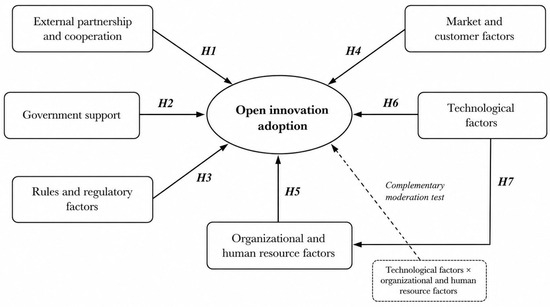
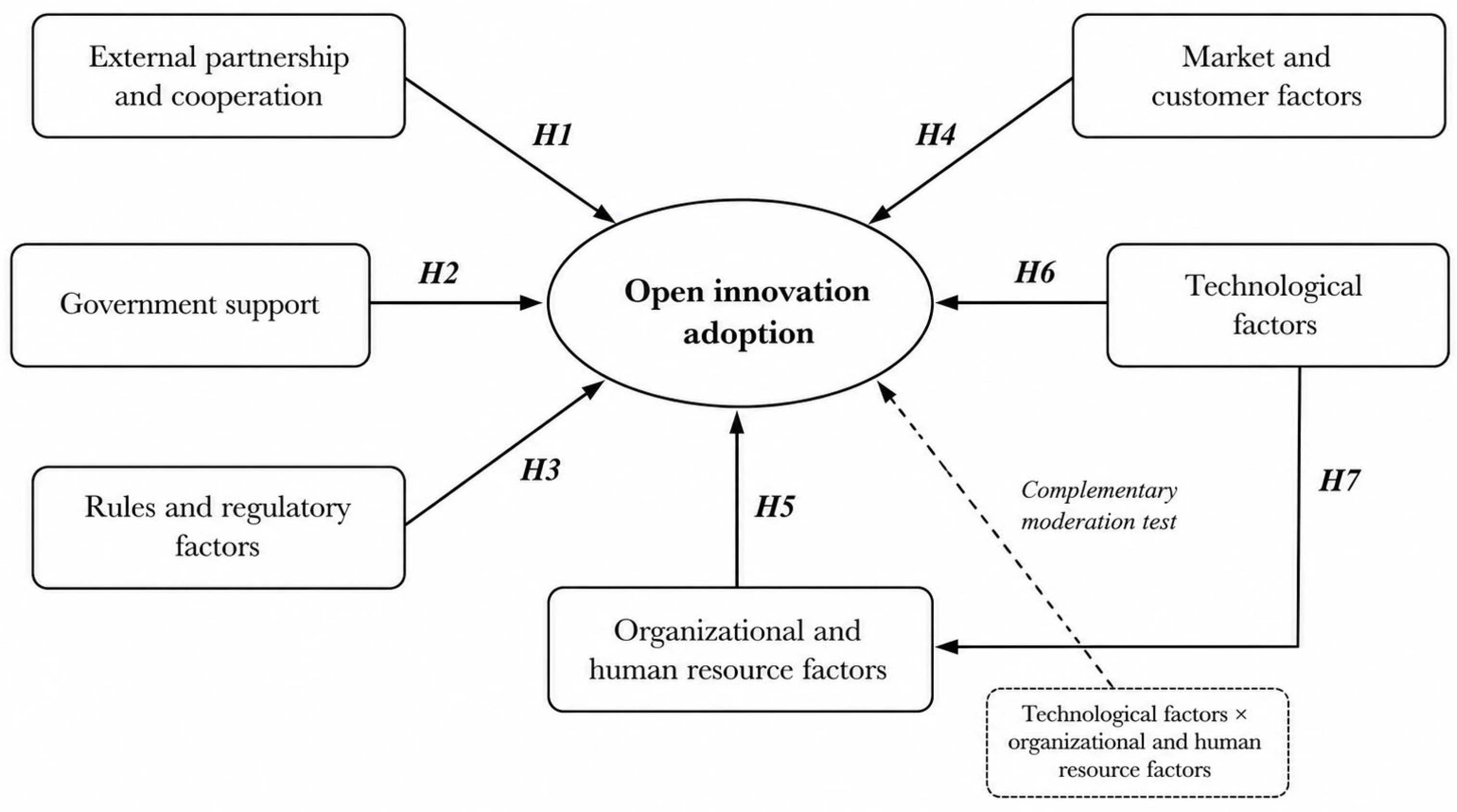
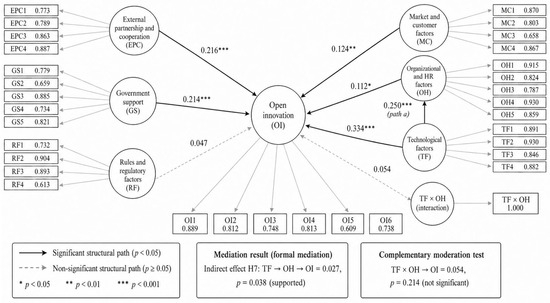
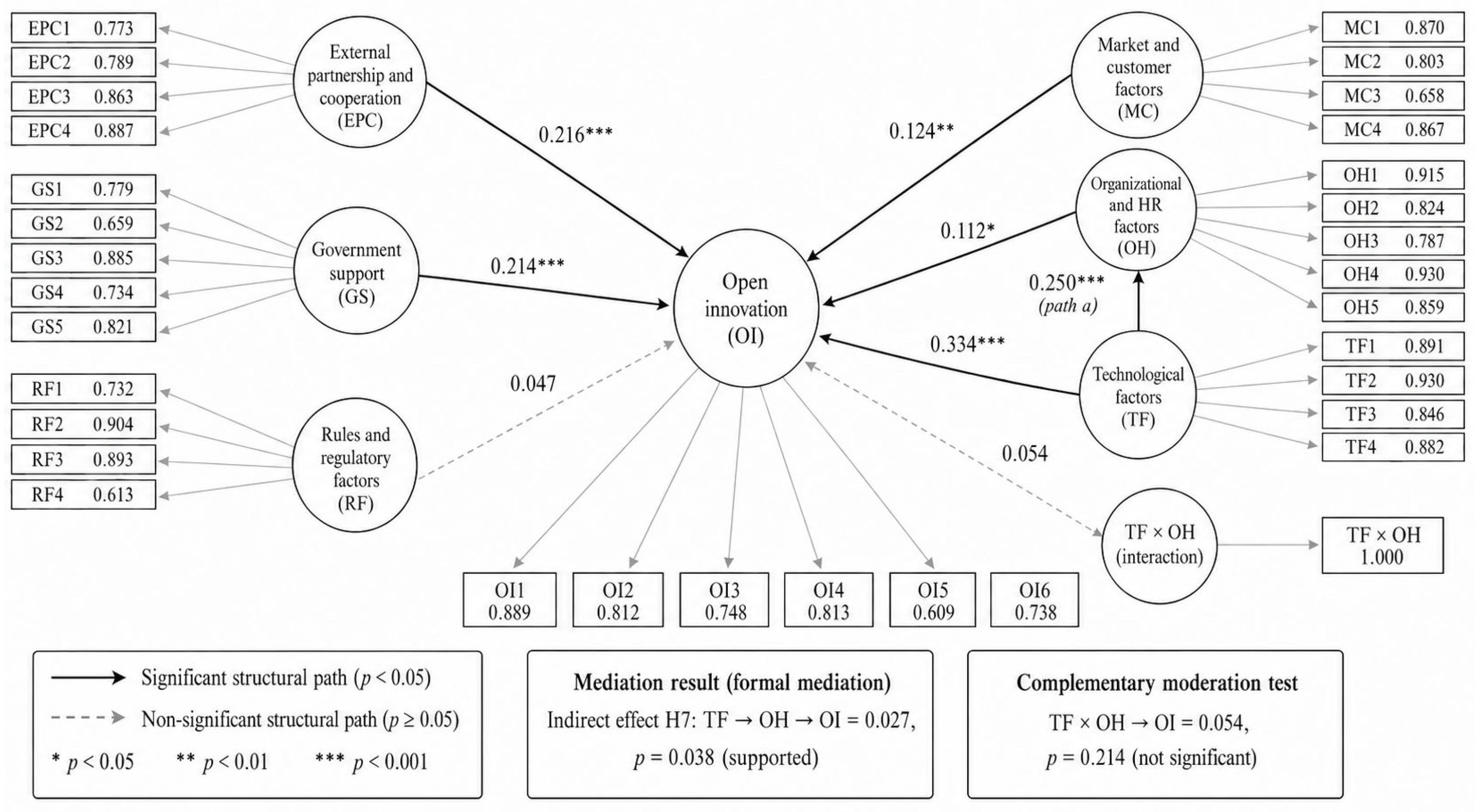

Disclaimer/Publisher’s Note: The statements, opinions and data contained in all publications are solely those of the individual author(s) and contributor(s) and not of MDPI and/or the editor(s). MDPI and/or the editor(s) disclaim responsibility for any injury to people or property resulting from any ideas, methods, instructions or products referred to in the content. |
© 2026 by the authors. Licensee MDPI, Basel, Switzerland. This article is an open access article distributed under the terms and conditions of the Creative Commons Attribution (CC BY) license.