Antecedents to Green Personal Care Product Purchase Intention Among Gen Z Consumers from India


 and
and 
Abstract
1. Introduction
2. Literature Review and the Study Context: Gen Z Population from India
3. Theoretical Underpinnings and Hypotheses Development
3.1. Subjective Norms and Attitude Towards GPCPs
3.2. PBC and Attitude Towards GPCPs
3.3. Social Media Influence and Attitude Towards GPCPs
3.4. Attitude Towards GPCPs and Awareness of GPCPs
3.5. Health Consciousness and Awareness of GPCPs
3.6. GPCP Awareness and GPCP Purchase Intention
3.7. Environmental Consciousness and GPCP Purchase Intention
4. Materials and Methods
4.1. Sample
4.2. Demographic Profile
4.3. Measures
5. Results
5.1. Checking the Measurement Model—Confirmatory Factor Analysis (CFA)
5.2. Common Method Bias (CMB)
5.3. Hypotheses Testing—Path Analysis
5.4. Model Predictive Accuracy and Effect Sizes
6. Discussion
6.1. Theoretical Contributions
6.2. Practical Implications
7. Conclusions
Limitations and Suggestions for Future Research
Author Contributions
Funding
Institutional Review Board Statement
Informed Consent Statement
Data Availability Statement
Conflicts of Interest
References
- Ahmad, S. N. B., Omar, A., Amirul, S. R., & Dousin, O. (2021). Influence of personal values of luxury cosmetic brand identification on consumer brand loyalty. Labuan Bulletin of International Business and Finance, 19(2), 39–54. [Google Scholar] [CrossRef]
- Ahmed, A. H. (2021). The impact of attitude and subjective norms on customers behavior toward Islamic banking: Evidence from palestine. In Global islamic marketing conference (pp. 53–69). Springer International Publishing. [Google Scholar]
- Ajzen, I. (1985). From intentions to actions: A theory of planned behavior. In J. Kuhl, & J. Beckman (Eds.), Action-control: From cognition to behavior (pp. 11–39). Springer. [Google Scholar] [CrossRef]
- Ajzen, I. (1991). The theory of planned behavior. Organizational Behavior and Human Decision Processes, 50(2), 179–211. [Google Scholar] [CrossRef]
- Alamsyah, D. P., & Febriani, R. (2020). Green customer behaviour: Impact of green brand awareness to green trust. Journal of Physics: Conference Series, 1477(7), 072022. [Google Scholar] [CrossRef]
- Alex, R. K., Maes, T., & Devipriya, S. P. (2024). Clean, but not green: Emission assessment, forecast modelling and policy solutions for plastic microbeads from personal care products in India. Emerging Contaminants, 10(3), 100326. [Google Scholar] [CrossRef]
- Ali, S., Usama Javed, H. M., Ali, W., & Zahid, H. (2023). Decoding men’s behavioral responses toward green cosmetics: An investigation based on the belief decomposition approach. Journal of Environmental Planning and Management, 66(13), 2640–2667. [Google Scholar] [CrossRef]
- Al Mamun, A., Mohamad, M. R., Yaacob, M. R. B., & Mohiuddin, M. (2018). Intention and behavior towards green consumption among low-income households. Journal of Environmental Management, 227, 73–86. [Google Scholar] [CrossRef] [PubMed]
- Al Mamun, A., Nawi, N. C., Hayat, N., & Zainol, N. R. B. (2020). Predicting the purchase intention and behaviour towards green skincare products among malaysian consumers. Sustainability, 12(24), 10663. [Google Scholar] [CrossRef]
- Anderson, J. C., & Gerbing, D. W. (1988). Structural equation modeling in practice: A review and recommended two-step approach. Psychological Bulletin, 103(3), 411. [Google Scholar] [CrossRef]
- Arifin, S., Yudha, A. T. R. C., & Narmaditya, B. S. (2026). Integration of attitudes and behavioral control on intention to consume halal and environment-friendly products. Journal of Islamic Accounting and Business Research. ahead-of-print. [Google Scholar] [CrossRef]
- Armstrong, J. S., & Overton, T. S. (1977). Estimating non-response bias in mail surveys. Journal of Marketing Research, 14(3), 396–402. [Google Scholar] [CrossRef]
- Asif, M. H., Zhongfu, T., Irfan, M., & Işık, C. (2023). Do environmental knowledge and green trust matter for purchase intention of eco-friendly home appliances? An application of extended theory of planned behavior. Environmental Science and Pollution Research, 30(13), 37762–37774. [Google Scholar] [CrossRef] [PubMed]
- Baltaci, D. Ç., Durmaz, Y., & Baltaci, F. (2024). The relationships between the multidimensional planned behavior model, green brand awareness, green marketing activities, and purchase intention. Brain and Behavior, 14(6), e3584. [Google Scholar] [CrossRef]
- Bełch, P., Hajduk-Stelmachowicz, M., Chudy-Laskowska, K., Vozňáková, I., & Gavurová, B. (2024). Factors determining the choice of pro-ecological products among generation Z. Sustainability, 16(4), 1560. [Google Scholar] [CrossRef]
- Bevan-Dye, A. L., & Synodinos, C. (2025). Antecedents of Consumers’ Green Beauty Product Brand Purchase Intentions: An Extended Theory of Planned Behavior Approach. Sustainability, 17(3), 1323. [Google Scholar] [CrossRef]
- Bresciani, S., Rehman, S. U., Alam, G. M., Ashfaq, K., & Usman, M. (2023). Environmental MCS package, perceived environmental uncertainty and green performance: In green dynamic capabilities and investment in environmental management perspectives. Review of International Business and Strategy, 33(1), 105–126. [Google Scholar] [CrossRef]
- Bulut, C., Nazli, M., Aydin, E., & Haque, A. U. (2021). The effect of environmental concern on conscious green consumption of post-millennials: The moderating role of greenwashing perceptions. Young Consumers, 22(2), 306–319. [Google Scholar] [CrossRef]
- Chaihanchanchai, P., & Anantachart, S. (2023). Encouraging green product purchase: Green value and environmental knowledge as moderators of attitude and behavior relationship. Business Strategy and the Environment, 32(1), 289–303. [Google Scholar] [CrossRef]
- Chang, C. W., & Chang, S. H. (2023). The impact of digital disruption: Influences of digital media and social networks on forming digital natives’ attitude. Sage Open, 13(3), 21582440231191741. [Google Scholar] [CrossRef]
- Chryssochoidis, G. (2000). Repercussions of consumer confusion for late introduced differentiated products. European Journal of Marketing, 34(5/6), 705–722. [Google Scholar] [CrossRef]
- Cohen, J. (1988). Statistical power analysis for the behavioral sciences (2nd ed.). Lawrence Erlbaum Associates. [Google Scholar]
- Cohen, M. J., Brown, H. S., & Vergragt, P. J. (Eds.). (2013). Innovations in sustainable consumption: New economics, socio-technical transitions and social practices. Edward Elgar. [Google Scholar]
- Confetto, M. G., Covucci, C., Addeo, F., & Normando, M. (2023). Sustainability advocacy antecedents: How social media content influences sustainable behaviours among generation Z. Journal of Consumer Marketing, 40(6), 758–774. [Google Scholar] [CrossRef]
- Demir, M., Rjoub, H., & Yesiltas, M. (2021). Environmental awareness and guests’ intention to visit green hotels: The mediation role of consumption values. PLoS ONE, 16(5), e0248815. [Google Scholar] [CrossRef]
- Dolot, A. (2018). The characteristics of Generation Z. E-mentor, 74(2), 44–50. [Google Scholar] [CrossRef]
- Dragolea, L.-L., Butnaru, G. I., Kot, S., Zamfir, C. G., Nuţă, A.-C., Nuţă, F.-M., Cristea, D. S., & Ştefănică, M. (2023). Determining factors in shaping the sustainable behavior of the generation Z consumer. Frontiers in Environmental Science, 11, 1096183. [Google Scholar] [CrossRef]
- Dunlap, R. E., & Van Liere, K. D. (1978). The “new environmental paradigm”. The Journal of Environmental Education, 9(4), 10–19. [Google Scholar] [CrossRef]
- Duong, C. D., Doan, X. H., Vu, D. M., Ha, N. T., & Dam, K. V. (2026). The role of perceived environmental responsibility and environmental concern on shaping green purchase intention. Vision, 30(1), 63–77. [Google Scholar]
- Filimonau, V., Chiang, C.-C., Wang, L.-E., Muhialdin, B. J., & Ermolaev, V. A. (2023). Resourcefulness of chefs and food waste prevention in fine dining restaurants. International Journal of Hospitality Management, 108, 103368. [Google Scholar] [CrossRef]
- Ghazali, E., Soon, P. C., Mutum, D. S., & Nguyen, B. (2017). Health and cosmetics: Investigating consumers’ values for buying organic personal care products. Journal of Retailing and Consumer Services, 39, 154–163. [Google Scholar] [CrossRef]
- Gupta, A., & Katarya, R. (2020). Social media-based surveillance systems for healthcare using machine learning: A systematic review. Journal of Biomedical Informatics, 108, 103500. [Google Scholar] [CrossRef]
- Hair, J. F., Risher, J. J., Sarstedt, M., & Ringle, C. M. (2019). When to use and how to report the results of PLS-SEM. European Business Review, 31(1), 2–24. [Google Scholar] [CrossRef]
- Halan, D., Aashish, K., & Thaichon, P. (2025). Continuous purchase intention of organic personal care products: Evidence from India. Journal of International Consumer Marketing, 37(1), 23–40. [Google Scholar] [CrossRef]
- Halvadia, N. B., Bhatt, K., Sharma, M., Sharma, A., & Dash, S. (2022). Consumers’ intention to use bicycle-sharing services: The role of consumer consciousness. Cleaner and Responsible Consumption, 7, 100076. [Google Scholar] [CrossRef]
- Han, H., Hsu, L. T. J., & Sheu, C. (2010). Application of the theory of planned behavior to green hotel choice: Testing the effect of environmental friendly activities. Tourism Management, 31, 325–334. [Google Scholar] [CrossRef]
- Henseler, J., Ringle, C. M., & Sarstedt, M. (2015). A new criterion for assessing discriminant validity in variance-based structural equation modeling. Journal of the Academy of Marketing Science, 43(1), 115–135. [Google Scholar] [CrossRef]
- Hoang, C. L., Huynh, L. T. V., Dang, N. K. T., Oh, H., & Nguyen, H. T. T. (2024). Factors affecting purchase intention of green cosmetics products toward young generation in Ho Chi Minh City. International Journal of Science Academic Research, 5(1), 6830–6836. [Google Scholar]
- Howard, M. C., Boudreaux, M., & Oglesby, M. (2024). Can Harman’s single-factor test reliably distinguish between research designs? Not in published management studies. European Journal of Work and Organizational Psychology, 33(6), 790–804. [Google Scholar] [CrossRef]
- Iqbal, J., Yu, D., Zubair, M., Rasheed, M. I., Khizar, H. M. U., & Imran, M. (2021). Health consciousness, food safety concern, and consumer purchase intentions toward organic food: The role of consumer involvement and ecological motives. Sage Open, 11(2), 21582440211015727. [Google Scholar] [CrossRef]
- Jiang, K., Zheng, J., & Luo, S. (2024). Green power of virtual influencer: The role of virtual influencer image, emotional appeal, and product involvement. Journal of Retailing and Consumer Services, 77, 103660. [Google Scholar] [CrossRef]
- Jinying, L. (2019). The influence of health consciousness, environmental consciousness, social influence, brand awareness, and brand trust on consumer purchase intention in the organic skin care industry [Master’s thesis, Universidade de Coimbra]. [Google Scholar]
- Khan, A., Khan, Z., Nabi, M. K., & Saleem, I. (2026). Unveiling the role of social media and females’ intention to buy online cosmetics. Global Knowledge, Memory and Communication, 75(1–2), 88–109. [Google Scholar] [CrossRef]
- Kim, S., & Seock, Y. K. (2009). Impacts of health and environmental consciousness on young female consumers’ attitude toward and purchase of natural beauty products. International Journal of Consumer Studies, 33(6), 627–638. [Google Scholar] [CrossRef]
- Kock, N. (2015). Common method bias in PLS-SEM: A full collinearity assessment approach. International Journal of e-Collaboration, 11(4), 1–10. [Google Scholar] [CrossRef]
- Krejcie, R. V., & Morgan, D. W. (1970). Determining sample size for research activities. Educational and Psychological Measurement, 30(3), 607–610. [Google Scholar] [CrossRef]
- Kumar, A., Prakash, G., & Kumar, G. (2021). Does environmentally responsible purchase intention matter for consumers? A predictive sustainable model developed through an empirical study. Journal of Retailing and Consumer Services, 58, 102270. [Google Scholar] [CrossRef]
- Kumar, N. V., Nirupa, C., Muthukrishnan, R., Gengatesan, G., & Muthu Kumar, T. (2026). Green is the new beautiful: Exploring the role of sustainability in building brand equity in cosmetic brands. European Journal of Management Studies. ahead-of-print. [Google Scholar] [CrossRef]
- Li, Y., & Shan, B. (2025). Exploring the role of health consciousness and environmental awareness in purchase intentions for green-packaged organic foods: An extended TPB model. Frontiers in Nutrition, 12, 1528016. [Google Scholar] [CrossRef] [PubMed]
- Lili, Z., Al Mamun, A., Hayat, N., Salamah, A. A., Yang, Q., & Ali, M. H. (2022). Celebrity endorsement, brand equity, and green cosmetics purchase intention among Chinese youth. Frontiers in Psychology, 13, 860177. [Google Scholar] [CrossRef]
- Limbu, Y. B., Pham, L., & Nguyen, T. T. T. (2022). Predictors of green cosmetics purchase intentions among young female consumers in Vietnam. Sustainability, 14(19), 12599. [Google Scholar] [CrossRef]
- Lupindo, M., Madinga, N. W., & Dlamini, S. (2024). Green beauty: Examining factors shaping millennials’ attitudes toward organic personal care products in South Africa. European Journal of Management Studies, 29(3), 271–291. [Google Scholar] [CrossRef]
- Luthra, C., Deshwal, P., Kushwah, S., & Gokarn, S. (2025). Exploring barriers towards green personal care products purchase: An integrated ISM-MICMAC approach. International Journal of Pharmaceutical and Healthcare Marketing, 19(3), 618–646. [Google Scholar] [CrossRef]
- Mai, R., & Hoffmann, S. (2015). How to combat the unhealthy = tasty intuition: The influencing role of health consciousness. Journal of Public Policy & Marketing, 34(1), 63–83. [Google Scholar] [CrossRef]
- Mancha, R. M., & Yoder, C. Y. (2015). Cultural antecedents of green behavioral intent: An environmental theory of planned behavior. Journal of Environmental Psychology, 43, 145–154. [Google Scholar] [CrossRef]
- Manley, A., Seock, Y. K., & Shin, J. (2023). Exploring the perceptions and motivations of Gen Z and Millennials toward sustainable clothing. Family and Consumer Sciences Research Journal, 51(4), 313–327. [Google Scholar] [CrossRef]
- Mason, M. C., Zamparo, G., Saleem, S., & Umar, R. M. (2025). Generational shifts: Understanding the role of green self-identity, social norms and cohort differences in consumer intentions to purchase stigmatised recycled products. Journal of Consumer Marketing, 42(7), 996–1010. [Google Scholar] [CrossRef]
- Michaelidou, N., & Hassan, L. M. (2008). The role of health consciousness, food safety concern and ethical identity on attitudes and intentions towards organic food. International Journal of Consumer Studies, 32(2), 163–170. [Google Scholar] [CrossRef]
- Muk, A., & Chung, C. (2026). Influence of self-construal patterns on green consumption: A cross-cultural study of American and Japanese consumers, 33(2), 278–293. [CrossRef]
- Ng, P. M., Chan, J. K., Lit, K. K., Cheung, C. T., Lau, M. M., Wan, C., & Choy, E. T. (2025). The impact of social media exposure and online peer networks on green purchase behavior. Computers in Human Behavior, 165, 108517. [Google Scholar] [CrossRef]
- Ngo-Thi-Ngoc, H., Nguyen-Viet, B., & Hong-Thach, H. (2024). Purchase intention for vegan cosmetics: Applying an extended theory of planned behavior model. Sage Open, 14(1), 21582440241240548. [Google Scholar] [CrossRef]
- Nguyen, D. T., & Truong, D. C. (2021). The impact of psychological and environmental factors on consumers’ purchase intention toward organic food: Evidence from Vietnam. The Journal of Asian Finance, Economics and Business, 8(1), 915–925. [Google Scholar]
- Nguyen, T. T. T., Limbu, Y. B., Pham, L., & Zúñiga, M. Á. (2024). The influence of electronic word of mouth on green cosmetics purchase intention: Evidence from young Vietnamese female consumers. Journal of Consumer Marketing, 41(4), 406–423. [Google Scholar] [CrossRef]
- Pancić, M., Serdarušić, H., & Ćućić, D. (2023). Green marketing and repurchase Intention: Stewardship of green advertisement, brand awareness, brand equity, green innovativeness, and brand innovativeness. Sustainability, 15(16), 12534. [Google Scholar] [CrossRef]
- Pilelienė, L., Alsharif, A. H., & Alharbi, I. B. (2022). Scientometric analysis of scientific literature on neuromarketing tools in advertising. Baltic Journal of Economic Studies, 8(5), 1–12. [Google Scholar] [CrossRef]
- Podsakoff, P. M., Podsakoff, N. P., Williams, L. J., Huang, C., & Yang, J. (2024). Common method bias: It’s bad, it’s complex, it’s widespread, and it’s not easy to fix. Annual Review of Organizational Psychology and Organizational Behavior, 11(1), 17–61. [Google Scholar] [CrossRef]
- Pop, R. A., Săplăcan, Z., & Alt, M. A. (2020). Social media goes green—The impact of social media on green cosmetics purchase motivation and intention. Information, 11(9), 447. [Google Scholar] [CrossRef]
- Priporas, C. V., Stylos, N., & Fotiadis, A. K. (2017). Generation Z consumers’ expectations of interactions in smart retailing: A future agenda. Computers in Human Behavior, 77, 374–381. [Google Scholar] [CrossRef]
- Promotosh, B., & Sajedul, I. (2011). Young consumers’ purchase intentions of buying green products. In A study based on the theory of planned behavior. Umea School of Business, Spring Semester. [Google Scholar] [CrossRef]
- Radomir, L., Ciornea, R., Wang, H., Liu, Y., Ringle, C. M., & Sarstedt, M. (2023). State of the art in partial least squares structural equation modeling (PLS-SEM): Methodological extensions and applications in the social sciences and beyond. Springer. [Google Scholar]
- Rahmadhani, A. V., & Widodo, A. (2023). Pengaruh green brand image, green brand trust, green brand awareness dan green brand satisfaction terhadap purchase intention pada konsumen air mineral merek aqua. Jurnal Samudra Ekonomi Dan Bisnis, 14(3), 393–405. [Google Scholar] [CrossRef]
- Ritter, Á. M., Borchardt, M., Vaccaro, G. L., Pereira, G. M., & Almeida, F. (2015). Motivations for promoting the consumption of green products in an emerging country: Exploring attitudes of Brazilian consumers. Journal of Cleaner Production, 106, 507–520. [Google Scholar] [CrossRef]
- Roberts, J. A. (1996). Green consumers in the 1990s: Profile and implications for advertising. Journal of Business Research, 36(3), 217–231. [Google Scholar] [CrossRef]
- Schlegelmilch, B. B., Bohlen, G. M., & Diamantopoulos, A. (1996). The link between green purchasing decisions and measures of environmental consciousness. European Journal of Marketing, 30, 35–55. [Google Scholar] [CrossRef]
- Schwepker, C. H., & Cornwell, T. B. (1991). An examination of ecologically concerned consumers and their intention to purchase ecologically packaged products. Journal of Public Policy & Marketing, 10(2), 77–101. [Google Scholar] [CrossRef]
- Setiawan, M., Widjojo, R., & Purnama Alamsyah, D. (2024). Consumers’ reasonings for intention to purchase natural personal care products in Indonesian market. Cogent Business & Management, 11(1), 2289205. [Google Scholar] [CrossRef]
- Shaaban, H., & Alhajri, W. (2020). Usage patterns of cosmetic and personal care products among female population in Saudi Arabia: Important factors for exposure and risk assessment. Journal of Environmental and Public Health, 2020(1), 8434508. [Google Scholar] [CrossRef]
- Shalender, K., & Sharma, N. (2021). Using extended theory of planned behaviour (TPB) to predict adoption intention of electric vehicles in India: K. Shalender, N. Sharma. Environment, Development and Sustainability, 23(1), 665–681. [Google Scholar] [CrossRef]
- Sharma, K., Aswal, C., & Paul, J. (2023). Factors affecting green purchase behavior: A systematic literature review. Business Strategy and the Environment, 32(4), 2078–2092. [Google Scholar] [CrossRef]
- Sharma, R. (2017). Building customer-based brand equity of domestic brands: Role of brand equity dimensions. Metamorphosis, 16(1), 45–59. [Google Scholar] [CrossRef]
- Shimul, A. S., Cheah, I., & Khan, B. B. (2022). Investigating female shoppers’ attitude and purchase intention toward green cosmetics in South Africa. Journal of Global Marketing, 35(1), 37–56. [Google Scholar] [CrossRef]
- Siyal, S., Ahmed, M. J., Ahmad, R., Khan, B. S., & Xin, C. (2021). Factors influencing green purchase intention: Moderating role of green brand knowledge. International Journal of Environmental Research and Public Health, 18(20), 10762. [Google Scholar] [CrossRef]
- Soler, F., Gil, J. M., & Sanchez, M. (2002). Consumers’ acceptability of organic food in Spain: Results from an experimental auction market. British Food Journal, 104(8), 670–687. [Google Scholar] [CrossRef]
- Spaargaren, G., & Martens, S. (2005). Globalisation and the role of citizen-consumers in environmental politics. In A handbook of globalisation and environmental policy. Edward Elgar Publishing. [Google Scholar]
- Srivastava, R., Sanjeev, M. A., & Gupta, S. (2024). A fuzzy approach to determining antecedents to green cosmetic consumption in India. International Journal of Retail & Distribution Management, 52(6), 671–688. [Google Scholar] [CrossRef]
- Synodinos, C. (2023). Generation Y consumers’ perceptions of organic food products in South Africa. Journal of Contemporary Management, 20(si1), 133–154. [Google Scholar] [CrossRef]
- Tan, Y., Geng, S., Katsumata, S., & Xiong, X. (2021). The effects of ad heuristic and systematic cues on consumer brand awareness and purchase intention: Investigating the bias effect of heuristic information processing. Journal of Retailing and Consumer Services, 63, 102696. [Google Scholar] [CrossRef]
- Tandon, A., Dhir, A., Kaur, P., Kushwah, S., & Salo, J. (2020). Why do people buy organic food? The moderating role of environmental concerns and trust. Journal of Retailing and Consumer Services, 57, 102247. [Google Scholar] [CrossRef]
- Teixeira, S., Oliveira, Z., Teixeira, S., & Teixeira, S. (2023). Understanding the impact of online communication strategies on consumer purchase intention for green cosmetics. Sustainability, 15(20), 14784. [Google Scholar] [CrossRef]
- Venciute, D., Kazukauskaite, M., Correia, R. F., Kuslys, M., & Vaiciukynas, E. (2023). The effect of cause-related marketing on the green consumption attitude–behaviour gap in the cosmetics industry. Journal of Contemporary Marketing Science, 6(1), 22–45. [Google Scholar] [CrossRef]
- Wang, C., Zhang, J., Xiao, X., Sun, F., Xiao, M., & Shi, Q. (2020). Examining the dimensions and mechanisms of tourists’ environmental behavior: A theory of planned behavior approach. Journal of Cleaner Production, 273, 123007. [Google Scholar] [CrossRef]
- Wang, J., Pham, T. L., & Dang, V. T. (2020). Environmental consciousness and organic food purchase intention: A moderated mediation model of perceived food quality and price sensitivity. International Journal of Environmental Research and Public Health, 17(3), 850. [Google Scholar] [CrossRef] [PubMed]
- Wang, J., Xue, Y., & Liu, T. (2023). Consumer motivation for organic food consumption: Health consciousness or herd mentality. Frontiers in Public Health, 10, 1042535. [Google Scholar] [CrossRef] [PubMed]
- Welch, D., Warde, A., Reisch, L., & Thøgersen, J. (Eds.). (2015). Theories of practice and sustainable consumption. In Handbook of research on sustainable consumption (pp. 84–100). Edward Elgar. [Google Scholar]
- Yadav, P., Rani, M., & Chaudhary, S. (2025). Identification, characterisation and implication of releasing microplastics from personal care and cosmetic products in India. Toxicology and Environmental Health Sciences, 17(2), 275–289. [Google Scholar] [CrossRef]
- Yang, X., Tseng, Y., & Lee, B. (2021). Merging the social influence theory and the goal-framing theory to understand consumers’ green purchasing behavior: Does the level of sensitivity to climate change really matter? Frontiers in Psychology, 12, 766754. [Google Scholar] [CrossRef]
- Zhao, X., Zhan, M., & Liu, B. F. (2018). Disentangling social media influence in crises: Testing a four-factor model of social media influence with large data. Public Relations Review, 44(4), 549–561. [Google Scholar] [CrossRef]
- Zheng, G. W., Siddik, A. B., Masukujjaman, M., Alam, S. S., & Akter, A. (2020). Perceived environmental responsibilities and green buying behavior: The mediating effect of attitude. Sustainability, 13(1), 35. [Google Scholar] [CrossRef]
- Zhou, Z., Zheng, F., Lin, J., & Zhou, N. (2021). The interplay among green brand knowledge, expected eudaimonic well-being and environmental consciousness on green brand purchase intention. Corporate Social Responsibility and Environmental Management, 28(2), 630–639. [Google Scholar] [CrossRef]
- Zollo, L., Carranza, R., Faraoni, M., Dıaz, E., & Martın-Consuegra, D. (2021). What influences consumers’ intention to purchase organic personal care products? The role of social reassurance. Journal of Retailing and Consumer Services, 60, 102432. [Google Scholar] [CrossRef]





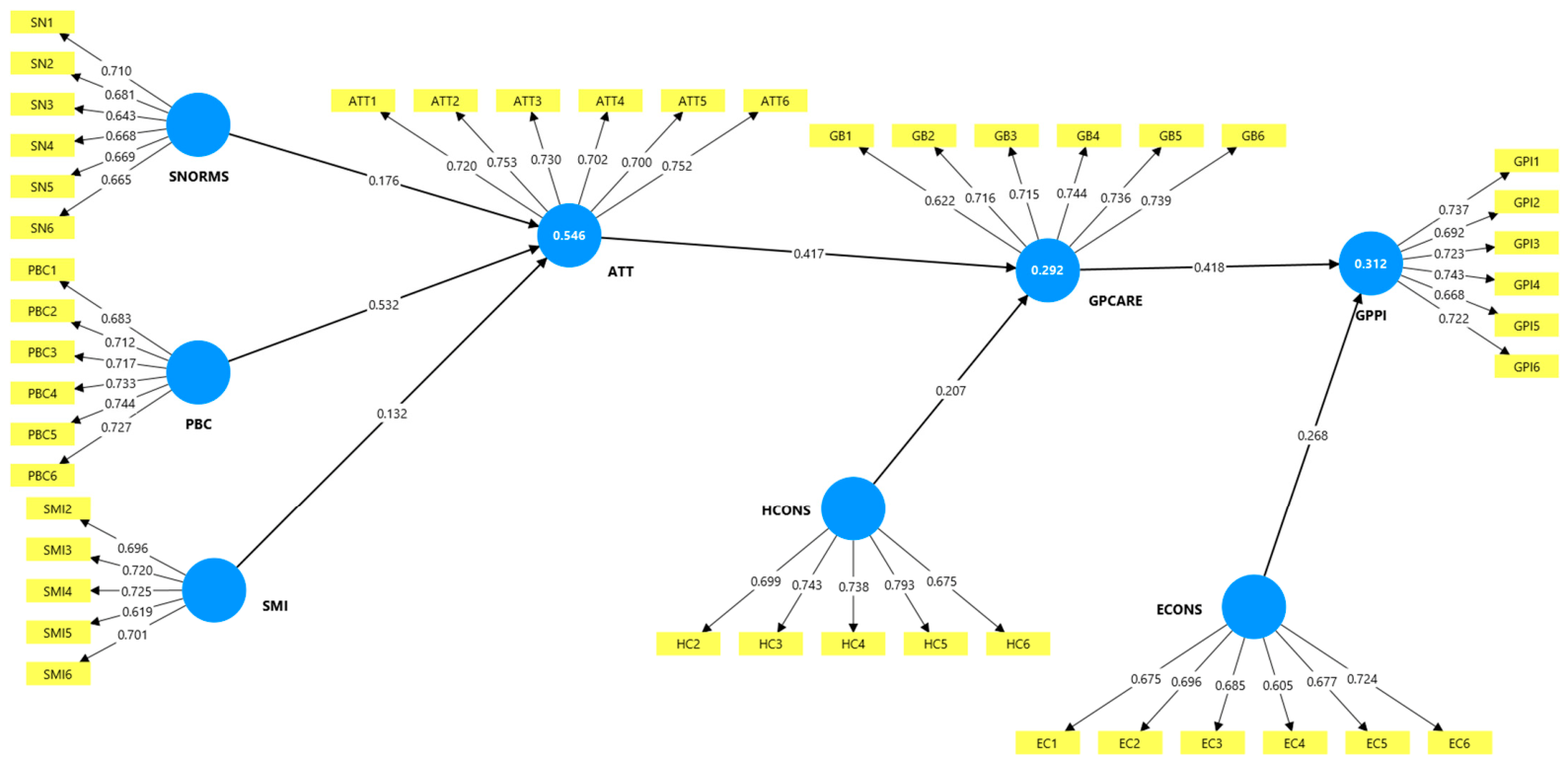
| Constructs and the Sources of Constructs | VIF Values | Factor Loadings | Cronbach’s Alpha | Composite Reliability | Average Variance- Extracted Estimate |
|---|---|---|---|---|---|
| Health consciousness (Iqbal et al., 2021; Michaelidou & Hassan, 2008) | 0.783 | 0.851 | 0.534 | ||
| I am very sensitive to my health concern. | 1.413 | 0.699 | |||
| I am attentive to any shifts in my health condition. | 1.493 | 0.743 | |||
| I am mindful of my health. | 1.515 | 0.738 | |||
| I am conscious of my health throughout the day. | 1.538 | 0.793 | |||
| I am accountable for the condition of my well-being. | 1.374 | 0.675 | |||
| Environmental consciousness (Dunlap & Van Liere, 1978; Roberts, 1996) | 0.765 | 0.836 | 0.456 | ||
| Human intervention in natural processes frequently leads to catastrophic outcomes. | 1.301 | 0.654 | |||
| To survive, humans must coexist peacefully with the natural world. | 1.442 | 0.697 | |||
| Humanity is greatly mistreating the environment. | 1.374 | 0.673 | |||
| Humans were not intended to govern over the other beings in nature. | 1.267 | 0.620 | |||
| The earth is nearing its capacity in terms of the number of people it can sustain. | 1.340 | 0.731 | |||
| The environment is being significantly harmed by human activities. | 1.523 | 0.669 | |||
| Green personal care product awareness (Jinying, 2019; R. Sharma, 2017; Lili et al., 2022) | 0.806 | 0.861 | 0.509 | ||
| I can identify the GPCP amidst other competing products. | 1.290 | 0.623 | |||
| I am familiar with eco-friendly natural personal care products. | 1.526 | 0.716 | |||
| I am aware of the eco-friendly natural personal care products company. | 1.579 | 0.715 | |||
| I have knowledge of the green personal care products. | 1.598 | 0.745 | |||
| I am familiar with the organic personal care products. | 1.616 | 0.735 | |||
| The organic personal care products come to mind whenever I consider the product category. | 1.571 | 0.738 | |||
| Social media influence (Pop et al., 2020; Teixeira et al., 2023) | 0.732 | 0.822 | 0.482 | ||
| I utilize social media platforms to find details regarding natural personal products. | 1.334 | 0.689 | |||
| Information regarding organic personal care on social media is reliable. | 1.397 | 0.700 | |||
| Information regarding GPCP on social networking sites is trustworthy. | 1.350 | 0.716 | |||
| The perspective of social media influencers greatly influences my decision to buy GPCP. | 1.325 | 0.654 | |||
| When seeking information on GPCP, I rely on the insights shared by influencers across various social media platforms. | 1.359 | 0.711 | |||
| Attitude (Chryssochoidis, 2000; Kim & Seock, 2009; Shimul et al., 2022; Soler et al., 2002) | 0.821 | 0.870 | 0.528 | ||
| I am convinced that GPCP are more advantageous for my health. | 1.495 | 0.719 | |||
| GPCP prove to be more effective in their performance than conventional personal care products. | 1.712 | 0.753 | |||
| I believe that there are substantial differences in quality between green personal care and traditional personal care products. | 1.605 | 0.729 | |||
| I would choose the organic personal care product over the conventional one, even if they are priced the same. | 1.500 | 0.702 | |||
| My top priority is always to use GPCP. | 1.469 | 0.700 | |||
| I take great pride in purchasing environmentally friendly personal care products. | 1.664 | 0.753 | |||
| Subjective norms (Ajzen, 1985; Han et al., 2010; Promotosh & Sajedul, 2011) | 0.758 | 0.453 | |||
| I opt for buying environmentally friendly personal care items whenever they are suggested by my family members. | 1.436 | 0.710 | |||
| I like to buy eco-friendly personal care products when they are suggested by my friends. | 1.381 | 0.681 | |||
| My parents taught me how to differentiate between GPCP and traditional personal care products. | 1.290 | 0.643 | |||
| I acquired the ability to differentiate between GPCP and traditional personal care products thanks to my friends. | 1.386 | 0.668 | |||
| The purchasing of GPCP can be influenced by social media. | 1.448 | 0.669 | |||
| The individuals who hold significance in my life would back my decision to purchase environmentally friendly personal care products. | 1.408 | 0.665 | |||
| Perceived behavioral control (Al Mamun et al., 2018; Ghazali et al., 2017) | 0.814 | 0.866 | 0.518 | ||
| I have the financial means to purchase eco-friendly personal care items. | 1.428 | 0.683 | |||
| It would be completely up to me to adopt environmentally friendly practices. | 1.545 | 0.712 | |||
| I am interested in purchasing environmentally friendly personal care items. | 1.509 | 0.717 | |||
| I can locate the vendors of environmentally friendly personal care items in close proximity to me. | 1.612 | 0.733 | |||
| I can dedicate time to finding personal care products that are environmentally friendly. | 1.602 | 0.744 | |||
| I am certain that I can easily purchase green personal care if that is what I desire. | 1.576 | 0.727 | |||
| Purchase intention of green personal care product (Hoang et al., 2024; D. T. Nguyen & Truong, 2021) | 0.808 | 0.862 | 0.511 | ||
| If I will purchase personal care products, I always opt for those that are free from chemical ingredients. | 1.505 | 0.721 | |||
| I strive to buy personal care products that are chemical-free, even if they come at a higher price. | 1.406 | 0.701 | |||
| I consistently buy environmentally friendly products that can be easily disposed of after use. | 1.527 | 0.721 | |||
| I always make sure to avoid purchasing personal care products that contain chemical ingredients. | 1.637 | 0.746 | |||
| If faced with the decision between two identical personal care products, I opt for the one that is more environmentally and socially responsible. | 1.390 | 0.658 | |||
| I have changed my personal care products due to environmental concerns. | 1.559 | 0.739 |
| Constructs | Mean | S.D | Skewness | Kurtosis | 1 | 2 | 3 | 4 | 5 | 6 | 7 | 8 |
|---|---|---|---|---|---|---|---|---|---|---|---|---|
| 1. Attitude | 3.549 | 0.672 | −0.700 | 1.481 | 0.726 | |||||||
| 2.Environmenal Consciousness | 3.797 | 0.694 | −0.713 | 1.683 | 0.411 | 0.675 | ||||||
| 3.Green personal care product awareness | 3.384 | 0.651 | −0.381 | 0.520 | 0.507 | 0.302 | 0.713 | |||||
| 4. Green personal care product purchase intention | 3.526 | 0.637 | −0.417 | 0.724 | 0.706 | 0.383 | 0.496 | 0.715 | ||||
| 5. Health Consciousness | 3.532 | 0.754 | −0.714 | 1.572 | 0.438 | 0.483 | 0.389 | 0.388 | 0.731 | |||
| 6. Perceived behavioral control | 3.447 | 0.817 | −0.685 | 1.296 | 0.712 | 0.312 | 0.560 | 0.633 | 0.358 | 0.726 | ||
| 7. Social media influence | 3.373 | 0.713 | −0.352 | 0.590 | 0.456 | 0.297 | 0.542 | 0.418 | 0.370 | 0.455 | 0.694 | |
| 8. Subjective norms | 3.458 | 0.604 | −0.533 | 1.122 | 0.607 | 0.295 | 0.656 | 0.609 | 0.379 | 0.616 | 0.512 | 0.673 |
| Hypotheses | Relationship | Beta Value | Mean | Standard Deviation | t-Value | p Value | Result |
|---|---|---|---|---|---|---|---|
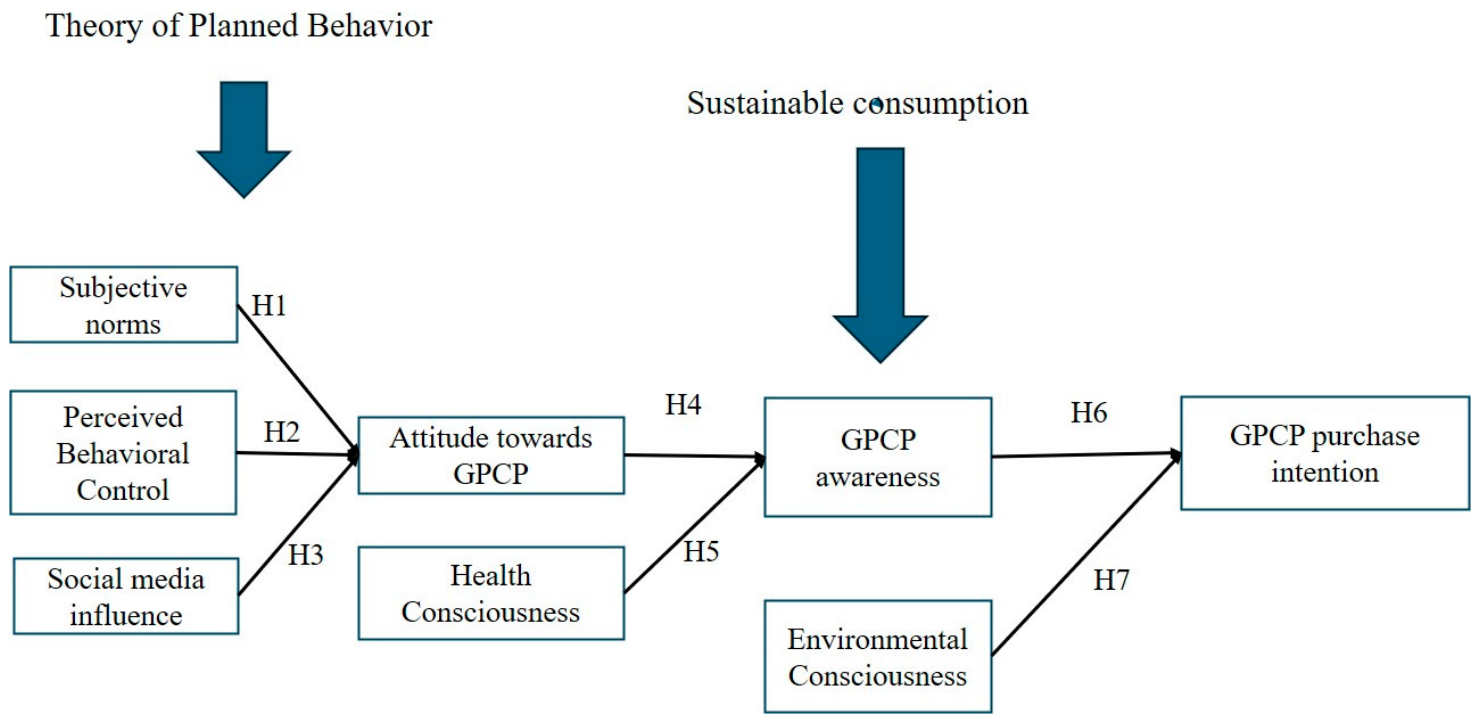
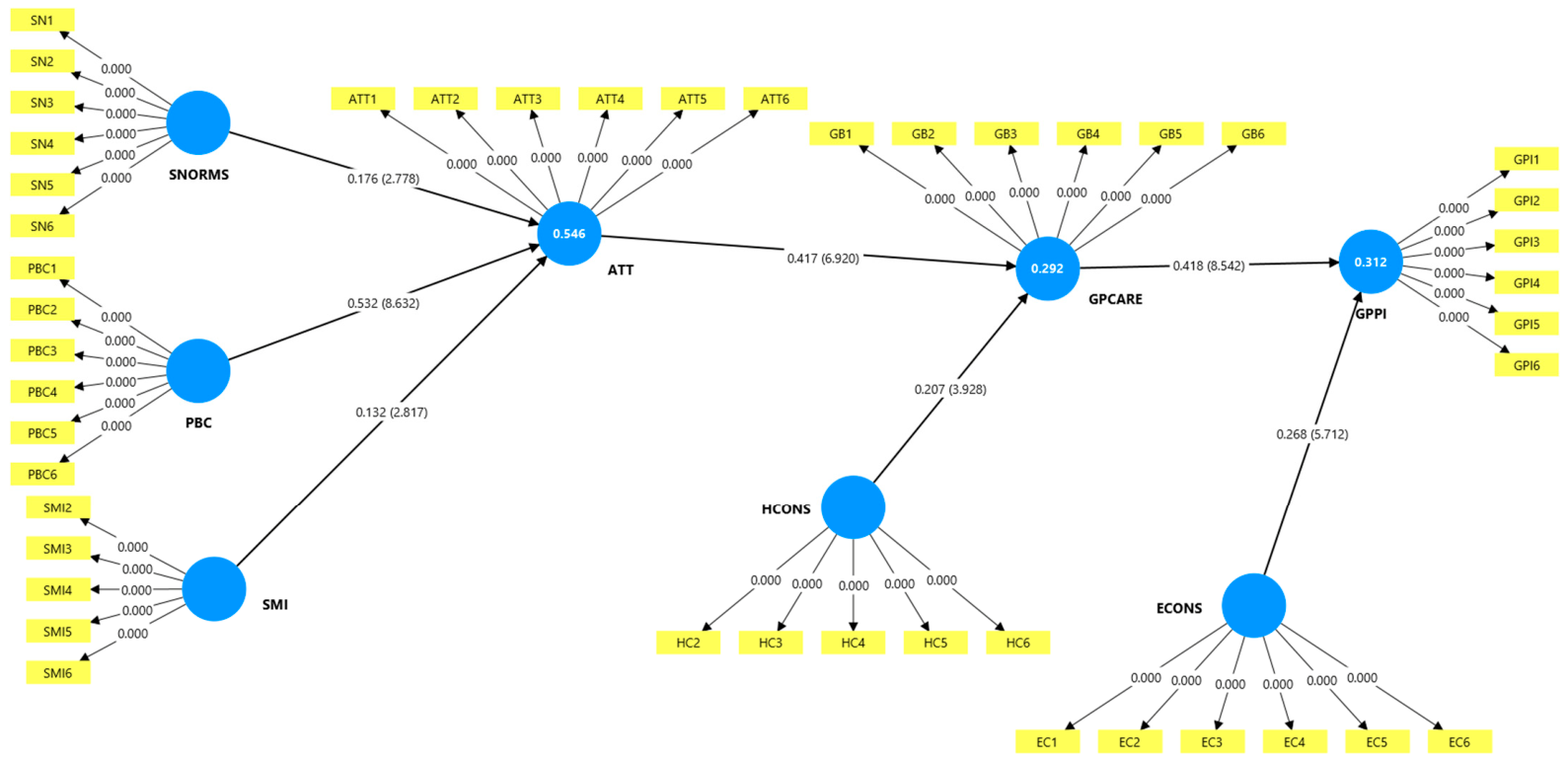
| H1 | Subjective norms → Attitude | 0.176 | 0.176 | 0.063 | 2.778 | 0.005 | Supported |
| H2 | PBC →Attitude towards GPCPs | 0.532 | 0.532 | 0.062 | 8.632 | 0.000 | Supported |
| H3 | Social media influence →Attitude towards GPCPs | 0.132 | 0.134 | 0.047 | 2.817 | 0.005 | Supported |
| H4 | Attitude towards GPCPs →GPCP awareness | 0.417 | 0.417 | 0.060 | 6.920 | 0.000 | Supported |
| H5 | Health consciousness → GPCP awareness | 0.207 | 0.212 | 0.053 | 3.928 | 0.000 | Supported |
| H6 | GPCP awareness → GPCP purchase intention | 0.418 | 0.419 | 0.049 | 8.542 | 0.000 | Supported |
| H7 | Environmental consciousness → GPCP purchase intention | 0.268 | 0.273 | 0.047 | 5.712 | 0.000 | Supported |
| Variables | R2 | Adjusted R2 | Q2 Predict | RMSE | MAE | Effect Size |
|---|---|---|---|---|---|---|
| Attitude towards GPCPs | 0.546 | 0.543 | 0.530 | 0.691 | 0.504 | Large |
| GPCP awareness | 0.292 | 0.289 | 0.366 | 0.802 | 0.613 | Large |
| GPCP purchase intention | 0.312 | 0.309 | 0.288 | 0.851 | 0.678 | Large |
| Relationships | f2 |
|---|---|
| Subjective norms → Attitude towards GPCPs | 0.033 |
| PBC → Attitude towards GPCPs | 0.322 |
| Social media influence → Attitude towards GPCOs | 0.028 |
| Attitude towards GPCPs → GPCP awareness | 0.198 |
| Health consciousness → GPCP awareness | 0.049 |
| GPCP awareness → GPCP purchase intention | 0.233 |
| Environmental consciousness → GPCP purchase intention | 0.096 |
| PLS Loss | IA Loss | Average Loss Difference | t-Value | p Value | |
|---|---|---|---|---|---|
| Attitude towards GPCPs | 0.597 | 0.828 | −0.231 | 6.690 | 0.000 |
| GPCP awareness | 0.697 | 0.857 | −0.160 | 7.676 | 0.000 |
| GPCP purchase intention | 0.685 | 0.802 | −0.117 | 6.302 | 0.000 |
| Overall | 0.660 | 0.829 | −0.169 | 8.146 | 0.000 |
Disclaimer/Publisher’s Note: The statements, opinions and data contained in all publications are solely those of the individual author(s) and contributor(s) and not of MDPI and/or the editor(s). MDPI and/or the editor(s) disclaim responsibility for any injury to people or property resulting from any ideas, methods, instructions or products referred to in the content. |
© 2026 by the authors. Licensee MDPI, Basel, Switzerland. This article is an open access article distributed under the terms and conditions of the Creative Commons Attribution (CC BY) license.
Share and Cite
Radhakrishnan, K.; Krishnan, M.M.; Parayitam, S.; Cristofaro, M. Antecedents to Green Personal Care Product Purchase Intention Among Gen Z Consumers from India. Adm. Sci. 2026, 16, 278. https://doi.org/10.3390/admsci16060278
Radhakrishnan K, Krishnan MM, Parayitam S, Cristofaro M. Antecedents to Green Personal Care Product Purchase Intention Among Gen Z Consumers from India. Administrative Sciences. 2026; 16(6):278. https://doi.org/10.3390/admsci16060278
Chicago/Turabian StyleRadhakrishnan, Kanipriya, Malar Mathi Krishnan, Satyanarayana Parayitam, and Matteo Cristofaro. 2026. "Antecedents to Green Personal Care Product Purchase Intention Among Gen Z Consumers from India" Administrative Sciences 16, no. 6: 278. https://doi.org/10.3390/admsci16060278
APA StyleRadhakrishnan, K., Krishnan, M. M., Parayitam, S., & Cristofaro, M. (2026). Antecedents to Green Personal Care Product Purchase Intention Among Gen Z Consumers from India. Administrative Sciences, 16(6), 278. https://doi.org/10.3390/admsci16060278