You are currently viewing a new version of our website. To view the old version click .

Microorganisms, Volume 7, Issue 4

April 2019 - 20 articles

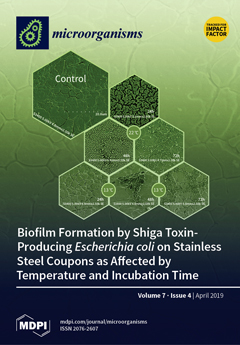
Cover Story: Shiga toxin-producing Escherichia coli (STEC) are important foodborne pathogens that can cause enteric disease and kidney failure in humans. Biofilms contribute to the persistence of STEC in food processing environments. Several factors, including nutrient profile, temperature, physical, and chemical properties of contact surfaces and the genomics of the strain can influence biofilm formation. Identification of the conditions that promote STEC biofilm formation in food processing facilities, is key to developing disinfection and production conditions that reduce the risk of adulteration of food. View this paper.
  • Issues are regarded as officially published after their release is announced to the table of contents alert mailing list .
  • You may sign up for email alerts to receive table of contents of newly released issues.
  • PDF is the official format for papers published in both, html and pdf forms. To view the papers in pdf format, click on the "PDF Full-text" link, and use the free Adobe Reader to open them.

Articles (20)

  • Article
  • Open Access
9 Citations
6,081 Views
19 Pages

Many root fungal endophytes inhabiting forest trees have potential impact on the health and disease progression of certain tree species. Hence, the screening of root endophytes for their biocontrol abilities is relevant for their potential to protect...

  • Article
  • Open Access
48 Citations
6,774 Views
18 Pages

Salmonella enterica serovar Enteritidis and Salmonella enterica serovar Typhimurium are major foodborne pathogens of concern worldwide. Bacteriophage applications have gained more interest for biocontrol in foods. This study isolated 36 Salmonella ph...

  • Article
  • Open Access
15 Citations
5,554 Views
15 Pages

Metabolic Modeling of Pectobacterium parmentieri SCC3193 Provides Insights into Metabolic Pathways of Plant Pathogenic Bacteria

  • Sabina Zoledowska,
  • Luana Presta,
  • Marco Fondi,
  • Francesca Decorosi,
  • Luciana Giovannetti,
  • Alessio Mengoni and
  • Ewa Lojkowska

Understanding plant–microbe interactions is crucial for improving plants’ productivity and protection. Constraint-based metabolic modeling is one of the possible ways to investigate the bacterial adaptation to different ecological niches...

  • Article
  • Open Access
7 Citations
4,408 Views
13 Pages

Genomic Analyses of Bifidobacterium moukalabense Reveal Adaptations to Frugivore/Folivore Feeding Behavior

  • Takahiro Segawa,
  • Satoshi Fukuchi,
  • Dylan Bodington,
  • Sayaka Tsuchida,
  • Pierre Philippe Mbehang Nguema,
  • Hiroshi Mori and
  • Kazunari Ushida

Despite the essential role of Bifidobacterium in health-promoting gut bacteria in humans, little is known about their functions in wild animals, especially non-human primates. It is difficult to determine in vivo the function of Bifidobacterium in wi...

  • Review
  • Open Access
26 Citations
8,410 Views
29 Pages

Food Supplements to Mitigate Detrimental Effects of Pelvic Radiotherapy

  • Charlotte Segers,
  • Mieke Verslegers,
  • Sarah Baatout,
  • Natalie Leys,
  • Sarah Lebeer and
  • Felice Mastroleo

Pelvic radiotherapy has been frequently reported to cause acute and late onset gastrointestinal (GI) toxicities associated with significant morbidity and mortality. Although the underlying mechanisms of pelvic radiation-induced GI toxicity are poorly...

  • Article
  • Open Access
3 Citations
4,218 Views
8 Pages

Extended multi-locus sequence typing (eMLST) methods have become popular in the field of genomic epidemiology. Before eMLST methods can be applied in epidemiological investigations, the selection of a suitable scheme is critical. The core genome sche...

  • Article
  • Open Access
35 Citations
6,653 Views
25 Pages

Coral reef-associated Symbiodiniaceae live in tropical and oligotrophic environments and are prone to heat and nutrient stress. How their metabolic pathways respond to pulses of warming and phosphorus (P) depletion is underexplored. Here, we conducte...

  • Article
  • Open Access
65 Citations
6,530 Views
17 Pages

Enterobacteriaceae Escherichia coli and Salmonella enterica serovar Typhimurium strains are among the main pathogens responsible for moderate and serious infections at hospital and community environments, in part because they frequently present resis...

  • Article
  • Open Access
42 Citations
7,947 Views
11 Pages

Biofilm Formation by Shiga Toxin-Producing Escherichia coli on Stainless Steel Coupons as Affected by Temperature and Incubation Time

  • Zhi Ma,
  • Emmanuel W. Bumunang,
  • Kim Stanford,
  • Xiaomei Bie,
  • Yan D. Niu and
  • Tim A. McAllister

Forming biofilm is a strategy utilized by Shiga toxin-producing Escherichia coli (STEC) to survive and persist in food processing environments. We investigated the biofilm-forming potential of STEC strains from 10 clinically important serogroups on s...

  • Article
  • Open Access
54 Citations
8,510 Views
14 Pages

Impact of Aquaculture Practices on Intestinal Bacterial Profiles of Pacific Whiteleg Shrimp Litopenaeus vannamei

  • Angela Landsman,
  • Benoit St-Pierre,
  • Misael Rosales-Leija,
  • Michael Brown and
  • William Gibbons

Considering the crucial role of the gut microbiome in animal health and nutrition, solutions to shrimp aquaculture challenges, such as improving disease resistance and optimizing growth on lower cost feeds, may lie in manipulation of their microbial...

of 2

Get Alerted

Add your email address to receive forthcoming issues of this journal.

XFacebookLinkedIn
Microorganisms - ISSN 2076-2607