


Skip to Content

Microorganisms, Volume 5, Issue 3

2017 September - 29 articles

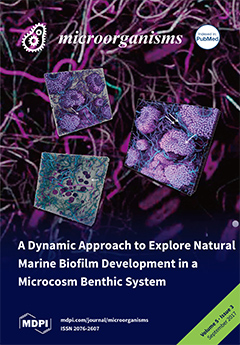
Cover Story: Toxic benthic microalgal blooms pose a threat to the environment. Marine biofilms were taken during a bloom of the dinoflagellate Ostreopsis cf. ovata and cultivated on artificial surfaces in a microcosm. Biofilm development, in the form of cell recruitment, adhesion to the surface, and growth in multilayered/network-like mature communities, was followed using the diverse autofluorescence signals of biofilm cells in confocal microscopy. Three-dimensional reconstructions showed loss in biodiversity, compositional shifts, cyanobacterial dominance, and heterogeneous distribution of cells on substrata. View Paper here
  • Issues are regarded as officially published after their release is announced to the table of contents alert mailing list .
  • You may sign up for email alerts to receive table of contents of newly released issues.
  • PDF is the official format for papers published in both, html and pdf forms. To view the papers in pdf format, click on the "PDF Full-text" link, and use the free Adobe Reader to open them.

Articles (29)

  • Article
  • Open Access
9 Citations
6,925 Views
13 Pages

Diagnostic Value of Endotracheal Aspirates Sonication on Ventilator-Associated Pneumonia Microbiologic Diagnosis

  • Laia Fernández-Barat,
  • Ana Motos,
  • Otavio T. Ranzani,
  • Gianluigi Li Bassi,
  • Elisabet Aguilera Xiol,
  • Tarek Senussi,
  • Chiara Travierso,
  • Chiara Chiurazzi,
  • Francesco Idone and
  • Antoni Torres
  • + 6 authors

Microorganisms are able to form biofilms within respiratory secretions. Methods to disaggregate such biofilms before utilizing standard, rapid, or high throughput diagnostic technologies may aid in pathogen detection during ventilator associated pneu...

  • Article
  • Open Access
19 Citations
6,446 Views
17 Pages

Sulfate-rich mine water must be treated before it is released into natural water bodies. We tested ethanol as substrate in bioreactors designed for biological sulfate removal from mine water containing up to 9 g L−1 sulfate, using granular sludge fro...

  • Article
  • Open Access
21 Citations
6,504 Views
14 Pages

Bioprospecting for Exopolysaccharides from Deep-Sea Hydrothermal Vent Bacteria: Relationship between Bacterial Diversity and Chemical Diversity

  • Christine Delbarre-Ladrat,
  • Marcia Leyva Salas,
  • Corinne Sinquin,
  • Agata Zykwinska and
  • Sylvia Colliec-Jouault

Many bacteria biosynthesize structurally diverse exopolysaccharides (EPS) and excrete them into their surrounding environment. The EPS functional features have found many applications in industries such as cosmetics and pharmaceutics. In particular,...

  • Article
  • Open Access
14 Citations
6,952 Views
16 Pages

Proteomic Characterization of Armillaria mellea Reveals Oxidative Stress Response Mechanisms and Altered Secondary Metabolism Profiles

  • Cassandra Collins,
  • Rachel Hurley,
  • Nada Almutlaqah,
  • Grainne O’Keeffe,
  • Thomas M. Keane,
  • David A. Fitzpatrick and
  • Rebecca A. Owens

Armillaria mellea is a major plant pathogen. Yet, the strategies the organism uses to infect susceptible species, degrade lignocellulose and other plant material and protect itself against plant defences and its own glycodegradative arsenal are large...

  • Article
  • Open Access
5 Citations
5,877 Views
14 Pages

Effect of Environmental Factors on Intra-Specific Inhibitory Activity of Carnobacterium maltaromaticum

  • Peipei Zhang,
  • Mandeep Kaur,
  • John P. Bowman,
  • David A. Ratkowsky and
  • Mark Tamplin

Carnobacterium maltaromaticum is frequently associated with foods having extended shelf-life due to its inhibitory activity to other bacteria. The quantification of such inhibition interactions affected by various environmental factors is limited. Th...

  • Article
  • Open Access
55 Citations
17,219 Views
16 Pages

The Skin Bacterium Propionibacterium acnes Employs Two Variants of Hyaluronate Lyase with Distinct Properties

  • Seven Nazipi,
  • Kristian Stødkilde,
  • Carsten Scavenius and
  • Holger Brüggemann

Hyaluronic acid (HA) and other glycosaminoglycans are extracellular matrix components in the human epidermis and dermis. One of the most prevalent skin microorganisms, Propionibacterium acnes, possesses HA-degrading activity, possibly conferred by th...

  • Article
  • Open Access
13 Citations
5,646 Views
19 Pages

Rapid and Highly Sensitive Non-Competitive Immunoassay for Specific Detection of Nodularin

  • Sultana Akter,
  • Markus Vehniäinen,
  • Harri T. Kankaanpää and
  • Urpo Lamminmäki

Nodularin (NOD) is a cyclic penta-peptide hepatotoxin mainly produced by Nodularia spumigena, reported from the brackish water bodies of various parts of the world. It can accumulate in the food chain and, for safety reasons, levels of NOD not only i...

  • Review
  • Open Access
123 Citations
16,189 Views
13 Pages

Among lactic acid bacteria of meat products, Lactobacillus sakei is certainly the most studied species due to its role in the fermentation of sausage and its prevalence during cold storage of raw meat products. Consequently, the physiology of this ba...

  • Article
  • Open Access
52 Citations
9,484 Views
10 Pages

Multiple Antibiotic-Resistant, Extended Spectrum-β-Lactamase (ESBL)-Producing Enterobacteria in Fresh Seafood

  • Asem Sanjit Singh,
  • Manjusha Lekshmi,
  • Sreepriya Prakasan,
  • Binaya Bhusan Nayak and
  • Sanath Kumar

Members of the family Enterobacteriaceae include several human pathogens that can be acquired through contaminated food and water. In this study, the incidence of extended spectrum β-lactamase (ESBL)-producing enterobacteria was investigated in fresh...

  • Review
  • Open Access
60 Citations
10,017 Views
18 Pages

Staphylococcus xylosus belongs to the vast group of coagulase-negative staphylococci. It is frequently isolated from meat products, either fermented or salted and dried, and is commonly used as starter cultures in sausage manufacturing. Analysis of t...

  • Review
  • Open Access
41 Citations
6,861 Views
18 Pages

Glycosaminoglycans (GAGs) are sulfated glycans capable of regulating various biological and medical functions. Heparin, heparan sulfate, chondroitin sulfate, dermatan sulfate, keratan sulfate and hyaluronan are the principal classes of GAGs found in...

  • Review
  • Open Access
354 Citations
25,353 Views
16 Pages

Bacterial Contaminants of Poultry Meat: Sources, Species, and Dynamics

  • Amélie Rouger,
  • Odile Tresse and
  • Monique Zagorec

With the constant increase in poultry meat consumption worldwide and the large variety of poultry meat products and consumer demand, ensuring the microbial safety of poultry carcasses and cuts is essential. In the present review, we address the bacte...

  • Article
  • Open Access
18 Citations
5,736 Views
15 Pages

Transcriptional Analysis Allows Genome Reannotation and Reveals that Cryptococcus gattii VGII Undergoes Nutrient Restriction during Infection

  • Patrícia Aline Gröhs Ferrareze,
  • Rodrigo Silva Araujo Streit,
  • Patricia Ribeiro dos Santos,
  • Francine Melise dos Santos,
  • Rita Maria Cunha de Almeida,
  • Augusto Schrank,
  • Livia Kmetzsch,
  • Marilene Henning Vainstein and
  • Charley Christian Staats

Cryptococcus gattii is a human and animal pathogen that infects healthy hosts and caused the Pacific Northwest outbreak of cryptococcosis. The inhalation of infectious propagules can lead to internalization of cryptococcal cells by alveolar macrophag...

  • Review
  • Open Access
44 Citations
9,836 Views
17 Pages

Phosphate Acquisition and Virulence in Human Fungal Pathogens

  • Mélanie Ikeh,
  • Yasmin Ahmed and
  • Janet Quinn

The ability of pathogenic fungi to acquire essential macro and micronutrients during infection is a well-established virulence trait. Recent studies in the major human fungal pathogens Candida albicans and Cryptococcus neoformans have revealed that a...

  • Article
  • Open Access
24 Citations
13,635 Views
16 Pages

MALDI-TOF MS for the Identification of Cultivable Organic-Degrading Bacteria in Contaminated Groundwater near Unconventional Natural Gas Extraction Sites

  • Inês C. Santos,
  • Misty S. Martin,
  • Doug D. Carlton,
  • Catarina L. Amorim,
  • Paula M. L. Castro,
  • Zacariah L. Hildenbrand and
  • Kevin A. Schug

Groundwater quality and quantity is of extreme importance as it is a source of drinking water in the United States. One major concern has emerged due to the possible contamination of groundwater from unconventional oil and natural gas extraction acti...

  • Article
  • Open Access
10 Citations
6,234 Views
15 Pages

A microcosm designed for culturing aquatic phototrophic biofilms on artificial substrata was used to perform experiments with microphytobenthos sampled during summer toxic outbreaks of Ostreopsis cf. ovata along the Middle Tyrrhenian coast. This dyna...

  • Article
  • Open Access
32 Citations
7,541 Views
13 Pages

Cyanobacteria are major bloom-forming organisms in freshwater ecosystems and many strains are known to produce toxins. Toxin production requires an investment in energy and resources. As light is one of the most important factors for cyanobacterial g...

  • Review
  • Open Access
70 Citations
8,649 Views
9 Pages

Disease caused by filamentous fungal human pathogens (FFHP) is increasing. These organisms cause severe mycoses in immunosuppressed individuals, such as those: (a) with AIDS; (b) having undergone transplantation; and/or (c) undergoing chemotherapy. I...

  • Article
  • Open Access
32 Citations
6,638 Views
7 Pages

Effect of Non-Dairy Food Matrices on the Survival of Probiotic Bacteria during Storage

  • Min Min,
  • Craig R. Bunt,
  • Susan L. Mason,
  • Grant N. Bennett and
  • Malik A. Hussain

The viability of probiotics in non-dairy food products during storage is required to meet content criteria for probiotic products. This study investigated whether non-dairy foods could be matrices for probiotics. Selected probiotic bacteria were coat...

  • Review
  • Open Access
253 Citations
25,575 Views
33 Pages

Diversity and Control of Spoilage Fungi in Dairy Products: An Update

  • Lucille Garnier,
  • Florence Valence and
  • Jérôme Mounier

Fungi are common contaminants of dairy products, which provide a favorable niche for their growth. They are responsible for visible or non-visible defects, such as off-odor and -flavor, and lead to significant food waste and losses as well as importa...

  • Article
  • Open Access
152 Citations
11,016 Views
16 Pages

Inoculation with Azospirillum sp. and Herbaspirillum sp. Bacteria Increases the Tolerance of Maize to Drought Stress

  • José Alfredo Curá,
  • Diego Reinaldo Franz,
  • Julián Ezequiel Filosofía,
  • Karina Beatríz Balestrasse and
  • Lautaro Exequiel Burgueño

Stress drought is an important abiotic factor that leads to immense losses in crop yields around the world. Strategies are urgently needed to help plants adapt to drought in order to mitigate crop losses. Here we investigated the bioprotective effect...

  • Review
  • Open Access
117 Citations
18,959 Views
22 Pages

Microorganisms in Fermented Apple Beverages: Current Knowledge and Future Directions

  • Fabien J. Cousin,
  • Rozenn Le Guellec,
  • Margot Schlusselhuber,
  • Marion Dalmasso,
  • Jean-Marie Laplace and
  • Marina Cretenet

Production of fermented apple beverages is spread all around the world with specificities in each country. ‘French ciders’ refer to fermented apple juice mainly produced in the northwest of France and often associated with short periods of consumptio...

  • Opinion
  • Open Access
19 Citations
5,447 Views
10 Pages

Cereal foods fermented by lactic acid bacteria are staples in many countries around the world particularly in developing countries, but some aspects of the nutritional and health benefits of traditional fermented foods in developing countries have no...

  • Review
  • Open Access
185 Citations
14,259 Views
25 Pages

Strategies for Pathogen Biocontrol Using Lactic Acid Bacteria and Their Metabolites: A Focus on Meat Ecosystems and Industrial Environments

  • Patricia Castellano,
  • Mariana Pérez Ibarreche,
  • Mariana Blanco Massani,
  • Cecilia Fontana and
  • Graciela M. Vignolo

The globalization of trade and lifestyle ensure that the factors responsible for the emergence of diseases are more present than ever. Despite biotechnology advancements, meat-based foods are still under scrutiny because of the presence of pathogens,...

  • Review
  • Open Access
323 Citations
29,028 Views
35 Pages

Antifungal Microbial Agents for Food Biopreservation—A Review

  • Marcia Leyva Salas,
  • Jérôme Mounier,
  • Florence Valence,
  • Monika Coton,
  • Anne Thierry and
  • Emmanuel Coton

Food spoilage is a major issue for the food industry, leading to food waste, substantial economic losses for manufacturers and consumers, and a negative impact on brand names. Among causes, fungal contamination can be encountered at various stages of...

  • Reply
  • Open Access
2 Citations
3,778 Views
2 Pages

We are pleased that our paper has generated this discussion.[...]

  • Article
  • Open Access
28 Citations
5,388 Views
11 Pages

Free and Nanoencapsulated Tobramycin: Effects on Planktonic and Biofilm Forms of Pseudomonas

  • Eulalia Sans-Serramitjana,
  • Marta Jorba,
  • Ester Fusté,
  • José Luis Pedraz,
  • Teresa Vinuesa and
  • Miguel Viñas

Cystic fibrosis (CF) is a genetic disorder in which frequent pulmonary infections develop secondarily. One of the major pulmonary pathogens colonizing the respiratory tract of CF patients and causing chronic airway infections is Pseudomonas aeruginos...

Get Alerted

Add your email address to receive forthcoming issues of this journal.

XFacebookLinkedIn
Microorganisms - ISSN 2076-2607