You are currently viewing a new version of our website. To view the old version click .

Microorganisms, Volume 12, Issue 3

March 2024 - 213 articles

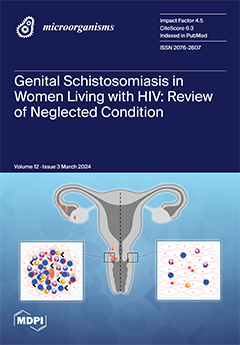
Cover Story: Schistosomiasis is a neglected parasitic disease transmitted by Schistosoma spp., with high prevalence in sub-Saharan Africa. It is a water-borne disease, causing both acute and chronic infections. Granuloma inflammation surrounding eggs trapped in various organs of the urogenital or hepatointestinal system contributes to the pathogenesis of the chronic infection, weakening host immunity.
In particular, female genital schistosomiasis (FGS), a disregarded gynecological condition, affects women’s reproductive health and increases vulnerability to HIV. Understanding the dynamics of FGS and HIV coinfection in terms of mutual transmission and diagnostic challenges is crucial for integrated healthcare strategies in regions with co-endemicity. View this paper
  • Issues are regarded as officially published after their release is announced to the table of contents alert mailing list .
  • You may sign up for email alerts to receive table of contents of newly released issues.
  • PDF is the official format for papers published in both, html and pdf forms. To view the papers in pdf format, click on the "PDF Full-text" link, and use the free Adobe Reader to open them.

Articles (213)

  • Article
  • Open Access
5 Citations
2,449 Views
11 Pages

Association between Gut Microbiota and Muscle Strength in Japanese General Population of the Iwaki Health Promotion Project

  • Yoshikuni Sugimura,
  • Yichi Yang,
  • Akira Kanda,
  • Akihiro Mawatari,
  • Yoshinori Tamada,
  • Tatsuya Mikami,
  • Shigeyuki Nakaji and
  • Kazushige Ihara

The association between the gut microbiota and muscle strength has garnered attention in the context of mitigating muscle decline. However, many study subjects have been individuals with existing illnesses or the elderly only. This study aims to eluc...

  • Article
  • Open Access
5 Citations
3,091 Views
22 Pages

Phosphorylation of proteins at serine, threonine, and tyrosine residues plays an important role in physiological processes of bacteria, such as cell cycle, metabolism, virulence, dormancy, and stationary phase functions. Little is known about the tar...

  • Article
  • Open Access
2 Citations
3,234 Views
12 Pages

Impact of COVID-19 Pandemic on the Trends of Trichomonas vaginalis Infection in a Tertiary Hospital of Madrid, Spain

  • Celia Bolumburu,
  • Vega Zamora,
  • María Muñoz-Algarra,
  • Maria Luisa de la Cruz Conty,
  • José Antonio Escario and
  • Alexandra Ibáñez-Escribano

More than one million sexually transmitted infections (STIs) occur every day, and Trichomonas vaginalis is responsible for more than 156 million cases each year worldwide. Nevertheless, epidemiological studies of this parasite in Europe are scarce. T...

  • Review
  • Open Access
4 Citations
4,823 Views
14 Pages

Vaginal Microbiota and HPV in Latin America: A Narrative Review

  • Eduardo Tosado-Rodríguez,
  • Ian Alvarado-Vélez,
  • Josefina Romaguera and
  • Filipa Godoy-Vitorino

With the expansion of human microbiome studies in the last 15 years, we have realized the immense implications of microbes in human health. The human holobiont is now accepted, given the commensal relationships with bacteria, fungi, parasites, viruse...

  • Article
  • Open Access
8 Citations
3,133 Views
12 Pages

Utilization of Spent Coffee Grounds for Bioelectricity Generation in Sediment Microbial Fuel Cells

  • Nurfarhana Nabila Mohd Noor,
  • Ilwon Jeong,
  • Seokjin Yoon and
  • Kyunghoi Kim

This study examined the utilization of spent coffee grounds with different aqueous extraction methods for the bioelectricity generation from coastal benthic sediment through a sediment microbial fuel cell (SMFC) system. Different methods for the aque...

  • Review
  • Open Access
3,163 Views
15 Pages

Back to the Future: Immune Protection or Enhancement of Future Coronaviruses

  • Merit Bartels,
  • Eric Sala Solé,
  • Lotte M. Sauerschnig and
  • Ger T. Rijkers

Before the emergence of SARS-CoV-1, MERS-CoV, and most recently, SARS-CoV-2, four other coronaviruses (the alpha coronaviruses NL63 and 229E and the beta coronaviruses OC43 and HKU1) had already been circulating in the human population. These circula...

  • Article
  • Open Access
4 Citations
2,611 Views
17 Pages

Alfalfa (Medicago sativa L.), a forage legume known for its moderate salt–alkali tolerance, offers notable economic and ecological benefits and aids in soil amelioration when cultivated in saline–alkaline soils. Nonetheless, the limited s...

  • Article
  • Open Access
4 Citations
1,781 Views
17 Pages

Arthrobotrys oligospora, a widespread nematode-trapping fungus which can produce conidia for asexual reproduction and form trapping devices (traps) to catch nematodes. However, little is known about the sporulation mechanism of A. oligospora. This re...

  • Article
  • Open Access
5 Citations
4,336 Views
15 Pages

Combined TCBS and CHROMagar Analyses Allow for Basic Identification of Vibrio vulnificus within a 48 h Incubation Period in the Coastal Baltic Sea

  • Conor Christopher Glackin,
  • Susann Dupke,
  • Thota Sharath Chandra,
  • David Riedinger and
  • Matthias Labrenz

With rising infection rates in recent years, Vibrio vulnificus poses an increasing threat to public safety in the coastal brackish Baltic Sea. It is therefore important to monitor this organism and assess the V. vulnificus infection risk on a more re...

  • Article
  • Open Access
4 Citations
2,248 Views
11 Pages

Characterization of the 3,4-Dichloroaniline Degradation Gene Cluster in Acinetobacter soli GFJ2

  • Namiko Gibu,
  • Daisuke Kasai,
  • Saki Sato,
  • Michiro Tabata,
  • Alisa Vangnai and
  • Masao Fukuda

3,4-Dichloroaniline (34DCA), a major metabolite of phenylurea herbicides, causes environmental contamination owing to its toxicity and recalcitrant properties. Acinetobacter soli strain GFJ2, isolated from soil potentially contaminated with herbicide...

of 22

Get Alerted

Add your email address to receive forthcoming issues of this journal.

XFacebookLinkedIn
Microorganisms - ISSN 2076-2607