

You are currently viewing a new version of our website. To view the old version click .

Microorganisms, Volume 12, Issue 3

March 2024 - 213 articles

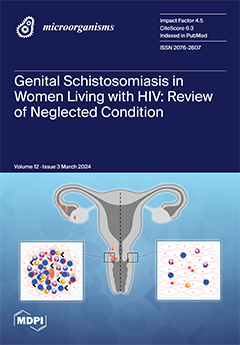
Cover Story: Schistosomiasis is a neglected parasitic disease transmitted by Schistosoma spp., with high prevalence in sub-Saharan Africa. It is a water-borne disease, causing both acute and chronic infections. Granuloma inflammation surrounding eggs trapped in various organs of the urogenital or hepatointestinal system contributes to the pathogenesis of the chronic infection, weakening host immunity.
In particular, female genital schistosomiasis (FGS), a disregarded gynecological condition, affects women’s reproductive health and increases vulnerability to HIV. Understanding the dynamics of FGS and HIV coinfection in terms of mutual transmission and diagnostic challenges is crucial for integrated healthcare strategies in regions with co-endemicity. View this paper
  • Issues are regarded as officially published after their release is announced to the table of contents alert mailing list .
  • You may sign up for email alerts to receive table of contents of newly released issues.
  • PDF is the official format for papers published in both, html and pdf forms. To view the papers in pdf format, click on the "PDF Full-text" link, and use the free Adobe Reader to open them.

Articles (213)

  • Article
  • Open Access
1 Citations
2,849 Views
11 Pages

Rare Plasmid-Mediated AmpC Beta-Lactamase DHA-1 Located on Easy Mobilized IS26-Related Genetic Element Detected in Escherichia coli from Livestock and Food in Germany

  • Chiara Manfreda,
  • Annemarie Kaesbohrer,
  • Silvia Schmoger,
  • Tanja Skladnikiewicz-Ziemer,
  • Mirjam Grobbel and
  • Alexandra Irrgang

AmpC beta-lactamases cause resistance to third-generation cephalosporins, including beta-lactamase inhibitors. In Escherichia coli from the German food production chain, the majority of AmpC beta-lactamase activity can be attributed to plasmid-mediat...

  • Article
  • Open Access
6 Citations
3,628 Views
21 Pages

LPS-Dephosphorylating Cobetia amphilecti Alkaline Phosphatase of PhoA Family Divergent from the Multiple Homologues of Cobetia spp.

  • Larissa Balabanova,
  • Svetlana Bakholdina,
  • Nina Buinovskaya,
  • Yulia Noskova,
  • Oksana Kolpakova,
  • Vanessa Vlasova,
  • Georgii Bondarev,
  • Aleksandra Seitkalieva,
  • Oksana Son and
  • Liudmila Tekutyeva

A highly active alkaline phosphatase (ALP) of the protein structural family PhoA, from a mussel gut-associated strain of the marine bacterium Cobetia amphilecti KMM 296 (CmAP), was found to effectively dephosphorylate lipopolysaccharides (LPS). There...

  • Review
  • Open Access
11 Citations
5,998 Views
13 Pages

Exploring Viral–Host Protein Interactions as Antiviral Therapies: A Computational Perspective

  • Sobia Idrees,
  • Hao Chen,
  • Nisha Panth,
  • Keshav Raj Paudel and
  • Philip M. Hansbro

The interactions between human and viral proteins are pivotal in viral infection and host immune responses. These interactions traverse different stages of the viral life cycle, encompassing initial entry into host cells, replication, and the eventua...

  • Article
  • Open Access
8 Citations
2,628 Views
14 Pages

Recently, probiotics have been widely applied for the in situ remediation of aquatic water. Numerous studies have proved that probiotics can regulate water quality by improving the microbial community. Nitrogen cycling, induced by microorganisms, is...

  • Article
  • Open Access
1 Citations
2,408 Views
12 Pages

Isolation and Characterization of a Novel Virulent Phage ASG01 of Aeromonas salmonicida and Its Cell Wall Hydrolase Activity

  • Chen Li,
  • Qiting Fang,
  • Yangjun Zhang,
  • Kunyan Li,
  • Yaoguang Li,
  • Rong Wang,
  • Yuyuan Peng,
  • Guofan Zhang,
  • Liqiu Xia and
  • Shengbiao Hu

Aeromonas salmonicida is an important pathogen that causes furunculosis in trout and salmon with high morbidity and mortality, resulting in significant economic losses in aquaculture. Overuse of antibiotics has led to the continuous emergence of drug...

  • Article
  • Open Access
2 Citations
2,489 Views
19 Pages

Dinoflagellate Proton-Pump Rhodopsin Genes in Long Island Sound: Diversity and Spatiotemporal Distribution

  • Huan Zhang,
  • Kelly J. Nulick,
  • Zair Burris,
  • Melissa Pierce,
  • Minglei Ma and
  • Senjie Lin

Microbial proton-pump rhodopsin (PPR)-based phototrophy, a light-harvesting mechanism different from chlorophyll-based photosystems, may contribute significantly to solar energy entry into the marine ecosystem. PPR transforms solar energy into cellul...

  • Review
  • Open Access
49 Citations
14,470 Views
32 Pages

Importance of Probiotics in Fish Aquaculture: Towards the Identification and Design of Novel Probiotics

  • Edgar Torres-Maravilla,
  • Mick Parra,
  • Kevin Maisey,
  • Rodrigo A. Vargas,
  • Alejandro Cabezas-Cruz,
  • Alex Gonzalez,
  • Mario Tello and
  • Luis G. Bermúdez-Humarán

Aquaculture is a growing industry worldwide, but it faces challenges related to animal health. These challenges include infections by parasites, bacteria, and viral pathogens. These harmful pathogens have devastating effects on the industry, despite...

  • Article
  • Open Access
2 Citations
2,368 Views
22 Pages

Evaluation of Pyrophosphate-Driven Proton Pumps in Saccharomyces cerevisiae under Stress Conditions

  • Krishnan Sreenivas,
  • Leon Eisentraut,
  • Daniel P. Brink,
  • Viktor C. Persson,
  • Magnus Carlquist,
  • Marie F. Gorwa-Grauslund and
  • Ed W. J. van Niel

In Saccharomyces cerevisiae, pH homeostasis is reliant on ATP due to the use of proton-translocating ATPase (H+-ATPase) which constitutes a major drain within cellular ATP supply. Here, an exogenous proton-translocating pyrophosphatase (H+-PPase) fro...

  • Article
  • Open Access
13 Citations
4,480 Views
15 Pages

Antimicrobial Effect of Copper Nanoparticles on Relevant Supragingival Oral Bacteria

  • Nia Oetiker,
  • Daniela Salinas,
  • Joaquín Lucero-Mora,
  • Rocío Orellana,
  • Mariana Quiroz-Muñoz,
  • Denisse Bravo and
  • José M. Pérez-Donoso

Copper nanoparticles (Cu NPs) show promise in dentistry for combating bacterial dysbiosis and tooth decay. Understanding their effects on commensal versus pathogenic bacteria is vital for maintaining oral health balance. While Cu NPs demonstrate anti...

  • Article
  • Open Access
2 Citations
1,862 Views
10 Pages

Antimicrobial Use during the SARS-CoV-2 Pandemic in a Greek Tertiary University Hospital

  • Dimitrios Biros,
  • Sempastian Filippas-Ntekouan,
  • Diamantina Limperatou,
  • Angelos Liontos,
  • Rafail Matzaras,
  • Konstantina-Helen Tsarapatsani,
  • Nikolaos-Gavriel Kolios,
  • Christiana Pappa,
  • Maria Nasiou and
  • Eleni Pargana
  • + 6 authors

In cases of SARS-CoV-2 hospitalization, despite low bacterial co-infection rates, antimicrobial use may be disproportionately high. Our aim was to quantify such usage in COVID-19 patients and identify factors linked to increased antibiotic use. We re...

of 22

Get Alerted

Add your email address to receive forthcoming issues of this journal.

XFacebookLinkedIn
Microorganisms - ISSN 2076-2607