You are currently viewing a new version of our website. To view the old version click .

Microorganisms, Volume 12, Issue 1

January 2024 - 230 articles

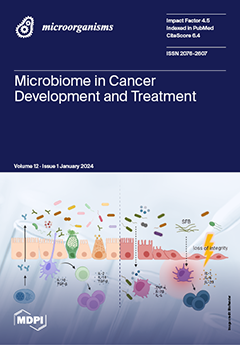
Cover Story: Cancer treatment negatively affects gut homeostasis via a disrupted mucosal barrier, leading to bacterial translocation and a significant inflammatory immune response. The scientific and clinical communities have widely accepted the crucial role of the microbiome in tumor development. Moreover, mounting evidence described the impact of the microbiome composition on chemo- and immunotherapy efficacy and treatment-induced late toxicity. Gut microbiota modulation via probiotics and fecal microbiota transplantation represents an emerging trend for increasing bacterial diversity, preventing inflammatory processes, and improving response to cancer therapies while minimizing side effects. A deep understanding of the host–microbiome crosstalk will help to bring a microbiome-based approach to routine clinical practice. View this paper
  • Issues are regarded as officially published after their release is announced to the table of contents alert mailing list .
  • You may sign up for email alerts to receive table of contents of newly released issues.
  • PDF is the official format for papers published in both, html and pdf forms. To view the papers in pdf format, click on the "PDF Full-text" link, and use the free Adobe Reader to open them.

Articles (230)

  • Review
  • Open Access
15 Citations
11,506 Views
28 Pages

Streptococcus pyogenes, or Group A Streptococcus, is an exclusively human pathogen that causes a wide variety of diseases ranging from mild throat and skin infections to severe invasive disease. The pathogenesis of S. pyogenes infection has been exte...

  • Communication
  • Open Access
2 Citations
2,807 Views
9 Pages

Metagenome and Resistome Analysis of Beta-Lactam-Resistant Bacteria Isolated from River Waters in Surabaya, Indonesia

  • Ryohei Nomoto,
  • Kayo Osawa,
  • Shohiro Kinoshita,
  • Koichi Kitagawa,
  • Noriko Nakanishi,
  • Rosantia Sarassari,
  • Dadik Raharjo,
  • Masato Fujisawa,
  • Kuntaman Kuntaman and
  • Toshiro Shirakawa

Antimicrobial agents are administered to humans and livestock, and bacterial antimicrobial resistance (AMR) and antimicrobial agents are released into the environment. In this study, to investigate the trend of AMR in humans, livestock, and the envir...

  • Article
  • Open Access
9 Citations
8,054 Views
11 Pages

Background: Antibiotic-associated diarrhea is a condition reported in 5–35% of patients treated with antibiotics, especially in older patients with comorbidities. In most cases, antibiotic-associated diarrhea is not associated with serious comp...

  • Article
  • Open Access
4 Citations
2,076 Views
14 Pages

The gill tissue of bivalve mollusks hosts rich symbiotic microbial communities that may contribute to host health. Spondylus spinosus is an invasive Lessepsian oyster in the Eastern Mediterranean Sea that has become highly abundant while constantly e...

  • Article
  • Open Access
9 Citations
3,045 Views
16 Pages

Ceftazidime–Avibactam Improves Outcomes in High-Risk Neutropenic Patients with Klebsiella pneumoniae Carbapenemase-Producing Enterobacterales Bacteremia

  • Fabián Herrera,
  • Diego Torres,
  • Ana Laborde,
  • Rosana Jordán,
  • Noelia Mañez,
  • Lorena Berruezo,
  • Sandra Lambert,
  • Nadia Suchowiercha,
  • Patricia Costantini and
  • Andrea Nenna
  • + 12 authors

Few studies have evaluated the efficacy of ceftazidime–avibactam (CA) for Klebsiella pneumoniae carbapenemase-producing Enterobacterales bacteremia (KPC-PEB) in high-risk neutropenic patients. This is a prospective multicenter observational stu...

  • Article
  • Open Access
4 Citations
2,561 Views
27 Pages

Diverse Small Circular DNA Viruses Identified in an American Wigeon Fecal Sample

  • Diego Olivo,
  • Anthony Khalifeh,
  • Joy M. Custer,
  • Simona Kraberger and
  • Arvind Varsani

American wigeons (Mareca americana) are waterfowls that are widely distributed throughout North America. Research of viruses associated with American wigeons has been limited to orthomyxoviruses, coronaviruses, and circoviruses. To address this poor...

  • Review
  • Open Access
30 Citations
12,161 Views
31 Pages

The Networked Interaction between Probiotics and Intestine in Health and Disease: A Promising Success Story

  • Maria Skoufou,
  • Christina Tsigalou,
  • Stergios Vradelis and
  • Eugenia Bezirtzoglou

Probiotics are known to promote human health either precautionary in healthy individuals or therapeutically in patients suffering from certain ailments. Although this knowledge was empirical in past tomes, modern science has already verified it and e...

  • Article
  • Open Access
10 Citations
3,150 Views
14 Pages

The Response of the Honey Bee Gut Microbiota to Nosema ceranae Is Modulated by the Probiotic Pediococcus acidilactici and the Neonicotinoid Thiamethoxam

  • Thania Sbaghdi,
  • Julian R. Garneau,
  • Simon Yersin,
  • Frédérique Chaucheyras-Durand,
  • Michel Bocquet,
  • Anne Moné,
  • Hicham El Alaoui,
  • Philippe Bulet,
  • Nicolas Blot and
  • Frédéric Delbac

The honey bee Apis mellifera is exposed to a variety of biotic and abiotic stressors, such as the highly prevalent microsporidian parasite Nosema (Vairimorpha) ceranae and neonicotinoid insecticides. Both can affect honey bee physiology and microbial...

  • Article
  • Open Access
6 Citations
2,564 Views
13 Pages

Belgian Cross-Sectional Epidemiological Study on Zoonotic Avian Chlamydia spp. in Chickens

  • Anne De Meyst,
  • Pieter De Clercq,
  • Jelmer Porrez,
  • Tom Geens,
  • Lutgart Braeckman,
  • Sander Ouburg,
  • Servaas A. Morré and
  • Daisy Vanrompay

Chlamydia psittaci, Chlamydia gallinacea, and Chlamydia abortus are the most common Chlamydia spp. in chickens and have a confirmed or suggested zoonotic potential. No recent data are available on their prevalence and impact in the Belgian chicken in...

  • Article
  • Open Access
5 Citations
2,551 Views
17 Pages

Exploring the Complexity of the Interaction between T. rubrum and S. aureus/S. epidermidis in the Formation of Polymicrobial Biofilms

  • Jenyffie A. Belizario,
  • Níura M. Bila,
  • Carolina O. Vaso,
  • Caroline B. Costa-Orlandi,
  • Matheus B. Mendonça,
  • Ana M. Fusco-Almeida,
  • Regina H. Pires and
  • Maria José S. Mendes-Giannini

Dermatophytes associated with bacteria can lead to severe, difficult-to-treat infections and contribute to chronic infections. Trichophyton rubrum, Staphylococcus aureus, and Staphylococcus epidermidis can form biofilms influenced by nutrient availab...

of 23

Get Alerted

Add your email address to receive forthcoming issues of this journal.

XFacebookLinkedIn
Microorganisms - ISSN 2076-2607