You are currently viewing a new version of our website. To view the old version click .

Microorganisms, Volume 11, Issue 10

October 2023 - 248 articles

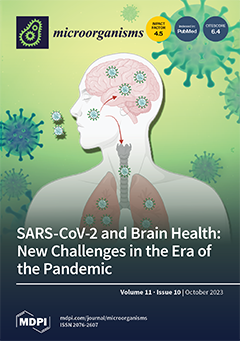
Cover Story: The impact of COVID-19, caused by the SARS-CoV-2 virus, on brain health is a topic of ongoing research. While the virus primarily affects the respiratory system, evidence suggests that it can also have neurological effects. Some patients with COVID-19 have reported symptoms such as headaches, confusion, and loss of smell or taste. Studies are being conducted to fully understand how SARS-CoV-2 impacts the CNS and determine the long-term effects of the virus on brain health, including the potential for cognitive impairment and an increased risk of neurological disorders. View this paper
  • Issues are regarded as officially published after their release is announced to the table of contents alert mailing list .
  • You may sign up for email alerts to receive table of contents of newly released issues.
  • PDF is the official format for papers published in both, html and pdf forms. To view the papers in pdf format, click on the "PDF Full-text" link, and use the free Adobe Reader to open them.

Articles (248)

  • Review
  • Open Access
12 Citations
3,000 Views
24 Pages

Bridging Molecular and Clinical Sciences to Achieve the Best Treatment of Enterococcus faecalis Endocarditis

  • Francesco Nappi,
  • Sanjeet Singh Avtaar Singh,
  • Vikram Jitendra and
  • Antonio Fiore

Enterococcus faecalis (E. faecalis) is a commensal bacterium that causes various infections in surgical sites, the urinary tract, and blood. The bacterium is becoming a significant concern because it tends to affect the elderly population, which has...

  • Article
  • Open Access
9 Citations
2,989 Views
20 Pages

The Imperative Use of Bacillus Consortium and Quercetin Contributes to Suppress Fusarium Wilt Disease by Direct Antagonism and Induced Resistance

  • Ali Hassan,
  • Waheed Akram,
  • Humaira Rizwana,
  • Zill-e-Huma Aftab,
  • Sana Hanif,
  • Tehmina Anjum and
  • Mona S. Alwahibi

Fusarium wilt diseases severely influence the growth and productivity of numerous crop plants. The consortium of antagonistic rhizospheric Bacillus strains and quercetin were evaluated imperatively as a possible remedy to effectively manage the Fusar...

  • Article
  • Open Access
4 Citations
2,604 Views
13 Pages

UHPLC/MS-Based Untargeted Metabolomics Reveals Metabolic Characteristics of Clinical Strain of Mycoplasma bovis

  • Fei Yang,
  • Mengmeng Yang,
  • Duoduo Si,
  • Jialin Sun,
  • Fan Liu,
  • Yanrong Qi,
  • Shenghu He and
  • Yanan Guo

Mycoplasma bovis is a global concern for the cattle industry owing to its high rates of infection and resulting morbidity, but its pathogenesis remains poorly understood. Metabolic pathways and characteristics of M. bovis clinical strain were elucida...

  • Article
  • Open Access
14 Citations
4,417 Views
22 Pages

Study of the Interface between Wild Bird Populations and Poultry and Their Potential Role in the Spread of Avian Influenza

  • Luca Martelli,
  • Diletta Fornasiero,
  • Francesco Scarton,
  • Arianna Spada,
  • Francesca Scolamacchia,
  • Grazia Manca and
  • Paolo Mulatti

Water birds play a crucial role in disseminating and amplifying avian influenza viruses (AIVs) in the environment. However, they may have limited interactions with domestic facilities, raising the hypothesis that other wild birds may play the bridgin...

  • Review
  • Open Access
4 Citations
2,570 Views
11 Pages

The novel industrial approach of co-fermenting wood wastes with agricultural wastes that are rich in nitrogen such as animal manures to produce bio-methane (renewable natural gas) fuel via thermophilic anaerobic digestion mimics an analogous process...

  • Review
  • Open Access
14 Citations
11,449 Views
34 Pages

Malassezia is a lipophilic unicellular fungus that is able, under specific conditions, to cause severe cutaneous and systemic diseases in predisposed subjects. This review is divided into two complementary parts. The first one discusses how virulence...

  • Review
  • Open Access
6 Citations
4,508 Views
12 Pages

Biliary tract cancer, encompassing intrahepatic and extrahepatic cholangiocarcinoma as well as gallbladder carcinoma, stands as a prevalent malignancy characterized by escalating incidence rates and unfavorable prognoses. The onset of cholangiocarcin...

  • Article
  • Open Access
3 Citations
2,075 Views
12 Pages

Assessment of the Virulence of the Burkholderia mallei Strain BAC 86/19 in BALB/c Mice

  • Emanuelle Baldo Gaspar,
  • Lenita Ramires dos Santos,
  • Andréa Alves do Egito,
  • Maria Goretti dos Santos,
  • Cynthia Mantovani,
  • Juliana da Silva Gomes Rieger,
  • Guilherme Augusto de Sousa Abrantes,
  • Paula Adas Pereira Suniga,
  • Júlia de Mendonça Favacho and
  • Ingrid Batista Pinto
  • + 3 authors

Burkholderia mallei is an aerobic, Gram-negative, non-motile bacillus. As an obligate mammalian pathogen, it primarily affects solipeds. Although rarely transmitted to humans, the disease it causes, glanders, is classified as a zoonosis. The bacteriu...

  • Article
  • Open Access
1 Citations
1,732 Views
17 Pages

The use of surfactin is a promising method to mitigate algal blooms. However, little is known about surfactin toxicity to algae and bacterioplankton. Here, we treated Chaetoceros curvisetus, the dominant species of algal blooms in the East China Sea,...

  • Review
  • Open Access
33 Citations
5,231 Views
19 Pages

Biofilms as Battlefield Armor for Bacteria against Antibiotics: Challenges and Combating Strategies

  • Sara Bano,
  • Noor Hassan,
  • Muhammad Rafiq,
  • Farwa Hassan,
  • Maliha Rehman,
  • Naveed Iqbal,
  • Hazrat Ali,
  • Fariha Hasan and
  • Ying-Qian Kang

Bacterial biofilms are formed by communities, which are encased in a matrix of extracellular polymeric substances (EPS). Notably, bacteria in biofilms display a set of ‘emergent properties’ that vary considerably from free-living bacteria...

of 25

Get Alerted

Add your email address to receive forthcoming issues of this journal.

XFacebookLinkedIn
Microorganisms - ISSN 2076-2607