


You are currently viewing a new version of our website. To view the old version click .

Pathogens, Volume 12, Issue 7

July 2023 - 117 articles

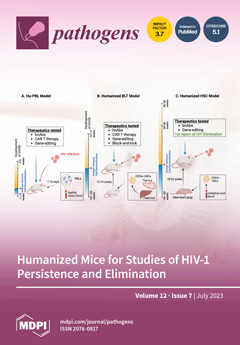
Cover Story: A major roadblock to achieving a cure for HIV-1 is the persistence of latent viral infections. Given the host-specificity, there are few animal models that replicate the natural course of HIV infection with precision, underlining the importance of humanized mouse models for viral latency and its elimination studies. The hu-PBL model is tested for quick screening of antiretroviral therapies lasting 4–5 weeks. The hu-BLT model involves the transplantation of human HSCs, fetal liver, and thymus tissue into immunocompromised mice and has been tested for HIV infection and latency studies lasting up to three months. The hu-HSC model utilizes transplantation of hematopoietic stem cells to generate a functional human immune system, lasting up to one year, allowing long-term HIV infection and therapeutic studies, including the first report of an HIV cure. View this paper
  • Issues are regarded as officially published after their release is announced to the table of contents alert mailing list .
  • You may sign up for email alerts to receive table of contents of newly released issues.
  • PDF is the official format for papers published in both, html and pdf forms. To view the papers in pdf format, click on the "PDF Full-text" link, and use the free Adobe Reader to open them.

Articles (117)

  • Review
  • Open Access
48 Citations
12,781 Views
25 Pages

From Infection to Death: An Overview of the Pathogenesis of Visceral Leishmaniasis

  • Carlos H. N. Costa,
  • Kwang-Poo Chang,
  • Dorcas L. Costa and
  • Francisco Valmor M. Cunha

Kala-azar, also known as visceral leishmaniasis (VL), is a disease caused by Leishmania infantum and L. donovani. Patients experience symptoms such as fever, weight loss, paleness, and enlarged liver and spleen. The disease also affects immunosuppres...

  • Article
  • Open Access
7 Citations
3,441 Views
20 Pages

Assessing Onchocerca volvulus Intensity of Infection and Genetic Diversity Using Mitochondrial Genome Sequencing of Single Microfilariae Obtained before and after Ivermectin Treatment

  • Shannon M. Hedtke,
  • Young-Jun Choi,
  • Anusha Kode,
  • Gowtam C. Chalasani,
  • Neha Sirwani,
  • Stephen R. Jada,
  • An Hotterbeekx,
  • Michel Mandro,
  • Joseph N. Siewe Fodjo and
  • Glory Ngongeh Amambo
  • + 6 authors

Onchocerciasis is a neglected tropical disease targeted for elimination using ivermectin mass administration. Ivermectin kills the microfilariae and temporarily arrests microfilariae production by the macrofilariae. We genotyped 436 microfilariae fro...

  • Article
  • Open Access
9 Citations
4,225 Views
12 Pages

In October 2020, samples of walnut branch blight were collected from Longnan. Pathogens were isolated and identified based on morphological and molecular features, and their characteristics were analyzed by pathogenicity. Pathogenicity testing reveal...

  • Review
  • Open Access
8 Citations
3,945 Views
13 Pages

Exposure to Biological Fluids in Dental Practice—Narrative Review on Appropriate Risk Assessment to Guide Post-Exposure Management

  • Mihai Săndulescu,
  • Mihnea Ioan Nicolescu,
  • Cristian Funieru,
  • Gülşen Özkaya Şahin and
  • Oana Săndulescu

Accidental exposure to blood or other biological fluids is a common occurrence in dentistry, and its post-exposure management is a key component of infection prevention and control programs designed to prevent the transmission of blood-borne pathogen...

  • Article
  • Open Access
2 Citations
3,674 Views
17 Pages

Analyses of Mosquito Species Composition, Blood-Feeding Habits and Infection with Insect-Specific Flaviviruses in Two Arid, Pastoralist-Dominated Counties in Kenya

  • Edwin O. Ogola,
  • Armanda D. S. Bastos,
  • Gilbert Rotich,
  • Anne Kopp,
  • Inga Slothouwer,
  • Dorcus C. A. Omoga,
  • Rosemary Sang,
  • Baldwyn Torto,
  • Sandra Junglen and
  • David P. Tchouassi

Insect-specific flaviviruses (ISFs), although not known to be pathogenic to humans and animals, can modulate the transmission of arboviruses by mosquitoes. In this study, we screened 6665 host-seeking, gravid and blood-fed mosquitoes for infection wi...

  • Review
  • Open Access
11 Citations
7,325 Views
20 Pages

For decades now, DNA fingerprinting by means of pulsed-field gel electrophoresis (PFGE) continues to be the most widely used to separate large DNA molecules and distinguish between different strains in alternating pulses. This is done by isolating in...

  • Article
  • Open Access
7 Citations
2,968 Views
22 Pages

In food desert areas, low-income households without convenient transportation often shop at small, independently owned corner markets and convenience stores (SIOMs). Studies indicate a higher potential for reduced product quality and safety of foods...

  • Review
  • Open Access
14 Citations
5,265 Views
18 Pages

PARPs and ADP-Ribosylation in Chronic Inflammation: A Focus on Macrophages

  • Diego V. Santinelli-Pestana,
  • Elena Aikawa,
  • Sasha A. Singh and
  • Masanori Aikawa

Aberrant adenosine diphosphate-ribose (ADP)-ribosylation of proteins and nucleic acids is associated with multiple disease processes such as infections and chronic inflammatory diseases. The poly(ADP-ribose) polymerase (PARP)/ADP-ribosyltransferase (...

  • Communication
  • Open Access
6 Citations
2,956 Views
9 Pages

Food Safety Monitoring of Salmonella spp. in Northern Italy 2019–2021

  • Daniela Manila Bianchi,
  • Paola Barzanti,
  • Daniela Adriano,
  • Francesca Martucci,
  • Monica Pitti,
  • Carla Ferraris,
  • Irene Floris,
  • Roberta La Brasca,
  • Carmela Ligotti and
  • Sara Morello
  • + 5 authors

Salmonella is the second most frequent bacterial pathogen involved in human gastrointestinal outbreaks in the European Union; it can enter the food-production chain from animal or environmental sources or from asymptomatic food operators. European fo...

  • Article
  • Open Access
5 Citations
7,884 Views
9 Pages

Lactate Dehydrogenase Inhibitors Suppress Borrelia burgdorferi Growth In Vitro

  • Adam Lynch,
  • Patrick Pearson,
  • Sergey N. Savinov,
  • Andrew Y. Li and
  • Stephen M. Rich

Borrelia burgdorferi, the causative agent of Lyme disease, has a highly reduced genome and relies heavily on glycolysis for carbon metabolism. As such, established inhibitors of lactate dehydrogenase (LDH) were evaluated in cultures to determine the...

of 12

Get Alerted

Add your email address to receive forthcoming issues of this journal.

XFacebookLinkedIn
Pathogens - ISSN 2076-0817