


Abstract
This thesis examines the theological status of artificial intelligence-generated religious imagery through Byzantine icon theory, asking whether such images can participate in the material, devotional, and communal, definitions traditionally ascribed to icons. Situating AI within an intellectual lineage beginning with iconoclasm debates and then turning to Alan Turing’s “Computing Machinery and Intelligence”, this project places contemporary image generation models such as DALL·E and Midjourney in dialog with late antique and Byzantine debates on representation, likeness, and mediation. Drawing on St Theodore the Studite’s defense of icons as relational images grounded in the Incarnation, this thesis argues that AI-generated portraits cannot be understood as icons in a theological or art historical sense. Icons depend upon an embodied triad between maker, prototype, and worshiping community, sustained through liturgical practice, ascetic discipline, and intentional craft. Adding Aristotle’s account of deliberation further clarifies this distinction: algorithmic production lacks the ethical agency and purposive choice intrinsic to sacred image-making. While engaging the scholarship of Robin Cormack, Charles Barber, Bissera V. Petcheva, and many others, this study reasserts the Christological foundations of icon theory while situating AI imagery within contemporary political economies of data extraction, militarism, and environmental cost. AI may attempt to reproduce religious imagery, but it cannot generate objects of real veneration.
1. Introduction
Artificial intelligence-generated images, visual outputs created through machine learning systems that synthesize vast algorithmic datasets, are rapidly reshaping how contemporary visual culture produces and understands representation (Samo and Highhouse 2025, p. 1084). Their emergence complicates long-standing assumptions about authorship, intentionality, and meaning, which becomes especially pressing when these systems are used to imitate sacred visual traditions. Within Christianity, particularly in Eastern Orthodoxy, iconography plays a distinctive and rooted role: icons or eikṓns (εἰκών) are not merely religious sacred representations on any medium but theologically divine images grounded in centuries of practice, doctrine, and communal reverence (Talbot 1998, p. vii). Placing AI-generated imagery alongside this tradition raises serious theological, aesthetic, and ethical questions about what constitutes an icon, who may create one, and whether an image lacking human intention or spiritual formation can participate in the sacred reality icons are meant to make present.
As argued previously by Noreen Herzfeld in “Is an AI-Generated Icon an Icon? A Case Study in Artificial Intelligence and Christian Spirituality,” on the potential of AI-generated iconography through three major points of perspective via the iconographer, the worshiper, and the liturgical community (Herzfeld 2024, p. 283), this paper will revisit this argument to augment the idea that AI-generated religious portraits cannot be considered icons in a theological or art historical sense because they diverge from the constitutive conditions of iconography. Such images are produced outside the historical and doctrinal traditions that authorize icons; they lack the embodied craft, devotional discipline, and ascetic labor through which icons acquire incarnational meaning; they sever the ethical and epistemic relationships binding maker, prototype, and worshiping community; and they bypass the liturgical, communal, and consecratory practices through which icons are invested with authority and function. By ignoring these ontological, material, relational, and ritual foundations, AI systems produce images that may visually resemble icons but cannot partake in the spiritual, cultural, and theological reality of icon-hood.
2. Iconoclasm History and Theological Foundations
Figurative art in Christianity emerged visibly during the fourth century with the early audience’s experience revolving around the veneration of martyrs’ bodies, relics, and objects related to the Virgin Mary and Christ (Cormack 2007, p. 9). There were many controversial questions for early Christians regarding the nature of art and idolatry. Due to its rapid production and widespread presence, it was banned by Leo III, the Byzantine emperor of Constantinople, in 730 and led to the formation of the Council of Constantinople of 754, making iconoclasm the dogma of the Orthodox Church (Cormack 2007, p. 9). The argument against icons was presented in the Second Commandment, which states the following: “Do not make an idol for yourself-no form whatsoever-of anything in the sky above or on the earth below or in the waters under the earth (Common English Bible 2011, Ex. 20:4).” Therefore, opening the debate for any imagery of the Holy was scripturally unsupported. Yet the theological conviction made by those supporting iconography, the iconophiles, was that the divine became visible and knowable through the Incarnation, making the representation of sacred figures not only permissible but necessary for the life of the Church.
In its earliest forms, the icon functioned as a visual affirmation that Christ’s humanity was real, tangible, and capable of being depicted, a stance that countered anxieties about idolatry by rooting sacred representation in the doctrine that “since God was made flesh, He could be depicted”, as argued by John of Damascus (John of Damascus 2003, p. 25). Iconophiles, such as the fourth-century Father Basil of Caesarea, stated that “The honor given to the image passes to the original (πρωτότυπο) (Talbot 1998, p. viii).” Interestingly, the restoration of icons began with the death of Leo IV, who died of suspicious circumstances in 780 (Talbot 1998, p. xii), when the discovery of his wife Irene stowing away secret icons in her private quarters emerged. With one son and assuming the regency, Empress Irene appointed the layman Tarasios as patriarch to lay the groundwork for reversing the iconoclastic rulings. The newly formed council distinguished between worship owed to God alone and the veneration appropriate to icons, insisting that honor given to the image passes to its prototype. With this ruling, iconography was solidified as a legitimate and theologically indispensable practice, grounded in the belief that material images can mediate divine presence because God first entered material form in Christ. After the reinstatement of iconography, Irene would serve as the empress on the imperial throne until 802, although the debate would carry on after her legacy until 843 (Talbot 1998, p. xiii). The relationship between these rulings and the actions of Empress Irene reveals a triangulation between the divine, imperial politics, and social authority, demonstrating how theological claims about material mediation were not merely abstract doctrines but operative forces that shaped governance, legitimacy, and the regulation of sacred visibility within the Byzantine world.
3. Materiality and Embodying the Craft
Before the sixth century, the visual representation of God posed a real theological and artistic problem (Cormack 2007, p. 18). Early Christian communities inherited deep anxieties surrounding figuration, shaped by Jewish aniconism, Greco-Roman visual conventions, and unresolved Christological questions concerning visibility, likeness, and divine presence. As Robin Cormack demonstrates in Icon, the emergence of figural sacred imagery was neither immediate nor inevitable but developed gradually through experimentation and negotiation (Cormack 2007, p. 25). Archeological evidence from Dura-Europos, dating back to the third century CE, marks one of the earliest instances of figurative imagery being introduced into religious contexts (Schenk 2010). These images do not yet function as icons (this can be disputed) but rather as narrative and symbolic visualizations that gesture toward presence without claiming it. Attending this emergence of figural imagery is crucial, as it reveals how theological reasoning, material practices, and visual strategies developed in tandem—and how early negotiations over representation laid the conceptual groundwork for later iconoclastic controversies over presence, mediation, and authority.
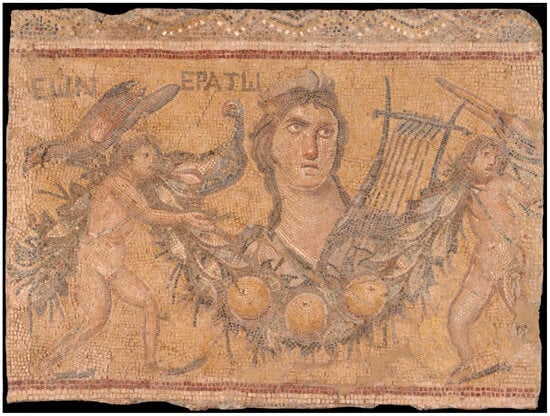
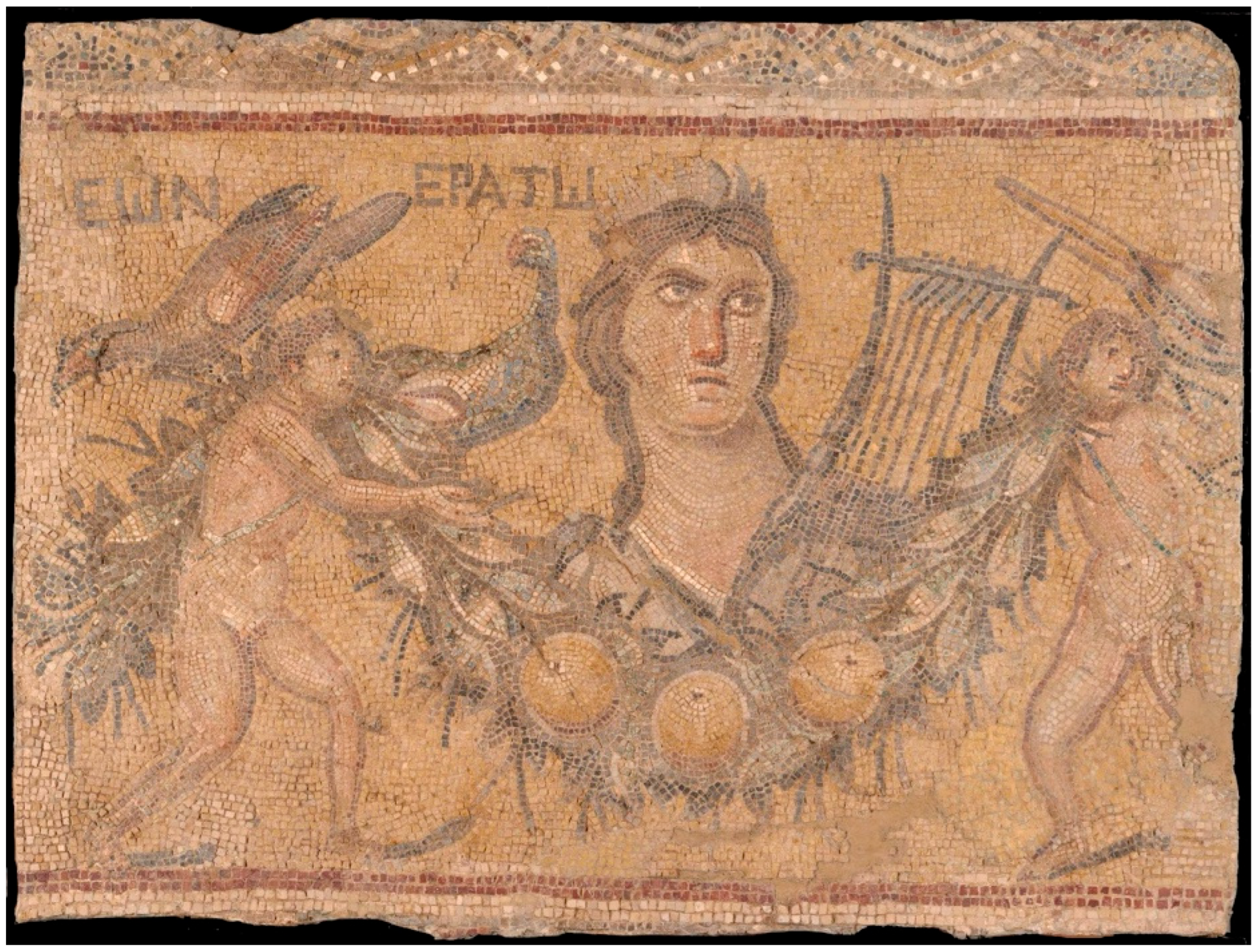
This gradual visual landscape is evident in earlier figurative precedents. Figure 1 shows a reconstructed mosaic excavated in 1927 and now in the Yale University Art Gallery. It depicts Dionysos with his consort, framed by vegetal motifs and attended by Erato and Euterpe, demonstrating a compositional logic that would later inform Christian iconography. The emphasis on the bust, the frontal orientation, and the ornamental framing anticipates features that would become central to an “iconic” visual grammar, even though the image itself operates within a mythological cultic register. This cultural continuity suggests that early Christian artists did not invent iconography but adapted preexisting visual structures, radically reinterpreting them to convey theological meaning.
Figure 1.
Mosaic Fragment with a Bust of Erato, Roman, late 2nd–early 3rd century CE, mosaic (limestone and glass tesserae). Yale University Art Gallery. Ruth Elizabeth White Fund (2004.2.4). Available online: https://artgallery.yale.edu/collections/objects/79009 (accessed on 15 December 2025).
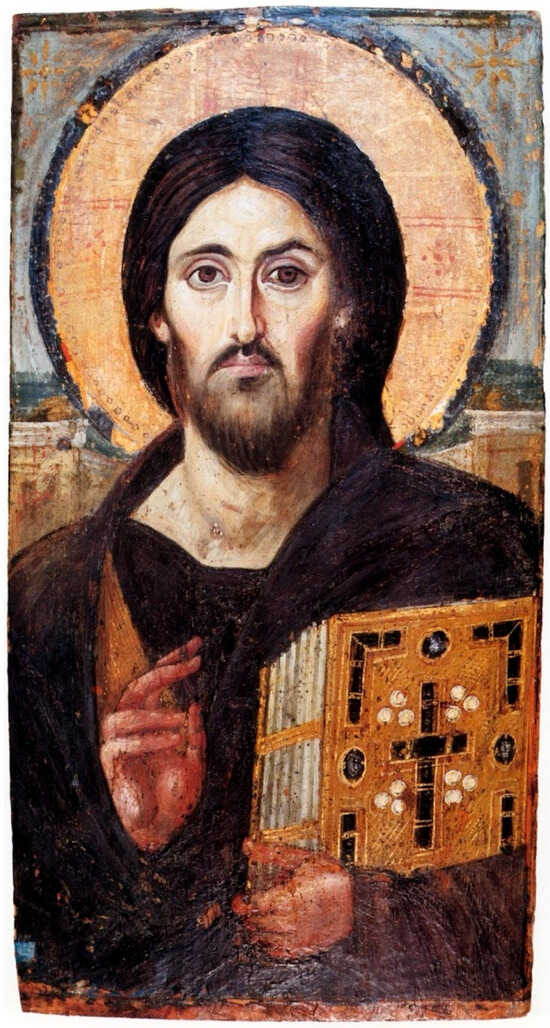
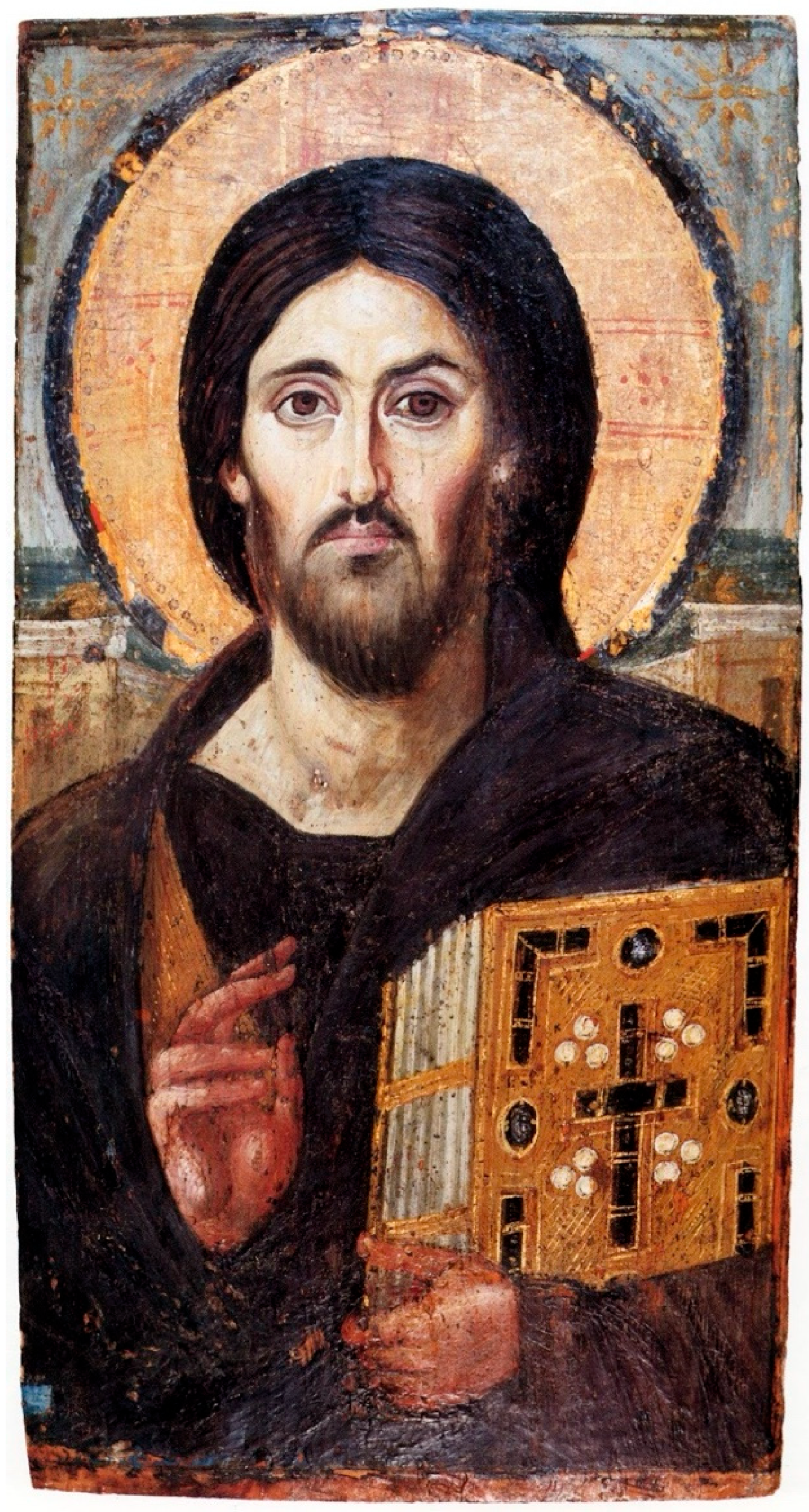
By contrast, Figure 2 displays a sixth-century Byzantine icon of Christ, marking a decisive shift. Here, the face of Christ emerges as a stabilized, authoritative image, resolving what had remained an enigma. As scholar Charles Barber argues in Figure and Likeness, this development coincides with the crystallization of Christological doctrine, particularly the affirmations of Christ’s dual nature, which made depiction not only permissible but theologically necessary (Barber 2002, pp. 46–48). The icon no longer merely represents, but it participates in presence through likeness, materially, and consecrated use. This historical trajectory demonstrates that icons are the result of prolonged theological reflection, material practice, and communal authorization.
Figure 2.
Icon with Christ, 6th century, encaustic on panel. Byzantine, Constantinople. Collection of the Holy Monastery of St. Catherine, Sinai, Egypt. Painting photography from Wikimedia Commons, Public Domain.
Within this framework, likeness does not function as a demand for naturalistic resemblance but as a theologically calibrated relation between image and prototype. As Theodore of Studion would later articulate philosophically, the icon’s authority rests not in mimetic precision but in its capacity to delineate Christ’s recognizable appearance in accordance with doctrinal truth (Tollefsen 2018, p. 111). The prototype establishes the standard of reference, while the icon renders that standard visible without exhausting it. What is required of the image, therefore, is not empirical exactitude but fidelity to those essential qualities, such as Christ’s humanity, dignity, and divine authority that make the Incarnation visually intelligible. This understanding clarifies how icons could mediate presence without collapsing into idolatry and why their legitimacy depended less on artistic realism than on theological intention and ecclesial sanction.
This distinction becomes more precise in the writings of Theodore, who clarifies that the logic of iconic representation does not operate at the level of abstract essence but at the level of personal existence. For Theodore, the icon does not seek to depict nature in the abstract, since such a task would be both impossible and theologically incoherent, but instead renders visible the hypostasis through which nature is concretely encountered. He explains the following:
“When anyone is portrayed, it is not the nature but the hypostasis which is portrayed. For how could a nature be portrayed unless it was contemplated in a hypostasis? For example, Peter is not portrayed insofar as he is animate, rational, mortal, and capable of thought and understanding; for this does not define Peter only, but also Paul and John, and all those of the same species. But insofar as he adds along with the common definition certain properties, such as long or short nose, curly hair, a good complexion, bright eyes, or whatever else characterizes his particular appearance, he is distinguished from the other individuals of the same species.”(Tollefsen 2018, p. 112)
Παντὸς εἰκονιζομένου, οὐχ ἡ φύσις, ἀλλ᾽ ἡ ὑπόστασις εἰκονίζεται· πῶς γὰρ ἂν καὶ ἐξεικονισθείη φύσις μὴ ἐν ὑποστάσει τεθεωρημένη; οἷον φέρε εἰπεῖν, Πέτρος, οὐ καθὸ ζῶον λογικὸν, θνητὸν, νοῦ καὶ ἐπιστήμης δεκτικόν ἐστι, εἰκονίζεται· τοῦτο γὰρ οὐ μόνον Πέτρον ὁρίζει· ἀλλὰ γὰρ καὶ Παῦλον καὶ Ἰωάννην, καὶ πάντας τοὺς ὑπὸ τὸ αὐτὸ εἶδος. Ἀλλὰ καθότι μετὰ τοῦ κοινοῦ ὅρου προσλαβὼν ἰδιώματά τινα, οἷον τὸ γρυπὸν, ἢ σιμὸν, ἢ οὗλον, ἢ εὔχρουν, ἢ εὐόμματον, ἢ εἴ τι ἄλλο τὸ χαρακτηρίζον τὴν προσοῦσαν αὐτῷ ἰδέαν, διακέκριται ἀπὸ τῶν ὁμοειδῶν ἀτόμων.
Their emergence depended on specific material and theological conditions, which are articulated in a surviving sixteenth-century text by Dionysios, a priest, monk, and painter active in northern Greece on Mount Athos, known as the Hermeneia or Painter’s Manual (Cormack 2007, pp. 31–32). These instructions do not function merely as technical guidance but as a doctrinal and ascetic framework governing the physical creation of the icon. The sequential stages of preparation, the selection of materials, grounding, drawing, gilding, and pigmentation instantiate an embodied process through which likeness to the prototype is intentionally received rather than arbitrarily produced (Cormack 2007, p. 34). In Theodore the Studite’s terms, this intentional and ecclesially regulated craftsmanship secures the icon’s true homonymous relation to its prototype: the image is identified according to likeness while differing in essence, such that veneration passes through the image without collapsing into materiality. The text thus preserves not only stylistic continuity but also the ontological conditions that allow the icon to participate in a whole veneration grounded in resemblance. Within this framework, the rise in paper iconography poses a challenge, not because of the transcendence of medium as such but because mechanical reproduction attenuates the confessional and ascetic intentionality that stabilizes homonymy. While mass reproduction technologies facilitate wider circulation and stylistic interpretation (Cormack 2007, p. 35), they also risk displacing the icon from the human, bodily act of making that anchors its likeness to the prototype, thereby weakening the theological coherence of veneration defended by Theodore.
However, AI-generated images fall entirely outside the established lineage of iconography because they are produced without any connection to the canonical traditions that govern sacred image-making. Unlike trained iconographers who inherit techniques, faith upbringings, and economic responsibilities through a living chain of teachers and communities, AI systems operate by scraping data surfaces to gain a traditional historical memory, imitating human brain neural networks (Samo and Highhouse 2025, p. 1085). Their outputs do not arise from human intention, spiritual discipline, or theological understanding; instead, they are assembled through automated pattern recognition and statistical inference. This absence of ascetic practice, prayerful preparation, and intentional authorship means that AI-generated images cannot embody the spiritual and relational depth that defines true icons.
Published by Alan Turing in 1948, at the beginning stages of industrialization, Turing predicted in his essay “Intelligent Machinery” that the emergence of machines as intelligent, conscious, embodied entities would yield consequential results for humanity whilst also holding a fascination with intelligent machines (Turing [1948] 2004, p. 431). Rather than emerging from a maker shaped by devotion and tradition, they are generated by an impersonal mechanism incapable of engaging the sacred realities that iconography exists to mediate. AI-generated images eliminate every aspect of embodied and devotional practice that gives traditional icons their theological depth. Because no human hands touch the surface of the image, the process is disembodied from start to finish—no tactile shaping of materials, no labor, no physical presence. The “maker” in this context undertakes a lack of prayer, minimal ascetic preparation, and liturgical participation, leaving the image without the spiritual grounding that iconography demands. Automation replaces intention, rendering the production of sacred imagery a matter of computational output rather than devotional engagement. This absence of participation and sacrifice has intense theological implications: without embodiment or presence, the resulting image cannot partake in the incarnational logic that undergirds the icon tradition, nor can it function as a vessel of sanctified meaning.
4. Ethical and Epistemic Relationships of Iconography
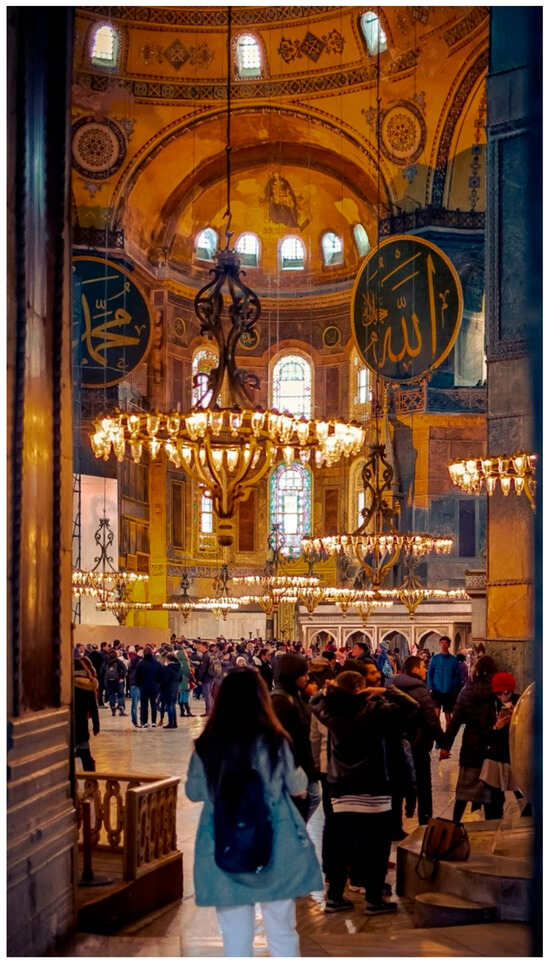
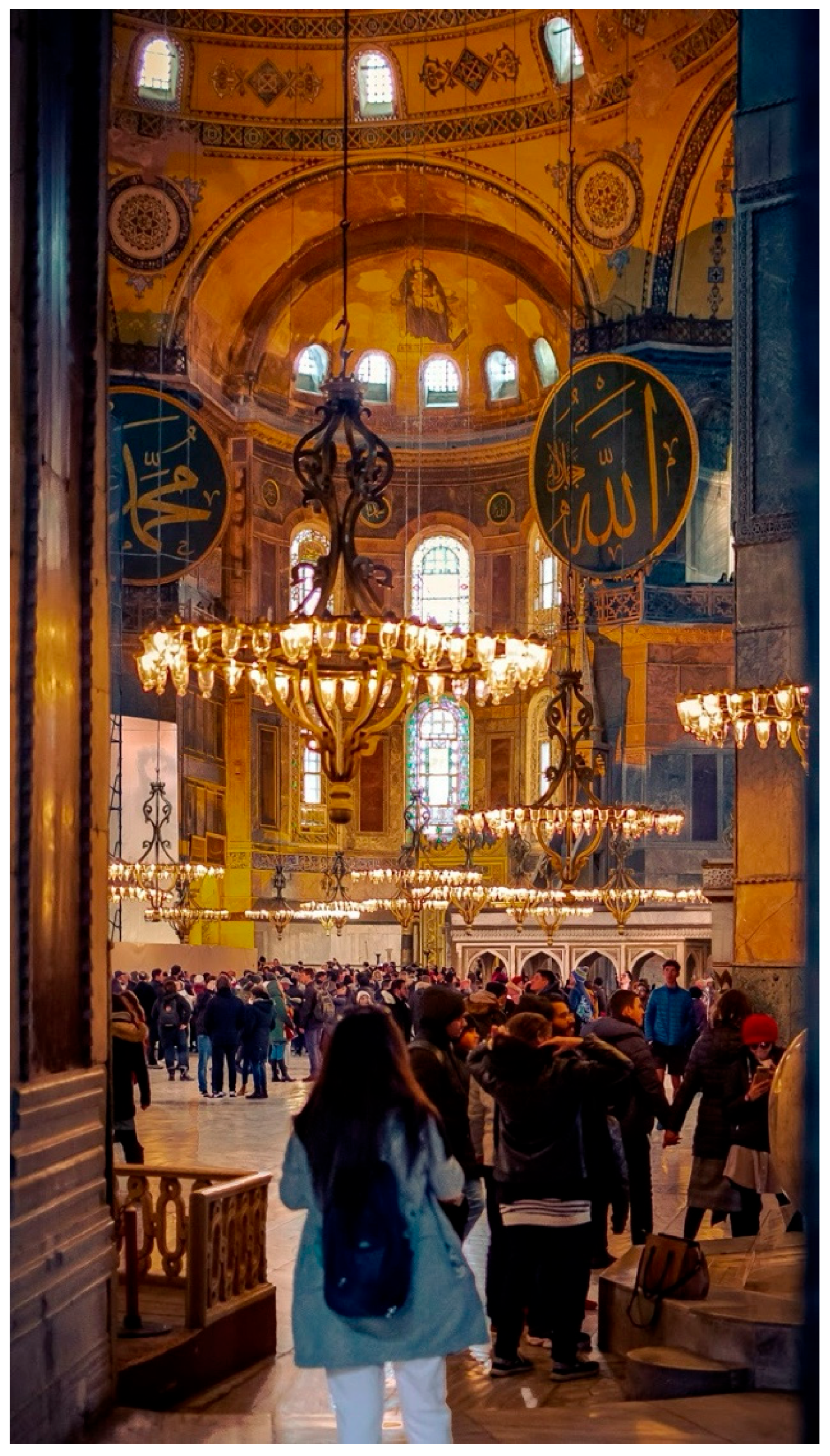
Building on the historical trajectory of iconography, this paper draws on Bissera V. Pentcheva’s The Sensual Icon: Space, Ritual, and the Senses in Byzantium, particularly her chapter on “Icons of Sound,” to emphasize the multisensory and relational dimensions of Byzantine icons (Pentcheva 2010, p. 45). Pentcheva highlights how the etymology of, sound, breath (pneuma), fire, and incense, was intertwined within liturgical practice, using the Hagia Sophia as a primary site where chant, movement, and ritual performance shaped both spiritual experience and social formation. Figure 3 depicts the interior of Hagia Sophia, where one can imagine the chorus (choros) coming alive, as Pentcheva describes, in performances that marked initiation into society, transitions into married life, and acts of propitiation and supplication (Pentcheva 2010, p. 46). The architecture, scripture reading, and orchestrated sensory environment created a communal relationship with faith, situating icons as central mediators of these interactions. Icons, in this framework, are fundamentally relational objects that emerge from the dynamic interplay among the iconographer, the sacred prototype, and the practicing community.
Figure 3.
Hagia Sophia Basilica, Istanbul, 27 July 2021. Photograph by Imad Alassiry.
The iconographer, through disciplined prayer, intentional authorship, and adherence to inherited visual and theological forms, seeks to render not merely a likeness but a spiritually faithful presence. This spiritual fidelity depends on rigorous training and ethical responsibility, which in turn grounds the community’s trust in the icon. The veneration of the icon is therefore not a solitary or purely aesthetic act; it is an enactment of communal continuity and shared knowledge, linking the faithful across generations. Ouspensky’s theology of the icon deepens this understanding by locating the icon within the disciplined governance of the senses that prayer requires. Drawing on St. Nilus of Mount Sinai, Ouspensky describes prayer as a conversation with God that demands the absence of passion and the rejection of external, worldly excitement and argues that this is precisely what the icon manifests (Ouspensky 1978, p. 210). The icon does not simply represent a holy figure; it orders the senses toward God. Following St. Anthony the Great, Ouspensky reminds us that evil enters the human soul through the five senses, which the Fathers call the doors of the soul, and that the icon functions as a guide for those senses, training the eyes to see with purity, the ears to hear in peace, and the heart to resist disorder (Ouspensky 1978, p. 211). By the image, the Church endeavors to help the faithful redeem a nature tainted by sin, not through aesthetic contemplation alone but through the bodily discipline of standing, seeing, and attending before a consecrated presence.
Incorporating Pentcheva’s insights into sound and multisensory engagement extends this argument further, demonstrating that the icon is experienced not only visually but also through a holistic penetration of body, space, and ritual. The Hodegetria procession, for instance, engaged the faithful through movement, chant, incense, and the physical proximity of the image moving through sacred and civic space (Pentcheva 2006, p. 109). Taken together, Ouspensky and Pentcheva illuminate a shared conviction: that the icon’s sacred authority is inseparable from its capacity to discipline and engage the whole person, body and soul, within a communally sustained ritual environment. This is precisely what algorithmic image generation cannot replicate. An AI-produced icon may satisfy the eye in isolation, but it has no capacity to order the senses, participate in ritual space, or serve as an instrument of the prayerful conversion Ouspensky describes. It enters through the doors of the soul without having been formed by the tradition that knows how to guard them.
AI-generated iconography fundamentally disrupts Pentcheva’s relational and sensory framework, and in doing so, it diminishes rather than enriches the religious plurality that defines Eastern Christian and broader cross-denominational traditions of sacred image-making. The geographical and devotional scope of these iconographic traditions spanning Orthodox, Catholic, Coptic, and other communions depends on the transmission of embodied knowledge, local material practice, and human intentionality across generations. As Berezhnaya argues, direct human contact with iconography is foundational to how sacred images accrue meaning, authority, and communal identity across these diverse traditions (Berezhnaya 2025, p. 13). AI image generation severs precisely this link. Drawing on Kate Crawford’s analysis in The Atlas of AI: Power, Politics, and the Planetary Costs of Artificial Intelligence, one observes a parallel between the historical practices of mass production in the eighteenth and nineteenth centuries and contemporary AI systems. Crawford argues that industrialist logics sought to control human time and labor, reducing engagement with festive, celebratory, and sensory-rich experiences in favor of mechanized output (Crawford 2021, p. 60). AI image generation replicates this paradigm: human labor is abstracted, sensory engagement with space and materiality is eliminated, and the iterative processes of craft, devotion, and communal participation are displaced. Where religious plurality is sustained through the distinctiveness of local iconographic practice, AI generation flattens these differences, producing images that are legible to algorithmic systems but detached from the doctrinal, liturgical, and communal contexts that give icons their sacred force. Because icons occupy doctrinal and liturgical roles, sacred image-making requires epistemic integrity.
The human maker must remain accountable for theological accuracy, stylistic coherence, and spiritual intentionality. These responsibilities ensure that the icon embodies truth-telling and mediates relationships among the maker, the prototype, and the community. AI-generated images, however, bypass this accountability: their production is determined by preexisting data scraping rather than spiritual or ethical consideration, and their outputs lack the relational grounding that sustains the authority of the icon. In this way, the mechanized, multisensory absence inherent in AI-generated iconography not only undermines ritual and communal participation but also severs the ethical and epistemic foundations essential to sacred visual culture.
AI-generated images fundamentally disrupt the relational and epistemic conditions that make icons meaningful. Because AI systems operate without authorship, responsibility, or theological understanding, they cannot sustain the bonds of trust that underlie sacred representation. Instead, they introduce significant risks: distorted features, stylistic inconsistencies, and careless appropriations of holy imagery. With no accountable maker behind the output, there is no guarantee of accuracy or coherence and no assurance that the depiction aligns with doctrinal norms. Delegating sacred representation to a machine raises grave ethical concerns, as it severs the relationships between artist and subject, image and community that allow icons to function as vessels of spiritual truth.
5. Liturgy and Communal Functions
Icons hold a central place in Christian worship, functioning not merely as decorative or illustrative images but as instruments of prayer, veneration, and communal devotion. In liturgical settings, they act as focal points that mediate the presence of the holy, guiding the faithful in contemplation and facilitating spiritual encounter. This mediating function rests on a distinction that Pavel Florensky articulates in their book Iconostasis: the difference between a face (litzo) and a countenance (lik). For Florensky, the countenance is not a portrait or artistic likeness motivated by compositional choice or aesthetic character; it is the material reality of a face conforming to the deepest tasks of its own essence, the visible manifestation of what Genesis distinguishes as the image of God, understood as the ontologically actual gift of God and the spiritual ground of each created person (Florenskiĭ 1996, pp. 51–52). Everything accidental, everything external to that essence, is swept away so that the face becomes a countenance: the hidden inheritance of sacred likeness made visible in flesh. The icon, on this account, does not represent a person so much as it reveals a countenance, the ontological reality of a being whose likeness to God has been actualized through spiritual formation. This is why the consecration of an icon, a ritual blessing performed by clergy, transforms it from a crafted object into a sacred vessel, ritually integrating it into the community’s worship life and affirming its participatory, relational character (Nicolaides 2014, p. 90).
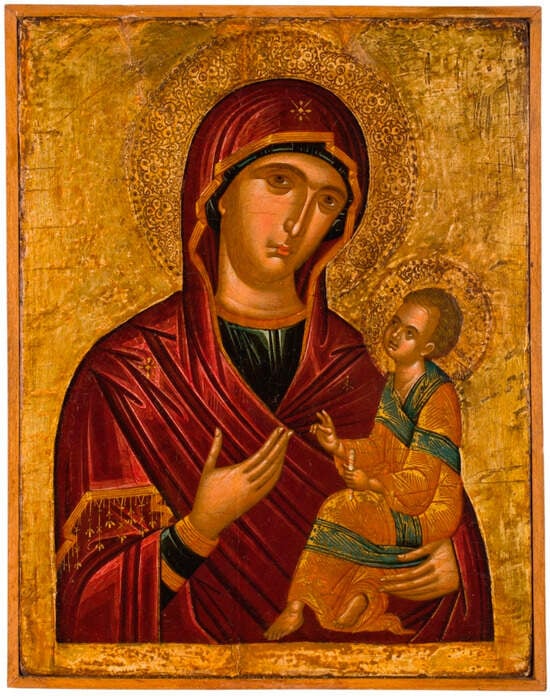
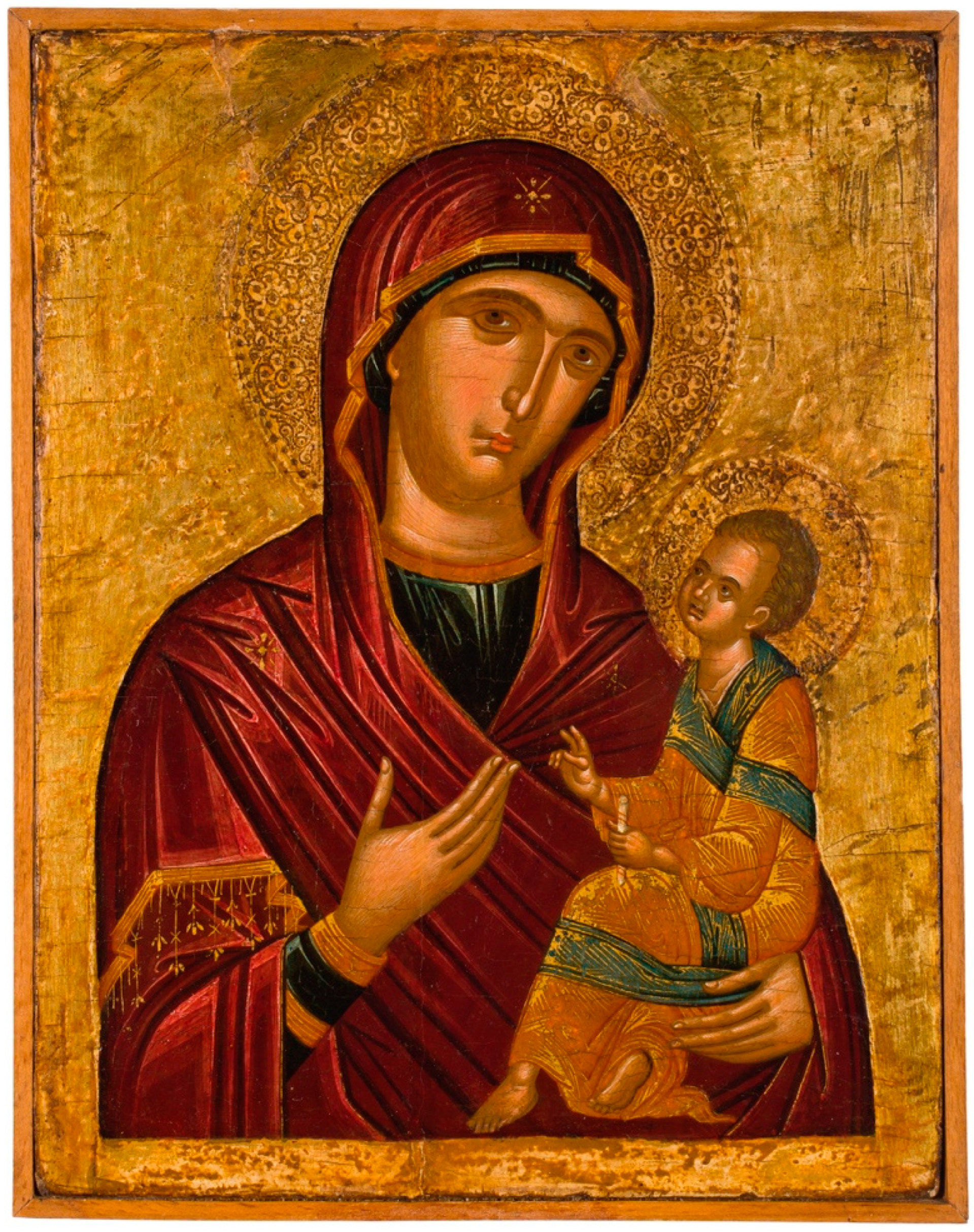
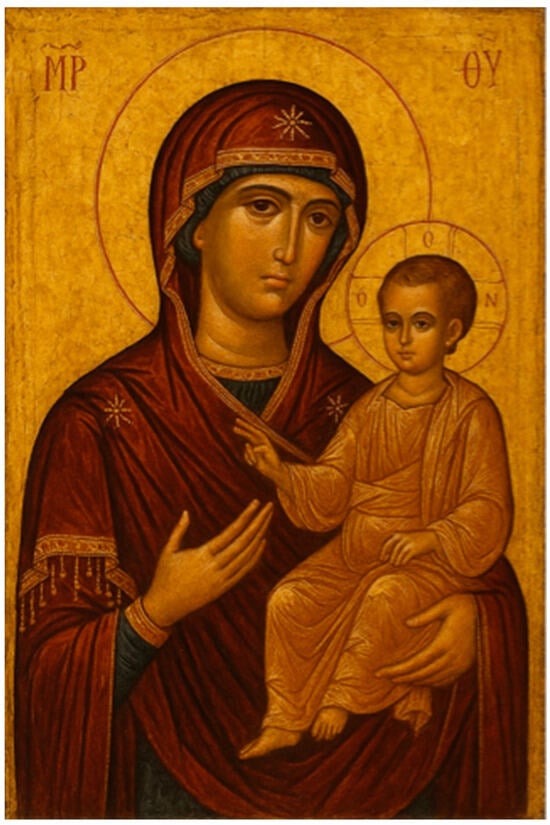
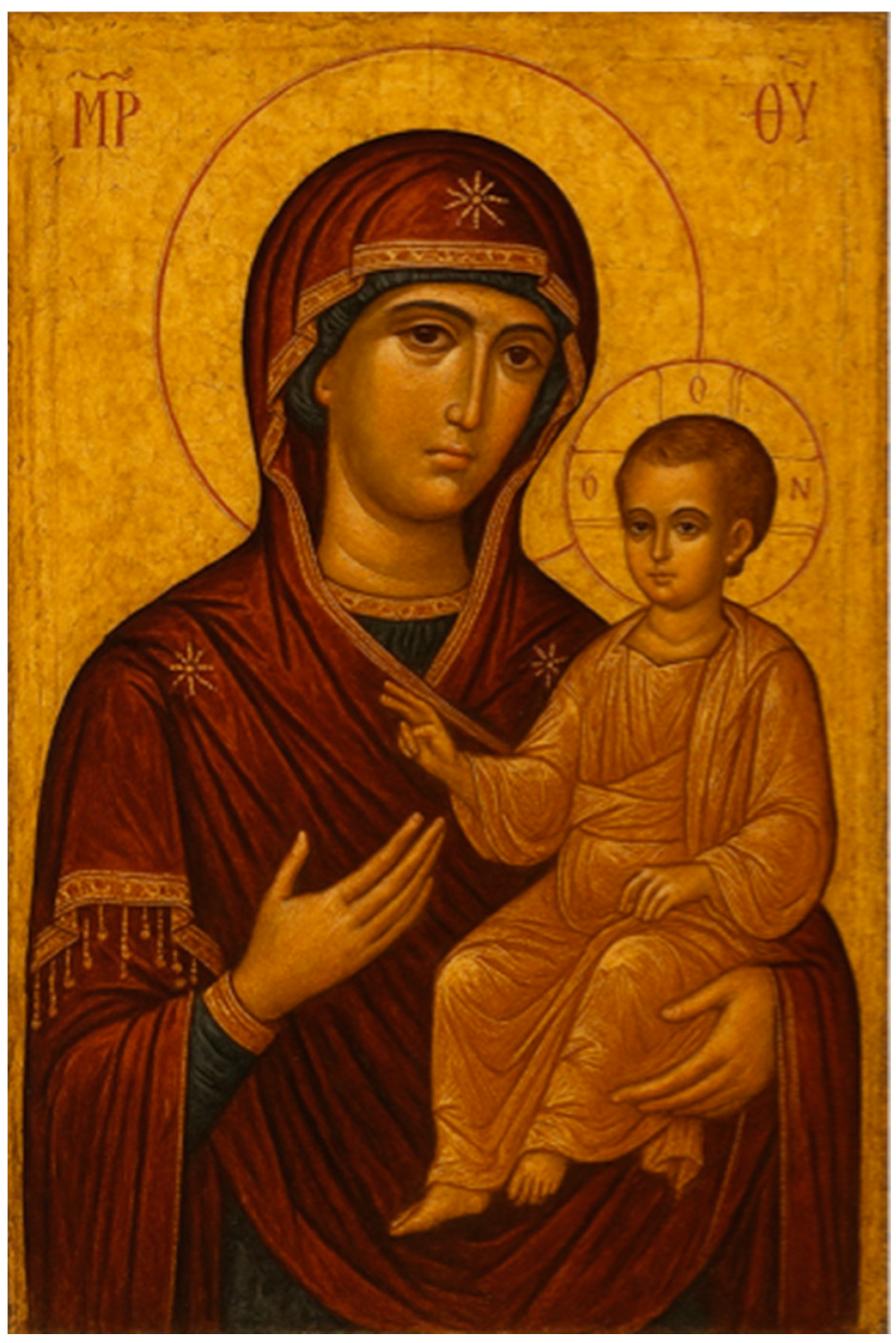
The Mother of God Hodegetria, a sixteenth-century icon produced in Crete and now preserved at the Icon Study Center in Massachusetts, exemplifies this dynamic, as shown in Figure 4. As Pentcheva emphasizes in Icons and Power: the Mother of God in Byzantium, the Hodegetria was central to commemorative rituals such as the Tuesday procession (Pentcheva 2006, p. 109), in which the image’s movement through public and sacred spaces enacted communal memory, reinforced devotional hierarchies, and projected both spiritual and imperial authority. Marian icons more broadly occupy a distinctive theological and political position: they mediate access to the divine while signaling imperial connections, linking local piety to the symbolic power of the state and ecclesiastical hierarchy. What the Cretan Hodegetria makes present, in Florensky’s terms, is not Mary’s face as an artistic likeness but her countenance, the ontological reality of a person whose image of God has been incarnated and revealed. The AI-generated Hodegetria in Figure 5, by contrast, can reproduce the face but not the countenance. It assembles visual markers, drapery, inscription, and compositional orientation, without access to the ontological ground those markers are meant to disclose. Where the human-made icon sweeps away the accidental to reveal the essential, the algorithmic image has only the accidental, the surface syntax of a tradition it cannot inhabit.
Figure 4.
Mother of God Hodigitria, early 16th century. Anonymous. Crete, Greece. Egg tempera on wood, 27.5 × 21 cm. Icon Museum and Study Center, Clinton, MA, USA. Museum purchase, Gordon B. Lankton Collections Fund (Inv. R2023.05.1).
Figure 5.
Can you create a Byzantine Hodegetria icon? 16 November 2025. ChatGPT (version 5.1). Image generated by the author using OpenAI’s DALL·E model, 2025. https://chat.openai.com.
Figure 5, showing an AI-generated Hodigitria created through ChatGPT 5.1, visually echoes the sixteenth-century prototype, reproducing compositional elements such as the frontal bust, hand gestures, and solemn gaze. On the surface, this replication suggests continuity with traditional iconography, yet the AI-generated image lacks the liturgical, communal, and performative dimensions that define the Hodigitria’s power. It cannot participate in commemorative services, be consecrated, or guide collective devotion. The ritual, auditory, and spatial experiences that Pentcheva identifies, chant, incense, processional movement, and interaction with sacred architecture, are virtually absent, severing the image from the embodied, relational networks through which meaning is historically and socially produced. While AI can reproduce the visual syntax of Marian iconography, it cannot instantiate the ethical, spiritual, or communal responsibilities inherent in the iconographic tradition, thereby highlighting the essential distinction between the image as aesthetic object and the icon as an active mediator of devotion, authority, and collective memory.
Henry Maguire uses the concept of “code enabling” to explain how saints were recognized in Byzantine icons. In The Icons and Their Bodies, Maguire notes that recognition depended on shared visual and textual conventions, including costume, attributes, portrait types, and inscriptions (Maguire 1996, p. 42). This codified system ensured that images were legible within their doctrinal, liturgical, and communal contexts; without it, even visually sophisticated works could fail to communicate sacred meaning. This failure is vividly illustrated by the reaction of the sixteenth-century cleric Gregory Melissenos at the Council of Ferrara, who remarked the following:
“When I enter a church of the Latins, I do not revere any of the [images of] saints that are there, because I do not recognize any of them. At the most, may recognize Christ, but I do not revere Him either, since I do not know how he is inscribed. But I make my own [sign of] the cross and revere it. I revere the cross that I make myself, and not anything else that I see there.”(Maguire 1996, p. 46)
Melissenos’s response makes clear that lifelike realism alone was insufficient to elicit reverence, since it lacked the inscriptions, attributes, and symbolic cues that anchored recognition and devotion within Orthodox visual culture. Code enabling, therefore, is not merely an aesthetic principle but a theological, social, and ethical framework that structures how sacred images mediate relationships among the maker, the prototype, and the faithful people.
Applying this concept to AI-generated icons, such as the ChatGPT-produced Mother of God Hodegetria in Figure 5, reveals a critical tension between visual legibility and transcendental incapacity. At first glance, the AI image reproduces familiar visual markers: the orientation of Mary, the red drapery of her robes, the saintly inscriptions, and other compositional elements are recognizable, demonstrating a superficial fidelity to canonical prototypes. Yet closer observation reveals its distinctly digital character: brushstrokes are algorithmic and contours unnaturally smooth, and textures lack the subtle irregularities of human handwork. This is not merely an aesthetic deficiency but a phenomenological one. As the phenomenological framework makes clear, human consciousness engages transcendental realities not through abstract observation but through immersion in the flux of the life-world itself, where noemata such as joy, guilt, shame, forgiveness, doubt, and abiding peace constitute the very texture of lived experience (Perrin and Jastrzębski 2025, p. 338). The iconographer does not stand outside of place and time to produce an image; they bring to the work a consciousness already shaped by these realities, and it is that formation which the icon makes visible. An AI system has no life-world, no noemata, and no capacity to engage the transcendental dimensions of human existence. It can replicate the visual syntax of grief or tenderness but has never known either. Unlike a human-made icon, the AI-generated image is not embedded in the labor, prayer, and intentionality of historically grounded recognition, and without that grounding it cannot mediate relational networks, participate in ritual, or convey spiritual authority through consecrated presence. What appears on the surface as iconographic fidelity is, at the level of meaning, an absence.
It is just one artificial intelligence image: what is the big deal? Moving from historical and theological frameworks to contemporary considerations, the question of what counts as “real” and “virtuous” becomes central to evaluating AI-generated imagery. As pronounced by Aristotle on the nature of deliberation in Eudemian Ethics II.10, “A man who deliberates always deliberates for some purpose and always has an aim in view: in deliberating he is inquiring what is useful towards that aim (Aristotle 2011, 1227a5-9).” Human iconographers, in contrast to algorithms, create with a deliberate aim: every gesture, color, and inscription is oriented toward a spiritual, communal, and ethical end. AI-generated images, however, lack an intentionality. Who makes the image? The system may reproduce recognizable visual markers, but without an aim grounded in liturgical, devotional, or relational purpose, the model cannot participate in the moral, epistemic, or spiritual networks that historically defined the authority and efficacy of icons. In this sense, assessing AI-generated iconography requires asking not only whether it “looks” like an icon but also whether it can fulfill the end that gives human-made icons their values and ethics.
Unlike human-made icons, which are grounded in embodied craft, liturgical practice, and relational accountability, AI-generated images are produced by algorithmic systems that abstract human labor and displace traditional notions of creation and authenticity. At the heart of this concern is a principle that iconographic traditions have long upheld: only a person can depict a person. The making of sacred images is not merely a technical act but a relational one, requiring the iconographer’s own humanity as the instrument of representation. When that human presence is removed, something theologically and artistically irreplaceable is lost.
The theological justification for sacred image-making did not emerge fully formed in the eighth century. Its roots extend into an earlier stratum of Christian thought, one in which the defense of the icon was still closely tied to the authority of prophetic scripture rather than to the philosophical abstractions that would characterize later Byzantine formulations. Among the earliest surviving treatises to engage this question systematically is the seventh century Armenian text Against the Iconoclasts, attributed to Vrtanēs K’ert’oł, which predates John of Damascus by more than a century (Mathews 2009, p. 105). Writing within a tradition of florilegia, Vrtanēs does not yet possess the theoretical architecture of the Damascene, but he articulates something equally significant: a scriptural logic of visual testimony in which the painted image is understood as the natural heir to the prophetic word. For Vrtanēs, the prophets did not merely predict events but rendered them present through symbolic narration, and the icon continues that same work in a different medium. The image is not a departure from scripture but its fulfillment in visible form. It is within this framework that Vrtanēs writes the following:
“God is certainly not the images and the paintings, but rather we paint these in the name of God, just as He made them manifest earlier in words. As Isaiah described the Nativity, and Jeremiah the going forth among the people, and David the Passion and the Burial, and Ezekiel and Hosea the Resurrection, and Daniel and Zachariah the Second Coming, and Nahum and Malachi the Judgement, because they narrated the events to us in symbols. And the icon is as the event was, it is as it shall be, and we paint the same as that which is written in the scriptures.”(Mathews and Muller 2016, p. 209)
Vrtanēs’s insistence that the icon is as the event was and as it shall be locates sacred image-making within a continuous chain of embodied witness, one that moves from prophetic word to painted surface through human hands formed by devotion and communal practice. It is precisely this chain that contemporary structures of technological development threaten to sever. Kate Crawford’s analysis in The Atlas of AI demonstrates how AI development is embedded within broader structures of exploitation and institutional control, redirecting the labor, resources, and creative capacity of human communities toward systems that serve military and corporate power rather than cultural or spiritual life. Crawford identifies Project Maven, initiated by the U.S. Department of Defense in April 2017, as a critical example in which AI and machine learning were integrated into battlefield operations, enhancing algorithms for drones, satellites, and surveillance systems (Crawford 2021, p. 189). This initiative did not simply advance technological capability; it catalyzed a competitive bidding sprint among Alphabet Inc., Amazon, and Microsoft, effectively transforming AI development into a commodified and militarized labor environment (Crawford 2021, p. 190). When political bodies direct resources toward AI for warfare, surveillance, and resource management, the displacement of skilled labor from traditional craft disciplines is not incidental but structural. The same systems that automate targeting and surveillance are the systems that displace the iconographer, the weaver, and the artisan. Where Vrtanēs understood image-making as an act of testimony requiring a human witness, these structures progressively eliminate the conditions under which such witness is possible.
This raises a deeper question about institutional accountability and the democratic capacity to create. Even as the U.S. Department of Defense established broad principles for AI use by 2020, the framework remained oriented toward the exercise of power rather than ethical restraint (Troath 2025, pp. 67–69). The ongoing characterization of an “AI arms race” (Pellerin 2017) signals that the trajectory of these technologies is being determined not by communities of practice or devotional traditions but by geopolitical competition. For iconographic traditions that depend on the slow transmission of embodied skill across generations, this represents not merely a cultural disruption but a civilizational one. The question is not only who controls the image but whether the conditions for human image-making can survive within an infrastructure increasingly governed by militarized and corporate imperatives.
These infrastructural conditions carry their own material consequences. The rapid expansion of data centers to support AI models produces environmental costs that extend far beyond abstract technological debates. Recent research indicates that data centers in the United States accounted for more than 105 million metric tons of carbon dioxide emissions in the twelve-month period ending in August 2024, roughly triple earlier estimates from 2018 and representing approximately 2.18 percent of total U.S. emissions (Guidi et al. 2024, p. 12). Approximately 56 percent of the electricity consumed by these facilities came from fossil fuel-burning power plants and 16 percent from coal, including from companies that have publicly pledged environmental sustainability initiatives (Guidi et al. 2024, pp. 12–13). Data centers also place disproportionate burdens on local water resources for cooling systems, further stressing regional ecosystems and human communities (Valdivia 2025, p. 2120). The same expansion of AI infrastructure that displaces skilled human labor also extracts from the land, concentrating environmental harm in ways that are anything but evenly distributed. This pattern of extraction without accountability is not merely an operational failure; it reflects a deeper absence of what Aristotle would recognize as deliberate, goal-directed action oriented toward the good.
In returning to Aristotelian writings, philosophy scholar Ursula Coope analyzes that deliberation is always oriented toward action: one does not deliberate merely to reflect but to determine the best course of action within one’s power, ceasing only when a goal is unattainable (Coope 2021, pp. 172–73). In the analogy of shipbuilding that Aristotle employs to illustrate craft deliberation (techne), the shipbuilder deliberates to bring a ship into being (Aristotle 2011, 1112b24–26). This framework illuminates the human–icon relationship, in which creating an icon is not a passive or accidental act but a goal-directed, intentional practice. Like a shipbuilder, the iconographer’s every brushstroke, choice of color, and inscription is guided toward mediating the recognition of the prototype and fostering devotional engagement. By contrast, AI-generated images and the decisions of large corporate stakeholders often lack this grounded deliberation. While AI can replicate visual forms, it does not aim toward ethical, relational, or spiritual ends, and corporate decisions about energy-intensive data centers may prioritize profit or efficiency over environmental stewardship. The parallel highlights a crucial question: are the “goals” of AI production aligned with what is beneficial in a broader, ethical sense? Just as craft deliberation produces tangible objects with intentional ends, human iconography produces images capable of relational, theological, and ethical effects, effects that cannot be realized by digital generation without embodied, goal-directed engagement.
6. Conclusions
AI-generated icons lack human essence, and it is worth naming precisely what that means. In reference to Boethius’s Theological Tractates: Contra Eutychen et Nestorium, in which he defines a person as “an individual substance of rational nature” (Boethius 1973, p. 85). This definition is not incidental to the question of image-making. If personhood is constituted by rational individuality, then only a person, endowed with reason, will, and relational accountability, can perform the kind of voluntary, goal-directed act that iconographic tradition demands. An algorithmic system, however sophisticated its outputs, possesses no rational nature in the Boethian sense: no substance, no interiority, and no capacity for the deliberate, ethically oriented action that transforms painted matter into sacred witness.
This understanding finds its deepest theological expression in St. Maximus the Confessor’s account of the synergy between God and man, as interpreted by Schönborn. Freedom, Schönborn argues, is not a gift added to a nature that already exists but is constitutive of human nature itself: whereas in beings not endowed with reason nature directs, in man it is directed, since he is moved by the self-determination of his will (Schönborn 2003, pp. 127–28). It is this freedom that makes genuine cooperation between God and man possible at all. The iconographer participates in that synergy precisely because they are free and accountable. Lacking rational nature and self-determination, an AI system cannot enter into this cooperation; it can produce a likeness but cannot bear witness, replicate a form but cannot offer it. The icon is therefore not simply a skilled artifact but an act of free human cooperation with the divine.
This paper argued that AI-generated religious imagery cannot fulfill the theological, historical, and ethical criteria that the Christian iconographic tradition has historically required of sacred images. From the early Christian struggle to depict the divine through the doctrinal stabilization of the icon in the sixth century, icons emerged as relational, multisensory, and communally authorized objects grounded in embodied labor, liturgical performance, and theological accountability. Drawing on Cormack, Barber, Pentcheva, and Maguire, this study demonstrated that icons operate through code-enabled recognition, sensory participation, and ritual consecration. These are conditions of iconicity that algorithmic image generation is structurally incapable of meeting, not because communities have uniformly rejected AI-generated imagery but because the criteria themselves presuppose a human maker capable of voluntary, accountable, and relationally embedded action. While generative AI systems can mimic the visual syntax of Marian iconography such as the Hodegetria, they cannot satisfy the epistemic and relational requirements between maker, prototype, and community that define sacred authority within this tradition. Crawford’s analysis further demonstrates that AI production is embedded in extractive labor practices, militarized infrastructures, and environmentally damaging data center expansion that disproportionately harms vulnerable communities, deepening the incompatibility between AI-generated images and the icon’s function as a truthful mediator of presence. Generative iconography reproduces form without participation, likeness without accountability, and visibility without communion. In doing so, it clarifies rather than extends the necessity of embodied, communal, and ethically grounded image-making within the Christian iconographic tradition and reminds us that what is at stake in the defense of the icon is not aesthetic preference but the irreducible dignity of the person who makes it.
Funding
This research received no external funding.
Institutional Review Board Statement
Not applicable.
Informed Consent Statement
Not applicable.
Data Availability Statement
Data are contained within the article.
Acknowledgments
During the preparation of this manuscript, the author used ChatGPT, version 5.1, for the purposes of generating an icon. The author has reviewed and edited the output and takes full responsibility for the content of this publication.
Conflicts of Interest
The author declares no conflicts of interest.
Abbreviations
The following abbreviations are used in this manuscript:
| AI | Artificial intelligence |
| GenAI | Generative artificial intelligence |
| US DoD | United States Department of Defense |
References
- Aristotle. 2011. The Eudemian Ethics. Edited by Anthony Kenny. Oxford: Oxford University Press. [Google Scholar]
- Barber, Charles. 2002. Figure and Likeness: On the Limits of Representation in Byzantine Iconoclasm. Princeton: Princeton University Press. [Google Scholar]
- Berezhnaya, Liliya, ed. 2025. Icons In-Between: Eastern Christian Art from Border Areas (Belarus, Ukraine, Romania, Western Balkans, Greece). Cooperated with Lutz Rickelt. Recklinghausen: EIKON. [Google Scholar] [CrossRef]
- Boethius. 1973. Theological Tractates: Contra Eutychen et Nestorium. Translated by Hugh Fraser Stewart, Edward Kennard Rand, and S. Jim Tester. Loeb Classical Library. Cambridge: Harvard University Press. [Google Scholar] [CrossRef] [Scilit]
- Common English Bible. 2011. Common English Bible. Available online: http://www.commonenglishbible.com (accessed on 6 April 2026).
- Coope, Ursula. 2021. Aristotle on Nature, Deliberation, and Purposiveness. In Ancient Ethics and the Natural World. Edited by Barbara M. Sattler and Ursula Cope. Cambridge: Cambridge University Press, pp. 164–82. [Google Scholar]
- Cormack, Robin. 2007. Icons. London: British Museum Press. [Google Scholar]
- Crawford, Kate. 2021. Atlas of AI: Power, Politics, and the Planetary Costs of Artificial Intelligence. New Haven: Yale University Press. [Google Scholar] [CrossRef] [Scilit]
- Florenskiĭ, Pavel Alexandrovich. 1996. Iconostasis. Crestwood: St. Vladimir’s Seminary Press. [Google Scholar]
- Guidi, Gianluca, Francesca Dominici, Jonathan Gilmour, Kevin Butler, Eric Bell, Scott Delaney, and Falco J. Bargagli-Stoffi. 2024. Environmental Burden of United States Data Centers in the Artificial Intelligence Era. arXiv arXiv:2411.09786. [Google Scholar] [CrossRef] [Scilit]
- Herzfeld, Noreen. 2024. Is an AI-Generated Icon an Icon? A Case Study in Artificial Intelligence and Christian Spirituality. Spiritus 24: 281–94. [Google Scholar] [CrossRef] [Scilit]
- John of Damascus. 2003. Three Treatises on the Divine Images. Translated by Andrew Louth. Crestwood: St. Vladimir’s Seminary Press. [Google Scholar]
- Maguire, Henry. 1996. The Icons of Their Bodies: Saints and Their Images in Byzantium. Princeton: Princeton University Press. [Google Scholar]
- Mathews, Thomas F. 2009. Vrt’anēs K’ert’oł and the Early Theology of Images. Revue des Études Arméniennes 31: 101–26. [Google Scholar] [CrossRef] [Scilit]
- Mathews, Thomas F., and Norman E. Muller. 2016. The Dawn of Christian Art in Panel Paintings and Icons. Malibu: Getty Museum. [Google Scholar]
- Nicolaides, Angelo. 2014. The Seventh Ecumenical Council and the Veneration of Icons in Orthodoxy. Acta Theologica 34: 77–93. [Google Scholar] [CrossRef] [Scilit]
- Ouspensky, Léonide. 1978. Theology of the Icon. Crestwood: St. Vladimir’s Seminary Press. [Google Scholar]
- Pellerin, Cheryl. 2017. Project Maven to Deploy Computer Algorithms to War Zone by Year’s End. US Department of Defense, July 21. Available online: https://www.war.gov/News/News-Stories/Article/Article/1254719/project-maven-to-deploy-computer-algorithms-to-war-zone-by-years-end/ (accessed on 6 April 2026).
- Pentcheva, Bissera V. 2006. Icons and Power: The Mother of God in Byzantium. University Park: Pennsylvania State University Press. [Google Scholar]
- Pentcheva, Bissera V. 2010. The Sensual Icon: Space, Ritual, and the Senses in Byzantium. University Park: Pennsylvania State University Press. [Google Scholar]
- Perrin, David B., and Andrzej K. Jastrzębski. 2025. Spirituality, Being-Human, and Artificial Intelligence. Spiritus 25: 322–44. [Google Scholar] [CrossRef] [Scilit]
- Samo, Andrew, and Scott Highhouse. 2025. Artificial Intelligence and Art. Psychology of Aesthetics, Creativity, and the Arts 19: 1084–98. [Google Scholar] [CrossRef] [Scilit]
- Schenk, Kära L. 2010. Temple, Community, and Sacred Narrative in the Dura-Europos Synagogue. AJS Review 34: 195–229. [Google Scholar] [CrossRef] [Scilit]
- Schönborn, Christoph. 2003. L’Icône du Christ: Fondements Théologiques. Paris: Cerf. [Google Scholar]
- Talbot, Alice-Mary Maffry. 1998. Byzantine Defenders of Images: Eight Saints’ Lives in English Translation. Washington, DC: Dumbarton Oaks Research Library and Collection. [Google Scholar]
- Tollefsen, Torstein Theodor. 2018. St Theodore the Studite’s Defence of the Icons: Theology and Philosophy in Ninth-Century Byzantium. Oxford Early Christian Studies. Oxford: Oxford University Press. [Google Scholar] [CrossRef] [Scilit]
- Troath, Sian. 2025. Trusting Technology to Wage War: The Politics of Trust and Ethics in the Development of Robotics, Autonomous Systems, and Artificial Intelligence. Critical Military Studies 11: 59–77. [Google Scholar] [CrossRef] [Scilit]
- Turing, Alan. 2004. Intelligent Machinery. In The Essential Turing. Edited by Brian Jack Copeland. Oxford: Oxford University Press. First published 1948. [Google Scholar] [CrossRef] [Scilit]
- Valdivia, Ana. 2025. The Supply Chain Capitalism of AI: A Call to (Re)think Algorithmic Harms and Resistance through an Environmental Lens. Information, Communication & Society 28: 2120–41. [Google Scholar] [CrossRef] [Scilit]
Disclaimer/Publisher’s Note: The statements, opinions and data contained in all publications are solely those of the individual author(s) and contributor(s) and not of MDPI and/or the editor(s). MDPI and/or the editor(s) disclaim responsibility for any injury to people or property resulting from any ideas, methods, instructions or products referred to in the content. |
© 2026 by the author. Licensee MDPI, Basel, Switzerland. This article is an open access article distributed under the terms and conditions of the Creative Commons Attribution (CC BY) license.