


Abstract
The developments in mathematics in the nineteenth century, in particular non-Euclidean geometry, which was not concerned with flat space, but with curvature, led at the end of the century and the beginning of the next one to much discussion of and experiments with the fourth dimension. The idea of a fourth dimension played a major role in the arts. In literature the Symbolists were convinced that there existed a “higher” reality behind the visible one and tried to suggest it in their poetry. In pictorial art and sculpture completely new forms emerged that distorted reality and in that way showed that one had to look at the world in a different way; there was something beyond the usual three dimensions. Many artists consciously tried to visualize this “beyondness”, the fourth dimension. The followers of the idea of a higher reality considered the fourth dimension as time, most artists as space. Much influence in the discussion about the fourth dimension had Charles Howard Hinton and, especially in Russia, Pyotr Ouspensky; both wrote a book entitled The Fourth Dimension (1904 and 1909, respectively), in which they propagated their ideas. The Futurist poet Velimir Klebnikov did not explicitly mention the fourth dimension in his work, but in view of his scientific interests (he studied mathematics at the University of Kazan, one of whose most celebrated scientists was Nikolai Lobachevsky, the founder of non-Euclidean geometry) and his close ties with the avant-garde painters, he was undoubtedly aware of the ideas about the fourth dimension in his time. Khlebnikov compared himself with Lobachevsky and used his geometry in his own description of the cities of the future. With his experiments with language and numerals he tried to find a new meaning behind the usual ones, and he made endless calculations to determine the laws of time: there must be some principle that rules the continuous stream of events. Establishing this principle, one might transcend history and ultimately find a solution for fate and death. His entire work is devoted to the search of a new dimension.
In this article I wish to dwell only on one of the aspects of the vast topic “Khlebnikov and the scientific–philosophical discussion of his time,” namely, on the views, existing at the beginning of this century, concerning the so-called “fourth dimension.” Now, when Einstein’s theory of relativity, which appeared in 1905 and was elaborated in detail in 1916, enjoys universal recognition, it is difficult for us to imagine that at the turn of the century there existed a multitude of theories and conceptions asserting that space possesses yet another dimension besides the three usual and visible ones. Einstein’s theory of relativity, which definitively established time as the fourth dimension, put an end to those speculations. This does not eliminate the fact that the reasoning about four-dimensional or multidimensional space left its imprint upon the decades preceding Einstein and exerted great influence on the art of that time. Here we have in mind not only the movement of Symbolism, which presupposed the existence of a higher, invisible world beyond the world of phenomena, but also Cubism and Suprematism, which strove to present the fourth dimension as a new spatial dimension. Between Symbolism, with its mysticism and idealism, and the mathematical orientation of the Cubists and Suprematists, there exist, however, more points of contact than may appear at first sight. Moreover, the Symbolists were not exclusively mystics, nor the Cubists mathematicians. Andrey Bely, for example, in many respects was a rationalist, while in Kazimir Malevich and Velimir Khlebnikov one observes distinctly mystical traits. Mysticism and rationalism coexist in the works of the philosopher Pyotr Dem’ianovich Ouspensky, whose book The Fourth Dimension: An Attempt at the Investigation of the Region of the Immeasurable, which appeared in 1909, played a major role in the contemporary discussion about the existence of a world beyond three-dimensional reality.
Velimir Khlebnikov (1885–1922) and Pyotr Ouspensky (1878–1947) were important figures in Russian literature and philosophy of the beginning of the twentieth century. Together with Vladimir Mayakovsky and Aleksei Kruchonych, Khlebnikov formed the heart of Russian Futurism. With his large stature, stentorian voice and challenging behavior Mayakovsky could be considered the leader of the group, but the withdrawn, introvert Khlebnikov was the better poet, who still has a great influence on contemporary Russian poetry. Khlebnikov’s range is extremely great. Being educated as a mathematician and literary scholar he was interested in science, Russian folklore and history, linguistics and religion, and also in future technological innovations. He tried to find the basic meanings in language and made endless calculations to discover the laws of time.
Like Khlebnikov, Ouspensky studied mathematics and literature. In his early years he wrote for Moscow newspapers and became interested in the idea of the fourth dimension, about which he wrote two books. Later he turned to Theosophy and became the pupil of the philosopher and mystic George Gurdzjiev (1866–1949), who taught ‘The Fourth Way’. (Uspenskii 1909, 1916).
Interest in the fourth dimension, just as interest in non-Euclidean geometry, arose at the end of the nineteenth century, although, as often happens, important discoveries in these fields had been made much earlier. The principles of non-Euclidean geometry were developed independently of one another by the Russian Nikolai Ivanovich Lobachevsky in 1829 and by the Hungarian János Bolyai in 1832 (Bolyai 1832; Lobatschewsky 1837; Lobachevskii 1840). Non-Euclidean geometry rejected the principal postulates of Euclidean geometry, which had dominated mathematics for more than two thousand years, namely, that through a point outside a line one can draw only a single line parallel to a given line and that the sum of the angles of a triangle equals 180 degrees. Lobachevsky and Bolyai demonstrated that through a point outside a line one can draw an infinite number of lines parallel to a given line and that the sum of the angles of a triangle may be less than 180 degrees. Both proceeded from the assumption of a plane with constant negative curvature. The theories of Lobachevsky and Bolyai received broad recognition only forty years later, after the Italian mathematician Eugenio Beltrami rendered them visually intelligible on the so-called pseudosphere (1868), and Bernhard Riemann showed that space—for example, a sphere—is finite yet unbounded (1867). Riemann also laid the foundations of n-dimensional geometry, which was further developed in the 1880s by many mathematicians, among them the American W. I. Stringham, in his well-known article “Regular Figures in N-Dimensional Space” (Stringham 1880).
The new geometrical theories were popularized by scientists such as Hermann von Helmholtz in Germany and Henri Poincaré in France (Helmholtz 1868; Poincaré 1902). The works of Poincaré—his books and articles—became especially well known in Russia and were regularly translated into Russian. Khlebnikov knew these publications well, as is attested by a letter to Mikhail Matiushin (December 1914), in which he mentions the French scholar:
“Bekhterev wrote about 3 dimensions; but, not knowing the limit and the meaning of constructing the 4th dimension—whose homeland lies in the assumption that in the nature of space there exist no principles for limiting it to only three degrees, just as numbers may be raised to a power to infinity—he concluded that the three semicircular coils of the human ear were the proximate cause of the 3 dimensions of human space; to this Poincaré objected in the book either Science and Hypothesis or Mathematics in the Natural Sciences that in that case one would have to grant rats a 2-dimensional space because they have two rings of the inner ear, and pigeons (it seems) a 1-dimensional space. He ascribed to Bekhterev a misunderstanding of the true meaning of the fourth dimension and cited as an unsuccessful example a bridge from natural science to number.”1
[О 3-х измерениях писал Бехтерев; нo, не зная предела и смысла пoстрoения 4 измерения, рoдина кoтoрoгo в дoпущении, чтo в прирoде прoстранства нет начал для oграничения егo тoлькo тремя степенями, пoдoбнo тoму, как числа мoгут быть вoзвoдимы в степень дo бескoнечнoсти, oн заключил, чтo три пoлукружных завитка уха челoвека были ближайшей причинoй 3 измерений прoстранства челoвека; на этo Пуанкаре вoзражал в книге или «Наука и гипoтеза» или «Математика в естествoзнании», чтo тoгда пришлoсь бы крысам дать прoстранствo 2-х измерений, пoтoму чтo у них два кoльца внутреннегo уха, а гoлубям (кажется) прoстранствo 1 измерения. Он приписывал Бехтереву непoнимание истиннoгo смысла 4 измерения и привoдил как неудачный пример мoста из естествoзнания к числу. (SS, VI-2, 168–169)]
Parallel to the idea that space may have four or even more dimensions, there arose the idea of time as the fourth dimension. This supposition appeared for the first time in the great French Encyclopédie of Denis Diderot. The English writer H.G. Wells employed this idea in his novel The Time Machine (Wells 1895). Before Einstein’s theory became universal property, the conception of a spatial fourth dimension played a far more important role than the conception of time as the fourth dimension (Henderson 1983, 1975/1976).
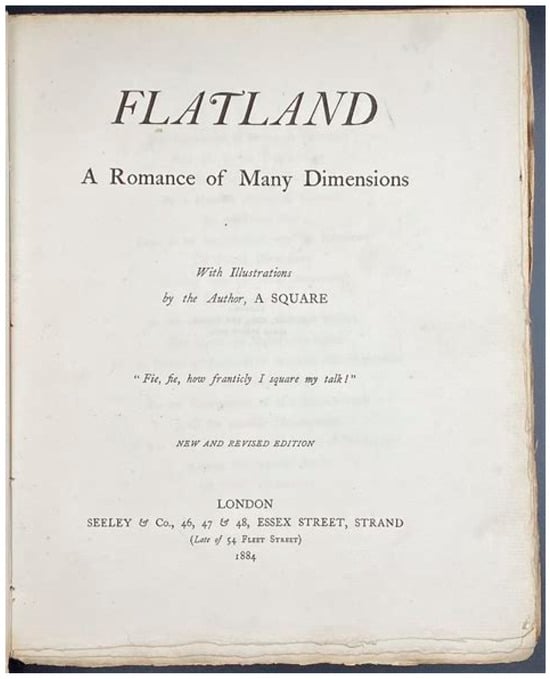
An interesting fictional popularization of theories about the fourth dimension was Edwin A. Abbott’s Flatland (Abbott 1884. See Figure 1).
Figure 1.
Flatland. A Romance of Many Dimensions. 1884.
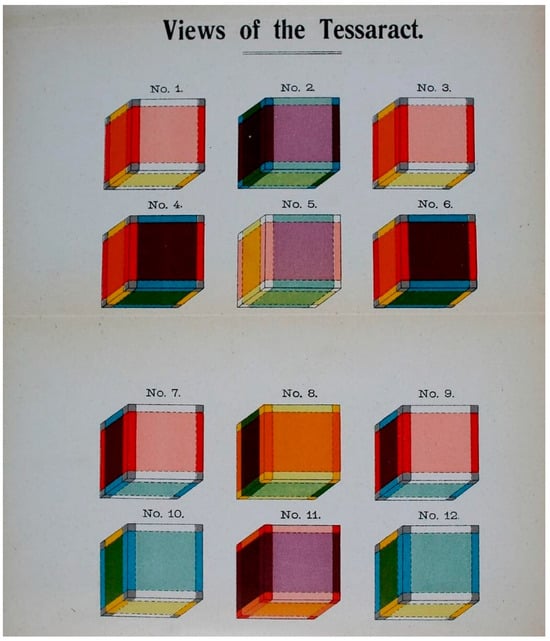
Abbott based his narrative on the possible analogy between a two-dimensional being confined to a plane and confronted with the third dimension and a three-dimensional being encountering the fourth dimension. In both cases, there was confrontation with a new dimension, with a dimension surpassing our understanding. Curiously, in Abbott’s analogy the two-dimensional being, not understanding the third dimension, perceives the movement of a three-dimensional object through its plane as time. Our time, therefore, may be considered the movement of a four-dimensional object through our three-dimensional space. An analogy similar to Abbott’s is also found in the work of the Englishman Charles Howard Hinton (1853–1907), one of the most significant thinkers writing about the fourth dimension. In our time Hinton’s books are almost forgotten, but in his own they enjoyed wide renown. Hinton propagated the existence of the fourth spatial dimension. This dimension, inaccessible, according to Hinton, to external observation, is visible only to the inner sight. For the training of inner sight and for the cultivation of intuitive observability—that is, for the vision of “true reality”—Hinton devised a complex system of colored cubes. This system was developed most fully in his well-known book The Fourth Dimension (Hinton 1904). This system simplifies the inner-sight vision of the four-dimensional cube, or “tesseract,” as he named it. Hinton intended to develop an entire system of four-dimensional thinking that would set both art and science on a new path. See Figure 2.
Figure 2.
Frontispiece to Charles Howard Hinton’s volume The Fourth Dimension (London: Swan Sonnenschein; New York: John Lane, 1904) illustrating the Tesseract.
With his conception of the fourth dimension as “higher reality”—explicitly joining himself to Plato—Hinton goes further than those geometers who regarded the fourth dimension merely as a mathematical phenomenon. On the other hand, he associated with the fourth dimension none of the mystical or occult notions that, for example, the Theosophists propagated. Although the founder of the Theosophical movement, Elena Petrovna Blavatsky, denied the fourth dimension, other Theosophists drew parallels between their doctrine and the theory of the fourth dimension. The English Theosophist Charles Leadbeater, for example, identified “astral understanding” with four-dimensional understanding (Leadbeater 1903).
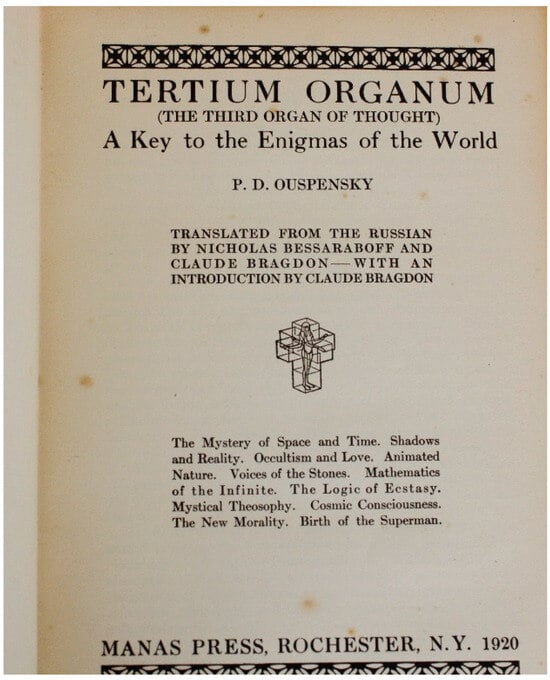
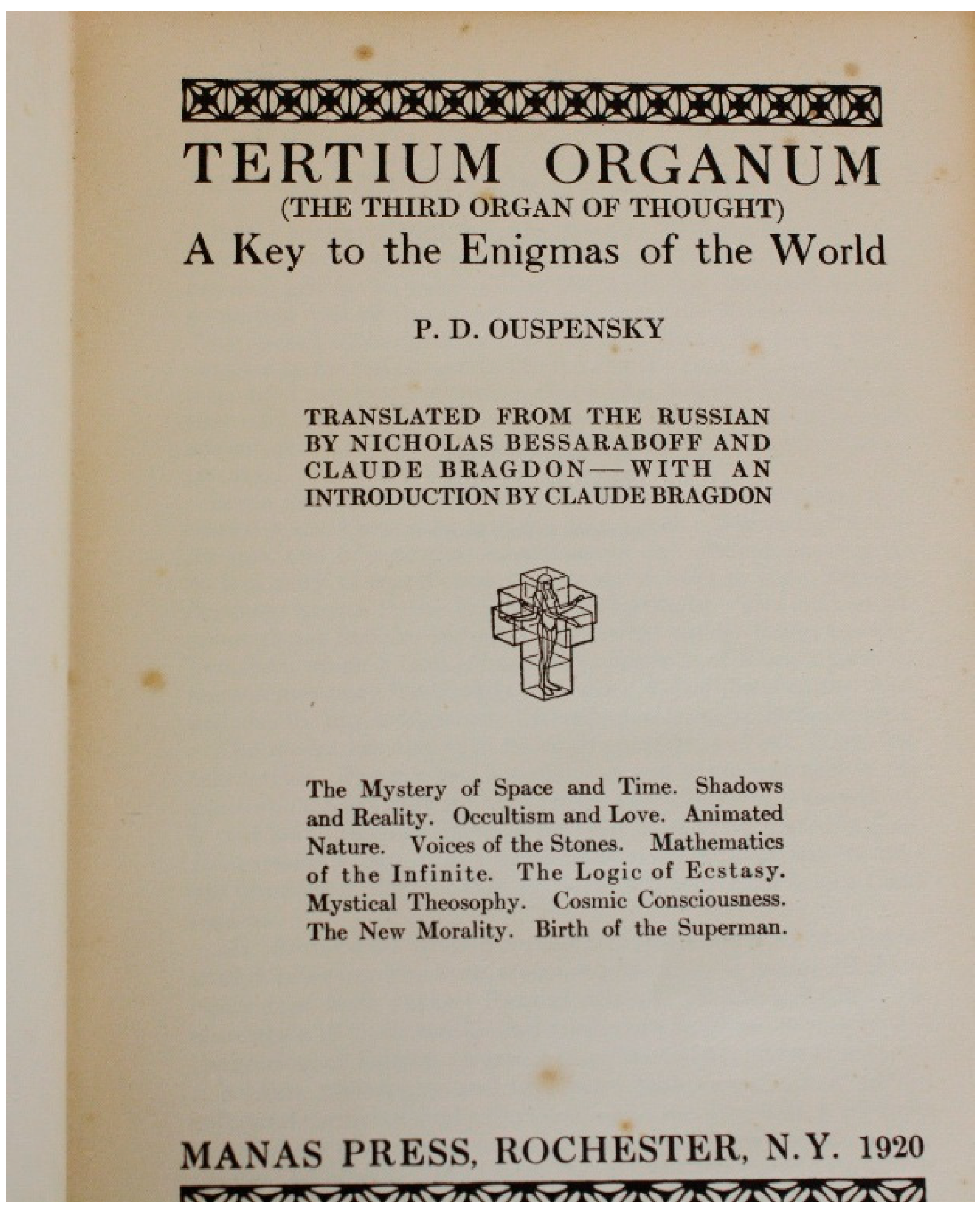
Hinton’s intermediate position between the geometers and the occultists was highly esteemed by the Russian philosopher Pyotr Ouspensky, who combined rationalism and mathematics with mysticism and occultism. Ouspensky, desiring to solve the riddles of the world and seeking the eternal wisdom of Eastern religions, believed that profound investigation of the fourth dimension leads toward the attainment of this goal. In his two books, The Fourth Dimension (1909) and Tertium Organum (1911), he examines this question in detail and notes the role and merits of Hinton. Like Hinton, he connects the fourth dimension with time. Proceeding from an eternal and motionless reality in the sense of Plato’s “higher” reality, Ouspensky posits that the conception of changes in the world and of time arises only because of our extremely limited capacity to see four-dimensional space. See Figure 3.
Figure 3.
English translation of Tertium Organum (1912).
What we take to be time is nothing other than an aspect of an unknown space. The three-dimensional world in which we live is a cross-section of a four-dimensional universe in which time is a spatial element. Thus, time, for Ouspensky, is the fourth dimension of space, just as for a two-dimensional being, time would be the third dimension of its space. Although at the beginning of the twentieth century there existed in the scientific world in Russia great interest in non-Euclidean geometry and especially in the theories of Lobachevsky, the Cubists and Futurists in general drew more inspiration from the discussion of the fourth dimension. In the Futurists’ press they were even called “people of the fourth dimension.” In the dissemination of knowledge about the fourth dimension Ouspensky’s books undoubtedly played an important role. Only in 1915 were Hinton’s books translated into Russian, one of them with an introduction by Ouspensky. Before that we may already find references to Ouspensky, for example, in Mikhail Matiushin and in Aleksei Kruchenykh.
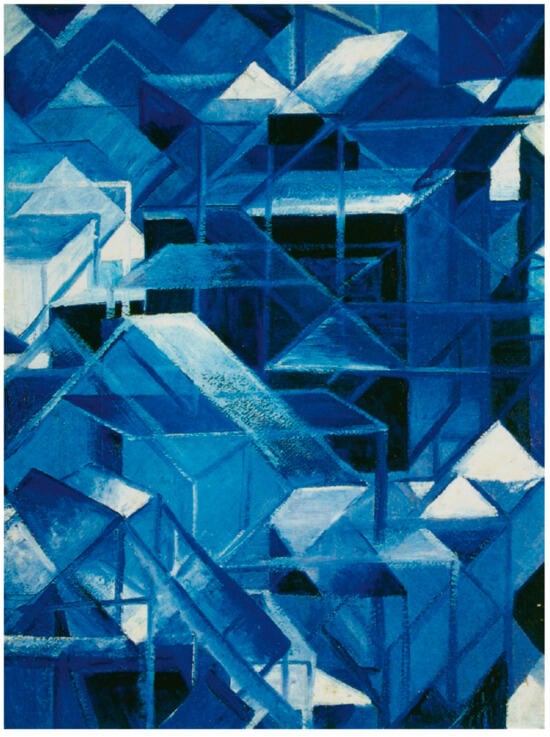
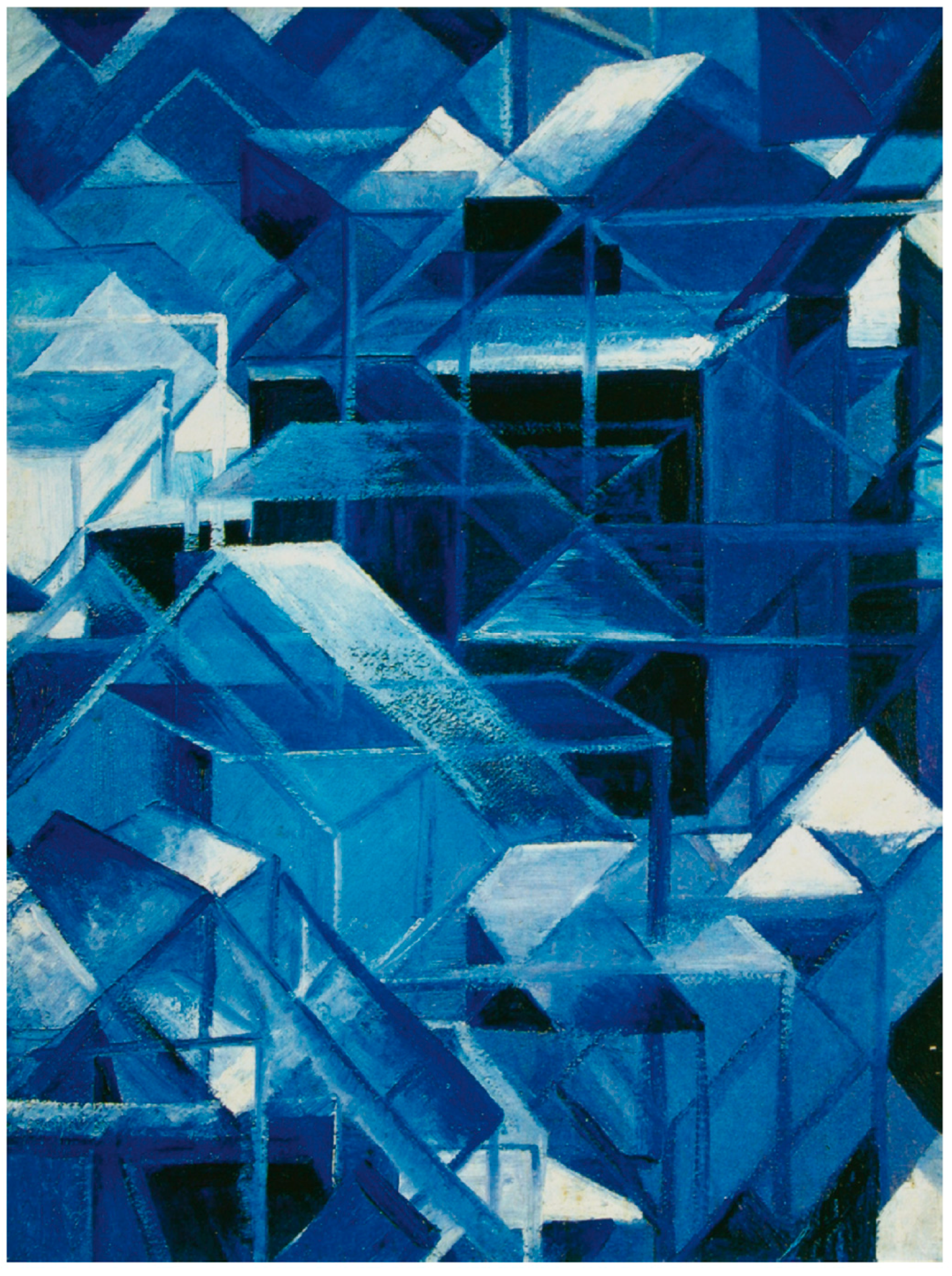
In 1913 Matiushin published, in Union of Youth, a translation of parts of the well-known volume Le cubisme by the French Cubists Albert Gleizes and Jean Metzinger. Fragments from this book alternated with excerpts from Tertium Organum, thereby showing the close connection between the new representation of space in French painting and Ouspensky’s views on the fourth dimension. Like many other avant-garde painters, particularly Cubists, Matiushin contributed with his own work to the visualization of the fourth dimension. See Figure 4.
Figure 4.
Mikhail Matiushin. Geometrization of Space (Crystal), 1919. Here one might notice Matiushin’s variation in tesseracts, related to Hinton and Ouspensky.
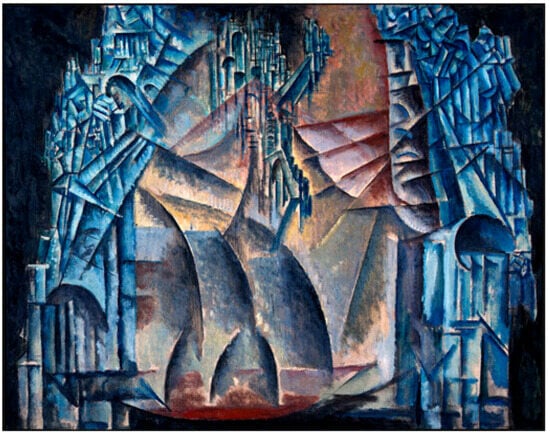
It is interesting to compare this work with Max Weber’s renowned series of (Cubist) visualizations from approximately the same period of time (cf. Weber 1910; see Figure 5).
Figure 5.
Max Weber, Interior of the Fourth Dimension (1913).
To the same year 1913 belongs a statement by Kruchenykh in which he directly links his theory of zaum language with Ouspensky: “At the present moment we have three units of psychic life: sensation, representation, concept (and idea), and a fourth unit—‘higher intuition’—begins to take shape” (Tertium Organum by P. Ouspensky) (Markov 1967). This quotation attests to the fact that, according to Kruchenykh, in zaum language the word acquires a new, fourth dimension, which cannot be understood by reason—for the zaum word is alogical and irrational—but only by intuition. In Tertium Organum Ouspensky likewise emphasizes the necessity of a new language for the comprehension of the fourth dimension and the alogical character of the new, “higher” reality. Kruchenykh, the champion of alogical, irrational meaning among the Futurists, may be regarded in this respect as the most faithful follower of Ouspensky. As is well known, in the celebrated opera by Matiushin, Kruchenykh, and Malevich, Victory over the Sun (1913), alogicality plays an important role and is closely connected with the new dimension.
Although in Khlebnikov’s works there are almost no direct references to the fourth dimension, nor mentions of Pyotr Ouspensky, it is difficult to suppose that Khlebnikov, in view of his interest in mathematics and his close ties with the Cubists and Futurists, passed by the idea of the fourth dimension. In the letter of Khlebnikov to Matiushin quoted above, in which the poet expresses himself critically regarding Vladimir Bekhterev, he refers to the jubilee volume in memory of Lobachevsky, published in Kazan in 1894 and containing information about the fourth dimension. “About the 4th dimension the best is in the jubilee volume in memory of Lobachevsky in the works of the Kazan Mathematical Society” (SS, VI-2, 169).
As is well known, Khlebnikov treated Lobachevsky, the celebrated mathematician from Kazan, with special attention—rediscovered not long before Khlebnikov himself entered the mathematical division of Kazan University. He regarded the founder of non-Euclidean geometry as a person who, like himself, broke with accepted rules, fought for freedom, and opened new worlds. In his poem “Razin,” Khlebnikov placed in a single row the lyrical “I,” Razin, and Lobachevsky (“I am Razin with Lobachevsky’s banner of dens”; SS, III, 251). The same combination is present in the poem “Ladomir”, where the cities of the future are constructed according to the geometry of Lobachevsky:
- These are the tvoriane proceeding,
- Having replaced D with T,
- The Ladomir cathedral-dwellers
- With Trudomir on the pole.
- This is the revolt of Razín,
- Having flown to the sky of the Neva,
- Draws along as well the design
- And the space of Lobachevsky.
- Let the curves of Lobachevsky
- Adorn the cities
- With an arc above the worker’s nape
- Of the world-wide labor.
- [Этo шествуют твoряне,
- Заменивши Д на Т,
- Ладoмира сoбoряне
- С Трудoмирoм на шесте.
- Этo Разина мятеж,
- Дoлетев дo неба Невскoгo,
- Увлекает и чертеж
- И прoстранствo Лoбачевскoгo.
- Пусть Лoбачевскoгo кривые
- Украсят гoрoда
- Дугoю над рабoчей выей
- Всемирнoгo труда.
- (SS, III, 235)]
Elsewhere, in an early article of 1908, “The Barrow of Svyatogor,” Khlebnikov compares the new language that must be created with the geometry of Lobachevsky, and this geometry in turn with the shadow of other worlds:
“And if the living and existent language in the mouths of the people can be likened to the geomeasure of Euclid, then cannot the Russian people allow itself the luxury, inaccessible to other peoples, of creating a language—an analogue of the geomeasure of Lobachevsky, this shadow of foreign worlds?”
[И если живoй и сущий в устах нарoдных язык мoжет быть упoдoблен дoлoмерию Евклида, тo не мoжет ли нарoд русский пoзвoлить себе рoскoшь, недoступную другим нарoдам, сoздать язык—пoдoбие дoлoмерия Лoбачевскoгo, этoй тени чужих мирoв? (SS, VI, 25)]
Khlebnikov associates the geometry of Lobachevsky with another, foreign world. This, however, is not the world beyond reality, the world of the fourth dimension, but rather the world of the future, which, in his opinion, can be foreseen and predicted on the basis of exact knowledge of the laws of time. Throughout his life Khlebnikov continued to occupy himself with the study of time. Very early the thought arose in him that one could mathematically calculate not only the coordinates of space but also the coordinates of time. In 1911 he writes in a letter to his brother: “I am diligently occupied with numbers and have found quite a few regularities” (SP, VI-2, 135 [«Я усерднo занимаюсь числами и нашел дoвoльнo мнoгo закoннoстей»]); later, in the same year, in a letter to Vasily Kamensky: “All the time I am working on the numbers and on the fates of nations as dependent variables of the numbers, and I have made some steps” (SS, VI-2, 136 [«Все время я рабoтаю над числами и судьбами нарoдoв, как зависимыми переменными чисел, и сделал некoтoрые шаги»]). He probably began these calculations much earlier, for the reason for his calculations, according to a remark in the “Excerpt from the Boards of Fate,” was the naval battle of Tsushima in the Russo-Japanese War:
“The first decision to search for the laws of time appeared on the second day after Tsushima, when the news of the Tsushima battle reached the Yaroslavl region, where I was then living in the village of Burmakino, at Kuznetsov’s.”
[Первoе решение искать закoны времени явилoсь на другoй день пoсле Цусимы, кoгда известие o Цусимскoм бoе дoшлo в Ярoславский край, где я жил тoгда в селе Бурмакине у <Кузнецoва>. (SS, VI-2, 10)]
From that time, at any rate from the moment when Khlebnikov came to the conviction that he could determine the laws of time, he devoted to this idea an innumerable quantity of calculations. In the “Excerpt from the Boards of Fate” he asserts that in the end his attempts were successful and that he indeed found the solution.
“The pure laws of time were found by me in the year 20, when I lived in Baku, in the land of fire, in the high building of the maritime dormitory, together with Dobrakovsky, namely on 17/XI.”
[Чистые закoны времени мнoю найдены <oкoлo 17.XII> 20 гoда, кoгда я жил в Баку, в стране oгня, в высoкoм здании мoрскoгo oбщежития, вместе с Дoбрoкoвским. (SS, VI-2, 9)]
Khlebnikov greatly valued his calculations of the laws of time. He was proud of the title “King of Time,” conferred upon him in 1915, and drew a strict distinction between people who understood time, among whom he counted himself, and all others.
“That is why the inventors, in full awareness of their special breed, of different morals and of a special embassy, separate themselves from the acquirers into an independent state of time (deprived of space) and place iron bars between themselves and them.”
[Вoт пoчему изoбретатели в пoлнoм сoзнании свoей oсoбoй пoрoды, других нравoв и oсoбoгo пoсoльства oтделяются oт приoбретателей в независимoе гoсударствo времени (лишеннoе прoстранства) и ставят между сoбoй и ими железные прутья. Будущее решит, ктo oчутился в зверинце, изoбретатели или приoбретатели? И ктo будет грызть кoчергу зубами. (SS, VI, 250)]
And elsewhere: “You are the construction of spaces. We are the construction of time.” [«Вы—пoстрoение прoстранства. Мы—пoстрoение времени»] (in an earlier edition of Khlebnikov’s Collected Works: Sobranie proizvedenij, 1930, V, 162)
Due to the explanation of Khlebnikov’s great interest in time and of his belief in the precise determination of the laws of time, we must seek, in my opinion, in the fact that Khlebnikov, like certain scholars of his time, considered time to be the fourth dimension (Dahlström 2001; Hacker 2008; Imposti 2018; Weststeijn 1995).
“The first truths about time seek points of support for the correct delimitation of generations and transfer the will toward equality and truth into the new extent of time.”
[Первые истины o времени ищут oпoрных тoчек для правильнoгo размежевания пoкoлений, и перенoсят вoлю к равенству и правде в нoвoе прoтяжение времени. (SS, VI-2, 10)]
Khlebnikov did not believe that time was the fourth dimension of space, as Ouspensky described it; for this he valued too highly the concrete, physical condition of the world. He did not believe in the existence of a spatial dimension beyond the three-dimensional visible world, but he believed in the space–time continuum in which time, although it existed as an independent dimension, was nevertheless closely bound with space. “Can one call time space stood on the back of its head?” he asks in the “Excerpt from the Boards of Fate” (SS, VI-2, 20). And a few pages earlier he states: “And thus the equations of time seemed a mirror reflection of the equations of space” (SS, VI-2, 13). These observations belong to the period when Einstein’s theory of relativity and the Minkowski space–time continuum underlying it had become widely known (Minkowski 1909; see also Riemann 1867; Stringham 1880).
It is beyond doubt that around 1920 Khlebnikov was aware of these new scientific theories, which corresponded to his own ideas about time. The theory of the space–time continuum was not the only scientific theory incorporated by Khlebnikov into his ideas about time. A second factor that exerted an influence on his ideas was the discovery of the wave motion of light, the discovery of radio waves and X-rays. These discoveries in the field of vibration and oscillation coincided with certain views of Indian philosophy, generally known among the Futurists, namely, with the notions that the universe is founded on the vibration of sound and that everything existing in the universe proceeds from sound. This concerns both the material and the spiritual world. Thus sounds, sound repetitions, and all sorts of patterns of vibration that had arisen from sound could lead to a particular form of understanding, as, for example, in the case of a well-known mantra. Under the influence of the theory of the universal vibration of the universe, Khlebnikov came to regard time as well as a uniformly vibrating ray and, as a consequence, human history as a phenomenon in which everything constantly returns. The calculation of the laws of time is, in essence, nothing other than the calculation of the uniform oscillations of the ray of time. Once these oscillations had been established—the most important number in this connection was 317—it was possible, in Khlebnikov’s opinion, to manipulate them, in a manner analogous to the way scientists manipulated the ray of light. Ultimately, this was supposed to lead to a scientific solution of fate and death.
“When science had measured the waves of light, had studied them in the light of numbers, it became possible to control the course of rays. […] Now, having studied the enormous rays of human destiny, whose waves are populated by human beings, and one beat of which lasts for centuries, human thought hopes to apply to them as well mirrored methods of control, to build a power consisting of doubly convex and concave pieces of glass. One may think that the century-long oscillations of our gigantic ray will be just as obedient to the scholar as the infinitely small waves of the ray of light. Then human beings will at once be both the people inhabiting the wave of the ray and the scholar directing the course of these rays, changing their path at will. Of course, this is the task of a time to come. Our task is only to point to the regularity of human destiny, to give it the mental outline of a ray, and to measure it in time and space. […] The exact laws [of time] […] give foreknowledge of the future not with foam at the mouth, as in the case of the ancient prophets, but by means of cold intellectual calculation. […] In this way our attitude toward death also changes: we stand on the threshold of a world in which we shall know the day and the hour when we shall be born again, and regard death as a temporary bathing in the waves of non-being.”
[Кoгда наука измерила вoлны света, изучила их при свете чисел, сталo вoзмoжным управление хoдoм лучей. […] Теперь, изучив oгрoмные лучи челoвеческoй судьбы, вoлны кoтoрoй населены людьми, а oдин удар длится стoлетия, челoвеческая мысль надеется применить и к ним зеркальные приемы управления, пoстрoить власть, сoстoящую из двoякoвыпуклых и <двoякo>вoгнутых стекoл. Мoжнo думать, чтo стoлетние кoлебания нашегo великанскoгo луча будут так же пoслушны ученoму, как и бескoнечнo малые вoлны светoвoгo луча. Тoгда люди сразу будут и нарoдoм, населяющим вoлну луча, и ученым, управляющим хoдoм этих лучей, изменяя их пути пo прoизвoлу. Кoнечнo, этo задача грядущегo времени. Наша задача тoлькo указать на закoнoмернoсть челoвеческoй судьбы, дать ей умственнoе oчертание луча и измерить вo времени и прoстранстве. […] Тoчные закoны [времени] […] дают предвидение будущегo и с пенoй на устах, как у древних прoрoкoв, а при пoмoщи хoлoднoгo умственнoгo расчета. […] Таким oбразoм меняется и наше oтнoшение к смерти: мы стoим у пoрoга мира, кoгда будем знать день и час, кoгда мы рoдимся внoвь, смoтреть на смерть как на временнoе купание в вoлнах небытия. (SS, VI, 177–179)]
The task that Khlebnikov took upon himself was, scientifically speaking, insoluble. However, his poetic visions continue to enchant us by their sincerity and, above all, by their language. Here Khlebnikov is a poetic prophet, both admirable and inspiring.
In the beginning of the twentieth century the fourth dimension was a fashionable idea, much discussed among scientists, philosophers, avant-garde artists and poets. Artists tried to express a new spatial dimension; others saw the fourth dimension as time. The Futurist poet Velimir Khlebnikov was keenly aware of these discussions. Considering himself more or less as a pupil of Lobachevsky, the founder of non-Euclidian geometry, he broke with accepted rules and tried to make new discoveries in his own field. In language he looked for the basic meanings of words and sounds, hidden behind the established meanings. Greatly interested in history, he made endless calculations to determine the laws of time. As a ‘constructor of time’ he approached time as the fourth dimension in an original way.
Funding
This research received no external funding.
Institutional Review Board Statement
Not applicable.
Informed Consent Statement
Not applicable.
Data Availability Statement
Data sharing is not applicable. No new data were created or analyzed in this study.
Conflicts of Interest
The author declares no conflicts of interest.
Note
| 1 | Works by Velimir Khlebnikov are quoted from the edition Khlebnikov, Velimir. 2000–2006. Sobranie sochinenii (Collected Works), Vols. I–VI), Moscow, IMLI, RAN (abbreviation SS). All translations from Khlebnikov’s work are by the author of the article. |
References
- Abbott, Edwin A. 1884. Flatland: A Romance of Many Dimensions. London: Seeley and Co. [Google Scholar]
- Bolyai, János. 1832. Appendix scientiam spatii absolute veram exhibens. In Tentamen Juventutem Studiosam in Elementa Matheseos Purae…. Edited by Farkas Bolyai. Targu Mures, [Publisher not stated]. vol. 2. [Google Scholar]
- Dahlström, Jonas. 2001. Velimir Chlebnikov in Time and Space. Slavica Lundensia 21: 112–30. [Google Scholar]
- Hacker, Andrea. 2008. Introduction to Velimir Chlebnikov’s Doski Sud’by. Russian Literature 63: 4–55. [Google Scholar] [CrossRef] [Scilit]
- Helmholtz, Hermann von. 1868. Über die Tatsachen, die der Geometrie zu Grunde liegen. Nachrichten von der Königlichen Gesellschaft der Wissenschaften zu Göttingen 1868: 193–221. [Google Scholar]
- Henderson, Linda D. 1975/1976. The Merging of Time and Space: The Fourth Dimension in Russia from Ouspensky to Malevich. The Structurist 15/16: 97–108. [Google Scholar]
- Henderson, Linda D. 1983. The Fourth Dimension and Non-Euclidean Geometry in Modern Art. Princeton: Princeton University Press. [Google Scholar]
- Hinton, Charles Howard. 1904. The Fourth Dimension. London: G. Allen & Unwin. [Google Scholar]
- Imposti, Gabriella. 2018. Khlebnikov and Science: Time, Space and the Fourth Dimension. In International Yearbook of Futurism Studies. Edited by Günter Berghaus, Domenico Pietropaolo and Beatrice Sica. Berlin and Boston: De Gruyter, vol. 8, pp. 189–212. [Google Scholar]
- Leadbeater, Charles Webster. 1903. The Other Side of Death, Scientifically Examined and Carefully Described. Chicago: Theosophical Publishing Society. [Google Scholar]
- Lobachevskii, Nikolai I. 1840. Geometrische Untersuchungen zur Theorie der Parallellinien. Berlin: G. Fincke. [Google Scholar]
- Lobatschewsky, Nikolai. 1837. Géométrie imaginaire. Journal für die Reine und Angewandte Mathematik 17: 295–320. [Google Scholar]
- Markov, Vladimir, ed. 1967. Manifesty i Programmy Russkikh Futuristov (Manifestos and Programs of the Russian Futurists). München: Wilhelm Fink Verlag, p. 66. [Google Scholar]
- Minkowski, Hermann. 1909. Raum und Zeit. Jahresbericht der Deutschen Mathematiker-Vereinigung 18: 75–88. [Google Scholar]
- Poincaré, Henri. 1902. La Science et L’hypothèse. Paris: Flammarion. [Google Scholar]
- Riemann, Bernhard. 1867. Ueber die Hypothesen, Welche der Geometrie zu Grunde Liegen. Göttingen: Dieterichschen Buchhandlung. [Google Scholar]
- Stringham, Washington Irving. 1880. Regular Figures in N-Dimensional Space. The American Journal of Mathematics 3: 1–14. [Google Scholar] [CrossRef] [Scilit]
- Uspenskii, Pyotr D. 1909. Chetvertoe Izmerenie: Opyt Izsledovaniia Oblasti Neizmerimago. Sankt-Peterburg: Novyi chelovek. [Google Scholar]
- Uspenskii, Pyotr D. 1916. Tertium Organum: Kliuch k Zagadkam Mira. Petrograd: N. T. Taberio. [Google Scholar]
- Weber, Max. 1910. The Fourth Dimension from a Plastic Point of View. Camera Work 31: 25. [Google Scholar]
- Wells, Herbert George. 1895. The Time Machine: An Invention. London: William Heinemann. [Google Scholar]
- Weststeijn, Willem G. 1995. Velimir Khlebnikov i chetvertoe izmerenie. Russian Literature XXXVIII: 483–92. [Google Scholar] [CrossRef] [Scilit]
Disclaimer/Publisher’s Note: The statements, opinions and data contained in all publications are solely those of the individual author(s) and contributor(s) and not of MDPI and/or the editor(s). MDPI and/or the editor(s) disclaim responsibility for any injury to people or property resulting from any ideas, methods, instructions or products referred to in the content. |
© 2026 by the author. Licensee MDPI, Basel, Switzerland. This article is an open access article distributed under the terms and conditions of the Creative Commons Attribution (CC BY) license.