Article

In the Shadow of the Eclipse (2 June 1509): Giulio Campagnola’s The Astrologer, Venice, and the Science of Stars


Department of Languages, Literatures, and Cultures, McGill University, Montreal, QC H3A 2M7, Canada
Arts 2026, 15(4), 75; https://doi.org/10.3390/arts15040075
Submission received: 9 February 2026 / Revised: 30 March 2026 / Accepted: 7 April 2026 / Published: 11 April 2026
(This article belongs to the Section Visual Arts)

Abstract

This article provides a new interpretation of Giulio Campagnola’s 1509 engraving, The Astrologer, by situating its innovative punteggiato technique and enigmatic iconography within the precise astrological and political climate of Renaissance Venice. By identifying the numerical data on the astrologer’s disc as a reference to the lunar eclipse of 2 June 1509, the author argues that the composition—featuring a scholar, a monstrous reptile, and a distant city—represents a visual projection of the eclipse’s predicted impact. Framed by the political crisis following the Battle of Agnadello, the engraving emerges as a prophetic defense of Venetian resilience, a message further reinforced by a comparative analysis of a recently rediscovered astrological sonnet attributed to Campagnola.

1. Introduction

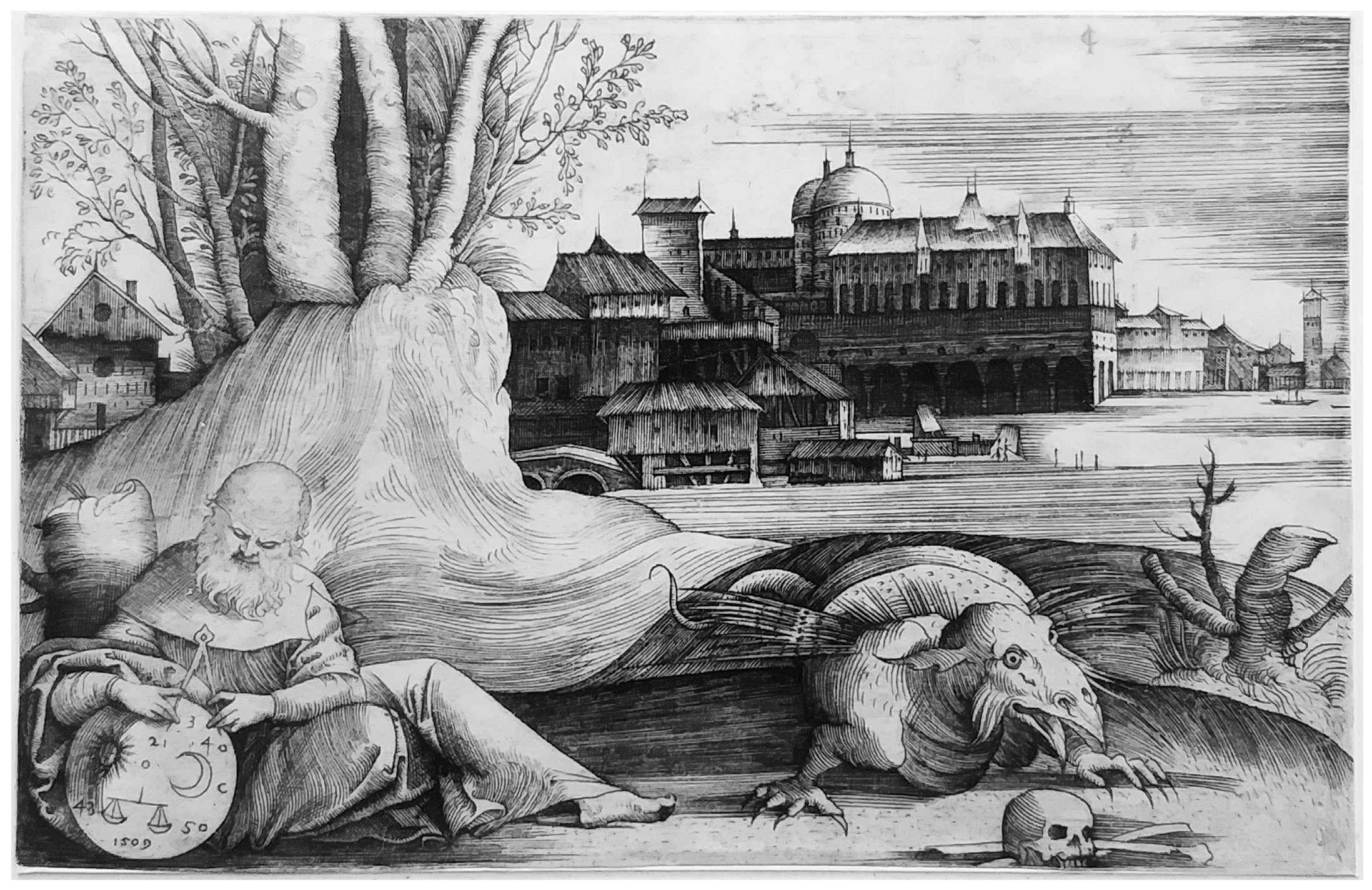
To this day, only 15 engravings have been attributed to Giulio Campagnola with certainty (Brooke 2020, pp. 371–82). Bearing the date 1509, The Astrologer is arguably the most fascinating. This is due to its distinctive technical features and elusive meaning (Figure 1). Since its second and third impressions, copies of which survive in numerous European collections, Campagnola’s print displays an innovative use of punteggiato, a stipple technique that, combined with hatching, the Paduan artist used to provide his engravings with an effect reminiscent of chiaroscuro (Landau 2016, pp. 107–35). The artwork’s technical features are a product of Venice’s excellence in the art of intaglio and the city’s thriving printing industry. They also provide evidence of the artist’s expertise as a painter and miniaturist capable of translating his pictorial skills onto a new medium. However, The Astrologer is also an enigmatic work of art, whose meaning intrigues interpreters. The maritime landscape or winding river in the background, the horizontal orientation of the whole scene, and the iconography of the astrologer and the reptile-looking monster in the foreground can be easily traced back to illustrious precedents signed by Giorgione da Castelfranco (1477–1510), Vittore Carpaccio, and other masters of Renaissance Venice. Moreover, the engraving’s elementary composition creates a set of juxtapositions of, for instance, land and water, rural and urban spaces, and leafy and dead trees—the last a codified symbol widely diffused in Renaissance art (Settis 1994, p. 26; Brown 2025, pp. 128–34). These visual cues smoothly guide the viewer from the astrologer on the left side of the print toward the vanishing point, placed above the tower on the upper right. What this relatively simple arrangement of often well-known iconographic motifs is supposed to mean, however, still eludes the interpreters.
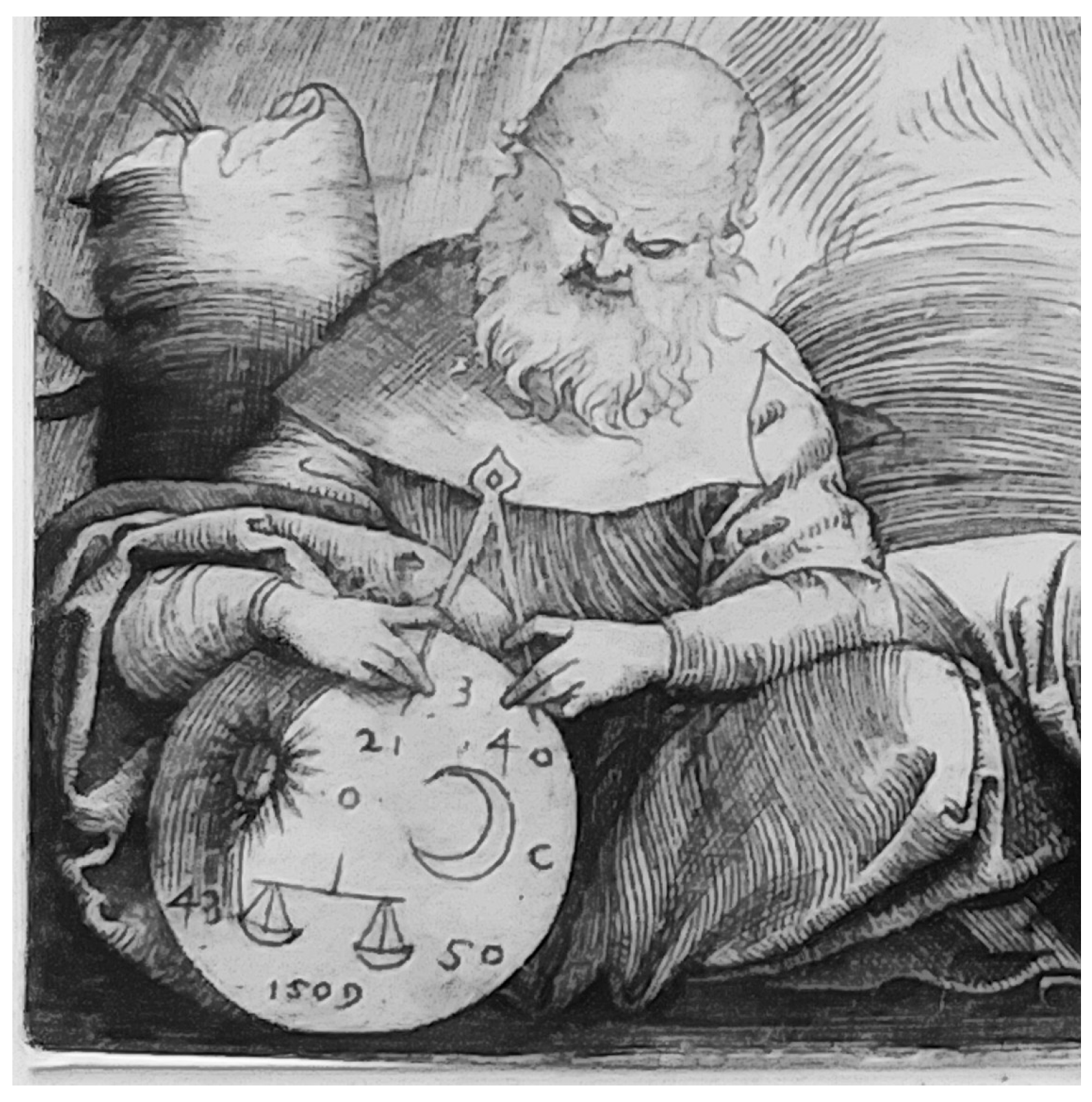
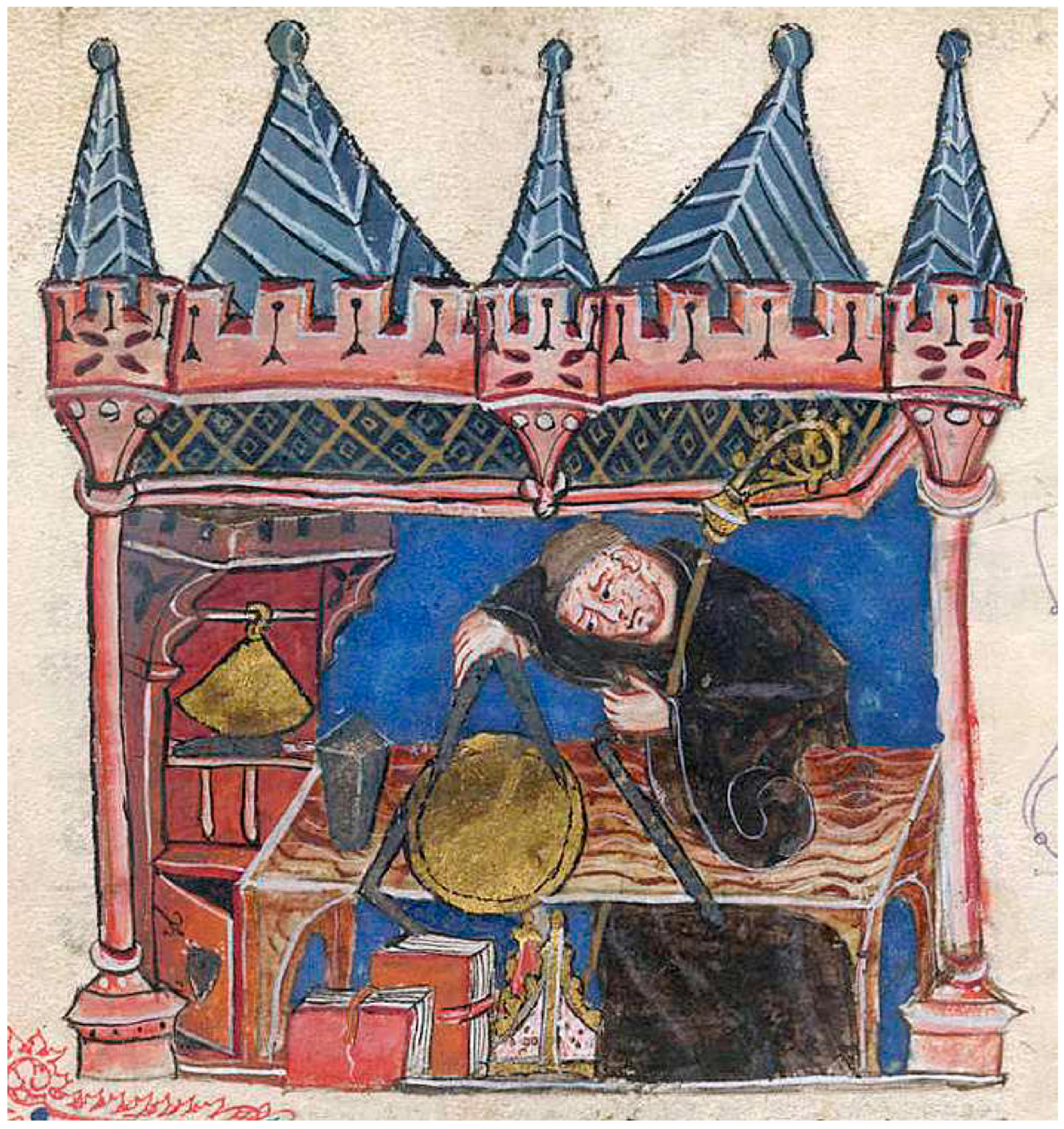
The human figure on the left side of the foreground sums up The Astrologer’s combination of simplicity and elusiveness: the pair of compasses and the disc or globe inscribed with obvious astronomical glyphs (Sun, Moon, and Libra) easily identify the stern-looking man as an astrologer. This identification is supported by comparison with famous artworks such as Giorgione’s painting Three Philosophers (c. 1508–9) or Albrecht Dürer’s woodcut on the title page of Messahalah’s De scientia motus orbis (1504). However, one may also observe that all these artists were elaborating on a codified iconographic topos. In the Late Middle Ages, many manuscript illuminators adapted the iconographic motif of Christ as a Divine Architect to human characters to extoll the quasi-divine status of astrology and its practitioners. A famous specimen is, for instance, the 14th-century portrait of English astrologer and mathematician Richard of Wallingford in MS Cotton Claudius E. IV of the British Library of London (Figure 2). Conventional as this iconography may be, the disc or plate in Campagnola’s engraving also displays numbers whose meaning is far from being obvious. The result is an artwork of remarkable ambiguity and depth.
This article aims to contribute to the ongoing conversation on Campagnola’s The Astrologer based on a new interpretation of its astrological data and its overall iconography. First, a comparison with a corpus of annual prognostics printed at the end of 1508 reveals that the astrological data found on the plate refer to the lunar eclipse of 2 June 1509, and its expected effects on Northern Italian cities, including Venice. If read alongside astrological publications of the time, the print’s iconography appears to be part of a widespread discourse celebrating Venice as a beacon of peace in war-torn Italy in the aftermath of the Battle of Agnadello (14 May 1509). My astrological and historical interpretation also matches Campagnola’s astrological sonnet, which Irene Brooke recently brought back to scholarly attention (Brooke 2022, pp. 251–63). While there is no direct evidence that the print and the sonnet were intended to circulate as a pair, their remarkable thematic and astrological compatibility strongly suggests they emerged from a shared intellectual context and convey a similar message, inviting a combined interpretative approach.

2. Foreground and Background

Campagnola’s artwork produces meaning through a studied relationship between the foreground and background. Overall, the print juxtaposes the human figure on the left with the reptile-like creature and city landscape on the right. These main elements are situated on three distinct planes through an elementary combination of linear and atmospheric perspectives. An implied line connects the astrologer’s disc or celestial globe to the urban landscape fading away in the distance. The careful use of the punteggiato technique juxtaposes land and sea, situating the urban landscape on a body of water and the other elements on what appears to be a landmass. This spatial disposition invites the viewer to subordinate the monster and the city on the water to the astrologer’s calculations. Drawing on visual conventions of the period, the figures in the background are best interpreted not as literal depictions, but as symbolic ‘mental projections’ or iconographic representations stemming from the astrologer’s interpretation of the disc’s data. Two of these conventions are particularly relevant to The Astrologer.
Campagnola’s use of foreground and background to produce meaning builds on the visual language of Giorgione da Castelfranco. It is well known that Campagnola often evoked Giorgione’s paintings in his own engravings. For instance, Franca Pellegrini persuasively traces Campagnola’s use of landscape backgrounds to early Renaissance paintings such as Giorgione’s Tramonto in her catalogue entry for this print (Pellegrini 2010, p. 188). According to Brooke, Campagnola’s allusive art should not be dismissed as derivative but appreciated as part of a distinctive aesthetic that rejoiced in reassembling elements from other paintings and placing them in new contexts (Brooke 2018b, pp. 212–60). Giorgione’s signature use of backgrounds symbolically related to other visual planes is one such element. In an essay devoted to Tiziano’s Amor sacro e profano, Konrad Oberhuber argues that this defining feature of Giorgione’s artistry was notably successful and diffused among Venetian artists (Oberhuber 1995, pp. 201–11). Building on Helena Szèpe’s insights, Brooke has recently shown that Giorgione’s symbolic use of the landscape influenced the illuminated views of Venice that often grace dedication copies of the Ducali (Brooke 2018a, p. 152). I suggest that Campagnola’s Astrologer elaborates on Giorgione’s features also at a structural level. The print invites viewers to interpret the monster and the city fading away in the background as engaged in a symbolic relationship and to ponder the nature of this link.
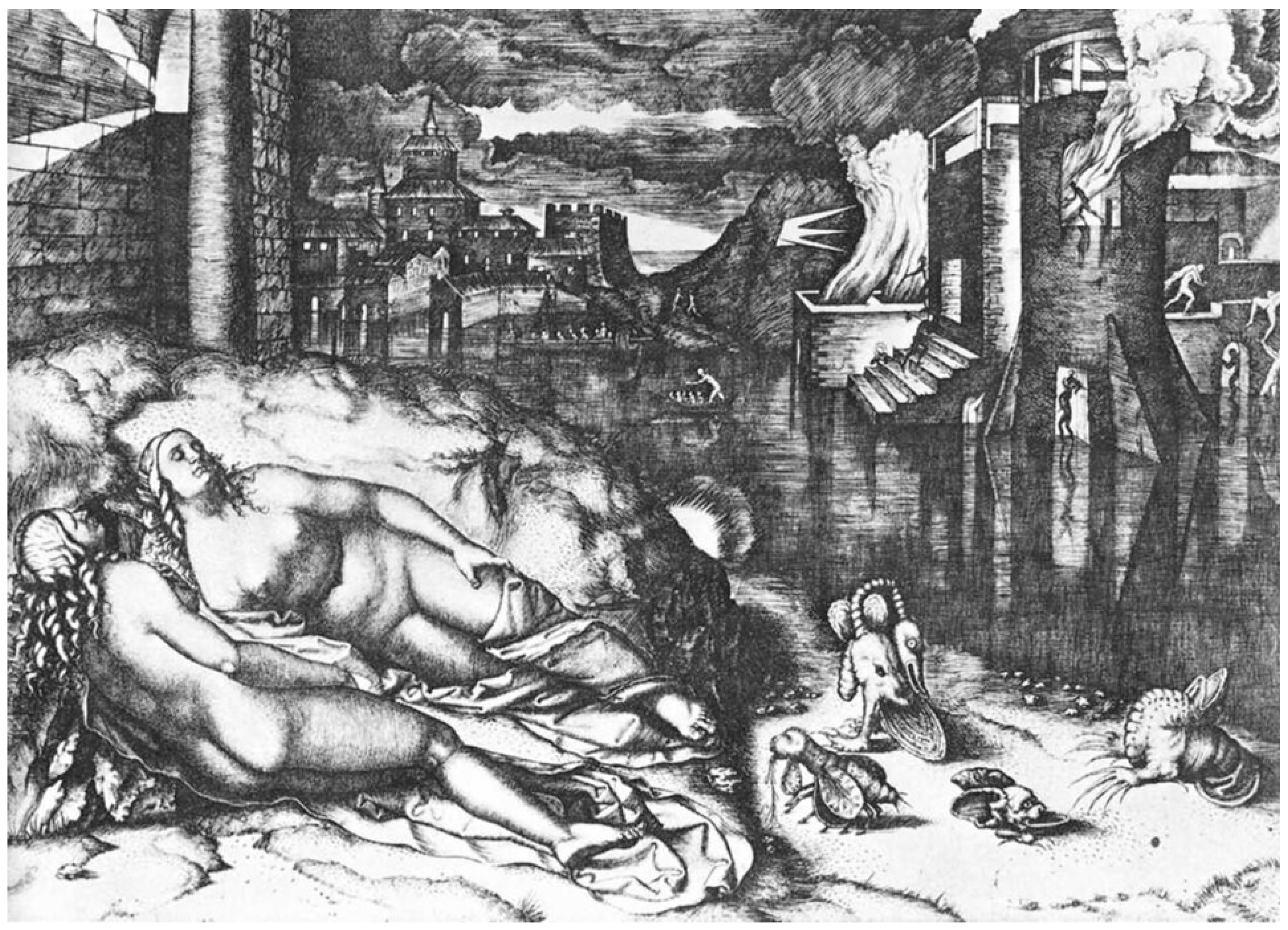
Besides concealing an allusion to Giorgione, the relationship between the foreground and background displayed in The Astrologer builds upon a codified way of visualizing dreams and other mental activities. As Francesco Sorce observed, the print’s foreground and background signify reality and illusion, respectively (Sorce 2003, p. 65). Although accurate, Sorce’s insights can be further contextualized. In a recent collection of essays, Yves Hersant, Cristina Acidini, and Ralph Deconink have shown that this iconographic model is widely documented in Medieval representations of prophetic dreams. Historiated initials of the Book of Daniel, for instance, often portray the author in the foreground while summarizing key elements of his prophecy in the background. In the Late Middle Ages and Early Renaissance, this iconography underwent a process of secularization and started being used apart from strictly religious subjects (Acidini 2013, pp. 20–29; Hersant 2013, pp. 13–19; Dekoninck 2013, pp. 30–35). Early Renaissance representations of dreams are a case in point here. Maria Ruvoldt, for example, has persuasively demonstrated the diffusion of this motif while also hinting at its metafictional potential. Dreams, the scholar observes, could be used to thematize the artist’s inspiration together with the viewer’s aesthetic experience, as it occurs, for example, in Marcantonio Raimondi’s Sogno di Raffaello (c. 1507–9), made in Venice and thus probably known to Campagnola (Figure 3) (Ruvoldt 2004, pp. 122–23). Mirroring, as in a sort of mise en abyme, the viewer’s experience, Campagnola’s astrologer sees the monstrous creature, rural landscape, and uncertain contours of the city by the sea in his mind’s eye. The vision dawns upon the old savant by interpreting the stars and numbers inscribed on the celestial disc, together with the viewer. As a result, viewers are left with two closely related questions: What is the astrologer doing? In what way does his astrological act translate into the print’s elusive iconography? The astrologer’s disc is key to answering these questions.

3. The Astrologer’s Globe

Numerous scholars have attempted to decipher the astrological data inscribed in Campagnola’s print (Figure 4). A quick survey of modern interpretations of the computational data found in the engraving is thus in order. In 1992, Silvio D’Amicone—whose interpretation is to this day the most influential—argued that the information found on the disc refers to a conjunction (signaled by the abbreviation c) of the Sun and Moon (indicated by their symbols) that took place when these planets were at 0 degrees (indicated by the circle placed between these planets’ symbols) in the constellation Libra (indicated by its symbol, the scales) in 1509 (clearly engraved in the lower part of the disc). D’Amicone also interpreted the numbers 21 40 as the time and 43 50 as the latitude of a city, which he identified as Bologna. By means of a careful investigation of printed tables of astronomical data, calendars, and prognostics available in Campagnola’s time, D’Amicone concluded that these data converge in singling out 13 September 1509, at 21:40 in Bologna, as the moment captured in the print. Less convincingly, D’Amicone also suggested that the number 3 on top of the disc may refer to a minor conjunction that occurred earlier in 1509 (D’Amicone 1992, pp. 75–87). In 1996, Paul Holberton provided a careful description of the print and summarized D’Amicone’s conclusions. Holberton also expressed some reasonable doubts concerning D’Amicone’s interpretation of the latitude and the number 3 on top of the astrologer’s disc (Holberton 1996, pp. 397–400). In 1997, Jaynie Anderson argued that the information found on the disc is part of a “prognostication of a lunar eclipse” but did not investigate how this would relate to the other numbers and symbols placed on this figure (Anderson 1997, p. 155). In 2012, Gandolfi endorsed, with minor corrections, D’Amicone’s interpretation. More specifically, Gandolfi confirmed that the numbers on the disc single out a conjunction that occurred on 13 September 1509, at 21:40 at the latitude of Bologna or Ferrara. In contrast to D’Amicone, who explained the difference between the time on the print and that of the conjunction itself as the result of a mistake, Gandolfi argued that the data displayed in the print match the time of the Fall Equinox in 1509. Gandolfi also suggested that the number 3 on top of the disc alludes to the triple conjunction of 1503, whose nefarious effects, according to the astrological literature of the time, were still lingering well into 1509 (Gandolfi 2012, pp. 169–88).
Despite their differences, all these interpretations agree on at least two points. First, 1509, contrary to what previous historians thought, should not be interpreted as the year of the print’s actual production but as its theme. In other words, the print was not necessarily made in 1509, but the story it tells is about this year. The second element of consensus is that the computational data found in Campagnola’s print refers to a specific astrological event (e.g., a conjunction, an eclipse, or the Fall equinox) and its influence on historical events linked with the War of the League of Cambrai. The first conclusion is reasonable and generally accepted by recent scholarship on Campagnola’s Astrologer. However, the second conclusion still presents two problems. First, none of the planetary events mentioned by these scholars occurred precisely at the time indicated on the disc. Second, the glyph of Libra’s zodiac sign appears to be unrelated to the remaining astrological data provided in the print. Overreliance on modern astronomical data and insufficient interest in premodern predictive techniques, I suggest, are the main causes of this confusion.
Failure to identify the astrological operation immortalized in the artwork gives rise to diverging interpretations. In his Sapientia Astrologica, H. Darrel Rutkin compared astrology to language, arguing that both systems rely on a codified lexicon, morphology, and syntax. Like speech, astrology expresses itself in codified acts and materializes in recognizable genres, that is, revolutions, nativities, elections, and interrogations. Each astrological act unfolds through suitable mathematical and interpretive techniques, by which the astrologer calculates and investigates charts to explain past occurrences, evaluates current trends, and predicts upcoming events (Rutkin 2019, p. 60). In summary, all the elements in the print point to a judgment based on the annual revolution of 1509. More specifically, using a widespread astrological technique used for interpreting eclipses, the print predicts that the lunar eclipse of 2 June 1509 would start manifesting its effects on Northern Italian territories in the Fall of the same year, namely, when the Sun would enter the constellation Libra in September. This interpretation makes sense of all the data found on the disc, is consistent with documented astrological techniques, and matches a corpus of astrological prognostics published at the time.

4. The Time of the Eclipse

Contrary to what previous scholars contended, the numbers 3, 21, and 40 placed in the disc’s upper part correctly refer to the time of the eclipse. D’Amicone and Gandolfi exclude the possibility that Campagnola’s print records this celestial event because of what they consider to be a time discrepancy: a lunar eclipse, as one can quickly learn from the 1476 edition of Regiomontanus’s Calendario, did occur on 2 June 1509, but not at 21:40. In doing so, they assume that the print indicates time counting twenty-four hours from midnight as we do today. Although this would not have been impossible, it would have been highly unusual (Quinlan-McGrath 1995, pp. 57–59).1 Until the 18th century and the imposition of the standard still used in Italy today, most Italian cities expressed time using the ora italica, a method of computation that started counting 24 h at sunset or, sometimes, 30 min after it. In two informative articles on the subject, Giovanni Paltrinieri explains that the ora italica was the most common way of measuring time in pre-modern Italy. The system was far from perfect, as it forced city authorities to adjust the city clock to the changing time of sunset throughout the year. Nevertheless, the ora italica allowed people to regulate their activities based on the cycle of natural light and darkness, a necessity in the absence of artificial sources of illumination (Paltrinieri 2006, pp. 75–82, 2020, pp. 27–33). Unsurprisingly, ora italica can be observed in a variety of sources. In his letters addressed to the Doge of Venice at the end of the Quattrocento, for example, the Venetian ambassador Girolamo Zorzi regularly recorded time using this standard (Blanchard et al. 2020). So did the Venetian chronicler Marin Sanudo. In his Diari, for instance, Sanudo recorded the lunar eclipse of 14 August 1505, as occurring at “hore due di note” whereas Regiomontanus (as well as modern astronomical databases) registered this phenomenon between 8:18 and 10:01 a meridie (that is, p.m.) (Sanudo 1879, p. 214). Domenico da Novara’s astrological prognostics, published between 1484 and 1505, moreover, record celestial events such as eclipses, conjunctions, as well as the beginning of the year using this standard (Bònoli et al. 2012, p. 132). However, the most visible proof of ora italica and its diffusion in pre-modern Italy is the large number of mechanical clocks that grace townhalls and cathedrals throughout the peninsula. Frescoed by Paolo Uccello in 1443, the Duomo of Florence’s clock was meant to express time according to this standard (Camporeale 2002, pp. 187–251). Mechanical clocks using ora italica could also be seen at work in Padua, where Campagnola was born, and Venice, where he lived at the time.2
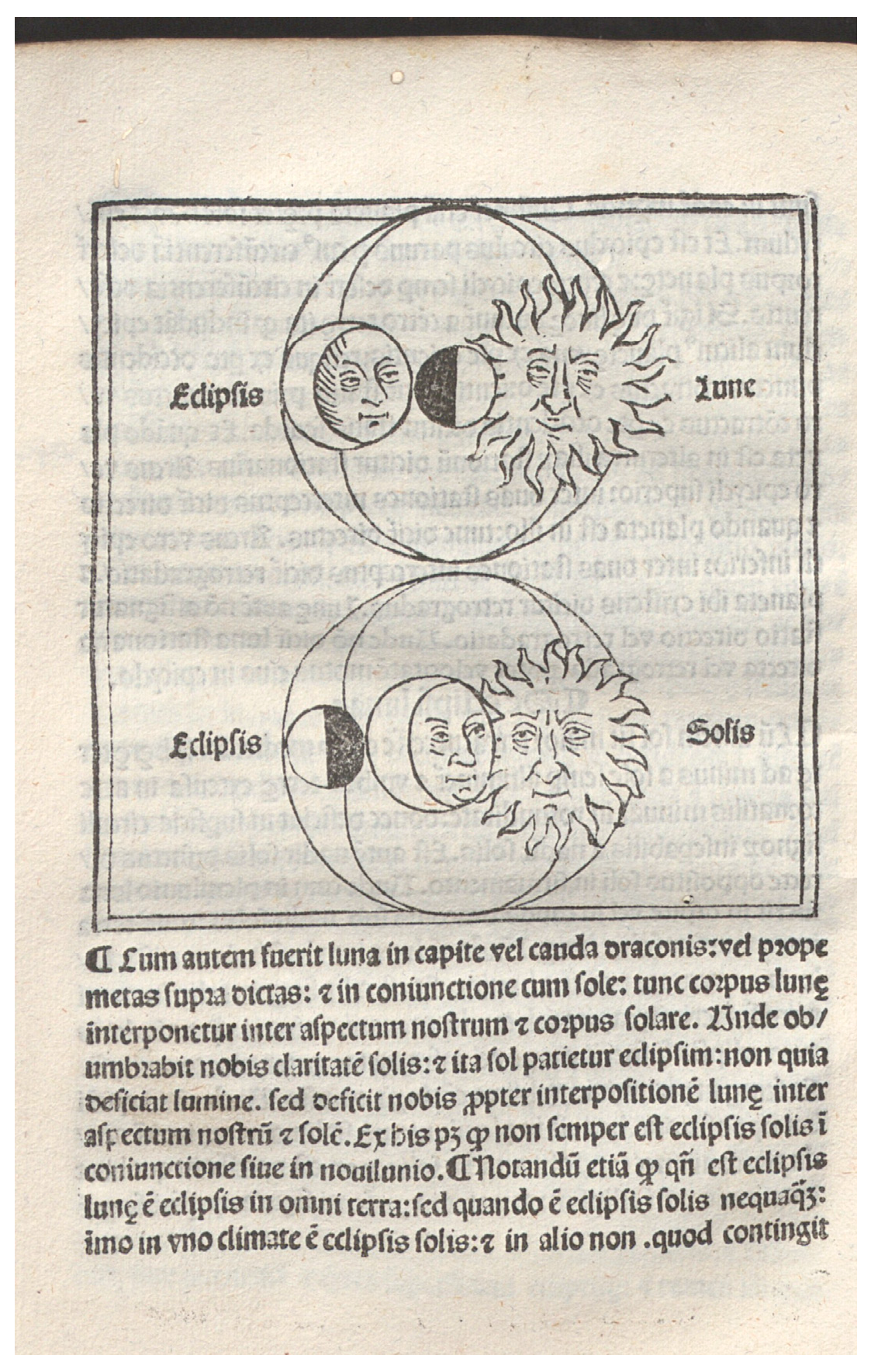
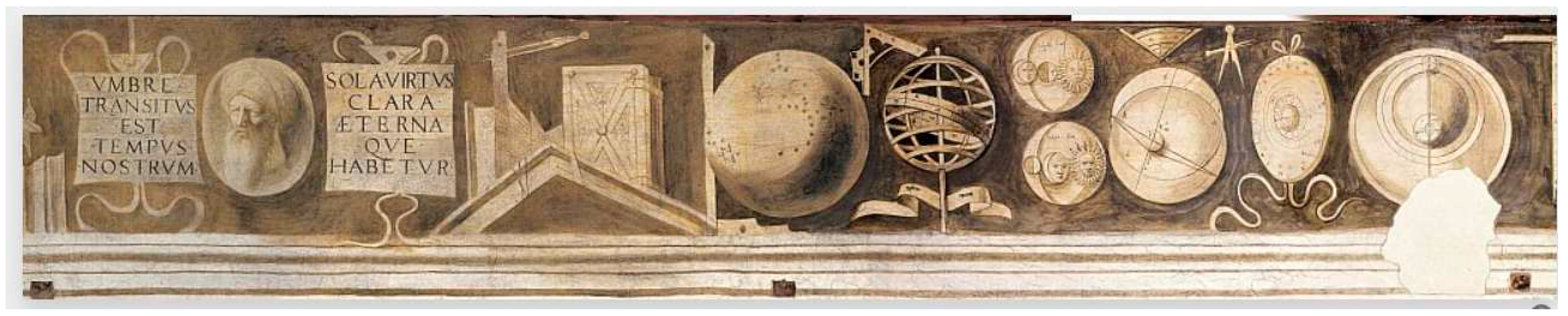
Failure to interpret the numbers 3, 21, and 40 as the time of the eclipse represented on the glyph ends up compromising the correct identification of its visual model. Anderson is accurate to point out that the glyphs of Sun and Moon placed on the sides of the disc present considerable analogies with an illustration found in Erhard Radtoldt’s 1482 compilation of astronomical texts, including Sacrobosco’s De Sphaera (Anderson 1997, p. 155). This accessible book was frequently printed in Venice between the end of the 15th and the beginning of the 16th century, and Campagnola was likely to be familiar with its graceful illustrations, if not its texts. Indeed, Radtoldt’s edition uses a diagram very similar to that found in Campagnola’s engraving, not to illustrate a conjunction but a lunar eclipse, explaining how this phenomenon results from the opposition of the sun and moon relative to planet Earth (Figure 5). Michael J. Shank has recently demonstrated that Radtoldt’s representation of a lunar eclipse was modeled on the diagrams Regiomontanus devised for his manuscript and printed works. Radtoldt’s celestial representations, one learns from Shank’s study, had a remarkable success outside of specialized literature. The same circular models of the celestial globe, for instance, made their way onto the frescoed walls of the Villa Pellizzari in Castelfranco (Figure 6) (Shank 2012, pp. 27–55). Radtoldt’s representation of a lunar eclipse was readily available at the time and very similar to that found in Campagnola’s print. However, prioritizing numerical data over visual evidence, to the exclusion of other interpretations, presents a significant interpretive challenge. It also forces D’Amicone and Gandolfi to ascribe the number 3 to a different system of meaning altogether, that is, alluding to a triple conjunction that is indeed recorded before 1509, but is absent from what the artwork translates visually.
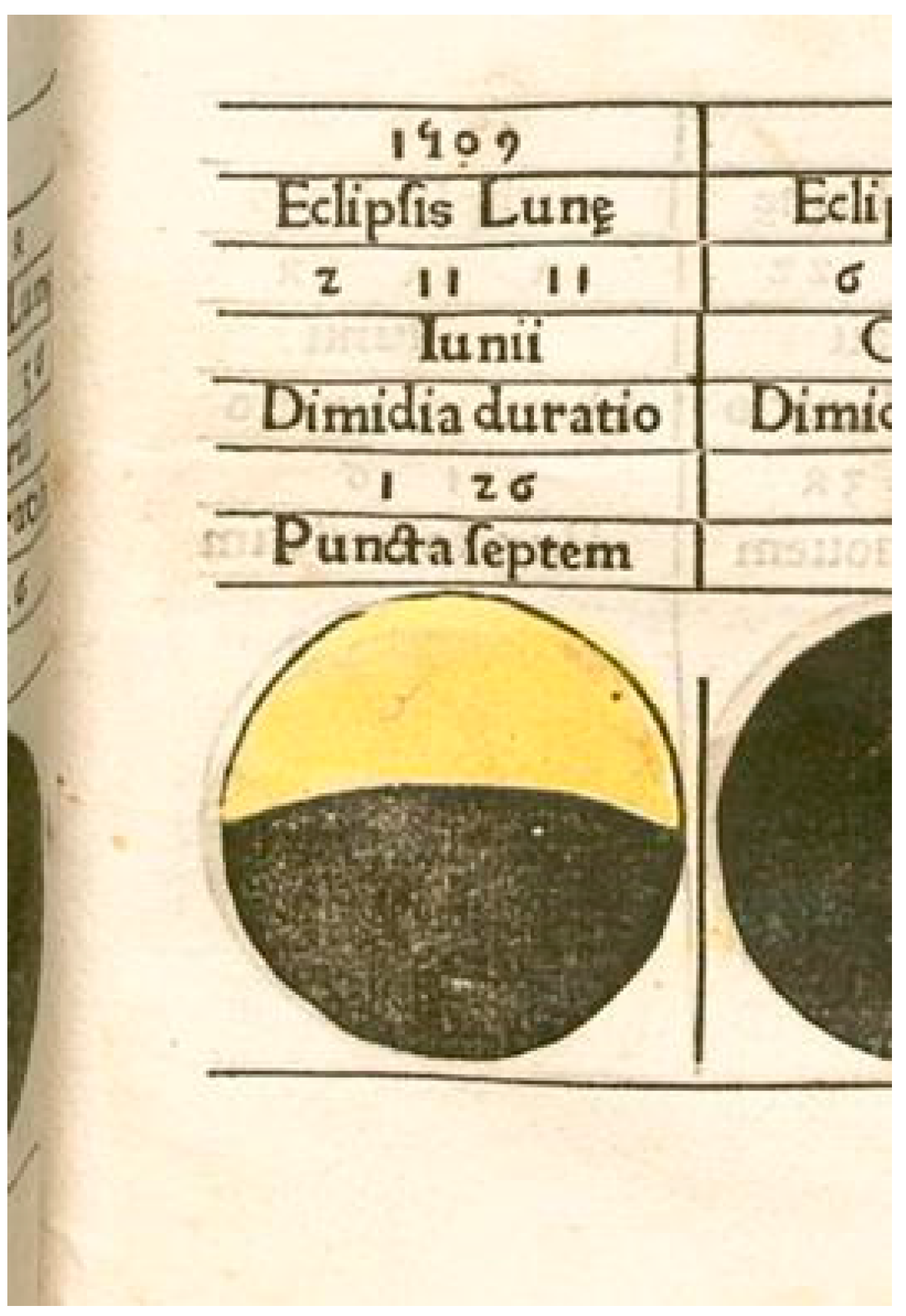
Furthermore, 3, 21, and 40 match the extant documents recording the eclipse. The five annual prognostics found in this article’s Appendix A, printed at the end of 1508 and authored by Cesare Avogaro (whose prognostic is available in Latin and the vernacular), Leandro Vicedomini (vernacular), Jacopo Pietramellara (Latin), and Ludovico Vitale (Latin), pay particular attention to this celestial event.3 They all predict a lunar eclipse for 2 June, agree on its importance, and underline the pervasive influence of this celestial event. Four out of five prognostics express the time of the eclipse in ora italica. For example, Avogaro’s prognostic informs readers that the mid-eclipse would occur at 3:36 (ora italica), a detail notable for its proximity to that inscribed on Campagnola’s print. If converted to other time-computation standards, these prognostics match other records of the eclipse scheduled for 2 June 1509 (a Saturday night). Regiomontanus’s Calendario, for instance, reports that the event would begin at 11:11 a meridie (p.m.) and last for 1 h and 26 min (Figure 7). Considering that in June at the latitude of Bologna or Venice the sun sets at about 8:50 a meridie (p.m.), the time recorded in Campagnola’s engraving is perfectly compatible with that found in Regiomontanus’ Calendario. At this point, all the numerical and visual data fall into place, with the notable exception of Libra’s glyph, which has so far eluded interpreters.

5. The Eclipse’s Effects

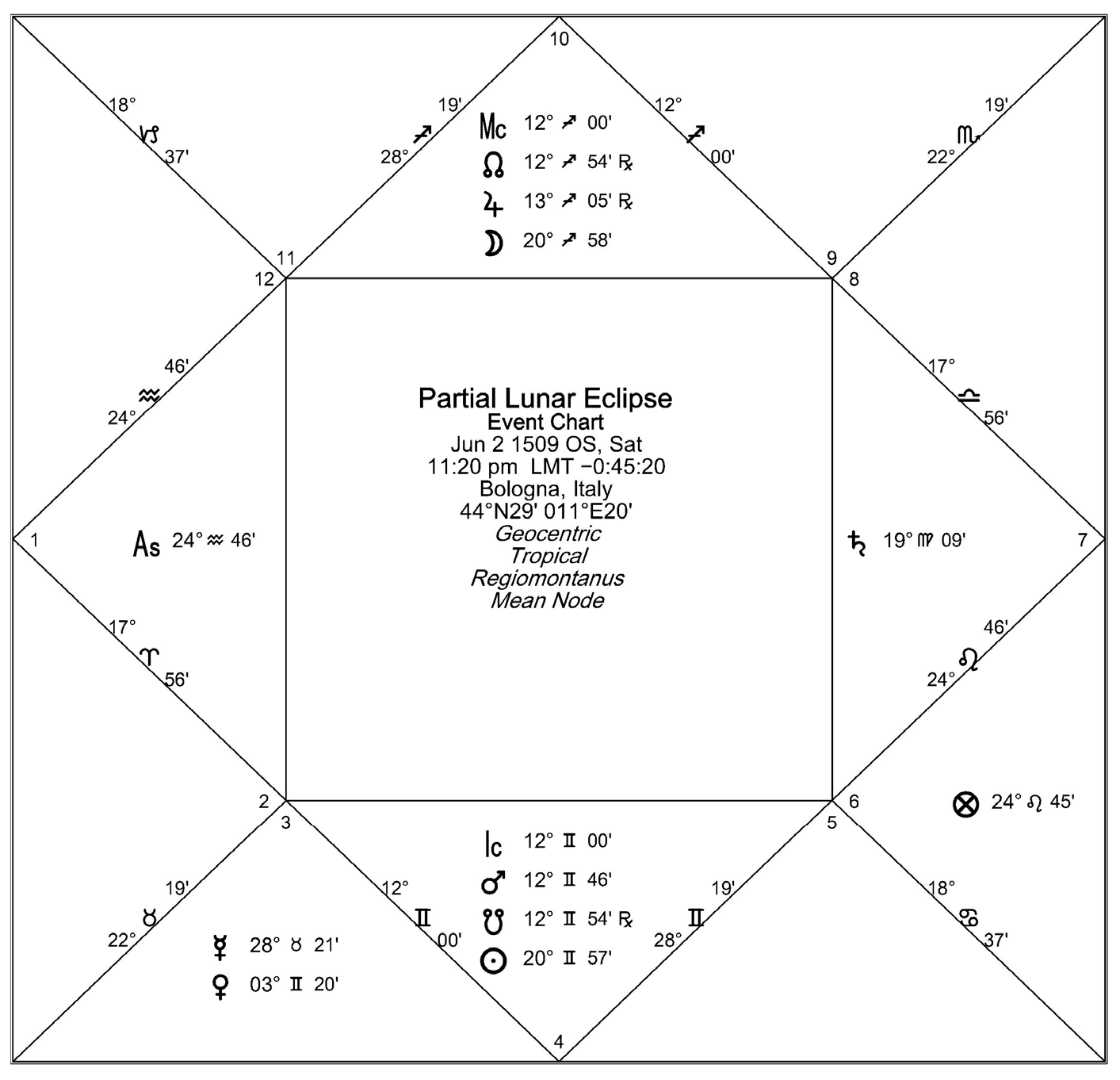
Previous scholars have correctly identified the zodiacal glyph on the astrologer’s disc as Libra. However, their interpretation clashes with the celestial phenomenon depicted in the disc. D’Amicone claimed that the sphere in the engraving depicts the Sun and Moon entering into conjunction (syzygy) specifically within the sign of Libra, concluding that the disc makes reference to the autumnal equinox of 1509 (D’Amicone 1992, p. 80). Further refining D’Amicone’s hypothesis, Gandolfi asserted that the artwork depicts the moment the Sun and Moon entered into conjunction (a new moon) in the sign of Libra on 13 September 1509. While endorsing D’Amicone’s interpretation, Gandolfi also refuted Anderson’s identification of the celestial phenomenon inscribed on the glyph as the eclipse of 2 June 1509, on the grounds that at that time the Sun was in Gemini and the Moon in Sagittarius, that is, far away from Libra (Gandolfi 2012, p. 179). In doing so, however, D’Amicone and Gandolfi do not consider how premodern authors of astrological prognostics interpreted eclipses.
In the first systematic examination of annual prognostics, Alexandre Tur recently demonstrated how these texts were not arbitrary but were grounded in a rigorous system of astronomical calculations (e.g., solar revolutions, preventions, and planetary aspects) supported by constant reference to authorities like Ptolemy, Haly Abenragel, and Albumasar to ensure their credibility. Tur’s investigation illustrates how these judgments were structured, typically organizing predictions thematically (weather, agriculture, health, war) and distinguishing between “universal” effects and “particular” predictions for specific regions, cities, social groups, or princes (Tur 2018). Tur’s study also singles out eclipses as objects of special interest among astrologers, with particular attention to a widespread predictive technique drawn from Ptolemy’s Tetrabiblos and regularly used to determine when, where, and how lunar or solar eclipses were expected to show their effects on nature, society, and politics (Tur 2018, p. 30). Ptolemy’s predictive technique sheds considerable light on Campagnola’s artwork, particularly the placement of Libra in the context of the 2 June 1509 lunar eclipse.
In Tetrabiblos (Book 2, Chapter 6), Ptolemy establishes that the timing of an eclipse’s effect is strictly determined by its position in the sky relative to the horizon. More specifically, ancient astrologers divided the future timeline into three distinct phases. If an eclipse occurs in the East (rising), its effects would begin immediately. If it occurs in the West (setting), the effects would be delayed until the final phase. However, if the eclipse occurs at Midheaven (Mc), the effects are suspended; they skip the first phase entirely and manifest only in the second period, that is, the middle third of the timeline (Ptolemy 1940, pp. 164–69). The lunar eclipse of 2 June 1509 took place while the Moon was located in the 10th House, that is, in Midheaven. Interpreted with Ptolemy’s rule, this indicates that the eclipse’s effects were not expected to appear immediately during the summer months (the first period). Instead, they would remain dormant until the arrival of the second period, that is, in the following season. In summary, one could paraphrase the astrological data found in Campagnola’s artwork in these terms: the 2 June 1509, eclipse would begin to show its effects when the Sun enters Libra on 13 September—the start of autumn—and intensify throughout this season.
Besides making sense of all the visual and numerical data found in Campagnola’s works, this interpretation also matches the extant astrological prognostics found in this article’s Appendix A. All the authors examined—Cesare Avogaro, Jacopo Pietramellara, Ludovico Vitale, and Leandro de Vicedomini—analyzed the upcoming lunar eclipse of 2 June 1509. Despite the event occurring in early summer, these astrologers converged on the prediction that its consequences would be delayed until the following season. Avogaro is the most precise, explicitly stating that the “malignant effects will begin on 13 September,” while Vitale similarly forecasts the onset for “around mid-September.” Pietramellara supports this timeline, noting that the impact would be felt “after August” and become most visible “toward the end of the Fall”, explicitly citing “Ptolemy’s commentators” as the authorities he followed to formulate his judgment. Their shared conclusion stems from their calculation that the Moon was located at the Midheaven (the 10th House), a position which, according to Ptolemaic doctrine, suspended the eclipse’s immediate influence and delayed its activation until the “second period” of the year.4 This conclusion perfectly matches the astrological information in Campagnola’s artwork. Do these considerations shed new light on its elusive iconography? Answering this question requires a brief methodological explanation.

6. Stars in the Spotlight

While earlier scholarship on Campagnola’s Astrologer often framed pre-modern astrology within an ‘occult’ or ‘hermetic’ culture, more recent investigations, informed by nuanced historiographical approaches, reveal this view to be largely untenable today. Starting with Dal Canton’s seminal articles, scholars have used Campagnola’s print as proof of the author’s hermetic interests (Dal Canton 1977, pp. 11–19, 1978, pp. 3–10). Matching the subject of the engraving with the tribute to Giulio Campagnola found in Giovanni Aurelio Augurello’s alchemical poem Chrysopoeia, scholars often imagine the Paduan artist as a kind of mysterious savant immersed in alchemy, astrology, magic, and a blend of “syncretic Neoplatonism” and Jewish Kabbalah (Carradore 2011, pp. 70–75). A canon of presumably hermetic authors, including Marsilio Ficino and Leone Ebreo, is often found in publications drawing from this scholarly tradition, which appears to build, often tacitly, on the influential narrative inaugurated by Frances A. Yates’ Giordano Bruno and the Hermetic Tradition. Recent scholarship on Western Esotericism, inaugurated by Wouter J. Hanegraaff, has contributed to the reappraisal of this narrative with greater granularity and prudence (Hanegraaff 2001, pp. 5–37).5 Synthetic projects that brought together, for instance, astrology and Neoplatonism did exist in Renaissance Italy and found their way into influential texts such as Marsilio Ficino’s De Vita.6 Texts such as Giovanni Agostino Panteo’s Cabala Chymica provide evidence of attempts to adapt cabalistic symbolism to alchemical operations (Forshaw 2013, pp. 361–89). However, operations of synthesis and thematization like these may be best understood as cases of what Kocku von Stuckrad calls discursive entanglements rather than instances of an occult or hermetic mentality (von Stuckrad 2013, pp. 312–19). This occult or “hermetic” historiography, as Rutkin has recently argued, is particularly insidious when dealing with the science of stars (Rutkin 2019, pp. 26–27).
Rather than being an occult art accessible to a small group of initiates, astrology was deeply entrenched in the daily life of pre-modern Italy. Even a passing look at Marin Sanudo’s Vite dei dogi, De situ, and Diari, for instance, provides evidence of the widespread knowledge of Venice’s horoscope of foundation—an important subtext, as I am about to propose, of Campagnola’s print (Centanni 2015, pp. 77–110). References to the city’s natal chart are omnipresent in the city’s symbolism, from the Crab (moeca) found on its coat of arms (allusions to the city’s Ascendant) to the decorations of the Bucintoro, the state barge that paraded through the city’s waters on Ascension Day (Urban 2001, pp. 105–16). Moreover, virtually everybody had access to the plethora of astrological information available on the numerous mechanical clocks that, as mentioned before, were becoming a common fixture of Italian urban centers such as Bassano del Grappa, Mantua, Padua, and Venice itself at the end of the Quattrocento. Built between 1496 and 1499 by Gian Paolo and Gian Carlo Rainieri, Saint Mark’s Clocktower and similar technologies allowed citizens to regulate their own lives and interpret current events following the course of the stars (Muraro 1984, pp. 603–9). If these factors were not enough, the invention of print also contributed to disseminating astrological information throughout Italian cities. As mentioned above, starting in the last decades of the Quattrocento, academics and a growing number of free-lance astrologers would publish succinct annual prognostics. An accessible prediction based on a chart erected when the Sun enters the constellation Aries, this popular genre relied on an established system matching Italian cities with the constellations of the zodiac, social groups with the seven planets, and other established divinatory techniques. In a few affordable pages, often available in Latin and the vernacular at the same time, readers of prognostics could find information about politics, society, conflicts, and weather patterns.7
Now, one cannot exclude that Campagnola’s grasp of astrology was as sophisticated and informed by newly rediscovered sources as, for instance, Ficino’s or Cornelius Agrippa’s. A child prodigy praised by his contemporaries for his remarkable learning, Campagnola, one learns from Antonio Carradore’s biography, might have indeed been an informed connoisseur addressing his engravings to a circle of like-minded individuals (Carradore 2011, pp. 55–134). However, the print’s imagery does not appear to be particularly arcane. For instance, it does not display symbols drawn from texts of very limited diffusion and difficult access, such as, to name a few, the Liber Bileth or the Clavicula Solomonis. Also, it does not display fonts borrowed from foreign alphabets, requiring special linguistic competencies. Given the public status of astrology in the daily life of Italian cities, therefore, I find it more reasonable to reinterpret Campagnola’s engraving in relation to a documented horizon of expectations formed by almanacs, prognostics, and other “mainstream” publications rather than an imagined library of quaint and curious volumes of limited diffusion. Likely, The Astrologer inscribes an allusion to a celestial event that Campagnola, his viewers, and contemporary astrologers would have easily remembered and discussed. With this caveat in mind, does the astrological chart of the eclipse help one decipher the iconography of Campagnola’s print?
Quinlan-McGrath warns historians from interpreting astrological charts. Astrology, the scholar reminds us, is immensely complex. Astrologers can use hundreds of rules to make sense of the data found on a chart. As the numerous detractors of the science of stars knew very well, moreover, contradictions are part of the game. Somebody, in other words, can demonstrate pretty much everything starting from an astrological chart, thus making this undertaking misleading for historical research. Nevertheless, Quinlan-McGrath continues, examining a chart may give us an idea of what astrologers of the time found interesting and guide our interpretation of historical facts or artworks (Quinlan-McGrath 2001, pp. 728–29). By investigating Agostino Chigi’s hypothetical birth-chart, for example, Kristen Lippincott and Quinlan-McGrath provide excellent insights for deciphering the iconography of Baldassare Peruzzi’s frescoes for the Sala di Galatea (Lippincott 1990, pp. 185–207; Quinlan-McGrath 1995, pp. 53–71). The horoscopes of the foundation of cities like Milan and Venice, moreover, are a valuable source of information for investigating the rationale behind the political decisions and ideology these cities cultivated (Quinlan-McGrath 2013, pp. 109–24). With this caveat in mind, the remainder of the article interprets The Astrologer based on what prognostics of the time had to say about the lunar eclipse of 2 June 1509. This event, I contend, was credited with special significance for Venice. So, let us start from the urban landscape in the background of Campagnola’s print.

7. The City in the Background

As mentioned earlier, The Astrologer sets up a symbolic relationship between foreground and background, subordinating the urban landscape to the astrologer’s operation. Except for Julia Triolo, however, scholars hesitate to identify the city in the background with Venice (Triolo 2001, pp. 52–63). However, the urban elements leaning on what appear to be a body of water, the imposing building provided with a colonnade and arches, and the two domes towering above it are reminiscent of a veduta of Saint Mark’s Basin, with distinctive elements of Palazzo Ducale and the Basilica of Saint Mark itself. Still very popular today, this view was already well known in Campagnola’s time. Jodi Cranston has recently argued that after Jacopo de Barbari finished his monumental View of Venice in 1500, this veduta became increasingly famous and found its way also into paintings not necessarily set in Venice. Inspired by de Barbari’s work, Titian’s Gozzi Altarpiece, Sebastiano del Piombo’s Death of Adonis, and other paintings of the time, Cranston illustrates, set their subjects on a non-existent land placed in the vicinity of the Basin (Cranston 2021, pp. 75–110). While the city in Campagnola’s engraving is not explicitly identified as Venice, its main traits intentionally evoke the iconography popularized by de Barbari. This suggestive resemblance was likely sufficient to conjure Venice in the contemporary viewer’s mind, allowing the city’s symbolic presence to ‘haunt’ the background and engage with local political anxieties and aspirations.
The relationship between foreground and background, I suggest, may be the visual transposition of what Rutkin insightfully calls an “astrological act” (Rutkin 2019, pp. 70–71). A symbolic grammar provided with its lexicon, morphology, and syntax, astrology entails a mathematical or astronomical part, which results in the drawing of the chart, and a conjectural one, which results in the prediction or judgment. Unless it is based on faulty tables or erroneous calculations, the mathematical/astronomical part resulting in the chart is to be taken as a model of the actual positions of planets against the band of the zodiac and in relation to each other at a given time and place. It is, as Albert the Great and Thomas Aquinas put it, a form of certain knowledge. Predictions, on the other hand, lead us onto a different ontology as they belong to the domain of possibility and uncertainty (Rutkin 2019, pp. 180–82). The contrast between foreground and background in Campagnola’s engraving effectively visualizes this epistemological dimension. The disc in the foreground presents us with accurate astronomical information. The print, however, invites the viewer to join the astrologer in interpreting these data and conjecture, so to speak, the city in the background; if not Venice, at least a possibility of this city.
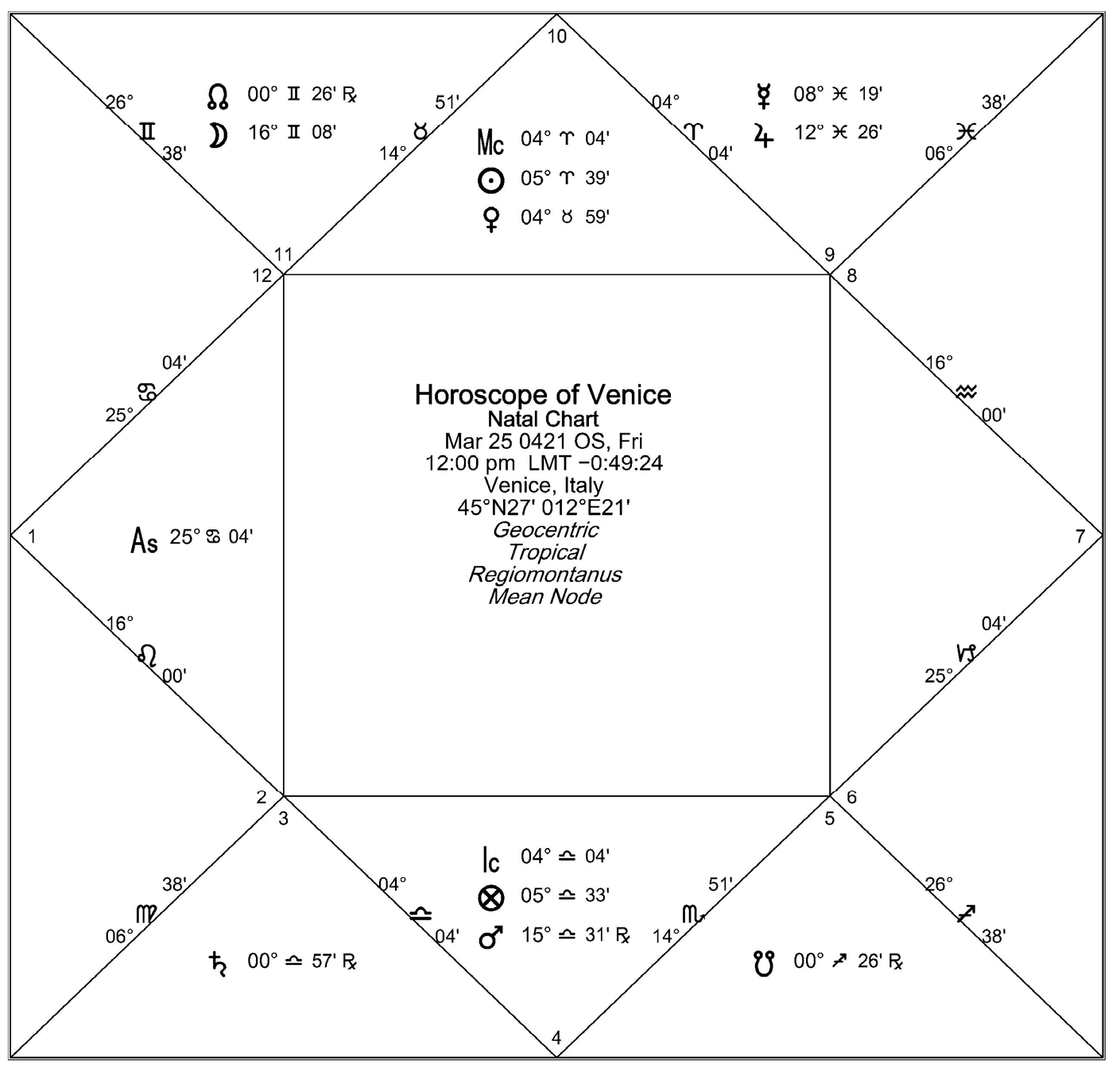
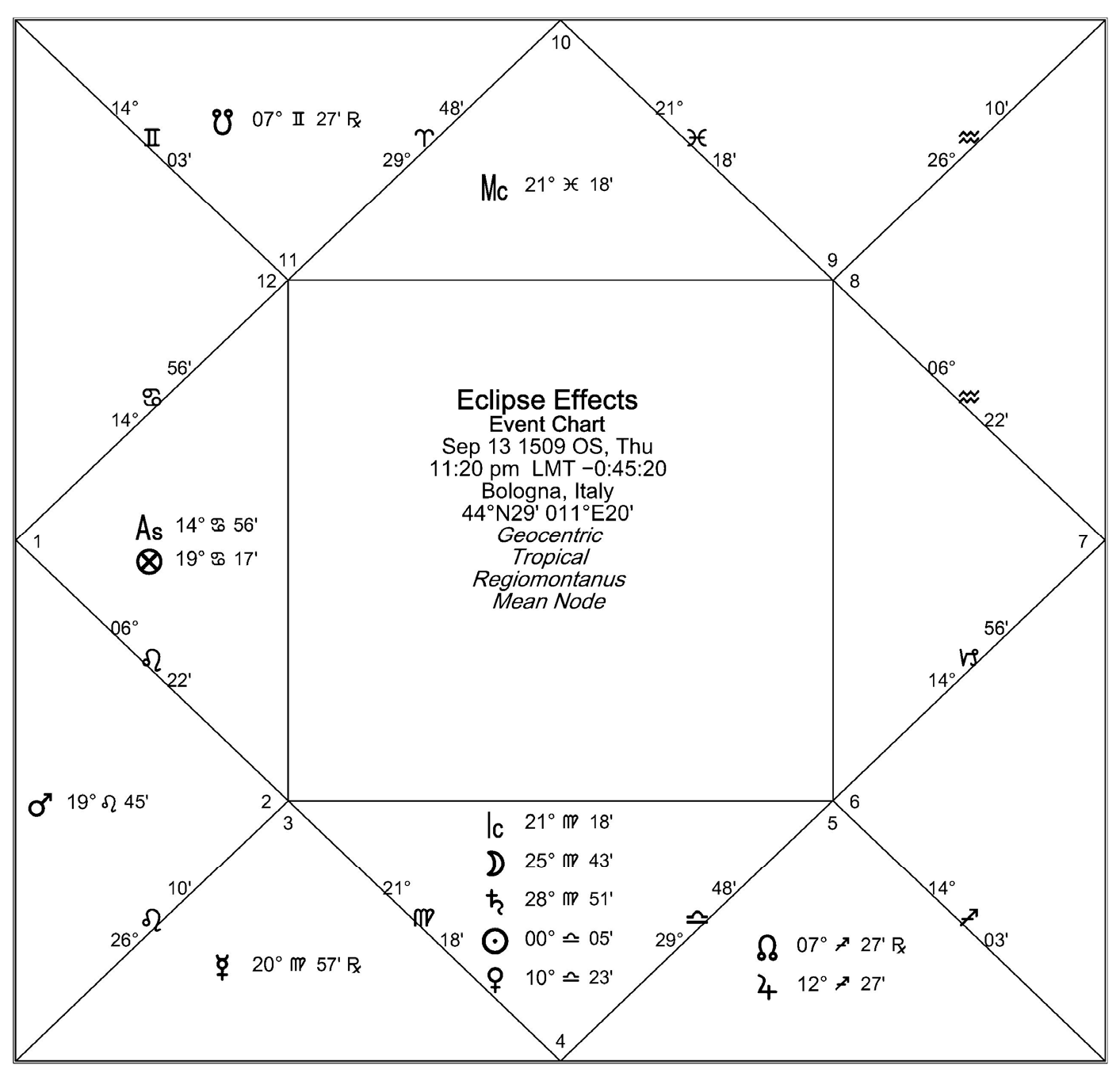
As mentioned earlier, the glyph of Libra placed on the astrologer’s indicates that the effects of the 2 June 1509 eclipse would begin to manifest at the beginning of the fall season, namely, on 13 September 1509. This prediction had special significance for Venetian viewers because the chart erected for this date presented considerable overlap with the horoscope of Venice. As mentioned earlier, Venetian chronicles, artworks, public events, and astrological iudicia regularly alluded to the city’s horoscope of foundation (Figure 8). Allegedly founded on March 25 at noon in 421 AD (a Friday), in its horoscope of foundation, Venice displayed Cancer in Ascendant, Aries in Midheaven, Libra in Imum Coeli, and Capricorn setting (Sanudo 1999, pp. 18–19). Quinlan-McGrath has persuasively argued that these features had the great advantage of aligning the foundation of Venice with the thema mundi, that is, the horoscope of creation. The choice of 25 March, moreover, connects the history of this city with the narrative of Salvation by having the first settlers arrive in Rivo Alto on the day of the Annunciation, that is, the conception of Christ nine months before Christmas. This horoscope, one may say, was engraved in people’s visual memory. Propagandists used it to explain Venice’s glorious destiny, immense wealth, and success. As the Venetian Republic was gradually imposing itself as a territorial power, the horoscope became a tool to celebrate the city’s wise administration of its possessions and territory. As Sanudo and Francesco Sansovino, among many others, did not fail to record, in Venice’s horoscope, Libra holds the Fourth House—a position traditionally associated with land, dominions, buildings, and other “earthly” matters. Astrologers would thus associate the sign of Libra with matters related to Venice’s just rule over the terraferma (Quinlan-McGrath 2013, pp. 117–19). Prognostics, once again, confirm this hypothesis.
The juxtaposition between land (characterized as barren and dangerous) and the city by the sea (characterized as formidable but serene) is the visual equivalent of contemporary predictions concerning the lunar eclipse of 2 June 1509. At the risk of treading into very dangerous waters, I will limit myself to remark that the annual prognostics examined for this article agree that 1509 would be a troubled year for most Italian cities. This resonates with D’Amicone’s reconstruction of the context of Campagnola’s The Astrologer and Gandolfi’s investigations of the astronomical events unfolding during the year. Further to these scholars’ general consideration, it should be noted that extant pronostics contrast Venice’s future with that of other Italian cities, predicting power and prosperity for this city. The pronostics draw these conclusions by matching upcoming celestial configurations, including eclipses, with an established system linking each city with the rising sign of its horoscope of foundation. As for the 1509 eclipse, extant pronostics make a favorable assessment regarding Venice by matching its horoscope of foundation with what appear to be two charts erected for the day of the eclipse itself (Figure 9) and the manifestation of its effects on the day of the Fall equinox (Figure 10). In both instances, Libra plays a crucial role. In the first chart, Libra holds the cusp of the Eighth House, traditionally associated with death and danger. The second chart, on the other hand, appears to be almost an exact reiteration of the horoscope of Venice itself. Just like at the time of the city’s foundation, the effects of the eclipse would begin to manifest themselves with Cancer in Ascendant and Libra in Imum Coeli. Campagnola’s artwork appears to visually translate the astrological judgment found in extant prognostics, a prediction one can paraphrase in these terms: when the effects of the eclipse begin to arise, Venice’s terraferma will be negatively impacted, but this city will be spared. Further examination of the print’s iconography confirms this interpretation, which resonates with annual prognostics and the widely known horoscope of Venice.
A notable element of Campagnola’s print is the reptile-like figure placed across the landscape and facing a skull with bones. In D’Amicone’s influential interpretation, this monster is a dragon and conceals an allusion to the Beast rising from the sea in Revelation 13:1 and echoes engravings of this biblical motif, such as Dürer’s (D’Amicone 1992, p. 85). More recently, Costanza Barbieri reinterpreted the monster as an allegory of an upcoming plague epidemic (Barbieri 2019, pp. 31–45). Both interpretations are plausible and resonate with the widespread climate of apocalyptic anxieties that animate the Veneto at the time of the Cambrai Wars. In Medieval and Renaissance art and literature, dragons are versatile signifiers whose meanings, as Sorce has recently summarized, spanned from Satan and sin to the Ottoman Empire. Dragons, as a result, are to be found in genres as different as hagiography, prophecy, spiritual guidance, and political propaganda (Sorce 2008, pp. 173–98).8 Expanding on this article’s interpretation of the astrological message of Campagnola’s artwork, however, I repropose identifying the monster with the eclipse itself.
In astrological literature, the dragon is a conventional metaphor used to designate the two points where solar and lunar orbits intersect, known in Latin as head/caput and tail/cauda of the dragon/draconis. In using the dragon to symbolize a lunar eclipse, once again, Campagnola was not relying on a particularly arcane iconography. In fact, since the Middle Ages, dragons biting, so to speak, the sun or the moon had been used to signify eclipses in manuscript illuminations and, most importantly, in woodcuts inserted in popular publications such as a German almanac printed in 1488 of considerable complexity and notable diffusion.9 Given the significant presence of German printers in Venice at the time, Campagnola would have had ready access to this iconographic tradition. Whether Campagnola’s print is the visual transposition of the eclipse chart, the chart of its inception, or—as I am more inclined to think—the evocation of a prediction based on both charts, the artwork appears to be communicating a message that, as the next section explores in further detail, would have resonated with Venetian viewers. The lunar eclipse of 2 June 1509 would afflict the part of Venice’s dominions subject to Libra, that is, the city’s terraferma. Venice, however, would be spared from these tragic events. In fact, these events would be the reiteration of the barbaric invasions, dangers, and devastations that, in 421, resulted in the foundation of this city. The stars, in other words, suggest that the current crisis would represent, for Venice, a moment of crisis but also an opportunity for renewal akin to a second birth. The closing sections of this article outline the possible context of this perception and assessment of the Cambrai War.

8. A Friendly Exhortation?

So far, this article has provided a novel interpretation of the astrological subtext of Campagnola’s The Astrologer, grounded in documented predictive techniques and prognostics, and used the astrological context to complement previous interpretations of this artwork’s iconography. These closing sections examine whether my interpretation matches other contextual evidence, starting from Campagnola’s poem, which Brooke has recently brought to scholarly attention. A specimen of sonetto caudato, that is, a sonnet followed by three additional verses, the text ends with what I suggest approaching as a kind of riddle. More specifically, Campagnola’s sonnet defines as blessed whoever may find a refuge in the shade (a l’ombra) of a city characterized as troubled (dagli affanni strecta) but nevertheless undefeated (invicta) and benedetta, an adjective one can translate as “blissful” but also as “fittingly named.” While the poet’s recipient and specific destination remain unidentified, I suggest that the sonnet’s hortatory tone and the print’s visual cues resonate with and even complement each other. If read in connection to political discourses of the time, they appear to read as an exhortation directed towards a broader Venetian audience grappling with the contemporary crisis, urging resilience and refuge:
  • Turmoil, attacks, violence, war
  • Fires, murder, and bitter destruction
  • Weeping, cries, laments without end:
  • Once again I see the preparation for these on earth.
  • O careworn Italia, already crushed to the ground,
  • Stars, planets, and divine will
  • Send a new scourge to your borders;
  • Thus the sky reveals, which never errs.
  • The third sphere still shows clearly
  • Souls inflamed by hate and vengeance
  • Greedy and intent only on their own security and advantage;
  • In the fourth degree a star is bound
  • To bring well-deserved happiness to the
  • Kind city now mired in suffering,
  • Unconquered (invicta) and blessed (benedetta).
  • Whoever will remain in the shade of its government
  • Can indeed call himself forever blessed.10
Political discourse, chronicles, and public oratory of the time often describe Venice as invicta, that is, “undefeated.” One may find this adjective too generic to single out Venice as the city celebrated in this sonnet. This adjective, however, had special relevance for Venetian readers and may have acted as a kind of easily recognizable dog whistle capable of eliciting an emotional response by harping on the readers’ civic pride. In a recent book, Sandra Toffolo illustrates that the adjective invicta belongs to a standardized topos. Its language is first documented in a letter addressed by an anonymous Venetian writer to King Louis of Hungary in 1380. Since then, Venetian writers regularly used this topos and the related adjective to extol the city for its intact dominion and undefeated liberty. Conventional as it certainly was, moreover, both topos and adjective came to prominence at the end of the Quattrocento and, most importantly, at the time of the War of Cambrai (Toffolo 2020, pp. 148–69). All this to say that in 1509, Venetian readers would have been particularly sensitive to this word choice and particularly keen to associate the adjective invicta with their hometown. The sonnet’s astrological terminology further confirms this identification.
Overall, the sonnet operates like the print: it juxtaposes the unidentified city mentioned in the coda with the rest of the Italian peninsula. The bellicose characterization of the third sphere suggests a reference to Mars, which was thought to occupy this position if the spheres are counted downward, that is, in Chaldean Order. This is compatible with astrological prognostics available at the time. Since Scorpio (Mars’ Domicile) was rising when the Sun entered Aries at the beginning of the year, astrologers like Avogaro assigned rulership over 1509 to Mars, predicting wars and social turmoil that match those evoked in the sonnet.11 As for the star bound (stella constrecta) in the fourth degree (quarto grado), the language is intentionally ambiguous. However, I suggest that the verse may conceal, like Campagnola’s print, an allusion to the horoscope of Venice and, more specifically, to the configuration of its Fourth House in Libra. In the text, stella means constellation, but it cannot be excluded that it also designates a planet, that is, an errant star. As for grado, at first sight, one may translate it as “degree”. In astrological texts such as Manilius’ Astronomica, however, gradus also refers to one of the Twelve Houses. If one interprets stella as a synecdoche for Libra, this constellation is indeed constrecta in the Fourth House both in the horoscope of Venice as well as on the day of the Fall equinox, when the eclipse of 2 June 1509 would begin to manifest itself. If one, instead, takes stella to mean ‘planet’, it should be noted that when the eclipse was expected to reveal its effects, Libra hosts and serves as the Domicile of Venus, the planet Venetians traditionally used to explain the origin of the city’s name. Venetian poets, propagandists, and artists traditionally associated their city, allegedly founded on Friday/venerdì, with the planet and goddess of Love born, like Venice, from the sea (Rosand 2001, p. 138; Centanni 2015, pp. 77–110). One may even suggest that astrological lore is the reason why the text qualifies the city as benedetta, that is, “fittingly named” after Venus.
Unfortunately, there is no definitive evidence that sonnet and engraving circulated together as a pair. If read together, however, they appear to be something more specific than a generic prediction based on the eclipse of 1509. In fact, if one relates the celestial configuration inscribed in the print with the sonnet, the hypothetical object they would form appears to function as a kind of friendly exhortation to go to Venice. By visually evoking a famous veduta of Saint Mark’s Basin or elusively alluding to Venice by means of an astrological riddle, in other words, the image and the text invites an unnamed recipient to leave the war-ridden terraferma behind and find refuge in a city that, if not certainly Venice, at least displays the essential features of this city juxtaposed to the war-ridden Italian territory. In a way that recalls the ambiguous language of astrological prognostics, moreover, the sonnet and the print construct this destination or city by means of ambiguous clues, thus engaging readers and viewers in the act of interpretation. Be that as it may, the urban architecture in the background of Campagnola’s print and the riddle placed at the end of the artist’s sonnet do not mention Venice directly. Rather, they conjure up this place in the spectator’s mind as an uncertain, albeit recognizable, possibility. Can one imagine a context for the peculiar object Campagnola’s print and poem may have formed together?

9. A Context for the Astrologer

Scholars generally agree that Campagnola’s The Astrologer voices a sombre assessment of the situation of Venice and Italy in general. This considerably bleak interpretation builds on a Zeitgeist argument interpreting astrology as a passive or escapist attitude in front of historical events at odds with Renaissance humanism. Rooted, in its essential features, in Ernst Cassirer’s Individual and the Cosmos, this narrative had the great merit of attracting scholarly attention to Giovanni Pico’s anti-astrological treatise Disputationes adversus astrologiam divinatricem (1494) and consecrating this philosopher’s vulgate image as the defender of human dignity and freedom. Time, however, has not been kind to this grand thesis. Recent scholarship on the science of stars, more specifically, provides a much more nuanced picture of this discipline and its presence in premodern culture. Imaginative and complex, premodern astrology strikes modern interpreters for its wide diffusion, public presence, and remarkable trust in the human capacity to construct possible futures, evaluate potentiality, weigh probability, and assess current events against what happened in the past or may happen in the future. New historiography on astrology, I suggest, might shed new light on the context of Campagnola’s The Astrologer.
One, as I did in this article, can interpret the numbers found on Campagnola’s engraving as part of the artwork’s subject. In astrological terms, then, the print and the sonnet would be the extant traces of a kind of friendly exhortation attuned with Campagnola’s biography in the aftermath of Agnadello. Circumstantial evidence corroborates this hypothesis. In his detailed biography of the artist, Carradore characterizes this period in the artist’s life as a “short circuit of arrivals and departures” (cortocircuito di arrivi e partenze) (Carradore 2011, p. 102). Faced with the ongoing crisis of Venice, people linked with the artist’s inner circle of friends and patrons, including Aldo Manuzio, decided to leave the city. Others, including Giovanni Aurelio Augurello and Girolamo Bologni, left the terraferma to relocate to Venice. These individual events were part of a broader context. While the Cambrai War was devastating its territory, Venice was a safe destination for a growing number of refugees. Different from its territory, the city could still rely on its maritime lines of supply, spared by the ongoing conflict. Although the exodus of war refugees brought about instability and social upheaval, it also enhanced Venice’s status in the eyes of poets and artists, who often used the crisis as an opportunity to celebrate the Serenissima.
Campagnola was not alone in interpreting these chaotic events based on recurrent astrological patterns. Numerous scholars, and most importantly Francesca Bosco Cortesi, investigated Campagnola’s intellectual affinity and documented friendship with Augurello (Bosco Cortesi 2016, pp. 226–28). In his poem Chrysopoeia, Campagnola’s friend and admirer hinted at the chaotic times of the Cambrai War in remarkably similar terms (Soranzo 2021, pp. 389–410). More specifically, Augurello compared the current refugees gathering in Venice in the aftermath of Agnadello with those who, in 421, laid down the first stone of Rivo Alto:
[…] now everyone strives to find a new home and goes away carrying all their belongings. While they abandon their fatherland, they all go to the Dominante, surrounded by mighty Amphitrite, in the same way that one day all things would have been safe under that sky beneath which the chosen people of Italy, running away, withdrew to survive on small islands and a narrow strip of water, while a measureless fire was ravaging all Italy, started almost everywhere by sinister barbarians, made to last for many years.
Augurello, Chrysopoeia, 2: 614–62312
In a way that deeply resonates with The Astrologer and Campagnola’s sonnet, astrology allowed Augurello and other intellectuals of the time to understand the Cambrai Wars, the Battle of Agnadello, and its chaotic aftermath as a moment of upheaval, but also as the reiteration of Venice’s foundation. Crafted, so to speak, in the shadow of the eclipse, The Astrologer might have transcended the anxiety and negativity of its times, voicing an empowering message of hope.

Funding

This research was funded by a SSHRC Insight Grant.

Data Availability Statement

No new data were created or analyzed in this study. Data sharing is not applicable to this article.

Conflicts of Interest

The author declares no conflict of interest.

Appendix A

Five annual astrological prognostics printed in 1508 focus on the upcoming year and single out the eclipse of 2 June 1509 as a significant celestial event. This appendix includes transcriptions and English translations of passages from these prognostics that provide astronomical and predictive data about the eclipse. The prognostics systematically reference the eclipse’s chart, discussing its angles (positions of planets relative to the horizon), houses (sectors of a chart representing life areas), aspects (relationships between planets), and faces (specific degrees of a sign). However, due to the low quality of these publications, they do not include visualizations. For the relevant charts, please refer to Figure 9 and Figure 10 of this article.
The transcription emended occasional minor errors, standardized the spelling of words and numbers, resolved abbreviations, and regularized punctuation. The translation standardized the use of technical terms by providing their English equivalents. In this process, it adheres to the English glossary of astrological terms devised by Charles Burnett (Burnett 1996, pp. 369–82).
A. Avogaro, Cesare. Allo Illustrissimo Duca de Ferrara Alphonso da Esti Pronostico de Cesaro Advogario Ferrarese nel Anno 1509. Ferrara, s.n., 1509 [USTC No. 811640]. Sevilla, Biblioteca Capitular Y Colombina Sign. top.: 12-1-13 (5)
B. Avogaro, Cesare. Ad Illustrissimum Ducem Alfonsum Estensem Cesaris Advogarii Ferrariensis Vaticinium Anni MDVIIII. Bologna: Giustiniano da Rubiera, 1509 [USTC No. 811641]. Sevilla, Biblioteca Capitular Y Colombina Sign. top. 12-1-13 (4)
C. Vicedomini, Leandro de. Allo Illustrissimo et Excellentissimo Principo Alphonso Duca de Ferrara Tertio Magistro Leandro de Vicedomini Monticulatno Pronostico Mcccccviiii. Ferrara, s.n., 1509 [USTC No. 863566] Sevilla, Sign. top. 12-1-13(6)
D. Pietramellara, Jabopo. Ad Reverendissimum in Christo Patrem dominum D. Angelum Leoninum Tiburtinum Episcopum Civitatisque inclite Bononie presidem Iacobi Petramellarie Artium et medicine doctoris pronosticon super dispositionem anni MDVIIII. s.l., s.n. [USTC n.a.] Sevilla, Biblioteca Capitular Y Colombina Sign. 12-1-13(3)
E. Vitale, Ludovico. Ad Reverendissimum in Christo Patrem Dominum D. Angelum Tyburtinum Episcopum S D N Reip. Bon. Digniss. Sub Lodovici Vitalis Bononiensis Pronosticon Anni 1509. Bologna: Jacopo Farfuglia, 1509 [USTC 863615] London, British Library C 27 h 22 (2)
Texts
A
Della Eclypse della Luna
Lo principio della eclypse lunare serà ali 2 de Junio la nocte sequente a hore 2 minuti 20 et obscurarà in la parte inferiore puncti 7. Lo mezo della eclypse serà a hore 3 minuti 36 de nocte ascendente 7 gradi de Aquario. La luna sera in gradi 21 minuti 3 de Sagittario in mezo del celo distante dalla cauda draconis gradi 8 minuti 9. Et durarà tale eclypse hore 2 minuti 32. Et ale hore 5 minuti 2 sarà tutta lucida. In principio della eclypse. Saturno serà in octava, nel mezo in settima, in la fine in sesta. Sicché li effecti maligni comenzaranno adi 13 de septembre et duraranno fine alla medietà de decembre, ma peiore seranno fin alli 10 de novembre. La quale eclypse mostra gran calori et venti calidi la estade et autunno et terremoti, infirmità pestifere, morte de quadrupedi. Nocerà alli ecclesiastici et legisti et multe a soldati, donne, vechij et rustici et più a quilli che hanno la terza facie de Sagittario o Gemini et la secunda di Virgini o Pesce. Li ecclesiastici seranno exaltati da armigeri. Doi almeno gran prelati moriranno questo anno. Un gran principe over capitanio de arme morirà per veneno o serà amazato o impicato. Li altri ioviali seranno fortunati dediti a luxuria. Quelli haverano la luna over lo ascendente in 21 grado de Gemini o Sagittario over 20 de Virgine seu Pisce patirano periculo de morte per febre acute et pestifere cum dolore de capo et ochii. A chi accasca in 10 over loco del sole patiranno alcuna vergogna, seranno dolori de testa, orechi, spalle et cosse over loci occulti. Li loci chi patiranno guerra o fame o peste seranno Hyspania, Sicilia, Sardegna, Corsica, Calabria, Apulia, Grecia, Creta, Dalmacia, Ungaria, Anglia, Flandria, Parise, Avegnon, Trenta, Friuli, Vicenza, Verona, Brixa, Como, Milano, Pavia, Piasenza, Parma, Regio, Cremona, Bologna, Fiorenza, Luca, Pisa, Sena, Varcella, Viterbo, Roma, Imola, Favenza, Cesena.
[The first contact of the lunar eclipse will occur on 2 June, at 2 h and 20 min after nightfall, and it will darken in the lower portion by 7 digits. The midpoint of the eclipse will be at 3 h and 36 min after nightfall, with Aquarius rising 7 degrees. The Moon will be at Midheaven, positioned at 21.3 degrees Sagittarius, with an 8.9-degree distance from the cauda draconis. The eclipse will last for 2 h and 32 min. At 5 h and 2 min, it will be completely clear. Saturn will be in the eighth house, seventh at the midpoint, and sixth at the end. Therefore, its malignant effects will begin on 13 September, last until mid-December, but worsen until 10 November. The eclipse signals great heat and hot winds during the summer and fall, accompanied by earthquakes, pestilential ailments, and the death of quadrupeds. It will adversely affect clergymen, lawyers, and especially soldiers, women, the elderly, and peasants, particularly those with the third face (i.e., Decan) of Sagittarius or Gemini and the second face (i.e., Decan) of Virgo or Pisces. Men-at-arms will yield to the authority of clergymen. At least two high prelates will die this year. Other jovial individuals will find fortune and be drawn to lust. Those with the Moon in Ascendant at 21 degrees Gemini, Sagittarius, Virgo, or Pisces will face mortal danger due to severe and pestilential fevers, experiencing pain in the head, ears, shoulders, thighs, or intimate areas. The regions that will experience war, famine, or plague include Spain, Sicily, Sardinia, Corsica, Calabria, Puglia, Greece, Crete, Dalmatia, Hungary, England, Flanders, Paris, Avignon, Trent, Friuli, Vicenza, Verona, Brescia, Como, Milano, Pavia, Piacenza, Parma, Reggio, Cremona, Bologna, Florence, Lucca, Pisa, Siena, Vercelli, Viterbo, Rome, Imola, Faventia, and Cesena].
B
De Eclypsi Lune
Initium lunaris defectus erit die secundo iunij nocte sequente horae 2 minuti 20 et incipiet obscurari in parte inferiori sui orbis. Medium vero eclypsis erit horae 3 minuti 36 noctis ascendente 24 gradu Aquarij et deficiet puncta 7 sed quinque par[t]es ex toto orbe lunari erunt radij solaribus illustrate. Et deficiet in 21 gradu minutis 2 Sagittarij in summo celi culmine Saturni tetragono sauciata. Deviatio ab eclyptica erit gradu 0 minutis 42 distans, a nodo meridionali gradus 8 minuti 9. Dimidia duratio erit hora 1 minuti 26. Tota duratio igitur hore 2 minuti 32. Quamobrem hora 5 minutis 2 noctis erit finis eclypsis et totum corpus Lune erit solaribus radijs illustratum. In principio eclypsis Saturnus erit in octava domo, in medio septimam infectabit, in fine vero sextam. Quare effectus erunt deteriores in principio et medio quam in fine sed maligni effectus incipient die 13 septembris et durabunt ad medietatem fere decembris sed peiores vigebunt usque ad 10 diem novembris. Eodem tempore Iovis et Martis diametra radio sed Mars a nodo meridiano depravatus. Quamobrem talis Lune defectus arguit in estate calores intensos et ventos calidos et autumno minatur terremotum et egritudines pestiferas sed quadrupedibus magnis mortem. Aliqu[a]ntulum quoque nocebit iovialibus utpote ecclesiasticis et legistis sed multum armigeris atque mulieribus quin et senibus atque rusticis et denique eis qui habuerint in horoscopo terciam faciem Sagittarii ac Geminorum aut secundam Virginis atque Piscium. Quondam Iupiter, eclypsis dominus, in 10 reperitur in suo domicilio cum capite draconis, ecclesiasticis supra martigenas hostes victoriam permittit et eis gloriam. Tamen duo ad minus viri ecclesiastici hoc anno cum morte vitam commutabunt. Quidam summus princeps vel bellipotens veneno aut laqueo morti occumbet aut obtruncabitur. Martiales ac saturnini erunt iovialibus parum amici. Tamen ioviales ad gaudia, iocos, lusus, convivia, et venereas voluptates solito procliviores. Qui habuerint horoscopum aut lunam in 21 gradu Geminorum aut Sagittarij aut 20 Virginis aut Piscium, timeant egritudines acutas subito pernecantes aut pestiferas sive oculorum dolores; qui habuerint decimam vel Solem in eisdem partibus honorum, iacturas; in secunda vero bonorum, apparebunt egritudines in capite, pectore, brachijs, humeris, manibus, coxis et partibus obscenis. Loca autem qui huius eclypsis malitiam magis sentient erunt: Aphrice pars magna, Hispania, Sicilia, Sardinia, Calabria, Apulia, Anglia, Flandria, Parisius, Avinio, Grecia, Creta, Dalmatia, Ungaria, Tridentum, Forumlivij, Vicentia, Ager Veronensis, Brixia, Comum, Mediolanum, Pa<p>[v]ia, Placentia, Parma, Regium, Cremona, Bononia, Florentia, Lucha, Pise, Sene, Imola, Faventia, Cesena, Vercelle, Viterbum, Roma regina urbium. Sed in ijs locis bello aliqua fame isti, illi vero peste aut egritudinibus acutis subito necantibus torquebuntur.
[The first contact of the lunar eclipse will occur on 2 June at 2 h and 20 min after nightfall, beginning to darken in the lower part of its circle. The midpoint of the eclipse will be at 3 h and 36 min after nightfall, with Aquarius rising 24 degrees. It will be a 7-digit eclipse, although the Sun will illuminate five sections of the Moon’s body. It will be in Midheaven at 21.3 degrees Sagittarius, wounded by Saturn’s square aspect. Its deviation will be 0.42 degrees from the ecliptic and 8.9 degrees from the south node. Its duration will be 1 h and 28 min on average, 2 h and 32 min in total. So, at 5 h and 2 min after nightfall, the eclipse will end, and the Moon’s whole body will be enlightened by the Sun. Saturn will be in the eighth house at first contact, at midpoint it will infect the seventh, and the sixth in the end. Therefore, the effects will be worse at first contact and midpoint than in the end, but the malignant effects will begin on 13 September and will last until about mid-December, although they will worsen until 10 November. At the same time, Mars and Jupiter are opposed, but the south node degrades Mars. For this reason, the lunar eclipse announces intense heat and hot winds in the summer, threatening an earthquake, pestilential ailments, and the death of large quadrupeds in the fall. Additionally, it will mildly affect jovial types such as clergymen and lawyers. Still, it will have a much more detrimental impact on men-at-arms, women, the elderly, and peasants—especially those with the third decan of Sagittarius or Gemini, or the second decan of Virgo or Pisces in their natal chart. Since Jupiter, the lord of the eclipse, is in the tenth place, and in his house with the caput draconis, it gives clergymen victory and glory over martial types. Yet this year, at least two clergymen will exchange death for life. Some illustrious or belligerent prince will either die or be murdered by poison or strangulation. Martial and saturnine individuals will not be particularly well-disposed toward jovial types. Meanwhile, jovial types will be more inclined than usual toward games, gambling, banquets, and indulgence in carnal pleasures. Individuals whose natal chart has the Moon at either 21 degrees Gemini or Sagittarius, or 20 degrees Virgo or Pisces, should be concerned about acute, rapidly fatal, or pestilential illnesses and ocular pain. Those with the Sun in the tenth house, associated with honours and losses, or in the second house, linked to material possessions, may experience illnesses affecting the head, chest, arms, shoulders, hands, thighs, and intimate areas. The regions that will experience the most potent effects of the eclipse will be a large part of Africa, Spain, Sicily, Sardinia, Calabria, Puglia, England, Flanders, Paris, Avignon, Greece, Crete, Dalmatia, Hungary, Trent, Friuli, Vicenza, Verona, Brescia, Como, Milan, Pavia, Piacenza, Parma, Reggio, Cremona, Bologna, Florence, Lucca, Pisa, Siena, Imola, Faenza, Cesena, Vercelli, Viterbo, Rome, queen of cities. But among these places, some will be troubled by war and hunger, others by plague and rapidly lethal acute diseases].
C
Capitulo nono dela eclypse dela luna
Nui diciamo in questo nono capitolo la eclypse dover esser nel anno 1509 adi 2 de zugno el di de Saturno la nocte sequente delo horologio a hore [om.] minuti 20 nel decimo grado de Sagittario nela decima casa e la luna cum lo capo del dracon coniuncta. Questa eclypse de potenti è risublimatione et è de subditi e rebelli de perfixione; significa le città da Sagittario irradiate come sono le parte inferiore de Ferrara, Napoli, Brixia, Ungaria, Dalmatia, la Marcha. Gran felicità e liberatione da molti mali significa.
[In this ninth chapter we say that the eclipse must take place on 2 June 1509, on Saturday at […] hours and 20 min of the clock after nightfall at 10 degrees Sagittarius, in the 10th house, with the Moon in conjunction with the caput draconis. This eclipse entails the resurrection of the powerful and the destruction of subjects and rebels. It refers to the cities enlightened by Sagittarius, such as the lower part of Ferrara, Naples, Brescia, Hungary, Dalmatia, and the Marca. It announces great happiness and liberation from many evils].
D
Que generaliter consideranda sunt in pronostico fiendo
[…] Quarto promittimus quatenus secunda Iunii presentis anni, quae eris dies sabatino, nocte sequenti hora 3 minutis 38 fere existente, luna in opposito solis et falciferi falcis radio tet<t>ragono, septem duodecime sui globi iuxta draconis caput, ab umbra terre obtenebrantur, ascendente tunc ultimo decanorum Aquarii supra horizontem inclitae urbis Bononie. Principium talis obumbrationis erit non longe post secundam horam noctis, finis vero hora 5 modo error non contingat hiis qui regulant horologium. Effectus autem huius ecclipsis erunt bella, festine mortis adventus in hominibus et domesticis animalibus, egritudines venenose cito pernecantes pregnantium aborsus, defectiones secretorum, mors famosissimi principis, oppressiones populorum ab armigeris, infortunia consiliorum regis et suorum principum. Item fraudes, subditorum rebelliones, et regnantium vicissitudines in locis precipue Sagit[t]ario et Geminorum signo dicatis ut sunt Pannonia, Albionis insula Britannie, Cicilia et Lombardorum regio in Italia et al.ia loca nobis gnota. Amplius hanc ecclipsim non parvi faciant domini, legiste, et magnorum prelatorum synodo propter eius Iovis infortunium hora ecclipsali sibi quam maxime adversa cernetur et ad mortem vel aliud genus infortunii plures eorum conducet. Et in paucis, haec ecclypsis tam pro nobilibus quam pro popularibus est mala. Tempus pululationis horum effectum erit post mense augusti attamen magis videbuntur versus finem auctumni ut asserunt Ptholomei expositores.
[What must be examined in general when casting a prognostic
Fourth, we forecast that on 2 June of this year, which will be a Saturday, at approximately 3 h and 38 min following the night, the Moon will be darkened by the Earth’s shadow when it opposes the Sun and squares Saturn (lit. “the sickle-bearer’s sickle”), seven twelfths of its orb is next to the caput draconis, and the last of Aquarius’ Decans rises over the horizon of Bologna, the famous city. The beginning of the eclipse will happen not long after the second hour of the night, the hand at the fifth hour, unless a mistake occurs to those managing the clock. This eclipse’s effects will be wars, the occurrence of sudden deaths of people and pets, deadly illnesses quickly killing pregnant women and causing miscarriages, betrayals of secrets, the death of a famous prince, oppressions of people by armed men, unfortunate outcomes of the king’s decisions and those of his princes. At the same time, conspiracies, rebellions of subjects, and toppling of rulers, especially in areas assigned to Sagittarius and Gemini, such as Pannonia, the British Island, Sicily, the Lombards’ region in Italy, and other places we know. Furthermore, lords, lawyers, and the synod’s high prelates should not disregard this eclipse: Jupiter’s affliction at the time of the eclipse announces the direst adversities to them and will bring death or other kinds of misfortune to many of them. In brief, this eclipse will be dire both for nobles and commoners. The time of impact of these effects will be after August but will be most visible toward the end of the Fall, as Ptolemy’s commentators explain].
E
De anni principio
[…] Fiet estatis initium die 2 iunij post meridiem hora 10 minutis 38 horologij vero hora prima munitis 30 fere. Et in hoc tempore erit luminarium oppositio et tunc de dyametro lunae visuali fere puncta scilicet cum dimidio erunt soli et nobis opposita. Lunaris vero corporis residuum radijs solaribus erit privatum Luna distante a nodo gradibus 8 minutis 6 fere. Eius vero ab ecclyptica deviatio erit gradis 0 minutis 31. Huiusmodi vero defectionis dominator efficitur Iu<p>piter qui a Marte viciatus dessignat popularibus contentiones et regentes facient subditis iniustitiam. Hora vero medie ecclypsis Saturnus in octava, luna i<f>[n]ficiens in colore ecclypsis nigredinem multiplicabit necnon febres cum habundantia flegmatis ac humiditatum catharalium ad pectus. Et apparebunt in extremitatibus crurium et in tibijs ulcerationes. Et hij effectus universaliter apparebunt in locis ignee triplicitati dicatis ut in Italia Rome, Florentie, Neapolis etiam civitas non erit a similibus immunis. Et quia Juppiter est in decimo retrogradus et in opposito Martis dessignat ecclesiasti[ci]s necnon eorum officialibus detrimenta et officialium aliqui ab eorum officijs deponentur ex malorum operum exercitatione. Dyametra Martis et Iovis applicatio officiales faciet luxurie et rapacitati deditos. Unde aliqui ipsorum aut carcerabuntur aut aliquo infortuniorum genere affligentur. Effectus huius ecclypsis alternati erunt et incipient circa medium mensis septembris et ad decembris initium terminabuntur. Acriores quandoquidem dabit effectus in fine, ex quo Saturnus erit ex opposito horoscopum vicians, Mars ex tetragono. Et incipiet obscurari hora noctis prima cum dimidia, status obscurationis hora secunda cum 54 minutis, finis vero hora quarta cum tertia. Secundum alios initium erit hora 2 minutis 5, medium hor<e>[a] 3 minutis 30, finis hora 4 minutis 55. Florentinis enim in itineribus tribuet molestias presertim longis, ex quo in nono ipsorum talis obscuratio reponetur. Malitia huius ecclypsis eos invadet in quorum nativitatibus prima horoscopi portio secunda[m] sagittarij decamoriam non transcendit. Hij vero in dominio ac magisterio patientur quibus similis Sagittarii portio in eorum celi medio fuerit reposita.
[On the beginning of the year
The summer will begin on 2 June at 10:38 p.m. (clock time), but at approximately 1 h and 30 min (after nightfall). And at this time, there will be an opposition of the luminaries, and then it will be pierced on the Moon’s visible diameter, that is, it will occur between us and the Sun. The rest of the Moon’s surface will be deprived of the Sun’s light when the Moon will be at approximately 8 degrees and 6 min from the node (i.e., caput draconis). Its deviation from the ecliptic will be 0 degrees and 31 min. Jupiter is the lord of this kind of obscuration: afflicted by Mars, it portends turmoil to commoners, while rulers will inflict injustice on their subjects. At the time of the eclipse’s midpoint, Saturn in the eighth (house), the Moon adding darkness to the eclipse’s colour, will multiply fevers with excess of phlegm and catarrhal buildups in the chest. And excoriations will appear on the arms’ extremities and on the legs. All these effects will appear in areas assigned to the Fire Triplicity in Italy, such as in Rome, Florence. And Naples will not be immune to similar effects. Since retrograde Jupiter is in the tenth (house) and opposed to Mars, it announces troubles to ecclesiastics and their functionaries, and others will be stripped of their office due to the perpetration of evil deeds. As a result, some of them will be either jailed or afflicted by other kinds of calamities. This eclipse’s effects will unfold in sequence; they will begin around mid-September and cease at the start of December. It (i.e., the eclipse) will cause the direst effects in the end, because opposed Saturn and square Mars will afflict the Ascendant. It will start darkening at the first hour and a half of the night, totality will be at the second hour and 54 min, the end at the fourth hour and a third. According to others, the first contact will be at 2 h and five minutes, midpoint at 3 h and 30 min, the end at the fourth hour and 55 min. It will bring about particularly lasting troubles in Florence’s territories, on account that this eclipse falls in their nineth (house). This eclipse’s evil will overcome those in whose natal chart the horoscope’s first section does not go beyond the second decan of Sagittarius. But this rulership and influence will also affect those who have a similar section of Sagittarius in Mid Heaven].

Notes

1
Quinlan-McGrath demonstrates that multiple timekeeping conventions coexisted in Renaissance Italy (from midnight, noon, sunset, and sunrise) and that context must determine which system a given document employs. While midnight-based computation had roots in civil and canon law, the prognostic literature directly relevant to Campagnola’s engraving consistently employs ora italica. Four out of five of the 1508 prognostics in this article’s Appendix A express the time of the eclipse in this standard.
2
On the mechanical clock of Padua and its use of ora italica, see (Pigatto 2010, pp. 9–12). On the subsequent changes made to adapt this clock to modern time computation, see (Liguori 2010, pp. 12–15).
3
See this article’s Appendix A for further bibliographic information regarding these annual prognostics.
4
All quotations refer to the editions and translations found in this article’s Appendix A.
5
Hanegraaf has further refined the argument broached in this seminal article in a considerable number of essays and books, and most notably in (Hanegraaff 2012).
6
On the limits of Yates’ interpretation of Ficino as “hermetic”, see (Hanegraaff 2015, pp. 179–209) and (Robichaud 2017, pp. 44–87).
7
Besides Tur’s thesis quoted above, valuable information about annual prognostics can be found in (Azzolini 2010, pp. 135–45). For an excellent contextualization of this genre and its diffusion, see (Westman 2011, pp. 62–75)
8
To the symbolic domains explored in Sorce’s study, one may also add the meaning assigned to dragons in alchemical sources. Ursula Szulakowska’s investigations on this topic reveal not only that dragons referred to specific chemical agents, but that they could also be charged with spiritual and escathological meaning. This domain, however, exceeds the scope of this study (Szulakowska 2000, pp. 140–41, 2006, pp. 115–16).
9
A reproduction of this woodcut is accessible on the Warburg Institute Iconographic Database: https://iconographic.warburg.sas.ac.uk/object-wpc-wid-bryd (accessed 8 April 2026).
10
The translation reproposes, with minor modification, that provided in (Brooke 2022, p. 263).
11
(Avogaro 1508, p. 1): “Lo introito del Sole in Ariete serà de sabbato alle hore 3 minuti 2 della nocte sequente, ascendente 28 gradi de Scorpione: Marte con Iove serà signore de l’anno” [Sun’s ingress in Aries will be on Saturday at 3 h and two minutes of the following night, the Ascendant 28 degrees Scorpio: Mars will be the Year Lord with Jupiter]. It should be noted that, once again, the time of the spring equinox is expressed in ora italica.
12
The translation is quoted, with minor changes, from (Soranzo 2019, pp. 238–39).

References

  1. Acidini, Cristina. 2013. Finestre, nebbie, bolle: La materia e l spazio del sogno. In Il sogno nel Rinascimento. Edited by Chiara Rabbi-Bernard, Alessandro Cecchi and Yves Hersant. Livorno: Sillabe, pp. 20–29. [Google Scholar]
  2. Anderson, Jaynie. 1997. Giorgione: The Painter of ‘Poetic Brevity’: Including Catalogue Raisonné. Paris: Flammarion. [Google Scholar]
  3. Avogaro, Cesare. 1508. Pronostico De Cesare Advogario Ferrarese Nel Anno 1509. Ferrara. [Google Scholar]
  4. Azzolini, Monica. 2010. The Political Uses of Astrology: Predicting the Illness and Death of Princes, Kings and Popes in the Italian Renaissance. Studies in History and Philosophy of Biological and Biomedical Sciences 41: 135–45. [Google Scholar] [CrossRef] [Scilit]
  5. Barbieri, Costanza. 2019. Ancora in Viaggio Nell’ermetismo E Nell’astrologia: Il Filosofo Di Giulio Campagnola E Un Ritratto Di Giorgione. Per Francesca Cortesi Bosco. Bergomum CXIII: 31–45. [Google Scholar]
  6. Blanchard, Joël, Giovanni Ciappelli, and Matthieu Scherman. 2020. La Correspondance de Girolamo Zorzi: Ambassadeur Vénitien en France (1485–1488). Genève: Droz. [Google Scholar]
  7. Bosco Cortesi, Francesca. 2016. Viaggio Nell’ermetismo Del Rinascimento: Lotto, Dürer, Giorgione. Biblioteca di arte 10. Padoua: Il Poligrafo. [Google Scholar]
  8. Bònoli, Fabrizio, Giuseppe Bezza, Salvo de Meis, and Cinzia Colavita. 2012. I Pronostici Di Domenico Maria Da Novara. Florence: Olschki. [Google Scholar]
  9. Brooke, Irene. 2018a. Giulio Campagnola, Landscape and Venetian Illumination. Colnaghi Studies Journal 3: 137–54. [Google Scholar]
  10. Brooke, Irene. 2018b. “Tratta Da Zorzi”: Giulio Campagnola’s Copies After Other Artists and His Use of Models. In Making Copies in European Art 1400–1600. Edited by Maddalena Bellavitis. Leiden: Brill, pp. 212–60. [Google Scholar]
  11. Brooke, Irene. 2020. New Evidence for the Life and Career of Giulio Campagnola. Print Quarterly 37: 371–82. [Google Scholar]
  12. Brooke, Irene. 2022. A Poetic Prognostication by Giulio Campagnola and Its Relationship to His Astrologer. Print Quarterly 39: 251–63. [Google Scholar]
  13. Brown, Katherine T. 2025. Arboreal Symbolism in European Art, 1300–1800. Routledge Research in Art and Religions. New York: Routledge. [Google Scholar]
  14. Burnett, Charles. 1996. Astrology. In Medieval Latin: An Introduction and Bibliographical Guide. Edited by Frank A. C. Mantello and Arthur G. Rigg. Washington, DC: Catholic University of America Press, pp. 369–82. [Google Scholar]
  15. Camporeale, Elisa. 2002. Telling Time in Florence Cathedral: The Frescoed Clock by Paolo Uccello and Coeval Toscan Public Clocks. Interfaces: Image, Texte, Langage 19/20: 187–251. [Google Scholar] [CrossRef] [Scilit]
  16. Carradore, Antonio. 2011. Giulio Campagnola, un artista umanista. Venezia Cinquecento 40: 55–134. [Google Scholar]
  17. Centanni, Monica. 2015. Venezia/Venusia nata dalle acque. In Lezioni Marciane (2013–2014. Venezia Prima Di Venezia: Archeologia E Mito, Alle Origini Di Un’identità. Edited by Maddalena Bassani and Marco Molin. Roma: “L’Erma” di Bretschneider. [Google Scholar]
  18. Cranston, Jodi. 2021. Green Worlds of Renaissance Venice. University Park: Penn State University Press. [Google Scholar]
  19. Dal Canton, Giuseppina. 1977. Giulio Campagnola “Pittore Alchimista”. Antichità Viva 16: 11–19. [Google Scholar]
  20. Dal Canton, Giuseppina. 1978. Giulio Campagnola “Pittore Alchimista”. Antichità Viva 17: 3–10. [Google Scholar]
  21. D’Amicone, Silvio. 1992. Apocalypsis Cum Mensuris: L’astrologo Di Giulio Campagnola. Venezia Cinquecento 2: 75–87. [Google Scholar]
  22. Dekoninck, Ralph. 2013. Dal sogno visionario profetico alla visione onirica artistica fra Nord e Sud. In Il sogno nel Rinascimento. Edited by Chiara Rabbi-Bernard, Alessandro Cecchi and Yves Hersant. Livorno: Sillabe, pp. 30–35. [Google Scholar]
  23. Forshaw, Peter J. 2013. Cabala Chymica or Chemia Cabalistica: Early Modern Alchemists and Cabala. Ambix 60: 361–89. [Google Scholar] [CrossRef] [Scilit]
  24. Gandolfi, Giangiacomo. 2012. Le metamorfosi dell’astrologo da Giulio Campagnola a Matthias Gerung. In Atti del XII Convegno Sia: Società Italiana di Archeoastronomia (Albano Laziale, 5–6 Ottobre, 2012). Edited by Vito F. Polcaro. Reggio Calabria: La Città del Sole, pp. 169–88. [Google Scholar]
  25. Hanegraaff, Wouter J. 2001. Beyond the Yates Paradigm: The Study of Western Esotericism Between Counterculture and New Complexity. Aries 1: 5–37. [Google Scholar] [CrossRef] [Scilit]
  26. Hanegraaff, Wouter J. 2012. Esotericism and the Academy: Rejected Knowledge in Western Culture. Cambridge: Cambridge University Press. [Google Scholar]
  27. Hanegraaff, Wouter J. 2015. How Hermetic Was Renaissance Hermetism? Aries 15: 179–209. [Google Scholar] [CrossRef] [Scilit]
  28. Hersant, Yves. 2013. Dipingere il sogno. In Il sogno nel Rinascimento. Edited by Chiara Rabbi-Bernard, Alessandro Cecchi and Yves Hersant. Livorno: Sillabe, pp. 13–19. [Google Scholar]
  29. Holberton, Paul. 1996. Notes on Giulio Campagnola’s Prints. Print Quarterly 13: 397–400. [Google Scholar]
  30. Landau, David. 2016. L’arte dell’incisione a Venezia ai tempi di Manuzio. In Aldo Manuzio e il Rinascimento di Venezia. Edited by Guido Beltramin. Venice: Marsilio, pp. 107–35. [Google Scholar]
  31. Liguori, Francesco. 2010. Il nuovo criterio nella misurazione del tempo. Padova e il suo Territorio XXV: 12–15. [Google Scholar]
  32. Lippincott, Kristen. 1990. Two Astrological Ceilings Reconsidered: The Sala Di Galatea in the Villa Farnesina and the Sala Del Mappamondo at Caprarola. Journal of the Warburg and Courtauld Institutes 53: 185–207. [Google Scholar] [CrossRef] [Scilit]
  33. Muraro, Michelangelo. 1984. The Moors of the Clock Tower of Venice and Their Sculptor. The Art Bulletin 66: 603–9. [Google Scholar] [CrossRef] [Scilit]
  34. Oberhuber, Konrad. 1995. L’ Amor Sacro E Profano Di Tiziano E La Grafica. In Tiziano: Amor Sacro E Amor Profano: Catalogo Della Mostra, Roma, Palazzo Delle Esposizioni, 22 Marzo–22 Maggio 1995. Edited by Maria G. Bernardini. Milan: Electa, pp. 201–11. [Google Scholar]
  35. Paltrinieri, Giovanni. 2006. Le meridiane a camera oscura della città di Bologna. In Atti Del Convegno Il Sole Nella Chiesa: Cassini E Le Grandi Meridiane Come Strumenti Di Indagine Scientifica. Rome: Giornale di Astronomia, pp. 75–82. [Google Scholar]
  36. Paltrinieri, Giovanni. 2020. L’antica ora italiana e i suoi vantaggi. Giornale di Astronomia 46: 27–33. [Google Scholar]
  37. Pellegrini, Franca. 2010. Cat. No. I.8: Astrologo. In Giorgione a Padova: L’enigma Del Carro. Catalogo Della Mostra, Padova, Musei Civici Agli Eremitani, 16 Ottobre 2010—16 Gennaio 2011. Edited by Davide Banzato. Milan: Skira, p. 188. [Google Scholar]
  38. Pigatto, Luisa. 2010. L’orologio astronomico di Piazza dei Signori. Padova e il suo Territorio XXV: 9–12. [Google Scholar]
  39. Ptolemy. 1940. Tetrabiblos. Edited by Frank E. Robbins. Loeb classical library 435. Cambridge: Harvard University Press. [Google Scholar]
  40. Quinlan-McGrath, Mary. 1995. The Villa Farnesina: Time-Telling Conventions and Renaissance Astrological Practice. Journal of the Warburg and Courtauld Institutes 58: 53–71. [Google Scholar] [CrossRef] [Scilit]
  41. Quinlan-McGrath, Mary. 2001. The Foundation Horoscope for St. Peter’s Basilica, Rome, 1506: Choosing a Time, Changing the Storia. Isis 92: 716–41. [Google Scholar] [CrossRef] [Scilit]
  42. Quinlan-McGrath, Mary. 2013. Influences: Art, Optics, and Astrology in the Italian Renaissance. Chicago: University of Chicago Press. [Google Scholar]
  43. Robichaud, Denis J. J. 2017. Ficino on Force, Magic, and Prayers Neoplatonic and Hermetic Influences in Ficino’s Three Books on Life. Renaissance Quarterly 70: 44–87. [Google Scholar] [CrossRef] [Scilit]
  44. Rosand, David. 2001. Myths of Venice: The Figuration of a State. Chapel Hill: University of North Carolina Press. [Google Scholar]
  45. Rutkin, H. Darrel. 2019. Sapientia Astrologica: Astrology, Magic and Natural Knowledge, Ca. 1250–1800. I, Medieval Structures (1250–1500): Conceptual, Institutional, Socio-Political, Theologico-Religious and Cultural. Cham: Springer. [Google Scholar]
  46. Ruvoldt, Maria. 2004. The Italian Renaissance Imagery of Inspiration: Metaphors of Sex, Sleep, and Dreams. Cambridge: Cambridge University Press. [Google Scholar]
  47. Sanudo, Marin. 1879. Diarii. Edited by Rinaldo Federico S. Fulin, Nicol Barozzi, Guglielmo Berchet and Marco Allegri. Venice: Visentini, vol. 6. [Google Scholar]
  48. Sanudo, Marin. 1999. Le Vite Dei Dogi: 1423–1474. Edited by Angela Caracciolo Aricò. Venice: La Malcontenta. [Google Scholar]
  49. Settis, Salvatore. 1994. Giorgione’s Tempest: Interpreting the Hidden Subject. Chicago: University of Chicago Press. [Google Scholar]
  50. Shank, Michael H. 2012. The Geometrical Diagrams in Regiomontanus’s Edition of His Own Disputationes (C. 1475): Background, Production, and Diffusion. Journal for the History of Astronomy 43: 27–55. [Google Scholar] [CrossRef] [Scilit]
  51. Soranzo, Matteo. 2019. Giovanni Aurelio Augurello (1441–1524) And Renaissance Alchemy: A Critical Edition of Chrysopoeia and Other Alchemical Poems, with an Introduction, English Translation and Commentary. Leiden and London: Brill. [Google Scholar]
  52. Soranzo, Matteo. 2021. Giovanni Aurelio Augurello: Poeta, Alchimista, Àugure. Rinascimento 61: 389–410. [Google Scholar]
  53. Sorce, Francesco. 2003. Di Ninfe, Astrologi E Pastori: Studi Di Iconologia Sulle Incisioni Di Giulio Campagnola. Venezia Cinquecento XIII: 47–110. [Google Scholar]
  54. Sorce, Francesco. 2008. Il drago come immagine del nemico turco nella rappresentazione di età moderna. Rivista Dell’istituto nazionale d’archeologia e storia dell’arte 63: 173–98. [Google Scholar]
  55. Szulakowska, Ursula. 2000. The Alchemy of Light: Geometry and Optics in Late Renaissance Alchemical Illustration. Symbola et Emblemata 10. Leiden, Boston and Köln: Brill. [Google Scholar]
  56. Szulakowska, Ursula. 2006. The Sacrificial Body and the Day of Doom: Alchemy and Apocalyptic Discourse in the Protestant Reformation. Aries Book Series 1; Leiden: Brill. [Google Scholar]
  57. Toffolo, Sandra. 2020. Describing the City, Describing the State: Representations of Venice and the Venetian Terraferma in the Renaissance. Leiden: Brill. [Google Scholar]
  58. Triolo, Julia. 2001. The Astrologer Plate. In La Maiolica Italiana Del Cinquecento: Capolavori Di Maiolica Della Collezione Strozzi Sacrati. Atti Del Convegno Di Studi, Museo Internazionale Delle Ceramiche (Faenza, 25–27 Settembre, 1998). Edited by Gian C. Bojani. Florence: Centro Di, pp. 52–63. [Google Scholar]
  59. Tur, Alexandre. 2018. Hora Introitus Solis in Arietem: Les Prédictions Astrologiques Annuelles Latines Dans L’europe Du XVe Siècle (1405–1484). Ph.D. dissertation, Doctoral School of Human and Social Sciences, Université d’Orléans, Orléans, France. [Google Scholar]
  60. Urban, Lina. 2001. Il Bucintoro. Nascita e fine di un mito. In Mito e antimito di Venezia nel bacino adriatico: Secoli 15–19. Edited by Sante Graciotti. Roma: Il Calamo, pp. 105–16. [Google Scholar]
  61. von Stuckrad, Kocku. 2013. Afterword: Mysticism, Gnosticism, and Esotericism as Entangled Discourses. In Histories of the Hidden God: Concealment and Revelation in Western Gnostic, Esoteric, and Mystical Traditions. Edited by April DeConick and Grant Adamson. Stocksfield: Acumen Publishing, pp. 312–19. [Google Scholar]
  62. Westman, Robert S. 2011. The Copernican Question: Prognostication, Skepticism, and Celestial Order. Berkeley: University of California Press. [Google Scholar]
Figure 1. Giulio Campagnola, The Astrologer, 1509. Engraving. Kupferstichkabinett, Staatliche Museen zu Berlin, Berlin. Source: Wikimedia Commons.
Arts 15 00075 g001
Figure 2. Richard of Wallingford, from Thomas of Walsingham, Gesta Abbatum Monasterii Sancti Albani, 14th century. British Library, Cotton MS Claudius E. IV, f. 201. Source: Wikimedia Commons.
Arts 15 00075 g002
Figure 3. Marcantonio Raimondi, The Dream of Raphael, ca. 1500–1520. Engraving. British Museum, London. Source: Wikimedia Commons/Web Gallery of Art.
Arts 15 00075 g003
Figure 4. Giulio Campagnola, The Astrologer (detail).
Arts 15 00075 g004
Figure 5. Johannes de Sacrobosco, Sphaera mundi, Venice: Erhard Ratdolt, 1482, fol. 17v. Woodcut. Bayerische Staatsbibliothek, Munich (4 Inc.c.a. 430). Source: Münchener DigitalisierungsZentrum (MDZ), digitale-sammlungen.de.
Arts 15 00075 g005
Figure 6. Giorgione, Fregio delle arti liberali e meccaniche, ca. 1496–1500. Fresco. Castelfranco Veneto, Museo Casa Giorgione. Source: Wikimedia Commons/Museo Casa Giorgione.
Arts 15 00075 g006
Figure 7. Johannes Regiomontanus, Kalendarium, Venice: Erhard Ratdolt, Bernhard Maler, and Peter Löslein, 1476. Detail showing the lunar eclipse of June 1509 (fol. 17r). Woodcut with hand colouring. Bayerische Staatsbibliothek, Munich. Source: Münchener DigitalisierungsZentrum (MDZ), digitale-sammlungen.de.
Arts 15 00075 g007
Figure 8. Horoscope of the Foundation of Venice, 25 March, 421 AD, noon. Chart generated using Solar Fire ©. Based on data provided in Marin Sanudo, De Origine, Situ, et Magistratibus Urbis Venetae, ed. A. Caracciolo Aricò (Venice: Centro Cicogna, 2011), p. 7.
Arts 15 00075 g008
Figure 9. 2 June 1509 (Julian Calendar). Chart for 11:20 p.m. (The Lunar Eclipse). Chart generated using Solar Fire ©.
Arts 15 00075 g009
Figure 10. 13 September 1509 (Julian Calendar). Chart for the Fall Equinox–Effects of the Lunar Eclipse. Chart generated using Solar Fire ©.
Arts 15 00075 g010
Disclaimer/Publisher’s Note: The statements, opinions and data contained in all publications are solely those of the individual author(s) and contributor(s) and not of MDPI and/or the editor(s). MDPI and/or the editor(s) disclaim responsibility for any injury to people or property resulting from any ideas, methods, instructions or products referred to in the content.