


Abstract
Granite residual soil slopes are highly water-sensitive and prone to rapid collapse, strength degradation, and rainfall-induced erosion. This study investigates the improvement effects and underlying mechanisms of carboxymethyl cellulose (CMC) on the water stability, mechanical properties, and rainfall erosion resistance of granite residual soil from Fuzhou, Fujian Province, China. Laboratory tests, including unconfined compressive strength (UCS) tests, direct shear tests, disintegration tests, slope rainfall scouring model experiments, X-ray diffraction test (XRD) and scanning electron microscopy (SEM) observations, were conducted to evaluate the performance and microstructural behavior of CMC-stabilized soils. The results indicate that the addition of CMC significantly enhances soil resistance to disintegration: the 24 h disintegration ratio decreased to 0.5% at 0.5% CMC content. The incorporation of CMC can significantly enhance the unconfined compressive strength (UCS) of the soil and lead to an increase in cohesion, while its effect on the internal friction angle is limited. Under simulated rainfall conditions (30° slope, 120 mm·h−1 rainfall intensity, 60 min duration), slopes stabilized with 0.5% CMC exhibited suppressed rill formation and a 47.5% reduction in sediment yield, accompanied by delayed moisture increase at different depths and reduced infiltration rates. Microstructural analyses reveal that CMC hydration forms gel-like films and filamentous bridges, promoting particle aggregation and pore filling, thereby constructing a denser particle network without generating new chemical compounds. This microstructure collectively enhances soil disintegration resistance, mechanical strength, and slope erosion resistance.
1. Introduction
Rainfall-induced surface erosion and progressive slope instability remain critical challenges in geotechnical and civil engineering, directly affecting the safety and economic performance of transportation infrastructure, building foundations, and hillside developments [1,2]. In the southeast coastal areas of China, granite residual soil (GRS) is widely distributed and commonly exposed on excavated slopes and foundation surfaces. Owing to its pronounced structural heterogeneity, developed porosity, and high water sensitivity, granite residual soil is highly susceptible to rapid collapse, strength degradation, and severe rainfall-induced erosion, often leading to rill formation, intensified slope scouring, and potential slope failure [3,4,5]. Conventional slope stabilization and reinforcement approaches typically employ cementitious materials, such as shotcrete, which, although effective in enhancing strength, raise concerns regarding high carbon emissions, ecological disturbance, and limited compatibility with landscape restoration [6,7]. In recent years, heightened environmental awareness has prompted the integration of vegetation into surface slope protection systems, providing substantial economic, ecological, and environmental benefits. Consequently, the focus of soil amendments has shifted from merely enhancing slope stability to improving the soil conditions of engineered slopes, thereby supplying essential water and nutrients for vegetation establishment while maintaining slope stability during early growth, effectively achieving both structural reinforcement and ecological restoration [8]. With the rapid development of slope monitoring and early-warning technologies, continuous observation based on surface deformation, moisture content, pore water pressure, and rainfall infiltration processes has become an important means of identifying rainfall-induced slope instability [9,10,11,12,13]. For granite residual soil slopes, shallow infiltration, softening, and erosion evolution are closely coupled. If green materials can improve the anti-infiltration capacity, erosion resistance, and hydro-mechanical response of surface soils, their application in slope protection would be of clear engineering significance and could complement modern monitoring technologies [14,15,16]. Accordingly, the development and deployment of green and high-performance soil amendments, alongside clarification of their functional mechanisms and application scope, have become central objectives in advancing ecological slope protection technologies.
In recent years, polymeric materials have gained increasing attention as environmentally friendly and sustainable soil amendments [1,2]. Research has shown that polymers can enhance soil engineering performance by improving strength, reducing permeability, and increasing durability; however, their effectiveness is highly dependent on soil moisture content, polymer dosage, and curing regime, and a standardized and comparable evaluation framework is still lacking [17]. Among bio-based polymers, carboxymethyl cellulose (CMC) has emerged as a promising candidate for soil improvement and erosion control due to its wide availability, environmental compatibility, and multifunctional properties, including thickening, gelation, and adsorption-mediated bonding [17,18]. The carboxymethyl groups along CMC chains can electrostatically interact with aluminum hydroxyl groups on kaolinite edges, while the long polymer chains can bridge multiple soil particles, thereby enhancing interparticle cohesion at the macroscale [18,19]. When combined with biopolymers such as chitosan, CMC can form interconnected networks via in situ gelation, leading to substantial improvements in soil mechanical performance [20]. Furthermore, the abundant hydrophilic groups along CMC chains confer notable water retention capability, which supports slope vegetation establishment and mitigates desiccation-induced cracking [14]. CMC has also been utilized for wind erosion control on soil slopes, improving surface crust formation and reducing soil loss [21]. Recent studies have shown that cellulose-based polymers can effectively improve the erosion resistance and hydraulic performance of soils. Cellulose-based curing agents and modified CMC have been reported to reduce infiltration, enhance water stability, and significantly improve the resistance of sandy or silty slopes to rainfall-induced erosion [22,23,24,25,26]. In rainfall-induced erosion scenarios, its excellent film-forming ability allows CMC to generate continuous films within soil pores after drying, thereby effectively enhancing slope erosion resistance. Additionally, dual-polymer stabilization layers composed of CMC and polyacrylamide (PAM) have been shown to substantially decrease sediment yield under high-intensity rainfall, with FTIR and SEM analyses elucidating the mechanisms of film formation, particle aggregation, and bridging [15,27]. In addition, CMC has been proven to regulate soil water movement, delay wetting front advancement, and enhance the water-retention capacity of different soil types. However, the existing literature has mainly focused on sandy soils, silts, organic clays, or saline-alkali soils, whereas studies on granite residual soil remain very limited, particularly under rainfall-induced erosion conditions [28,29,30,31]. Therefore, the effects of CMC on the disintegration behavior, hydro-mechanical response, and erosion resistance of granite residual soil still require systematic clarification.
In summary, although substantial progress has been made in the application of CMC for reinforcing granite residual soil slopes, several critical gaps remain. First, most previous studies have addressed either mechanical strength or erosion control in isolation, and few have developed a comprehensive evaluation linking water stability, mechanical properties, and rainfall scouring response within a single material system, despite the fact that these factors collectively govern slope erosion resistance under rainfall. Second, the effects of polymer dosage and its optimization have not been systematically investigated. Polymer-modified soils often exhibit non-monotonic dosage effects due to the interplay of competing mechanisms, including particle bridging, cohesion enhancement, and over-hydration-induced softening, highlighting the need for systematic dosage optimization tailored to specific soil types and field conditions [17,18]. Furthermore, mechanistic evidence for granite residual soils remains limited, particularly regarding the integration of soil moisture dynamics during rainfall infiltration (e.g., depth-dependent water content evolution and infiltration rate) with microstructural observations, which is essential to elucidate how polymer-induced particle aggregation, pore structure refinement, and surface crust formation contribute to rill suppression and reduced sediment yield [3,16].
Accordingly, this study focuses on granite residual soil from the Qishan area, Fuzhou, China, and systematically evaluates the combined effects and underlying micro-mechanisms of carboxymethyl cellulose (CMC) on soil water stability, mechanical performance, and resistance to rainfall-induced erosion. Remolded specimens were prepared with varying CMC contents, and a series of laboratory tests were performed, including immersion disintegration, unconfined compressive strength (UCS), and slope rainfall scouring model experiments, while SEM analyses were conducted to examine microstructural evolution. The objective is to develop an integrated disintegration–UCS–rainfall erosion evaluation framework, providing a mechanistic understanding and quantitative guidance for the application of CMC in environmentally sustainable slope protection within civil and geotechnical engineering contexts.
2. Materials and Methods
2.1. Materials
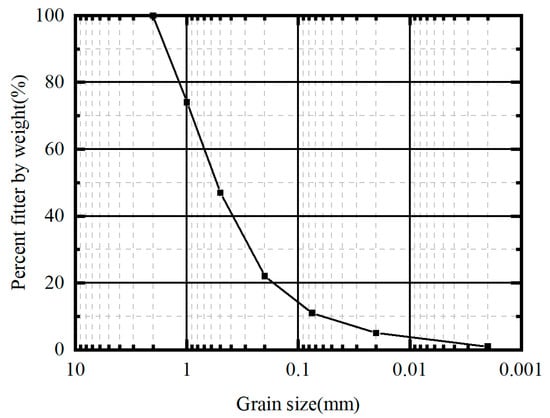
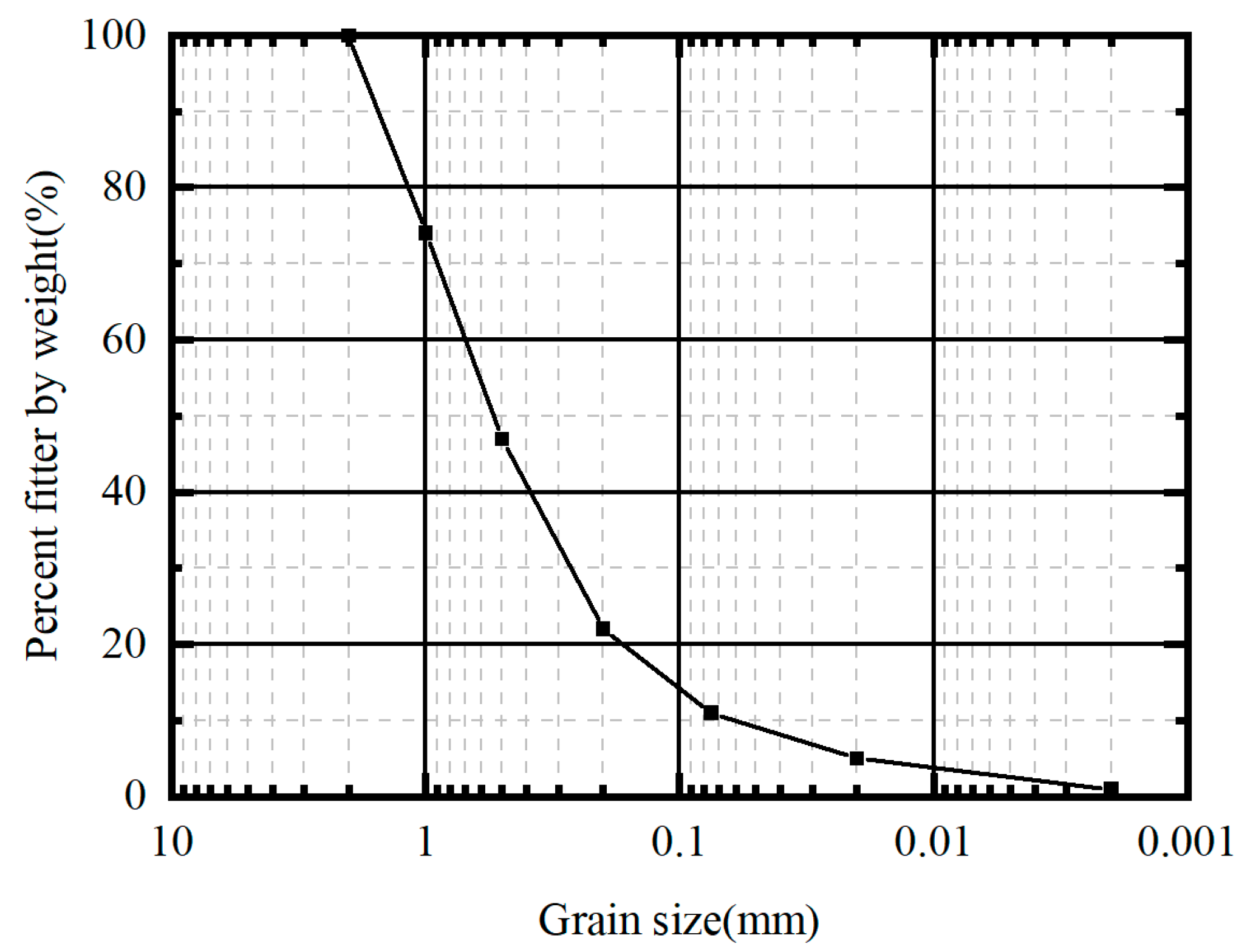
The soil employed in this study was obtained from the Qishan area, Minhou County, Fuzhou, Fujian Province, China, and is classified as granite residual soil. The natural soil exhibited a brown-red color, which turned pink upon air-drying. The samples were air-dried, crushed, and sieved through a 2 mm standard sieve, with particles smaller than 2 mm selected for the experiments. The basic physical properties of the soil were determined in accordance with the Standard for Geotechnical Testing Methods (GB/T 50123-2019) [32], and the measured results are summarized in Table 1. The particle size distribution curve is presented in Figure 1.
Table 1.
Basic physical properties of test soil.
Figure 1.
Particle gradation curve.
In this study, a commonly used cellulose ether, carboxymethyl cellulose (CMC, sodium carboxymethyl cellulose), was employed, with the chemical formula [C6H7O2(OH)2OCH2COONa]n. The CMC aqueous solution exhibits a pH range of 7–9 and is a transparent, colorless liquid. At 20 °C, a 2% (w/w) aqueous solution displays a viscosity of 5000 mPa·s. This material is produced by Chonglian Chemical Reagents Company, in Tianjin, China.
2.2. Preparation of Samples
The stabilizer type and dosage are key factors governing the performance of stabilized soils. Based on preliminary trials, carboxymethyl cellulose (CMC) was selected as the stabilizer. Four CMC dosages were considered, including 0.25% (w/w), 0.50% (w/w), 0.75% (w/w), and 1.00% (w/w). Remolded soil without stabilizer was tested as the control.
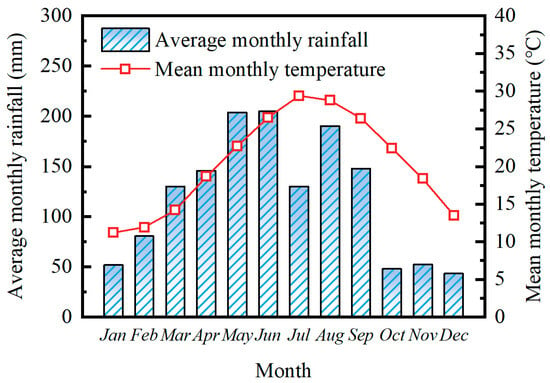
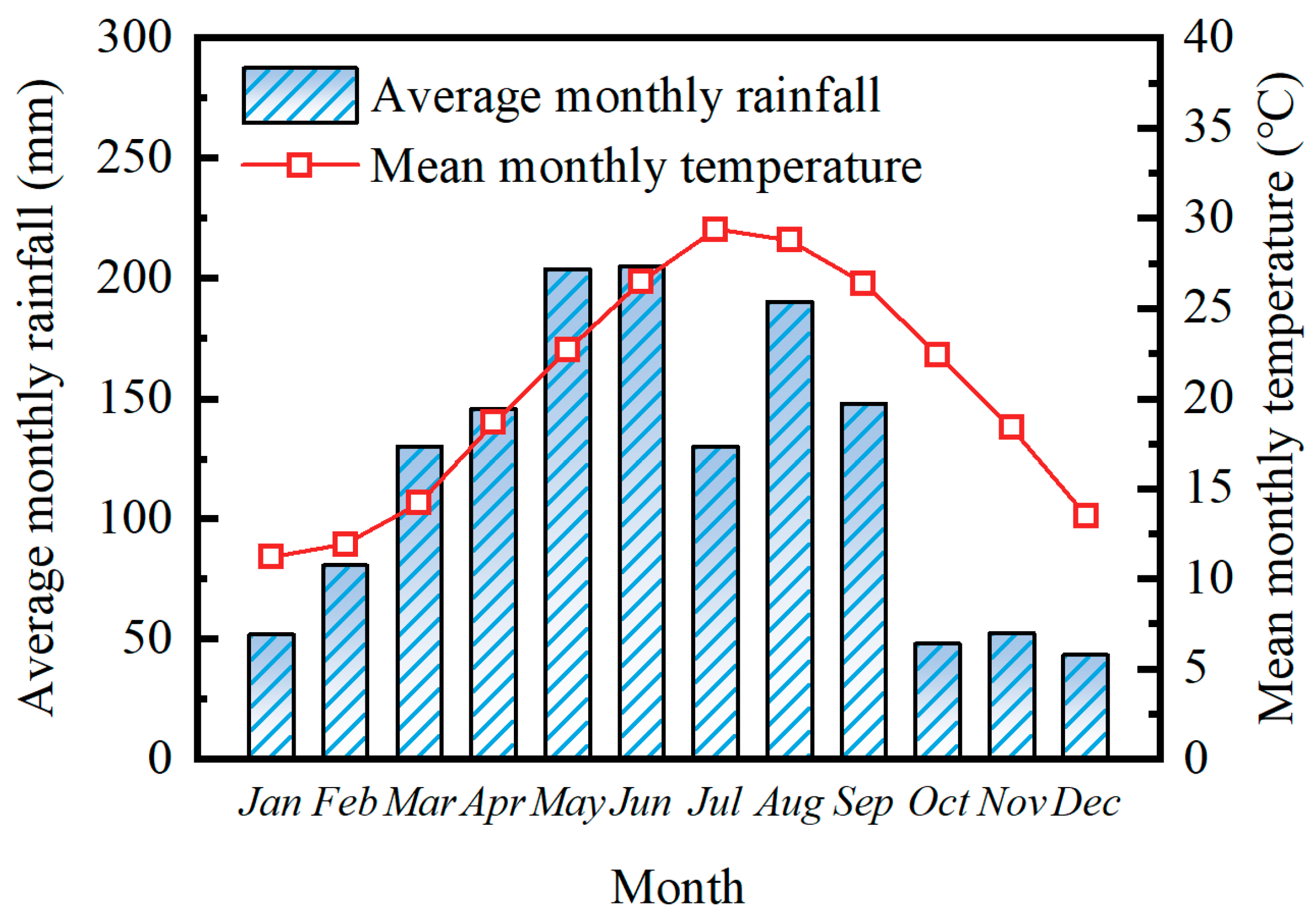
Specimens were prepared as follows. CMC was weighed as a prescribed fraction of the dry soil mass and thoroughly blended with the soil to ensure homogeneity. Water was then added using a sprayer until the optimum moisture content of the natural soil (23.6%) was achieved. The conditioned soil was sealed in polyethylene bags and cured for 24 h to allow moisture equilibration. After curing, specimens were formed in accordance with the Standard for Geotechnical Testing Methods (GB/T 50123-2019). For the unconfined compressive strength (UCS) test, cylindrical specimens (39.1 mm in diameter and 80 mm in height) were prepared by dynamic compaction using a rammer. For the disintegration test and the direct shear test, ring-knife specimens (61.8 mm in diameter and 20 mm in height) were prepared by static compaction using a hydraulic press. SEM specimens were fabricated using the same procedure as the UCS specimens, and a soil block was collected from the central portion of each specimen (20 × 20 mm). A slope model was required for the rainfall scouring test; the detailed preparation procedure is provided in a subsequent section. According to the results of the disintegration and strength tests, a CMC content of 0.5% exhibited the optimum overall improvement effect and was therefore selected as the representative dosage for the rainfall erosion model tests. Since this study focuses on slopes during the rainy season in the southeastern coastal region of China, all experiments were conducted under ambient temperature conditions corresponding to the rainy season in Fuzhou, Fujian Province (from May to September). The monthly average temperature and monthly average rainfall in this region throughout the year are shown in Figure 2.
Figure 2.
Distribution of monthly average temperature and rainfall of project area.
All specimens were prepared to a dry density of 1.4 g/cm3, corresponding to a degree of compaction of 0.90. The experimental program is summarized in Table 2.
Table 2.
Test groups.
2.3. Unconfined Compressive Strength Test
Unconfined compressive strength (UCS) tests were performed in accordance with the Standard for Geotechnical Testing Methods (GB/T 50123-2019). Prepared soils were molded into cylindrical specimens (39.1 mm in diameter and 80 mm in height) using dynamic compaction in five lifts. All specimens were produced at a dry density of 1.4 g/cm3 with a degree of compaction of 0.90, and three replicate specimens were tested for each condition. UCS testing was conducted using an unconfined compression apparatus at a constant displacement rate of 1.0 mm/min. Loading was continued until failure occurred or an axial strain of 15% was reached. The UCS was determined as the peak axial stress when a distinct peak was observed; otherwise, the axial stress at 15% axial strain was reported as the UCS.
2.4. Direct Shear Test
Shear strength is an important index reflecting the shear resistance of soil. To obtain the shear strength and corresponding parameters of the natural soil and polymer-treated soil, direct shear tests were conducted using a TKA-DDS-4F strain-controlled automatic quadruple direct shear apparatus manufactured by Nanjing TKAO Technology Co., Ltd. (Nanjing, China), in accordance with the Standard for Geotechnical Testing Methods (GB/T 50123-2019). After sample preparation, an appropriate amount of soil was weighed and statically compacted into ring-knife specimens with a diameter of 61.8 mm and a height of 20 mm. All specimens were prepared at a dry density of 1.4 g/cm3 with a degree of compaction of 0.90. Three identical specimens were prepared for parallel testing.
The direct shear test procedure mainly consisted of the following two steps:
(1) Consolidation and normal loading stage: the specimen was placed into the shear box, and vertical pressures of 100 kPa, 200 kPa, 300 kPa, and 400 kPa were applied.
(2) Rapid shear stage: the shear rate was controlled at 0.8 mm/min, and the test was terminated when the shear displacement reached 6 mm.
After the test, according to the recorded shear stress–shear displacement curves, the peak value or stable value on the shear stress–shear displacement curve was taken as the shear strength τ. If no obvious peak was observed, the shear stress corresponding to a shear displacement of 4 mm was taken as the shear strength τ. Based on these results, the shear strength–normal stress relationship was plotted. The cohesion c and internal friction angle φ of the soil were calculated using the Mohr–Coulomb criterion.
2.5. Disintegration Test
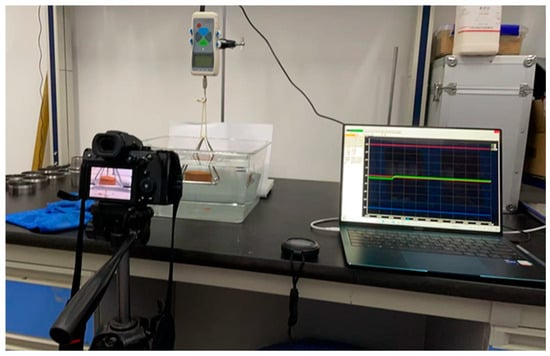
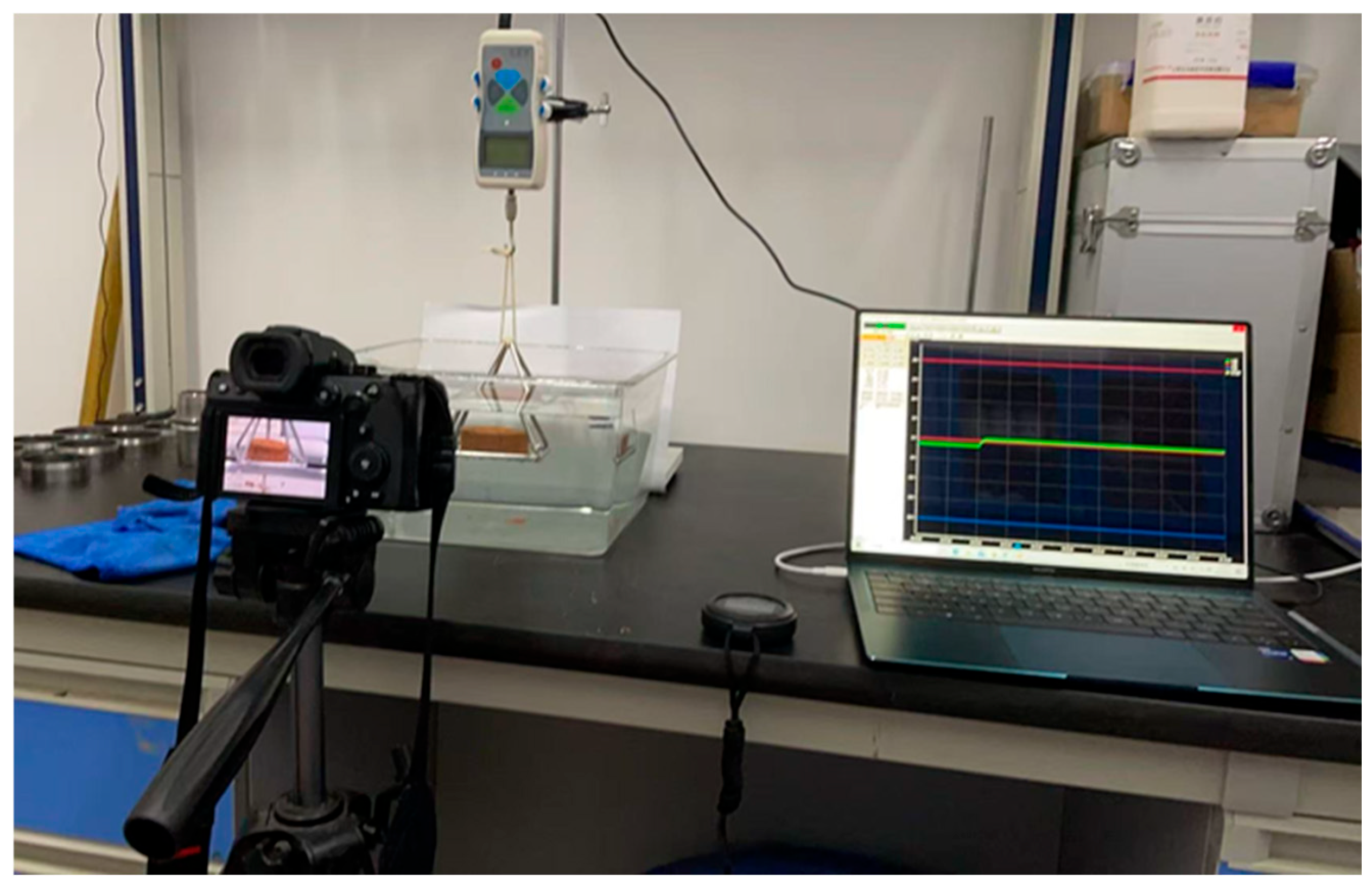
The disintegration test was performed in accordance with the Standard for Geotechnical Testing Methods (GB/T 50123-2019) using a custom-built apparatus (Figure 3). Each specimen was placed on a steel wire mesh with a 10 mm × 10 mm aperture and submerged in water. A force gauge was used to continuously monitor the mass change of the specimen supported by the mesh. The disintegration rate was adopted to quantify the disintegration rate and its temporal evolution [33]. In this study, the immersion duration was fixed at 24 h for all specimens. After the test, the disintegrated residues were oven-dried to determine the true disintegration rate. In addition, the disintegration curve was refined by incorporating the recorded damage images during the disintegration process, thereby ensuring that all disintegration rate values along the curve remained positive. The disintegration rate is calculated as:
where denotes the stabilized initial reading of the force gauge at the start of the test, and denotes the gauge reading at time t.
Figure 3.
Disintegration test equipment.
2.6. Rainfall Erosion Test
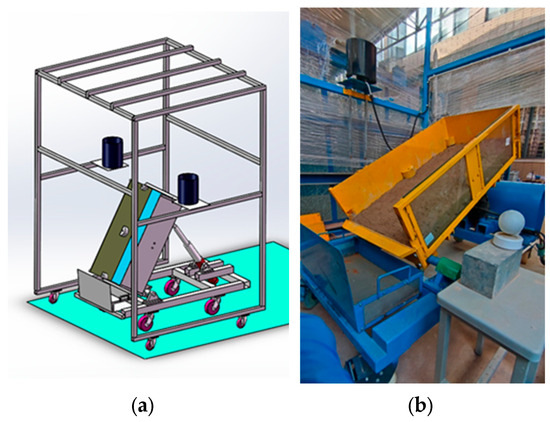
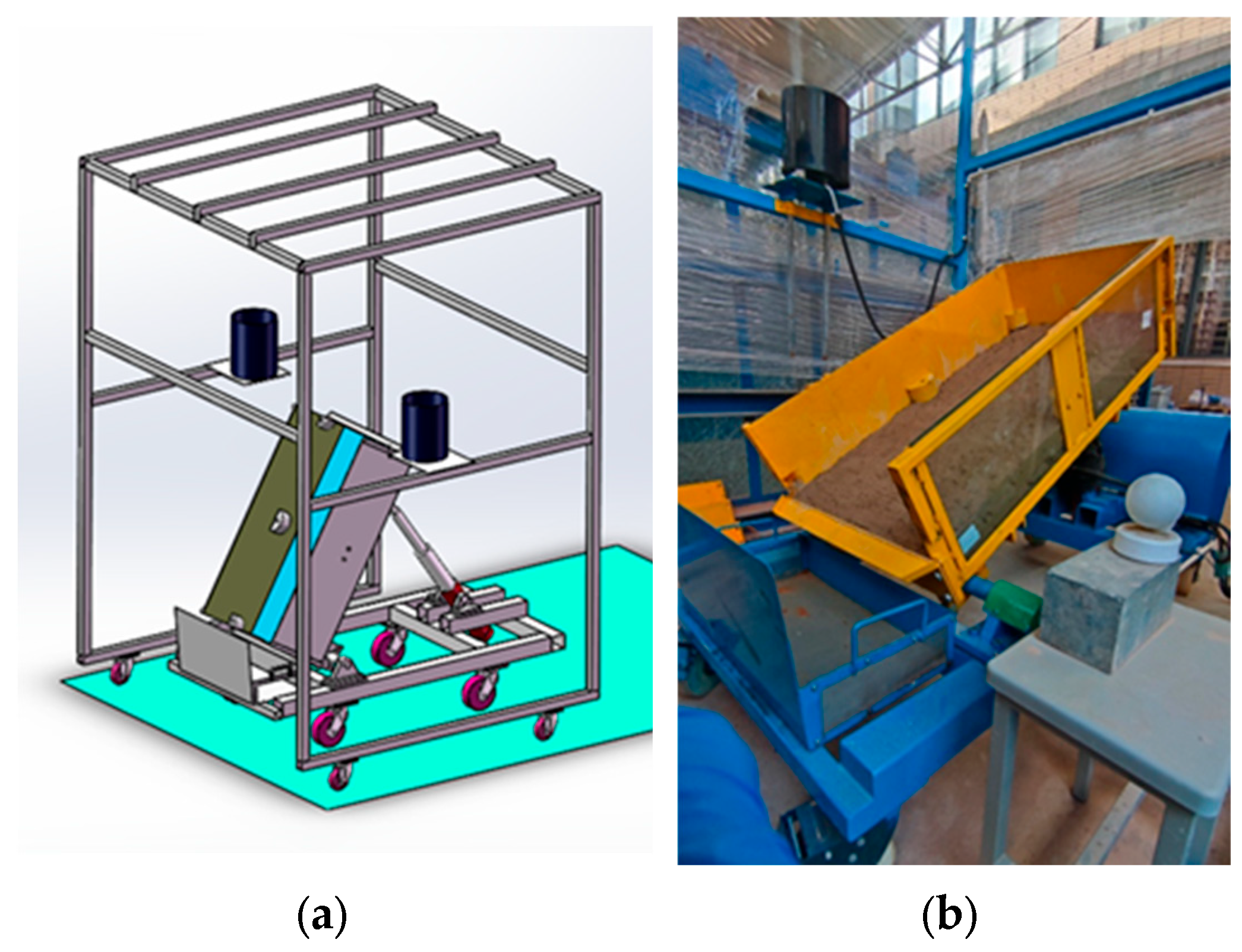
As illustrated in Figure 4, the simulated rainfall scouring setup comprised three components: a slope model, a rainfall generation unit, and a measurement system. The adjustable-slope model consisted of a soil flume (soil bin), a lifting hydraulic actuator, an inclination (angle) sensor, and a runoff-collection trough. The slope angle could be varied from 15° to 66°, corresponding to slope ratios of 1:2.75–1:0.5. For the present tests, the slope angle was fixed at 30°. The rainfall generation unit included a control panel, water tank, pump, water-supply lines, pressure gauge, rain gauge, and spray nozzles. By regulating nozzle pressure, the pressure gauge enabled control of rainfall characteristics. Four nozzle types (drizzle, light, moderate, and heavy rainfall) were available and could be combined to achieve the target rainfall intensity. The system provided rainfall intensities ranging from 20 to 180 mm/h. In this study, a rainfall intensity of 120 mm·h−1 was applied for 60 min, and the measured rainfall uniformity was ≥80%. The measurement system comprised water content sensors, a data acquisition unit, a digital camera, and equipment for oven-drying and weighing the collected sediment.
Figure 4.
(a) Rainfall erosion test device model; (b) Rainfall erosion test device.
Slope models were prepared as follows. Prepared soil with 0.5% CMC was weighed and placed into a mold (40 cm × 30 cm × 10 cm). The soil was compacted in three lifts, with a 2 cm void left at the rear wall to serve as a water-storage section. The target dry density was 1.4 g/cm3 (degree of compaction = 0.90); therefore, the required mass for each lift was calculated and weighed accordingly. Soil was then evenly placed into the mold, while water content sensors were embedded simultaneously at depths of 2, 4, and 6 cm, corresponding to the thickness of each lift. After each lift was leveled, compaction was performed using an acrylic plate and a hammer. The surface was subsequently scarified to minimize distinct interlayer boundaries, and the compaction procedure was repeated three times. Upon completion, the model was covered with a tarp and sealed for 24 h of curing. The rainfall scouring test was conducted after curing.
Prior to the simulated rainfall scouring test, the rainfall apparatus was activated, the rainfall parameters were set, and a pre-rainfall calibration was carried out to verify whether the measured rainfall intensity, as determined by the rain gauge, deviated from the target value. Meanwhile, the moisture sensors were calibrated. Both the natural soil slope and the CMC-stabilized slope were tested under the same rainfall intensity, rainfall duration, and experimental apparatus conditions to ensure the comparability of the data. A pre-rainfall calibration was conducted, and the rainfall intensity was verified using a rain gauge to ensure that the target intensity was achieved. After calibration, the camera was installed, the water content sensors were connected, and the slope-model flume was positioned. Initial water content data were recorded, and photographs of the initial slope surface morphology were taken. During the test, water content measurements and slope-surface photographs were acquired at 5 min intervals. Runoff water and detached sediments were collected in a plastic container throughout rainfall, and the rainfall event was terminated after 60 min. The slope erosion indices were defined as follows:
- Slope-surface runoff: starting from rainfall onset, the eroded soil–water mixture was collected every 5 min and measured by volume using a graduated cylinder.
- Sediment yield: the collected mixture was allowed to settle until a stable layered structure formed. The supernatant was removed using a syringe, and the remaining sediments were oven-dried at 105 °C for 24 h and weighed to determine sediment yield.
- Erosion characteristics: slope-surface images were captured every 5 min.
- Water content variation with depth: water content at each sensor depth was recorded every 5 min to evaluate rainfall infiltration.
2.7. X-Ray Diffraction Test
In this study, an X-ray diffractometer manufactured by BRUKER, (Karlsruhe, Germany) (model: D8 Advance), was used. The instrument was equipped with a semiconductor array detector, with a maximum count rate of 1.3 × 10⁸ cps, a 99% linear range of 1 × 10⁶ cps, and a background noise level of no more than 0.1 cps. The preparation procedure for the tested specimens was as follows. First, the soil samples were air-dried. The dried treated soil samples were then sieved and ground into 200-mesh powder. Approximately 2–4 g of the powdered sample was placed into the square groove of a glass sample holder and flattened using a glass plate. The test conditions were set as follows: Cu target, tube voltage of 40 kV, tube current of 20 mA, continuous scanning mode, step size of 0.02°, counting time of 0.1 s, and scanning range of 5–70°. The test data were processed and analyzed using Jade 6.5 software. By comparing the obtained diffraction patterns with standard spectra or PDF cards, the types of compounds present in the samples were identified.
2.8. SEM Test
The microstructural features of the different soil specimens were examined using a field-emission scanning electron microscope (FE-SEM; Nova Nano SEM 230, FEI CZECH REPUBLIC S.R.O., Hillsboro, OR, USA). Prior to imaging, specimens were oven-dried; a small fragment was then selected and sputter-coated with gold before SEM observation.
3. Results and Discussion
3.1. Unconfined Compressive Strength of Samples
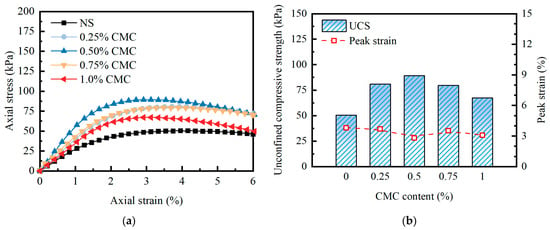
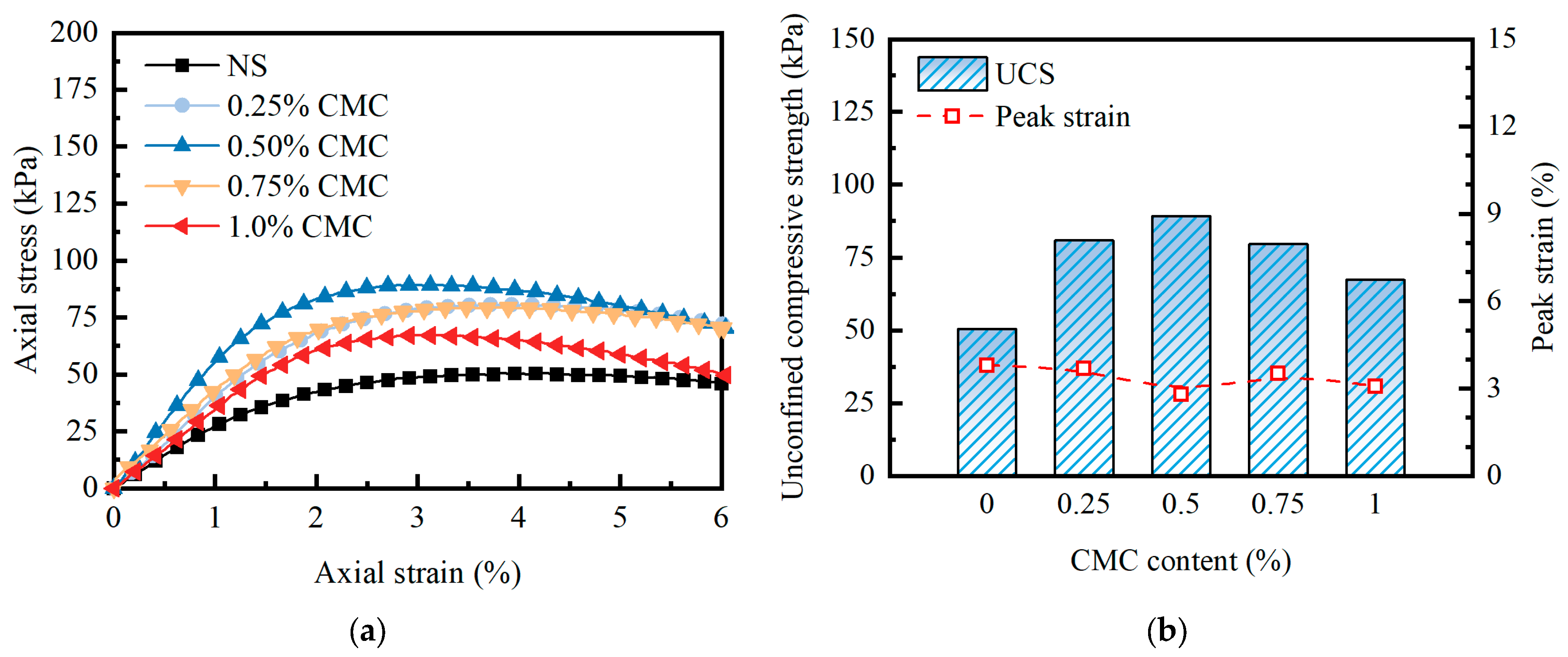
Figure 5 shows the results of the unconfined compressive strength test for CMC-stabilized soils with different dosages (0% dosage corresponds to natural soil). As shown in Figure 5a, the stress–strain curves indicate that the curves of CMC-treated soils at all dosages are generally located above that of the natural soil, demonstrating that CMC can increase the UCS of granite residual soil. In terms of curve shape, the addition of CMC did not change the failure mode of the natural soil. All specimens exhibited a strain-softening behavior characterized by an initial increase in stress to a peak value, followed by a gradual post-peak stress reduction. This suggests that, under the testing conditions of this study, the primary effect of CMC is to enhance the peak strength and pre-peak load-bearing capacity, rather than transforming the soil from a softening-type failure to a hardening-type failure or a markedly more ductile response. As also observed in Figure 5a, the pre-peak rising branch becomes steeper after CMC addition, indicating an improved initial resistance to deformation, which is generally associated with polymer film formation on particle surfaces and inter-particle bridging.
Figure 5.
(a) Stress–strain curve of sample; (b) UCS and peak strain curve of sample.
For CMC-stabilized soils with different dosages (Figure 5b), the peak strain shows little overall variation and is basically comparable to that of the natural soil, indicating that the addition of CMC does not significantly change the ductility and deformation uniformity of the soil. In terms of the trend of UCS with dosage, the strength of CMC-treated soil first increases and then decreases. In the low-dosage stage (0.25–0.50%), the strength increase is more pronounced and reaches a relatively maximum value of 94.3 kPa near the 0.5% dosage, which is 87.3% higher than the 50.4 kPa of the natural soil. When the dosage further increases to 0.75% and 1.0%, the UCS decreases, but it remains overall higher than that of the natural soil. This indicates that CMC stabilization of granite residual soil has an effective dosage range: an appropriate dosage can fully exert the bonding-enhancement effect, whereas excessive dosage reduces the efficiency of strength gain. The possible reasons are as follows. When the CMC dosage is within an appropriate range, CMC absorbs water and swells to form a viscous gel, which can coat particle surfaces and form bridging structures between particles, while also filling pores and densifying the structure. This makes the force-transmission paths of the soil skeleton more continuous, thereby significantly increasing the UCS. When the CMC dosage is relatively high, the increased gel phase may occupy part of the soil skeleton space and form local gel-enriched zones. During compressive loading, because the stiffness and strength of the polymer itself are limited, these zones can easily become relatively weak regions where deformation and slippage occur, resulting in a decrease in peak strength. In addition, an overly thick polymer coating layer may weaken effective inter-particle interlocking and frictional resistance, thereby inhibiting further strength improvement.
3.2. Shear Strength of Samples
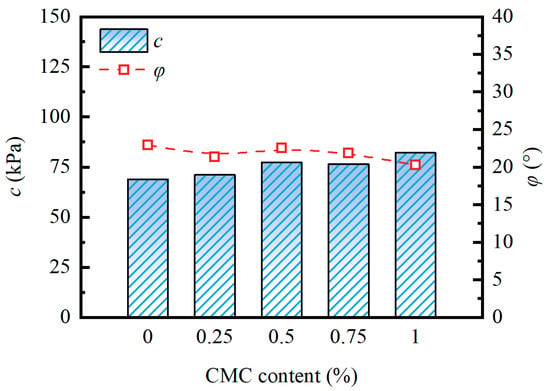
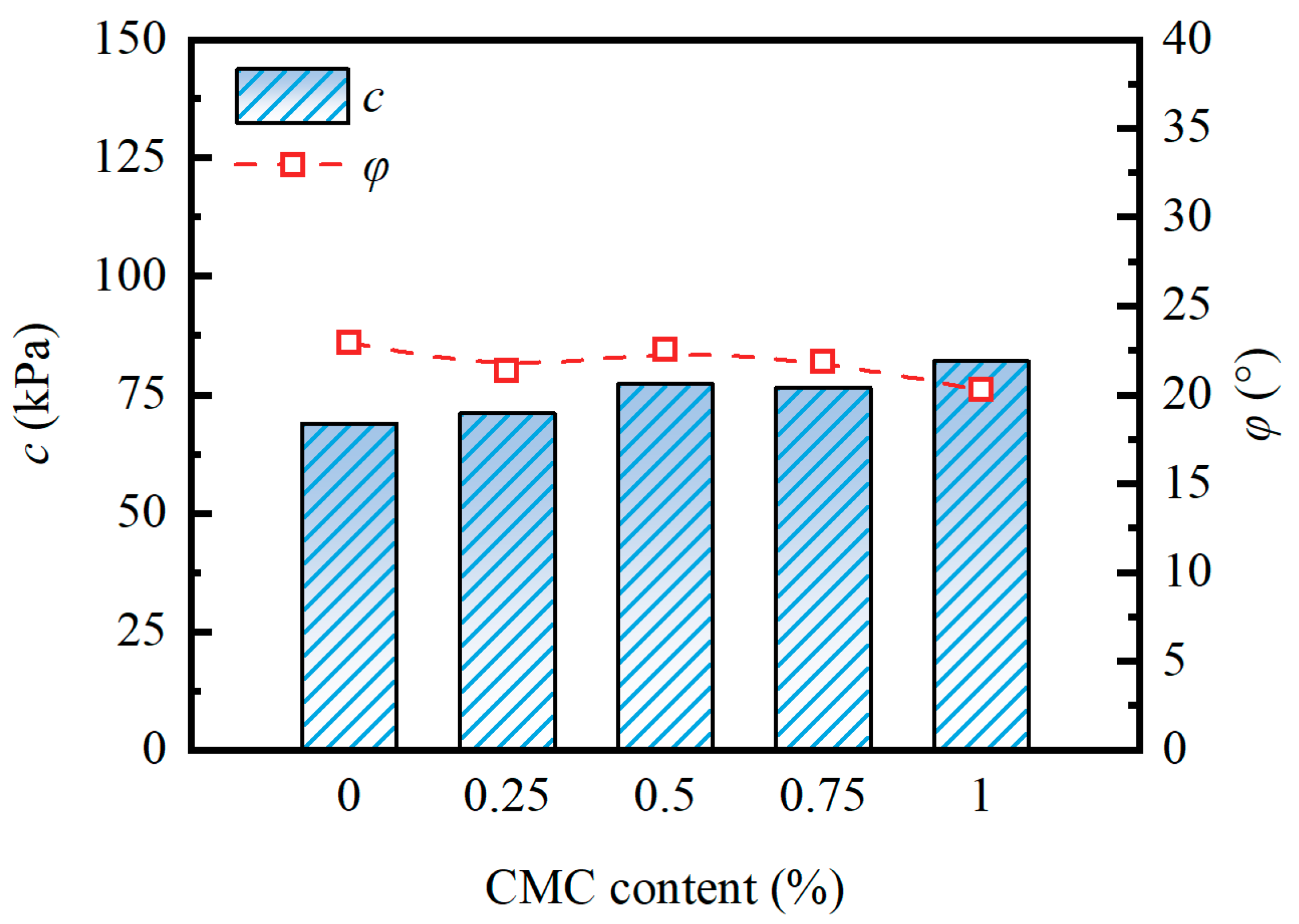
Figure 6 presents the variations in cohesion c and internal friction angle φ with CMC content. It can be seen that the cohesion generally increases with increasing CMC content, whereas the internal friction angle changes only slightly and shows a slight overall decrease. Compared with the untreated soil, the enhancement in shear strength induced by CMC is mainly reflected in the increase in cohesion. This result indicates that CMC improves the shear strength of granite residual soil primarily by enhancing the bonding force between particles, rather than by significantly increasing frictional interlocking. The absence of a corresponding increase in the internal friction angle may be attributed to the lubricating effect of the polymer at particle contacts, which partially offsets the increase in frictional resistance.
Figure 6.
Cohesion (c) and internal friction angle (φ) of sample.
3.3. Anti-Disintegration Characteristics of Samples
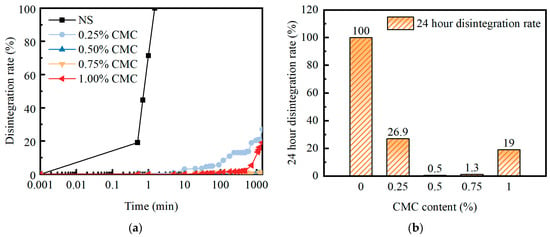
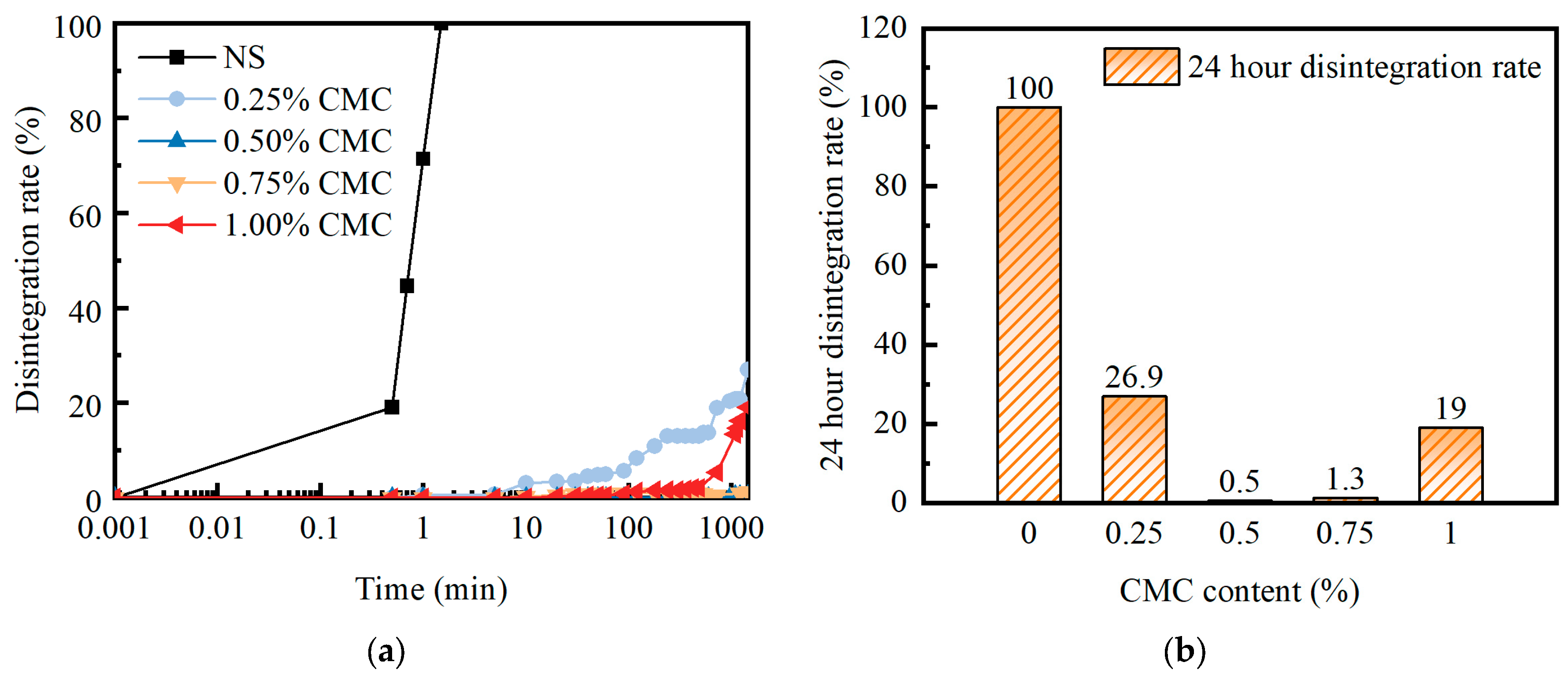
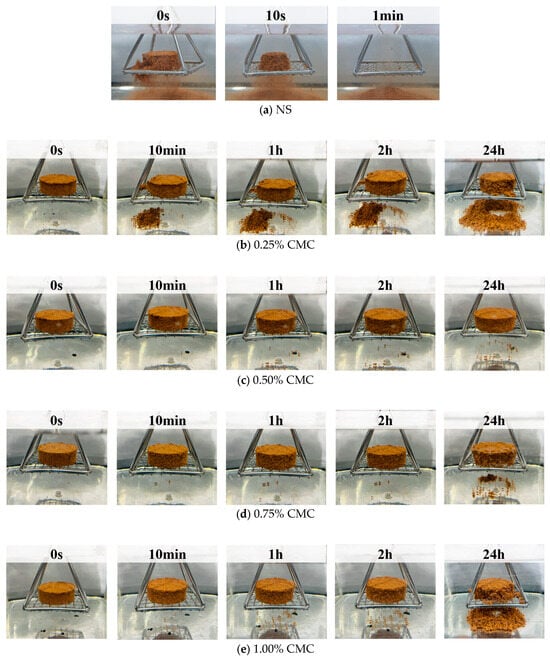
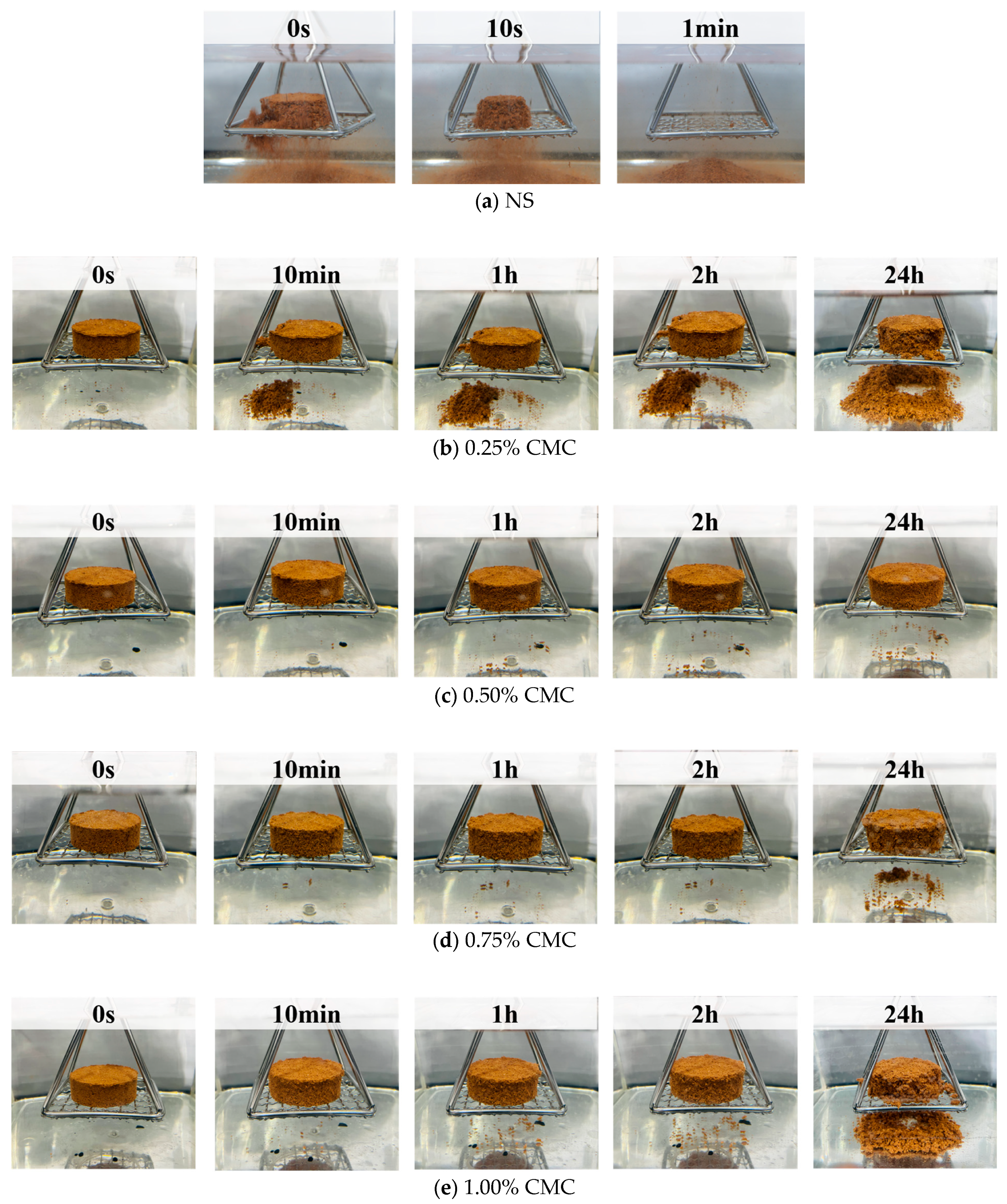
Figure 7 shows the disintegration curves of CMC-stabilized soil with different dosages (0% dosage corresponds to natural soil), including the variation in disintegration rate with time and the change in the 24 h disintegration rate. Meanwhile, Figure 8 present the typical morphological evolution of the natural soil specimen and the CMC specimens with different dosages during the disintegration test. As can be seen from Figure 7 and Figure 8, the untreated natural soil specimen showed obvious disintegration within a short time after being immersed in water. Rapid scattering occurred from 0 s to 10 s, and the specimen basically disintegrated into loose particles within about 1 min and deposited at the bottom. This indicates that the original weak cementation and structure of the natural soil were rapidly weakened under the action of water, and after the soil skeleton lost its constraint, rapid dispersion and spalling occurred.
Figure 7.
(a) Disintegration curve of sample; (b) 24 h disintegration rate of sample.
Figure 8.
Photos of sample during disintegration test: (a) Untreated sample; (b) 0.25% CMC-stabilized sample; (c) 0.50% CMC-stabilized sample; (d) 0.75% CMC-stabilized sample; (e) 1.00% CMC-stabilized sample.
After adding CMC, the curves of all treated groups in the disintegration plot shifted downward as a whole, and the development rate of disintegration decreased significantly. This indicates that CMC can effectively delay the structural destabilization process caused by water invasion, transforming the soil behavior from instantaneous disintegration to gradual spalling [17,34]. From the morphological evolution (Figure 8), it can be further seen that the 0.25% CMC specimen showed relatively obvious particle scattering and bottom deposition within 10 min. Subsequently, the deposited mass continued to increase, and the disintegration accumulation became more evident at 24 h. This suggests that, although a low CMC dosage can inhibit the rapid breakup of granite residual soil, it is still difficult to maintain continuous overall cementation under long-term immersion. In contrast, the 0.5% and 0.75% CMC specimens basically maintained an intact shape after 10 min, 1 h, 2 h, and even 24 h of immersion, with only a small amount of fine particles migrating and depositing. This represents a more typical disintegration mode dominated by slight surface erosion. When the dosage increased to 1.0%, the specimen remained relatively stable at the early stage, but obvious block disintegration occurred at 24 h, accompanied by a sharp increase in sediment. This phenomenon indicates that the anti-disintegration effect of CMC has an appropriate dosage range. An excessively high dosage may, due to the strong hydrophilicity of the material, lead to progressive softening under long-term immersion, enhanced interfacial lubrication, or local structural rearrangement, thereby inducing more pronounced spalling and damage at a later stage [21].
The 24 h disintegration rate shown in Figure 7b further quantifies the above observations. When the CMC dosage was 0.25%, the 24 h disintegration rate of the specimen was 26.9%, indicating that CMC can significantly improve water stability even at a relatively low dosage. When the dosage increased to 0.5%, the 24 h disintegration rate dropped sharply to 0.5%, reaching the optimal effect. When the dosage was 0.75%, the 24 h disintegration rate remained at a very low level (1.3%). However, when the dosage was further increased to 1.0%, the 24 h disintegration rate increased instead to 19%. Therefore, within the dosage range investigated in this study, the anti-disintegration performance of CMC shows a non-monotonic change, with a rapid enhancement followed by an increase. The dosage range of 0.5–0.75% is more conducive to forming a stable cementation network structure, whereas at 1.0%, the swelling–softening effect caused by the excessive hydrophilicity and water retention of CMC may reduce the structural durability of the specimens under long-term immersion.
Mechanistically, CMC is an anionic, water-soluble polymer belonging to the cellulose-ether family. Upon hydration and swelling, it forms a cohesive viscoelastic network. This network can (i) increase the viscosity of pore fluid and reduce the connectivity of flow paths, thereby suppressing rapid water migration and the associated propagation of softening within the soil matrix; and (ii) generate a coating layer on particle surfaces while enhancing inter-particle adhesion and bridging via hydrogen bonding, which improves structural continuity and aggregate stability [17]. Microstructural evidence further indicates that CMC treatment promotes particle flocculation/aggregation, strengthens inter-particle bonding, and partially fills pores, thereby enhancing water-induced stability and erosion resistance [21]. Notably, however, the pronounced hydrophilicity and water-retention capacity of CMC may also produce adverse long-term effects under prolonged immersion: cumulative softening may develop, making high-dosage specimens more susceptible to late-stage edge spalling and blocky sloughing. Consistent with this interpretation, previous work within a 0.25–1.0% dosage range reported that 0.5% CMC provided more pronounced strength gains and permeability reduction [17], aligning with the rebound in the 24 h disintegration rate observed for the 1.0% group in this study.
3.4. Erosion Resistance Characteristics of Samples
3.4.1. Erosion Characteristics and Sediment Yield Law of Slope Surface
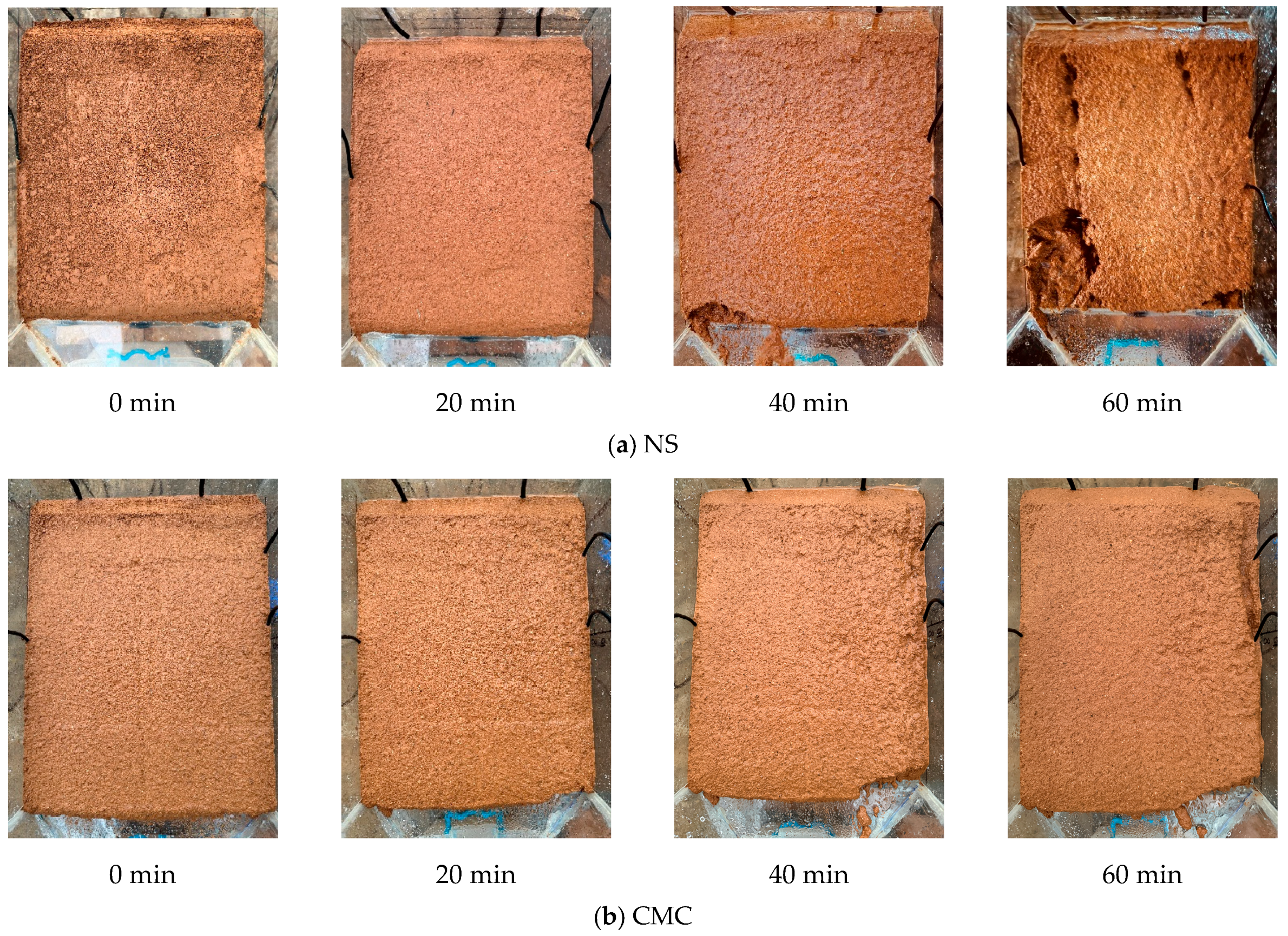
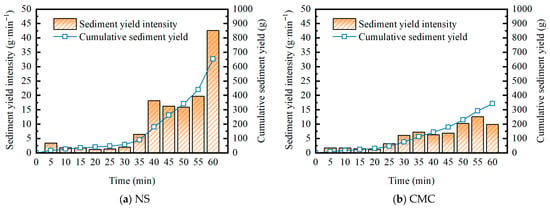
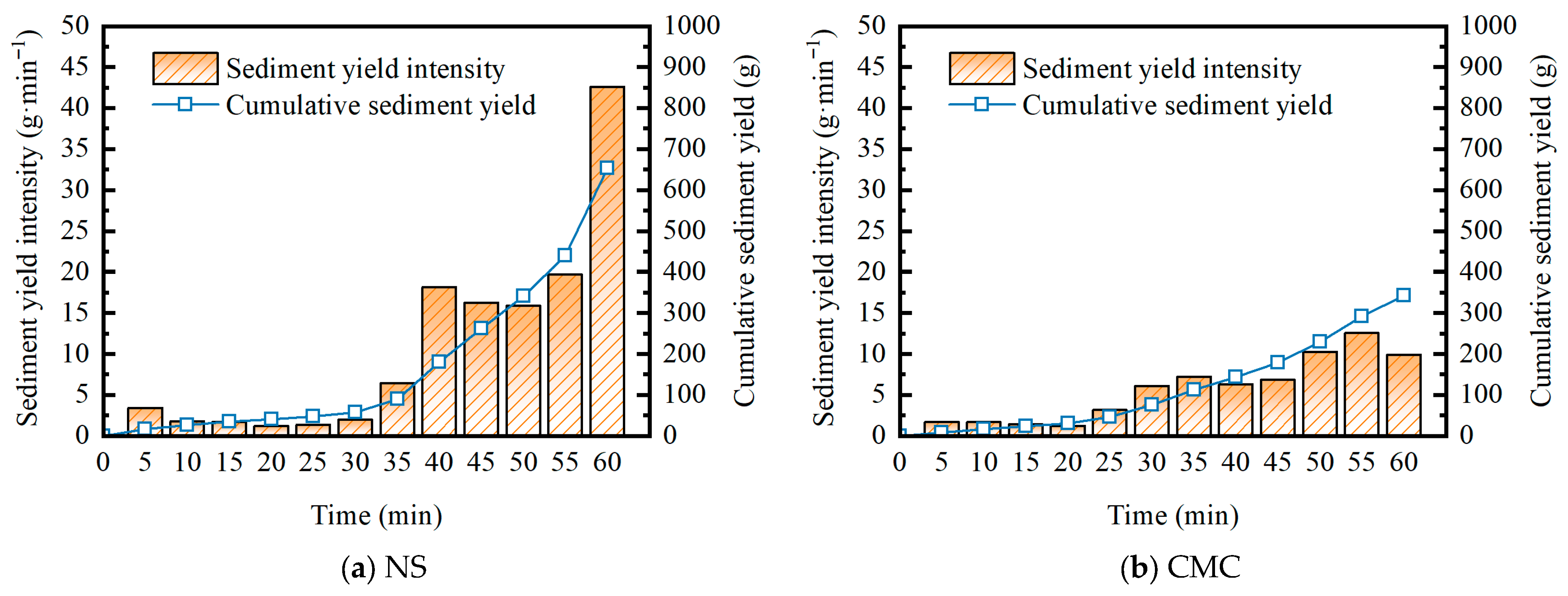
Figure 9 illustrates the rainfall-induced erosion process on the natural-soil slope surface. Under a slope angle of 30°, a rainfall intensity of 120 mm·h−1, and a rainfall duration of 60 min, the granite residual soil exhibited a pronounced stage-wise evolution in erosion behavior. Morphologically, the slope surface remained largely intact during the first 20 min, with only raindrop splash and shallow sheet erosion disturbing the surficial layer; no distinct concentrated flow paths were observed. By approximately 40 min, localized scour hollows developed near the slope toe, and incipient downslope runoff traces emerged. After 60 min, rills became more continuous and were accompanied by localized blocky detachment, marking a rapid transition from sheet-dominated erosion to rill-controlled erosion [35]. This transition is consistent with the sediment response shown in Figure 10a, which remained negligible in the early stage but increased sharply later: the sediment yield rate was nearly zero during 0–30 min, rose markedly after 35 min, and peaked at 42.6 g·min−1 at 60 min, with a final cumulative sediment yield of 652 g. Such behavior aligns with the widely reported phase characteristics of rainfall-driven slope erosion. As overland flow evolves from sheet flow to concentrated flow and exceeds the critical shear stress, rill initiation and enlargement can greatly enhance both detachment and sediment transport efficiency, driving an accelerated sediment-export stage [36,37].
Figure 9.
Photos of slope during rainfall erosion test: (a) Untreated slope; (b) CMC-stabilized slope.
Figure 10.
Slope sediment production situation: (a) Untreated slope; (b) CMC-stabilized slope.
During rainfall scouring, the CMC-stabilized slope exhibited an “overall stable, locally concentrated” damage evolution pattern. As illustrated in Figure 9, the slope surface remained largely intact during the first 20 min, with sheet-flow erosion and progressive surface roughening dominating. By 40 min, pronounced localized scour and spalling developed near the boundary zone, accompanied by a weak plane-controlled damage band. After 60 min, boundary rill erosion became more apparent and soil loss near the slope corner intensified; nevertheless, the main slope surface was still relatively planar and intact, indicating enhanced resistance to rainfall scouring. A consistent response was observed in sediment production: the sediment yield rate increased overall with time and intensified markedly in the late stage, reaching 12.5 g·min−1 at 55 min, while the final cumulative sediment yield was 342 g. This behavior suggests that CMC reduces soil loss and improves erosion resistance by increasing pore-fluid viscosity, promoting particle aggregation, strengthening inter-particle bonding, and partially filling pores. However, under prolonged rainfall, localized runoff channels can still develop, resulting in limited rill formation and modest sediment export.
3.4.2. Runoff Characteristics and Rainwater Infiltration Law of Slope Surface
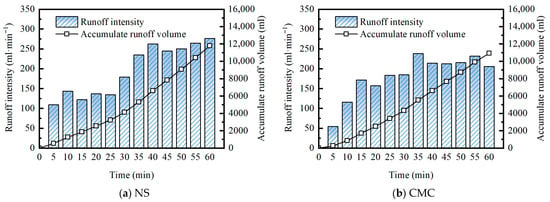
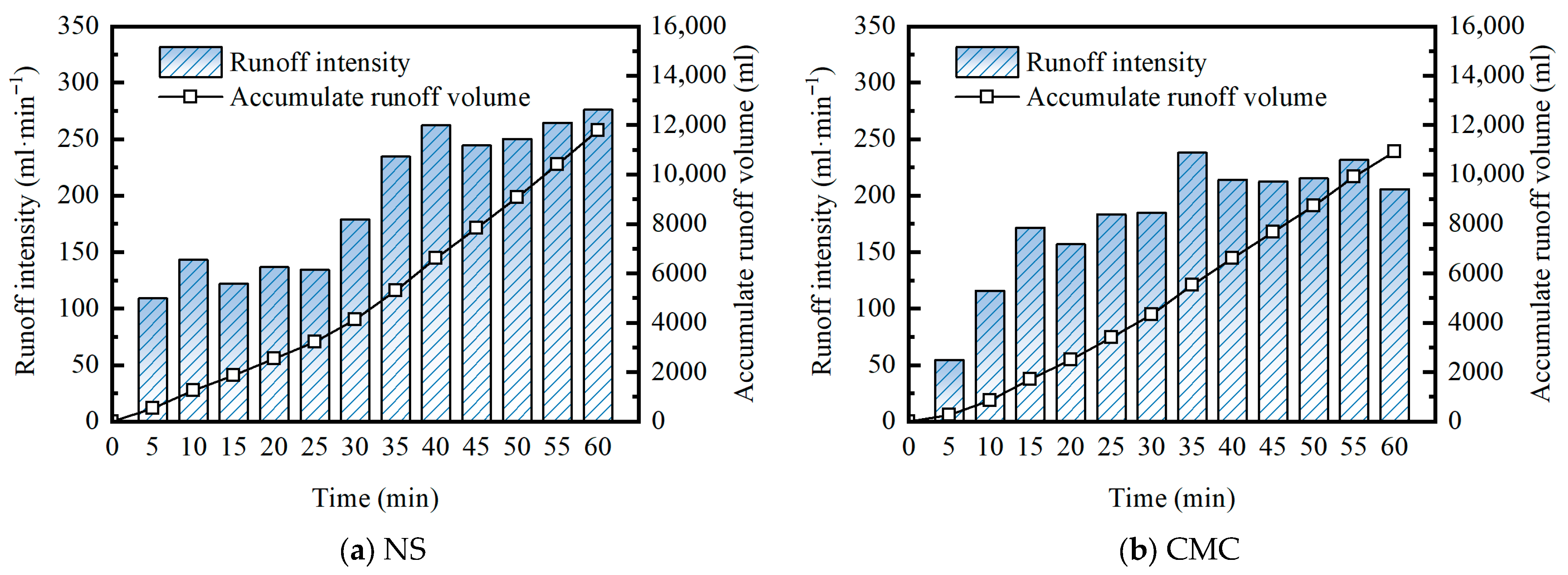
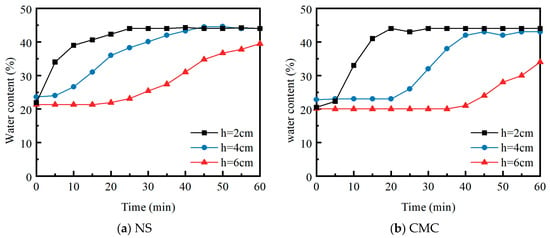
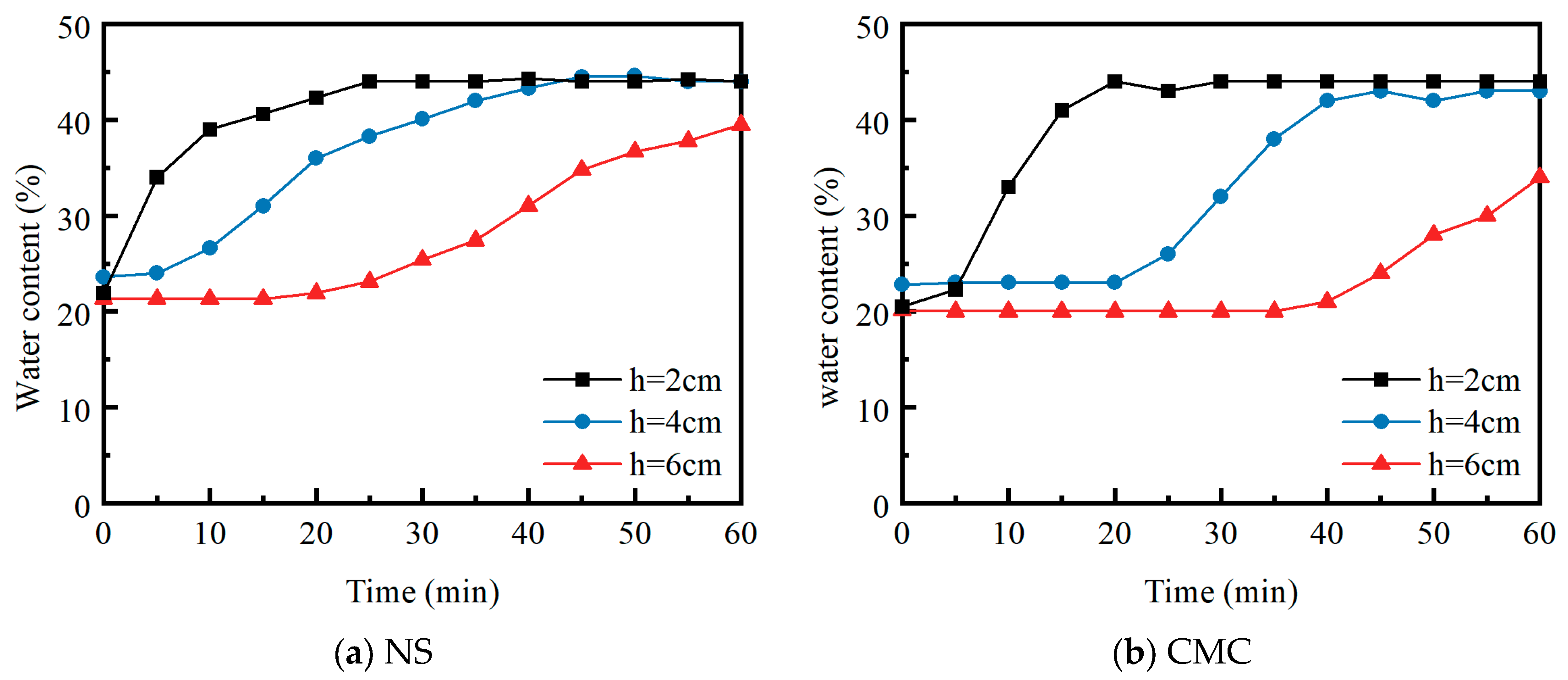
The temporal response of water content at different depths and runoff from the natural-soil slope during rainfall is presented as follows (Figure 11 and Figure 12). At 2 cm depth, water content increased rapidly within the first 10 min and stabilized at approximately 45% after 25 min. At 4 cm depth, water content exhibited accelerated growth between 10 and 25 min, stabilizing at about 45% after 30 min. At 6 cm depth, water content remained low during the first 20 min and then gradually rose to 39.5%, reflecting a typical top-down progressive wetting front. Corresponding runoff initially increased gradually and then remained relatively steady during the mid-to-late stage. After 30 min, runoff intensity rose markedly, maintaining a high level of 240–280 mL·min−1 between 40 and 60 min, with a cumulative runoff of 1.2 × 10⁴ mL. These observations suggest that, during rainfall, water infiltration dominates the early stage. Runoff is generated only after deeper layers become progressively wetted and the infiltration capacity declines, which in turn triggers accelerated sediment production after 35 min, reaching a peak towards the end of the event.
Figure 11.
Slope runoff situation: (a) Untreated slope; (b) CMC-stabilized slope.
Figure 12.
The change in water content in different depths of slope surface: (a) Untreated slope; (b) CMC-stabilized slope.
Regarding soil moisture content, the CMC-stabilized slope exhibits a layered wetting phenomenon during rainfall events. At a depth of 2 cm, the volumetric water content rapidly increases from 20.5% to 44% within the first 20 min and then remains stable. At 4 cm, the volumetric water content remains around 23–24% during the first 20 min, then rises significantly between 20 and 40 min, reaching 43% at approximately 40 min before stabilizing. At 6 cm, the volumetric water content stays at 20–21% for the first 35 min, increases rapidly after 40 min, and reaches 42% at 60 min, indicating a pronounced top-down lag in wetting front propagation. This phenomenon can be explained by the regulation of soil water movement and hydraulic parameters by CMC. Previous studies show that applying CMC can increase soil profile moisture content, reduce saturated hydraulic conductivity, and delay wetting front advancement, while also systematically influencing soil aggregate structure and soil water movement characteristics. Regarding runoff, the rainfall runoff intensity on the CMC-stabilized slope surface is approximately 25 mL·min−1 during the first 5 min, rises to a plateau of about 140 mL·min−1 between 10 and 25 min, then gradually increases, reaching 240 mL·min−1 at 60 min, with a cumulative runoff volume of 9400 mL. This indicates that the initial rainfall mainly contributes to soil layer saturation, while runoff generation increases later as the shallow slope layers approach saturation. CMC can improve erosion resistance and reduce soil loss through increased viscosity, aggregation, and cementation, which explains why the slope exhibits relatively high runoff but a limited erosion area and lower sediment yield compared with natural soil slopes.
It should be noted that the relatively strong water-retention capacity of CMC-treated soil may have a certain influence on the absolute response of volumetric water content measurements. Therefore, the interpretation of the sensor data in this study is based primarily on the relative evolution patterns of moisture content in the two slope groups under the same rainfall conditions, in combination with runoff and erosion phenomena for a comprehensive analysis.
3.5. Mechanism
Carboxymethyl cellulose (CMC) molecular chains, rich in hydrophilic carboxymethyl groups (-CH2-COO-Na), readily hydrate in aqueous environments. Through hydrogen bonding, van der Waals interactions, and limited covalent interactions, CMC forms a viscous gel that adsorbs onto soil particle surfaces, promoting particle aggregation and cementation to form soil aggregates. When sufficient gel is present, it progressively envelops the soil particles and establishes bridging connections between aggregates and larger particles, ultimately forming continuous or semi-continuous polymer films and fibrous networks during curing. It is important to note that the interaction between CMC and soil is purely physical, with no formation of new chemical compounds [17].
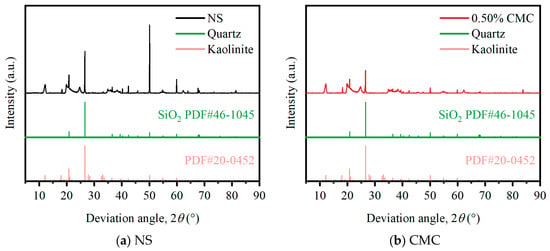
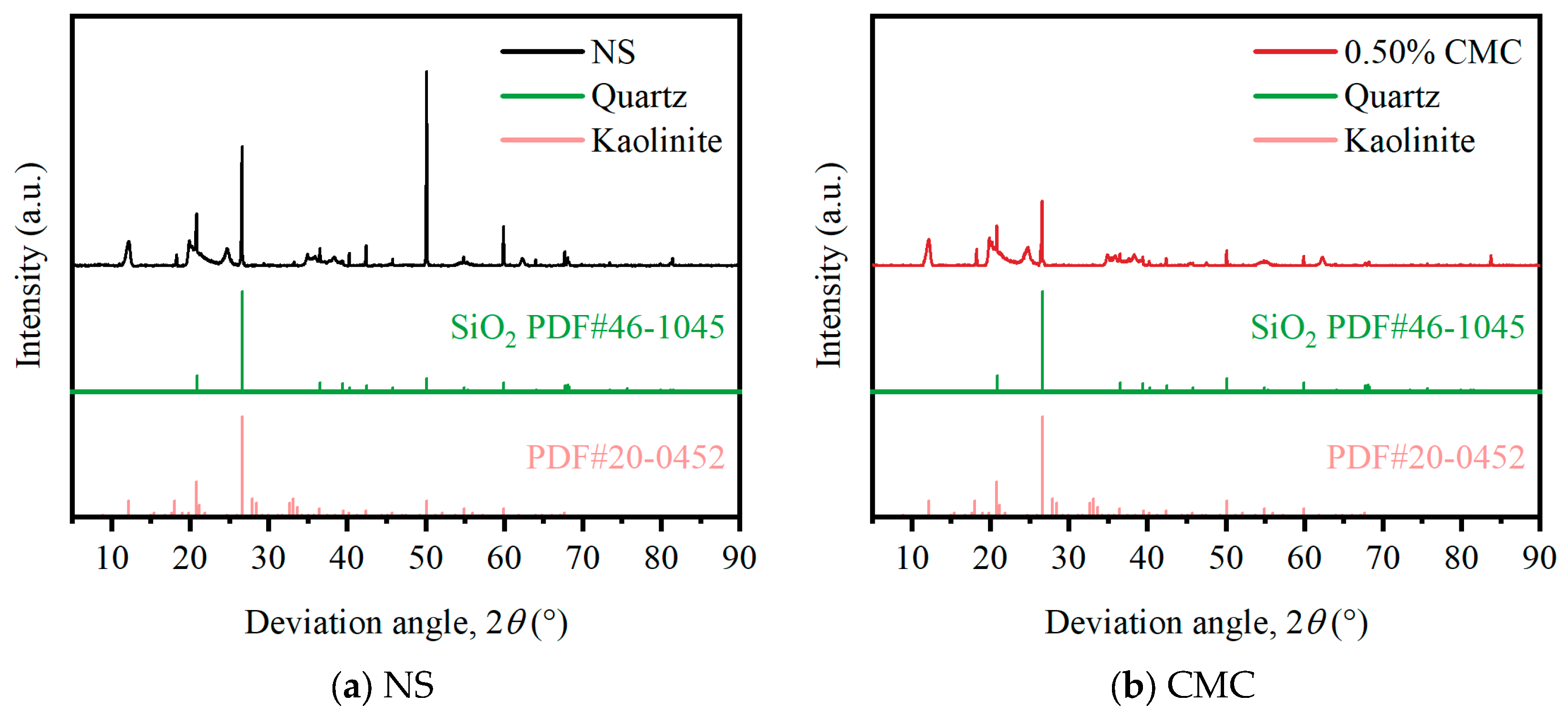
Figure 13 shows the comparison of the X-ray diffraction patterns of the specimens with the corresponding PDF cards. As can be seen from the figure, the diffraction pattern of the CMC-stabilized soil is generally consistent with that of the natural soil, with quartz and kaolinite remaining the main mineral components. No new diffraction peaks or obvious peak shifts were observed. This indicates that the stabilization mechanism of CMC is not associated with the formation of new compounds, but is mainly related to physical interactions and the reorganization of the soil microstructure.
Figure 13.
XRD analysis: (a) Untreated sample; (b) CMC-stabilized sample.
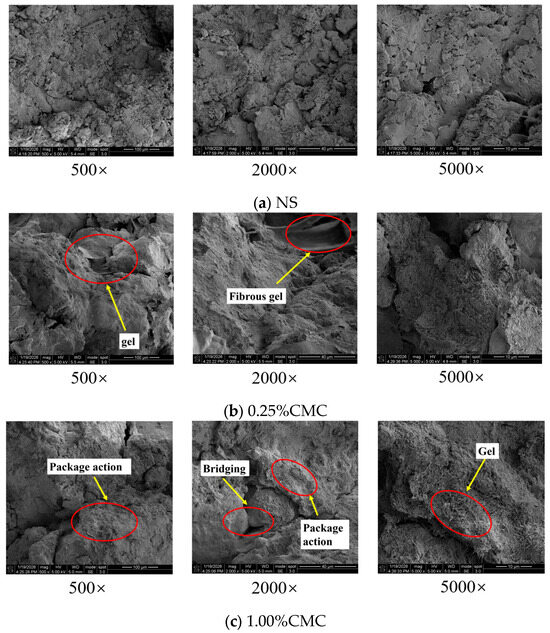
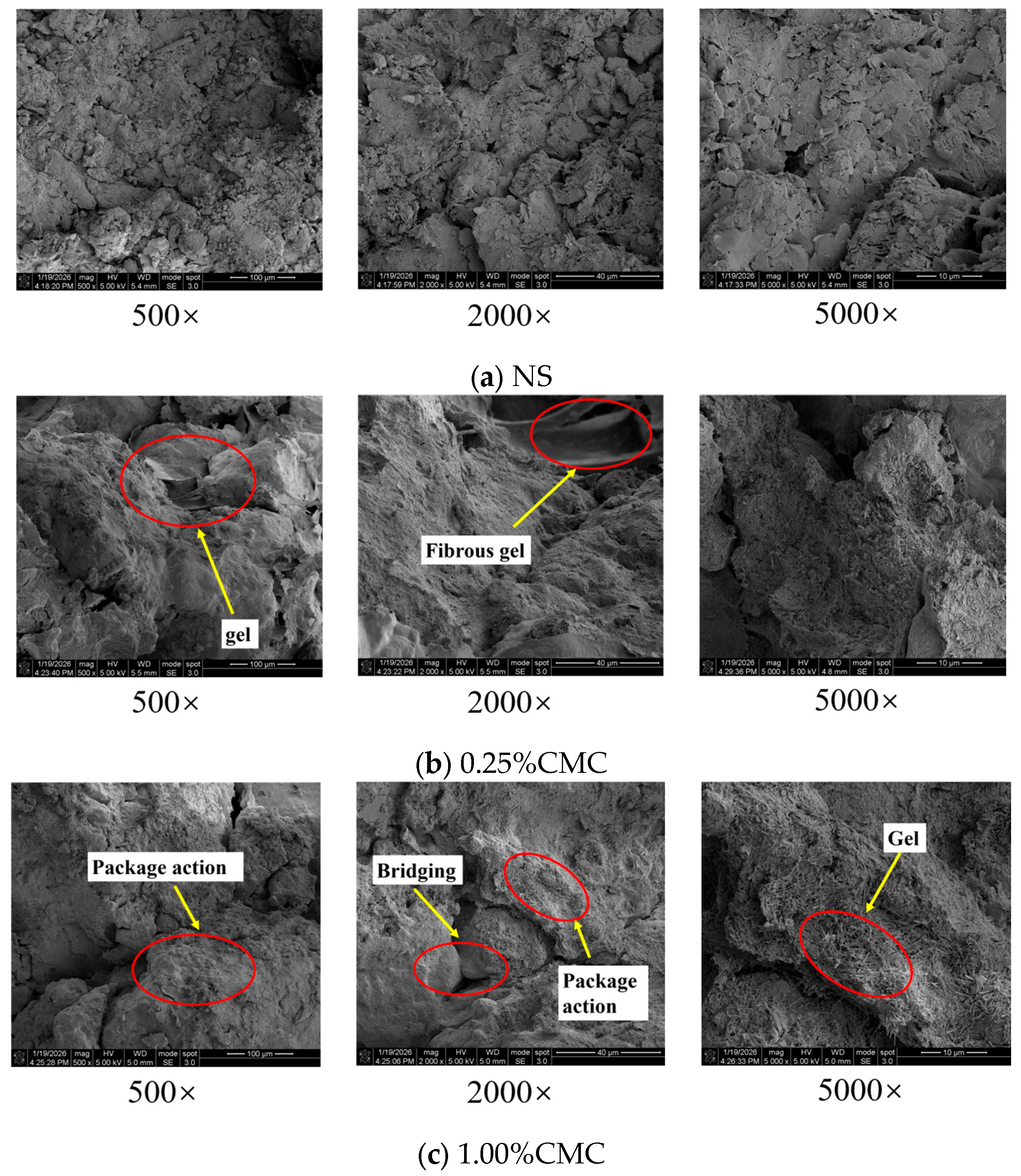
SEM observations (Figure 14) reveal that natural soil, at magnifications of 500×, 2000×, and 5000×, displays distinct particle boundaries, interconnected pores, and a relatively loose microstructure. Such a porous and weakly connected soil skeleton is highly susceptible to water film thickening and structural softening under wetting or rainfall, resulting in disintegration and erosion. With the addition of 0.25% CMC, the soil particles exhibit more pronounced surface coating and aggregation, with interparticle pores connected by fibrous gel. Particle contacts gradually shift from point-to-point toward predominantly face-to-face, while pore size and connectivity are reduced. Increasing the CMC content to 1.0% results in a denser CMC-stabilized soil structure, more concentrated fibrous strands, and the original pores being filled or covered by film-like materials, producing more continuous cementing films and an overall networked linkage structure. Such microstructural changes are consistent with previous studies. The enhanced strength of CMC-stabilized soil is attributed to the binding and bridging effects of fibrous cementing agents, which improve overall load-bearing capacity and shear resistance. Moreover, the polymer films and microfibrillar networks formed by CMC can interconnect soil particles via electrostatic interactions, conferring measurable compressive strength even at low CMC contents and further improving it upon drying [15,20,27].
Figure 14.
SEM image of sample: (a) Untreated sample; (b) 0.25% CMC-stabilized sample; (c) 1.00% CMC-stabilized sample.
The observed microstructural evolution can account for the enhanced anti-disintegration behavior, unconfined compressive strength (UCS), and rainfall erosion resistance of CMC-stabilized soil at three hierarchical levels.
- Soil disintegration is fundamentally associated with rapid water infiltration, particle wetting and softening, and structural collapse. The hydrated CMC gel and resulting polymer networks fill and coat interparticle pores, reducing the fraction of large and connected pores and shifting the pore size distribution toward finer, less interconnected pores. This inhibits moisture migration within the sample and mitigates wetting-induced weakening. Concurrently, the membrane-like coatings reduce direct water infiltration onto particles, delay pore water pressure buildup, and slow the softening process, thereby suppressing soil disintegration. As a result, under identical wetting conditions, the formation of through-going softened zones is hindered, leading to lower disintegration rates and a delayed disintegration process.
- Fine-grained components of granite residual soil (clay minerals and silt) are highly susceptible to dispersion and softening upon wetting, which is critical to disintegration and strength loss. Upon CMC addition, hydrated gels induce interparticle cementation, which, after curing, develops into membrane-like films and fibrous linkages. This transforms particle contacts from friction-dominated to combined friction-and-cementation load-bearing, gradually increasing contact area. Fine particles aggregate from dispersed states into flocculated clusters, enhancing the continuity of the soil skeleton. Macroscopically, this manifests as increased UCS, altered peak strain, and a more robust shear foundation that improves resistance to erosion.
- During rainfall-induced slope erosion, failure is typically governed by surface particle detachment, runoff scouring, and shallow layer softening [32,38]. CMC-induced surface films and particle bridging enhance the shear and detachment resistance of the soil surface and reduce slope instability by weakening the coupling between surface infiltration and runoff-driven fine particle migration. Similarly, under wind erosion, CMC treatment strengthens the surface crust and interparticle bonding, substantially reducing soil loss. The low loss rates maintained after repeated wetting-drying cycles indicate the durability of the reinforced surface layer [39,40].
It should be emphasized that the effectiveness of CMC modification typically exhibits an optimal dosage. At low dosages, the hydrated CMC fails to form continuous surface coatings, and interparticle bridging is insufficient to span the soil pores, limiting structural reinforcement. Conversely, when the CMC content exceeded the appropriate range, abnormal phenomena such as a rebound in the disintegration ratio and a reduction in strength were observed. This indicates that an excessive CMC dosage may induce non-uniform internal structural distribution, local aggregation, pore reorganization, and changes in water migration patterns within the soil, thereby weakening its stabilization effect. Compared with the conclusions of previous studies, which have generally emphasized the positive improvement effects of cellulose-based polymers, this phenomenon reflects the particularity of granite residual soil in terms of material response. Future studies should further clarify the intrinsic mechanisms responsible for performance deterioration at high dosages by combining investigations of microstructure, pore evolution, and water transport behavior.
For materials such as granite residual soil, which contain a mix of coarse and fine particles and possess sensitive pore structures, CMC offers a relatively environmentally friendly means of reinforcing the soil surface and regulating hydraulic–mechanical coupling, provided that water content, mixing procedure, and curing duration are carefully controlled to achieve a stable and reproducible microstructural network. This perspective aligns with review studies on biopolymer-treated soils, where biopolymers primarily enhance strength and erosion resistance by modifying interparticle cementation, pore architecture, and by regulating soil–water characteristic curves and flow pathways. Nevertheless, practical implementation still requires careful consideration of durability, wetting–drying cycles, and construction uniformity in field applications [41,42,43].
3.6. Practical Applicability and Comparative Consideration with Conventional Reinforcement Methods
From the perspective of engineering application, the performance of CMC-stabilized granite residual soil should be evaluated in comparison with conventional stabilization methods. Cement and lime-based stabilization methods are widely used because they can provide relatively strong and reliable strength improvement, but they are also associated with relatively high carbon emissions and environmental burdens. Shotcrete-based slope protection is another mature and effective method for controlling surface erosion and enhancing structural protection. Relevant engineering estimates indicate that the cost of ordinary shotcrete protection is usually about CNY 50–100/m2, while mesh-reinforced shotcrete generally costs about CNY 80–150/m2, and the total cost of anchor-mesh-shotcrete composite support systems may be much higher.
Compared with these conventional methods, the use of CMC for slope-surface stabilization appears to be more suitable for environmentally sensitive slope improvement scenarios, where shallow anti-disintegration performance, resistance to rainfall erosion, water-retention capacity, and ecological compatibility all need to be taken into account. In this sense, CMC is not intended to completely replace all traditional stabilization methods, especially in cases where high structural bearing capacity and deep-seated stability are required. Rather, it may serve as a low-carbon and environmentally friendly surface-improvement material for rainfall-sensitive granite residual soil slopes. However, this study did not conduct a side-by-side cost-effectiveness comparison under identical engineering conditions, and the related construction cost can only be preliminarily estimated on the basis of the price of the tested material, namely CMC. At a CMC dosage of 0.5%, the estimated cost of slope stabilization using CMC is approximately CNY 40–60/m2. Future work is still needed to provide more rigorous evaluations of life-cycle cost, durability, and field construction feasibility.
4. Conclusions
This study provided a comprehensive evaluation of the key properties of CMC-treated granite residual soil. Disintegration tests, unconfined compressive strength (UCS) tests, and rainfall erosion experiments were conducted, and complemented by SEM analysis for mechanistic insight, yielding consistent and reliable results. The main findings are summarized as follows:
- The incorporation of CMC has a pronounced effect on the soil’s resistance to disintegration. Within the tested range, the anti-disintegration performance of CMC-stabilized soil exhibited a non-monotonic trend, initially increasing rapidly with CMC content before declining at higher dosages. The soil treated with 0.5% CMC showed a 24 h disintegration rate approaching zero, indicating the optimal modification effect.
- After CMC treatment, both the unconfined compressive strength and shear strength of the soil were improved. At a CMC content of 0.5%, the unconfined compressive strength increased from 50.35 kPa to 94.3 kPa, showing the most pronounced improvement. With increasing CMC content, the cohesion generally increased, with a maximum increase of 19.1%, whereas the internal friction angle changed only slightly and exhibited a slight downward trend.
- Application of CMC to slope surfaces effectively mitigates gully formation, reduces soil loss, and improves slope erosion resistance. Compared to natural slopes, reinforced slopes exhibited a 47.5% reduction in sediment yield, slower moisture variation at different depths, reduced infiltration rates, and a lower propensity for runoff formation.
Although this study demonstrates that CMC can effectively enhance the water stability and slope protection performance of granite residual soil in terms of disintegration resistance, mechanical strength, and erosion resistance, its practical engineering applicability and long-term durability still require further investigation. Future research may proceed in the following directions. First, more systematic microstructural and multi-scale characterization methods should be adopted. Techniques such as nuclear magnetic resonance (NMR), mercury intrusion porosimetry (MIP), and CT scanning can be used to quantitatively analyze the effects of CMC on the soil pore structure; molecular dynamics simulations can be employed to investigate the interactions between CMC and soil chemical bonds; and further comparative rainfall erosion tests under different CMC dosages should be conducted to establish a more comprehensive quantitative relationship between CMC dosage, soil microstructure, and erosion resistance, as well as to develop predictive models. Second, hydro-mechanical coupling tests and numerical simulations should be carried out under different rainfall intensities, slope gradients, initial water contents, and wetting-drying cycle conditions. Combined with relevant laboratory tests on both saturated and unsaturated soils, such as CBR and triaxial tests, these efforts would help to further clarify erosion thresholds and the evolution of instability mechanisms. Third, by integrating monitoring of moisture content, pore water pressure, deformation, and infiltration processes, the long-term durability and risk evolution of CMC-stabilized slopes under field conditions should be evaluated. Such studies will help promote the field validation, performance optimization, and coordinated application of green soil improvement materials in slope engineering, together with modern monitoring and early-warning technologies.
Author Contributions
Funding acquisition, Z.C.; project administration, Z.C.; resources, Z.C.; writing—review and editing, Z.C., W.H. and N.G.; writing—original draft, N.G.; formal analysis, N.G. and S.H.; methodology, W.H.; conceptualization, S.H.; validation, Y.L.; investigation, Y.L. All authors have read and agreed to the published version of the manuscript.
Funding
This research was supported by the National Natural Science Foundation of China (Grant No. 52278335 and 52208335); Science and Technology Innovation Program of Fujian Provincial Department of Natural Resources (Grant No. KY-070000-04-2022-021 and KY-070000-04-2022-026); Technology Innovation Center for Ecological Conservation and Restoration in Dongting Lake Basin, Ministry of Natural Resources, Changsha 410007, China (Grant No. DTB.TICECR-2024-05); the Opening Foundation of the Research and Development Center of Transport Industry of New Materials, Technologies Application for Highway Construction and Maintenance of Offshore Areas (Fujian Communication Technology Development Group) (Grant No. 202302); and the Research Start-up Project of Fuzhou University (Grant No. XRC-23053, No. XRC-24019).
Data Availability Statement
Data will be made available from the corresponding author on reasonable request.
Conflicts of Interest
Senkai He is from the Research and Development Center of Transport Industry of New Materials, Technologies Application for Highway Construction and Maintenance of Offshore Areas (Fujian Communication Technology Development Group). The remaining authors declare that the research was conducted in the absence of any commercial or financial relationships that could be construed as a potential conflict of interest.
Abbreviations
The following abbreviations are used in this manuscript:
| CMC | Carboxymethyl cellulose |
| GRS | Granite residual soil |
| UCS | Unconfined compressive strength |
| SEM | Scanning electron microscopy |
| PAM | Polyacrylamide |
References
- Huang, J.; Kogbara, R.B.; Hariharan, N.; Masad, E.A.; Little, D.N. A State-of-the-Art Review of Polymers Used in Soil Stabilization. Constr. Build. Mater. 2021, 305, 124685. [Google Scholar] [CrossRef] [Scilit]
- Fatehi, H.; Ong, D.E.L.; Yu, J.; Chang, I. Biopolymers as Green Binders for Soil Improvement in Geotechnical Applications: A Review. Geosciences 2021, 11, 291. [Google Scholar] [CrossRef] [Scilit]
- Liu, W.; Ouyang, G.; Luo, X.; Luo, J.; Hu, L.; Fu, M. Moisture Content, Pore-Water Pressure and Wetting Front in Granite Residual Soil during Collapsing Erosion with Varying Slope Angle. Geomorphology 2020, 362, 107210. [Google Scholar] [CrossRef] [Scilit]
- Luo, X.; Gao, H.; He, P.; Liu, W. Experimental Investigation of Dry Density, Initial Moisture Content, and Temperature for Granite Residual Soil Disintegration. Arab. J. Geosci. 2021, 14, 1060. [Google Scholar] [CrossRef] [Scilit]
- Chen, Y.; Zhou, X.; Ai, X.; Zhou, M.; Zhao, Y.; Lan, Z. Disintegration Characteristics of Remolded Granite Residual Soil with Different Moisture Contents. Sustainability 2023, 16, 84. [Google Scholar] [CrossRef] [Scilit]
- Firoozi, A.A.; Guney Olgun, C.; Firoozi, A.A.; Baghini, M.S. Fundamentals of Soil Stabilization. Geo-Engineering 2017, 8, 26. [Google Scholar] [CrossRef] [Scilit]
- Latifi, N.; Horpibulsuk, S.; Meehan, C.L.; Majid, M.Z.A.; Rashid, A.S.A. Xanthan Gum Biopolymer: An Eco-Friendly Additive for Stabilization of Tropical Organic Peat. Environ. Earth Sci. 2016, 75, 825. [Google Scholar] [CrossRef] [Scilit]
- Fu, D.; Yang, H.; Wang, L.; Yang, S.; Li, R.; Zhang, W.; Ai, X.; Ai, Y. Vegetation and Soil Nutrient Restoration of Cut Slopes Using Outside Soil Spray Seeding in the Plateau Region of Southwestern China. J. Environ. Manag. 2018, 228, 47–54. [Google Scholar] [CrossRef] [Scilit]
- Dixon, N.; Spriggs, M. Quantification of Slope Displacement Rates Using Acoustic Emission Monitoring. Can. Geotech. J. 2007, 44, 966–976. [Google Scholar] [CrossRef] [Scilit]
- Smethurst, J.A.; Clarke, D.; Powrie, W. Seasonal Changes in Pore Water Pressure in a Grass-Covered Cut Slope in London Clay. Géotechnique 2006, 56, 523–537. [Google Scholar] [CrossRef] [Scilit]
- Piciullo, L.; Calvello, M.; Cepeda, J.M. Territorial Early Warning Systems for Rainfall-Induced Landslides. Earth Sci. Rev. 2018, 179, 228–247. [Google Scholar] [CrossRef] [Scilit]
- Greco, R.; Giorgio, M.; Capparelli, G.; Versace, P. Early Warning of Rainfall-Induced Landslides Based on Empirical Mobility Function Predictor. Eng. Geol. 2013, 153, 68–79. [Google Scholar] [CrossRef] [Scilit]
- Di Gennaro, L.; Damiano, E.; De Cristofaro, M.; Netti, N.; Olivares, L.; Zona, R.; Iavazzo, L.; Coscetta, A.; Mirabile, M.; Giarrusso, G.A.; et al. An Innovative Geotechnical and Structural Monitoring System Based on the Use of NSHT. Smart Mater. Struct. 2022, 31, 065022. [Google Scholar] [CrossRef] [Scilit]
- Ning, S.; Jumai, H.; Wang, Q.; Zhou, B.; Su, L.; Shan, Y.; Zhang, J. Comparison of the Effects of Polyacrylamide and Sodium Carboxymethylcellulose Application on Soil Water Infiltration in Sandy Loam Soils. Adv. Polym. Technol. 2019, 2019, 6869454. [Google Scholar] [CrossRef] [Scilit]
- Yuan, J.; Ye, C.; Luo, L.; Pei, X.; Yang, Q.; Chen, J.; Liao, B. Sand Fixation Property and Erosion Control through New Cellulose-Based Curing Agent on Sandy Slopes under Rainfall. Bull. Eng. Geol. Environ. 2020, 79, 4051–4061. [Google Scholar] [CrossRef] [Scilit]
- Pan, Y.; Jian, W.; Li, L.; Lin, Y.; Tian, P. A Study on the Rainfall Infiltration of Granite Residual Soil Slope with an Improved Green-Ampt Model. Rock Soil Mech. 2021, 41, 7. [Google Scholar] [CrossRef]
- Sujatha, E.R.; Kannan, G. An Investigation on the Potential of Cellulose for Soil Stabilization. Sustainability 2022, 14, 16277. [Google Scholar] [CrossRef] [Scilit]
- Sujatha, E.R.; Saisree, S. Geotechnical Behaviour of Guar Gum-Treated Soil. Soils Found. 2019, 59, 2155–2166. [Google Scholar] [CrossRef] [Scilit]
- Mohamood, N.F.A.-Z.T.; Halim, A.H.A.; Zainuddin, N. Carboxymethyl Cellulose Hydrogel from Biomass Waste of Oil Palm Empty Fruit Bunch Using Calcium Chloride as Crosslinking Agent. Polymers 2021, 13, 4056. [Google Scholar] [CrossRef] [Scilit]
- Zinchenko, A.; Sakai, T.; Morikawa, K.; Nakano, M. Efficient Stabilization of Soil, Sand, and Clay by a Polymer Network of Biomass-Derived Chitosan and Carboxymethyl Cellulose. J. Environ. Chem. Eng. 2022, 10, 107084. [Google Scholar] [CrossRef] [Scilit]
- Owji, R.; Habibagahi, G.; Nikooee, E.; Afzali, S.F. Wind Erosion Control Using Carboxymethyl Cellulose: From Sand Bombardment Performance to Microfabric Analysis. Aeolian Res. 2021, 50, 100696. [Google Scholar] [CrossRef] [Scilit]
- Zhang, J.; Wang, Q.; Shan, Y.; Guo, Y.; Mu, W.; Wei, K.; Sun, Y. Effect of Sodium Carboxymethyl Cellulose on Water and Salt Transport Characteristics of Saline–Alkali Soil in Xinjiang, China. Polymers 2022, 14, 2884. [Google Scholar] [CrossRef] [Scilit]
- Yang, Q.; Pei, X.; Huang, R. Impact of Polymer Mixtures on the Stabilization and Erosion Control of Silty Sand Slope. J. Mt. Sci. 2019, 16, 470–485. [Google Scholar] [CrossRef] [Scilit]
- Kwon, Y.-M.; Ham, S.-M.; Kwon, T.-H.; Cho, G.-C.; Chang, I. Surface-Erosion Behaviour of Biopolymer-Treated Soils Assessed by EFA. Géotech. Lett. 2019, 10, 106–112. [Google Scholar] [CrossRef] [Scilit]
- Zhang, J.; Liu, J.; Cheng, Y.; Jiang, T.; Sun, D.; Saberian, M. Water-Retention Behaviour and Microscopic Analysis of Two Biopolymer-Improved Sandy Soils. Constr. Build. Mater. 2023, 403, 133202. [Google Scholar] [CrossRef] [Scilit]
- Dubey, A.A.; Hooper-Lewis, J.; Ravi, K.; Dhami, N.K.; Mukherjee, A. Biopolymer-Biocement Composite Treatment for Stabilisation of Soil against Both Current and Wave Erosion. Acta Geotech. 2022, 17, 5391–5410. [Google Scholar] [CrossRef] [Scilit]
- Yuan, J.; Ye, C.; Pei, X.; Pei, Z.; Xie, Z.; Luo, L.; Yu, B. Runoff and Soil Loss Characteristics on Sandy Soil Slope with New Chemical Sand-Fixing Agent under Simulated Rainfall. Environ. Earth Sci. 2023, 82, 266. [Google Scholar] [CrossRef] [Scilit]
- Babatunde, Q.O.; Byun, Y.-H. Soil Stabilization Using Zein Biopolymer. Sustainability 2023, 15, 2075. [Google Scholar] [CrossRef] [Scilit]
- Lee, M.; Chang, I.; Park, D.-Y.; Cho, G.-C. Strengthening and Permeability Control in Sand Using Cr3+-Crosslinked Xanthan Gum Biopolymer Treatment. Transp. Geotech. 2023, 43, 101122. [Google Scholar] [CrossRef] [Scilit]
- Babatunde, Q.O.; Kim, H.J.; Byun, Y.-H. Enhancing Shear Strength of Sandy Soil Using Zein Biopolymer. Results Eng. 2024, 24, 102891. [Google Scholar] [CrossRef] [Scilit]
- Amiri Tasuji, M.; Ghadir, P.; Hosseini, A.; Javadi, A.A.; Habibnejad Korayem, A.; Ranjbar, N. Experimental Investigation of Sandy Soil Stabilization Using Chitosan Biopolymer. Transp. Geotech. 2024, 46, 101266. [Google Scholar] [CrossRef] [Scilit]
- GB/T 50123-2019; Standard for Geotechnical Testing Method. China Planning Publishing House: Beijing, China, 2019.
- Lai, H.-J.; Ding, X.-Z.; Cui, M.-J.; Zhou, Y.-J.; Zheng, J.-J.; Chen, Z.-B. Premix–Spray Biomineralization Method for Anti-Disintegration Improvement of Granite Residual Soil. Acta Geotech. 2025, 20, 1251–1265. [Google Scholar] [CrossRef] [Scilit]
- Sujatha, E.R.; O’Kelly, B.C. Biopolymer Based Soil Treatment for Geotechnical Engineering Applications. In Handbook of Biopolymers; Springer: Singapore, 2023; pp. 609–626. ISBN 978-981-19-0710-4. [Google Scholar]
- Shi, H.; Xiao, H.; Liu, G.; Abd Elbasit, M.A.M.; Zheng, F.; Zhang, Q.; Zhang, Y.; Guo, Z. Identifying Interrill, Rill, and Ephemeral Gully Erosion Evolution by Using Rare Earth Elements as Tracers. J. Hydrol. 2022, 612, 128271. [Google Scholar] [CrossRef] [Scilit]
- Zuo, Z.; Wang, H.; Ding, S.; Wu, Y. Effect of Rill Development on Slope Erosion and Sediment Yield Based on Stereophotogrammetry Technology. Water 2022, 14, 2951. [Google Scholar] [CrossRef] [Scilit]
- Sun, L.; Fang, H.; Cai, Q.; Yang, X.; He, J.; Zhou, J.L.; Wang, X. Sediment Load Change with Erosion Processes under Simulated Rainfall Events. J. Geogr. Sci. 2019, 29, 1001–1020. [Google Scholar] [CrossRef] [Scilit]
- Lee, M.; Chang, I.; Cho, G.-C. Hydraulic Erosion Mitigation in Sandy Soil Using Cation-Crosslinked Gelation Biopolymer. Acta Geotech. 2025, 20, 3563–3580. [Google Scholar] [CrossRef] [Scilit]
- Tan, D.; Wang, L.; Xu, X.; Wang, K.; Zhang, H.; Shi, Q.; Xu, J.; Chen, Y. Response of a Granite Residual Soil Slope to Rainfall Based on Stable Slope Angle: From Field Experiments in Northern Guangdong Province, China. Nat. Hazards 2025, 121, 20513–20535. [Google Scholar] [CrossRef] [Scilit]
- Smolar, J.; Fortuna, B.; Logar, J.; Sorze, A.; Valentini, F.; Maček, M.; Pulko, B. Reducing Drought Vulnerability of Forest Soils Using Xanthan Gum-Based Soil Conditioners. Heliyon 2024, 10, e39974. [Google Scholar] [CrossRef] [Scilit]
- Mugula, J.; Nakayenga, J.; Kido, R.; GuhaRay, A.; Hata, T. Sustainable Stabilization of Sandy Soils Using Steel Slag and Biopolymer Cellulose. Case Stud. Constr. Mater. 2025, 22, e04555. [Google Scholar] [CrossRef] [Scilit]
- Gezgin, A.T.; Ercan, C. Harnessing Biopolymers for Sustainable Soil Improvement in Geotechnical Engineering: A State-of-the-Art Review. Int. J. Environ. Sci. Technol. 2025, 23, 83. [Google Scholar] [CrossRef] [Scilit]
- Chang, I.; Lee, M.; Tran, A.T.P.; Lee, S.; Kwon, Y.-M.; Im, J.; Cho, G.-C. Review on Biopolymer-Based Soil Treatment (BPST) Technology in Geotechnical Engineering Practices. Transp. Geotech. 2020, 24, 100385. [Google Scholar] [CrossRef] [Scilit]

Disclaimer/Publisher’s Note: The statements, opinions and data contained in all publications are solely those of the individual author(s) and contributor(s) and not of MDPI and/or the editor(s). MDPI and/or the editor(s) disclaim responsibility for any injury to people or property resulting from any ideas, methods, instructions or products referred to in the content. |
© 2026 by the authors. Licensee MDPI, Basel, Switzerland. This article is an open access article distributed under the terms and conditions of the Creative Commons Attribution (CC BY) license.