
Article

Can Recreational Soccer Improve Physical Literacy Dimensions Among Adolescents with High Cardiometabolic Risk?


by
Gustavo Pavez-Adasme
1,2,3,
Juan Párraga-Montilla
2,
Cristián Martínez-Salazar
4,
Marcelo Castillo-Retamal
3,5,*,
Pedro Latorre-Román
2 and
Nicolás Gómez-Álvarez
1,*
1
Centro Regional de Estudios Avanzados en Estilos de Vida Activos y Saludable (CREA-EVAS), Universidad Adventista de Chile, Chillán 3780000, Chile
2
Departamento de Didáctica de la Expresión Musical, Plástica y Corporal, Universidad de Jaén, 23001 Jaén, Spain
3
Centro de Investigación en Alfabetización Motriz, Universidad de La Frontera, Temuco 4780000, Chile
4
Departamento de Educación Física, Deportes y Recreación, Universidad de La Frontera, Temuco 4780000, Chile
5
Dirección de Postgrado, Universidad Católica del Maule, Talca 3460000, Chile
*
Authors to whom correspondence should be addressed.
Sports 2025, 13(12), 423; https://doi.org/10.3390/sports13120423 (registering DOI)
Submission received: 17 October 2025 / Revised: 21 November 2025 / Accepted: 27 November 2025 / Published: 2 December 2025

Abstract

This study aimed to analyze whether recreational soccer, through small-sided and traditional soccer formats, can promote improvements in different dimensions of physical literacy among adolescents with high cardiometabolic risk. Methodology. A randomized controlled trial was conducted with two experimental conditions (small-sided soccer games and traditional soccer) and one control condition. A total of 51 male adolescents aged 11–15 years with high cardiometabolic risk participated in the study. A model including three dimensions of physical literacy was established: physical, psychological, and cognitive dimensions. Data were standardized using z-scores to allow variable weighting within the model, and effect sizes and ANCOVA were used for inter- and intragroup comparisons. Results. The overall effect on physical literacy was small (ES: 0.31). The small-sided soccer group showed better results in the physical and psychological dimensions. The per-protocol analysis showed small effects in the high-adherence groups (ES = 0.43 and 0.38) and significant within-group differences; however, the post hoc analyses only revealed trends when compared with the low-adherence groups. Conclusions. Recreational soccer, whether in SSG or TSG formats, was insufficient to elicit significant improvements in physical literacy among adolescents with high cardiometabolic risk. Participants with higher adherence showed better outcomes, with SSG showing a clear tendency toward greater improvements in the physical and psychological domains.

1. Introduction

Pediatric obesity is recognized as one of the main global public health problems [1,2], given its close association with multiple metabolic disorders such as arterial hypertension, type 2 diabetes, metabolic syndrome, and increased cardiovascular mortality—conditions that tend to persist into adulthood [3]. Chile ranks second worldwide in the prevalence of obesity among adults [4], while in the pediatric population, it is positioned as the fifth country with the greatest increase in childhood obesity [5], with a current prevalence of overweight and obesity of 50.9% among children and adolescents, implying an increased cardiometabolic risk from early stages [6]. Although this problem is multifactorial [7], physical activity (PA) and exercise are key strategies to counteract these risks [8].
Although physical exercise has been shown to be effective in improving cardiometabolic health, its effectiveness in real-world settings is often debated due to problems with adherence and low sustainability of long-term benefits [9]. In this context, the recent development of the concept of physical literacy (PL) provides an integrative theoretical framework that can enhance PA-based intervention programs by recognizing the importance of motivation, confidence, knowledge, and motor competence needed to maintain an active and healthy lifestyle throughout life [10]. This construct, which has been widely studied [11,12], promotes adherence to and enjoyment of motor activities across the lifespan [13,14]. Among adolescents with high cardiometabolic risk, PA becomes particularly relevant, as it addresses not only physiological parameters but also psychological, cognitive, and social interaction barriers, which can be strengthened through participation in sports activities—thereby improving engagement and the sustainability of interventions [15].
Soccer is one of the most popular sports worldwide, characterized as a highly social and enjoyable activity [16] and a promising strategy to enhance health [17,18]. Likewise, small-sided soccer games (SSG)—a modified version of soccer with fewer players, smaller spaces, and adapted rules—have gained popularity due to their effectiveness and versatility in both sport practice [19] and teaching [20]. Evidence from youth populations highlights their ability to promote physical fitness in children and adolescents [21,22], improve cardiometabolic health [23,24,25], enhance agility [26,27], and develop decision-making under pressure [28]. Moreover, its playful and interactive nature increases enjoyment [29] and intrinsic motivation [30], fostering social well-being [31] and inclusive interactions that facilitate its implementation in both school and community settings [32].
The integrative potential of SSG as an intervention strategy is capable of generating benefits across multiple dimensions—physical, psychological, social, and cognitive—as proposed by the PL framework, which justifies the interest in analyzing its effectiveness in promoting PL. However, to the best of our knowledge, no studies have analyzed these benefits from a truly multidimensional perspective, which represents an operationalization challenge already identified within the PL framework [33]. This need is particularly relevant in clinical or at-risk populations [34], such as adolescents with cardiometabolic risk factors, in line with the inclusive perspective that underpins this concept [35].
Therefore, this study aimed to analyze whether recreational soccer, through small-sided and traditional soccer formats, can promote improvements in the different dimensions of PL in adolescents with high cardiometabolic risk. It was hypothesized that the small-sided soccer intervention would be more effective in promoting the development of PL than the traditional soccer format among adolescents with high cardiometabolic risk.

2. Materials and Methods

This study was a randomized controlled trial that included two experimental conditions and one control condition. The study was registered at ClinicalTrials.gov (ID: NCT06377137) and adhered to the CONSORT guidelines for reporting randomized controlled trials.

2.1. Participants

Participants were 51 male adolescents with abdominal obesity, with a mean age of 12.66 ± 1.20 years, height of 162.55 ± 9.36 cm, and a mean body weight of 76.23 ± 12.06 kg. Abdominal obesity was defined as a waist circumference (WC) ≥ 90th percentile [36] or waist-to-height ratio (WHtR) ≥ 0.50 [37].
The eligibility criteria were as follows: inclusion criteria: (i) males aged 11–15 years at the start of the intervention; (ii) abdominal obesity defined as WC ≥ 90th percentile [36] or WHtR ≥ 0.50 [37]; and (iii) availability to participate regardless of group assignment. The exclusion criteria were as follows: (i) health conditions incompatible with vigorous exercise (e.g., cardiovascular disease, orthopedic or neurological limitations); (ii) significant musculoskeletal injuries within the previous six months; and (iii) participation in structured weight-loss or exercise programs outside of regular physical education classes.
The protocol was approved by the Ethics Committees of the Faculty of Sport, University of Porto (CEFADE 08-21) and Universidad Adventista de Chile (No. 2023-03), and was conducted in accordance with the principles of the Declaration of Helsinki of the 75th General Assembly of the World Medical Association [38]. Recruitment took place between March and April 2023 at four schools in Chillán, Chile. All participants and their legal guardians provided signed assent and informed consent forms.

2.2. Materials and Tests

2.2.1. Physical Literacy Measures

To assess the components of physical literacy (PL), the Canadian model was used as a reference, integrating the physical, cognitive, psychological (affective), and behavioral dimensions [39]. Specifically, the second version of the Canadian Assessment of Physical Literacy (CAPL-2) [40] was employed, which includes indicators of physical activity (behavioral dimension), muscular strength and cardiorespiratory endurance (physical dimension), motivation and confidence (psychological dimension), and knowledge and understanding (cognitive dimension) [41].
A PL model was established based on z-scores to standardize the data and weight the variables within the model. The weighting of the dimensions was established in a 50:40:10 ratio for the physical–behavioral, psychological, and cognitive dimensions, respectively, consistent with the proportions used in the CAPL-2 manual [40]. The test applied is detailed below.

2.2.2. Cardiorespiratory Endurance

Cardiorespiratory fitness was assessed using the six-minute walk test (6MWT), following the recommendations of the ATS Committee on Proficiency Standards for Clinical Pulmonary Function Laboratories [42] and previously validated in Chilean adolescents [43]. Maximal oxygen consumption (VO2max) was estimated using the equation proposed by Jalili et al. [44]:
VO2max (ml·kg−1·min−1) = 12.701 + (0.06 × distance walked in 6 min [m]) − (0.732 × body mass index [kg/m2])

2.2.3. Moderate-to-Vigorous Physical Activity (MVPA)

MVPA was quantified objectively using accelerometry. The participants were instructed to wear an accelerometer on their left wrist for seven consecutive days, including the weekend [45,46]. Actigraph® wGT3X devices (Actigraph L.L.C, Pensacola, FL, USA), were used, configured at a sampling frequency of 100 Hz and a 15 s epoch, following recommendations for this population [47,48]. For analysis, recordings were considered valid if they included at least four complete days (≥8 h per day), with at least one weekend day, according to Trost et al. [49]. Device initialization and data download were performed using ActiLife software (Actigraph, v.6, Pensacola, FL, USA), and subsequent data processing was conducted using the GGIR package v.3.3-2 (R Project for Statistical Computing), with cut-off points specific to pediatric populations [47].

2.2.4. Strength Variables

Lower-body strength was assessed using the horizontal jump (HJ) test, recording the best of three attempts [50]. Upper-body strength was measured using a JAMAR® Plus dynamometer (Chicago, IL, USA), considering the sum of the highest values from each hand as handgrip strength (HGS). In addition, adjusted indicators were calculated: HGS relative to body weight (HGS/relative) and HGS adjusted for BMI to obtain the muscular quality index (MQI) [51,52]. Finally, the General Strength Index (GSI) was calculated following the proposal of Pacheco-Herrera et al. [53], corresponding to the mean of the z-scores for maximal handgrip strength in both hands and the maximal horizontal jump.
IGF = H G S M Á X   Z S C O R E + S H M Á X   Z S C O R E 2
HGS max = z-score of maximal handgrip strength of both hands.
HJ max = z-score of maximal horizontal jump.

2.3. Psychological Dimension

2.3.1. Motivation and Confidence

Motivation and confidence were assessed using the corresponding section of the Canadian Assessment of Physical Literacy—second version (CAPL-2) [40], validated in Spanish by Pastor-Cisneros et al. [54], which showed high internal consistency (α = 0.730–0.987). This dimension includes two variables: Adequacy and Predilection (α = 0.918), measured with the “What is more like me?” questionnaire, which consists of six items with response options “very true for me” or “not very true for me,” and Intrinsic Motivation (α = 0.905), evaluated according to the CAPL-2 manual guidelines.

2.3.2. Enjoyment

The level of enjoyment of physical activity was assessed using the Physical Activity Enjoyment Scale (PACES) [55], in its Spanish-translated and validated version by Moreno et al. [56], which has been previously applied to Chilean populations [57,58]. This questionnaire, with high reliability (α = 0.89), measures the degree of enjoyment through 16 statements rated on a Likert scale from 1 (strongly disagree) to 5 (strongly agree).

2.3.3. Cognitive Dimension

The level of knowledge and understanding of physical activity was measured using the cognitive dimension of the CAPL-2 instrument [54]. This tool assesses content related to PL (α = 0.903) and aligns with the Chilean Physical Education and Health curriculum [59]. It consists of five multiple-choice questions and one completion item, with results scored according to the guidelines established in the CAPL-2 manual [40,54].

2.3.4. Cardiometabolic Risk Measures

Cardiometabolic risk variables were measured using standardized clinical procedures conducted under controlled conditions by trained nursing staff, including biochemical, anthropometric, and blood pressure assessments. Venous blood samples were collected by a private clinical laboratory in compliance with biosafety standards, following an overnight fast of 8 to 12 h. Anthropometric and blood pressure measurements were performed at educational institutions, in school infirmaries, or designated areas specifically prepared for this purpose.
Biochemical analyses included the determination of high-density lipoprotein cholesterol (HDL-C), triglyceride (TG), and fasting glucose (FG) levels. Blood pressure was assessed after a five-minute seated rest, with three consecutive measurements of systolic blood pressure (SBP) and diastolic blood pressure (DBP) taken at one-minute intervals using an automatic sphygmomanometer (Omron HEM-7130; Omron Healthcare, Inc., Bannockburn, IL, USA). For the statistical analysis, the mean of the last two readings was considered.
Anthropometric measurements included body weight, height, and waist circumference (WC). Body weight (kg) was measured using a digital scale with a precision of 0.1 kg (model 813, Seca GmbH & Co., Hamburg, Germany), with participants barefoot and wearing light clothing (shorts and a T-shirt). Height (cm) was assessed using a portable stadiometer accurate to 0.1 cm (model 213, Seca GmbH & Co., Hamburg, Germany). WC was measured using a flexible, self-locking measuring tape (Seca 201, Seca GmbH & Co., Hamburg, Germany), positioned at the level of the navel with a precision of 1 mm. Each measurement was performed twice, and a measurement was repeated if discrepancies were found. BMI was calculated from weight and height values using the formula weight/height2 [60,61].
Based on these variables, a continuous metabolic syndrome score (MetS-score) was constructed, as formulated by Gurka et al. [62] and previously applied to Chilean populations [63]. This indicator integrates the main components of metabolic syndrome (BMI, SBP, HDL, TG and FG), allowing continuous assessment of cardiometabolic risk. To identify participants with or without cardiometabolic risk, the Single Point Insulin Sensitivity Estimator (SPISE ≤ 5.4) was used, a tool validated in Chilean children and adolescents [64]. The SPISE value was calculated according to the formula described by Paulmichl et al. [65]:
600 × H D L 0.185 T G 0.2 × B M I 1.338

2.4. Co-Variable

Somatic Maturation

Peak height velocity (PHV) was evaluated using the equation described by Mirwald et al. [66]: PHV = −9.236 + (0.0002708 × (leg length × sitting height)) − (0.001663 × (age × leg length)) + (0.007216 × (age × sitting height)) + (0.02292 × (weight/height × 100)).

2.5. Intervention

Participants were randomly assigned, using simple randomization, to two experimental groups and one control group. Those allocated to the experimental groups were invited to participate in 48 supervised training sessions over 16 weeks, consisting of three sessions per week, each lasting approximately 60 min. Each session began with a 15 min standardized warm-up that included joint mobility and movement exercises performed with and without a ball. The main part of the session lasted approximately 40 min. Each session concluded with a 5 min cool-down consisting of low-intensity aerobic activities and stretching exercises. All sessions were monitored using Polar® Verity Sense devices (Polar Electro Oy Inc, Kempele, Finland). The characteristics of each group were as follows:

2.5.1. Small-Sided Soccer Games (SSG)

The SSG-based training protocol was designed based on a pilot study, in which participants were estimated to sustain vigorous intensity for approximately 80% of each session (>77% of maximum heart rate) [67,68]. The training design was structured according to previous evidence indicating that specific conditions enhance the effectiveness of this format. A fractional training model was implemented [58], consisting of 6–7 sets of 4 min. each, interspersed with 2 min rest intervals, on a reduced indoor playing area of 9 × 18 m. [30]. The number of players on the field varied between 2 vs. 2, 3 vs. 3, and 4 vs. 4 formats [69]. Game conditions were established to enhance play fluidity and intensity, such as individualized marking tasks [70], requiring full offensive participation for goal validation, and the use of multiple balls to minimize interruptions. Additionally, positive verbal encouragement was provided by the coach [71] to stimulate engagement and motivation during the game. The participants freely used their technical and tactical skills throughout the game.

2.5.2. Traditional Soccer Group (TSG)

The training protocol for the TSG was based on Wang et al. [72] with minor modifications. The sessions consisted of traditional soccer training conducted on an indoor futsal surface (15 × 25 m.). The main 40 min portion of each session was structured and supervised by an instructor, focusing on the following technical skills: 10 min of dribbling, 10 min of passing, 10 min of dribbling again, followed by 10 min of standardized 5 vs. 5 gameplay according to the official rules. Exercise intensity was monitored during each session using a Polar® Verity Sense device (Polar Electro Oy Inc.).

2.5.3. Control Group (CG)

Participants assigned to the CG did not participate take part in any experimental intervention or weight reduction treatment (nutritional, pharmacological, or structured exercise). They were instructed to maintain their usual daily activities throughout the study period.

2.6. Procedures

Data collection was conducted over two weeks. During the first week, and after prior coordination, a mobile laboratory from a private clinic visited each school to collect blood samples for cardiometabolic risk assessments. Subsequently, a session was held in which participants completed self-report questionnaires and received an accelerometer, which they were required to wear according to the protocol for seven consecutive days. In the second week, anthropometric measurements were taken, and the accelerometers were retrieved. Finally, in a separate session, following the familiarization phase, physical fitness tests were administered to each participant in the following order: HGS, HJ, and 6MWT. Data collection was conducted by physical education teachers and the research team, following standardized protocols for each test.

2.7. Statistical Analysis

The sample size was calculated using G*Power v.3.1.9.6 and was based on the primary aim of the research project—to detect a significant treatment effect from baseline to four months post-intervention. Assuming an effect size (f) of 0.45 [33], a significance level of 5%, and statistical power of 80%, the analysis indicated that 17 participants per group were required (n = 51). Participant characteristics were described using descriptive statistics, expressed as mean and standard deviation (SD). All outcome variables were standardized by calculating the z-scores for the baseline values, subtracting the mean and dividing by the SD. Post-intervention z-scores were calculated relative to the baseline mean and SD as a standardized measure of the effect size [73,74]. Effect sizes were interpreted following Hopkins et al. [75]: trivial (<0.20), small (0.20–0.59), moderate (0.60–1.19), large (1.20–1.99), very large (2.00–3.99), and extremely large (≥4.00). Each outcome score was winsorized (when necessary) to minimize the influence of outliers [73,74]. Analysis of covariance (ANCOVA) models were constructed, including post-intervention outcome values as dependent variables (i.e., exercise vs. control), group as a fixed factor, and baseline levels of the outcome as a covariate [74]. All statistical analyses were performed using R (version 4.0.0; R Project for Statistical Computing). Statistical significance was set at p < 0.05.

3. Results

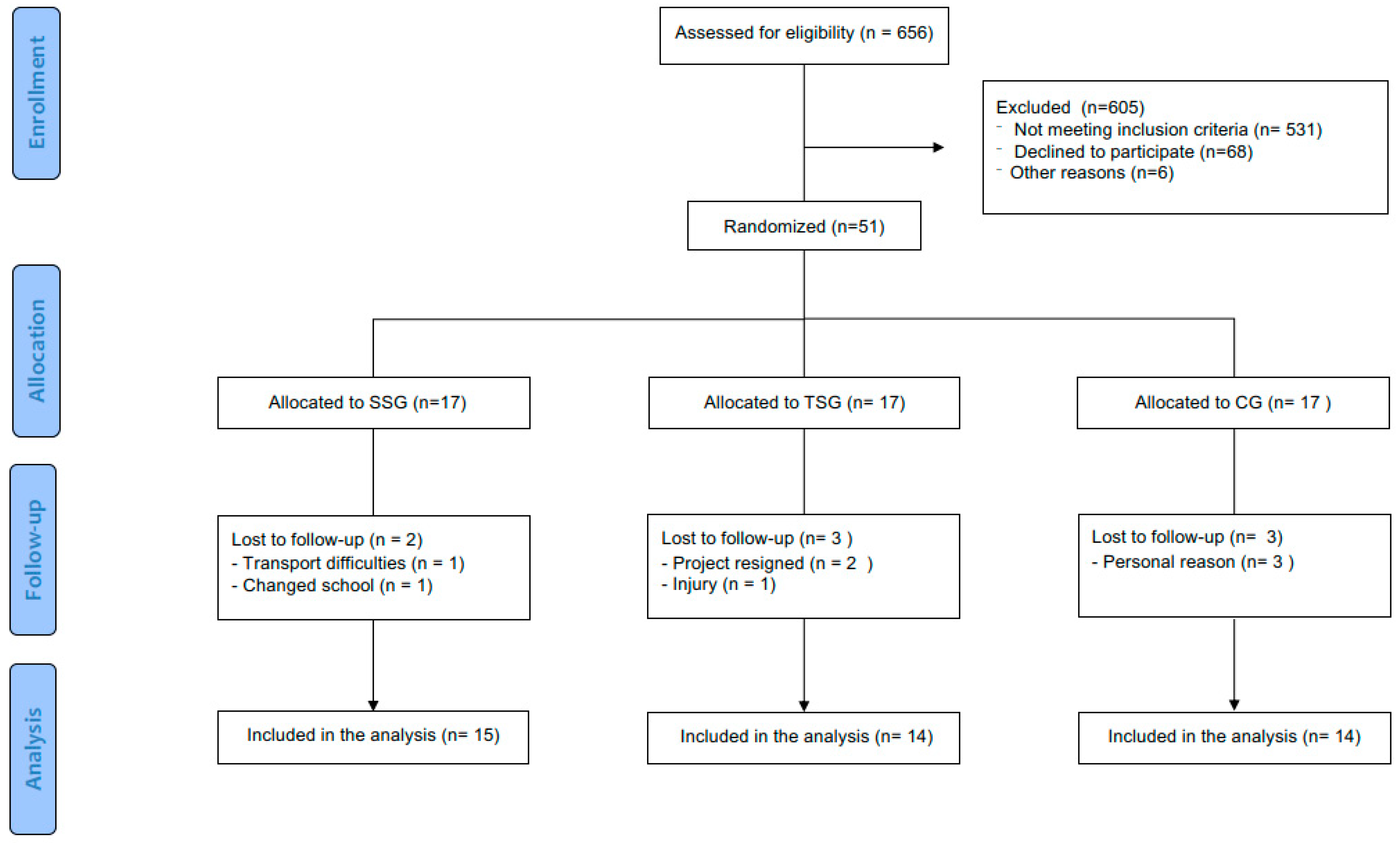
No statistically significant differences were observed between the groups at baseline in terms of anthropometry, body composition, cardiometabolic risk, or physical fitness. During the intervention period, eight participants withdrew from the study: two from the SSG group, three from the TSG, and three from the CG. The characteristics of the participants who withdrew did not differ from those who completed the final assessments, and therefore did not affect group homogeneity. Regarding session intensity, assessed through heart rate, the SSG interventions were more demanding than the TSG sessions (mean %HRmax: 81.1 ± 9.5% vs. 76.7 ± 10.5%; p < 0.001). Participants showed a 43% adherence rate to the intervention, with no significant differences between the SSG and TSG (42.5 ± 23.8% vs. 43.0 ± 21.9%; p = 0.96) across 48 programmed sessions (Figure 1).
Regarding sociodemographic, cardiometabolic risk, and PL characteristics, baseline values showed no significant differences among the CG, SSG, and TSG. Participants presented a BMI within the overweight–obesity range (28.61 ± 3.45 kg/m2) and a PHV indicative of mid-pubertal maturation (−1.04 ± 1.29). Cardiometabolic risk variables, including SBP and DBP, remained within age-appropriate normal ranges (SBP = 111.59 ± 11.59 mmHg; DBP = 66.98 ± 6.65 mmHg). FG levels reflected normoglycemia (FG: 89.3 ± 4.71 mg/dL). In terms of lipid profile, average triglyceride and HDL cholesterol levels indicated a mildly altered metabolic condition (TG = 109.37 ± 48.44 mg/dL; HDL = 46.14 ± 10.21 mg/dL). The results for the PL variables are presented in Table 1.
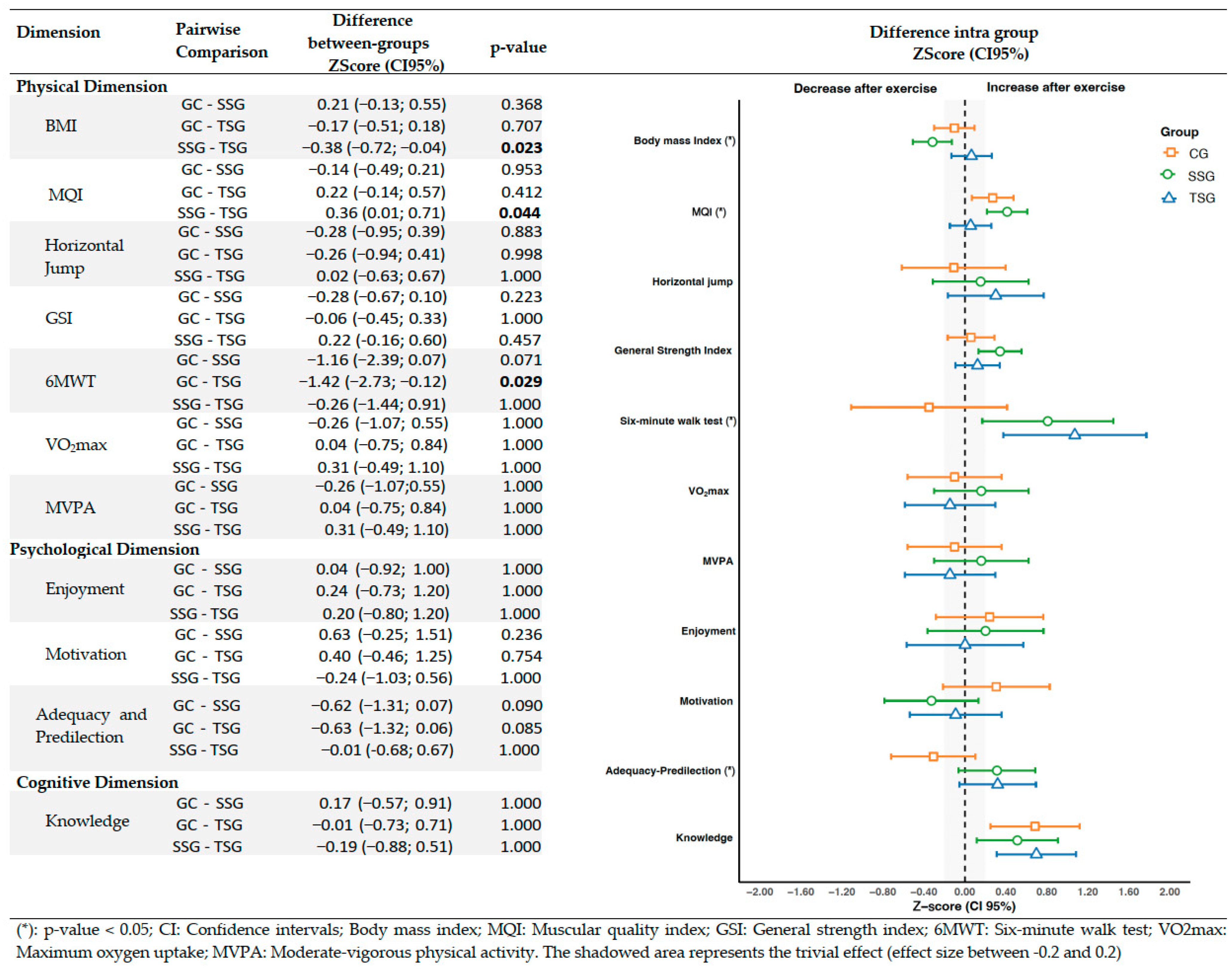
Figure 2 shows the differences in z-scores after the intervention (with their respective confidence intervals) among the three groups for each PL variable. The ANCOVA results revealed statistically significant differences among the SSG, TSG, and CG in BMI (F = 3.97(2); p = 0.03; η2p = 0.18), MQI (F = 3.30(2); p = 0.04; η2p = 0.08), 6MWT (F = 4.24(2); p = 0.02; η2p = 0.13), and Adequacy and Predilection (F = 3.40(2); p = 0.04; η2p = 0.15) (see Supplementary Materials). Similarly, the post hoc ANCOVA analysis indicated significant changes within the physical dimension, specifically in BMI and MQI for the SSG group compared to the TSG. A reduction in BMI was observed (−0.38 [−0.72; −0.04]; p = 0.023), along with an increase in muscle quality (MQI = 0.36 [0.01; 0.71]; p = 0.044). Additionally, significant differences in 6MWT were identified between the TSG and CG (−1.42 [−2.73; −0.12]; p = 0.029), indicating an improvement in functional performance in the TSG.

3.1. Intention-to-Treat Analysis

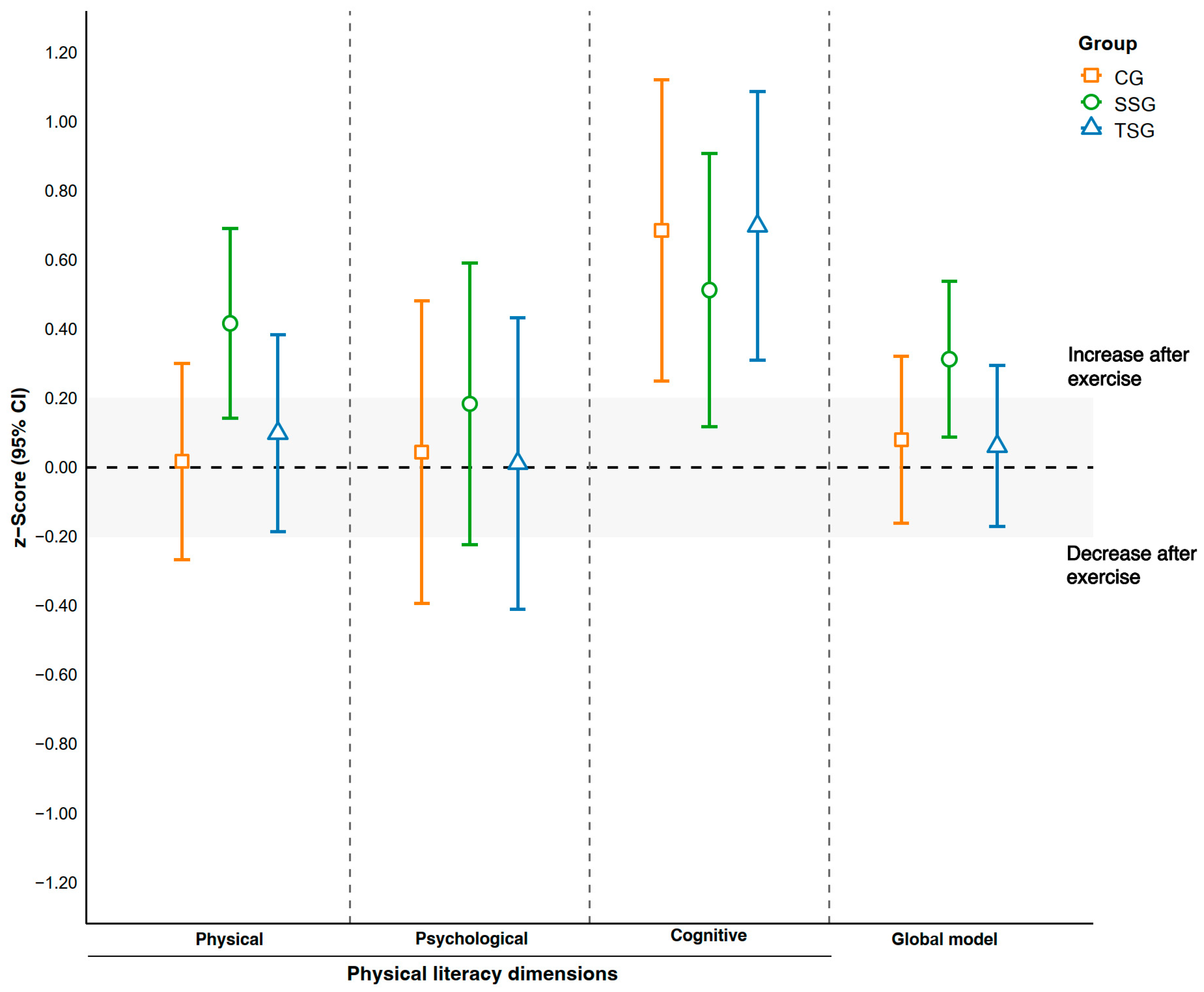
Figure 3 presents the effect size results (z-scores) and their corresponding 95% confidence intervals (CI95%) for the PL dimensions. The ANCOVA analyses revealed no statistically significant differences among the groups in any dimension: physical (F = 1.56(2); p = 0.22; η2p = 0.08), psychological (F = 0.20(2); p = 0.82; η2p = 0.01), cognitive (F = 0.27(2); p = 0.77; η2p = 0.09), or in the overall PL model (F = 1.53(2); p = 0.23; η2p = 0.07). Although no intergroup differences reached statistical significance, within-group analyses showed a positive trend in the SSG group, with higher effects in the overall PL model (0.31 [0.08; 0.53]) compared to TSG (0.06 [−0.17; 0.29]) and CG (0.08 [−0.16; 0.32]). In the physical dimension, SSG also showed moderate improvements (0.41 [0.14; 0.69]) compared with TSG (0.09 [−0.18; 0.38]) and CG (0.01 [−0.26; 0.30]). For the psychological dimension, a small favorable effect was observed for SSG (0.18 [−0.22; 0.59]), while in the cognitive dimension, the largest effects were recorded in TSG (0.78 [0.37; 1.2]) and CG (0.72 [0.30; 1.15]), with lower values for SSG (0.36 [−0.05; 0.77]).

3.2. Per-Protocol Analysis

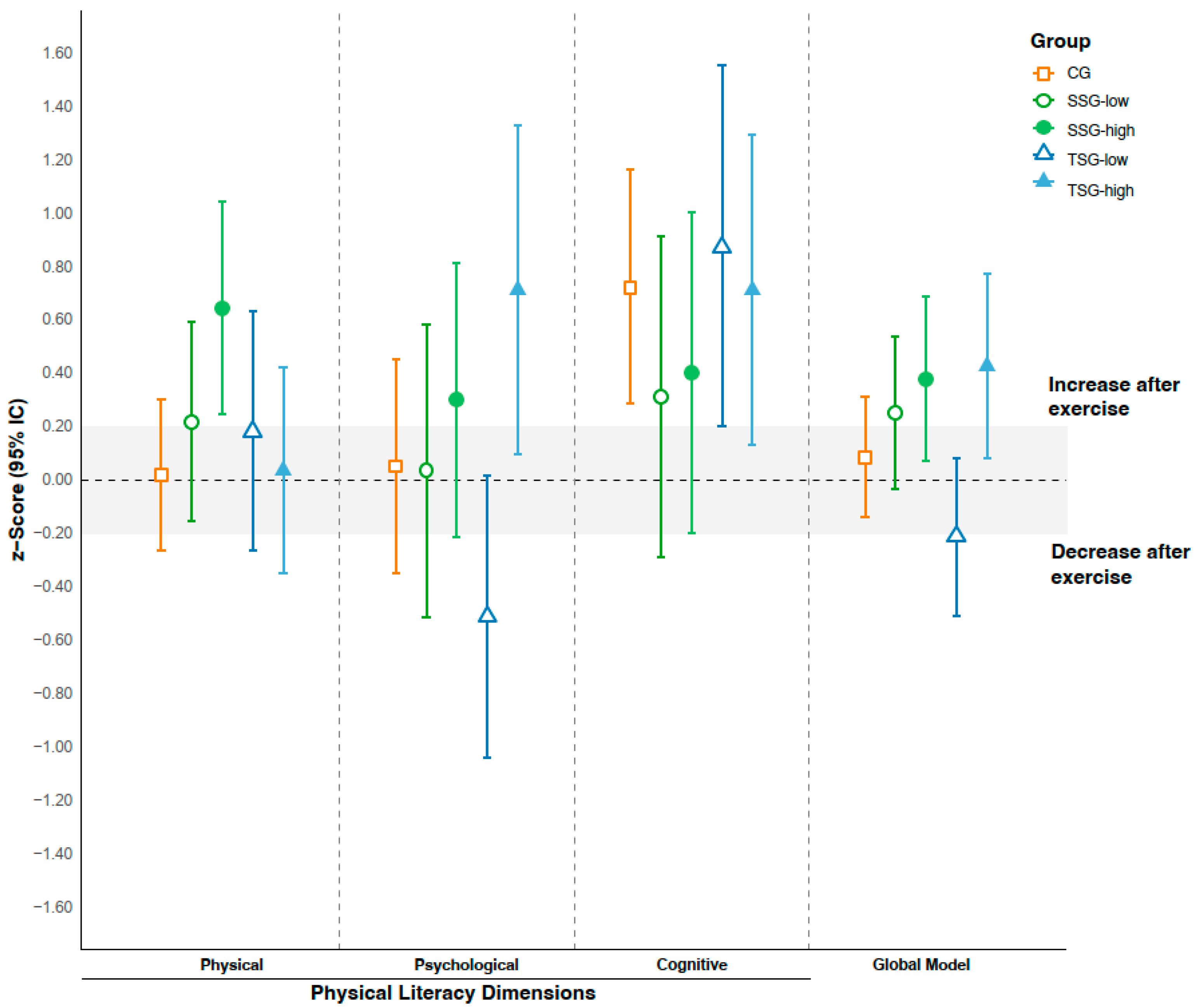
Figure 4 shows the results of the per-protocol analysis. Subgroups for SSG and TSG were established based on program adherence. The terms SSG-low and TSG-low were used for participants who attended less than 50% of the sessions, while SSG-high and TSG-high referred to those with more than 50% attendance. A total of 47% (n = 7) of participants were classified as SSG-low and 43% (n = 6) as TSG-low. The within-group ANCOVA analysis revealed significant differences in the overall PL model (F = 2.91(4); p = 0.035; η2p = 0.26). The post hoc analysis indicated a non-significant trend between high- and low-adherence subgroups (SSG-high and TSG-high vs. TSG-low; p = 0.07 and p = 0.08, respectively). In the physical (F = 1.88(4); p = 0.13; η2p = 0.17) and psychological dimensions (F = 2.43(4); p = 0.06; η2p = 0.25), similar trends were observed, with a marginal difference between TSG-low and TSG-high (p = 0.05). The cognitive dimension showed no significant effects (F = 0.65(4); p = 0.63; η2p = 0.09). Regarding within-group effects in the overall PL model, the highest values were observed in the high-adherence subgroups: SSG-high (0.38 [0.07; 0.68]) and TSG-high (0.43 [0.08; 0.77]). In the physical dimension, the SSG-high group achieved the greatest effect (0.64 [0.24; 1.04]); in the psychological dimension, TSG-high reached the highest score (0.71 [0.13; 1.29]); and in the cognitive dimension, the highest value corresponded to TSG-low (0.87 [0.20; 1.55]).

4. Discussion

The aim of this study was to analyze whether recreational soccer, through SSG and TSG modalities, could promote improvements across the different dimensions of PL in adolescents with high cardiometabolic risk. The results of the study rejected the initial hypothesis; however, the findings showed that the overall PL model exhibited a small, statistically non-significant effect for the SSG group (ES = 0.31) compared with TSG and CG, which reported trivial effects (ES = 0.06 and 0.08, respectively). The effects observed within the PL model dimensions indicated that SSG performed better in two out of the three dimensions, showing a small effect for the physical dimension (ES = 0.41) and a trivial effect for the psychological dimension (ES = 0.18). In this context, the per-protocol analysis adjusted for adherence showed that the overall model presented a small effect in both TSG-high and SSG-high (ES = 0.43 and 0.38, respectively) and revealed significant within-group differences (F = 2.91(4); p = 0.035; η2p = 0.26). However, post hoc results only reached trend-level significance for the SSG-high and TSG-high groups compared with the TSG-low group (p = 0.07 and p = 0.08, respectively). The physical dimension showed a moderate effect in the SSG-high group (ES = 0.64), as did the psychological dimension in the TSG-high group (ES = 0.71), while the cognitive dimension for the TSG-low group (ES = 0.87).
The analysis of the overall model demonstrates that an intervention based solely on recreational soccer is insufficient to comprehensively enhance the multidimensional construct of PL within a three-dimensional theoretical framework. In contrast to our study, interventions that have incorporated multidimensional elements have shown significant effects across various dimensions of PL [76,77]. However, the evidence remains limited regarding the overall assessment of PL. In their meta-analysis, Carl et al. [33] identified that only 21.7% of the interventions evaluated multidimensional effects, and only three reported significant results. Furthermore, while Nezondet et al. [76] observed a 16% improvement in overall PL, Romero-Martínez et al. [77], despite finding changes in specific dimensions, did not report an effect on the global PL score. In line with this, our findings indicate that improvements in the physical dimension—specifically in BMI, MQI, and 6MWT—do not necessarily translate into increases in overall PL, reinforcing the complexity of the construct and the challenge of capturing its multidimensional nature [33].
On the other hand, the per-protocol analysis results for the overall PL model indicated that adherence is a potential determinant of program effectiveness. The findings revealed trends and some significant differences among participants with higher adherence (SSG-high and TSG-high) compared with those who participated less (<50%), which had not been observed in the intention-to-treat analyses. This reinforces the importance of high adherence to facilitate adaptation processes and improvements in the evaluated parameters. In this context, poor reporting of dropout rates [78,79] can bias interpretations of intervention efficacy, effectiveness and transferability [9]. While studies such as Telford et al. [80] and Nezondet et al. [76] did not report adherence despite implementing long-term interventions, others require ≥ 50% attendance [22,81], a criterion also applied here.
The low participation observed in the program may be attributable to a combination of behavioral and contextual barriers. Behaviorally, adolescents’ tendency to prioritize immediate rewards [82] hinders the sustained commitment required for PL. From the perspective of Self-Determination Theory [83], which suggests the theoretical model of PL [14], behavior change is driven by autonomous motivation and enjoyment, which emerge when basic psychological needs are satisfied, providing deeper and more sustainable internal rewards than impulsive gratification. However, in adolescents with elevated BMI, intrinsic motivation is typically lower [84], which may have negatively influenced adherence and the effectiveness of the intervention. This tendency may help explain why obesity management programs often show limited effectiveness in this developmental stage [85,86]. Contextually, the intervention was implemented in late 2023, immediately after school hours, coinciding with residual post-COVID-19 disruptions to healthy behaviors and the reestablishment of school routines [87]. Regionally, a 39% absenteeism rate [88] reflected these difficulties. Although attendance data were not collected, such contextual factors likely hindered adherence and consistent participation in the intervention.

4.1. Physical Dimension

The SSG effect on the physical dimension did not show significant between-group differences; however, it demonstrated a small effect (0.33 [0.04; 0.61]) compared with TSG and CG (0.09 [−0.18; 0.38] and 0.01 [−0.26; 0.30], respectively), which is consistent with existing evidence from interventions using SSG as a strategy to improve physical components [23]. When comparing groups within the physical dimension variables, significant differences were observed in BMI and muscle quality, specifically between SSG and TSG (ES: −0.38, p = 0.023; ES: 0.36, p = 0.044, respectively). The latter is particularly relevant in populations with abdominal obesity, as lower muscle efficiency and greater intramuscular fat infiltration increase metabolic dysfunction and inflammation [89,90], altering myokine secretion and exacerbating insulin resistance and cardiometabolic risk [91,92]. Regarding BMI, the results were similar to those reported by Nezondet et al. [76] for post-intervention z-score changes (−0.3; p = 0.003). Although the SSG strategy has demonstrated effectiveness in reducing BMI [79], it is important to note that the characteristics of the sample with high cardiometabolic risk interact with the individual in a negative or inverse spiral [14,93], hindering the development of the physical dimension, motivation, enjoyment, and adherence. Meanwhile, the TSG showed significant differences in cardiorespiratory fitness, as measured by the 6MWT, compared with the CG (ES: −1.42; p = 0.029), whereas no significant differences were found between TSG and SSG.
Although the other variables of the physical dimension (GSI, SH, VO2max, and MVPA) did not show significant changes, it is noteworthy that the MVPA data collected are similar to the intervention effects reported by Telford et al. [80] and Nezondet et al. [76] regarding MVPA time modifications in PL-based interventions (p = 0.058 and p = 0.36, respectively), in normal-weight children (n = 318 over 33 weeks) and adolescents with abdominal obesity (n = 11 over 9 months), respectively. In this regard, the non-significant effect may be attributed both to the characteristics of the sample and to the high variability observed, as well as to the limitations of wrist-worn accelerometers which, although practical and well tolerated by participants, may substantially underestimate soccer-specific movements—particularly those involving intermittent bursts of intensity or minimal arm displacement [47,94]—in addition to the inherent limitations of accelerometer-based MVPA measurements [95]. Nevertheless, maintaining MVPA levels after the intervention is relevant, as it suggests that a recreational soccer-based program, in addition to enhancing physical literacy, may prevent the typical decline in MVPA during adolescence [96], a finding supported by previous studies in adolescent and university populations [97,98].

4.2. Psychological and Cognitive Dimensions

The psychological dimension did not show significant changes between groups (0.18 [−0.22; 0.59]); however, the variable “adequacy and predilection” toward physical activity showed significant differences (F = 3.40(2); p = 0.04), with a small effect in favor of SSG and TSG (0.31 [−0.05; 0.68] and 0.32 [−0.05; 0.69], respectively) compared with CG (−0.30 [−0.71; 0.10]). These results are consistent with those reported by Liu and Chen [99], who found a small effect (d = 0.26) for the same variable after eight weeks of intervention. Regarding motivation and enjoyment, our findings are consistent with those of Muñoz-Urtubia et al. [84] in children with elevated BMI, showing an inverse relationship between BMI and motivation (ES = 0.198), which in turn represents a direct barrier to motivation and enjoyment, and indirectly to program adherence. Although recreational soccer is usually a highly motivating activity for adolescent boys [84], in this study, it did not produce a significant increase in motivation (p = 0.21) in any of the groups. This result can be understood in light of adolescents’ tendency to prioritize immediate rewards over long-term benefits [82], a behavioral pattern that acts as a barrier to the promotion of PL and to the behavior change processes proposed by Self-Determination Theory [83]. This is particularly relevant considering that intrinsic motivation is a core component of the physical literacy framework proposed by Cairney et al. [14].
Finally, the cognitive dimension did not show statistically significant effects between the experimental groups; however, moderate effects were observed in SSG (0.51 [0.12; 0.91]), TSG (0.70 [0.31; 1.09]), and CG (0.69 [0.25; 1.12]). Similarly to the pilot study by Liu and Chen [99], in which an 8-week intervention led to small but positive changes in the cognitive dimension (g = 0.15), our results also demonstrated moderate effect sizes. It is important to note that Liu and Chen [99] included targeted sessions addressing each dimension of physical literacy as part of their intervention, thereby explicitly incorporating the cognitive component into the program design. In contrast, our study evaluated the effects of a recreational soccer program without implementing a specific cognitive intervention. Thus, the observed improvement in the cognitive dimension may be more closely related to participants’ increased familiarity with curricular content corresponding to their educational level rather than to the direct effects of the intervention itself.

4.3. Practical Considerations

The multidimensional nature of PL [14] presents a significant challenge for designing interventions that comprehensively assess an individual’s level of PL, as reflected in other assessment frameworks [40,100,101]. Our approach aligns with multidimensional assessment models that emphasize the predominance of the physical dimension over the cognitive and psychosocial dimensions. Although there is consistent evidence supporting SSG as an integrated strategy for fostering the transfer of knowledge and the development of motor, affective, and social competencies within the PL framework, our findings underscore the need to continue developing multidimensional intervention strategies that can enhance adherence among clinical populations such as adolescents at high cardiometabolic risk.

4.4. Limitations and Recommendations

This study has several limitations that should be considered when interpreting the results. (i) The adherence rate to the intervention program was low (43%), reflecting the persistent challenge of maintaining sustained participation in real-world settings, particularly among adolescents with high cardiometabolic risk. This low adherence may have limited both the magnitude and depth of the observed effects. (ii) The sample size was small and comprised exclusively of male adolescents, which restricts the generalizability of the findings to female or mixed populations. Future studies should increase the sample size and include representative samples of both sexes to enhance the applicability of the PL model in diverse and real-world contexts. (iii) Future research should also strengthen the assessment of the cognitive dimension and incorporate the evaluation of a social dimension, as well as measures of actual and perceived motor competence (iv) The use of wrist-worn accelerometers, although practical and well-tolerated by participants, may have led to an underestimation of actual physical activity levels, particularly for activities involving limited arm movement or intermittent intensity typical of soccer play.
It is recommended that future research designs interventions that not only include structured playful strategies but also integrate intentional and differentiated pedagogical approaches to stimulate the dimensions of physical literacy (PL) in a balanced manner. Furthermore, considering the role of the educator or coach, as well as the pedagogical models they apply, may be crucial for enhancing participants’ autonomous motivation, motivational climate, and affective engagement. In addition, future studies should explicitly analyze the relationship between PL levels and clinical indicators of cardiometabolic risk using statistical models that allow the establishment of causal links. This would help to strengthen the multidimensional approach to PL as a preventive tool in clinical populations, particularly among adolescents at high cardiometabolic risk. This recommendation is especially relevant for populations with clinical conditions or special needs, in which motor trajectories may be influenced by multiple individual and contextual factors. Based on the experience of our intervention, it is also recommended that future studies involving adolescents with high cardiometabolic risk include intermediate measurement points to monitor program effects over time and to more consistently track adherence processes in this population.

5. Conclusions

Recreational soccer, whether implemented in SSG or TSG formats, appears insufficient on its own to produce meaningful improvements in physical literacy among adolescents with high cardiometabolic risk. Nevertheless, participants who demonstrated higher adherence tended to achieve better outcomes in physical literacy, particularly in the physical and psychological domains, where SSG yielded more consistent positive effects. The modest magnitude of these improvements, together with the generally low adherence observed, highlights the need to refine both the design and implementation of such interventions. Future studies should adopt a multidimensional and pedagogically intentional framework that integrates strategies actively engaging all components of physical literacy—physical, cognitive, and affective—while fostering adherence to enhance the effectiveness and long-term sustainability of outcomes in adolescents at high cardiometabolic risk.

Supplementary Materials

The following supporting information can be downloaded at: https://www.mdpi.com/article/10.3390/sports13120423/s1, Table S1: Analysis of between-group differences in z-score data.

Author Contributions

Conceptualization, G.P.-A. and N.G.-Á.; methodology, G.P.-A., N.G.-Á., P.L.-R. and J.P.-M.; formal analysis, N.G.-Á. and G.P.-A.; investigation, G.P.-A. and N.G.-Á.; data curation, N.G.-Á.; writing—original draft preparation, G.P.-A.; writing—review and editing, G.P.-A., N.G.-Á., P.L.-R., J.P.-M., M.C.-R. and C.M.-S. All authors have read and agreed to the published version of the manuscript.

Funding

This study has been supported by the Research Department, Universidad Adventista de Chile (Regular Research Project No. 2023-183) and the National Fund for the Promotion of Sport (FONDEPORTE) of the Chilean Ministry of Sport (No. 2300120030).

Institutional Review Board Statement

This study was conducted with approval from the Ethics Committees of the Faculty of Sports of the University of Porto (CEFADE 08-21) and the Adventist University of Chile (No. 2021-17). Written informed consent and assents were obtained from all parents or legal guardians and participants before participation.

Informed Consent Statement

Informed consent was obtained from all legal guardians and informed assent from subjects involved in the study.

Data Availability Statement

The data are not publicly available due to privacy or ethical restrictions.

Conflicts of Interest

The authors declare no conflicts of interest.

References

  1. Di Cesare, M.; Sorić, M.; Bovet, P.; Miranda, J.J.; Bhutta, Z.; Stevens, G.A.; Laxmaiah, A.; Kengne, A.P.; Bentham, J. The Epidemiological Burden of Obesity in Childhood: A Worldwide Epidemic Requiring Urgent Action. BMC Med. 2019, 17, 212. [Google Scholar] [CrossRef]
  2. Lobstein, T.; Brinsden, O.; Neveux, M.; Barata, O.; Barquera, S.; Baur, L.; Busch, V.; Buse, K.; Dietz, B.; French, A.; et al. World Obesity Atlas 2022; World Obesity Federation: London, UK, 2022. [Google Scholar]
  3. Twig, G.; Yaniv, G.; Levine, H.; Leiba, A.; Goldberger, N.; Derazne, E.; Shor, D.B.-A.; Tzur, D.; Afek, A.; Shamiss, A.; et al. Body-Mass Index in 2.3 Million Adolescents and Cardiovascular Death in Adulthood. N. Engl. J. Med. 2016, 374, 2430–2440. [Google Scholar] [CrossRef]
  4. OECD. OECD Measured Overweight (Including Obesity) Rates among Adults, by Sex, 2019 (or Nearest Year). In Health at a Glace 2021: OECD Indicators; OECD Publishing: Paris, France, 2021. [Google Scholar]
  5. Phelps, N.H.; Singleton, R.K.; Zhou, B.; Heap, R.A.; Mishra, A.; Bennett, J.E.; Paciorek, C.J.; Lhoste, V.P.; Carrillo-Larco, R.M.; Stevens, G.A.; et al. Worldwide Trends in Underweight and Obesity from 1990 to 2022: A Pooled Analysis of 3663 Population-Representative Studies with 222 Million Children, Adolescents, and Adults. Lancet 2024, 403, 1027–1050. [Google Scholar] [CrossRef]
  6. Subdepartamento de Estudios y Análisis de Datos JUNAEB. Informe Ejecutivo Resultados Mapa Nutricional 2024; Ministerio de Educación: Santiago, Chile, April 2025; Available online: https://www.junaeb.cl/wp-content/uploads/2025/04/INFORME-MN_2024-1.pdf (accessed on 16 October 2025).
  7. Zhang, X.; Liu, J.; Ni, Y.; Yi, C.; Fang, Y.; Ning, Q.; Shen, B.; Zhang, K.; Liu, Y.; Yang, L.; et al. Global Prevalence of Overweight and Obesity in Children and Adolescents: A Systematic Review and Meta-Analysis. JAMA Pediatr. 2024, 178, 800–813. [Google Scholar] [CrossRef]
  8. García-Hermoso, A.; López-Gil, J.F.; Izquierdo, M.; Ramírez-Vélez, R.; Ezzatvar, Y. Exercise and Insulin Resistance Markers in Children and Adolescents With Excess Weight: A Systematic Review and Network Meta-Analysis. JAMA Pediatr. 2023, 177, 1276–1284. [Google Scholar] [CrossRef]
  9. Beedie, C.; Mann, S.; Jimenez, A.; Kennedy, L.; Lane, A.M.; Domone, S.; Wilson, S.; Whyte, G. Death by Effectiveness: Exercise as Medicine Caught in the Efficacy Trap! Br. J. Sports Med. 2016, 50, 323–324. [Google Scholar] [CrossRef]
  10. IPLA International Physical Literacy Association. Available online: https://www.physical-literacy.org.uk/ (accessed on 8 August 2025).
  11. Cornish, K.; Fox, G.; Fyfe, T.; Koopmans, E.; Pousette, A.; Pelletier, C.A. Understanding Physical Literacy in the Context of Health: A Rapid Scoping Review. BMC Public Health 2020, 20, 1569. [Google Scholar] [CrossRef]
  12. Whitehead, M. Physical Literacy Across the World, 1st ed.; Routledge: London, UK, 2019; Volume 1, ISBN 9781138571556. [Google Scholar]
  13. Young, L.; O’Connor, J.; Alfrey, L. Physical Literacy: A Concept Analysis. Sport Educ. Soc. 2019, 25, 946–959. [Google Scholar] [CrossRef]
  14. Cairney, J.; Dudley, D.; Kwan, M.; Bulten, R.; Kriellaars, D. Physical Literacy, Physical Activity and Health: Toward an Evidence-Informed Conceptual Model. Sport Med. 2019, 49, 371–383. [Google Scholar] [CrossRef] [PubMed]
  15. van Sluijs, E.M.F.; Ekelund, U.; Crochemore-Silva, I.; Guthold, R.; Ha, A.; Lubans, D.; Oyeyemi, A.L.; Ding, D.; Katzmarzyk, P.T. Physical Activity Behaviours in Adolescence: Current Evidence and Opportunities for Intervention. Lancet 2021, 398, 429–442. [Google Scholar] [CrossRef] [PubMed]
  16. Krustrup, P.; Dvorak, J.; Bangsbo, J. Small-Sided Football in Schools and Leisure-Time Sport Clubs Improves Physical Fitness, Health Profile, Well-Being and Learning in Children. Br. J. Sports Med. 2016, 50, 1166–1167. [Google Scholar] [CrossRef]
  17. Zouhal, H.; Hammami, A.; Tijani, J.M.; Jayavel, A.; de Sousa, M.; Krustrup, P.; Sghaeir, Z.; Granacher, U.; Ben Abderrahman, A. Effects of Small-Sided Soccer Games on Physical Fitness, Physiological Responses, and Health Indices in Untrained Individuals and Clinical Populations: A Systematic Review. Sport Med. 2020, 50, 987–1007. [Google Scholar] [CrossRef]
  18. Krustrup, P.; Krustrup, B.R. Football Is Medicine: It Is Time for Patients to Play! Br. J. Sports Med. 2018, 52, 1412–1414. [Google Scholar] [CrossRef]
  19. Clemente, F.; Afonso, J.; Sarmento, H. Small-Sided Games: An Umbrella Review of Systematic Reviews and Meta-Analyses. PLoS ONE 2021, 16, e0247067. [Google Scholar] [CrossRef]
  20. Fernández-Espínola, C.; Robles, M.T.A.; Fuentes-Guerra, F.J.G. Small-Sided Games as a Methodological Resource for Team Sports Teaching: A Systematic Review. Int. J. Environ. Res. Public Health 2020, 17, 1884. [Google Scholar] [CrossRef]
  21. Vasconcellos, F.; Seabra, A.; Cunha, F.; Montenegro, R.; Penha, J.; Bouskela, E.; Nogueira Neto, J.; Collett-Solberg, P.; Farinatti, P. Health Markers in Obese Adolescents Improved by a 12-Week Recreational Soccer Program: A Randomised Controlled Trial. J. Sports Sci. 2016, 34, 564–575. [Google Scholar] [CrossRef]
  22. Cvetković, N.; Stojanović, E.; Stojiljković, N.; Nikolić, D.; Scanlan, A.T.; Milanović, Z. Exercise Training in Overweight and Obese Children: Recreational Football and High-Intensity Interval Training Provide Similar Benefits to Physical Fitness. Scand. J. Med. Sci. Sports 2018, 28, 18–32. [Google Scholar] [CrossRef]
  23. Gómez-Álvarez, N.; Boppre, G.; Hermosilla-Palma, F.; Reyes-Amigo, T.; Oliveira, J.; Fonseca, H. Effects of Small-Sided Soccer Games on Physical Fitness and Cardiometabolic Health Biomarkers in Untrained Children and Adolescents: A Systematic Review and Meta-Analysis. J. Clin. Med. 2024, 13, 5221. [Google Scholar] [CrossRef] [PubMed]
  24. Seabra, A.; Katzmarzyk, P.; Carvalho, M.J.; Seabra, A.; Coelho-E-Silva, M.; Abreu, S.; Vale, S.; Póvoas, S.; Nascimento, H.; Belo, L.; et al. Effects of 6-Month Soccer and Traditional Physical Activity Programmes on Body Composition, Cardiometabolic Risk Factors, Inflammatory, Oxidative Stress Markers and Cardiorespiratory Fitness in Obese Boys. J. Sports Sci. 2016, 34, 1822–1829. [Google Scholar] [CrossRef]
  25. Vasconcellos, F.; Cunha, F.; Gonet, D.; Farinatti, P. Does Recreational Soccer Change Metabolic Syndrome Status in Obese Adolescents? A Pilot Study. Res. Q. Exerc. Sport 2020, 92, 91–99. [Google Scholar] [CrossRef] [PubMed]
  26. Paul, D.J.; Gabbett, T.J.; Nassis, G.P. Agility in Team Sports: Testing, Training and Factors Affecting Performance. Sport Med. 2016, 46, 421–442. [Google Scholar] [CrossRef]
  27. Bujalance-Moreno, P.; Latorre-Román, P.Á.; García-Pinillos, F. A Systematic Review on Small-Sided Games in Football Players: Acute and Chronic Adaptations. J. Sports Sci. 2019, 37, 921–949. [Google Scholar] [CrossRef]
  28. Skala, F.; Zemková, E. Neuromuscular and Perceptual-Cognitive Response to 4v4 Small-Sided Game in Youth Soccer Players. Front. Physiol. 2023, 14, 1260096. [Google Scholar] [CrossRef]
  29. Gómez-Álvarez, N.; Igaimán-Saavedra, M.; Quintana-Herrera, S.; Zúñiga-Providel, J.; Hermosilla-Palma, F.; Oliveira, J.; Fonseca, H. Intensity Profile and Enjoyment of Small-Sided Soccer Games with Continuous and Fractionated Regimens in Untrained Adolescents. Sport Sci. Health 2025, 21, 777–786. [Google Scholar] [CrossRef]
  30. Toh, S.H.; Guelfi, K.J.; Wong, P.; Fournier, P.A. Energy Expenditure and Enjoyment of Small-Sided Soccer Games in Overweight Boys. Hum. Mov. Sci. 2011, 30, 636–647. [Google Scholar] [CrossRef] [PubMed]
  31. Fuller, C.W.; Orntoft, C.; Larsen, M.N.; Elbe, A.M.; Ottesen, L.; Junge, A.; Dvorak, J.; Krustrup, P. “FIFA 11 for Health” for Europe. 1: Effect on Health Knowledge and Well-Being of 10-to 12-Year-Old Danish School Children. Br. J. Sports Med. 2017, 51, 1483–1488. [Google Scholar] [CrossRef] [PubMed]
  32. Lubans, D.R.; Eather, N.; Smith, J.J.; Beets, M.W.; Harris, N.K. Scaling-Up Adolescent High-Intensity Interval Training Programs for Population Health. Exerc. Sport Sci. Rev. 2022, 50, 128–136. [Google Scholar] [CrossRef]
  33. Carl, J.; Barratt, J.; Wanner, P.; Töpfer, C.; Cairney, J.; Pfeifer, K. The Effectiveness of Physical Literacy Interventions: A Systematic Review with Meta-Analysis. Sport Med. 2022, 52, 2965–2999. [Google Scholar] [CrossRef]
  34. Fortnum, K.; Weber, M.D.; Dudley, D.; Tudella, E.; Kwan, M.; Richard, V.; Cairney, J. Physical Literacy, Physical Activity, and Health: A Citation Content Analysis and Narrative Review. Sport Med. Open 2025, 11, 44. [Google Scholar] [CrossRef] [PubMed]
  35. Whitehead, M. (Ed.) Physical Literacy Throughout the Lifecourse, 1st ed.; Routledge: London, UK, 2010; ISBN 9781134010684. [Google Scholar]
  36. Fernández, J.R.; Redden, D.T.; Pietrobelli, A.; Allison, D.B. Waist Circumference Percentiles in Nationally Representative Samples of African-American, European-American, and Mexican-American Children and Adolescents. J. Pediatr. 2004, 145, 439–444. [Google Scholar] [CrossRef]
  37. Browning, L.M.; Hsieh, S.D.; Ashwell, M. A Systematic Review of Waist-to-Height Ratio as a Screening Tool for the Prediction of Cardiovascular Disease and Diabetes: 05 Could Be a Suitable Global Boundary Value. Nutr. Res. Rev. 2010, 23, 247–269. [Google Scholar] [CrossRef]
  38. World Medical Association. World Medical Association Declaration of Helsinki: Ethical Principles for Medical Research Involving Human Participants. JAMA 2025, 333, 30–31. [Google Scholar]
  39. Sport for Life Society Canada’s Physical Literacy Consensus Statement—Physical Literacy. Available online: https://physicalliteracy.ca/portfolio/canadas-physical-literacy-consensus-statement/ (accessed on 25 August 2025).
  40. Longmuir, P.E.; Gunnell, K.E.; Barnes, J.D.; Belanger, K.; Leduc, G.; Woodruff, S.J.; Tremblay, M.S. Canadian Assessment of Physical Literacy Second Edition: A Streamlined Assessment of the Capacity for Physical Activity among Children 8 to 12 Years of Age. BMC Public Health 2018, 18, 1047. [Google Scholar] [CrossRef] [PubMed]
  41. Shearer, C.; Goss, H.R.; Boddy, L.M.; Knowles, Z.R.; Durden-Myers, E.J.; Foweather, L. Assessments Related to the Physical, Affective and Cognitive Domains of Physical Literacy Amongst Children Aged 7–11.9 Years: A Systematic Review. Sport Med. Open 2021, 7, 37. [Google Scholar] [CrossRef]
  42. ATS Committee on Proficiency Standards for Clinical Pulmonary Function Laboratories. ATS Statement: Guidelines for the Six-Minute Walk Test. Am. J. Respir. Crit. Care Med. 2002, 166, 111–117. [Google Scholar] [CrossRef]
  43. Lobos-Fernández, L.; Leyton-Dinamarca, B.; Kain-Bercovich, J.; Vio, F. Evaluación de Una Intervención Educativa Para La Prevención de La Obesidad Infantil En Escuelas Básicas de Chile. Nutr. Hosp. 2013, 28, 1156–1164. [Google Scholar] [CrossRef] [PubMed]
  44. Jalili, M.; Nazem, F.; Sazvar, A.; Ranjbar, K. Prediction of Maximal Oxygen Uptake by Six-Minute Walk Test and Body Mass Index in Healthy Boys. J. Pediatr. 2018, 200, 155–159. [Google Scholar] [CrossRef]
  45. Chandler, J.L.; Brazendale, K.; Beets, M.W.; Mealing, B.A. Classification of Physical Activity Intensities Using a Wrist-worn Accelerometer in 8–12-year-old Children. Pediatr. Obes. 2016, 11, 120–127. [Google Scholar] [CrossRef]
  46. Nystrom, C.D.; Pomeroy, J.; Henriksson, P.; Forsum, E.; Ortega, F.B.; Maddison, R.; Migueles, J.H.; Lof, M. Evaluation of the Wrist-Worn ActiGraph WGT3x-BT for Estimating Activity Energy Expenditure in Preschool Children. Eur. J. Clin. Nutr. 2017, 71, 1212–1217. [Google Scholar] [CrossRef] [PubMed]
  47. Migueles, J.H.; Cadenas-Sanchez, C.; Ekelund, U.; Delisle Nyström, C.; Mora-Gonzalez, J.; Löf, M.; Labayen, I.; Ruiz, J.R.; Ortega, F.B. Accelerometer Data Collection and Processing Criteria to Assess Physical Activity and Other Outcomes: A Systematic Review and Practical Considerations. Sport Med. 2017, 47, 1821–1845. [Google Scholar] [CrossRef]
  48. Ngueleu, A.-M.; Barthod, C.; Best, K.L.; Routhier, F.; Otis, M.; Batcho, C.S. Criterion Validity of ActiGraph Monitoring Devices for Step Counting and Distance Measurement in Adults and Older Adults: A Systematic Review. J. Neuroeng. Rehabil. 2022, 19, 112. [Google Scholar] [CrossRef]
  49. Trost, S.; McIver, K.; Pate, R. Conducting Accelerometer-Based Activity Assessments in Field-Based Research. Med. Sci. Sport Exerc. 2005, 37, S531–S543. [Google Scholar] [CrossRef]
  50. Ruiz, J.R.; Castro-Piñero, J.; España-Romero, V.; Artero, E.G.; Ortega, F.B.; Cuenca, M.M.; Jimenez-Pavón, D.; Chillón, P.; Girela-Rejón, M.J.; Mora, J.; et al. Field-Based Fitness Assessment in Young People: The ALPHA Health-Related Fitness Test Battery for Children and Adolescents. Br. J. Sports Med. 2011, 45, 518–524. [Google Scholar] [CrossRef]
  51. Straight, C.; Brady, A.; Schmidt, M.; Evans, E. Comparison of Laboratory-and Field-Based Estimates of Muscle Quality for Predicting Physical Function in Older Women. J. Aging Res. Clin. Pr. 2013, 2, 276–279. [Google Scholar]
  52. Barbat-Artigas, S.; Rolland, Y.; Zamboni, M.; Aubertin-Leheudre, M. How to Assess Functional Status: A New Muscle Quality Index. J. Nutr. Health Aging 2012, 16, 67–77. [Google Scholar] [CrossRef]
  53. Pacheco-Herrera, J.D. Índice General de Fuerza y Adiposidad Como Medida de La Condición Física Relacionada Con La Salud En Niños y Adolescentes de Bogotá, Colombia: Estudio FUPRECOL. Nutr. Hosp. 2016, 33, 556–564. [Google Scholar] [CrossRef]
  54. Pastor-Cisneros, R.; Carlos-Vivas, J.; Adsuar, J.C.; Barrios-Fernández, S.; Rojo-Ramos, J.; Vega-Muñoz, A.; Contreras-Barraza, N.; Mendoza-Muñoz, M. Spanish Translation and Cultural Adaptation of the Canadian Assessment of Physical Literacy-2 (CAPL-2) Questionnaires. Int. J. Environ. Res. Public Health 2022, 19, 8850. [Google Scholar] [CrossRef]
  55. Motl, R.W.; Dishman, R.K.; Saunders, R.; Dowda, M.; Felton, G.; Pate, R.R. Measuring Enjoyment of Physical Activity in Adolescent Girls. Am. J. Prev. Med. 2001, 21, 110–117. [Google Scholar] [CrossRef] [PubMed]
  56. Moreno, J.; González-Cutre, D.; Martínez, C.; Alonso, N.; López, M. Propiedades Psicométricas de La Physical Activity Enjoyment Scale (PACES) En El Contexto Español. Stud. Psychol. Estud. Psicol. 2008, 29, 173–180. [Google Scholar] [CrossRef]
  57. Pavez-Adasme, G.; Chambilla, R.; Grez, C.; Cárcamo-Oyarzún, J.; Poblete-Valderrama, F.; Párraga-Montilla, J.; Gómez-Álvarez, N. Physical Domain of Physical Literacy and Its Relationship with Enjoyment in Physical Education Classes of 5th and 6th Grade Students. Retos 2024, 51, 1478–1485. [Google Scholar] [CrossRef]
  58. Gómez-Álvarez, N.; Costa Luengo, H.; Alarcón Lamilla, L.; Barraza Álvarez, K.; Salinas, V.E.; Olate-Pasten, Y.; Godoy-Tapia, C.; Pavez-Adasme, G.; Hermosilla-Palma, F. Influence of Physical Fitness, Anthropometric Profile, and Biological Maturation on Technical Performance and Enjoyment of Untrained Children Who Participate in Continuous and Fractional Small-Sided Games. Children 2022, 9, 1730. [Google Scholar] [CrossRef]
  59. MINEDUC. Bases Curriculares Primero a Sexto Básico; Unidad de Currículum y Evaluación, Ministerio de Educa-ción: Santiago, Chile, 2018; ISBN 978-956-292-743-7. Available online: https://www.curriculumnacional.cl/recursos/bases-curriculares-1-6-basico (accessed on 18 August 2025).
  60. De Onis, M.; Onyango, A.; Borghi, E.; Siyam, A.; Nishida, C.; Siekmann, J. Development of a WHO Growth Reference for School-Aged Children and Adolescents. Bull. World Health Organ. 2007, 85, 660. [Google Scholar] [CrossRef] [PubMed]
  61. Khanna, D.; Peltzer, C.; Kahar, P.; Parmar, M.S. Body Mass Index (BMI): A Screening Tool Analysis. Cureus 2022, 14, e22119. [Google Scholar] [CrossRef]
  62. Gurka, M.J.; Ice, C.L.; Sun, S.S.; DeBoer, M.D. A Confirmatory Factor Analysis of the Metabolic Syndrome in Adolescents: An Examination of Sex and Racial/Ethnic Differences. Cardiovasc. Diabetol. 2012, 11, 128. [Google Scholar] [CrossRef]
  63. Burrows, R.; Correa-Burrows, P.; Rogan, J.; Cheng, E.; Blanco, E.; Gahagan, S. Long-Term vs. Recent-Onset Obesity: Their Contribution to Cardiometabolic Risk in Adolescence. Pediatr. Res. 2019, 86, 776–782. [Google Scholar] [CrossRef]
  64. Correa-Burrows, P.; Matamoros, M.; de Toro, V.; Zepeda, D.; Arriaza, M.; Burrows, R. A Single-Point Insulin Sensitivity Estimator (SPISE) of 5.4 Is a Good Predictor of Both Metabolic Syndrome and Insulin Resistance in Adolescents with Obesity. Front. Endocrinol. 2023, 14, 1078949. [Google Scholar] [CrossRef]
  65. Paulmichl, K.; Hatunic, M.; Højlund, K.; Jotic, A.; Krebs, M.; Mitrakou, A.; Porcellati, F.; Tura, A.; Bergsten, P.; Forslund, A.; et al. Modification and Validation of the Triglyceride-to–HDL Cholesterol Ratio as a Surrogate of Insulin Sensitivity in White Juveniles and Adults without Diabetes Mellitus: The Single Point Insulin Sensitivity Estimator (SPISE). Clin. Chem. 2016, 62, 1211–1219. [Google Scholar] [CrossRef]
  66. Mirwald, R.; Baxter-Jones, A.; Bailey, D.; Beunen, G. An Assessment of Maturity from Anthropometric Measurements. Med. Sci. Sport Exerc. 2002, 34, 689–694. [Google Scholar]
  67. Coates, A.M.; Joyner, M.J.; Little, J.P.; Jones, A.M.; Gibala, M.J. A Perspective on High-Intensity Interval Training for Performance and Health. Sports Med. 2023, 53, 85–96. [Google Scholar] [CrossRef]
  68. Raghuveer, G.; Hartz, J.; Lubans, D.R.; Takken, T.; Wiltz, J.L.; Mietus-Snyder, M.; Perak, A.M.; Baker-Smith, C.; Pietris, N.; Edwards, N.M. Cardiorespiratory Fitness in Youth: An Important Marker of Health: A Scientific Statement from the American Heart Association. Circulation 2020, 142, E101–E118. [Google Scholar] [CrossRef]
  69. Póvoas, S.; Randers, M.B.; Krustrup, P.; Larsen, M.N.; Pereira, R.; Castagna, C. Heart Rate and Perceived Experience Differ Markedly for Children in Same- versus Mixed-Gender Soccer Played as Small—and Large-Sided Games. Biomed. Res. Int. 2018, 2018, 7804642. [Google Scholar] [CrossRef]
  70. Ngo, J.K.; Tsui, M.-C.; Smith, A.W.; Carling, C.; Chan, G.-S.; Wong, D. The Effects of Man-Marking on Work Intensity in Small-Sided Soccer Games. J. Sport Science Med. 2012, 11, 109–114. [Google Scholar]
  71. Sahli, H.; Selmi, O.; Zghibi, M.; Hill, L.; Rosemann, T.; Knechtle, B.; Clemente, F. Effect of the Verbal Encouragement on Psychophysiological and Affective Responses during Small-Sided Games. Int. J. Environ. Res. Public Health 2020, 17, 8884. [Google Scholar] [CrossRef]
  72. Wang, J.; Cao, L.; Xie, P.; Wang, J. Recreational Football Training Improved Health-Related Physical Fitness in 9- to 10-Year-Old Boys. J. Sports Med. Phys. Fitness 2018, 58, 326–331. [Google Scholar] [CrossRef] [PubMed]
  73. Sink, K.M.; Espeland, M.A.; Castro, C.M.; Church, T.; Cohen, R.; Dodson, J.A.; Guralnik, J.; Hendrie, H.C.; Jennings, J.; Katula, J.; et al. Effect of a 24-Month Physical Activity Intervention vs Health Education on Cognitive Outcomes in Sedentary Older Adults. JAMA 2015, 314, 781. [Google Scholar] [CrossRef]
  74. Migueles, J.H.; Cadenas-Sanchez, C.; Lubans, D.R.; Henriksson, P.; Torres-Lopez, L.V.; Rodriguez-Ayllon, M.; Plaza-Florido, A.; Gil-Cosano, J.J.; Henriksson, H.; Escolano-Margarit, M.V.; et al. Effects of an Exercise Program on Cardiometabolic and Mental Health in Children With Overweight or Obesity: A Secondary Analysis of a Randomized Clinical Trial. JAMA Netw. Open 2023, 6, e2324839. [Google Scholar] [CrossRef]
  75. Hopkins, W.; Marshall, S.; Batterham, A.; Hanin, J. Progressive Statistics for Studies in Sports Medicine and Exercise Science. Med. Sci. Sport Exerc. 2009, 41, 3–13. [Google Scholar] [CrossRef]
  76. Nezondet, C.; Gandrieau, J.; Bourrelier, J.; Nguyen, P.; Zunquin, G. The Effectiveness of a Physical Literacy-Based Intervention for Increasing Physical Activity Levels and Improving Health Indicators in Overweight and Obese Adolescents (CAPACITES 64). Children 2023, 10, 956. [Google Scholar] [CrossRef]
  77. Romero-Martínez, J.; Menescardi, C.; Ortega-Benavent, N.; Montalt-García, S.; Barnett, L.M.; García-Massó, X.; Estevan, I. Effects of a Classroom-Based Intervention to Promote Physical Literacy in Children: The Randomized and Controlled ALPHYL Study. J. Sci. Med. Sport 2025, 28, 833–839. [Google Scholar] [CrossRef] [PubMed]
  78. Guijo, J.A.; do Prado, W.L.; de Araújo, R.C.; dos Santos, E.E.P.; Malik, N.; Lofrano-Prado, M.C.; Botero, J.P. Adherence and Dropout in Exercise-Based Interventions in Childhood Obesity: A Systematic Review of Randomized Trials. Obes. Rev. 2024, 25, e13721. [Google Scholar] [CrossRef]
  79. Clemente, F.; Moran, J.; Ramirez-Campillo, R.; Oliveira, R.; Brito, J.; Silva, A.F.; Badicu, G.; Praça, G.; Sarmento, H. Recreational Soccer Training Effects on Pediatric Populations Physical Fitness and Health: A Systematic Review. Children 2022, 9, 1776. [Google Scholar] [CrossRef] [PubMed]
  80. Telford, R.M.; Olive, L.S.; Keegan, R.J.; Keegan, S.; Barnett, L.M.; Telford, R.D. Student Outcomes of the Physical Education and Physical Literacy (PEPL) Approach: A Pragmatic Cluster Randomised Controlled Trial of a Multicomponent Intervention to Improve Physical Literacy in Primary Schools. Phys. Educ. Sport Pedagog. 2020, 26, 97–110. [Google Scholar] [CrossRef]
  81. Faude, O.; Kerper, O.; Multhaupt, M.; Winter, C.; Beziel, K.; Junge, A.; Meyer, T. Football to Tackle Overweight in Children. Scand. J. Med. Sci. Sports 2010, 20 (Suppl. 1), 103–110. [Google Scholar] [CrossRef]
  82. Shulman, E.P.; Smith, A.R.; Silva, K.; Icenogle, G.; Duell, N.; Chein, J.; Steinberg, L. The Dual Systems Model: Review, Reappraisal, and Reaffirmation. Dev. Cogn. Neurosci. 2016, 17, 103–117. [Google Scholar] [CrossRef]
  83. Deci, E.L.; Ryan, R.M. Intrinsic Motivation and Self-Determination in Human Behavior, 1st ed.; Springer: Boston, MA, USA, 1985; ISBN 978-1-4899-2273-1. [Google Scholar]
  84. Muñoz-Urtubia, N.; Vega-Muñoz, A.; Salazar-Sepúlveda, G.; Contreras-Barraza, N.; Mendoza-Muñoz, M.; Ureta-Paredes, W.; Carabantes-Silva, R. Relationship Between Body Composition and Physical Literacy in Chilean Children (10 to 16 Years): An Assessment Using CAPL-2. J. Clin. Med. 2024, 13, 7027. [Google Scholar] [CrossRef]
  85. Cardel, M.I.; Atkinson, M.A.; Taveras, E.M.; Holm, J.-C.; Kelly, A.S. Obesity Treatment Among Adolescents: A Review of Current Evidence and Future Directions. JAMA Pediatr. 2020, 174, 609–617. [Google Scholar] [CrossRef] [PubMed]
  86. Luppino, G.; Wasniewska, M.; Casto, C.; Ferraloro, C.; Li Pomi, A.; Pepe, G.; Morabito, L.A.; Alibrandi, A.; Corica, D.; Aversa, T. Treating Children and Adolescents with Obesity: Predictors of Early Dropout in Pediatric Weight-Management Programs. Children 2024, 11, 205. [Google Scholar] [CrossRef] [PubMed]
  87. Dee, T.S. Higher Chronic Absenteeism Threatens Academic Recovery from the COVID-19 Pandemic. Proc. Natl. Acad. Sci. USA 2024, 121, e2312249121. [Google Scholar] [CrossRef]
  88. Arraño, A.; García, G.; Quiroz, J.P.; Toro, V. Documento de Trabajo 32: Reporte Nacional de Asistencia de Marzo a Septiembre de Los Años 2018, 2022 y 2023; Chile. Ministerio de Educación, Centro de Estudios MINEDUC: Santiago, Chile, 2023. [Google Scholar]
  89. Shero, J.A.; Lindholm, M.E.; Sandri, M.; Stanford, K.I. Skeletal Muscle as a Mediator of Interorgan Crosstalk During Exercise: Implications for Aging and Obesity. Circ. Res. 2025, 136, 1407–1432. [Google Scholar] [CrossRef]
  90. Domínguez-Barbosa, A.; Reyes-Romo, D.; Salvador-Quezada, M.; Becerra-Morales, S.N.; Lopez-Gonzalez, D.; Serralde-Zúñiga, A.E.; Guevara-Cruz, M.; Medina-Vera, I. Associations Between Body Composition Measurements and Muscle Ultrasound Parameters Amongst Children and Adolescents with Overweight and Obesity. Nutrients 2025, 17, 2659. [Google Scholar] [CrossRef]
  91. Letukienė, A.; Hendrixson, V.; Ginevičienė, V. Current Knowledge and Scientific Trends in Myokines and Exercise Research in the Context of Obesity. Front. Med. 2024, 11, 1421962. [Google Scholar] [CrossRef]
  92. Iglesias, P. Muscle in Endocrinology: From Skeletal Muscle Hormone Regulation to Myokine Secretion and Its Implications in Endocrine–Metabolic Diseases. J. Clin. Med. 2025, 14, 4490. [Google Scholar] [CrossRef] [PubMed]
  93. Stodden, D.F.; Langendorfer, S.J.; Goodway, J.D.; Roberton, M.A.; Rudisill, M.E.; Garcia, C.; Garcia, L.E. A Developmental Perspective on the Role of Motor Skill Competence in Physical Activity: An Emergent Relationship. Quest 2008, 60, 290–306. [Google Scholar] [CrossRef]
  94. Montoye, A.H.K.; Pivarnik, J.M.; Mudd, L.M.; Biswas, S.; Pfeiffer, K.A. Validation and Comparison of Accelerometers Worn on the Hip, Thigh, and Wrists for Measuring Physical Activity and Sedentary Behavior. AIMS Public Health 2016, 3, 298–312. [Google Scholar] [CrossRef] [PubMed]
  95. Cain, K.L.; Sallis, J.F.; Conway, T.L.; Van Dyck, D.; Calhoon, L. Using Accelerometers in Youth Physical Activity Studies: A Review of Methods. J. Phys. Act. Health 2013, 10, 437–450. [Google Scholar] [CrossRef]
  96. Currie, C.; Zanotti, C.; Morgan, A.; Currie, D.; de Looze, M.; Roberts, C.; Samdal, O.; Smith, O.; Barnekow, V. Social Determinants of Health and Well-Being Among Young People. Health Behaviour in School-Aged Children (HBSC) Study: International Report from the 2009/2010 Survey; WHO Regional Office for Europe: Copenhagen, Denmark, 2012. [Google Scholar]
  97. Belton, S.; McCarren, A.; McGrane, B.; Powell, D.; Issartel, J. The Youth-Physical Activity Towards Health (Y-PATH) Intervention: Results of a 24 Month Cluster Randomised Controlled Trial. PLoS ONE 2019, 14, e0221684. [Google Scholar] [CrossRef]
  98. Kwan, M.Y.W.; Li, Y.-C.; Cairney, J. Theory-Based Correlates of Physical Activity Among Children With Developmental Coordination Disorder: A Scoping Review. Curr. Dev. Disord. Reports 2022, 9, 105–109. [Google Scholar] [CrossRef]
  99. Liu, Y.; Chen, S. Characterizing Middle School Students’ Physical Literacy Development: A Self-Determination Theory-Based Pilot Intervention in Physical Education. Front. Sport Act. Living 2022, 3, 809447. [Google Scholar] [CrossRef]
  100. Sum, R.K.W.; Ha, A.S.C.; Cheng, C.F.; Chung, P.K.; Yiu, K.T.C.; Kuo, C.C.; Yu, C.K.; Wang, F.J. Construction and Validation of a Perceived Physical Literacy Instrument for Physical Education Teachers. PLoS ONE 2016, 11, e0155610. [Google Scholar] [CrossRef]
  101. Sport Australia SportAus. The Australian Physical Literacy Framework; Sport Australia: Canberra, Australia, 2019; ISBN 978-1-74013-127-8. [Google Scholar]
Figure 1. Flow diagram of participant enrollment, group allocation, follow-up, and final analysis. Note: SSG: Small-Sided Soccer Games; TSG: Traditional Soccer Group; CG: Control Group.
Sports 13 00423 g001
Figure 2. Effects of the exercise program on z-score changes between groups in physical literacy outcomes.
Sports 13 00423 g002
Figure 3. Effects of the exercise program on z-score changes across dimensions and the global model of physical literacy outcomes. Note. The shadowed area represents the trivial effect (effect size between −0.2 and 0.2).
Sports 13 00423 g003
Figure 4. Effects of the exercise program on z-score changes across dimensions and the global model of physical literacy outcomes. Per-protocol analysis. Note. The shadowed area represents the trivial effect (effect size between −0.2 and 0.2).
Sports 13 00423 g004
Table 1. Participant characteristics by intervention group.
All (N = 43)CG (n = 14)SSG (n = 15)TSG (n = 14)
Mean (SD)Mean (SD)Mean (SD)Mean (SD)p-Value
Sociodemographic variables
Age (year)13.16 (1.40)13.07 (1.47)12.97 (1.31)13.44 (1.45)0.605
Weight (kg)76.41 (15.36)75.15 (14.46)78.57 (14.6)75.52 (17.52)0.768
Height (cm)162.62 (10.04)162.04 (8.68)163.54 (11.20)162.28 (10.63)0.906
PHV−1.04 (1.29)−1.09 (1.19)−1.04 (1.27)−0.99 (1.48)0.979
BMI (kg/m2)28.61 (3.45)28.41 (3.48)29.1 (2.55)28.30 (4.25)0.722
Cardiometabolic variables
SBP (mmHg)111.59 (11.59)108.82 (9.48)113.82 (13.75)112.12 (11.27)0.428
DBP (mmHg)66.98 (6.65)65.97 (6.08)66.44 (7.07)68.53 (6.88)0.506
FG (mg/dL)89.3 (4.71)89.49 (5.11)90.46 (4.52)87.98 (4.47)0.290
HDL-C (mg/dL)46.14 (10.21)48.2 (12.37)44.29 (8.04)46.18 (10.31)0.572
TG (mg/dL)109.37 (48.44)98.73 (41.48)106.94 (41.56)121.18 (59.55)0.475
SPISE (a.u)5.57 (1.22)5.66 (1.28)5.37 (0.88)5.68 (1.49)0.664
Physical dimensión
MQI (a.u)2.14 (0.65)2.12 (0.54)2.11 (0.62)2.19 (0.79)0.944
Horizontal jump (cm)130.60 (24.84)131.43 (23.84)132.41 (23.02)127.94 (28.69)0.885
GSI (a.u)0.03 (0.92)0.10 (0.93)0.00 (0.93)0.01 (0.96)0.951
6MWT (m)529.67 (123.5)566.33 (50.57)555.91 (56.75)546.72 (42.85)0.490
VO2max (mL/kg/min)24.05 (6.22)25.88 (4.41)24.75 (3.9)24.79 (4.81)0.698
MVPA/DAY (min)14.8 (11.23)9.87 (9.82)17.11 (12.67)16.11 (10.23)0.179
Psychological dimension
Enjoyment (a.u)65.29 (10.87)67.14 (7.63)64.38 (7.07)64.53 (16.08)0.589
Adequacy and Predilection (a.u)12.27 (2.8)12.78 (2.25)11.19 (3.4)12.84 (2.44)0.279
Motivation (a.u)11.41 (2.31)10.75 (2.34)12.13 (1.88)11.31 (2.59)0.228
Cognitive dimension
Knowledge (a.u)5.89 (2.18)6 (2.32)5.13 (2.03)6.5 (2.1)0.203
p-value < 0.05; SD: Standard deviation; PHV: Peak high velocity; BMI: Body mass index; DBP: Diastolic blood pressure; SBP: Systolic blood pressure; FG: fasting glucose; HDL-C: Lipoprotein cholesterol; TG: Triglyceride; SPISE: Single point insulin sensitivity estimator; GSI: General Strength index; 6MWT: Six-minute walk test; VO2max: Maximum oxygen uptake; MVPA: Moderate-vigorous physical activity; MQI: muscular quality index; bpm: Beats per minute; mmHg: Milligrams of mercury; µU/mL: Micro-units per milliliter; mg/dL: Milligrams per deciliter; cm: Centimeter; m: Meters; mL/kg/min: Milliliters per kilogram per minute; a.u: Arbitrary units.
Disclaimer/Publisher’s Note: The statements, opinions and data contained in all publications are solely those of the individual author(s) and contributor(s) and not of MDPI and/or the editor(s). MDPI and/or the editor(s) disclaim responsibility for any injury to people or property resulting from any ideas, methods, instructions or products referred to in the content.