

You are currently on the new version of our website. Access the old version .

Insects, Volume 13, Issue 6

2022 June - 71 articles

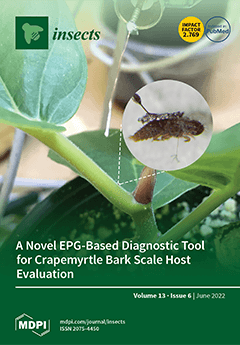
Cover Story: This study established a novel real-time diagnostic tool for quick crapemyrtle bark scale (CMBS) host evaluation. Canonical host range confirmation of invasive hemipterans relies on the evaluation of plant susceptibility through greenhouse or field trials, which are inefficient and time-consuming. The researchers developed an alternative technology to complement conventional host confirmation methods. Using electrical penetration graph (EPG)-based technology, the research team monitored the CMBS invisible stylet-tip position when the insect was feeding on different plant tissues. The occurrences of stylet-tip in the phloem phase and xylem phase offered conclusive evidence for host plant evaluation. Moreover, CMBS typical feeding behaviors measured by EPG-based data analysis revealed how CMBS susceptible plants differed from non-susceptible plants. View this paper
  • Issues are regarded as officially published after their release is announced to the table of contents alert mailing list .
  • You may sign up for email alerts to receive table of contents of newly released issues.
  • PDF is the official format for papers published in both, html and pdf forms. To view the papers in pdf format, click on the "PDF Full-text" link, and use the free Adobe Reader to open them.

Articles (71)

  • Article
  • Open Access
15 Citations
10,890 Views
65 Pages

Revision of the World Species of Megaphragma Timberlake (Hymenoptera: Trichogrammatidae)

  • Andrew Polaszek,
  • Lucian Fusu,
  • Gennaro Viggiani,
  • Andie Hall,
  • Paul Hanson and
  • Alexey A. Polilov

20 June 2022

Megaphragma species are important models for basic organismal research, and many are potential biological control agents. We present the first extensive revision of species of the genus Megaphragma based on morphological and molecular data. Our revis...

  • Article
  • Open Access
29 Citations
6,711 Views
14 Pages

20 June 2022

Yellow mealworm larvae (Tenebrio molitor L.) are a sustainable source of protein for food and feed. This study represents a new approach in analyzing changes in the nutritional composition of mealworm larvae using near-infrared reflectance spectrosco...

  • Article
  • Open Access
6 Citations
3,024 Views
13 Pages

20 June 2022

Trichogramma pretiosum Riley is an important natural enemy and biological control agent of lepidopteran pests. Wolbachia is an intracellular endosymbiont that induces parthenogenesis in the parasitoid T. pretiosum. In this paper, the sublethal effect...

  • Feature Paper
  • Article
  • Open Access
4 Citations
3,530 Views
11 Pages

19 June 2022

The systematic position and actual distribution of Recaredus rex, for a long time one of the most enigmatic lace bug genus and species, is very obscure because only the type specimen and three other individuals from India are known to date. In the pr...

  • Review
  • Open Access
8 Citations
5,965 Views
21 Pages

19 June 2022

Anhydrobiosis, an ametabolic dehydrated state triggered by water loss, is observed in several invertebrate lineages. Anhydrobiotes revive when rehydrated, and seem not to suffer the ultimately lethal cell damage that results from severe loss of water...

  • Article
  • Open Access
11 Citations
6,674 Views
14 Pages

Exploring Honeybee Abdominal Anatomy through Micro-CT and Novel Multi-Staining Approaches

  • Jessica Carreira De Paula,
  • Kevin Doello,
  • Cristina Mesas,
  • Garyfalia Kapravelou,
  • Alberto Cornet-Gómez,
  • Francisco José Orantes,
  • Rosario Martínez,
  • Fátima Linares,
  • Jose Carlos Prados and
  • Luis Miguel de Pablos
  • + 2 authors

18 June 2022

Continuous improvements in morphological and histochemical analyses of Apis mellifera could improve our understanding of the anatomy and physiology of these insects at both the cellular and tissue level. In this work, two different approaches have be...

  • Article
  • Open Access
3 Citations
3,438 Views
13 Pages

18 June 2022

In many human societies, domestic insect pests often evoke feelings of disgust, fear and aversion. These common feelings may translate to increased use of household pesticides. No study has ever explored this possibility and consequently, efforts to...

  • Article
  • Open Access
34 Citations
3,732 Views
17 Pages

Automatic Crop Pest Detection Oriented Multiscale Feature Fusion Approach

  • Shifeng Dong,
  • Jianming Du,
  • Lin Jiao,
  • Fenmei Wang,
  • Kang Liu,
  • Yue Teng and
  • Rujing Wang

18 June 2022

Specialized pest control for agriculture is a high-priority agricultural issue. There are multiple categories of tiny pests, which pose significant challenges to monitoring. Previous work mainly relied on manual monitoring of pests, which was labor-i...

  • Feature Paper
  • Article
  • Open Access
11 Citations
3,575 Views
15 Pages

17 June 2022

Glenea cantor Fabricius (Cerambycidae: Lamiinae) is a pest that devastates urban landscapes and causes ecological loss in southern China and Southeast Asian countries where its main host kapok trees are planted. The olfactory system plays a vital rol...

  • Article
  • Open Access
15 Citations
5,783 Views
12 Pages

Optimizing the Use of Basil as a Functional Plant for the Biological Control of Aphids by Chrysopa pallens (Neuroptera: Chrysopidae) in Greenhouses

  • Yan Fang,
  • Shu Li,
  • Qingxuan Xu,
  • Jie Wang,
  • Yajie Yang,
  • Yingying Mi,
  • Zhenyu Jin,
  • Nicolas Desneux and
  • Su Wang

16 June 2022

Effective biological control agents that can provide sustainable pest control need to be researched in further detail; functional plants (or non-crop insectary plants), in particular, are garnering increased research interest. Much remains to be lear...

of 8

Get Alerted

Add your email address to receive forthcoming issues of this journal.

XFacebookLinkedIn
Insects - ISSN 2075-4450