Skip to Content

Galaxies, Volume 8, Issue 4

2020 December - 19 articles

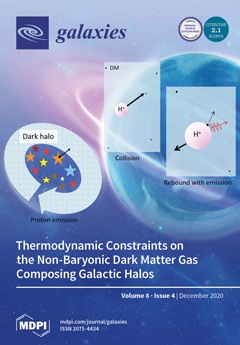
Cover Story: “Thermodynamic Constraints on the Non-Baryonic Dark Matter Gas Composing Galactic Halos” by Anne M. Hofmeister tests the postulated properties of non-baryonic matter (that NBDM interacts gravitationally with baryonic matter, yet negligibly interacts with photons) against classical physics, which governs gas bodies. Without NBDM–NBDM collisions, the impossible limit of absolute zero can be reached. Collisions with baryons in the intergalactic medium are unavoidable, and would generate light since baryons have finite size and can deform inelastically. The halo must then be detectable. If no thermal energy arises in collisions, NBDM gas would collapse to a tiny, dense volume during any disturbance. NBDM gas should occupy central galactic regions since self-gravitating objects are density stratified. The properties postulated for NBDM in halos would result in a universe unlike that observed. View this paper
  • Issues are regarded as officially published after their release is announced to the table of contents alert mailing list .
  • You may sign up for email alerts to receive table of contents of newly released issues.
  • PDF is the official format for papers published in both, html and pdf forms. To view the papers in pdf format, click on the "PDF Full-text" link, and use the free Adobe Reader to open them.

Articles (19)

  • Article
  • Open Access
20 Citations
5,514 Views
24 Pages

Classification of Planetary Nebulae through Deep Transfer Learning

  • Dayang N. F. Awang Iskandar,
  • Albert A. Zijlstra,
  • Iain McDonald,
  • Rosni Abdullah,
  • Gary A. Fuller,
  • Ahmad H. Fauzi and
  • Johari Abdullah

11 December 2020

This study investigate the effectiveness of using Deep Learning (DL) for the classification of planetary nebulae (PNe). It focusses on distinguishing PNe from other types of objects, as well as their morphological classification. We adopted the deep...

  • Article
  • Open Access
6 Citations
3,372 Views
13 Pages

Development of a Frequency Tunable Green Laser Source for Advanced Virgo+ Gravitational Waves Detector

  • Camilla De Rossi,
  • Jonathan Brooks,
  • Julia Casanueva Diaz,
  • Antonino Chiummo,
  • Eric Genin,
  • Matthieu Gosselin,
  • Nicolas Leroy,
  • Maddalena Mantovani,
  • Beatrice Montanari and
  • Gabriel Pillant
  • + 1 author

9 December 2020

After one year of data taking, the observing run three (O3), we are preparing for an improved version of the system, named the Advanced Virgo plus. One of the major upgrades will be the installation of the signal recycling mirror to form an additiona...

  • Article
  • Open Access
12 Citations
5,752 Views
13 Pages

Advanced LIGO Laser Systems for O3 and Future Observation Runs

  • Nina Bode,
  • Joseph Briggs,
  • Xu Chen,
  • Maik Frede,
  • Peter Fritschel,
  • Michael Fyffe,
  • Eric Gustafson,
  • Matthew Heintze,
  • Peter King and
  • Benno Willke
  • + 4 authors

8 December 2020

The advanced LIGO gravitational wave detectors need high power laser sources with excellent beam quality and low-noise behavior. We present a pre-stabilized laser system with 70 W of output power that was used in the third observing run of the advanc...

  • Article
  • Open Access
20 Citations
4,722 Views
21 Pages

Interferometer Sensing and Control for the Advanced Virgo Experiment in the O3 Scientific Run

  • Annalisa Allocca,
  • Diego Bersanetti,
  • Julia Casanueva Diaz,
  • Camilla De Rossi,
  • Maddalena Mantovani,
  • Alain Masserot,
  • Loïc Rolland,
  • Paolo Ruggi,
  • Bas Swinkels and
  • Michal Was
  • + 2 authors

8 December 2020

Advanced Virgo is a 2nd-generation laser interferometer based in Cascina (Italy) aimed at the detection of gravitational waves (GW) from astrophysical sources. Together with the two USA-based LIGO interferometers they constitute a network which opera...

  • Article
  • Open Access
1 Citations
2,808 Views
14 Pages

8 December 2020

Advanced Virgo+ is a major upgrade of the Advanced Virgo gravitational-wave detector aiming to increase sensitivity in terms of binary neutron star (BNS) range by a factor 3–5 in the next few years. In this work, we present an optimization of t...

  • Article
  • Open Access
45 Citations
7,158 Views
20 Pages

The Hunt for Environmental Noise in Virgo during the Third Observing Run

  • Irene Fiori,
  • Federico Paoletti,
  • Maria Concetta Tringali,
  • Kamiel Janssens,
  • Christos Karathanasis,
  • Alexis Menéndez-Vázquez,
  • Alba Romero-Rodríguez,
  • Ryosuke Sugimoto,
  • Tatsuki Washimi and
  • Neha Singh
  • + 10 authors

7 December 2020

The first twenty years of operation of gravitational-wave interferometers have shown that these detectors are affected by physical disturbances from the surrounding environment. These are seismic, acoustic, or electromagnetic disturbances that are ma...

  • Article
  • Open Access
2 Citations
5,827 Views
17 Pages

Anomalous Sun Flyby of 1I/2017 U1 (`Oumuamua)

  • Klaus Wilhelm and
  • Bhola N. Dwivedi

7 December 2020

The findings of Micheli et al. (Nature2018, 559, 223–226) that 1I/2017 U1 (`Oumuamua) showed anomalous orbital accelerations have motivated us to apply an impact model of gravity in search for an explanation. A small deviation from the 1/r pote...

  • Concept Paper
  • Open Access
1 Citations
3,068 Views
8 Pages

Modulated Differential Wavefront Sensing: Alignment Scheme for Beams with Large Higher Order Mode Content

  • A. Bisht,
  • M. Prijatelj,
  • J. Leong,
  • E. Schreiber,
  • C. Affeldt,
  • M. Brinkmann,
  • S. Doravari,
  • H. Grote,
  • V. Kringel and
  • K. Danzmann
  • + 5 authors

3 December 2020

Modulated differential wavefront sensing (MDWS) is an alignment control scheme in the regime of beams with strong higher order transversal modes (HOMs). It is based on the differential wavefront sensing (DWS) technique. MDWS represents a significant...

  • Article
  • Open Access
6 Citations
3,347 Views
15 Pages

Temperature Control for an Intra-Mirror Etalon in Interferometric Gravitational Wave Detector Fabry–Perot Cavities

  • Jonathan Brooks,
  • Maddalena Mantovani,
  • Annalisa Allocca,
  • Julia Casanueva Diaz,
  • Vincenzo Dattilo,
  • Alain Masserot and
  • Paolo Ruggi

1 December 2020

The sensitivity of interferometric gravitational wave detectors is optimized, in part, by balanced finesse in the long Fabry–Perot arm cavities. The input test mass mirrors of Advanced Virgo feature parallel faces, which creates an etalon withi...

  • Feature Paper
  • Article
  • Open Access
19 Citations
5,984 Views
10 Pages

26 November 2020

From 1 April 2019 to 27 March 2020, the Advanced Virgo detector, together with the two Advanced LIGO detectors, conducted the third joint scientific observation run O3, aiming for further detections of gravitational wave signals from astrophysical so...

  • Review
  • Open Access
5 Citations
4,699 Views
15 Pages

13 November 2020

The continuous improvement in observational methods of eclipsing binaries, EBs, yield more accurate data, while the development of their light curves, that is magnitude versus time, analysis yield more precise results. Even so, and in spite the large...

  • Article
  • Open Access
5,395 Views
18 Pages

8 November 2020

To explain rotation curves of spiral galaxies through Newtonian orbital models, massive halos of non-baryonic dark matter (NBDM) are commonly invoked. The postulated properties are that NBDM interacts gravitationally with baryonic matter, yet negligi...

  • Article
  • Open Access
32 Citations
4,044 Views
20 Pages

Magnetized Particle Motion in γ-Spacetime in a Magnetic Field

  • Ahmadjon Abdujabbarov,
  • Javlon Rayimbaev,
  • Farruh Atamurotov and
  • Bobomurat Ahmedov

29 October 2020

In the present work we explored the dynamics of magnetized particles around the compact object in γ-spacetime in the presence of an external asymptotically-uniform magnetic field. The analysis of the circular orbits of magnetized particles arou...

  • Article
  • Open Access
7 Citations
3,647 Views
24 Pages

28 October 2020

The present work concerns the Asteroseismology of the Kepler-detached eclipsing binary KIC 8504570. Particularly, it focuses on the pulsational behaviour of the oscillating component of this system and the estimation of its physical parameters in ord...

  • Feature Paper
  • Article
  • Open Access
9 Citations
4,636 Views
13 Pages

Imprint of Pressure on Characteristic Dark Matter Profiles: The Case of ESO0140040

  • Kuantay Boshkayev,
  • Talgar Konysbayev,
  • Ergali Kurmanov,
  • Orlando Luongo and
  • Marco Muccino

22 October 2020

We investigate the dark matter distribution in the spiral galaxy ESO0140040, employing the most widely used density profiles: the pseudo-isothermal, exponential sphere, Burkert, Navarro-Frenk-White, Moore and Einasto profiles. We infer the model para...

  • Feature Paper
  • Review
  • Open Access
77 Citations
7,957 Views
32 Pages

1 October 2020

Supermassive black holes lying in the center of galaxies can launch relativistic jets of plasma along their polar axis. The physics of black-hole jets is a very active research topic in astrophysics, owing to the fact that many questions remain open...

  • Article
  • Open Access
11 Citations
4,481 Views
9 Pages

Unraveling the Physics of Quasar Jets: Optical Polarimetry and Implications for the X-ray Emission Process

  • Eric S. Perlman,
  • Devon Clautice,
  • Sayali Avachat,
  • Mihai Cara,
  • William B. Sparks,
  • Markos Georganopoulos and
  • Eileen Meyer

27 September 2020

Since the launch of Chandra twenty years ago, one of the greatest mysteries surrounding Quasar Jets is the production mechanism for their extremely high X-ray luminosity. Two mechanisms have been proposed. In the first view, the X-ray emission is inv...

  • Article
  • Open Access
3,673 Views
21 Pages

Variable Magellanic HMXB Sources versus Variable ULX Sources: Nothing to Brag about the ULX Sources

  • Dimitris M. Christodoulou,
  • Silas G. T. Laycock,
  • Rigel Cappallo,
  • Ankur Roy,
  • Sayantan Bhattacharya  and
  • Demosthenes Kazanas

24 September 2020

We carry out a meta-analysis of ultraluminous X-ray (ULX) sources that show large variabilities (by factors of >10) between their highest and lowest emission states in the X-ray energy range of 0.3–10 keV. We are guided by a recent stringent...

Get Alerted

Add your email address to receive forthcoming issues of this journal.

XFacebookLinkedIn
Galaxies - ISSN 2075-4434