

Skip to Content

Galaxies, Volume 9, Issue 1

2021 March - 19 articles

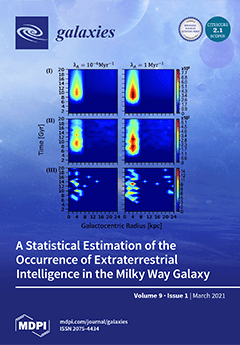
Cover Story: This study uses a numerical model to analyze the spatial–temporal variations and prevalence of Extraterrestrial Intelligence (ETI) in the Milky Way Galaxy. It considers key parameters based on known observations and the established theory of star and galaxy evolution, supernova sterilization, abiogenesis, evolutionary timescale, and ETI self-annihilation. The main conclusions are: (1) ETI in the galaxy is most prevalent at ~ 4 kpcs (13,000 light-years) from the galactic center and ~8 billion years since the big bang; (2) self-annihilation is highly influential in the total number of galactic civilizations; (3) most civilizations in the galaxy might be young; (4) our location within the galaxy is outside of the boundary where we expect most ETI to occur. Overall, this study serves as a baseline for analyzing ETI in the Milky Way and providing information for the Search for Extraterrestrial Intelligence (SETI). View this paper
  • Issues are regarded as officially published after their release is announced to the table of contents alert mailing list .
  • You may sign up for email alerts to receive table of contents of newly released issues.
  • PDF is the official format for papers published in both, html and pdf forms. To view the papers in pdf format, click on the "PDF Full-text" link, and use the free Adobe Reader to open them.

Articles (19)

  • Article
  • Open Access
4 Citations
3,557 Views
11 Pages

On the Modeling of Algol-Type Binaries

  • Walter van Rensbergen and
  • Jean-Pierre de Greve

In earlier papers, we presented a binary evolutionary code for the purpose of reproducing the orbital parameters, masses, radii, and location in the Hertzsprung Russell diagram (abbreviated as HRD) of well-observed Algol systems. In subsequent versio...

  • Article
  • Open Access
3 Citations
4,126 Views
15 Pages

The Dirac electron is considered as a particle-like solution consistent with its own Kerr–Newman (KN) gravitational field. In our previous works we considered the regularized by López KN solution as a bag-like soliton model formed from the Higgs fiel...

  • Article
  • Open Access
2,957 Views
10 Pages

Testing Noncommutativity-Like Model as a Galactic Density Profile

  • Juan Jordi Ancona-Flores,
  • Alberto Hernández-Almada and
  • Miguel Angel García-Aspeitia

Noncommutative-like model (NC-like) is an interesting alternative inspired by string theory to understand and describe the velocity rotation curves of galaxies without the inclusion of dark matter particles. In a natural way, a Gaussian density profi...

  • Article
  • Open Access
6 Citations
3,943 Views
6 Pages

25 February 2021

Bringing gravity into a quantum-mechanical framework is likely the most profound remaining problem in fundamental physics. The “unitarity crisis” for black hole evolution appears to be a key facet of this problem, whose resolution will provide import...

  • Review
  • Open Access
10 Citations
4,282 Views
41 Pages

23 February 2021

This paper focuses on a survey of experimental data related to radiation into CO2 plasma flows, which are encountered during Mars and Venus entries. The review emphasizes on VUV and IR radiation, since recent experimental efforts has been devoted to...

  • Article
  • Open Access
20 Citations
3,954 Views
15 Pages

Improvement of the Target Sensitivity in DECIGO by Optimizing Its Parameters for Quantum Noise Including the Effect of Diffraction Loss

  • Tomohiro Ishikawa,
  • Shoki Iwaguchi,
  • Yuta Michimura,
  • Masaki Ando,
  • Rika Yamada,
  • Izumi Watanabe,
  • Koji Nagano,
  • Tomotada Akutsu,
  • Kentaro Komori and
  • Seiji Kawamura
  • + 3 authors

16 February 2021

The DECi-hertz Interferometer Gravitational-wave Observatory (DECIGO) is the future Japanese, outer space gravitational wave detector. We previously set the default design parameters to provide a good target sensitivity to detect the primordial gravi...

  • Article
  • Open Access
6 Citations
3,457 Views
16 Pages

4 February 2021

Fine structure of the density distribution in giant molecular clouds (GMCs) around W43 (G31+00+90 km s1at ∼5.5 kpc) was analyzed using the FUGIN* CO-line survey at high-angular (20”∼0.5 pc) and velocity (1.3 km s1) resolutions (*Four-receiver-syste...

  • Feature Paper
  • Article
  • Open Access
12 Citations
4,277 Views
10 Pages

29 January 2021

We studied the effects of the Lorentz invariance violation on the rotation of neutron stars (NSs) in the minimal gravitational Standard-Model Extension framework, and calculated the quadrupole radiation generated by them. Aiming at testing Lorentz in...

  • Review
  • Open Access
7 Citations
4,603 Views
14 Pages

28 January 2021

In the past few decades, many studies have analyzed the data of gamma-rays, X-rays, radio waves, electrons, positrons, anti-protons, and neutrinos to search for the signal of dark matter annihilation. In particular, analyzing radio data has been one...

  • Article
  • Open Access
14 Citations
4,012 Views
14 Pages

Quantum Noise in a Fabry-Perot Interferometer Including the Influence of Diffraction Loss of Light

  • Shoki Iwaguchi,
  • Tomohiro Ishikawa,
  • Masaki Ando,
  • Yuta Michimura,
  • Kentaro Komori,
  • Koji Nagano,
  • Tomotada Akutsu,
  • Mitsuru Musha,
  • Rika Yamada and
  • Seiji Kawamura
  • + 3 authors

26 January 2021

The DECi-hertz Interferometer Gravitational wave Observatory (DECIGO) is designed to detect gravitational waves at frequencies between 0.1 and 10 Hz. In this frequency band, one of the most important science targets is the detection of primordial gra...

  • Article
  • Open Access
3 Citations
3,788 Views
9 Pages

26 January 2021

The discovery of 3C 273 in 1963, and the emergence of the Kerr solution shortly thereafter, precipitated the current era in astrophysics focused on using black holes to explain active galactic nuclei (AGN). But while partial success was achieved in s...

  • Article
  • Open Access
2 Citations
3,834 Views
12 Pages

Analysis of the Open Cluster NGC 2281

  • Dirk Terrell,
  • John Gross and
  • Walter R. Cooney

21 January 2021

BV observations of an approximately 68×48 field centered on the open cluster NGC 2281 and covering more than 400 nights from 2013 to 2018 are presented. The photometric observations were transformed to the standard system using standards from the A...

  • Article
  • Open Access
18 Citations
15,123 Views
14 Pages

18 January 2021

In the field of astrobiology, the precise location, prevalence, and age of potential extraterrestrial intelligence (ETI) have not been explicitly explored. Here, we address these inquiries using an empirical galactic simulation model to analyze the s...

  • Review
  • Open Access
7 Citations
4,081 Views
17 Pages

18 January 2021

In this paper, we consider the relativistic effects of rotation in the magnetospheres of γ-ray pulsars. The paper reviews the progress achieved in this field during the last three decades. For this purpose, we examine the direct centrifugal accelerat...

  • Article
  • Open Access
7 Citations
4,934 Views
16 Pages

Gravitational Measurements in Higher Dimensions

  • Davood Mahdavian Yekta,
  • Seyed Aliasghar Alavi and
  • Majid Karimabadi

11 January 2021

We attempt to study three significant tests of general relativity in higher dimensions, both in commutative and non-commutative spaces. In the context of non-commutative geometry, we will consider a solution of Einstein’s equation in higher dim...

  • Article
  • Open Access
12 Citations
3,323 Views
7 Pages

Quantum noise limits the sensitivity of laser interferometric gravitational-wave detectors. Given the state-of-the-art optics, the optical losses define the lower bound of the best possible quantum-limited detector sensitivity. In this work, we come...

  • Review
  • Open Access
3,354 Views
16 Pages

29 December 2020

Cosmic rays were discovered over one hundred years ago but there are still unsolved problems. One of the hot problems is the origin of cosmic rays of the highest energies. Sources are still unclear and it is neither clear how particles gain ultra-hig...

  • Article
  • Open Access
7 Citations
3,696 Views
12 Pages

22 December 2020

The Kwee–van Woerden (KvW) method used for the determination of eclipse minimum times has been a staple in eclipsing binary research for decades, due its simplicity and the independence of external input parameters, which also makes it well-sui...

Get Alerted

Add your email address to receive forthcoming issues of this journal.

XFacebookLinkedIn
Galaxies - ISSN 2075-4434