

You are currently viewing a new version of our website. To view the old version click .

Galaxies, Volume 10, Issue 3

June 2022 - 16 articles

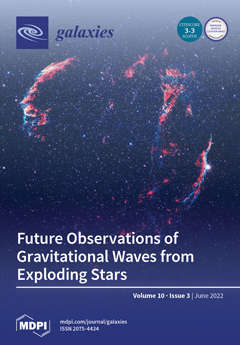
Cover Story: Core-collapse supernovae are the violent deaths of massive stars, and these spectacular events happen only around once per century in our Milky Way. The next exploding nearby star will be one of the most exciting phenomena of the century. In particular, detecting gravitational waves will help us to understand their inner engines. In our work, we study the detectability of predicted gravitational waves with a detector network planned for the end of the 2020s and the early 2030s. We find that, for the most realistic explosion models, we will be able to reach source distances only within our galaxy, while this will not be possible for more-energetic explosions outside of the Milky Way. However, the sky localization will improve greatly with more detectors in the network. View this paper
  • Issues are regarded as officially published after their release is announced to the table of contents alert mailing list .
  • You may sign up for email alerts to receive table of contents of newly released issues.
  • PDF is the official format for papers published in both, html and pdf forms. To view the papers in pdf format, click on the "PDF Full-text" link, and use the free Adobe Reader to open them.

Articles (16)

  • Review
  • Open Access
8 Citations
5,630 Views
28 Pages

Cosmic rays are relativistic particles that come to the Earth from outer space. Despite a great effort made in both experimental and theoretical research, their origin is still unknown. One of the main keys to understand their nature is the determina...

  • Review
  • Open Access
20 Citations
5,497 Views
34 Pages

Gamma-ray bursts (GRBs) are the most luminous explosions in the Universe and are powered by ultra-relativistic jets. Their prompt γ-ray emission briefly outshines the rest of the γ-ray sky, making them detectable from cosmological distanc...

  • Article
  • Open Access
1 Citations
4,200 Views
9 Pages

The observed Tully-Fisher and Faber-Jackson laws between the baryonic mass of galaxies and the velocity of motion of stars at the edge of galaxies are explained within the framework of the model of accretion of galaxies around supermassive black hole...

  • Review
  • Open Access
48 Citations
7,119 Views
36 Pages

The birth of gravitational wave astronomy was triggered by the first detection of a signal produced by the merger of two compact objects (also known as a compact binary coalescence event). The following detections made by the Earth-based network of a...

  • Article
  • Open Access
2 Citations
3,194 Views
11 Pages

According to the weak formulation of the anthropic principle, all fundamental physical constants have just such values that they enabled the origin of life. In this survey paper, we demonstrate also that the current value of the Hubble–Lema&ici...

  • Article
  • Open Access
10 Citations
3,819 Views
10 Pages

We studied the detectability and reconstruction of gravitational waves from core-collapse supernova multidimensional models using simulated data from detectors predicted to operate in the late 2020s and early 2030s. We found that the detection range...

  • Article
  • Open Access
3,204 Views
20 Pages

A Mass Dependent Density Profile from Dwarfs to Clusters

  • Antonino Del Popolo and
  • Morgan Le Delliou

In this paper, we extend the work of Freundlich et al. 2020 who showed how to obtain a Dekel–Zhao density profile with mass dependent shape parameters in the case of galaxies. In the case of Freundlich et al. 2020, the baryonic dependence was o...

  • Article
  • Open Access
4 Citations
22,015 Views
13 Pages

Avoiding the Great Filter: Predicting the Timeline for Humanity to Reach Kardashev Type I Civilization

  • Jonathan H. Jiang,
  • Fuyang Feng,
  • Philip E. Rosen,
  • Kristen A. Fahy,
  • Prithwis Das,
  • Piotr Obacz,
  • Antong Zhang and
  • Zong-Hong Zhu

The level of technological development of any civilization can be gauged in large part by the amount of energy it produces for its use, but also encompasses that civilization’s stewardship of its home world. Following the Kardashev definition,...

  • Review
  • Open Access
12 Citations
4,088 Views
24 Pages

Unveiling the mystery of gamma-ray bursts (GRBs) has been the target of many multi-waveband observational and theoretical efforts during the last decades. The results collected by current and past space-based instruments have provided important insig...

  • Article
  • Open Access
44 Citations
8,545 Views
65 Pages

Afterglow radiation in gamma-ray bursts (GRB), extending from the radio band to GeV energies, is produced as a result of the interaction between the relativistic jet and the ambient medium. Although in general the origin of the emission is robustly i...

of 2

Get Alerted

Add your email address to receive forthcoming issues of this journal.

XFacebookLinkedIn
Galaxies - ISSN 2075-4434