You are currently viewing a new version of our website. To view the old version click .

Life, Volume 10, Issue 3

March 2020 - 12 articles

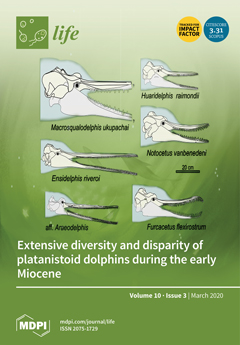
Cover Story: The Platanistoidea clade, as here redefined, is a toothed whale group that appeared in the late Oligocene and, nowadays, represented only by the Asian river dolphin Platanista gangetica. Here, we present new significant platanistoid material from the Chilcatay Formation (19–18 Ma, Peru). Two new genera and species, the hyper-longirostrine Ensidelphis riveroi and the squalodelphinid Furcacetus flexirostrum, are described together with new specimens of the squalodelphinid Notocetus vanbenedeni and fragmentary platanistid remains of aff. Araeodelphis . The fossils examined here further confirm the high diversity and disparity of platanistoids during the early Miocene. Morphofunctional considerations of the entire platanistoid assemblage of the Chilcatay Formation suggest high trophic partitioning of this peculiar cetacean paleocommunity. View this paper
  • Issues are regarded as officially published after their release is announced to the table of contents alert mailing list .
  • You may sign up for email alerts to receive table of contents of newly released issues.
  • PDF is the official format for papers published in both, html and pdf forms. To view the papers in pdf format, click on the "PDF Full-text" link, and use the free Adobe Reader to open them.

Articles (12)

  • Article
  • Open Access
4 Citations
5,150 Views
14 Pages

24 March 2020

Diatom-derived oxylipins, including polyunsaturated aldehydes (PUA), are considered to have infochemical, allelochemical and bacteriostatic properties, with plausible roles as grazing deterrents and regulators of inter- and intraspecific competition....

  • Article
  • Open Access
4 Citations
3,378 Views
12 Pages

Low Long Terminal Repeat (LTR)-Retrotransposon Expression in Leaves of the Marine Phanerogam Posidonia Oceanica L.

  • Alberto Vangelisti,
  • Flavia Mascagni,
  • Gabriele Usai,
  • Lucia Natali,
  • Tommaso Giordani and
  • Andrea Cavallini

24 March 2020

Seagrasses as Posidonia oceanica reproduce mostly by vegetative propagation, which can reduce genetic variability within populations. Since, in clonally propagated species, insurgence of genetic variability can be determined by the activity of transp...

  • Review
  • Open Access
26 Citations
5,824 Views
15 Pages

Biogenic Metal Nanoparticles: A New Approach to Detect Life on Mars?

  • Marta Filipa Simões,
  • Cristiane Angélica Ottoni and
  • André Antunes

20 March 2020

Metal nanoparticles (MNPs) have been extensively studied. They can be produced via different methods (physical, chemical, or biogenic), but biogenic synthesis has become more relevant, mainly for being referred by many as eco-friendly and more advant...

  • Article
  • Open Access
28 Citations
10,981 Views
62 Pages

18 March 2020

Several aspects of the fascinating evolutionary history of toothed and baleen whales (Cetacea) are still to be clarified due to the fragmentation and discontinuity (in space and time) of the fossil record. Here we open a window on the past, describin...

  • Article
  • Open Access
11 Citations
5,526 Views
14 Pages

18 March 2020

Circumnutation is a periodic growth movement, which is an important physiological mechanism of plants to adapt to their growth environments. Gravity and photoperiod are two key environmental factors in regulating the circumnutation of plants, but the...

  • Review
  • Open Access
34 Citations
8,752 Views
18 Pages

Spectrum of Light as a Determinant of Plant Functioning: A Historical Perspective

  • Oxana S. Ptushenko,
  • Vasily V. Ptushenko and
  • Alexei E. Solovchenko

17 March 2020

The significance of the spectral composition of light for growth and other physiological functions of plants moved to the focus of “plant science” soon after the discovery of photosynthesis, if not earlier. The research in this field rece...

  • Review
  • Open Access
47 Citations
8,548 Views
18 Pages

12 March 2020

The overgrowth of human population and the demand for high-quality foods necessitate the search for sustainable alternatives to increase crop production. The use of biofertilizers, mostly based on plant probiotic bacteria (PPB), represents a reliable...

  • Article
  • Open Access
8 Citations
4,067 Views
13 Pages

The Effects of Salts and Osmoprotectants on Enzyme Activities of Fructose-1,6-biphosphate Aldolases in a Halotolerant Cyanobacterium, Halothece sp. PCC 7418

  • Siripat Ngoennet,
  • Masaki Honda,
  • Tanutcha Patipong,
  • Takashi Hibino,
  • Rungaroon Waditee-Sirisattha and
  • Hakuto Kageyama

9 March 2020

The halotolerant cyanobacterium, Halothece sp. PCC 7418, possesses two classes of fructose-1,6-bisphosphate aldolase (FBA): H2846 and H2847. Though class I (CI)-FBA H2846 is thought to be associated with salt tolerance, the regulatory mechanisms, mol...

  • Article
  • Open Access
4 Citations
4,080 Views
20 Pages

Evolving Always-Critical Networks

  • Marco Villani,
  • Salvatore Magrì,
  • Andrea Roli and
  • Roberto Serra

4 March 2020

Living beings share several common features at the molecular level, but there are very few large-scale “operating principles” which hold for all (or almost all) organisms. However, biology is subject to a deluge of data, and as such, gene...

  • Review
  • Open Access
37 Citations
11,355 Views
22 Pages

2 March 2020

Life on Earth and the genetic code evolved around tRNA and the tRNA anticodon. We posit that the genetic code initially evolved to synthesize polyglycine as a cross-linking agent to stabilize protocells. We posit that the initial amino acids to enter...

of 2

Get Alerted

Add your email address to receive forthcoming issues of this journal.

XFacebookLinkedIn
Life - ISSN 2075-1729