1. Introduction
In the 20th century, Kuhn [
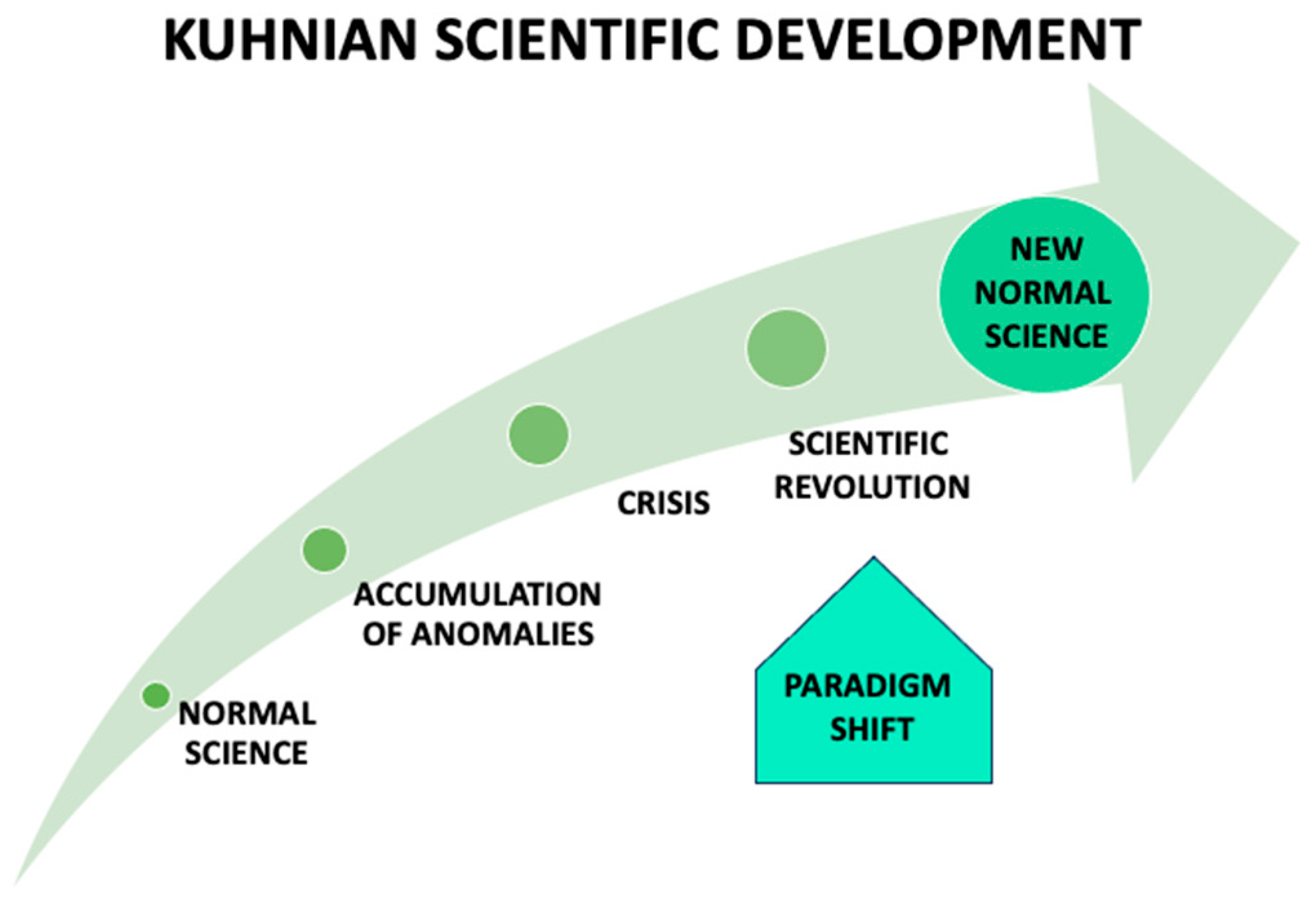
1] introduced the idea that science does not grow mainly through small, smooth additions but through changes in the basic way of seeing the world, that is, through changes in paradigms. In Kuhnian terms, a scientific paradigm is a shared framework or context of theories, methods, standards and typical problems that guides “normal science” within a scientific community. Some findings (anomalies) may resist explanation; if these become serious and numerous, a crisis arises. An anomaly is an observation or result that should not appear according to the rules of the accepted theory. Initially, anomalies are often treated as experimental errors or minor discrepancies rather than as threats to the whole framework. However, if a new framework appears and explains the problems better, the community may adopt it: this is a paradigm shift or scientific revolution in Kuhn’s view.
Kuhn explicitly uses the terms “scientific revolutions” and “paradigm shifts” almost interchangeably. Classical examples of paradigm shifts in his account are the change from the geocentric Ptolemaic system to the Copernican heliocentric system, and the transition from Newtonian mechanics and absolute space-time to Einstein’s relativity theory. In contrast to Kuhn, scientific development is often defined as a continuous, cumulative growth of knowledge that approaches truth, guided by stable canons of rationality rather than by changes in the underlying assumptions, beliefs and mental models (“paradigm-constrained” normal science and revolutions).
Figure 1 shows the path of what Kuhn assumes as the scientific development.
In essence, Kuhn argues that no scientific paradigm is permanent or exhaustive, because anomalies and new standards eventually drive revolutions. When scientists face multiple problems that they cannot solve within a given paradigm, they may search for a new paradigm. In such cases, basic concepts, methods and problems need to be rethought.
Complexity theory and network science challenge the dominance of reductionist, linear models by framing phenomena as nonlinear, adaptive and multi-scale systems, thereby altering what counts as an acceptable explanation in many fields. Interdisciplinarity, data-intensive science and AI-driven modelling change methods, tools and standards (for example, simulations, machine-learning forecasts and massive observational datasets becoming central “instruments” of discovery), which fits Kuhn’s idea of new examples and puzzle-solving practices.
Twenty-first-century science is increasingly characterized by the rise of complexity theory, interdisciplinarity, big data and AI ([
2,
3,
4], among others). Evidence from these areas suggests a new path for the natural sciences. Many parts of the natural sciences are undergoing deep transformations, but whether this amounts to a general Kuhnian paradigm shift or scientific revolution is still debated. Several philosophers and historians of science argue that the rise of complexity theory, interdisciplinarity, big data and AI can be interpreted as elements of an emerging paradigm shift, although this is not yet a fully consolidated “new paradigm” in Kuhn’s strict sense [
5].
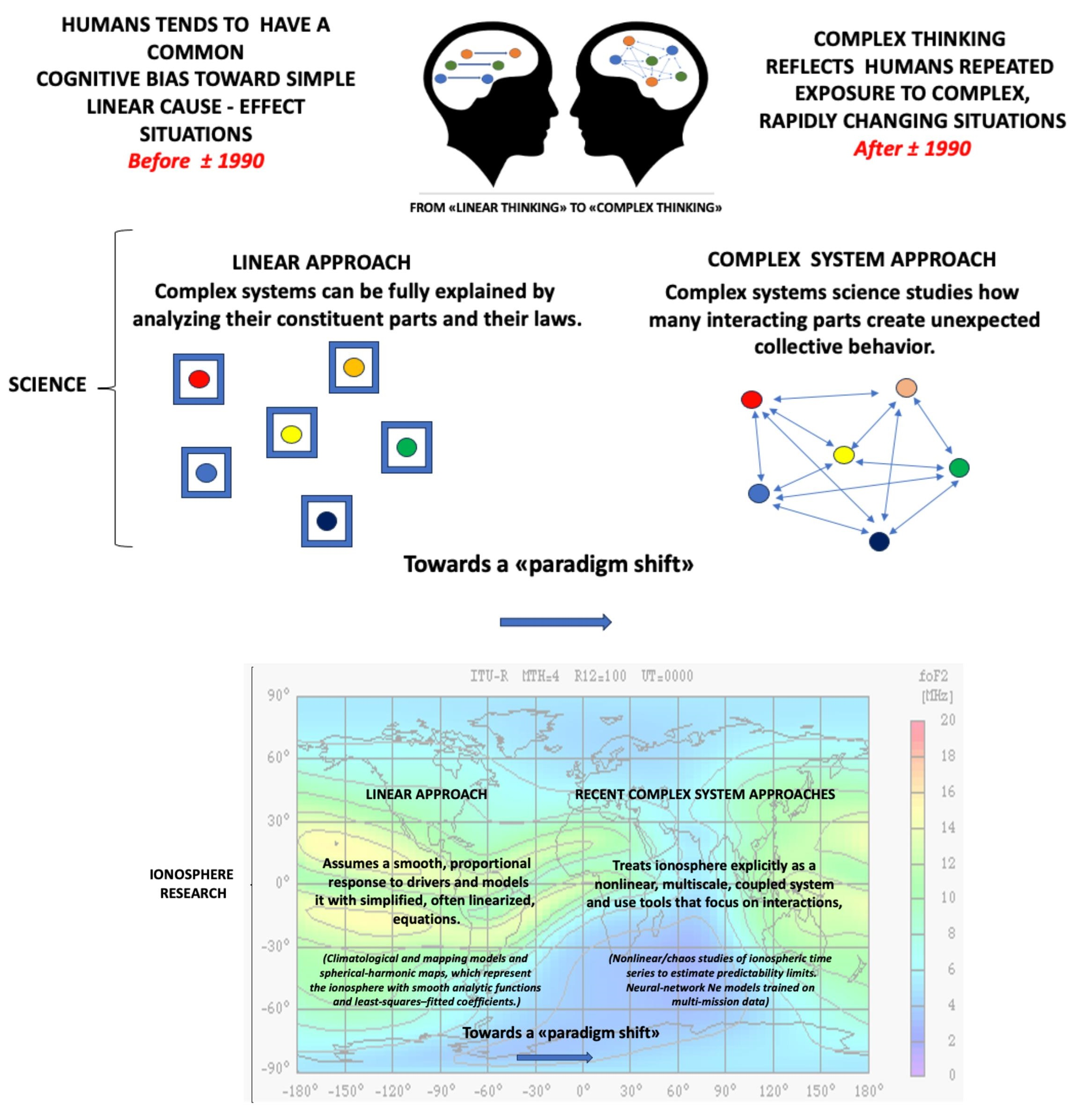
Without doubt, complexity science, network theory, interdisciplinarity and AI-based modelling are increasingly replacing simple linear or reductionist pictures, pushing researchers to treat phenomena as components of complex systems, with climate science being a prominent example. However, it is not clear how general this putative paradigm shift is across the natural sciences or whether it can already be considered a full scientific revolution. Assuming a paradigm shift would mean a change from linear/reductionist thinking to complexity thinking. Linear/reductionist thinking assumes that systems can be decomposed into independent parts, with simple proportional cause–effect relations. By contrast, complexity thinking requires treating systems as nonlinear, path-dependent, multi-scale and feedback-rich, with strong interdependencies. Some areas of physics, chemistry and geology still rely heavily on reductionist approaches that remain extremely successful, so any shift in paradigms appears partial rather than common to all natural sciences.
A reasonable question, therefore, is whether the advent of complexity science, network theory, interdisciplinarity and AI-based modelling is driving towards a paradigm shift in ionospheric research.
The ionosphere, the ionized part of the upper atmosphere (roughly 60–1000 km), is now increasingly considered as a sub-system of the larger geospace environment rather than as an isolated atmospheric layer. Geospace denotes the region extending from the upper atmosphere, through the ionosphere and magnetosphere, where Earth’s atmosphere and magnetic field interact with the solar wind.
Complexity theory, interdisciplinarity, big data and AI are beginning to appear as important tools to improve ionospheric forecasts and to address basic questions. In many such cases, the same physical picture of the ionosphere is maintained, but these tools approximate that picture in more effective ways; this situation alone does not represent a paradigm shift. However, accepting a new paradigm that treats the ionosphere as a coupled, nonlinear, emergent system does imply abandoning comforting linear intuitions and adopting a more demanding cognitive style. The move from linear to complex thinking is a key cognitive obstacle, amplified by social identity, institutional incentives and emotional attachment to familiar problem-solving styles.
What has just been noted for ionospheric research is common to many scientific fields. For instance, regarding complexity in biology, ref. [
6] explicitly argues that a paradigm shift is needed “from the Newtonian model that has dominated science, to an appraisal of complexity that includes both holism and reductionism, and which relaxes determinism in favour of recognizing unpredictability as intrinsic to complex systems.”
Complexity science and network-based geospace views in fact encourage treating the ionosphere as a node in a coupled, multiscale, self-organizing geospace system. Some authors explicitly call for a new paradigm for the geosciences as a whole ([
7,
8]).
Considering the ionosphere as a node of such a complex geosystem, this paper analyses how scientists in the field who use complexity theory, interdisciplinarity, big data and AI explicitly or implicitly refer to a path towards a paradigm shift in ionospheric research, and assesses the status of this process from a Kuhnian perspective.
2. Complexity, Interdisciplinarity, Big Data and AI in Ionospheric Research
Quantification of forecast uncertainty in ionospheric prediction is a critical aspect that assesses the reliability, confidence and precision of model outputs for parameters such as electron density, peak plasma frequency (foF2), peak density height (hmF2) and total electron content (TEC). Ionospheric model development aims at progressively better forecasts of such parameters. This need acts as a driver for any explicitly or implicitly desired paradigm shift in the way research progresses.
Only a few peer-reviewed papers explicitly use the expression “paradigm shift” in relation to ionospheric research. Ref. [
9] already referred to a “paradigm shift” by stating: “We have reached a paradigm shift, where any self-respecting space weather model of the upper atmosphere now needs to have some representation of the lower atmosphere.” They also emphasized that data assimilation and whole-atmosphere coupling are now required to model Earth’s atmosphere properly. Their paper reports on a Whole Atmosphere Modelling Workshop held in Tres Cantos, Spain, in June 2018, where a strong consensus emerged on the need to represent the lower atmosphere in upper-atmosphere models. This statement can be considered a first step towards articulating the need for a true paradigm shift in ionospheric research. With reference to the interaction of the lower atmosphere with the ionosphere, a series of investigations have been done over many years now. A recent review by [
10] shows that tides, planetary waves and gravity waves from the troposphere–stratosphere imprint clear signatures in ionospheric parameters, evidencing strong upward coupling. Ref. [
11], using satellite data, show that a limited set of global-scale waves from the lower atmosphere accounts for much of the longitudinal and day-to-day variations in the low- and mid-latitude ionosphere–thermosphere system. Ref. [
12], using multi-instrument observations show that Traveling Ionospheric Disturbances (TIDs) generated both by auroral sources and by tropospheric weather systems show that gravity waves provide two-way coupling between the troposphere and ionosphere. These results, among others, show clearly that lower-atmosphere–ionosphere coupling is a strong indicator and driver of the complexity of the ionosphere.
2.1. Complexity and Interdisciplinarity in Ionospheric Research
Complexity and interdisciplinarity are now of central interest in ionospheric research, both conceptually and in practice. Complex-network and systems-dynamics approaches treat ionospheric features as emergent patterns arising from many interacting processes (solar forcing, geomagnetic activity, waves from below), explicitly framing the ionosphere as a complex system.
Modern ionospheric studies couple magnetospheric, ionospheric, thermospheric, plasmaspheric and even lithospheric/atmospheric processes, requiring expertise from space physics, atmospheric science, geodesy and plasma physics. Such studies borrow tools from information theory, turbulence, signal processing and nonlinear dynamics, illustrating strong interdisciplinarity.
The book edited by [
13] provides a synthesis of the state of the art on the “dynamical ionosphere” up to that year. In summary, the chapters argue that the ionosphere must be understood and modelled as a complex dynamical system, using tools from nonlinear dynamics, turbulence and information theory rather than only traditional deterministic models. The volume systematically reframes the ionosphere from a quasi-static “layer” with perturbations into a dynamical complex system, emphasizing nonlinear processes, turbulence, multiscale coupling and emergent irregularities. By promoting systems theory, information theory and complex-network tools alongside traditional plasma physics, it proposes new examples and standards for adequately describing ionospheric variability. This book can reasonably be considered as part of a broader path towards a paradigm shift in ionospheric research, even though it does not use Kuhn’s language explicitly.
Ref. [
14], by applying nonlinear time-series tools (such as Lyapunov exponents, correlation dimension and surrogate tests) to ionospheric indices and vTEC (vertical total electron content), present evidence of low-dimensional deterministic chaos rather than pure randomness. They demonstrate finite prediction horizons and scale-dependent predictability, concluding that ionospheric variability arises from a chaotic dynamical system with limited but real short-term predictability, a hallmark of complex-system behaviour.
Ref. [
15], using wavelet-based and multiscale nonlinear diagnostics, show that chaotic behaviour and predictability in vTEC change with time scale, latitude and geophysical conditions. The results indicate that the ionosphere exhibits a hierarchy of interacting scales, where some bands are more predictable and others highly chaotic, supporting a view of vTEC as a multi-scale complex system rather than a single-scale process.
Ref. [
16] use fine-temporal-resolution datasets of vertical vTEC, the SYM-H and AE geomagnetic indices, and solar extreme ultraviolet EUV and X-ray fluxes. By analysing these data using structure function (SF) and multifractal detrended fluctuation analysis (MFDFA), they show that mid-latitude ionosphere and solar variability are strongly multifractal and that this complexity changes in a structured way with the solar cycle. Their results reinforce and extend the view that the ionosphere is a complex, multifractal, and only partially predictable system. They further highlight the need for nonlinear, stochastic or machine-learning models in ionospheric forecasting.
Ref. [
17] treat the magnetosphere, ionosphere and thermosphere as a globally coupled, time-dependent system with feedback via inductive electric fields and field-aligned currents, rather than as loosely connected sub-systems. Conceptually, this aligns ionospheric research with complexity thinking: focusing on emergent global patterns from many interacting processes, not just local linear cause–effect relations.
A key question is whether these recent results on chaos and complexity in ionospheric research represent steps toward a paradigm shift in the field. The answer is arguably yes, although the authors do not usually claim this explicitly. Their results challenge the traditional view that often treated ionospheric variability as either a smooth deterministic response to drivers or as stochastic “noise” around empirical climatologies. Instead, they show that key ionospheric time series and plasma responses display low-dimensional deterministic chaos, scale-dependent predictability and multi-scale interactions, all signatures of a nonlinear complex system rather than simple noise.
These studies introduce nonlinear-dynamics and complex-systems tools (Lyapunov exponents, multifractal and multiscale analyses, chaos diagnostics) as central methods for ionospheric analysis, and they propose new criteria for what counts as an adequate description of variability. By emphasizing finite predictability horizons, multi-time-scale structure and self-organized chaotic behaviour, they suggest that future ionospheric models and forecasts must be built around complex-systems and probabilistic thinking rather than purely linear or empirical frameworks. In Kuhnian terms, these works provide strong examples of a complexity-oriented approach and therefore support an ongoing transition towards a new paradigm, even though the older empirical/linear paradigm remains widely used.
2.2. AI and Big Data in Ionospheric Research
AI and big data are reshaping ionospheric research by enabling data-driven modelling, multi-sensor fusion and uncertainty-aware forecasting at a level that was not previously achievable. Big-data initiatives focus on integrating satellite, GNSS (global navigation satellite systems) and space-weather data streams into machine-learning-ready datasets, explicitly framing ionospheric research as a big-data, AI-driven Earth-observation problem.
Ref. [
18] describe a novel neural network model of the topside ionosphere and state in their abstract that the study “provides a paradigm shift in ionospheric research” because their results outperform more standard models. In the same year, ref. [
19] write that their paper “summarizes the current status of the paradigm shift in space weather research driven by big data and artificial intelligence.” Ref. [
20], considering the system of sub-systems Sun–interplanetary medium–magnetosphere–ionosphere–atmosphere–Earth (internal shells), which he calls SIMMIAE, argues that, to study what he terms a “pan-planetary storm,” “the time has come for a paradigm shift to occur.”
Other authors avoid the phrase “paradigm shift” but clearly indicate that machine learning and AI are generating a new paradigm in ionospheric research. A notable example is the review paper by [
21] which emphasizes surrogate models for physics codes, data-assimilative neural networks and probabilistic or uncertainty-aware forecasts for TEC, foF2, electron density Ne and scintillations. The present paper adds other studies not cited by [
21] to the list of relevant publications, with comments on their contributions towards a paradigm shift in ionospheric research.
Ref. [
22] highlight in their conclusions that random-forest and multilayer-perceptron methods are accurate and stable “for data-driven prediction of global ionospheric TEC in various scenarios,” and they suggest that future operational TEC models should be multivariate and machine learning (ML)-centric. This study remains a “different data-driven prediction” approach rather than a fundamental replacement of physics-based or empirical paradigms, and it does not propose a radically new conceptual framework for ionospheric variability. It is therefore reasonable to say that in this case the paradigm shift is seen as ongoing.
Ref. [
23] propose that operational ionospheric space-weather forecasting should be built around coupled physics models plus data assimilation with explicit bias estimation, rather than relying on “model-only” or “data assimilation without bias” systems. In Kuhnian terms, this redefines a “good” ionospheric forecast model as not only accurate in its physics but also as a continuously corrected, bias-aware system tightly linked to observations via data assimilation. This implicitly moves the field towards a new paradigm in ionospheric modelling, although the authors do not state this explicitly.
Ref. [
24] combine physical inputs with deep networks to improve hmF2 forecasting, proposing hybrid deep-learning (DP) models as a new standard for key ionospheric parameters. They conclude that whole-atmosphere models, from the ground to 500 km, should become basic tools for understanding and predicting the ionosphere–thermosphere system, which implicitly supports a paradigm shift away from “upper-atmosphere-only” modelling. In paradigm terms, emphasis shifts from designing improved analytic TEC formulas to designing and training high-capacity data-driven models on long, multi-factor records, effectively proposing a data-intensive, ML-based modelling framework for global TEC.
Ref. [
25] present a ML emulator of a numerical model updated via data assimilation (DA), proposing this hybrid ML–DA approach as a general template for ionospheric and magnetosphere–ionosphere prediction. The study implicitly suggests a new modelling architecture: physics-based global simulations → ML emulator → data assimilation into the emulator, rather than assimilation directly into the expensive full model. While the authors do not use Kuhn’s language, their work can be interpreted as supporting a possible paradigm shift toward hybrid ML–DA modelling frameworks in ionospheric research.
A recent preprint by [
26] concludes that graph-based DL can skilfully forecast global TEC by fusing heterogeneous drivers and observations, and that such ML frameworks are promising building blocks for future operational ionospheric forecasting systems. The study treats the ionosphere primarily as a high-dimensional dynamical system to be learned from data, rather than as a field to be described mainly through analytic or empirical formulae, which implicitly shifts emphasis from traditional models to end-to-end ML predictors.
Ref. [
27] introduces probabilistic neural networks that learn electron density directly from data and output full predictive distributions, shifting the “normal” goal from a single best profile to an uncertainty-aware, data-driven characterization of the ionosphere. By replacing traditional deterministic empirical and physics-based models with probabilistic NN (neural network) approaches, this work can be read as contributing to an emerging Kuhnian paradigm shift in ionospheric modelling, though not yet as a complete revolution by itself.
A report by the National Academies of Sciences, Engineering, and Medicine [
28] on the next decade of discovery in solar and space physics considers a systems perspective as an enabling paradigm for understanding complexity in the ionosphere–thermosphere–mesosphere (ITM) and in the geospace system in which the ITM is embedded. It argues that ITM science must move to a fully coupled, system-level, data-rich framework that treats the ITM as an active, nonlinear part of the heliophysical system rather than a passive layer. The report describes the ionosphere as a crucial and variable player that feeds back on magnetospheric and atmospheric dynamics, not just a receiver of solar and geomagnetic forcing. This requires abandoning paradigms in which the ionosphere is treated as a boundary condition and instead embedding it in end-to-end Sun–magnetosphere–ITM models with feedbacks and self-consistency. The report calls for integrated programmes that bridge traditionally separate communities (magnetospheric physics, atmospheric science, space-weather operations and heliophysics theory) to capture this coupling, and it implicitly promotes a shift toward data-assimilative, predictive frameworks combining physics-based models with large heterogeneous datasets.
3. The State of Modern Ionospheric Research
Table 1 provides a concise, chronological overview of representative achievements in ionospheric research that explicitly involve complexity, interdisciplinarity, big data and AI in the period 2020–2025, illustrating the emerging new path of the field.
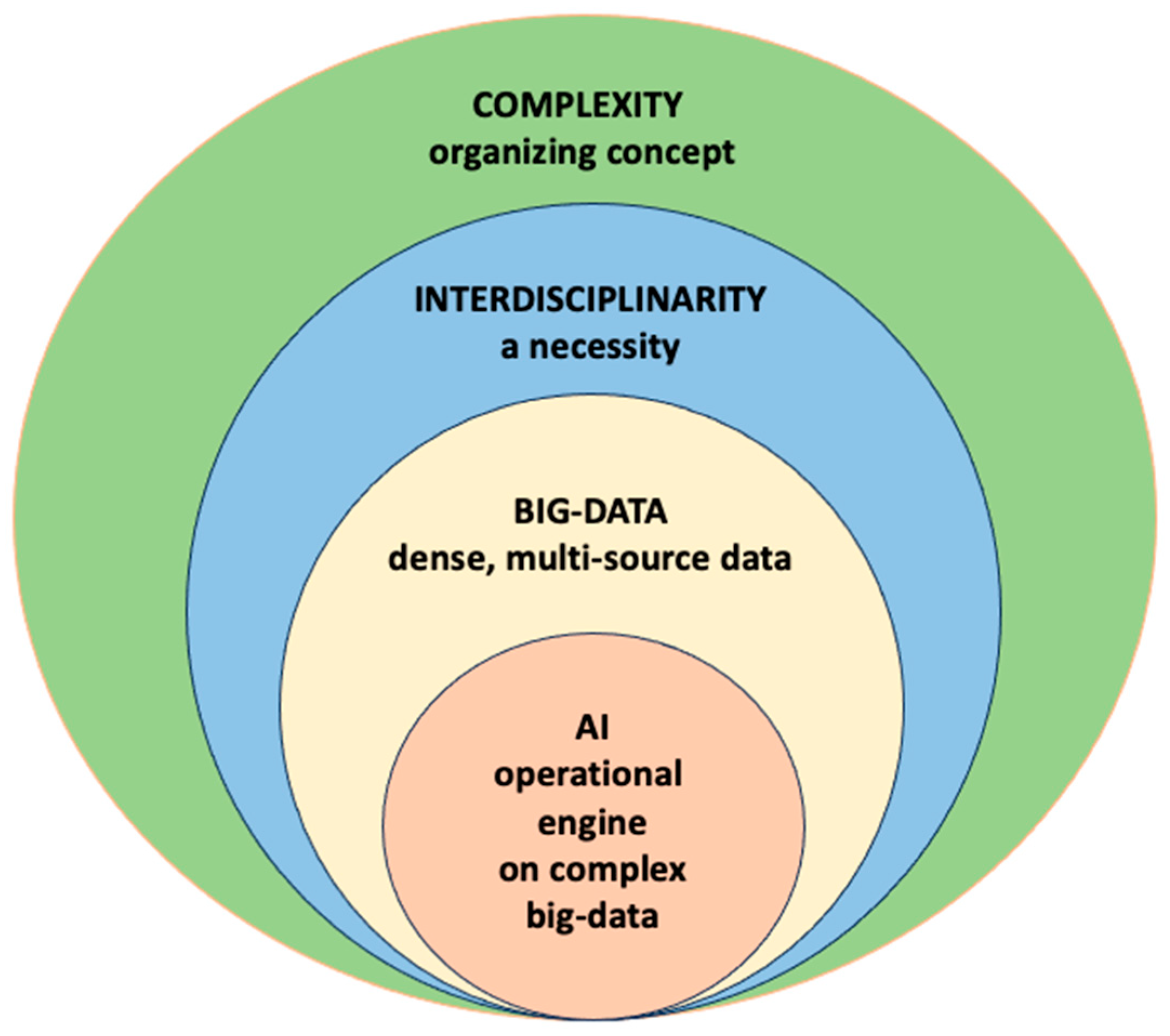
Modern complexity-oriented natural sciences are becoming data-driven and AI-enhanced, with physics-guided learning as a central theme, and ionospheric research is following the same pattern. Complexity, interdisciplinarity, big data and AI in ionospheric research are converging into a single emerging framework: the ionosphere is treated as a complex, coupled system whose behaviour must be understood with interdisciplinary methods and data-driven AI models operating on large heterogeneous datasets.
Complexity as an organizing concept. In this view, the ionosphere is treated as a complex, coupled system whose behaviour must be understood with multi-disciplinary methods and data-driven AI models operating on large heterogeneous datasets. This approach motivates modelling both the average ionosphere and the high-variability components, using tools from stochastic dynamics, information theory, signal processing and turbulence.
Interdisciplinarity as a necessity. To understand interactions within the complex geospace system, interdisciplinary work is required, coupling solar, magnetospheric, thermospheric and ionospheric physics with data science and complex-systems theory.
Big data from dense, multi-source observations. Modern ionospheric research uses dense GNSS networks, ionosondes, satellites, radio-occultation measurements and imaging systems, generating large heterogeneous datasets in time and space. Such data streams are needed to characterize multi-scale variability, rare extremes and network-like couplings that cannot be captured by sparse observations alone.
AI as the operational engine on complex big data. DP architectures (Long Short-Term Memory (LSTM), Convolutional Neural Networks (CNNs), Convolutional LSTMC (ConvLSTM), Graph Neural Network (GN, Transformers)) are now used for global TEC prediction, local foF2 and hmF2 forecasting, equatorial plasma-bubble and scintillation detection, and F-region plasma-density modelling. These models explicitly process heterogeneous multi-source data and long sequences, treating the ionosphere as a high-dimensional spatio-temporal system.
Figure 2 schematically illustrates these key components of modern ionosphere research.
The table below shows only in a synthetic chronological way representative achievements of complexity, interdisciplinarity, big data and AI ionosphere research (with reference) in the period 2020–2025, showing the acceleration of the use of these components of ionosphere research.
Table 1.
Concise 2020–2025 list of the main achievements in ionosphere research using explicitly complexity, interdisciplinarity, big data and AI. With representative reference.
Table 1.
Concise 2020–2025 list of the main achievements in ionosphere research using explicitly complexity, interdisciplinarity, big data and AI. With representative reference.
| Year | Study/Approach | Method/Data (Very Brief) | Main Advance/Relevance |
|---|
| 2020–2021 | Multifractal and nonlinear TEC time series
characterization | MF-DFA and related nonlinear metrics on multi-year GNSS TEC [29] [Widely used to the year 2020]. | Revealed scale-dependent complexity and long-range correlations in TEC. |
| 2021–2022 | LSTM DL for global TEC forecasting | LSTM-type DL models trained on global TEC plus solar/geomagnetic indices. Ref. [30] mentioned in [21]. | Improved 24 h global TEC forecasts over empirical models and persistence. |
| 2022 | Graph/sequence DL for TEC (IonCast) | Graph and sequence deep networks on heterogeneous TEC plus drivers [26]. | Treated the ionosphere as a high-dimensional spatio-temporal system. |
| 2023 | Chaos and predictability in vTEC | Correlation dimension and entropy metrics on GNSS vTEC [14]. | Quantified short predictability horizons and set upper bounds on forecast skill. |
| 2023 | Multisource DL Es reconstruction | DP arning fusion of GNSS, RO, reanalysis, and solar-wind data [31]. | Reconstructed sporadic-E morphology from multi-source big data. |
| 2023 | Complex-systems geospace review | Synthesis of chaos, multifractals, networks, and
ML methods [32]. | Positioned the ionosphere within a complex-systems, interdisciplinary framework. |
| 2024 | Multi-scale chaos in vTEC | Time-scale decomposition with scale-wise chaos metrics [15] | Showed that ionospheric predictability depends strongly on time scale. |
| 2024 | DL TEC forecasting during storms | ConvLSTM/ensemble DP on long global TEC archives.
Ref. [33] mentioned in [21]. | Achieved robust global TEC forecasts under geomagnetic storm conditions. |
| 2025 | Ionformer Transformer-based global TEC forecasting | Transformer (Ionformer) trained on global TEC plus solar–geomagnetic drivers [34] | Strong DL baseline for global TEC prediction with improved long-lead forecasts and efficient use of heterogeneous datasets. |
A useful way to understand the links between the components of modern ionospheric research is as follows:
Complexity → need interdisciplinarity. Recognizing the ionosphere as a complex, coupled system makes it clear that no single discipline (for example, classical aeronomy) is sufficient; techniques from nonlinear dynamics, networks, statistics and computation must be combined.
Complexity + big data → need AI. The combination of multi-scale dynamics and massive multi-source observations naturally calls for AI to extract patterns, emulate sub-grid processes and provide fast forecasts and surrogates for expensive physics models.
Complexity + AI → constrained dynamical systems. Chaos and predictability studies (for example, entropy-based vTEC horizons) show intrinsic limits on what any model can forecast, guiding AI design and evaluation so that deep models respect physical predictability limits instead of over-fitting noise.
4. Towards a Paradigm Shift
Taking into account the recent achievements summarized in the previous sections, it is now possible to assess whether the trend is moving towards a paradigm shift in ionospheric research. Following Kuhn’s framework [
1], a paradigm shift occurs when:
A new paradigm solves key anomalies that the old one could not.
It reorganizes normal practice (methods, standards, textbooks, training).
The research community largely converges on the new framework.
The present situation in ionospheric research can be summarized as follows:
Anomalies are present. Studies of chaos, multifractality and predictability show intrinsic limits and multi-scale behaviour that classical, purely deterministic or climatological models handle poorly (for example, ref. [
14]).
New tools and concepts are in use. Complex-systems framing (for example, [
13]) and AI/ML models for TEC and foF2 introduce new questions (predictability horizons, multi-scale structure, networks) and new success criteria (for example, respecting entropy-based limits, not only RMSE) (for example [
30]).
Interdisciplinarity is increasing. Methods from nonlinear dynamics, information theory, networks and big data/AI are becoming part of mainstream discussions, not merely side topics ([
13]).
These are necessary ingredients for a Kuhnian revolution and clearly challenge the old paradigm. However, several aspects of the traditional framework remain in place. Background empirical models still constitute the dominant reference and operational standard [
35]. AI, chaos and complex-systems tools are often used as add-ons or specialized modules, not yet as the core organizing framework for “normal science” in ionospheric modelling and forecasting. In practice, the classical picture persists, with complexity and AI framed as advanced topics rather than default options.
5. Conclusions
In Kuhnian terms, the present status of modern ionospheric research can be described as follows: current developments in complexity, AI, big data and interdisciplinarity mark a transition or crisis-like phase, in which the limitations of the old paradigm are explicit and candidate new frameworks are emerging. This phase could mature into a true paradigm shift if, over the next decade, complexity-aware, AI-enabled and predictability-constrained modelling becomes the standard way in which ionospheric science is practised and taught. Thus, in strict Kuhnian terms, it is more accurate to say that ionospheric research is undergoing a pre-revolutionary or proto-paradigmatic transformation rather than a completed “scientific revolution” with a fully established new paradigm.