
Article

Design and Experimental Validation of a High-Accuracy Naturally Ventilated Radiation Shield for Near-Surface Air Temperature Observation
1
Jiangsu Key Laboratory of Meteorological Observation and Information Processing, Nanjing University of Information Science and Technology, Nanjing 21044, China
2
Jiangsu Collaborative Innovation Center on Atmospheric Environment and Equipment Technology, Nanjing University of Information Science and Technology, Nanjing 210044, China
*
Author to whom correspondence should be addressed.
Atmosphere 2026, 17(3), 272; https://doi.org/10.3390/atmos17030272
Submission received: 28 January 2026 / Revised: 23 February 2026 / Accepted: 3 March 2026 / Published: 5 March 2026
(This article belongs to the Special Issue Urban Impact on the Low Atmosphere Processes)

Abstract

Near-surface air temperature measurements are sensitive to solar radiation and ambient longwave irradiance, which can introduce measurement errors of approximately 1 °C. This study presents the design and experimental validation of a high-accuracy naturally ventilated radiation shield that operates without mechanical aspiration. Computational fluid dynamics (CFD) simulations were used to optimize a bowl–cover airflow-guiding structure and shading configuration, thereby enhancing air exchange around the sensing probe and reducing radiation-induced heating. A coupled multi-parameter simulation framework was further developed to evaluate the sensitivity of radiation error to wind speed, scattered radiation, altitude, and other environmental factors. Field intercomparison experiments were conducted using a Model 076B radiation shield as the reference and a Model 41003 radiation shield for comparison. Results show that the proposed shield exhibits a mean uncorrected radiation error of 0.12 °C, which is significantly lower than that of the 41003 shield (0.59 °C). In addition, a multilayer perceptron (MLP)-based radiation error correction model was developed using environmental parameters as inputs, achieving a root mean square error (RMSE) of 0.051 °C and a mean absolute error (MAE) of 0.043 °C. After correction, the correlation coefficient between Pt100 probe measurements and reference values reaches 0.999, demonstrating the potential of the proposed approach for high-accuracy near-surface air temperature observations.

1. Introduction

Near-surface air temperature is a key variable in land–atmosphere interactions [1], vegetation responses [2], atmospheric boundary layer processes [3], and climate change studies [4]. Accurate measurements of near-surface air temperature are therefore essential for climate research and meteorological applications [5]. According to the Intergovernmental Panel on Climate Change (IPCC) Sixth Assessment Report, the global mean surface temperature during 2001–2020 was about 0.99 °C above that of the pre-industrial period (1850–1900), with each consecutive decade over the past forty years exhibiting a stronger warming trend than the preceding decades [6,7].
Despite its importance, achieving high-accuracy near-surface air temperature measurements remains challenging in practical observations, particularly under conditions of low wind speed and strong solar radiation. From the late nineteenth to the early twentieth century, temperature measurement practices transitioned from exposed configurations (e.g., wall-mounted or open supports) to standardized Stevenson screens. Differences in shielding structures have been shown to significantly affect the homogeneity of historical temperature records [8,9]. Radiative heating is widely recognized as a primary source of systematic bias in temperature measurements [10]. Although Stevenson screens and radiation shields can effectively attenuate direct solar radiation, heat absorbed by the housing can warm the internal air through conduction and convection, leading to positively biased temperature readings [11,12]. Several studies have reported substantial radiation-induced errors in naturally ventilated temperature sensors. For example, the low-cost temperature measurement system developed by Holden et al. exhibited hourly mean absolute errors of up to 0.52 °C under full-sun conditions when compared with a Remote Automated Weather Station (RAWS) [13]. Aoshima et al. further showed that under strong solar radiation, four naturally ventilated sensors—AV-040, YG-41003L, DTR503A, and JMA-W1—exhibited temperature biases of up to +0.9 to +1.4 °C, +0.3 to +0.7 °C, 0 to +0.3 °C, and +0.2 to +0.5 °C, respectively, relative to the JMA-95 reference instrument [14].
In contrast, forced ventilation has been demonstrated to effectively reduce radiation-induced measurement errors. Waugh et al. reported that under a solar irradiance of 950 W/m2 sustained for 30 min, the maximum temperature bias of their U-tube aspirated sensor was limited to 0.3–0.6 °C [15]. Thomas et al. showed that an aspirated temperature sensor could constrain temperature bias within ±0.08 °C [16]. However, forced ventilation systems require continuous power supply, involve more complex mechanical structures, and incur higher maintenance costs. These limitations restrict their applicability in remote or harsh environments and hinder long-term operation in large-scale, high-density observation networks.
To mitigate these challenges, a near-surface air radiation shield is developed in this study that minimizes radiative interference through aerodynamic and thermal structural optimization, without relying on active ventilation. To quantitatively characterize radiation-induced errors under complex meteorological conditions involving multi-physics coupling, CFD simulations were combined with neural network algorithms [17,18,19,20,21] to develop a radiation error correction model. This approach overcomes the limitations of traditional empirical formulations by enabling dynamic compensation for nonlinear radiative effects. Furthermore, outdoor intercomparison experiments were carried out for the purpose of assessing the measurement accuracy and robustness of the proposed shield under real atmospheric conditions, providing a feasible technical pathway toward the development of high-density, low-cost near-surface air temperature observation networks.

2. Radiation Shield Structural Design and Thermal Performance Analysis

2.1. Structural Optimization of the Radiation Shield

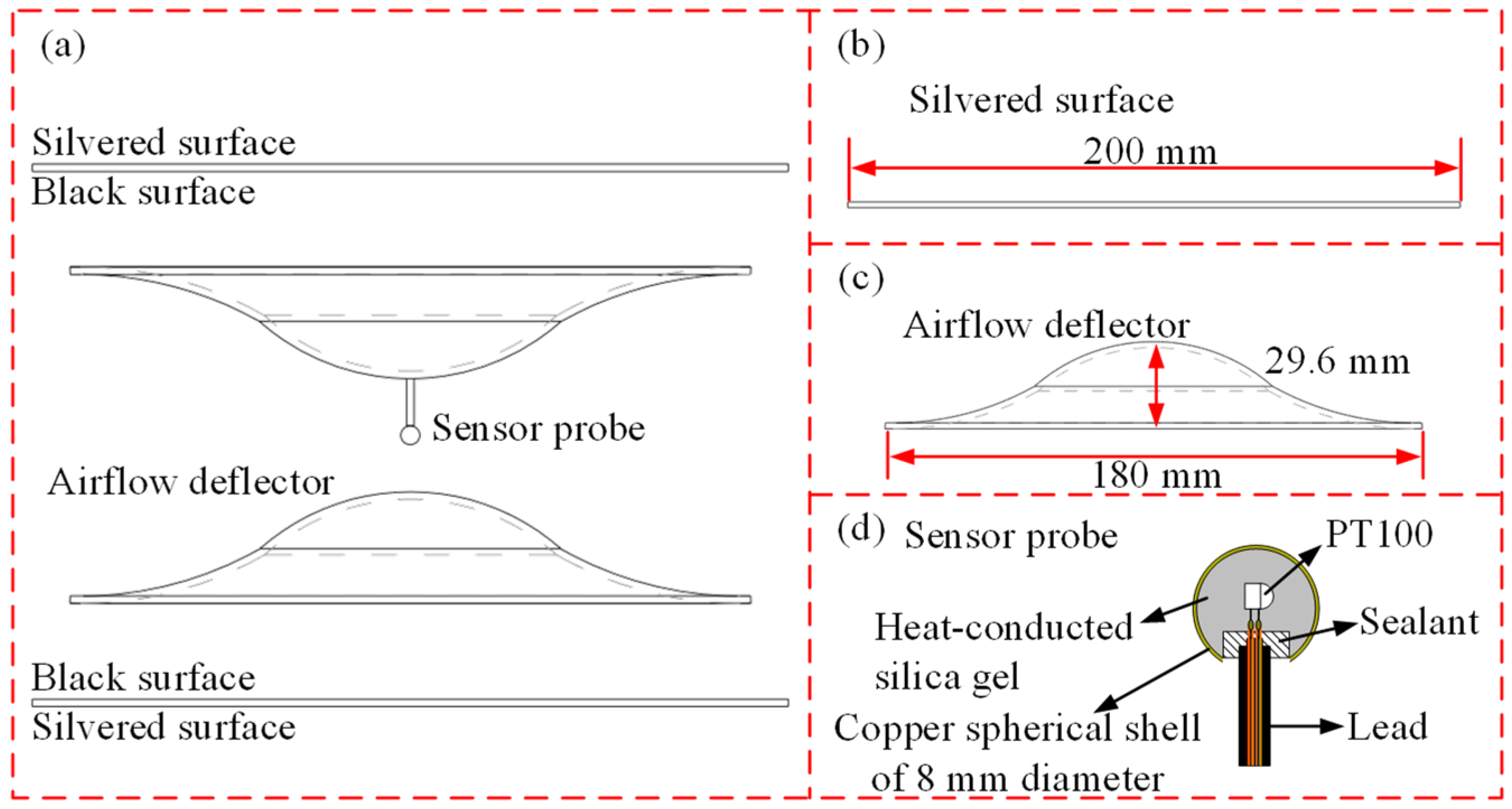
Figure 1 shows the schematic of the proposed near-surface air radiation shield. The overall assembly and the arrangement of the upper/lower shading plates and bowl–cover flow-guiding shrouds are illustrated in Figure 1a. The dimensions and surface treatment of the square shading plate are shown in Figure 1b. The geometry of the airflow deflector is provided in Figure 1c, and the detailed structure of the sensing probe (Pt100 packaged in an 8-mm copper spherical shell) is shown in Figure 1d. The sensing element consists of a 100-Ω platinum resistive temperature sensor fabricated using thin-film technology housed within an external assembly designed for radiation shielding and natural ventilation. To mitigate the effects of downward solar radiation and upward ground-emitted longwave radiation, two square shading plates (side length: 200 mm; thickness: 2 mm) are installed above and below the sensing probe.
To further improve the thermal environment around the probe, two symmetrically arranged curved flow-guiding shrouds are mounted between the upper and lower shading plates, forming an axisymmetric bowl–cover structure. This configuration guides ambient airflow smoothly through the internal cavity, enhancing natural ventilation, suppressing local turbulent disturbances, and reducing measurement bias caused by radiative heating. The spacing between the two shrouds is set to 30 mm.
The heat dissipation and radiation shielding performance of the radiation shield are strongly influenced by both structural design and material properties. Previous studies have investigated the effects of different structural configurations on internal airflow and heat transfer characteristics [22]. However, systematic assessments of material properties and their influence on thermal performance remain limited. Therefore, CFD simulations were conducted for four candidate material configurations, as summarized in Table 1, to support structural and material optimization.
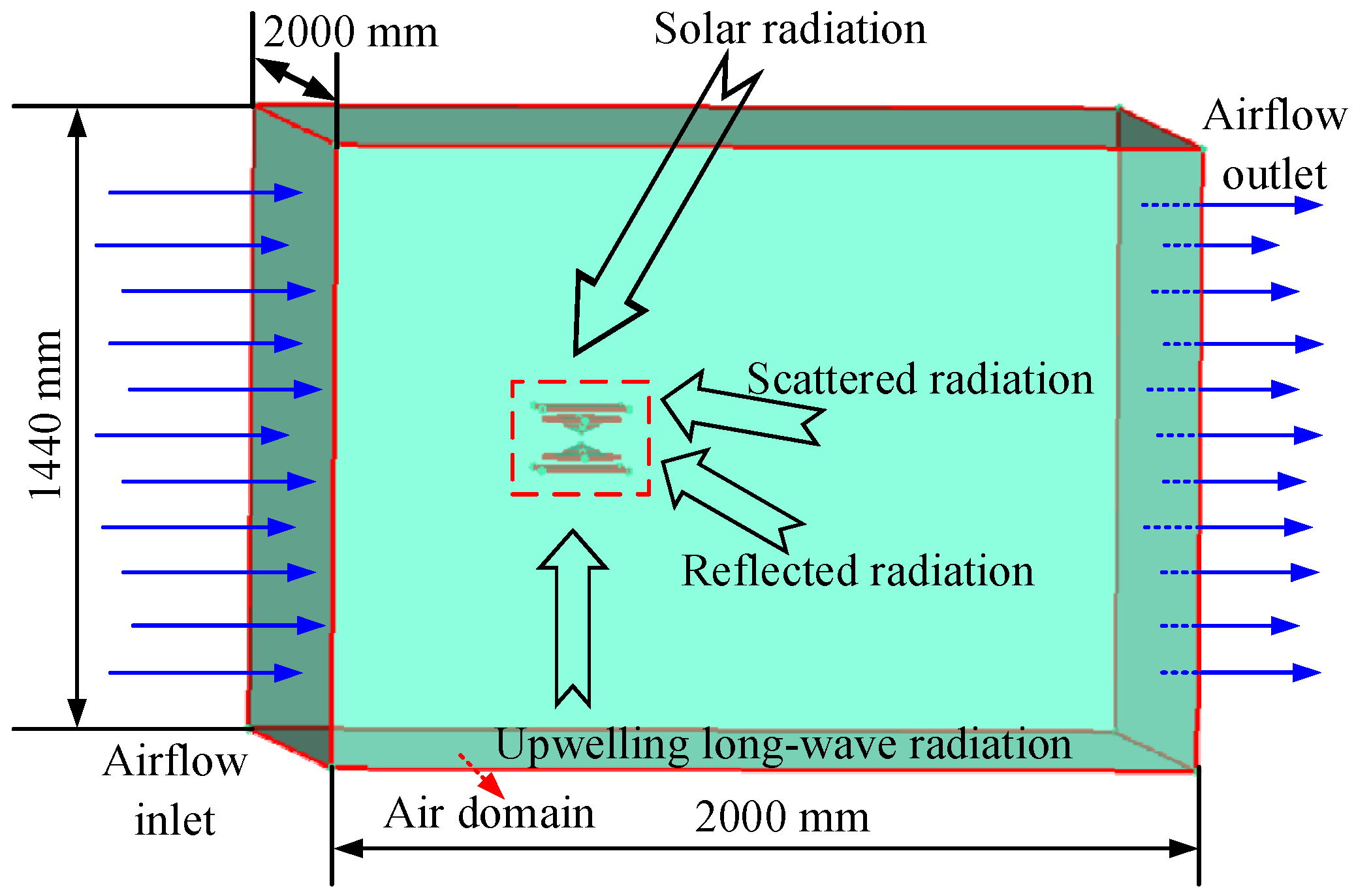
To balance computational efficiency and numerical accuracy, finite-element-based simulations were performed. A three-dimensional solid model of the shield (Figure 2) was embedded within an external fluid domain to approximate an unbounded atmospheric environment. The size of the computational domain was established according to the shield geometry and extended along the incoming flow direction to adequately reproduce airflow conditions encountered during field experiments while preventing outlet backflow. The final domain dimensions for the CFD simulation were selected to replicate real-world conditions and prevent backflow at the outlet. The computational domain measures 2000 mm × 2000 mm × 1440 mm, with the upstream boundary defined as a velocity inlet and the downstream boundary as a pressure outlet. These dimensions ensure that the airflow environment is accurately represented, providing sufficient space to capture airflow dynamics while minimizing interference from backflow at the outlet.

2.2. Simulation Results and Performance Evaluation

A coupled fluid–solid heat transfer analysis was performed using ANSYS Fluent (v15.0). The energy equation was activated, and pressure–velocity coupling was handled using the SIMPLE algorithm. Turbulence effects were modeled using the standard k–ε model, which is a robust and commonly used choice for external flow and conjugate heat-transfer simulations around shielding structures, providing a practical balance between accuracy and computational efficiency [22,23]. Solar radiation was incorporated using the solar ray tracing model to represent the directional dependence of shortwave irradiance on the shield and probe; this is necessary because radiation-induced heating is a major source of systematic bias in naturally ventilated temperature measurements [10,11,12]. The primary simulation parameters were specified as follows: direct solar radiation of 1000 W/m2, ground-emitted longwave radiation of 300 W/m2, scattered radiation of 200 W/m2, a solar elevation angle of 45°, an ambient wind speed of 0.6 m/s, an altitude of 0.022 km, a surface albedo of 0.2, and an initial ambient temperature of 300 K.
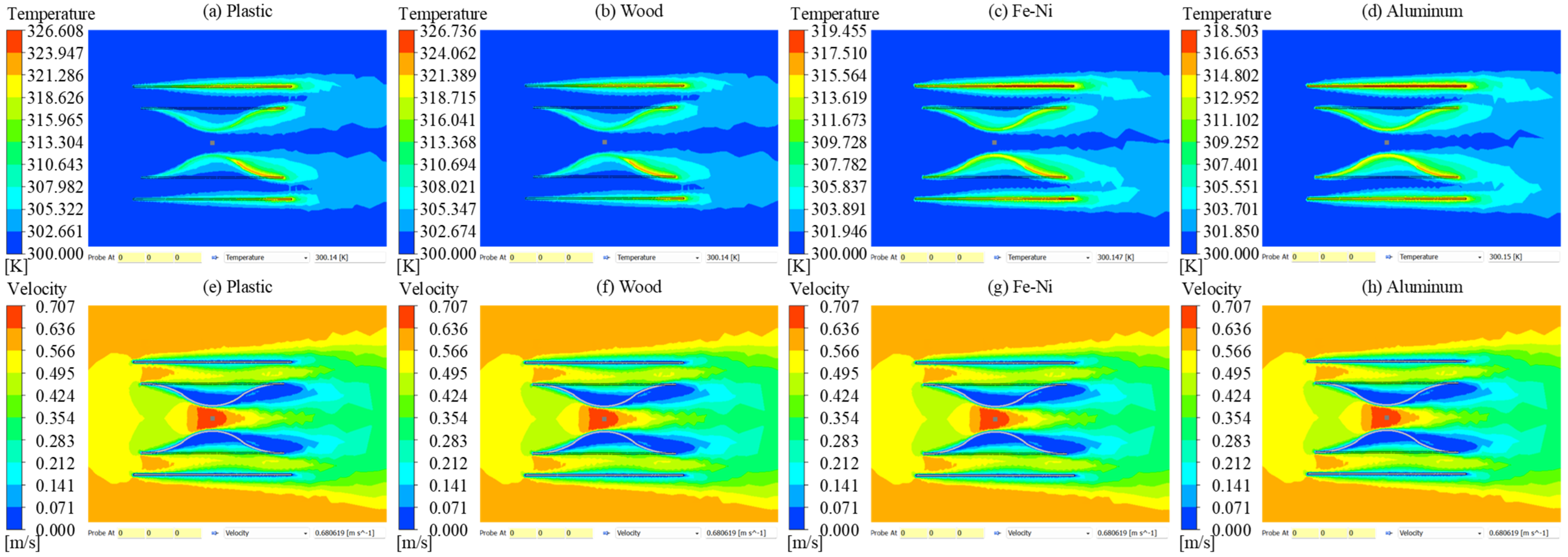
The CFD-predicted temperature and velocity fields are summarized in Figure 3 and Figure 4. For the four candidate structural materials, the temperature fields are shown in Figure 3a–d and the corresponding velocity fields are shown in Figure 3e–h (plastic: Figure 3a,e; wood: Figure 3b,f; Fe–Ni alloy: Figure 3c,g; aluminum: Figure 3d,h). To eliminate the influence of surface optical properties, all external surfaces were assigned a white coating with a reflectance of approximately 0.87, so that only the thermophysical parameters (density, specific heat capacity, and thermal conductivity) varied.
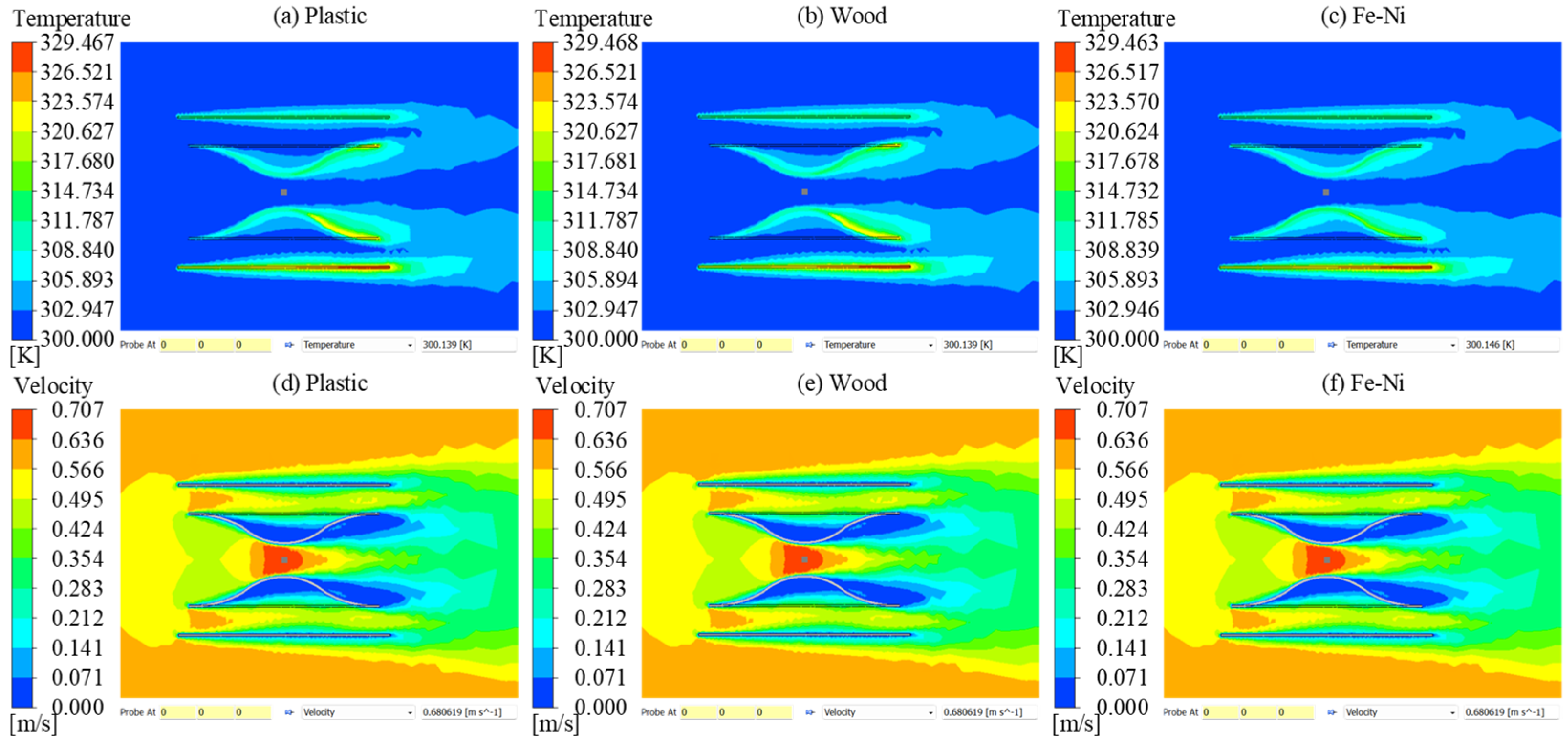
In the optimized configuration with a mirror-finished aluminum sunshade, the temperature fields are shown in Figure 4a–c and the corresponding velocity fields in Figure 4d–f (plastic: Figure 4a,d; wood: Figure 4b,e; Fe–Ni alloy: Figure 4c,f). The upper and lower square shading plates were modeled as mirror-finished aluminum (reflectance ≈ 0.95) to minimize direct solar heating, while the inner surfaces were coated with a high-absorptance black layer (absorptance ≈ 0.9) to absorb reflected and longwave radiation and suppress secondary reflections affecting the probe.
The simulation results (Figure 3) indicate that the probe temperature for the four materials ranged from 300.14 to 300.15 K, resulting in radiation-induced temperature errors of approximately 0.14–0.15 K. Radiation shields constructed from materials with lower thermal conductivity (plastic and wood) exhibited slightly better performance than those made from metals, likely due to reduced heat transfer from heated structural components. Under the optimized configuration shown in Figure 4, the use of mirror-finished aluminum shading plates with black inner linings further reduced probe temperature. When the flow-guiding shrouds were made of plastic, wood, or Fe–Ni alloy, the radiation error decreased to 0.139–0.146 K, confirming the effectiveness of high-reflectance shading plates in suppressing solar heating.
Considering overall thermal performance, structural weight, and manufacturing cost, the final radiation shield design adopts mirror-finished aluminum for the upper and lower shading plates to maximize reflectance and reduce radiation-induced errors, while plastic is selected for the flow-guiding shrouds to balance ventilation performance, weather resistance, and cost-effectiveness. This combined design strategy optimizes both radiation shielding and natural ventilation to meet the accuracy requirements of near-surface air temperature observations.

2.3. Influence of Environmental Factors on Radiation Error

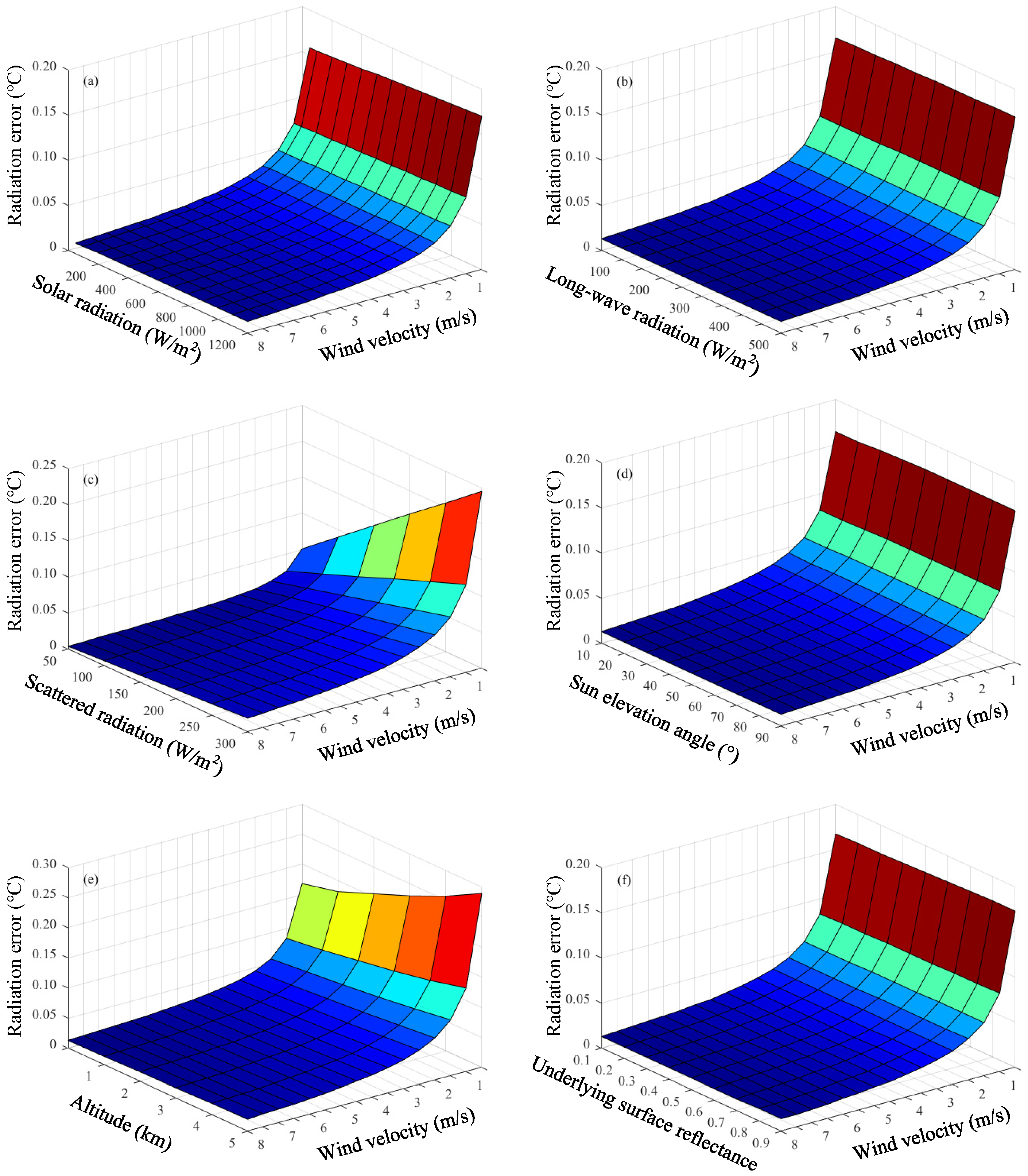
To systematically evaluate the sensitivity of radiation-induced temperature errors to environmental conditions, a series of coupled multi-parameter CFD simulations were conducted. The baseline conditions were defined as follows: airflow speed V = 1 m/s, solar radiation P1 = 1000 W/m2, longwave radiation P2 = 300 W/m2, scattered radiation P3 = 200 W/m2, solar elevation angle E = 45°, altitude H = 0.022 km, and surface reflectance f = 0.2. Based on these reference conditions, the parameter ranges were set to V = 0.5–8 m/s, P1 = 50–1200 W/m2, P2 = 50–500 W/m2, P3 = 50–300 W/m2, E = 10–90°, H = 0–5 km, and f = 0.1–0.9. The resulting effects of individual environmental parameters on radiation error are summarized in Figure 5.
Owing to the high-reflectance aluminum radiation shielding, direct solar radiation and ground-emitted longwave radiation exerted relatively minor influences on the temperature measurements. Within typical intensity ranges, the radiation error remained only between 0.079 and 0.085 °C for direct solar radiation (Figure 5a) and between 0.083 and 0.085 °C for ground longwave radiation (Figure 5b). In contrast, scattered radiation, which originates from multiple directions and cannot be fully mitigated by geometric shielding, produced a more pronounced impact. As P3 increased from 50 to 300 W/m2, the radiation error rose to 0.122 °C (Figure 5c). The solar elevation angle showed only a limited influence on radiation error, which remained within the range of 0.082–0.084 °C across the tested angles (Figure 5d). By contrast, altitude had a more substantial effect. As altitude increased, the reduction in air density weakened convective heat dissipation, leading to radiation error rising from 0.084 °C under sea-level conditions and reaching 0.139 °C at an altitude of 5 km (Figure 5e). Variations in surface reflectance produced only a slight increase in radiation error; when reflectance increased from 0.1 to 0.9, the error rose marginally to 0.087 °C (Figure 5f). Overall, under all tested environmental conditions, the radiation-induced temperature error of the proposed shield remained below 0.30 °C.

2.4. Development and Application of the Radiation Error Correction Model
Although CFD simulations provide valuable radiation error estimates under discrete environmental conditions, they cannot support continuous prediction under arbitrary meteorological scenarios, thereby limiting their direct applicability for dynamic measurement correction. Data-driven models (e.g., neural networks) have been increasingly used to approximate the nonlinear mapping between environmental variables and measurement errors when explicit empirical formulations become inadequate under multi-parameter coupling [17,18,19,20,21]. In this work, a multilayer perceptron (MLP) was adopted due to its simple architecture and strong capability in representing nonlinear relationships with low computational cost, which is suitable for real-time correction. Accordingly, the MLP model was trained using a multi-parameter CFD-generated dataset to enable continuous prediction and correction of radiation-induced errors.
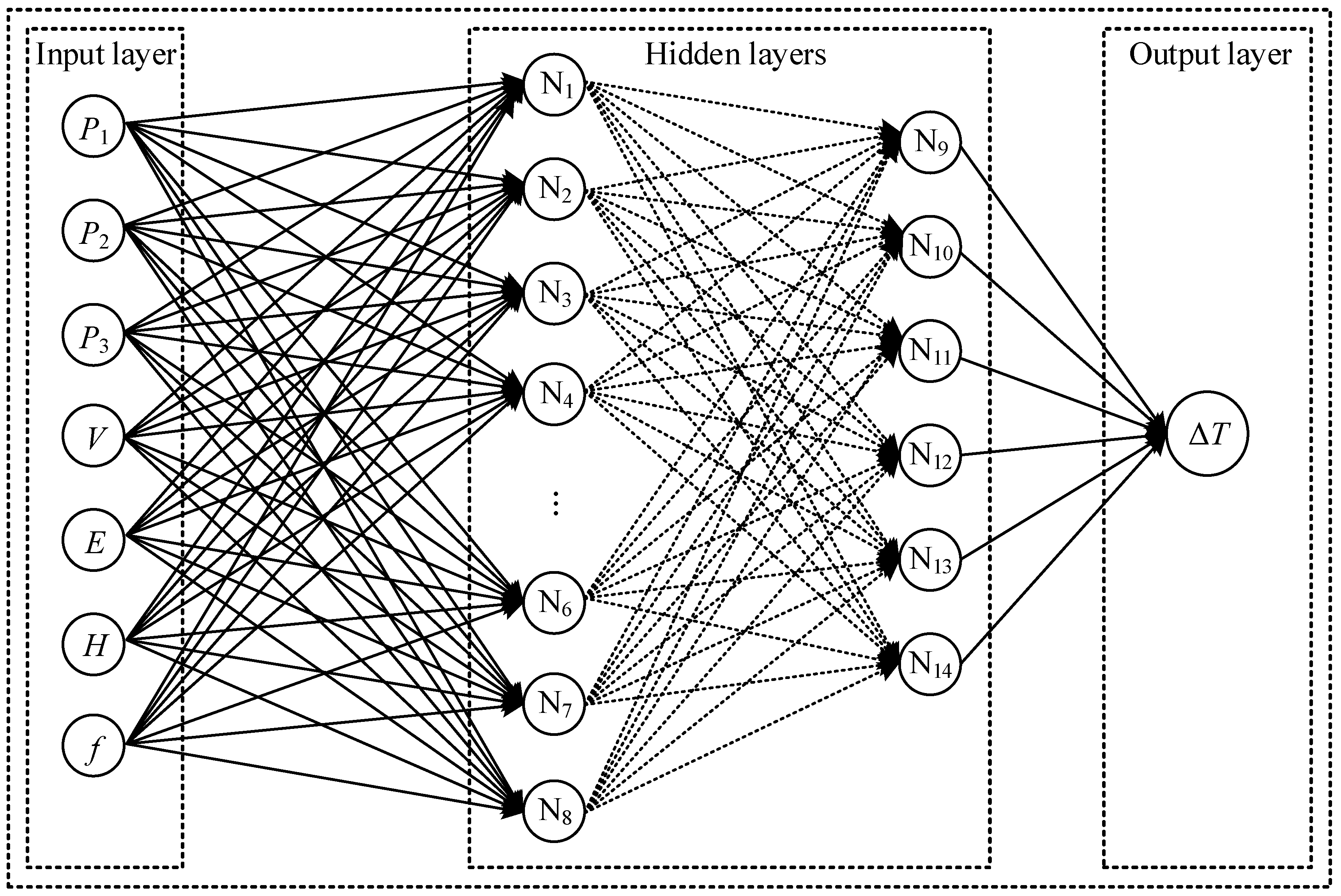
The input layer consists of seven environmental variables: wind speed V (m/s), solar radiation P1 (W/m2), longwave radiation P2 (W/m2), scattered radiation P3 (W/m2), solar elevation angle E (°), altitude H (km), and surface reflectance f (-). The model output is the radiation error ΔT. The CFD-generated dataset was randomly split into training and validation subsets with a ratio of 75% to 25%. The network architecture (number of hidden layers and neurons) was determined via a hyperparameter study. Candidate MLPs with 1–3 hidden layers and different neuron numbers were trained under identical settings and evaluated on the validation subset using RMSE and MAE between the MLP-predicted radiation error and the CFD-simulated radiation error. The final architecture comprises two hidden layers with 8 and 6 neurons (Figure 6), because it achieved the best overall validation performance among the tested candidates; wider or deeper networks did not provide a consistent improvement.
To evaluate model generalization under real atmospheric conditions, the trained MLP was further tested on an independent field intercomparison dataset that was not used during training or hyperparameter selection. The predicted ΔT was compared with the experimentally derived radiation error defined as the probe–reference difference (probe − reference), and the test performance was quantified using RMSE and MAE.
The rectified linear unit (ReLU) function was adopted as the activation function, as defined in Equation (1). ReLU offers computational efficiency and strong nonlinear representation capability, while mitigating vanishing gradient issues and improving training stability and convergence speed. This choice provides an effective balance between model complexity and computational cost for radiation error prediction under complex meteorological conditions.
Re LU = x , x > 0 0 , x 0
The mathematical formulations corresponding to the first and second hidden layers and the output layer are given in Equations (2)–(4), respectively.
A 1 = Re LU W 1 X + b 1
A 2 = Re LU W 2 A 1 + b 2
Δ T = Re LU W 3 A 2 + b 3
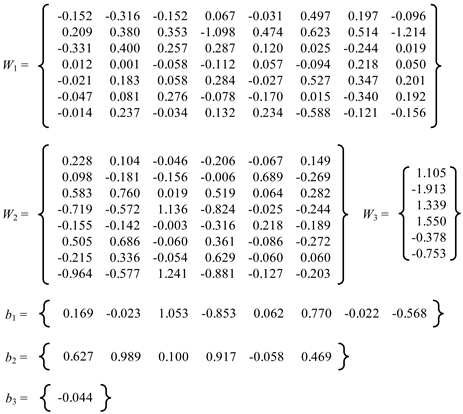
Here, the input vector is defined as X = [V, P1, P2, P3, E, H, f]T. For the 7-8-6-1 architecture, W1 ∈ R8×7, W2 ∈ R6×8, W3 ∈ R1×6, b1 ∈ R8, b2 ∈ R6, and b3 ∈ R.
In these equations, W1, W2, and W3 denote the weight matrices linking the input and first hidden layers, the first and second hidden layers, and the second hidden and output layers, respectively, while b1, b2, and b3 represent the corresponding bias vectors. A1 and A2 represent the activation responses of the first and second hidden layers, and the final output ΔT corresponds to the predicted radiation error. ReLU is also used in the output layer because ΔT represents a radiation-induced heating bias under irradiance conditions and is non-negative in our datasets. The parameter matrices are specified as follows:
Atmosphere 17 00272 i001
After training, the MLP model approximates the functional relationship between the seven environmental variables and the radiation-induced error. Figure 7 compares the MLP-predicted ΔT with the CFD-simulated ΔT for the validation dataset, showing a good agreement across the tested conditions. The prediction accuracy on the validation set is quantified by an RMSE of 0.005 °C and an MAE of 0.002 °C, indicating that the MLP provides a reliable surrogate for the discrete CFD results within the investigated parameter ranges. This surrogate model enables continuous radiation-error estimation and supports subsequent dynamic correction of experimental temperature measurements.

3. Experimental Study

3.1. Setup and Validation for the Radiation Error Test Platform

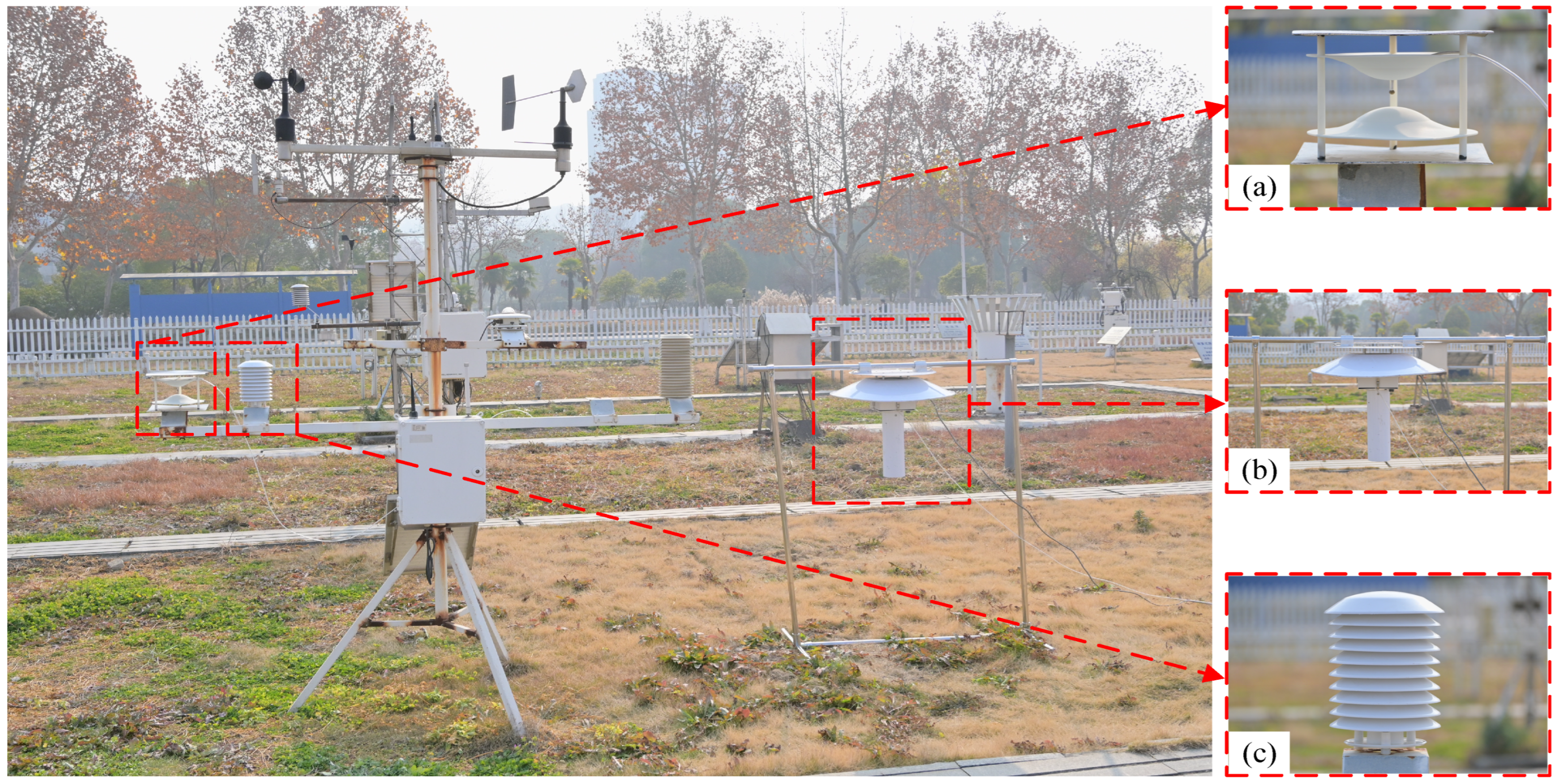
To validate the measurement accuracy of the developed radiation shield (housing a Pt100 probe), a radiation error intercomparison platform was implemented at the Nanjing Meteorological Observation Center under the China Meteorological Administration (32.12° N, 118.42° E; altitude: 22 m), as shown in Figure 8. The proposed shield is presented in Figure 8a, while the comparison instruments (MET ONE Model 076B, Met One Instruments, Inc., Grants Pass, OR, USA, and R. M. Young Model 41003, R. M. Young Company, Traverse City, MI, USA) are shown in Figure 8b and Figure 8c, respectively. The 076B shield, featuring active aspiration and a specified measurement uncertainty better than ±0.03 °C, was adopted as the reference device [24]. The proposed sensor employs a 1/3 DIN thin-film Pt100 (Heraeus Holding GmbH, Hanau, Germany), measured using a four-wire, constant-current circuit and digitized by a 24-bit AD7794 ADC (Analog Devices, Inc., Norwood, MA, USA). A two-point calibration (water triple point and gallium melting point) was applied before field deployment. The Pt100, Kipp & Zonen CMP21 pyranometer (Kipp & Zonen B.V., Delft, The Netherlands), and R. M. Young 03002V anemometer (R. M. Young Company, Traverse City, MI, USA) signals were recorded by an AD7794-based data acquisition system; the CMP21 output was acquired via a differential voltage channel and the 03002V output via a pulse/frequency channel. All variables were logged every 5 min with synchronized timestamps.

3.2. Measurement of Environmental Parameters

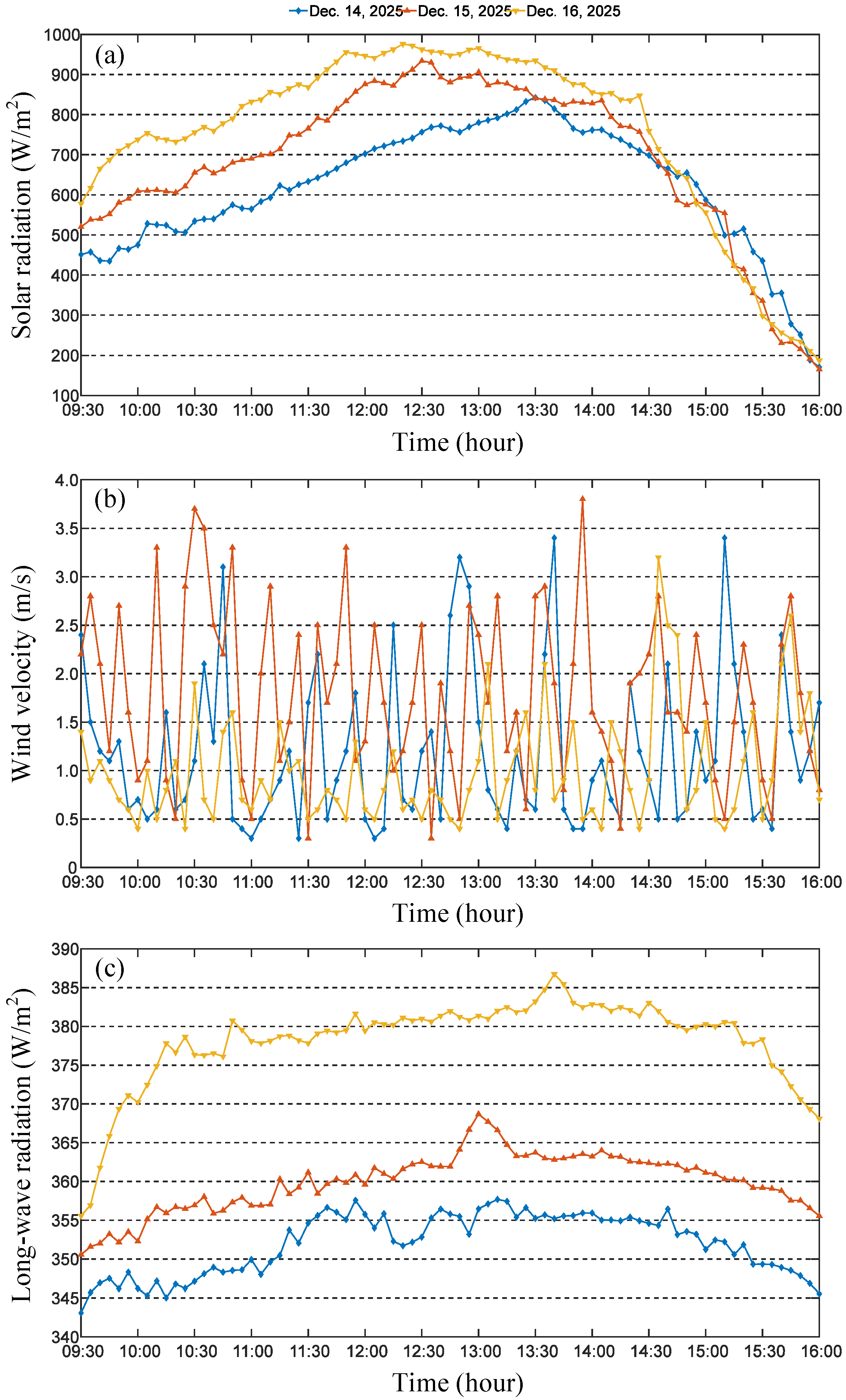
During the field intercomparison, seven key environmental parameters were synchronously collected to support radiation error analysis and the development of the correction model. At each 5-min time stamp, data were collected continuously for 1 min, and the 1-min mean was recorded as the measurement value. Figure 9 presents the daytime time series (14–16 December 2025) of solar radiation (Figure 9a), wind speed (Figure 9b), and upward longwave radiation (Figure 9c). The underlying surface was grassland, with the surface reflectance set to 0.2. The ground surface was treated as a gray body, and the upward longwave radiation was calculated using the Stefan–Boltzmann law (Equation (5)), with the emissivity set to 0.95. Here, Tg denotes the measured ground surface temperature [25,26]. As shown in Figure 9, wind speed ranged approximately from 0.3 to 3.8 m/s and solar radiation from about 165 to 1000 W/m2, thereby covering low-to-moderate natural ventilation and a broad range of radiative forcing for evaluating radiation-induced temperature bias.
I l , 0 = 0.95 σ T g 4
where σ denotes the Stefan–Boltzmann constant, whose value is 5.67 × 10⁻⁸ W·m−2·K−4.

3.3. Radiation Error Analysis and Discussion

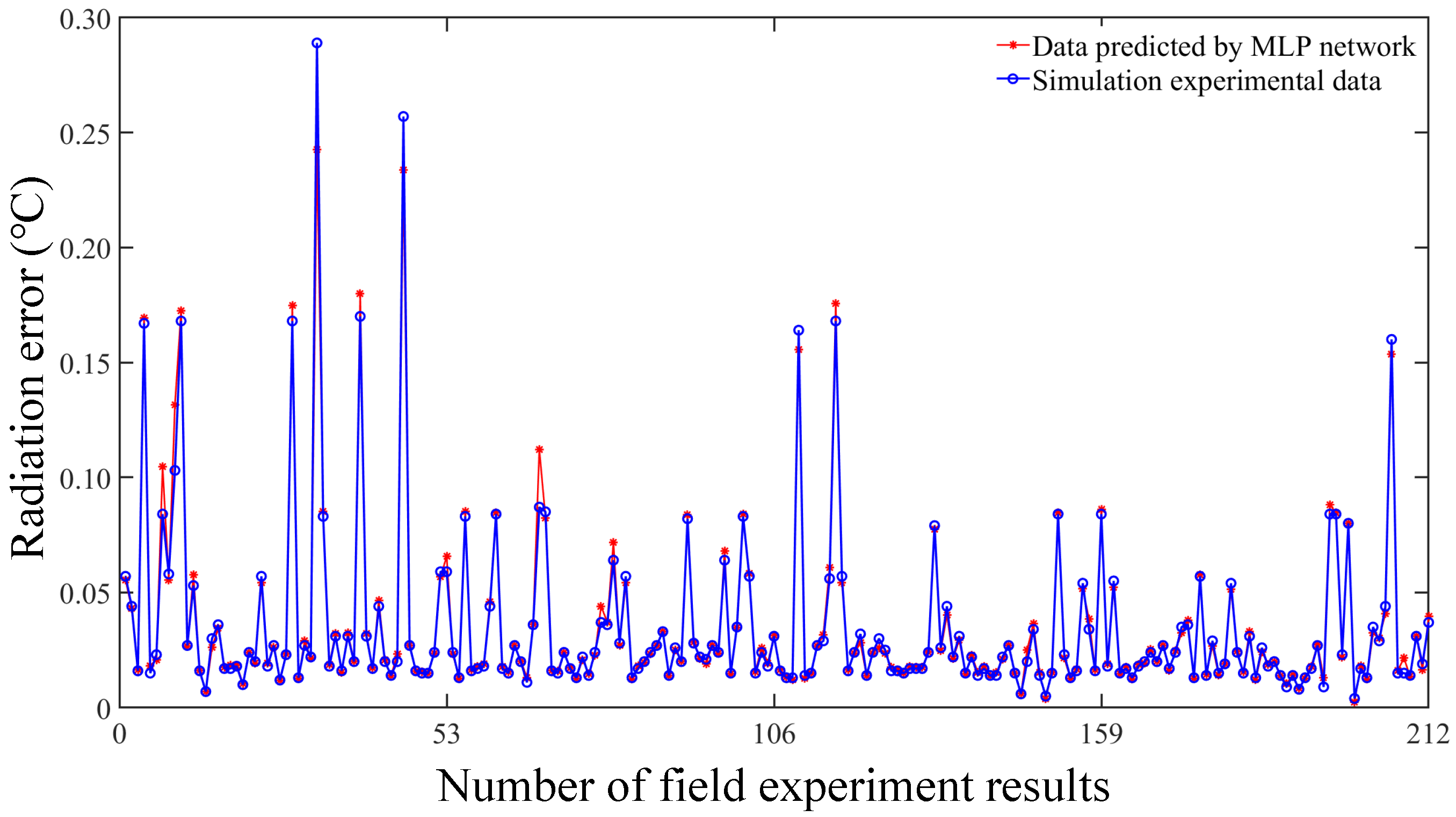
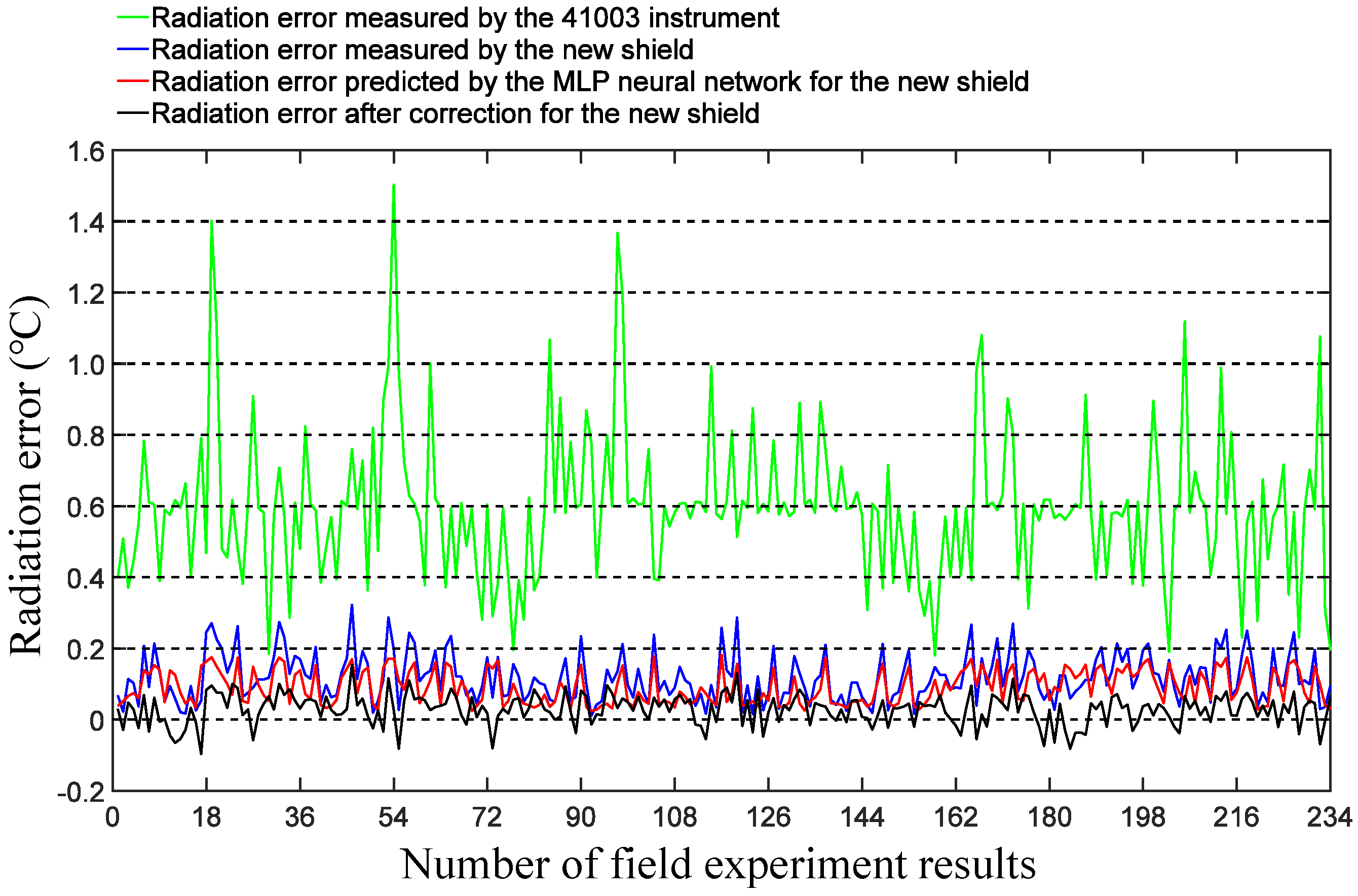
The experimental radiation error was computed as the difference between the measurements obtained from each evaluated configuration (the proposed shield and the 41003 shield) and those from the reference configuration (the 076B shield with an accuracy of ±0.03 °C). The seven synchronously measured environmental variables were input into the trained MLP correction model to obtain predicted radiation error values, which were subsequently used to correct the raw temperature measurements. Figure 10 presents a comparison of the measured radiation errors of the 41003 shield and the proposed shield, as well as those of the proposed shield before and after model-based correction.
The results indicate that, under identical meteorological conditions, the Model 41003 shield exhibits a pronounced systematic radiation bias, with a maximum experimental radiation error of approximately 1.5 °C and a mean radiation error of 0.59 °C. In contrast, the proposed shield shows substantially reduced radiation errors prior to correction, with maximum and mean experimental radiation errors of 0.32 °C and 0.12 °C, respectively. This improvement is likely attributable to the bowl–cover curved airflow-guiding structure, which enhances natural ventilation around the sensing element and thereby mitigates solar radiation-induced heating effects.
The performance of the MLP-based correction model was evaluated using the independent field intercomparison dataset, which was not used for training or hyperparameter selection. The predicted radiation error was compared with the experimentally derived radiation error defined as the probe–reference difference (probe–reference), resulting in a MAE of 0.043 °C and a RMSE of 0.051 °C. After correction, the correlation coefficient between the corrected temperature measurements and the reference values reached 0.999, indicating that the proposed correction effectively compensates for radiation-induced errors under real meteorological conditions. Compared with the notable radiation-induced warm biases commonly reported for naturally ventilated sensors under strong insolation and low wind [13,14], our system achieves a lower mean uncorrected error (0.12 °C; max 0.32 °C) and, with MLP correction, provides a low-power alternative with improved agreement to the aspirated reference [15,16].

4. Conclusions and Future Work

A high-accuracy naturally ventilated radiation shield was designed and experimentally validated for near-surface air temperature observation. By integrating aerodynamic structural optimization with a radiation error correction model, radiation-induced errors were effectively suppressed without the need for active ventilation. The key findings are as follows:
(1)
Field experiments demonstrated that, under the tested conditions, the proposed shield exhibited a mean uncorrected radiation error of 0.12 °C, which is significantly lower than that of the 41003 shield (0.59 °C). This result indicates that the bowl–cover flow-guiding structure combined with the shading configuration enhances air exchange and heat transfer around the sensing probe, thereby mitigating radiative heating effects.
(2)
Coupled multi-parameter simulations showed that, within the specified ranges of wind speed, radiation intensity, altitude, solar elevation angle, and surface reflectance, the radiation error remained below 0.30 °C. Among these factors, scattered radiation and altitude were identified as more sensitive contributors to radiation error variations, providing quantitative guidance for the environmental adaptability of the structural design.
(3)
An MLP-based correction model constructed using seven environmental parameters as inputs achieved an RMSE of 0.051 °C and an MAE of 0.043 °C based on field observation data. These results indicate that the proposed method effectively captures the nonlinear characteristics of radiation-induced errors and can be applied to correct near-surface air temperature measurements.
Future work will involve intercomparison experiments across multiple sites and seasons to evaluate the generalizability of the conclusions and to determine the limits of applicability. A limitation of this study is that the CFD evaluations were mainly conducted under steady-state boundary conditions and did not explicitly quantify the effects of diurnal thermal transients or component aging/soiling on measurement errors. In addition, relative humidity and atmospheric pressure were not treated as independent variables because they were not recorded synchronously during the intercomparison campaign; their effects are expected to be mainly indirect via air properties and convective heat transfer. Long-term continuous operation will be conducted to quantify temperature probe drift and aging, as well as the impacts of environmental processes such as condensation, precipitation, and frost on measurement performance. Future multi-site and multi-season campaigns will incorporate synchronized humidity and pressure measurements to quantify their incremental impact and, if beneficial, extend the correction model inputs accordingly. In addition, a reproducible evaluation protocol will be established by driving an unsteady conjugate heat transfer CFD model with representative diurnal forcing (e.g., ambient temperature and wind speed, together with shortwave/longwave radiative flux time series) and by perturbing key optical properties (e.g., shield reflectance/emissivity) to link plausible aging states to radiation error. Cross-site validation strategies will be adopted to assess the robustness of the correction model and its feasibility for engineering deployment.

Author Contributions

Conceptualization, Y.Z. and J.T.; data curation, W.J.; formal analysis, J.T. and Y.Z.; investigation, Y.Z. and H.M.A.; methodology, Y.Z.; software, W.J.; validation, W.J. and H.M.A.; writing—original draft preparation, W.J.; writing—review and editing, J.T.; visualization, W.J.; project administration, H.M.A. All authors have read and agreed to the published version of the manuscript.

Funding

This study was funded by the National Natural Science Foundation of China (42275143).

Institutional Review Board Statement

Not applicable.

Informed Consent Statement

Not applicable.

Data Availability Statement

The datasets generated and/or analyzed during the current study are available from the corresponding author on reasonable request.

Conflicts of Interest

The authors declare no conflicts of interest.

References

  1. Zhang, J.; Gao, S.Y.; Chen, H.S.; Yu, J.H.; Tang, Q. Retrieval of the land surface-air temperature difference from high spatial resolution satellite observations over complex surfaces in the Tibetan Plateau. J. Geophys. Res. Atmos. 2015, 120, 8065–8079. [Google Scholar] [CrossRef] [Scilit]
  2. Shikwambana, L.; Xongo, K.; Mashalane, M.; Mhangara, P. Climatic and vegetation response patterns over south Africa during the 2010/2011 and 2015/2016 strong ENSO phases. Atmosphere 2023, 14, 416. [Google Scholar] [CrossRef] [Scilit]
  3. Chilson, P.B.; Bell, T.M.; Brewster, K.A. Moving towards a network of autonomous UAS atmospheric profiling stations for observations in the Earth’s lower atmosphere: The 3D mesonet concept. Sensors 2019, 19, 2720. [Google Scholar] [CrossRef] [Scilit]
  4. Liu, X.; Wu, W.; Wielicki, B.A.; Yang, Q.G. Spectrally dependent CLARREO infrared spectrometer calibration requirement for climate change detection. J. Clim. 2017, 30, 3979–3998. [Google Scholar] [CrossRef] [Scilit] [PubMed]
  5. Madonna, F.; Essa, Y.H.; Marra, F.; Serva, F. Uncertainties on climate extreme indices estimated from US Climate Reference Network (USCRN) near-surface temperatures. J. Geophys. Res. Atmos. 2023, 128, e2022JD038057. [Google Scholar] [CrossRef] [Scilit]
  6. IPCC. Climate Change 2023: Synthesis Report; IPCC: Geneva, Switzerland, 2023. [Google Scholar]
  7. IPCC. Climate Change 2021: The Physical Science Basis; IPCC: Geneva, Switzerland, 2021. [Google Scholar]
  8. Wallis, E.J.; Osborn, T.J.; Taylor, M.; Jones, P.D.; Joshi, M.; Hawkins, E. Quantifying exposure biases in early instrumental land surface air temperature observations. Int. J. Climatol. 2024, 44, 1611–1635. [Google Scholar] [CrossRef] [Scilit]
  9. Ashcroft, L.; Trewin, B.; Benoy, M.; Ray, D.; Courtney, C. The world’s longest known parallel temperature dataset: A comparison between daily Glaisher and Stevenson screen temperature data at Adelaide, Australia, 1887–1947. Int. J. Climatol. 2022, 42, 2670–2687. [Google Scholar] [CrossRef] [Scilit]
  10. Buisan, S.T.; Azorin-Molina, C.; Jimenez, Y. Impact of two different sized Stevenson screens on air temperature measurements. Int. J. Climatol. 2015, 35, 4408–4416. [Google Scholar] [CrossRef] [Scilit]
  11. Young, D.T.; Chapman, L.; Muller, C.L.; Cai, X.M.; Grimmond, C.S.B. A low-cost wireless temperature sensor: Evaluation for use in environmental monitoring applications. J. Atmos. Ocean. Technol. 2014, 31, 938–944. [Google Scholar] [CrossRef] [Scilit]
  12. Yang, J.; Liu, Q.Q.; Dai, W. Computational fluid dynamic design and experimental study of a temperature sensor array used in climate reference station. J. Atmos. Ocean. Technol. 2019, 36, 1835–1847. [Google Scholar] [CrossRef] [Scilit]
  13. Holden, Z.A.; Klene, A.E.; Keefe, R.F.; Moisen, G.G. Design and evaluation of an inexpensive radiation shield for monitoring surface air temperatures. Agric. For. Meteorol. 2013, 180, 281–286. [Google Scholar] [CrossRef] [Scilit]
  14. Aoshima, T.; Nakashima, K.; Kawamura, H.; Kumamoto, M.; Sakai, S.; Kawano, S.; Joko, M. RIC-Tsukuba (Japan) Intercomparison of Thermometer Screens/Shields in 2009–2010; TECO: Singapore, 2010. [Google Scholar]
  15. Waugh, S.M. The “U-tube”: An improved aspirated temperature system for mobile meteorological observations, especially in severe weather. J. Atmos. Ocean. Technol. 2021, 38, 1477–1489. [Google Scholar] [CrossRef] [Scilit]
  16. Thomas, C.K.; Smoot, A.R. An effective, economic, aspirated radiation shield for air temperature observations and its spatial gradients. J. Atmos. Ocean. Technol. 2013, 30, 526–537. [Google Scholar] [CrossRef] [Scilit]
  17. Javanroodi, K.; Nik, V.M.; Giometto, M.G.; Scartezzini, J.L. Combining computational fluid dynamics and neural networks to characterize microclimate extremes: Learning the complex interactions between meso-climate and urban morphology. Sci. Total Environ. 2022, 829, 154223. [Google Scholar] [CrossRef] [Scilit]
  18. Cui, L.K.; Yang, J.; Tan, M.Q.; Ding, R.H. Development of a sounding temperature sensor with four wires for upper-air temperature measurements. Measurement 2025, 249, 117069. [Google Scholar] [CrossRef] [Scilit]
  19. Zhang, J.H.; Xie, X.L.; Liu, Q.Q.; Li, M.; Mao, X.L. Fluid dynamics analysis and experimental study for solar radiation error correction of sounding humidity sensor. Rev. Sci. Instrum. 2021, 92, 055010. [Google Scholar] [CrossRef] [Scilit] [PubMed]
  20. Guo, Q.C.; He, Z.F.; Wang, Z.S. Monthly climate prediction using deep convolutional neural network and long short-term memory. Sci. Rep. 2024, 14, 17748. [Google Scholar] [CrossRef] [Scilit] [PubMed]
  21. Yang, J.; Wang, X.T.; Li, L.; Yuan, K.Y. Development of a solar radiation measuring instrument for building energy management system. Rev. Sci. Instrum. 2025, 96, 055108. [Google Scholar] [CrossRef] [Scilit]
  22. Erell, E.; Leal, V.; Maldonad, E. Measurement of air temperature in the presence of a large radiant flux: An assessment of passively ventilated thermometer screens. Bound.-Layer Meteorol 2005, 114, 205–231. [Google Scholar] [CrossRef] [Scilit]
  23. Yang, J.; Ying, Z.J.; Yuan, K.Y.; Ding, R.H.; Liu, Q.Q. Design and experimental study of a measurement system for total solar radiation and upward longwave radiation. IEEE Trans. Instrum. Meas. 2025, 74, 9534613. [Google Scholar] [CrossRef] [Scilit]
  24. Met One Instruments, Inc. Fan Aspirated Radiation Shield 076B; Met One Instruments, Inc.: Grants Pass, OR, USA, 2019. [Google Scholar]
  25. Yin, K.L.; Zhang, X.J.; Xie, J.C. Modeling of longwave radiation on coastal building façades based on field measurements. Build. Environ. 2026, 287, 113859. [Google Scholar] [CrossRef] [Scilit]
  26. Zeng, Q.; Cheng, J.; Dong, L.X. Assessment of the long-term high-spatial-resolution global land surface satellite (GLASS) Surface longwave radiation product using ground measurements. IEEE J. Sel. Top. Appl. Earth Obs. Remote Sens. 2020, 13, 2032–2055. [Google Scholar] [CrossRef] [Scilit]
Figure 1. Proposed naturally ventilated radiation shield: (a) overall assembly; (b) square shading plate; (c) airflow deflector; (d) sensing probe.
Atmosphere 17 00272 g001
Figure 2. 3D representation of the proposed radiation shield assembly and the surrounding air domain (2000 mm × 2000 mm × 1440 mm).
Atmosphere 17 00272 g002
Figure 3. Temperature and velocity field distributions (ah) for different shield materials (plastic, wood, Fe–Ni alloy, aluminum).
Atmosphere 17 00272 g003
Figure 4. Temperature and velocity field distributions (af) for different diffuser materials (plastic, wood, and Fe–Ni alloy) combined with a mirror-finish aluminum sunshade.
Atmosphere 17 00272 g004
Figure 5. Variation in shield radiation errors under different environmental parameters: (a) solar radiation; (b) longwave radiation; (c) scattered radiation; (d) solar elevation angle; (e) altitude; (f) underlying surface reflectance.
Atmosphere 17 00272 g005
Figure 6. Schematic diagram of the MLP neural network.
Atmosphere 17 00272 g006
Figure 7. Validation comparison between MLP-predicted and CFD-simulated ΔT.
Atmosphere 17 00272 g007
Figure 8. Radiation-error intercomparison platform: (a) proposed shield; (b) MET ONE 076B (reference); (c) R. M. Young 41003.
Atmosphere 17 00272 g008
Figure 9. Observed environmental conditions during the experiment: (a) solar radiation, (b) wind speed, and (c) longwave radiation.
Atmosphere 17 00272 g009
Figure 10. Comparison of the measured radiation errors between the 41003 instrument and the proposed shield, and those for the proposed shield before and after MLP-based correction.
Atmosphere 17 00272 g010
Table 1. Thermophysical properties of the four materials.
MaterialDensity (kg·m−3)Heat Capacity (J·kg−1·K−1)Thermal Conductivity (W·m−1·K−1)
Plastic11015910.2
Wood70023100.173
Fe–Ni alloy838544986
Aluminum2719871202.4
Disclaimer/Publisher’s Note: The statements, opinions and data contained in all publications are solely those of the individual author(s) and contributor(s) and not of MDPI and/or the editor(s). MDPI and/or the editor(s) disclaim responsibility for any injury to people or property resulting from any ideas, methods, instructions or products referred to in the content.