

You are currently viewing a new version of our website. To view the old version click .

Agronomy, Volume 9, Issue 7

July 2019 - 68 articles

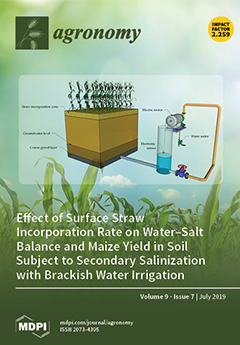
Cover Story: Secondary salinization induced by brackish water irrigation has forced agricultural development to increasingly rely on soil management. A two-year field experiment was conducted to explore the effects of different straw incorporation rates (SIRs) within 0 to 20 cm topsoil on the soil water–salt balance, maize yield production, and water use efficiency (WUE) under brackish water irrigation in a naturally non-saline area. Results demonstrated that straw incorporation markedly increased the soil water content during two growing seasons, and SIR was directly correlated to the deep percolation, but inversely correlated to the soil water depletion, under both the SL and SH condition. Results in this study would be helpful in the adoption of straw incorporation and brackish water irrigation in ways that facilitate soil water availability and reduce the risk of soil salinization. View this paper.
  • Issues are regarded as officially published after their release is announced to the table of contents alert mailing list .
  • You may sign up for email alerts to receive table of contents of newly released issues.
  • PDF is the official format for papers published in both, html and pdf forms. To view the papers in pdf format, click on the "PDF Full-text" link, and use the free Adobe Reader to open them.

Articles (68)

  • Article
  • Open Access
14 Citations
5,156 Views
12 Pages

Genetic Mapping Reveals Large-Effect QTL for Anther Extrusion in CIMMYT Spring Wheat

  • Quddoos H. Muqaddasi,
  • Jochen C. Reif,
  • Marion S. Röder,
  • Bhoja R. Basnet and
  • Susanne Dreisigacker

Hybrid breeding facilitates the exploitation of heterosis and it can result in significant genetic gains and increased crop yields. Inefficient cross-pollination is a major limiting factor that hampers hybrid wheat seed production. In this study, we...

  • Feature Paper
  • Article
  • Open Access
12 Citations
4,428 Views
24 Pages

Application of Proximal Optical Sensors to Fine-Tune Nitrogen Fertilization: Opportunities for Woody Ornamentals

  • Jolien Bracke,
  • Annemie Elsen,
  • Sandy Adriaenssens,
  • Lore Schoeters,
  • Hilde Vandendriessche and
  • Marie-Christine Van Labeke

Today, high amounts of residual nitrogen are regularly being reported in the open field production of hardy nursery stock. In some cases, excessive fertilizers or side-dressings are applied when circumstances are not favorable for uptake. Aquatic as...

  • Article
  • Open Access
7 Citations
4,210 Views
18 Pages

Influence of Pyrolyzed Grape-Seeds/Sewage Sludge Blends on the Availability of P, Fe, Cu, As and Cd to Maize

  • Sara Aceña-Heras,
  • Jeff Novak,
  • María Luz Cayuela,
  • Jesus M. Peñalosa and
  • Eduardo Moreno-Jiménez

Current intensive agricultural practices, although highly successful in terms of production, have been found to be environmentally unsustainable. One of the crucial approaches to increase agricultural sustainability is the recycling of organic wastes...

  • Article
  • Open Access
34 Citations
7,535 Views
13 Pages

Integrating Sentinel-2 Imagery with AquaCrop for Dynamic Assessment of Tomato Water Requirements in Southern Italy

  • Anna Dalla Marta,
  • Giovanni Battista Chirico,
  • Salvatore Falanga Bolognesi,
  • Marco Mancini,
  • Guido D’Urso,
  • Simone Orlandini,
  • Carlo De Michele and
  • Filiberto Altobelli

A research study was conducted in an open field tomato crop in order to: (i) Evaluate the capability of Sentinel-2 imagery to assess tomato canopy growth and its crop water requirements; and (ii) explore the possibility to predict crop water requirem...

  • Article
  • Open Access
25 Citations
4,054 Views
11 Pages

Assessment of Stability and Adaptation Patterns of White Sugar Yield from Sugar Beet Cultivars in Temperate Climate Environments

  • Marcin Studnicki,
  • Tomasz Lenartowicz,
  • Kinga Noras,
  • Elżbieta Wójcik-Gront and
  • Zdzisław Wyszyński

The yield and yield quality of sugar from the sugar beet (Beta vulgaris L.) and are determined by genotype, environment and crop management. This study was aimed at analyzing the stability of white sugar yield and the adaptation of cultivars based on...

  • Article
  • Open Access
3 Citations
4,508 Views
12 Pages

The tung tree, Vernicia fordii (Herbert Kenneth Airy Shaw), is a woody species native to South-East Asia (from Central and Southwest China to North Vietnam), which is also cultivated in China for the production of industrial oil. It is listed as a Ca...

  • Article
  • Open Access
86 Citations
16,719 Views
20 Pages

AgROS: A Robot Operating System Based Emulation Tool for Agricultural Robotics

  • Naoum Tsolakis,
  • Dimitrios Bechtsis and
  • Dionysis Bochtis

This research aims to develop a farm management emulation tool that enables agrifood producers to effectively introduce advanced digital technologies, like intelligent and autonomous unmanned ground vehicles (UGVs), in real-world field operations. To...

  • Article
  • Open Access
8 Citations
4,137 Views
16 Pages

The Management Strategies of Pearl Millet Farmers to Cope with Seasonal Rainfall Variability in a Semi-Arid Agroclimate

  • Festo Richard Silungwe,
  • Frieder Graef,
  • Sonoko Dorothea Bellingrath-Kimura,
  • Siza Donald Tumbo,
  • Frederick Cassian Kahimba and
  • Marcos Alberto Lana

Rainfed agriculture constitutes around 80% of the world’s agricultural land, achieving the lowest on-farm crop yields and greatest on-farm water losses. Much of this land is in developing countries, including sub-Saharan Africa (SSA), where hun...

  • Article
  • Open Access
4 Citations
4,616 Views
15 Pages

Sisymbrium officinale is a wild Brassicaceae species that is known for its use in the alleviation of vocal inflammatory states. Since this species is particularly rich in bioactive compounds, there is an interest for developing cultivation protocols...

  • Article
  • Open Access
40 Citations
5,694 Views
14 Pages

Abscisic acid (ABA) plays a central role in the plant response to water deficit by inducing stomatal closure to conserve water when the soil dries. Exogenous ABA was applied at 45 days after sowing (DAS) as a soil drench, the physiological and seed y...

of 7

Get Alerted

Add your email address to receive forthcoming issues of this journal.

XFacebookLinkedIn
Agronomy - ISSN 2073-4395