You are currently on the new version of our website. Access the old version .

Polymers, Volume 16, Issue 24

2024 December-2 - 165 articles

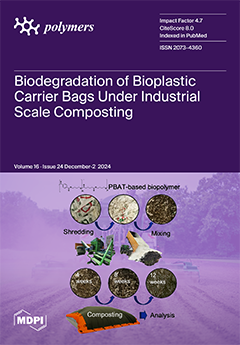
Cover Story: Bioplastics have emerged as eco-friendly solutions for the waste management of plastics. An industrial-scale composting experiment was conducted over 12 weeks using 37.5 tons of manure/wood and 50 tons of processed biopolymer bags composed of 20% starch, 10% additives, and 70% polybutylene adipate terephthalate (PBAT). Bioplastic disintegration tests revealed that 95% of the bags disintegrated by the 12th week, although ecotoxicity tests indicated varying germination inhibition rates. The result of the biodegradation assessment using gas chromatography coupled with mass spectrometry indicated that the PBAT biopolymer was not fully decomposed even in 1-year matured compost and identified three major final metabolites. View this paper
  • Issues are regarded as officially published after their release is announced to the table of contents alert mailing list .
  • You may sign up for email alerts to receive table of contents of newly released issues.
  • PDF is the official format for papers published in both, html and pdf forms. To view the papers in pdf format, click on the "PDF Full-text" link, and use the free Adobe Reader to open them.

Articles (165)

  • Article
  • Open Access
7 Citations
1,735 Views
21 Pages

3D-Printed Acrylated Soybean Oil Scaffolds with Vitrimeric Properties Reinforced by Tellurium-Doped Bioactive Glass

  • Matteo Bergoglio,
  • Matthias Kriehuber,
  • Bernhard Sölle,
  • Elisabeth Rossegger,
  • Sandra Schlögl,
  • Ziba Najmi,
  • Andrea Cochis,
  • Federica Ferla,
  • Marta Miola and
  • Marco Sangermano
  • + 1 author

23 December 2024

In this study, we present novel, vitrimeric and biobased scaffolds that are designed for hard tissue applications, composed of acrylated, epoxidized soybean oil (AESO) and reinforced with bioactive glass that is Tellurium doped (BG-Te) and BG-Te sila...

  • Article
  • Open Access
5 Citations
1,266 Views
20 Pages

23 December 2024

This study introduces a novel method to enhance the antibacterial functionality of electrospun nanofibrous textiles by integrating silver nanoparticles (AgNPs) into poly (lactic acid) (PLA) fabrics through pre- and post-electrospinning techniques. Ag...

  • Review
  • Open Access
2 Citations
1,054 Views
18 Pages

23 December 2024

As a category of polymeric materials, soft dielectrics, such as most elastomers and rubber-like materials, have shown great potential for extensive applications in various fields. Owing to their intriguing electromechanical coupling behaviors, the mo...

  • Review
  • Open Access
1 Citations
1,583 Views
22 Pages

23 December 2024

The sensitivity of positron annihilation characteristics to changes in the molecular packing in network-forming polymers has been demonstrated since the early 1980s. Positron annihilation lifetime spectroscopy (PALS) is a unique technique that can pr...

  • Article
  • Open Access
1,179 Views
13 Pages

A Novel Polytetrahydrofuran-Based Shape Memory Polyurethane Enhanced by Polyglycolide-Block-Polytetrahydrofuran-Block-Polyglycolide Copolymer

  • Xin Li,
  • Lingchen Mao,
  • Weiqian Li,
  • Han Wu,
  • Suyang Dai,
  • Rui Xiao,
  • Jiayi Huang,
  • Guodong Liu,
  • Keda Yang and
  • Zhenbo Ning
  • + 3 authors

23 December 2024

A series of polyurethanes (PU-GT) were prepared using polyglycolide-block-polytetrahydrofuran-block-polyglycolide (PGA-PTHF-PGA), polytetrahydrofuran homopolymer (PTHF), glycerol, and hexamethylene diisocyanate (HDI) by a one-pot synthesis method. Th...

  • Article
  • Open Access
4 Citations
1,329 Views
22 Pages

Alkali-Polymer Flooding in an Austrian Brownfield: From Laboratory to Field—Insights

  • Muhammad Tahir,
  • Rafael Hincapie,
  • Torsten Clemens,
  • Dominik Steineder,
  • Amir Farzaneh and
  • Silvan Mikulic

23 December 2024

We focus on optimizing oil displacement in brownfields using alkali polymers (AP) flooding. The goal is to enhance rock–fluid and fluid–fluid interactions to improve oil recovery. The evaluation includes detailed screening of AP mixtures...

  • Article
  • Open Access
2 Citations
2,105 Views
14 Pages

23 December 2024

This work investigates the sustainable reuse of expanded polystyrene (EPS) waste through a multi-cycle physical recycling process involving dissolution in acetone and subsequent manufacturing via Direct Ink Write (DIW) 3D printing and casting. Morpho...

  • Article
  • Open Access
6 Citations
1,762 Views
17 Pages

In Situ Preparation of Silver Nanoparticles/Organophilic-Clay/Polyethylene Glycol Nanocomposites for the Reduction of Organic Pollutants

  • Amina Sardi,
  • Bouhadjar Boukoussa,
  • Aouicha Benmaati,
  • Kheira Chinoune,
  • Adel Mokhtar,
  • Mohammed Hachemaoui,
  • Soumia Abdelkrim,
  • Issam Ismail,
  • Jibran Iqbal and
  • Mohamed Abboud
  • + 2 authors

23 December 2024

This work focuses on the preparation and application of silver nanoparticles/organophilic clay/polyethylene glycol for the catalytic reduction of the contaminants methylene blue (MB) and 4-nitrophenol (4-NP) in a simple and binary system. Algerian cl...

  • Article
  • Open Access
3 Citations
2,412 Views
22 Pages

Poly(3-hydroxybutyrate) Modified with Thermoplastic Polyurethane and Microfibrillated Cellulose: Hydrolytic Degradation and Thermal and Mechanical Properties

  • Adriana Nicoleta Frone,
  • Denis Mihaela Panaitescu,
  • Augusta Raluca Gabor,
  • Cristian-Andi Nicolae,
  • Marius Ghiurea and
  • Corina Bradu

23 December 2024

Blending poly(3-hydroxybutyrate) (PHB) with other polymers could be a rapid and accessible solution to overcome some of its drawbacks. In this work, PHB was modified with microfibrillated cellulose (MC) and a thermoplastic polyurethane containing bio...

  • Article
  • Open Access
2 Citations
1,507 Views
20 Pages

High Speed Sintering of Polyamide 12: From Powder to Part Properties

  • Jan Kemnitzer,
  • Marco Wimmer,
  • Anna Tarasova and
  • Frank Döpper

23 December 2024

High Speed Sintering (HSS) is an additive manufacturing process with great potential to produce complex, high-quality polymer parts on an industrial scale. However, little information is currently available on the characteristics of the powder materi...

of 17

Get Alerted

Add your email address to receive forthcoming issues of this journal.

XFacebookLinkedIn
Polymers - ISSN 2073-4360