Efficacy of Human Milk Oligosaccharide 6′-Sialyllactose Supplementation on Exercise Performance and Training Adaptations
 , , , , ,

Abstract
1. Introduction
2. Methods
2.1. Experimental Design
2.2. Study Participants
2.3. Testing Protocol
2.4. Familiarization
2.5. Randomization
2.6. Supplementation and Blinding Protocol
2.7. Exercise Training Program
3. Procedures
3.1. Demographics
3.2. Diet Assessment
3.3. Training Volume Assessment
3.4. Body Composition Assessment
3.5. Exercise Assessment
3.6. Blood Collection and Analysis
3.7. Side Effects
3.8. Statistical Analysis
4. Results
4.1. Demographic Data
4.2. Macronutrient and Energy Intake
4.3. Training Volume
4.4. Body Composition
4.5. Anaerobic Training Adaptations
4.6. Aerobic Training Adaptations
4.7. Cell Blood Counts
4.8. Markers of Catabolism
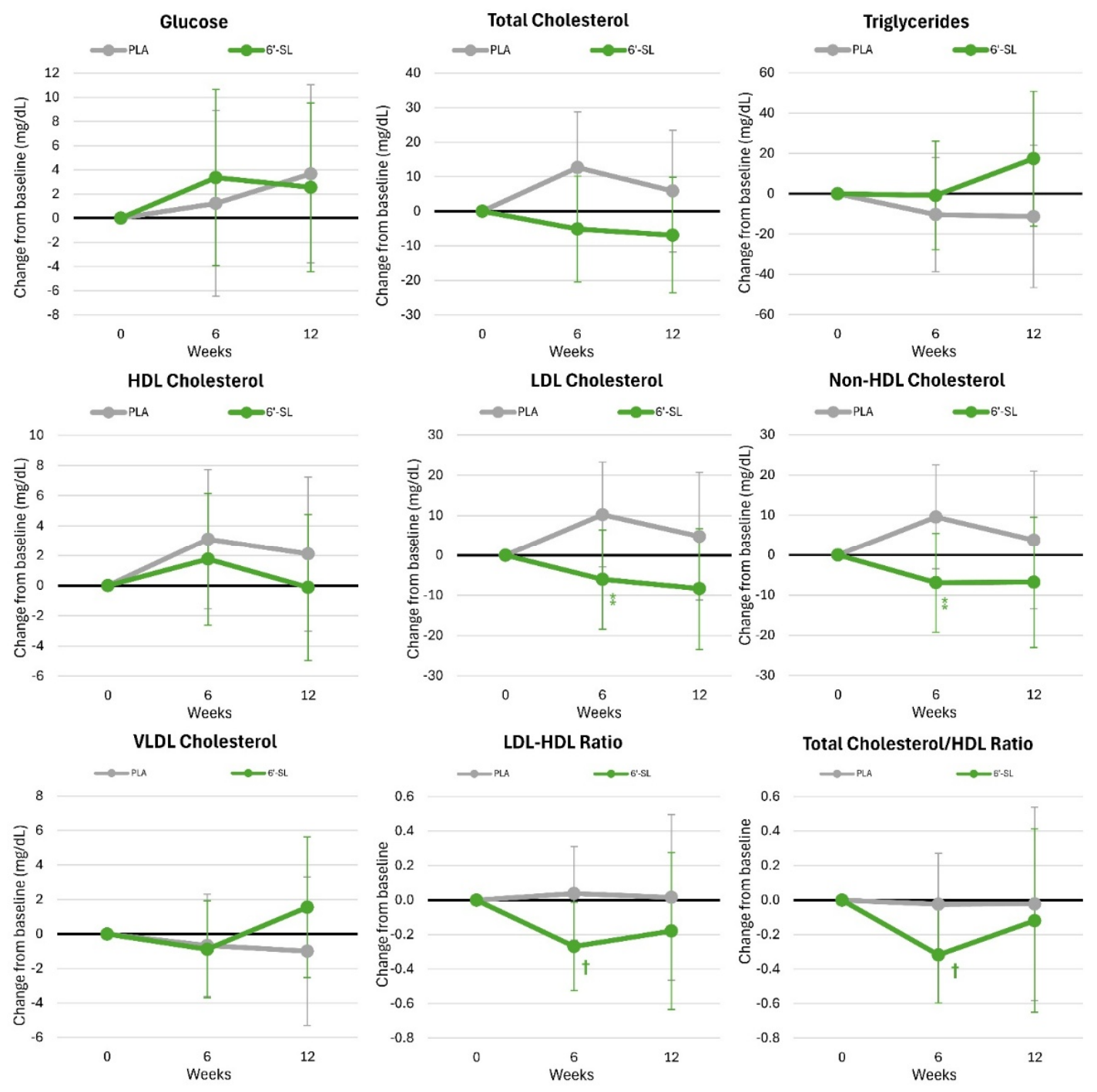
4.9. Glucose and Blood Lipids
4.10. Serum Electrolytes
4.11. Side Effect Analysis
5. Discussion
5.1. Primary Outcomes: Body Composition and Resistance Training Adaptations
5.2. Secondary Outcomes: Aerobic Capacity, Substrate Utilization, and Metabolic Adaptations
5.3. Dietary Intake and Cardiometabolic Markers
5.4. Safety and Tolerability Compared with Human Trials
5.5. Limitations and Future Directions of Research
6. Conclusions
Supplementary Materials
Author Contributions
Funding
Institutional Review Board Statement
Informed Consent Statement
Data Availability Statement
Acknowledgments
Conflicts of Interest
Abbreviations
| 3′-SL | 3′-Sialyllactose |
| 6′-SL | 6′-Sialyllactose |
| AMPK | AMP-activated protein kinase |
| BF% | Body Fat Percentage |
| BIA | Bioelectrical Impedance Analysis |
| BMC | Bone Mineral Content |
| BMD | Bone Mineral Density |
| BMI | Body Mass Index |
| BP | Bench Press |
| CI | Confidence Interval |
| CONSORT | Consolidated Standards of Reporting Trials |
| CPXT | Cardiopulmonary Exercise Test |
| Cv | Coefficient of Variation |
| DEXA | Dual-Energy X-ray Absorptiometry |
| EDTA | Ethylenediaminetetraacetic Acid |
| ESNL | Exercise and Sport Nutrition Lab |
| ETC | Electron Transport Chain |
| FFM | Fat Free Mass |
| FM | Fat Mass |
| GLM | General Linear Model |
| HCRF | Human Clinical Research Facility |
| HDL | High-Density Lipoprotein |
| HMO | Human Milk Oligosaccharide |
| HR | Heart Rate |
| ICC | Intraclass Correlation Coefficient |
| LDL | Low-Density Lipoprotein |
| LL | Lower Limit |
| LP | Leg Press |
| LSD | Least Significant Difference |
| METs | Metabolic Equivalents |
| MHC | Myosin Heavy Chain |
| PLA | Placebo |
| PGC-1α | Peroxisome Proliferator-Activated Receptor Gamma Coactivator-1α |
| RBP | Resting Blood Pressure |
| REE | Resting Energy Expenditure |
| RHR | Resting Heart Rate |
| RM | Repetition Maximum |
| RPE | Rating of Perceived Exertion |
| SA | Sialic Acid |
| SST | Serum Separation Tube |
| TG | Triglycerides |
| UL | Upper Limit |
| VANT | Ventilatory Anaerobic Threshold |
| VE | Ventilation |
| VO2 | Oxygen Uptake |
| VCO2 | Volume of Expired Carbon Dioxide |
References
- ten Bruggencate, S.J.; Bovee-Oudenhoven, I.M.; Feitsma, A.L.; van Hoffen, E.; Schoterman, M.H. Functional role and mechanisms of sialyllactose and other sialylated milk oligosaccharides. Nutr. Rev. 2014, 72, 377–389. [Google Scholar] [CrossRef]
- Berger, P.K.; Ong, M.L.; Bode, L.; Belfort, M.B. Human Milk Oligosaccharides and Infant Neurodevelopment: A Narrative Review. Nutrients 2023, 15, 719. [Google Scholar] [CrossRef] [PubMed]
- Bode, L. Recent Advances on Structure, Metabolism, and Function of Human Milk Oligosaccharides. J. Nutr. 2006, 136, 2127–2130. [Google Scholar] [CrossRef]
- Howie, P.W.; Forsyth, J.S.; Ogston, S.A.; Clark, A.; Florey, C. Protective effect of breast feeding against infection. Br. Med. J. 1990, 300, 11–16. [Google Scholar] [CrossRef] [PubMed]
- Ikeda, N.; Shoji, H.; Murano, Y.; Mori, M.; Matsunaga, N.; Suganuma, H.; Ikeno, M.; Hisata, K.; Hirayama, S.; Ueno, T. Effects of breastfeeding on the risk factors for metabolic syndrome in preterm infants. J. Dev. Orig. Health Dis. 2014, 5, 459–464. [Google Scholar] [CrossRef] [PubMed]
- Saarinen, U.M.; Kajosaari, M. Breastfeeding as prophylaxis against atopic disease: Prospective follow-up study until 17 years old. Lancet 1995, 346, 1065–1069. [Google Scholar] [CrossRef]
- Victora, C.G.; Bahl, R.; Barros, A.J.; França, G.V.; Horton, S.; Krasevec, J.; Murch, S.; Sankar, M.J.; Walker, N.; Rollins, N.C. Breastfeeding in the 21st century: Epidemiology, mechanisms, and lifelong effect. Lancet 2016, 387, 475–490. [Google Scholar] [CrossRef]
- Sprenger, N.; Tytgat, H.L.P.; Binia, A.; Austin, S.; Singhal, A. Biology of human milk oligosaccharides: From basic science to clinical evidence. J. Hum. Nutr. Diet. 2022, 35, 280–299. [Google Scholar] [CrossRef]
- Lis-Kuberka, J.; Orczyk-Pawiłowicz, M. Sialylated Oligosaccharides and Glycoconjugates of Human Milk. The Impact on Infant and Newborn Protection, Development and Well-Being. Nutrients 2019, 11, 306. [Google Scholar] [CrossRef]
- Sprenger, N.; Lee, L.Y.; De Castro, C.A.; Steenhout, P.; Thakkar, S.K. Longitudinal change of selected human milk oligosaccharides and association to infants’ growth, an observatory, single center, longitudinal cohort study. PLoS ONE 2017, 12, e0171814. [Google Scholar] [CrossRef]
- Hobbs, M.; Jahan, M.; Ghorashi, S.A.; Wang, B. Current Perspective of Sialylated Milk Oligosaccharides in Mammalian Milk: Implications for Brain and Gut Health of Newborns. Foods 2021, 10, 473. [Google Scholar] [CrossRef]
- Wang, B.; Yu, B.; Karim, M.; Hu, H.; Sun, Y.; McGreevy, P.; Petocz, P.; Held, S.; Brand-Miller, J. Dietary sialic acid supplementation improves learning and memory in piglets. Am. J. Clin. Nutr. 2007, 85, 561–569. [Google Scholar] [CrossRef]
- Jacobi, S.K.; Yatsunenko, T.; Li, D.; Dasgupta, S.; Yu, R.K.; Berg, B.M.; Chichlowski, M.; Odle, J. Dietary isomers of sialyllactose increase ganglioside sialic acid concentrations in the corpus callosum and cerebellum and modulate the colonic microbiota of formula-fed piglets. J. Nutr. 2016, 146, 200–208. [Google Scholar] [CrossRef]
- Wang, H.X.; Chen, Y.; Haque, Z.; de Veer, M.; Egan, G.; Wang, B. Sialylated milk oligosaccharides alter neurotransmitters and brain metabolites in piglets: An In vivo magnetic resonance spectroscopic (MRS) study. Nutr. Neurosci. 2021, 24, 885–895. [Google Scholar] [CrossRef] [PubMed]
- Obelitz-Ryom, K.; Bering, S.B.; Overgaard, S.H.; Eskildsen, S.F.; Ringgaard, S.; Olesen, J.L.; Skovgaard, K.; Pankratova, S.; Wang, B.; Brunse, A. Bovine milk oligosaccharides with sialyllactose improves cognition in preterm pigs. Nutrients 2019, 11, 1335. [Google Scholar] [CrossRef] [PubMed]
- Moon, J.S.; Joo, W.; Ling, L.; Choi, H.S.; Han, N.S. In vitro digestion and fermentation of sialyllactoses by infant gut microflora. J. Funct. Foods 2016, 21, 497–506. [Google Scholar] [CrossRef]
- Young, W.; Egert, M.; Bassett, S.A.; Bibiloni, R. Detection of sialic acid-utilising bacteria in a caecal community batch culture using RNA-based stable isotope probing. Nutrients 2015, 7, 2109–2124. [Google Scholar] [CrossRef]
- Kavanaugh, D.W.; O’Callaghan, J.; Butto, L.F.; Slattery, H.; Lane, J.; Clyne, M.; Kane, M.; Joshi, L.; Hickey, R.M. Exposure of Bifidobacterium longum subsp. infantis to milk oligosaccharides increases adhesion to epithelial cells and induces a substantial transcriptional response. PLoS ONE 2013, 8, e67224. [Google Scholar] [CrossRef] [PubMed]
- Arellano Spadaro, J.; Hishida, Y.; Matsunaga, Y.; van Es-Remers, M.; Korthout, H.; Kim, H.K.; Poppelaars, E.; Keizer, H.; Iliopoulou, E.; van Duijn, B.; et al. 3′sialyllactose and 6′sialyllactose enhance performance in endurance-type exercise through metabolic adaptation. Food Sci. Nutr. 2023, 11, 6199–6212. [Google Scholar] [CrossRef]
- Park, E.J.; Kim, L.; Lee, J.; Lee, H.; Kim, Y.A.; Go, H. 6′-Sialyllactose Alleviates Muscle Fatigue through Reduced Blood Lactate Level after Treadmill Exercise in Mice. Nutrients 2024, 16, 2957. [Google Scholar] [CrossRef]
- Park, E.-J.; Kim, L.-L.; Lee, J.-O.; Lee, H.-Y.; Kim, Y.-A.; Go, H.-R. 6′-Sialyllactose Enhances Exercise Performance via Increased Muscle Mass and Strength. Nutrients 2024, 16, 2600. [Google Scholar] [CrossRef] [PubMed]
- Kim, J.H.; Yong, S.-Y.; Kim, S.H.; Baek, A.; Go, T.-H.; Kang, D.-R. Randomized, triple-blind, placebo-controlled study to evaluate the safety of 6′-Sialyllactose in healthy adults. Regul. Toxicol. Pharmacol. 2022, 129, 105110. [Google Scholar] [CrossRef] [PubMed]
- Park, Y.-E.; Choi, J.; Kim, L.; Park, E.; Go, H.; Shin, J. A pilot trial for efficacy confirmation of 6′-sialyllactose supplementation in GNE myopathy: Randomized, placebo-controlled trial. Mol. Genet. Metab. 2025, 144, 108614. [Google Scholar] [CrossRef] [PubMed]
- Park, Y.-E.; Park, E.; Choi, J.; Go, H.; Park, D.B.; Kim, M.-Y.; Sung, N.J.; Kim, L.; Shin, J.-H. Pharmacokinetics and clinical efficacy of 6′-sialyllactose in patients with GNE myopathy: Randomized pilot trial. Biomed. Pharmacother. 2023, 168, 115689. [Google Scholar] [CrossRef]
- Gail, S.; Künzell, S. Reliability of a 5-Repetition Maximum Strength Test in Recreational Athletes. Dtsch. Z. Sportmed. 2014, 65, 314–317. [Google Scholar] [CrossRef]
- Radaelli, R.; Fleck, S.J.; Leite, T.; Leite, R.D.; Pinto, R.S.; Fernandes, L.; Simão, R. Dose-response of 1, 3, and 5 sets of resistance exercise on strength, local muscular endurance, and hypertrophy. J. Strength Cond. Res. 2015, 29, 1349–1358. [Google Scholar] [CrossRef]
- Mitter, B.; Csapo, R.; Bauer, P.; Tschan, H. Reproducibility of strength performance and strength-endurance profiles: A test-retest study. PLoS ONE 2022, 17, e0268074. [Google Scholar] [CrossRef]
- Lim, C.Y.; In, J. Randomization in clinical studies. Korean J. Anesth. 2019, 72, 221–232. [Google Scholar] [CrossRef]
- Dickerson, B.; Maury, J.; Jenkins, V.; Nottingham, K.; Xing, D.; Gonzalez, D.E.; Leonard, M.; Kendra, J.; Ko, J.; Yoo, C. Effects of Supplementation with Microalgae Extract from Phaeodactylum tricornutum (Mi136) to Support Benefits from a Weight Management Intervention in Overweight Women. Nutrients 2024, 16, 990. [Google Scholar] [CrossRef]
- Kerksick, C.; Thomas, A.; Campbell, B.; Taylor, L.; Wilborn, C.; Marcello, B.; Roberts, M.; Pfau, E.; Grimstvedt, M.; Opusunju, J.; et al. Effects of a popular exercise and weight loss program on weight loss, body composition, energy expenditure and health in obese women. Nutr. Metab. 2009, 6, 23. [Google Scholar] [CrossRef]
- World Health Organization. Waist Circumference and Waist-Hip Ratio: Report of a WHO Expert Consultation; World Health Organization: Geneva, Switzerland, 2008. [Google Scholar]
- Ferguson, B. ACSM’s Guidelines for Exercise Testing and Prescription 9th Ed. 2014. J. Can. Chiropr. Assoc. 2014, 58, 328. [Google Scholar]
- Teixeira, V.; Voci, S.M.; Mendes-Netto, R.S.; da Silva, D.G. The relative validity of a food record using the smartphone application MyFitnessPal. Nutr. Diet. 2018, 75, 219–225. [Google Scholar] [CrossRef]
- Lohman, T.G.; Harris, M.; Teixeira, P.J.; Weiss, L. Assessing body composition and changes in body composition. Another look at dual-energy X-ray absorptiometry. Ann. N. Y. Acad. Sci. 2000, 904, 45–54. [Google Scholar] [CrossRef]
- Klesges, R.C.; Ward, K.D.; Shelton, M.L.; Applegate, W.B.; Cantler, E.D.; Palmieri, G.M.; Harmon, K.; Davis, J. Changes in bone mineral content in male athletes. Mechanisms of action and intervention effects. JAMA 1996, 276, 226–230. [Google Scholar] [CrossRef]
- Almada, A.L.; Kreider, R.B.; Ransom, J.; Rasmussen, C. Comparison of the reliability of repeated whole body DEXA scans to repeated spine and hip scans. In Proceedings of Journal of Bone and Mineral Research; American Society for Bone and Mineral Research: Durham, NC, USA; p. S369.
- Liguori, G.; American College of Sports Medicine. ACSM’s Guidelines for Exercise Testing and Prescription; Lippincott Williams & Wilkins: Philadelphia, PA, USA, 2020. [Google Scholar]
- Orr, G.W.; Green, H.J.; Hughson, R.L.; Bennett, G.W. A computer linear regression model to determine ventilatory anaerobic threshold. J. Appl. Physiol. Respir. Environ. Exerc. Physiol. 1982, 52, 1349–1352. [Google Scholar] [CrossRef]
- Graef, J.L.; Smith, A.E.; Kendall, K.L.; Fukuda, D.H.; Moon, J.R.; Beck, T.W.; Cramer, J.T.; Stout, J.R. The effects of four weeks of creatine supplementation and high-intensity interval training on cardiorespiratory fitness: A randomized controlled trial. J. Int. Soc. Sports Nutr. 2009, 6, 18. [Google Scholar] [CrossRef]
- Bassett, D.R., Jr.; Howley, E.T.; Thompson, D.L.; King, G.A.; Strath, S.J.; McLaughlin, J.E.; Parr, B.B. Validity of inspiratory and expiratory methods of measuring gas exchange with a computerized system. J. Appl. Physiol. 2001, 91, 218–224. [Google Scholar] [CrossRef]
- Haff, G.; Triplett, N.T.; NSCA-National Strength; Conditioning Association. Essentials of Strength Training and Conditioning, 4th ed.; Human Kinetics: Champaign, IL, USA, 2016. [Google Scholar]
- World Health Organization. WHO Guidelines on Drawing Blood: Best Practices in Phlebotomy; World Health Organization: Geneva, Switzerland, 2010. [Google Scholar]
- Tanner, R.K.; Fuller, K.L.; Ross, M.L. Evaluation of three portable blood lactate analysers: Lactate Pro, Lactate Scout and Lactate Plus. Eur. J. Appl. Physiol. 2010, 109, 551–559. [Google Scholar] [CrossRef] [PubMed]
- Grubic, T.J.; Sowinski, R.J.; Nevares, B.E.; Jenkins, V.M.; Williamson, S.L.; Reyes, A.G.; Rasmussen, C.; Greenwood, M.; Murano, P.S.; Earnest, C.P. Comparison of ingesting a food bar containing whey protein and isomalto-oligosaccharides to carbohydrate on performance and recovery from an acute bout of resistance-exercise and sprint conditioning: An open label, randomized, counterbalanced, crossover pilot study. J. Int. Soc. Sports Nutr. 2019, 16, 34. [Google Scholar] [PubMed]
- Drinkwater, E. Applications of confidence limits and effect sizes in sport research. Open Sports Sci. J. 2008, 1, 3–4. [Google Scholar] [CrossRef]
- Earnest, C.P.; Roberts, B.M.; Harnish, C.R.; Kutz, J.L.; Cholewa, J.M.; Johannsen, N.M. Reporting Characteristics in Sports Nutrition. Sports 2018, 6, 139. [Google Scholar] [CrossRef]
- Grabowski, B. “P < 0.05” Might Not Mean What You Think: American Statistical Association Clarifies P Values. J. Natl. Cancer Inst. 2016, 108, djw194. [Google Scholar] [CrossRef]
- Hopkins, W.G.; Marshall, S.W.; Batterham, A.M.; Hanin, J. Progressive statistics for studies in sports medicine and exercise science. Med. Sci. Sports Exerc. 2009, 41, 3–13. [Google Scholar] [CrossRef] [PubMed]
- Page, P. Beyond statistical significance: Clinical interpretation of rehabilitation research literature. Int. J. Sports Phys. Ther. 2014, 9, 726. [Google Scholar]
- Sharma, H. Statistical significance or clinical significance? A researcher’s dilemma for appropriate interpretation of research results. Saudi J. Anaesth. 2021, 15, 431–434. [Google Scholar] [CrossRef]
- Sullivan, G.M.; Feinn, R. Using Effect Size-or Why the P Value Is Not Enough. J. Grad. Med. Educ. 2012, 4, 279–282. [Google Scholar] [CrossRef] [PubMed]
- Grindstaff, P.D.; Kreider, R.; Bishop, R.; Wilson, M.; Wood, L.; Alexander, C.; Almada, A. Effects of creatine supplementation on repetitive sprint performance and body composition in competitive swimmers. Int. J. Sport Nutr. 1997, 7, 330–346. [Google Scholar] [CrossRef] [PubMed]
- Kreider, R.B.; Ferreira, M.; Wilson, M.; Grindstaff, P.; Plisk, S.; Reinardy, J.; Cantler, E.; Almada, A.L. Effects of creatine supplementation on body composition, strength, and sprint performance. Med. Sci. Sports Exerc. 1998, 30, 73–82. [Google Scholar] [CrossRef]
- Kreider, R.B.; Ferreira, M.P.; Greenwood, M.; Wilson, M.; Grindstaff, P.; Plisk, S.; Reinardy, J.; Cantler, E.; Amalda, A.L. Effects of calcium β-HMB supplementation during training on markers of catabolism, body composition, strength and sprint performance. J. Exerc. Physiol. 2000, 3, 48–59. [Google Scholar]
- Kreider, R.B.; Melton, C.; Greenwood, M.; Rasmussen, C.; Lundberg, J.; Earnest, C.; Almada, A. Effects of oral D-ribose supplementation on anaerobic capacity and selected metabolic markers in healthy males. Int. J. Sport Nutr. Exerc. Metab. 2003, 13, 76–86. [Google Scholar] [CrossRef]
- Kerksick, C.; Rasmussen, C.; Bowden, R.; Leutholtz, B.; Harvey, T.; Earnest, C.; Greenwood, M.; Almada, A.; Kreider, R. Effects of ribose supplementation prior to and during intense exercise on anaerobic capacity and metabolic markers. Int. J. Sport Nutr. Exerc. Metab. 2005, 15, 653–664. [Google Scholar] [CrossRef] [PubMed][Green Version]
- Roberts, M.D.; Iosia, M.; Kerksick, C.M.; Taylor, L.W.; Campbell, B.; Wilborn, C.D.; Harvey, T.; Cooke, M.; Rasmussen, C.; Greenwood, M.; et al. Effects of arachidonic acid supplementation on training adaptations in resistance-trained males. J. Int. Soc. Sports Nutr. 2007, 4, 21. [Google Scholar] [CrossRef] [PubMed]
- Cooke, M.; Iosia, M.; Buford, T.; Shelmadine, B.; Hudson, G.; Kerksick, C.; Rasmussen, C.; Greenwood, M.; Leutholtz, B.; Willoughby, D.; et al. Effects of acute and 14-day coenzyme Q10 supplementation on exercise performance in both trained and untrained individuals. J. Int. Soc. Sports Nutr. 2008, 5, 8. [Google Scholar] [CrossRef]
- Spillane, M.; Schoch, R.; Cooke, M.; Harvey, T.; Greenwood, M.; Kreider, R.; Willoughby, D.S. The effects of creatine ethyl ester supplementation combined with heavy resistance training on body composition, muscle performance, and serum and muscle creatine levels. J. Int. Soc. Sports Nutr. 2009, 6, 6. [Google Scholar] [CrossRef]
- Kresta, J.Y.; Oliver, J.M.; Jagim, A.R.; Fluckey, J.; Riechman, S.; Kelly, K.; Meininger, C.; Mertens-Talcott, S.U.; Rasmussen, C.; Kreider, R.B. Effects of 28 days of beta-alanine and creatine supplementation on muscle carnosine, body composition and exercise performance in recreationally active females. J. Int. Soc. Sports Nutr. 2014, 11, 55. [Google Scholar] [CrossRef] [PubMed]
- Oliver, J.M.; Jagim, A.R.; Pischel, I.; Jager, R.; Purpura, M.; Sanchez, A.; Fluckey, J.; Riechman, S.; Greenwood, M.; Kelly, K.; et al. Effects of short-term ingestion of Russian Tarragon prior to creatine monohydrate supplementation on whole body and muscle creatine retention and anaerobic sprint capacity: A preliminary investigation. J. Int. Soc. Sports Nutr. 2014, 11, 6. [Google Scholar] [CrossRef]
- Galvan, E.; Walker, D.K.; Simbo, S.Y.; Dalton, R.; Levers, K.; O’Connor, A.; Goodenough, C.; Barringer, N.D.; Greenwood, M.; Rasmussen, C.; et al. Acute and chronic safety and efficacy of dose dependent creatine nitrate supplementation and exercise performance. J. Int. Soc. Sports Nutr. 2016, 13, 12. [Google Scholar] [CrossRef]
- Levers, K.; Dalton, R.; Galvan, E.; O’Connor, A.; Goodenough, C.; Simbo, S.; Mertens-Talcott, S.U.; Rasmussen, C.; Greenwood, M.; Riechman, S.; et al. Effects of powdered Montmorency tart cherry supplementation on acute endurance exercise performance in aerobically trained individuals. J. Int. Soc. Sports Nutr. 2016, 13, 22. [Google Scholar] [CrossRef]
- Dalton, R.L.; Sowinski, R.J.; Grubic, T.J.; Collins, P.B.; Coletta, A.M.; Reyes, A.G.; Sanchez, B.; Koozehchian, M.; Jung, Y.P.; Rasmussen, C.; et al. Hematological and Hemodynamic Responses to Acute and Short-Term Creatine Nitrate Supplementation. Nutrients 2017, 9, 1359. [Google Scholar] [CrossRef]
- Gonzalez, D.E.; Dickerson, B.L.; Johnson, S.E.; Woodruff, K.E.; Leonard, M.; Yoo, C.; Ko, J.; Xing, D.; Martinez, V.; Kendra, J.; et al. Impact of astaxanthin supplementation on markers of cardiometabolic health and tactical performance among firefighters. J. Int. Soc. Sports Nutr. 2024, 21, 2427751. [Google Scholar] [CrossRef]
- Perneger, T.V. What’s wrong with Bonferroni adjustments. BMJ 1998, 316, 1236–1238. [Google Scholar] [CrossRef]
- Rothman, K.J. No adjustments are needed for multiple comparisons. Epidemiology 1990, 1, 43–46. [Google Scholar] [CrossRef] [PubMed]
- Cohen, J. Statistical Power Analysis for the Behavioral Sciences; Lawrence Erlbaum: Hillsdale, NJ, USA, 1988; pp. 75–108. [Google Scholar]
- Kang, H. The prevention and handling of the missing data. Korean J. Anesth. 2013, 64, 402–406. [Google Scholar] [CrossRef]
- Quintero, M.; LeBoulluec, A. Missing Data Imputation for Ordinal Data. Int. J. Comput. Appl. 2018, 181, 10–16. [Google Scholar] [CrossRef]
- Engels, J.M.; Diehr, P. Imputation of missing longitudinal data: A comparison of methods. J. Clin. Epidemiol. 2003, 56, 968–976. [Google Scholar] [CrossRef]
- Elliott, P.; Hawthorne, G. Imputing missing repeated measures data: How should we proceed? Aust. N. Z. J. Psychiatry 2005, 39, 575–582. [Google Scholar] [CrossRef]
- Morris, T.P.; White, I.R.; Royston, P. Tuning multiple imputation by predictive mean matching and local residual draws. BMC Med. Res. Methodol. 2014, 14, 75. [Google Scholar] [CrossRef]
- Tan, F.E.S.; Jolani, S.; Verbeek, H. Guidelines for multiple imputations in repeated measurements with time-dependent covariates: A case study. J. Clin. Epidemiol. 2018, 102, 107–114. [Google Scholar] [CrossRef] [PubMed]
- Pugh, S.L.; Brown, P.D.; Enserro, D. Missing repeated measures data in clinical trials. Neuro-Oncol. Pract. 2022, 9, 35–42. [Google Scholar] [CrossRef]
- Ribeiro, A.S.; Avelar, A.; Schoenfeld, B.J.; Ritti Dias, R.M.; Altimari, L.R.; Cyrino, E.S. Resistance training promotes increase in intracellular hydration in men and women. Eur. J. Sport Sci. 2014, 14, 578–585. [Google Scholar] [CrossRef]
- Otsuka, Y.; Yamada, Y.; Maeda, A.; Izumo, T.; Rogi, T.; Shibata, H.; Fukuda, M.; Arimitsu, T.; Miyamoto, N.; Hashimoto, T. Effects of resistance training intensity on muscle quantity/quality in middle-aged and older people: A randomized controlled trial. J. Cachexia Sarcopenia Muscle 2022, 13, 894–908. [Google Scholar] [CrossRef]
- Campbell, W.W.; Crim, M.C.; Young, V.R.; Evans, W.J. Increased energy requirements and changes in body composition with resistance training in older adults. Am. J. Clin. Nutr. 1994, 60, 167–175. [Google Scholar] [CrossRef] [PubMed]
- Stoian, M.; Mănescu, D.C. Training–Fuel Coupling (TFC): A Molecular Sports Nutrition Framework for Energy Availability, Chrono-Nutrition, and Performance Optimization. Nutrients 2026, 18, 693. [Google Scholar] [CrossRef]
- Rowe, G.C.; Raghuram, S.; Jang, C.; Nagy, J.A.; Patten, I.S.; Goyal, A.; Chan, M.C.; Liu, L.X.; Jiang, A.; Spokes, K.C. PGC-1α induces SPP1 to activate macrophages and orchestrate functional angiogenesis in skeletal muscle. Circ. Res. 2014, 115, 504–517. [Google Scholar] [CrossRef]
- Wright, D.C.; Han, D.-H.; Garcia-Roves, P.M.; Geiger, P.C.; Jones, T.E.; Holloszy, J.O. Exercise-induced mitochondrial biogenesis begins before the increase in muscle PGC-1α expression. J. Biol. Chem. 2007, 282, 194–199. [Google Scholar] [CrossRef] [PubMed]
- Feng, K.; Lin, Z.; Du, J.; Xu, Z.; Xiang, X.; Shi, H. The combined effects of 2′-fucosyllactose and 6′-sialyllactose on immune function and gut microbiota in healthy mice. Food Biosci. 2025, 71, 107366. [Google Scholar] [CrossRef]
- Zhu, M.; Zhang, W.; Dekyi, K.; Zheng, L.; Zhang, Y.; Lv, Y.; Li, H. Potential effects of sialic acid and 3′-Sialyllactose on intestinal health and anti-cardiovascular disease in mice fed with a high-fat diet. J. Funct. Foods 2024, 116, 106215. [Google Scholar] [CrossRef]
- Li, T.; Lin, X.; Mao, X.; Chen, S.; Feng, Z.; Fu, Y.; Zhao, P.; Huang, X.; Ma, Y.; Song, L.; et al. The prebiotics 2′-fucosyllactose prevent high-fat diet induced obesity via the promotion of thermogenesis and modulation of gut microbiota. J. Funct. Foods 2024, 119, 106287. [Google Scholar] [CrossRef]
- Orekhov, A.N.; Elizova, N.V.; Melnichenko, A.A.; Karagodin, V.P.; Myasoedova, V.A.; Zhelankin, A.V.; Trubinov, S.S.; Orekhova, V.A.; Sinyov, V.V.; Barinova, V.A. GW26-e0208 Naturally occurring multiple-modified low density lipoprotein (LDL). J. Am. Coll. Cardiol. 2015, 66, C71. [Google Scholar] [CrossRef]
- Zakiev, E.R.; Sukhorukov, V.N.; Melnichenko, A.A.; Sobenin, I.A.; Ivanova, E.A.; Orekhov, A.N. Lipid composition of circulating multiple-modified low density lipoprotein. Lipids Health Dis. 2016, 15, 134. [Google Scholar] [CrossRef]
- Asif, S.; Kim, R.Y.; Fatica, T.; Sim, J.; Zhao, X.; Oh, Y.; Denoncourt, A.; Cheung, A.C.; Downey, M.; Mulvihill, E.E. Hmgcs2-mediated ketogenesis modulates high-fat diet-induced hepatosteatosis. Mol. Metab. 2022, 61, 101494. [Google Scholar] [CrossRef]
- Chen, D.; Ruan, X.; Liu, Y.; He, Y. HMGCS2 silencing attenuates high glucose-induced in vitro diabetic cardiomyopathy by increasing cell viability, and inhibiting apoptosis, inflammation, and oxidative stress. Bioengineered 2022, 13, 11417–11429. [Google Scholar] [CrossRef] [PubMed]
- Getz, G.S.; Reardon, C.A. Apoprotein E and reverse cholesterol transport. Int. J. Mol. Sci. 2018, 19, 3479. [Google Scholar] [CrossRef]
- Jiang, X.-C.; Yu, Y. The role of phospholipid transfer protein in the development of atherosclerosis. Curr. Atheroscler. Rep. 2021, 23, 9. [Google Scholar] [CrossRef]
- Zhang, K.; Zheng, J.; Chen, Y.; Dong, J.; Li, Z.; Chiang, Y.-P.; He, M.; Huang, Q.; Tang, H.; Jiang, X.-C. Inducible phospholipid transfer protein deficiency ameliorates atherosclerosis. Atherosclerosis 2021, 324, 9–17. [Google Scholar] [CrossRef]
- EFSA Panel on Nutrition, Novel Foods and Food Allergens (NDA); Turck, D.; Bohn, T.; Castenmiller, J.; De Henauw, S.; Hirsch-Ernst, K.I.; Maciuk, A.; Mangelsdorf, I.; McArdle, H.J.; Naska, A.; et al. Scientific Opinion on the safety of 6′-sialyllactose (6′-SL) sodium salt produced by derivative strains of Escherichia coli BL21 (DE3) as a novel food pursuant to Regulation (EU) 2015/2283. EFSA J. 2022, 20, e07645. [Google Scholar]
- Gurung, R.B.; Kim, D.H.; Kim, L.; Lee, A.W.; Wang, Z.; Gao, Y. Toxicological evaluation of 6′-sialyllactose (6′-SL) sodium salt. Regul. Toxicol. Pharmacol. 2018, 95, 182–189. [Google Scholar] [CrossRef]




Disclaimer/Publisher’s Note: The statements, opinions and data contained in all publications are solely those of the individual author(s) and contributor(s) and not of MDPI and/or the editor(s). MDPI and/or the editor(s) disclaim responsibility for any injury to people or property resulting from any ideas, methods, instructions or products referred to in the content. |
© 2026 by the authors. Licensee MDPI, Basel, Switzerland. This article is an open access article distributed under the terms and conditions of the Creative Commons Attribution (CC BY) license.
Share and Cite
Estes, L.; Broeckel, J.; Rhoades, N.; Kibler, G.L.; Bivins, I.H.; Liu, Y.; Johnson, S.; Dickerson, B.L.; Gonzalez, D.E.; Sowinski, R.J.; et al. Efficacy of Human Milk Oligosaccharide 6′-Sialyllactose Supplementation on Exercise Performance and Training Adaptations. Nutrients 2026, 18, 1743. https://doi.org/10.3390/nu18111743
Estes L, Broeckel J, Rhoades N, Kibler GL, Bivins IH, Liu Y, Johnson S, Dickerson BL, Gonzalez DE, Sowinski RJ, et al. Efficacy of Human Milk Oligosaccharide 6′-Sialyllactose Supplementation on Exercise Performance and Training Adaptations. Nutrients. 2026; 18(11):1743. https://doi.org/10.3390/nu18111743
Chicago/Turabian StyleEstes, Landry, Jacob Broeckel, Nathaniel Rhoades, Giuliet L. Kibler, Ian H. Bivins, Yuhang Liu, Sarah Johnson, Broderick L. Dickerson, Drew E. Gonzalez, Ryan J. Sowinski, and et al. 2026. "Efficacy of Human Milk Oligosaccharide 6′-Sialyllactose Supplementation on Exercise Performance and Training Adaptations" Nutrients 18, no. 11: 1743. https://doi.org/10.3390/nu18111743
APA StyleEstes, L., Broeckel, J., Rhoades, N., Kibler, G. L., Bivins, I. H., Liu, Y., Johnson, S., Dickerson, B. L., Gonzalez, D. E., Sowinski, R. J., Rasmussen, C. J., & Kreider, R. B. (2026). Efficacy of Human Milk Oligosaccharide 6′-Sialyllactose Supplementation on Exercise Performance and Training Adaptations. Nutrients, 18(11), 1743. https://doi.org/10.3390/nu18111743