


Abstract
Background: The purpose of this study is to compare and analyze research studies focused on orthorexia nervosa (ON) as a spectrum of eating disorders, and to summarize potential risk factors in different age and social groups. ON is characterized by an obsession with healthy eating, which leads to a restrictive diet and health problems. Methods: Due to a lack of comprehensive analyses, this review re-examined studies from 2006 to 2023, initially retrieving 53,134 articles. Upon refining the criteria and risk factors for eating disorders, 34 notable records were identified. These studies employed diagnostic tools such as ORTO and BOT, focusing on risk factors for ON. Results: Results indicate that individuals suffering from eating disorders, losing weight, exercising heavily, developing relationship problems, and suffering from body dysmorphic disorder are at high risk of developing ON. A significant correlation was found between ON, BMI, and gender, but not between ON and OCD. Interestingly, ON symptoms appear to overlap with those of other eating disorders, such as anorexia and bulimia, especially in terms of obsessive control over dieting and fear of gaining weight, indicating a close relationship between the two. Conclusions: Interestingly, orthorexia nervosa may serve as a coping mechanism for anorexia, providing a sense of control. However, further research on its long-term effects is required.
1. Introduction
1.1. Introduction to Orthorexia Nervosa
In many highly developed countries, a significant increase in harmful eating habits has been observed over the last decade or so. A clear contrast is currently visible in society, as one can meet people affected by malnutrition and obesity. Interestingly, in highly developed countries, “fast food” consumption has increased, but an obsession with healthy eating has also developed. Increasing public awareness of health and sociocultural influences, including social media, have been shown to have a strong impact on eating habits, leading to an increasing incidence of the so-called healthy eating obsession, known as orthorexia nervosa [1].
1.2. Historical Context and Definition
The first description of this phenomenon was made by S Bratman in 1997 under the name orthorexia nervosa (ON) [2]. According to Dunn and Bratman, ON is characterized by pathological consumption of healthy food, which in effect leads to nutritional deficiencies and the simultaneous occurrence of tensions in interpersonal relationships [3].
The pursuit of perfect health through diet may result in malnutrition or excessive weight loss. It is common for patients with eating disorders to experience orthorexia nervosa, and research suggests that these symptoms may be present in patients with anorexia nervosa (AN) as well as bulimia nervosa (BN). In contrast to AN and BN, orthorexia nervosa focuses on the quality and purity of food, not its quantity [4]. This concept was coined by Dunn and Bratman and is currently one of the latest formulations that describes ON from a diagnostic perspective. Despite this, ON is still a disease of unknown etiology and epidemiology. Although orthorexia nervosa is increasingly recognized, it has not yet been included in major diagnostic systems such as the ICD-11 (WHO 2022) and DSM-5 (American Psychiatric Association 2013).
1.3. Prevalence and Risk Factors
As with other eating disorders, ON occurs frequently. A large meta-analysis comprising 30,476 attendees from 18 countries determined the global prevalence of orthorexia nervosa symptoms at about 30% and affects both men and women equally [5]. Research shows that adolescents and young adults are particularly susceptible to orthorexic tendencies due to the influence of social media and peer pressure. Nearly 49% of young adults exhibit symptoms of orthorexia nervosa, driven by idealized images of healthy eating promoted online [6]. Furthermore, studies indicate that the prevalence of orthorexia nervosa among medical students can reach up to 76.2%, as they tend to focus more on health and body image [7]. Adolescents aged 15–21 also display significant orthorexic behaviors, with average ORTO-15 scores around 39.2, highlighting the impact of social and academic pressures [8]. These figures demonstrate that orthorexia nervosa is not evenly distributed across all age groups but is notably higher among younger populations, especially those engaged in health-related fields or exposed to media promoting dietary ideals.
The overall percentage was higher in groups of athletes or fitness enthusiasts. Also intriguing is that orthorexia nervosa symptoms seem to be increasing over time [5].
1.4. Challenges in Classification and Diagnosis
Recently, research on orthorexia nervosa (ON) has grown in popularity because of the increasing number of reported cases [9]. Scientific literature lacking a standardized definition of orthorexia nervosa (ON) makes it hard to compare studies and identify risk factors, pathophysiology, and effective treatments [10]. Research is ongoing on this relatively new manifestation of eating disorders, with some researchers considering it an eating disorder, others postulating that it should be classified as obsessive–compulsive disorder, and there are also those who wonder whether ON belongs to behavioral addictions. However, there is still insufficient empirical evidence to support the recognition of ON as a distinct disorder, which leaves it in limbo. This is influenced by the lack of consensus among researchers regarding the definition and classification of ON. Because orthorexia nervosa has symptoms that overlap with anorexia nervosa (AN), bulimia nervosa (BN), and obsessive–compulsive disorder (OCD), it is difficult to classify. The absence of a clear definition makes it difficult to determine whether ON is a distinct condition or a subset of other disorders such as anorexia nervosa (AN), avoidant-restrictive food intake disorder (ARFID) or obsessive–compulsive disorder (OCD) [10].
The orthorexia nervosa (ON) is a growing eating disorder characterized by an unhealthy obsession with eating only clean, healthy foods, which can lead to malnutrition and social problems. Research and diagnosis are challenging due to the lack of a standardized definition and ongoing debate regarding whether ON is a separate disorder or part of other conditions such as anorexia or obsessive–compulsive disorder. The state of affairs suggests that previous findings and research results should be systematized for the purpose of synthesizing the findings. Consequently, in our review, we reanalyzed and reviewed published research.
With a focus on risk factors and questionnaire tools for ON identification, we selected 34 articles by reviewing the MEDLINE/PubMed, Wiley Online Library, SpringerLink, and Scopus databases. The search criteria were narrowed by eliminating articles that did not include current diagnostic tools; studies with flawed methodology, e.g., studies with healthy participants only, too small study groups, or biased selection of participants; as well as studies that used a healthy diet as a condition for treating disease.
2. Methodology and Selection Criteria
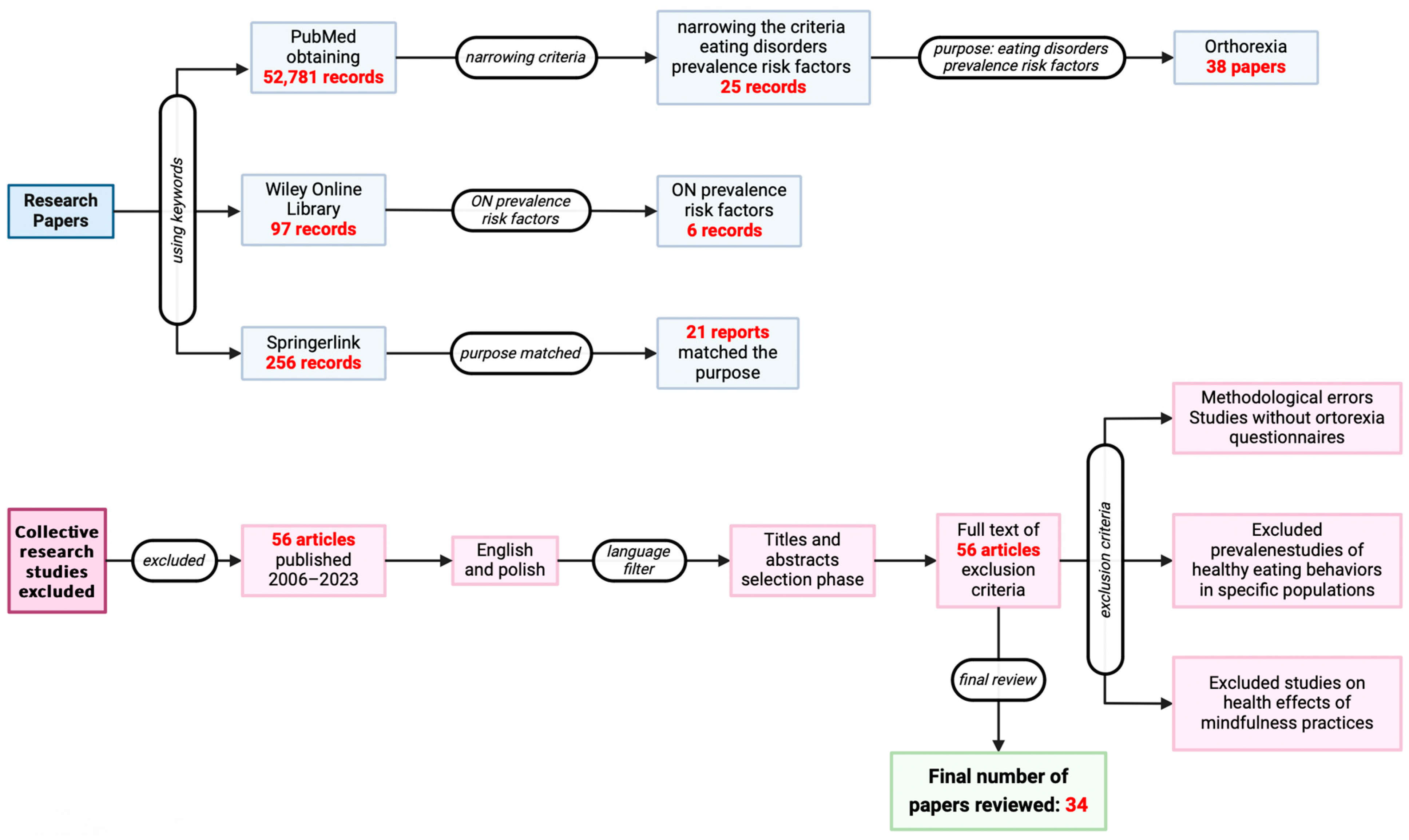
Our article reviews the literature of publications published between 2006 and 2023. The analysis was performed using the following search engines: MEDLINE/PubMed, Wiley Online Library, SpringerLink, and Scopus. Our review focused on clinical studies that examined risk factors for orthorexia nervosa and its potential classification as an eating disorder. By searching PubMed using the keywords “eating disorders”, we were able to identify 52,781 articles, which were further refined by including additional keywords such as “orthorexia nervosa”, “diagnostic scales”, and “risk factors”. Additionally, filters were utilized in order to limit the results to empirical studies, leading to the selection of 34 articles that were relevant to the study. Then, focusing exclusively on our topic—orthorexia nervosa—38 scientific texts were extracted. One search engine, the Wiley Online Library, found 97 publications, 6 of which were about ON and the prevalence of risk factors. A total of 256 articles were retrieved from SpringerLink’s resources, of which 21 met our requirements. When searching for relevant publications, we did not take into account collective studies.
Several factors may be contributing to the reduction in articles available in some databases, including changes in policy, changes in publication focus, or limitations in the inclusion criteria. It is possible that these limitations impacted the comprehensiveness of the literature review, potentially limiting its scope. However, we ensured that the available resources were exhaustively analyzed to minimize any impact on the review’s robustness.
We initially selected 65 articles published between 2006 and 2023 that examined prevalence and risk factors for orthorexia and other eating disorders, based on titles and abstracts. A further analysis in terms of methodology and results was performed by reading the complete texts of 56 of the originally selected articles, which were then entered into the model. As exclusion criteria, after careful analysis, we used studies with methodological flaws—e.g., studies with healthy participants only; too small study groups, which we considered fewer than 30 study participants; or biased selection of participants—and publications that did not include the questionnaire tools currently used to identify ON. Studies that included only healthy participants and those focusing on mindfulness practices were excluded in accordance with the scope of the review. Although orthorexia nervosa (ON) is associated with mental health and emotional regulation, this study aimed to examine pathological behaviors linked to obsessive healthy eating. Although mindfulness practices are beneficial in many mental health contexts, they are incompatible with the compulsive nature of ON, and therefore were excluded in order to maintain clarity in the distinction between therapeutic practices and harmful behaviors.
We noted that the most popular questionnaires were the ORTO, the BOT (Bratman Test for Orthorexia), the Treuel Orthorexia Scale, and the Dusseldorf Orthorexia Scale. These orthorexia nervosa tests were developed for the purpose of measuring tendency and symptoms related to the obsession with healthy eating. While all of these scales are utilized to identify orthorexia nervosa, their precision, popularity, and research scope differ. There are two main limitations to these tools: a lack of clear diagnostic criteria and difficulty in distinguishing orthorexia nervosa from healthy eating habits.
We also did not take into account articles in which the study group consisted of people for whom healthy nutrition was one of the conditions for effective treatment of various diseases, e.g., postpartum mothers and persons with diseases related to the nervous system such as diseases of the intestinal tract. We excluded groups such as postpartum women and patients with neurological conditions due to the possibility that their health status could cause confounding effects on their dietary behaviors. In many cases, these groups require specialized nutritional plans in order to recover or treat their conditions, which may not be reflected in their orthorexia tendencies. It is possible that their inclusion could distort our understanding of ON since it specifically addresses pathological eating behaviors in otherwise healthy individuals.
From the remaining works, we excluded studies that described the positive impact of mindfulness practices on health. In our review, we analyzed 34 remaining works.
The set-up process is described in the schematic below—Figure 1.
Figure 1.
A diagram of the choice-making process.
As a point of clarification, it is important to note that diagnostic tools used to assess orthorexia nervosa, such as the ORTO-15, have known limitations, especially in the area of distinguishing ON from healthy eating habits. Furthermore, this review had some limitations, including difficulty finding current studies and comparing results across studies that used different orthorexia diagnostic scales.
3. Overview of the Research Review
3.1. Prevalence Studies
In our review, we finally analyzed 21,341 male and female subjects. After analyzing the selected publications, we wanted to estimate the prevalence of orthorexia nervosa and identify possible causes of its occurrence. The limited number of publications meeting the required criteria makes it difficult to achieve our goal. The reason is that the selected articles analyze different groups of patients; some of the works concern population studies, while others precisely specific groups, e.g., people with self-identified eating problems, athletes, creatives, or people addicted to social media. Interestingly, the authors emphasize the exceptionally high frequency of orthorexia among social media users (90.6%) because these results may distort the overall picture of ON by overrepresenting this subgroup compared to the general population. The high values obtained in this group may result from the fact that the analyzed works used a variety of survey forms, which results from the fact that the diagnostic process of ON has not yet been precisely standardized. This diversity is an obstacle to obtaining potentially objective results. In some studies, using the ORTO-15 questionnaire, the threshold is 40. As a result, other researchers using this threshold obtained significantly overestimated results suggesting the estimated prevalence of orthorexia nervosa. Using this cut-off point, the prevalence rate even reached 86%, with a range from 56.4% to 90.6%. Therefore, it can be seen that when using the ORTO-15 questionnaire, it is considered correct to use 35 as a cut-off point [11,12,13,14]. After discarding excessively high scores and considering the use of other ORTO/BOT (Bratman Test for Orthorexia) tests, it can be concluded that the prevalence rate of orthorexia nervosa oscillates between 6.5% and 41.7%, according to various studies. Thus, it can be concluded that an average of 24% of patients suffer from orthorexia nervosa. Interestingly, the highest likelihood of ON is found in the population of people with disorders related to poor eating, such as anorexia and bulimia [13,15,16,17,18,19,20,21,22,23,24]—Table 1.
Table 1.
Linking ON to nutrition-related abnormalities.
3.2. Personality Traits and Orthorexia
Among the analyzed studies, the most interesting are the works in which the main topic was the study of the relationship between personality traits and the development of orthorexia nervosa. The greatest influences on morbidity were obsession with body image, dieting, obsessive focus on concerns about looks and weight, combined with difficulties in the process of fitting into the changing environments, implementation of yet unseen defense mechanisms, and a low rate of self-acceptance [20,21,23,25,26,27,28]. The aforementioned features are also found in people suffering from other eating disorders. They appear to be regularly observed in all people affected by eating disorders. Interestingly, other researchers have shown that people suffering from OD and ED are characterized by problems with emotion regulation and identification. The authors also observed that people with ON correctly characterize the emotions they experience [20].
3.3. Orthorexia and Related Eating Disorders
Other studies show a correlation concerning ON and anorexia nervosa (AN). It can be stated that the manifestations of orthorexia nervosa are similar to those observed in anorexia nervosa; these are perfectionism, excessive physical exertion, problems in relationships, and an attitude towards nutrition that is perceived by patients as a way to feel dominance over themselves and their lives [12,18,20,24,29,30,31,32,33,34,35,36,37,38]. It is very interesting that ON patients have abnormal attachment styles. For this reason, ON should be classified as an eating disorder in the future. In our work, we want to propose an interpretation of ON as a specific type of ED. Many investigators note a lot of correlations between the occurrence of ON and dysfunctions regarding personality, various symptomatic features, and the everyday capability of patients. Subsequent publications show the relationship occurring the interplay between ON and BMI. The analyzed studies included a group of 5048 people. In 1312, a statistically significant relationship between high BMI and orthorexia nervosa was observed. The publication, in which the research group consisted of 1120 people, did not show such correlations [14,39,40]—Table 2. On the other hand, three studies, in which a total of 2616 people participated, showed a quantitatively significant association between low BMI and orthorexia nervosa [41,42,43]. The obtained results are very interesting, but they require in-depth research and more detailed analysis. Such studies can be enriched with imaging diagnostics and more precise screening tests, which will reveal people affected by disorders and people at risk for this type of condition.
In the studies analyzed, it can be noted that ON patients are characterized by perfectionism, appearance concerns and interpersonal difficulties. The authors of the analyzed articles did not focus on a detailed analysis of the correlations between these factors. Further research in this area is needed to get a more accurate picture of these correlations and their impact on the incidence of ON.
However, interestingly, similar correlations are observed in people suffering from anorexia. Researchers show that a hallmark of anorexia patients is the presence of high levels of perfectionism, which in effect influences critical and harsh self-assessment [44]. In addition, people with anorexia often face problems in interpersonal relationships, which may be a result of their high expectations of themselves [45]. This comparison may provide valuable insights into the complex interactions between risk factors that are equally common in ON patients. In the case of the frequency of orthorexia nervosa by gender, the authors of the study observed a correlation between the female gender and the occurrence of ON [40]. It is also noteworthy that in three studies, in which 1254 people participated, the authors, focusing on the diagnostic classification of the orthorexia nervosa phenomenon, did not observe a relationship between ON and obsessive–compulsive disorder [13,24,41].
Table 2.
Other risk contributors (personality traits, body image, excessive exercising, eating habits, BMI, gender).
3.4. Risk Factors in Adolescents and Young Adults
Additionally, it is important to pay attention to children and teenagers who suffer from orthorexia nervosa. Adolescence and early youth have a high demand for nutrients and microelements from food. It is important to ensure that these ingredients are supplied in the proper quantities in order to maintain optimal health on a somatic, cognitive, and emotional level. Adolescence is characterized by excessive criticism related to one’s own body and peer pressure regarding weight and body appearance, which can lead to the development of an obsession with healthy eating [52].
Some authors have noted a link between social media and the incidence of ON in adolescents, who are a more susceptible age group to manipulative influences in this regard. In one study of 680 young adults, Turner et al. noted that as many as 49% of the subjects suffered from ON (Table 3). The results may suggest that images of healthy meals posted on social media have more power to influence memory than verbal content, which may lead to an increased risk of orthorexia nervosa [6]. The occurrence of eating disorders in the adolescent population may be correlated with the development of orthorexia nervosa, as highlighted by other researchers [53]. Young men between the ages of 18 and 25 who are excessively focused on figure maintenance and restrictive dieting are a group at increased risk of developing orthorexia nervosa [54]. Interestingly, the correlation between the choice of nutrition-related majors, such as dietetics, and the propensity for orthorexia nervosa has also been recognized by researchers, who have shown an elevated tendency to develop the condition among students in these majors [7,8]. Also, the risk of orthorexia nervosa is higher in young adults who are engaged in healthcare professions as well as athletes and fitness enthusiasts [9,55]. It has also been linked to the co-occurrence of eating disorders and the fear of gaining too much weight, which is another risk factor [56]. Studies have suggested that excessive parental control can lead to anxiety that promotes the development of orthorexia nervosa, which was confirmed in 18% of patients studied [12]. It is also worth noting those who attend sports schools may be at higher risk of developing the disorder. Hyrnik and colleagues showed that orthorexia nervosa occurs with equal frequency in both children and adults, highlighting the importance of early diagnosis and intervention to prevent serious health consequences [57].
Table 3.
Orthorexia nervosa in children and young adults.
3.5. Potential Treatments
Although orthorexia is becoming increasingly recognized, there is still a lack of research on the effectiveness of various intervention methods and the long-term effects of actions taken in the treatment of this disorder. It is important to analyze how ON develops over time and what therapeutic strategies can be used to help in the rapid treatment of this disorder. Cognitive behavioral therapy (CBT), mindfulness-based techniques, and family therapy seem to be promising. Research on pharmacotherapy is also needed, especially in the case of comorbid anxiety or depressive disorders. The current lack of unified diagnostic and therapeutic guidelines limits the possibilities of effective intervention, which emphasizes the need for further research on the treatment of orthorexia.
4. Discussion
The aim of this study is to thoroughly investigate the factors leading to the development of orthorexia nervosa (OC) and to identify evidence supporting that OC belongs to the spectrum of eating disorders.
Orthorexia nervosa (OC) is characterized by an obsession with healthy eating. Nowadays, promoting healthy eating habits is usually recommended, but OC occurs when this behavior becomes too perfectionistic. There is an ongoing debate in the literature on two key clinical issues. The first one is whether OC (obsessive–compulsive symptoms) should be considered a behavioral phenomenon or lifestyle, or rather a mental disorder. Therefore, it is important to deepen the knowledge on how OC manifests itself in different populations and to develop therapeutic methods that will take into account both the specific symptoms of OC and interactions with other disorders [58].
4.1. Comorbidities
Many researchers point out that eating disorders such as anorexia nervosa (AN), bulimia nervosa (BN), and other eating disorders significantly increase the risk of developing orthorexia. In a study by Segura-Garcia et al., 32 patients with AN or BN were assessed using the ORTO-15 scale, the Yale–Brown–Cornell Eating Disorder Scale (YBC-EDS), and the Eating Attitude Test (EAT-26), both before and three years after treatment. The results showed a significant increase in ON symptoms after treatment in 58% of patients, suggesting that ON may develop in response to clinical improvement in eating disorders [14]. Additionally, studies suggest that the risk of ON may be particularly high in groups practicing yoga, where a greater tendency to orthorexic behavior is observed [11]. Furthermore, Kiss-Leizer et al. showed that factors characteristic of AN, BN, and OCD may be key parameters in the development of ON [13]. The comorbidity of ON with anorexia and obsessive–compulsive disorder (OCD) indicates the complexity of mechanisms that may affect the treatment of these patients. The overlap of these disorders requires tailored treatment strategies that not only address the specific symptoms of ON, but also take into account the interactions with symptoms of anorexia and OCD. Treatment of ON in people with AN and OCD should focus on developing more flexible eating habits and reducing anxiety related to deviations from “ideal” eating rules.
4.2. Body Image and Eating Habits
In addition to comorbidities, body image also plays a key role in the development of orthorexia, as it often forms the basis for the creation of unhealthy eating patterns. A study conducted at the University of New South Wales in Sydney revealed a significant association between body image and the occurrence of ON among Australian adults. In this study, the ORTO-15 tool for the diagnosis of ON was used, which indicated that 21% of participants showed features of orthorexia nervosa based on the adopted diagnostic threshold. Analysis of the results suggests that negative body image may promote the development of orthorexia nervosa, in which the obsession with healthy eating is used as a control strategy for body image [46]. Other researchers have observed similar correlations, indicating significant links between body image and the development of orthorexia nervosa (ON) [29,30,31]. Interestingly, both negative body image and excessive exercise may reinforce each other, leading to the exacerbation of orthorexia symptoms, especially in the context of ON. Excessive physical exercise often leads to obsessive focus on body image, which can deepen the problems associated with orthorexia nervosa (ON). Studies suggest that intensive exercise can reinforce unhealthy attitudes towards one’s body shape, which in turn contributes to the intensification of orthorexia nervosa symptoms [23,24,34,56].
In addition to the physical aspects of orthorexia, psychological factors also play a key role in the development of the disorder, deepening problematic habits. An interesting perspective is also presented a study on the relationship between orthorexia nervosa and psychopathological features. In the study, Noebel et al. examined the occurrence of orthorexia nervosa in 405 people suffering from problems with cognitive functions using the Orthorexia Nervosa Inventory (ONI) and the Behavioral Assessment of Executive Functions for Adults (BRIEF-A). The results indicated links between the level of orthorexia nervosa and deficits in executive functions, especially in the area of behavioral regulation, such as emotion control, inhibition, and self-control [22]. Similar results were obtained by other researchers focusing on psychopathology in the sense of ON tendencies. After conducting research involving students at the University of Palermo, they found that people diagnosed with ON had greater psychopathological symptoms than other groups [24]. An interesting reference is also a study conducted on 3235 students with personality disorders. The results obtained suggest that ON correlates with psychopathological features in young adults [27]. Other researchers have noticed similar links [17,20]. Other studies focus on examining the personality profile of people with a tendency to orthorexia nervosa. After the participants completed an online survey, it was concluded that people with a tendency to avoid risk and threats are at greater risk of ON [20].
When analyzing publications on orthorexia nervosa, it is important to pay attention to eating habits, which are a key element in research on this disorder. The literature increasingly emphasizes the link between specific eating habits and the occurrence of orthorexia nervosa. In the study conducted by Anna Dittfeld and co-authors, the relationship between vegetarianism and orthorexia nervosa was analyzed. The study included a sample of 2611 participants, including 1346 vegetarians and 1265 non-vegetarians. The study used a questionnaire that included, among others, the BOT. The results suggest that vegetarians may be more susceptible to the development of orthorexia nervosa, which indicates clear differences in the frequency of this disorder depending on the type of diet [36]. Similar correlations were also noted in the study by Kalik et al. [48]. The participants of another study were students at the University of Pavia. The analysis involved 671 students (including dietetics, economics, and humanities). Although no significant differences in the risk of ON were found between students of different fields of study, the diet used was confirmed as the main risk factor for orthorexia nervosa [37]. ON is increasingly diagnosed in young adults, which is why other researchers also pay attention to the study of the relationship between eating style and ON. In the population of students at an Italian university, the type of diet used turned out to be a predictor of ON [47]. Voglino et al. examined customers of organic shops (OSC). The ORTO-15 test and the Eating Habits Questionnaire (EHQ) were used as questionnaires to assess sociodemographic characteristics and current eating habits. Interestingly, the results of the study showed that customers of organic shops were more likely to obtain positive results in the ORTO-15 test compared to people from the non-OSC group. The prevalence of ON symptoms among OSC was 69.4% using 40 cut-off points and 23.1% using 35 cut-off points in ORTO-15 [38]. Interestingly, “eating with awareness” within mindful eating (ME) has a negative association with ON, suggesting that people who are more aware of their eating habits may be less prone to orthorexia nervosa [49]. Many researchers are attempting to standardize the results of studies to better understand how different BMI levels affect the risk of developing orthorexia nervosa [14]. One large study conducted on a group of 864 people showed that people with a higher BMI are more likely to develop orthorexia nervosa [14]. This is confirmed by the results obtained by Bundros et al., where overweight people achieved higher scores in the Bratman Test (BOT) [32]. In the literature, there are studies on the correlation of high BMI and the occurrence of ON [12]. However, other studies indicate the opposite trend, with an association between low BMI and ON [24,33]. In the study by Karniej et al. conducted in Poland and Spain, unique predictors of psychological orthorexia nervosa (ON) were identified among homosexual men. Interestingly, low body mass index (BMI) has been shown to be a significant predictor [34]. Analysis of the studies indicates that both high and low body mass index (BMI) may affect the risk of developing orthorexia nervosa (ON), but the results are ambiguous and varied, which emphasizes the need for further research to fully understand these relationships. The discrepancies that occur may be due to methodological differences, such as different definitions and diagnostic criteria for ON used in different studies. Cultural differences are also an important factor, influencing the perception of health, nutrition, and BMI in individual populations. These differences shape specific attitudes towards health, which may vary significantly across cultures, which influences the way BMI is perceived. These attitudes may be reinforced by social media, which promote global patterns of beauty and healthy lifestyles, influencing eating habits.
Additionally, differences in the demographics of the study groups, such as age, gender, socioeconomic status, or geographic location, may shape the varied research results. It is also worth noting that the lack of standardization of diagnostic tools used to diagnose ON may overestimate the scale of the problem. This is evident in a study on a group of students from Sydney. When reviewing the literature on orthorexia nervosa (ONER), it can be seen that many studies focus on the role of gender as a significant factor influencing orthodox tendencies. These publications often indicate differences in the prevalence of ONER between women and men, with results suggesting that women may be more vulnerable to developing ONER than men. In the Dell’Osso study, 2130 participants were examined who were students at one of the universities in Italy. The results indicate that ONER, characterized by a pathological approach to eating related to concerns about health and food, is more common among women [47].
4.3. The Influence of Social Media
In today’s digital world, eating habits are largely shaped by social media, which promotes specific diets and lifestyles that can further amplify orthorexia symptoms. These reports are now prompting researchers to conduct a detailed analysis of its prevalence in younger age groups, including children and young adults. Among adolescents, it is crucial to understand how different factors may influence the development of this disorder. In one study, Turner et al. drew attention to the influence of social media on the incidence of orthorexia nervosa, finding that intensive use of platforms such as Instagram was associated with a higher risk of its occurrence. The results suggest that users who actively follow accounts related to healthy eating may be more prone to obsession with healthy eating. In this study, the incidence of this disorder was 49% [59]. In young adults, a correlation between the occurrence of eating disorders and ON can also be observed [55]. The White Mika study involved 103 male university students who completed an online survey assessing the symptoms of orthorexia nervosa. After analyzing the obtained results, the authors noted associations between ON and eating disorders occurring with exercise addiction [53]. An interesting approach is to consider ON in the context of parental control. In a study of 403 Italian youth athletes (231 boys and 172 girls) aged 14–18 years, it was shown that parental psychological control has a negative impact on children’s emotional states, which is associated with a higher incidence of ON [56]. In the preliminary study, 116 student athletes and 99 non-athletes from the North East England were conducted to assess the incidence of ON in this age group. The ORTO-15 test was used for the assessment. The results showed a high incidence of ON symptoms, reaching 76% among all participants [12]. In turn, a study of 1899 patients attending secondary schools revealed that the main factors associated with orthorexia nervosa in young people are overweight, intense sports activity, involvement in extracurricular activities, smoking, working parents, and high family income. These factors influence the development of orthorexia nervosa in this age group, shaping their approach to healthy eating and diet-related behaviors. The mean score in the ORTO-15 test was 39.2 ± 3.6 points, without taking into account gender differences [57]. Studies on orthorexia nervosa (ON) in the younger population were conducted among medical students at the University of Inu. Using the ORTO-15 test, it was found that 76.2% of participants showed orthorexia nervosa tendencies [7]. Similar associations between ON and studying a medical profession have been observed in other studies [8,54]. Studies on orthorexia nervosa in the younger population reveal a number of significant associations with various risk factors, which emphasizes the complexity and multifaceted nature of this disorder. Contemporary studies on ON increasingly focus on the influence of social media on its occurrence. Social media, such as Instagram and Facebook, are seen as tools that can shape attitudes and behaviors related to nutrition not only in adolescents but also in adults. Mass media often promote unrealistic body patterns, which can lead to comparisons and dissatisfaction with one’s own appearance. Additionally, easy access to the so-called “experts” and dietary challenges online may promote unhealthy eating practices that may worsen ON symptoms.
The results of a study conducted in Germany indicate a link between following accounts related to health and physical fitness and orthorexia nervosa tendencies. This study was conducted on a group of adult women and men aged 18–30 [60]. Other authors have also noted that the use of social media, especially accounts related to healthy eating on Instagram, is associated with a high incidence of orthorexia nervosa symptoms, which is particularly visible in young people. One study examined 653 teenagers and showed that young people with strong symptoms of social media addiction suffer from a higher risk of developing eating disorders (OR = 2.04, 95% CI 1.34–3.12) [61].
The influence of social media on the development of orthorexia may be particularly pronounced across cultural boundaries, where social norms and expectations regarding the body and health may differ significantly.
4.4. Cultural Differences and Profession
Interestingly, the results of studies conducted in countries with large cultural differences, such as Russia and Spain, show significant differences in the way different social groups react to the influence of social media. A study conducted in Russia shows that Instagram users who post orthorexia nervosa-related content have different experiences. Positive content can sometimes support a healthy relationship with food, while negative content can increase obsessions with healthy eating. In Spain, on the other hand, intensive use of various social media platforms was associated with a higher risk of eating disorders [61]. Similar results were obtained by Gramaglia et al., in which
Perfectionism, which may be reinforced by idealized body images presented in social media, is also a significant risk factor for orthorexia nervosa [19,42]. Studies conducted among medical and nursing candidates reveal that people in these professions, where taking care of health and body appearance plays a key role, are more likely to develop orthorexia nervosa. High levels of social media addiction and orthorexic tendencies are particularly evident in this group, suggesting that pressure related to professional image and perfectionism may reinforce orthorexia nervosa tendencies [62]. Other studies also increasingly indicate the occurrence of orthorexia nervosa (ON) among medical professionals, especially in professions related to nutrition. Studies suggest that people studying or working in fields related to dietetics, such as dietitians, nurses, and medical students, may be at greater risk of developing ON. Interestingly, studies on orthorexia nervosa (ON) have been conducted in different parts of the world, such as Australia, New Zealand, and the United States, indicating that the problem of ON among medical professions is of a global nature. The fact that studies from different environments lead to similar conclusions suggests that there is a universal correlation between ON and the abovementioned factors, regardless of the region in which the studies are conducted [59,63].
It is worth noting that the studies discussed provide a lot of valuable information that can be helpful in diagnosing ON. However, their limitations should be noted. Many of the studies cited are based on diagnostic tools that are not standardized, which may affect the discrepancies in the obtained results. In addition, most studies were conducted on specific populations, which limits the possibility of generalizing the results to wider groups. Factors such as cultural, demographic, or social differences may have a significant impact on the results, which requires further research on more diverse groups. However, the strengths of the existing studies are their interdisciplinary nature, combining various aspects of mental and physical health, and showing the complexity of orthorexia. To fully understand the mechanisms associated with ON, further, more diverse studies that will take into account these limitations and use more solid research methods are necessary.
4.5. Limitations
The analyzed publications point to several important limitations. These include the lack of standardized diagnostic tools for assessing orthorexia (ON) and inconsistency in defining the disorder. The use of a diagnostic tool such as the ORTO-15 can produce hypocritical test results. The reason for this is the varying number of cut-off points used by researchers—some studies use a threshold of 35 points, others 40 or 45 [9].
In the absence of standardization, a diagnostic tool such as ORTO-15 can lead to an incorrect diagnosis. For example, an overestimation of the scores obtained may result in the unnecessary implementation of dietary or psychological interventions for patients. Conversely, under-scoring and overlooking cases of ON may involve overlooking a health problem, which can also have serious consequences. Therefore, it is important to introduce and validate standardized diagnostic tools to minimize the risk of misdiagnosis.
Another major limitation is understanding whether ON represents an independent clinical disorder, whether it belongs to the eating disorder spectrum, or whether it is a form of behavioral addiction or a variant of obsessive–compulsive disorder. The lack of consensus on the definition of ON hinders further research and clinical practice.
It is also worth noting the need for longitudinal studies of ON that could assess how the disorder co-occurs with other problems, such as anorexia or bulimia, as well as what role sociocultural factors, such as the promotion of healthy lifestyles in the media, play. Studies of this kind could determine whether ON is distinct or an outgrowth of other disorders, as well as the long-term effects of the disorder.
Understanding and effectively treating orthorexia requires interdisciplinary collaboration between mental health professionals and nutritionists
5. Conclusions
The obtained research results indicate significant associations between orthorexia (ON) and eating disorders (ED). The highest risk of ON is observed in individuals focused on substantial weight loss, displaying perfectionism, dissatisfaction with body image, excessive exercise, and difficulties in interpersonal relationships. The analysis also revealed significant correlations between ON, body mass index (BMI), and gender; however, no significant relationship was found between ON and obsessive–compulsive disorder (OCD).
Based on available studies, orthorexia can be considered a disorder that falls within the spectrum of eating disorders, though it should not be classified as a classic subtype of anorexia or a pure form of OCD. Therefore, we suggest that ON be treated as a distinct disorder within the “Eating Disorders” category in classifications such as the DSM or ICD. Such classification would allow for the precise differentiation of ON from anorexia and OCD and facilitate the development of more tailored diagnostic and therapeutic methods. Including ON in psychiatric classifications such as the DSM or ICD would also aid in accurate diagnosis and effective therapeutic interventions.
The literature review suggests that a promising direction for future research is to investigate the correlation between orthorexia and excessive engagement with social media, addiction to it, and the health status of students in health-related fields. The high risk of ON in these groups has already been noted in the literature [6,8,50,51,62,64,65,66,67,68,69]. Future research should also focus on assessing the effectiveness of various therapeutic strategies for treating ON. Additionally, raising awareness and educational efforts regarding orthorexia, both among the general public and healthcare professionals, are crucial in minimizing the long-term effects of this disorder.
Funding
This research received no external funding.
Conflicts of Interest
The authors declare no conflicts of interest.
References
- Bogár, N.; Dukay-Szabó, S.; Simon, D.; Túry, F. Higher orthorexia tendency among female fashion models: An empirical international study. Eat. Weight. Disord. EWD 2024, 29, 44. [Google Scholar] [CrossRef] [Scilit] [PubMed]
- Donini, L.M.; Marsili, D.; Graziani, M.P.; Imbriale, M.; Cannella, C. Orthorexia nervosa: A preliminary study with proposal for diagnosis and attempt to measure the dimension of the phenomenon. Eat. Weight Disord. 2004, 9, 151–157. [Google Scholar] [CrossRef] [Scilit]
- Dunn, T.M.; Bratman, S. On orthorexia nervosa: A review of literature and proposed diagnostic criteria. Eat. Behav. 2016, 21, 11–17. [Google Scholar] [CrossRef] [Scilit] [PubMed]
- Yılmaz, H.; Karakuş, G.; Tamam, L.; Demirkol, M.E.; Namlı, Z.; Yeşiloğlu, C. Association of Orthorexic Tendencies with Obsessive-Compulsive Symptoms, Eating Attitudes and Exercise. Neuropsychiatr. Dis. Treat. 2020, 16, 3035–3044. [Google Scholar] [CrossRef] [Scilit]
- López-Gil, J.F.; Tárraga-López, P.J.; Hershey, M.S.; López-Bueno, R.; Gutiérrez-Espinoza, H.; Soler-Marín, A.; Fernández-Montero, A.; Victoria-Montesinos, D. Overall Proportion of Orthorexia Nervosa Symptoms: A Systematic Review and Meta-Analysis Including 30,476 Individuals from 18 Countries. J. Glob. Health 2023, 13, 04087. [Google Scholar] [CrossRef] [Scilit] [PubMed]
- Turner, P.G.; Lefevre, C.E. Instagram Use Is Linked to Increased Symptoms of Orthorexia Nervosa. Eat. Weight Disord. 2017, 22, 277–284. [Google Scholar] [CrossRef] [Scilit]
- Erol, Ö.; Özer, A. Determination of Orthorexia Nervosa Symptoms and Eating Attitudes in Medicine Students. Eur. J. Public Health 2019, 29 (Suppl. S4), ckz186.280. [Google Scholar] [CrossRef] [Scilit]
- Bo, S.; Zoccali, R.; Ponzo, V.; Soldati, L.; De Carli, L.; Benso, A.; Fea, E.; Rainoldi, A.; Durazzo, M.; Fassino, S.; et al. University Courses, Eating Problems and Muscle Dysmorphia: Are There Any Associations? J. Transl. Med. 2014, 12, 221. [Google Scholar] [CrossRef] [Scilit]
- Niedzielski, A.; Kaźmierczak-Wojtaś, N. Prevalence of Orthorexia Nervosa and Its Diagnostic Tools—A Literature Review. Int. J. Environ. Res. Public Health 2021, 18, 5488. [Google Scholar] [CrossRef] [Scilit]
- Donini, L.M.; Barrada, J.R.; Barthels, F.; Dunn, T.M.; Babeau, C.; Brytek-Matera, A.; Cena, H.; Cerolini, S.; Cho, H.H.; Coimbra, M.; et al. A consensus document on definition and diagnostic criteria for orthorexia nervosa. Eat. Weight. Disord. EWD 2022, 27, 3695–3711. [Google Scholar] [CrossRef] [Scilit]
- Stochel, M.; Janas-Kozik, M.; Zejda, J.E.; Hyrnik, J.; Jelonek, I.; Siwiec, A. Walidacja kwestionariusza ORTO-15 w grupie młodzieży miejskiej w wieku 15–21 lat. Psychiatr. Pol. 2015, 49, 119–134. [Google Scholar] [CrossRef] [Scilit]
- Clifford, T.; Blyth, C. A pilot study comparing the prevalence of orthorexia nervosa in regular students and those in University sports teams. Eat. Weight Disord. 2019, 24, 473–480. [Google Scholar] [CrossRef] [Scilit] [PubMed]
- Łucka, I.; Janikowska-Hołoweńko, D.; Domarecki, P.; Plenikowska-Ślusarz, T.; Domarecka, M. Orthorexia nervosa—A separate clinical entity, a part of eating disorder spectrum or another manifestation of obsessive-compulsive disorder? Psychiatr. Pol. 2019, 53, 371–382. [Google Scholar] [CrossRef] [Scilit]
- Łucka, I.; Janikowska-Hołoweńko, D.; Domarecki, P.; Plenikowska-Ślusarz, T.; Domarecka, M. The prevalence and risk factors of orthorexia nervosa among school-age youth of Pomeranian and Warmian-Masurian voivodeships. Psychiatr. Pol. 2019, 53, 383–398. [Google Scholar] [CrossRef] [Scilit] [PubMed]
- Segura-Garcia, C.; Ramacciotti, C.; Rania, M.; Aloi, M.; Caroleo, M.; Bruni, A.; Gazzarrini, D.; Sinopoli, F.; De Fazio, P. The prevalence of orthorexia nervosa among eating disorder patients after treatment. Eat. Weight Disord. 2015, 20, 161–166. [Google Scholar] [CrossRef] [Scilit]
- Segura-García, C.; Papaianni, M.C.; Caglioti, F.; Procopio, L.; Nisticò, C.G.; Bombardiere, L.; Ammendolia, A.; Rizza, P.; De Fazio, P.; Capranica, L. Orthorexia nervosa: A frequent eating disordered behavior in athletes. Eat. Weight Disord. 2012, 17, e226–e233. [Google Scholar] [PubMed]
- Gramaglia, C.; Brytek-Matera, A.; Rogoza, R.; Zeppegno, P. Orthorexia and anorexia nervosa: Two distinct phenomena? A cross-cultural comparison of orthorexic behaviors in clinical and non-clinical samples. BMC Psychiatry 2017, 17, 75. [Google Scholar] [CrossRef] [Scilit]
- Parra-Fernandez, M.L.; Rodriguez-Cano, T.; Perez-Haro, M.J.; Onieva-Zafra, M.D.; Fernandez-Martinez, E.; Notario-Pacheco, B. Structural validation of ORTO-11-ES for diagnosis of orthorexia nervosa, Spanish version. Eat. Weight Disord. 2018, 23, 745–752. [Google Scholar] [CrossRef] [Scilit]
- Domingues, R.B.; Carmo, C. Orthorexia nervosa in yoga practitioners: Relationship with personality, attitudes about appearance, and yoga engagement. Eat. Weight Disord. 2021, 26, 789–795. [Google Scholar] [CrossRef] [Scilit]
- Barnes, M.A.; Caltabiano, M.L. The interrelationship between orthorexia nervosa, perfectionism, body image and attachment style. Eat. Weight Disord. 2017, 22, 177–184. [Google Scholar] [CrossRef] [Scilit] [PubMed]
- Kiss-Leizer, M.; Rigó, A. People behind unhealthy obsession to healthy food: The personality profile of tendency to orthorexia nervosa. Eat. Weight Disord. 2019, 24, 29–35. [Google Scholar] [CrossRef] [Scilit] [PubMed]
- Yung, J.J.; Tabri, N. The association of perfectionism, health-focused self-concept, and erroneous beliefs with orthorexia nervosa symptoms: A moderated mediation model. Int. J. Eat. Disord. 2022, 55, 892–901. [Google Scholar] [CrossRef] [Scilit]
- Noebel, N.A.; Oberle, C.D.; Marcell, H.S. Orthorexia nervosa and executive dysfunction: Symptomatology is related to difficulties with behavioural regulation. Eat. Weight Disord. 2022, 27, 2019–2026. [Google Scholar] [CrossRef] [Scilit]
- Eriksson, L.; Baigi, A.; Marklund, B.; Lindgren, E.C. Social physique anxiety and sociocultural attitudes toward appearance impact on orthorexia test in fitness participants. Scand. J. Med. Sci. Sports 2008, 18, 389–394. [Google Scholar] [CrossRef] [Scilit]
- Costanzo, G.; Marchetti, D.; Manna, G.; Verrocchio, M.C.; Falgares, G. The role of eating disorders features, psychopathology, and defence mechanisms in the comprehension of orthorexic tendencies. Eat. Weight Disord. 2022, 27, 2713–2724. [Google Scholar] [CrossRef] [Scilit]
- Kinzl, J.F.; Hauer, K.; Traweger, C.; Kiefer, I. Orthorexia nervosa in dieticians. Psychother. Psychosom. 2006, 75, 395–396. [Google Scholar] [CrossRef] [Scilit]
- Mutluer, G.; Yilmaz, D. Relationship between healthy eating fixation (Orthorexia) and past family life, and eating attitudes in young adults. Am. J. Health Educ. 2023, 54, 155–167. [Google Scholar] [CrossRef] [Scilit]
- Lasson, C.; Raynal, P. Personality profiles in young adults with orthorexic eating behaviours. Eat. Weight Disord. 2021, 26, 2727–2736. [Google Scholar] [CrossRef] [Scilit]
- Brytek-Matera, A.; Fonte, M.L.; Poggiogalle, E.; Donini, L.M.; Hellas, C. Orthorexia nervosa: Relationship with obsessive-compulsive symptoms, disordered eating patterns and body uneasiness among Italian university students. Eat. Weight Disord. 2017, 22, 609–617. [Google Scholar] [CrossRef] [Scilit] [PubMed]
- Duran, S.; Çiçekoğlu, P. Relationship between orthorexia nervosa, muscle dysmorphic disorder (bigorexia), and self-confidence levels in male students. Perspect. Psychiatr. Care 2020, 56, 878. [Google Scholar] [CrossRef] [Scilit]
- Messer, M.; Liu, C.M.; McClure, Z.; Mode, J.; Tiffin, C.; Linardon, J. Negative body image components as risk factors for orthorexia nervosa: Prospective findings. Appetite 2022, 178, 106280. [Google Scholar] [CrossRef] [Scilit] [PubMed]
- Sfeir, M.; Malaeb, D.; Obeid, S.; Hallit, S. Association between religiosity and orthorexia nervosa with the mediating role of self-esteem among a sample of the Lebanese population–short communication. J. Eat. Disord. 2022, 10, 151. [Google Scholar] [CrossRef] [Scilit] [PubMed]
- Rudolph, S. The connection between exercise addiction and orthorexia nervosa in German fitness sports. Eat. Weight Disord. 2018, 23, 581–586. [Google Scholar] [CrossRef] [Scilit]
- Valera, J.H.; Acuña Ruiz, P.; Romero Valdespino, B.; Visioli, F. Prevalence of orthorexia nervosa among ashtanga yoga practitioners: A pilot study. Eat. Weight Disord. 2014, 19, 469–472. [Google Scholar] [CrossRef] [Scilit]
- Bóna, E.; Szél, Z.; Kiss, D.; Gyarmathy, V.A. An unhealthy health behaviour: Analysis of orthorexic tendencies among Hungarian gym attendees. Eat. Weight Disord. 2019, 24, 13–20. [Google Scholar] [CrossRef] [Scilit]
- Dittfeld, A.; Gwizdek, K.; Jagielski, P.; Brzęk, A.; Ziora, K. Ocena związku pomiędzy ortoreksją a wegetarianizmem z użyciem BOT (Bratman Test for Orthorexia). Psychiatr. Pol. 2017, 51, 1133–1144. [Google Scholar] [CrossRef] [Scilit] [PubMed]
- Guglielmetti, M.; Ferraro, O.E.; Gorrasi, I.S.R.; Carraro, E.; Bo, S.; Abbate-Daga, G.; Tagliabue, A.; Ferraris, C. Lifestyle-Related Risk Factors of Orthorexia Can Differ among the Students of Distinct University Courses. Nutrients 2022, 14, 1111. [Google Scholar] [CrossRef] [Scilit] [PubMed]
- Voglino, G.; Bert, F.; Parente, B.; Lo Moro, G. Orthorexia Nervosa, a challenging evaluation: Analysis of a sample of customers from organic food stores. Psychol. Health Med. 2020, 26, 478–486. [Google Scholar] [CrossRef] [Scilit]
- Bundros, J.; Clifford, D.; Silliman, K.; Neyman Morris, M. Prevalence of Orthorexia nervosa among college students based on Bratman’s test and associated tendencies. Appetite 2016, 101, 86–94. [Google Scholar] [CrossRef] [Scilit]
- Plichta, M.; Jezewska-Zychowicz, M.; Gębski, J. Orthorexic tendency in Polish students: Exploring association with dietary patterns, body satisfaction and weight. Nutrients 2019, 11, 100. [Google Scholar] [CrossRef] [Scilit]
- Reynolds, R. Is the prevalence of orthorexia nervosa in an Australian university population 6.5%? Eat. Weight Disord. 2018, 23, 453–458. [Google Scholar] [CrossRef] [Scilit] [PubMed]
- Dell’Osso, L.; Abelli, M.; Carpita, B.; Pini, S.; Castellini, G.; Carmassi, C.; Ricca, V. Historical evolution of the concept of anorexia nervosa and relationship with orthorexia nervosa, autism, and obsessive-compulsive spectrum. Neuropsychiatr. Dis. Treat. 2016, 12, 1651–1660. [Google Scholar] [PubMed]
- Dittfeld, A.; Gwizdek, K.; Koszowska, A.; Nowak, J.; Brończyk-Puzoń, A.; Jagielski, P.; Oświęcimska, J.; Ziora, K. Assessing the Risk of Orthorexia in Dietetic and Physiotherapy Students Using the BOT (Bratman Test for Orthorexia). Pediatr. Endocrinol. Diabetes Metab. 2016, 22, 6–14. [Google Scholar] [CrossRef] [Scilit]
- Bers, S.A.; Quinlan, D.M. Perceived-competence deficit in anorexia nervosa. J. Abnorm. Psychol. 1992, 101, 423–431. [Google Scholar] [CrossRef]
- Carter, J.C.; Kelly, A.C.; Norwood, S.J. Interpersonal problems in anorexia nervosa: Social inhibition as defining and detrimental. Personal. Individ. Differ. 2012, 53, 169–174. [Google Scholar] [CrossRef] [Scilit]
- Vuillier, L.; Robertson, S.; Greville-Harris, M. Orthorexic tendencies are linked with difficulties with emotion identification and regulation. J. Eat. Disord. 2020, 8, 15. [Google Scholar] [CrossRef] [Scilit] [PubMed]
- Dell’Osso, L.; Carpita, B.; Muti, D.; Cremone, I.M.; Massimetti, G.; Diadema, E.; Gesi, C.; Carmassi, C. Prevalence and characteristics of orthorexia nervosa in a sample of university students in Italy. Eat. Weight Disord. 2018, 23, 55–65. [Google Scholar] [CrossRef] [Scilit] [PubMed]
- Kalika, E.; Egan, H.; Mantzios, M. Exploring the role of mindful eating and self-compassion on eating behaviours and orthorexia in people following a vegan diet. Eat. Weight Disord. 2022, 27, 2641–2651. [Google Scholar] [CrossRef] [Scilit] [PubMed]
- Miley, M.; Egan, H.; Wallis, D.; Mantzios, M. Orthorexia nervosa, mindful eating, and perfectionism: An exploratory investigation. Eat. Weight Disord. 2022, 27, 2869–2874. [Google Scholar] [CrossRef] [Scilit]
- Karniej, P.; Pérez, J.; Juárez-Vela, R.; Santolalla-Arnedo, I.; Gea-Caballero, V.; del Pozo-Herce, P.; Dissen, A.; Czapla, M. Orthorexia nervosa in gay men—The result of Spanish-Polish eating disorders study. BMC Public Health 2023, 23, 58. [Google Scholar] [CrossRef] [Scilit]
- Sanlier, N.; Yassibas, E.; Bilici, S.; Sahin, G.; Celik, B. Does the rise in eating disorders lead to increasing risk of orthorexia nervosa? Correlations with gender, education, and body mass index. Ecol. Food Nutr. 2016, 55, 266–278. [Google Scholar] [CrossRef] [Scilit] [PubMed]
- Gkiouleka, M.; Stavraki, C.; Sergentanis, T.N.; Vassilakou, T. Orthorexia Nervosa in Adolescents and Young Adults: A Literature Review. Children 2022, 9, 365. [Google Scholar] [CrossRef] [Scilit] [PubMed]
- White, M.; Berry, R.; Rodgers, R.F. Body Image and Body Change Behaviors Associated with Orthorexia Symptoms in Males. Body Image 2020, 34, 46–50. [Google Scholar] [CrossRef] [Scilit] [PubMed]
- Agopyan, A.; Kenger, E.B.; Kermen, S.; Ulker, M.T.; Uzsoy, M.A.; Yetgin, M.K. The Relationship between Orthorexia Nervosa and Body Composition in Female Students of the Nutrition and Dietetics Department. Eat. Weight Disord. 2019, 24, 257–266. [Google Scholar] [CrossRef] [Scilit] [PubMed]
- Arslantaş, H.; Adana, F.; Öğüt, S.; Ayakdaş, D.; Korkmaz, A. Relationship Between Eating Behaviors of Nursing Students and Orthorexia Nervosa (Obsession with Healthy Eating): A Cross-Sectional Study. J. Psychiatric Nurs. 2017, 8, 137–144. [Google Scholar] [CrossRef] [Scilit]
- Guerra, G.C.; Paone, A.; Lionetti, F.; Spinelli, M.; Fasolo, M.; D’Urso, G. The Role of Psychological Parental Control and Internalizing Problems in the Etiology of Vigorexia and Orthorexia in Adolescence. Children 2024, 11, 259. [Google Scholar] [CrossRef] [Scilit]
- Hyrnik, J.; Janas-Kozik, M.; Stochel, M.; Jelonek, I.; Siwiec, A.; Rybakowski, J.K. The Assessment of Orthorexia Nervosa Among 1899 Polish Adolescents Using the ORTO-15 Questionnaire. Int. J. Psychiatry Clin. Pract. 2016, 20, 199–203. [Google Scholar] [CrossRef] [Scilit]
- Pontillo, M.; Zanna, V.; Demaria, F.; Averna, R.; Di Vincenzo, C.; De Biase, M.; Di Luzio, M.; Foti, B.; Tata, M.C.; Vicari, S. Orthorexia Nervosa, Eating Disorders, and Obsessive-Compulsive Disorder: A Selective Review of the Last Seven Years. J. Clin. Med. 2022, 11, 6134. [Google Scholar] [CrossRef] [Scilit]
- Reynolds, R.; McMahon, S. Views of Health Professionals on the Clinical Recognition of Orthorexia Nervosa: A Pilot Study. Eat. Weight Disord. 2020, 25, 1117–1124. [Google Scholar] [CrossRef] [Scilit] [PubMed]
- Scheiber, R.; Diehl, S.; Karmasin, M. Socio-cultural power of social media on orthorexia nervosa: An empirical investigation on the mediating role of thin-ideal and muscular internalization, appearance comparison, and body dissatisfaction. Appetite 2023, 185, 106522. [Google Scholar] [CrossRef] [Scilit]
- López-Gil, J.F.; Chen, S.; Jiménez-López, E.; Abellán-Huerta, J.; Herrera-Gutiérrez, E.; Royo, J.M.P.; Mesas, A.E.; Tárraga-López, P.J. Are the Use and Addiction to Social Networks Associated with Disordered Eating Among Adolescents? Findings from the EHDLA Study. Int. J. Ment. Health Addict. 2023, 21, 1–15. [Google Scholar] [CrossRef] [Scilit]
- Yılmazel, G. Orthorexia Tendency and Social Media Addiction Among Candidate Doctors and Nurses. Perspect. Psychiatr. Care 2021, 57, 1846–1852. [Google Scholar] [CrossRef] [Scilit] [PubMed]
- Sanzari, C.M.; Hormes, J.M. U.S. Health Professionals’ Perspectives on Orthorexia Nervosa: Clinical Utility, Measurement and Diagnosis, and Perceived Influence of Sociocultural Factors. Eat. Weight Disord. 2023, 28, 31. [Google Scholar] [CrossRef] [Scilit]
- King, E.; Wengreen, H. Associations between level of interest in nutrition, knowledge of nutrition, and prevalence of orthorexia traits among undergraduate students. Nutr. Health 2023, 29, 149–155. [Google Scholar] [CrossRef] [Scilit] [PubMed]
- Aktürk, U.; Gül, E.; Erci, B. The Effect of Orthorexia Nervosa Levels of Nursing Students and Diet Behaviors and Socio-Demographic Characteristics. Ecol. Food Nutr. 2019, 58, 397–409. [Google Scholar] [CrossRef] [Scilit] [PubMed]
- Erkin, Ö.; Kocaçal, E. Health perceptions and orthorexia nervosa tendencies among academics. Perspect. Psychiatr. Care 2022, 58, 2782–2790. [Google Scholar] [CrossRef] [Scilit] [PubMed]
- Aksoydan, E.; Camci, N. Prevalence of orthorexia nervosa among Turkish performance artists. Eat. Weight Disord. 2009, 14, 33–37. [Google Scholar] [CrossRef] [Scilit] [PubMed]
- Villa, M.; Opawsky, N.; Manriquez, S.; Ananias, N.; Leonario-Rodriguez, M. Orthorexia nervosa risk and associated factors among Chilean nutrition students: A pilot study. J. Eat. Disord. 2022, 10, 6. [Google Scholar] [CrossRef] [Scilit] [PubMed]
- Valente, M.; Renckens, S.; Bunders-Aelen, J.; Syurina, E.V. The #orthorexia community on Instagram. Eat. Weight Disord. 2022, 27, 473–482. [Google Scholar]

Disclaimer/Publisher’s Note: The statements, opinions and data contained in all publications are solely those of the individual author(s) and contributor(s) and not of MDPI and/or the editor(s). MDPI and/or the editor(s) disclaim responsibility for any injury to people or property resulting from any ideas, methods, instructions or products referred to in the content. |
© 2024 by the authors. Licensee MDPI, Basel, Switzerland. This article is an open access article distributed under the terms and conditions of the Creative Commons Attribution (CC BY) license (https://creativecommons.org/licenses/by/4.0/).