You are currently viewing a new version of our website. To view the old version click .

Journal of Xenobiotics, Volume 14, Issue 3

September 2024 - 28 articles

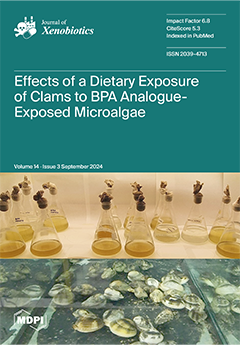
Cover Story: This study tests the hypothesis that microalgae (Phaeodactylum tricornutum) exposed to BPA analogues, namely, BPAF, BPF and BPS, exert negative effects on primary consumers, such as the clam Ruditapes philippinarum. After exposure to BPA analogues, microalgae were supplied as food to bivalves. The effects of this dietary exposure were evaluated on a battery of biomarkers measured in the haemolymph/haemocytes, gills and digestive glands of the clams. Bioaccumulation in the clams was also evaluated. The results obtained demonstrated that a diet of BPA-analogue-exposed microalgae can induce significant alterations in some important biological responses of R. philippinarum, suggesting a potential ecotoxicological risk for the marine food chain, at least at the first few levels. View this paper
  • Issues are regarded as officially published after their release is announced to the table of contents alert mailing list .
  • You may sign up for email alerts to receive table of contents of newly released issues.
  • PDF is the official format for papers published in both, html and pdf forms. To view the papers in pdf format, click on the "PDF Full-text" link, and use the free Adobe Reader to open them.

Articles (28)

  • Article
  • Open Access
2 Citations
2,253 Views
20 Pages

Time of Application of Desiccant Herbicides Affects Photosynthetic Pigments, Physiological Indicators, and the Quality of Cowpea Seeds

  • Ester dos Santos Coêlho,
  • João Everthon da Silva Ribeiro,
  • Welder de Araújo Rangel Lopes,
  • Anna Kézia Soares de Oliveira,
  • Pablo Henrique de Almeida Oliveira,
  • Gisele Lopes dos Santos,
  • Ewerton da Silva Barbosa,
  • Valécia Nogueira Santos e Silva,
  • Hamurábi Anizio Lins and
  • Clarisse Pereira Benedito
  • + 4 authors

19 September 2024

Chemical desiccation is widely used in agriculture to anticipate harvest and mitigate the effects of adverse environmental conditions. It is applied to both grains and seeds. Although this practice is widely used, there are still significant gaps in...

  • Article
  • Open Access
1,940 Views
19 Pages

19 September 2024

Gene mutations linked to diseases like cancer may be caused by exposure to environmental chemicals. The X-linked phosphatidylinositol glycan class A (PIG-A) gene, required for glycosylphosphatidylinositol (GPI) anchor biosynthesis, is a key target lo...

  • Review
  • Open Access
11 Citations
5,098 Views
25 Pages

19 September 2024

Osteoarthritis (OA) is a debilitating joint disease characterized by cartilage degradation, leading to pain and functional impairment. A key contributor to OA progression is the decline in cartilage lubrication. In physiological conditions, synovial...

  • Communication
  • Open Access
3 Citations
1,843 Views
12 Pages

Pregnenolone 16-Alpha Carbonitrile, an Agonist of Rodent Pregnane X Receptor, Regulates Testosterone Biosynthesis in Rodent Leydig Cells

  • Julia M. Salamat,
  • Elizabeth M. Ayala,
  • Chen-Che J. Huang,
  • Frank S. Wilbanks,
  • Rachel C. Knight,
  • Benson T. Akingbemi and
  • Satyanarayana R. Pondugula

16 September 2024

Leydig cells (LCs) in the testes produce the male sex hormone testosterone (T). Several xenobiotics, including clinical drugs, supplements, and environmental chemicals, are known to disrupt T homeostasis. Notably, some of these xenobiotics are known...

  • Article
  • Open Access
4 Citations
6,687 Views
18 Pages

10 September 2024

This study investigates using KOH-activated coffee grounds (KACGs) as an effective adsorbent for removing organophosphorus xenobiotics malathion and chlorpyrifos from water. Malathion and chlorpyrifos, widely used as pesticides, pose significant heal...

  • Article
  • Open Access
1 Citations
2,011 Views
17 Pages

Assessing the Effects of a Diet of BPA Analogue-Exposed Microalgae in the Clam Ruditapes philippinarum

  • Jacopo Fabrello,
  • Michela Dalla Fontana,
  • Noemi Gaiani,
  • Maria Ciscato,
  • Marco Roverso,
  • Sara Bogialli and
  • Valerio Matozzo

6 September 2024

In our previous study, we demonstrated that the microalgae Phaeodactylum tricornutum can bioaccumulate bisphenol A analogues. Since this microalgae species is part of the diet of marine filter-feeding organisms, such as bivalves, in this study we tes...

  • Article
  • Open Access
6 Citations
3,581 Views
20 Pages

4 September 2024

Bisphenols are a group of endocrine-disrupting chemicals used worldwide for the production of plastics and resins. Bisphenol A (BPA), the main bisphenol, exhibits many unwanted effects. BPA has, currently, been replaced with bisphenol F (BPF) and bis...

  • Article
  • Open Access
1 Citations
2,035 Views
14 Pages

4 September 2024

Contact of aquatic microbiocenoses with antibiotics present in the environment can cause the former to develop resistance to antimicrobial drugs. Therefore, the search for methods to detect antibiotics and drug-resistant microorganisms in the environ...

  • Article
  • Open Access
2 Citations
2,072 Views
22 Pages

Persistent Organic Pollutants in Tagus Estuary Salt Marshes: Patterns of Contamination and Plant Uptake

  • Ricardo Cruz de Carvalho,
  • João Cardoso,
  • João Albuquerque Carreiras,
  • Paula Santos,
  • Carla Palma and
  • Bernardo Duarte

2 September 2024

The presence of anthropogenic compounds, including organochlorine pesticides (OCPs) and polychlorinated biphenyls (PCBs), was studied in three salt marshes within the Tagus estuary, Portugal, along an anthropogenic pressure gradient. Results revealed...

  • Article
  • Open Access
4 Citations
3,738 Views
22 Pages

27 August 2024

Toxicological analyses often necessitate the identification of compounds belonging to diverse functional groups. For GC–MS analyses, derivatization of compounds belonging to different functional groups can pose a challenge and requires the deve...

of 3

Get Alerted

Add your email address to receive forthcoming issues of this journal.

XFacebookLinkedIn
J. Xenobiot. - ISSN 2039-4713