You are currently viewing a new version of our website. To view the old version click .

Future Internet, Volume 10, Issue 9

September 2018 - 10 articles

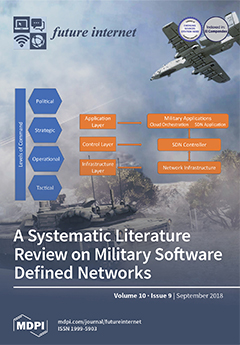
Cover Story: Military and emergency response networks rely fully or partially on constrained dynamic networks, due to technical, physical or other limitations of a financial and regulatory nature. Contemporary data-centric trends in the civil domain, such as Software-Defined Networks and Network Function Virtualization, execute network control in a centralized manner, while CPU intensive services are distributed. These principles have the potential of satisfying the network constraints of military networks, and can contribute to solving their operational challenges. View this paper
  • Issues are regarded as officially published after their release is announced to the table of contents alert mailing list .
  • You may sign up for email alerts to receive table of contents of newly released issues.
  • PDF is the official format for papers published in both, html and pdf forms. To view the papers in pdf format, click on the "PDF Full-text" link, and use the free Adobe Reader to open them.

Articles (10)

  • Article
  • Open Access
13 Citations
5,578 Views
17 Pages

15 September 2018

Cloud computing systems are popular in computing industry for their ease of use and wide range of applications. These systems offer services that can be used over the Internet. Due to their wide popularity and usage, cloud computing systems and their...

  • Article
  • Open Access
4 Citations
4,369 Views
19 Pages

15 September 2018

Wireless sensor networks (WSN) are designed to collect information by means of a large number of energy-limited battery sensor nodes. Therefore, it is important to minimize the energy consumed by each sensor, in order to extend the network life. The...

  • Feature Paper
  • Review
  • Open Access
11 Citations
4,596 Views
17 Pages

13 September 2018

One of the most important research topics nowadays is human action recognition, which is of significant interest to the computer vision and machine learning communities. Some of the factors that hamper it include changes in postures and shapes and th...

  • Review
  • Open Access
28 Citations
8,786 Views
39 Pages

A Systematic Literature Review on Military Software Defined Networks

  • Vasileios Gkioulos,
  • Håkon Gunleifsen and
  • Goitom Kahsay Weldehawaryat

12 September 2018

Software Defined Networking (SDN) is an evolving network architecture paradigm that focuses on the separation of control and data planes. SDN receives increasing attention both from academia and industry, across a multitude of application domains. In...

  • Article
  • Open Access
10 Citations
4,155 Views
21 Pages

6 September 2018

A conventional Wireless Sensor Network (WSN) cannot have an infinite lifetime without a battery recharge or replacement. Energy Harvesting (EH), from environmental energy sources, is a promising technology to provide sustainable powering for a WSN. I...

  • Article
  • Open Access
4 Citations
5,091 Views
10 Pages

6 September 2018

The cloud-computing concept has emerged as a powerful mechanism for data storage by providing a suitable platform for data centers. Recent studies show that the energy consumption of cloud computing systems is a key issue. Therefore, we should reduce...

  • Article
  • Open Access
4 Citations
3,935 Views
12 Pages

6 September 2018

This paper presents log likelihood ratio (LLR) based relay selection scheme for a cooperative amplify and forward relaying system. To evaluate the performance of the aforementioned system model, a three state Markov chain based fading environment has...

  • Article
  • Open Access
3 Citations
4,779 Views
11 Pages

24 August 2018

Frame repetition (FR) is a common temporal-domain tampering operator, which is often used to increase the frame rate of video sequences. Existing methods detect FR forgery by analyzing residual variation or similarity between video frames; however, t...

  • Article
  • Open Access
29 Citations
5,411 Views
16 Pages

23 August 2018

A data center network is vulnerable to suffer from concealed low-rate distributed denial of service (L-DDoS) attacks because its data flow has the characteristics of data flow delay, diversity, and synchronization. Several studies have proposed addre...

  • Article
  • Open Access
6 Citations
4,265 Views
15 Pages

21 August 2018

Passive Radio Frequency IDentification (RFID) tags are generally highly constrained and cannot support conventional encryption systems to meet the required security. Hence, designers of security protocols may try to achieve the desired security only...

Get Alerted

Add your email address to receive forthcoming issues of this journal.

XFacebookLinkedIn
Future Internet - ISSN 1999-5903