You are currently viewing a new version of our website. To view the old version click .

Diversity, Volume 12, Issue 7

July 2020 - 25 articles

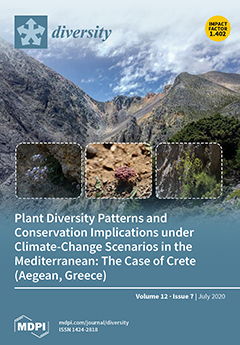
Cover Story: Climate change poses a great challenge for biodiversity conservation and alters biodiversity patterns at all scales. The Mediterranean Basin, a global biodiversity hotspot and a hotspot of vulnerable species, is expected to experience large changes in climate, with these more prominent changes in its islands and mountain summits. We assessed climate change’s impacts on the biodiversity patterns of Crete, the hottest endemic plant diversity Mediterranean hotspot. We found that the high altitude areas of Cretan mountains constitute biodiversity hotspots and areas of high conservation and evolutionary value. Due to the “escalator to extinction” phenomenon, these areas are projected to become diversity “death-zones” and should, thus, be prioritized. View this paper
  • Issues are regarded as officially published after their release is announced to the table of contents alert mailing list .
  • You may sign up for email alerts to receive table of contents of newly released issues.
  • PDF is the official format for papers published in both, html and pdf forms. To view the papers in pdf format, click on the "PDF Full-text" link, and use the free Adobe Reader to open them.

Articles (25)

  • Feature Paper
  • Article
  • Open Access
12 Citations
5,445 Views
20 Pages

Two New Benthic Diatoms of the Genus Achnanthidium (Bacillariophyceae) from the Hangang River, Korea

  • Minzi Miao,
  • Zhun Li,
  • Eun-A Hwang,
  • Ha-Kyung Kim,
  • Hyuk Lee and
  • Baik-Ho Kim

21 July 2020

Two new benthic freshwater species belonging to the genus Achnanthidium were found in Korea. Achnanthidium ovale sp. nov. and A. cavitatum sp. nov. are described as new species based on light and scanning electron microscopy observations and molecula...

  • Article
  • Open Access
8 Citations
4,614 Views
15 Pages

19 July 2020

Species coexistence is one of the most important concepts in ecology for understanding how biodiversity is shaped and changed. In this study, we investigated the mechanism by which two small cyprinid fishes (H. leucisculus and H. bleekeri) coexist by...

  • Article
  • Open Access
5 Citations
3,827 Views
22 Pages

Endemism of Uropodina Mites: Spurious or Real?

  • Jerzy Błoszyk and
  • Agnieszka Napierała

18 July 2020

Analyzing the data from the existing literature about geographic distribution of mites from the suborder Uropodina (Acari: Mesostigmata), one can get the impression that this group of mites is characterized by an unusual extent of endemism on a globa...

  • Article
  • Open Access
6 Citations
4,857 Views
21 Pages

17 July 2020

North American freshwaters are among the world’s most threatened ecosystems, and freshwater mussels are among the most imperiled inhabiting these systems. A critical aspect of conservation biology is delineating patterns of genetic diversity, w...

  • Editorial
  • Open Access
5 Citations
3,608 Views
3 Pages

17 July 2020

Domesticated animals live and produce in an environment influenced by both natural and human factors. These agricultural environments are important to maintain for human survival and also for their interactions with natural environments. Effective co...

  • Review
  • Open Access
72 Citations
12,276 Views
15 Pages

15 July 2020

Wild and managed bees provide pollination services to crops and wild plants, as well as a variety of other services beneficial to humans. Honey bees are the most economically valuable pollinator worldwide. It has been calculated that 9.5% of the tota...

  • Article
  • Open Access
13 Citations
4,421 Views
23 Pages

13 July 2020

Time-series studies at the LTER (Long-Term Ecological Research) observatory HAUSGARTEN have yielded the world’s longest time-series on deep-sea meiofauna and thus provide a decent basis to investigate the variability in deep-sea meiobenthic com...

  • Article
  • Open Access
23 Citations
5,382 Views
19 Pages

10 July 2020

The Acidobacteria is one of the most abundant phyla in most soil types. Fynbos plants are endemic to South Africa, and these soils provide the ideal habitat for Acidobacteria, because of its low pH and oligotrophic properties. However, little is know...

  • Communication
  • Open Access
4 Citations
5,391 Views
18 Pages

Oral Microbiome Metabarcoding in Two Invasive Small Mammals from New Zealand

  • Arsalan Emami-Khoyi,
  • Isma Benmazouz,
  • Adrian M. Paterson,
  • James G. Ross,
  • Elaine C. Murphy,
  • Jennifer Bothwell,
  • Hossein Alizadeh,
  • Bettine Jansen van Vuuren and
  • Peter R. Teske

10 July 2020

All multicellular organisms host a wide diversity of microorganisms in and on their bodies, which are collectively known as their microbiome. Characterising microbial communities that inhabit different body niches in wild animals is critical to bette...

  • Communication
  • Open Access
4 Citations
3,984 Views
8 Pages

Genetic Diversity of Local Greek and Bulgarian Grapevine (Vitis Vinifera L.) Varieties

  • Maria Papapetrou,
  • Dimitrios Loukovitis,
  • Orestis Papadopoulos,
  • Zoi Kazlari,
  • Anastasia Peristeraki,
  • Slavina Arsenova,
  • Desislava Bardarova,
  • Desislava Doncheva,
  • Serafeim Theocharis and
  • Constantinos Karagiannidis
  • + 4 authors

9 July 2020

The aim of this study was to estimate the genetic diversity of Greek and Bulgarian grapevine varieties with the use of microsatellite markers. The studied samples were collected from various productive vineyards, consisting of eight Greek and nine Bu...

of 3

Get Alerted

Add your email address to receive forthcoming issues of this journal.

XFacebookLinkedIn
Diversity - ISSN 1424-2818