You are currently viewing a new version of our website. To view the old version click .

Diversity, Volume 11, Issue 3

March 2019 - 19 articles

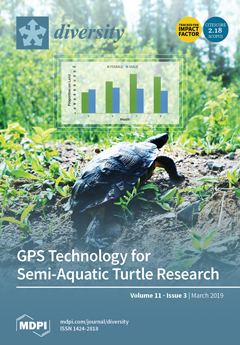
Cover Story: We used snapshot global positioning system (GPS) units in stationary tests and on wood turtles (Glyptemys insculpta) in northeastern Minnesota. The location error in the stationary tests was 10 m. We collected 122,657 GPS locations and 242,781 temperature readings from 26 turtles. Each wood turtle’s location was classified based on the GPS location, turtle temperature, and temperature profiles from river, sun, and shade locations. From May to September, 68% of the locations were on land. Only 38% of the GPS location attempts were successful, indicating that wood turtles are using forested areas. The mean daily movement was 55 m. Snapshot GPS units and temperature loggers provided fine-scale GPS data useful in describing spatial ecology and habitat use of semi-aquatic turtles. View Paper here.
  • Issues are regarded as officially published after their release is announced to the table of contents alert mailing list .
  • You may sign up for email alerts to receive table of contents of newly released issues.
  • PDF is the official format for papers published in both, html and pdf forms. To view the papers in pdf format, click on the "PDF Full-text" link, and use the free Adobe Reader to open them.

Articles (19)

  • Article
  • Open Access
14 Citations
7,147 Views
11 Pages

Bat Pass Duration Measurement: An Indirect Measure of Distance of Detection

  • Christian Kerbiriou,
  • Yves Bas,
  • Isabelle Le Viol,
  • Romain Lorrillière,
  • Justine Mougnot and
  • Jean-François Julien

22 March 2019

Few reports have been published on detection distances of bat calls because the evaluation of detection distance is complicated. Several of the approaches used to measure detection distances are based on the researcher’s experience and judgment...

  • Article
  • Open Access
25 Citations
6,141 Views
11 Pages

Plasticity in Three-Dimensional Geometry of Branching Corals Along a Cross-Shelf Gradient

  • Neil E. Doszpot,
  • Michael J. McWilliam,
  • Morgan S. Pratchett,
  • Andrew S. Hoey and
  • Will F. Figueira

21 March 2019

Scleractinian corals often exhibit high levels of morphological plasticity, which is potentially important in enabling individual species to occupy benthic spaces across a wide range of environmental gradients. This study tested for differences in th...

  • Review
  • Open Access
14 Citations
5,667 Views
10 Pages

Could Hair-Lichens of High-Elevation Forests Help Detect the Impact of Global Change in the Alps?

  • Juri Nascimbene,
  • Renato Benesperi,
  • Paolo Giordani,
  • Martin Grube,
  • Lorenzo Marini,
  • Chiara Vallese and
  • Helmut Mayrhofer

21 March 2019

Climate change and the anthropic emission of pollutants are likely to have an accelerated impact in high-elevation mountain areas. This phenomenon could have negative consequences on alpine habitats and for species of conservation in relative proximi...

  • Article
  • Open Access
17 Citations
8,345 Views
23 Pages

21 March 2019

Many coral reef systems are shelf-based and consist of reefs that are arranged in rows parallel to the coastline. They usually show an increase in species richness in the offshore direction, coinciding with decreasing terrigenous impact and a deeper...

  • Review
  • Open Access
61 Citations
10,197 Views
14 Pages

Antarctic Studies Show Lichens to be Excellent Biomonitors of Climate Change

  • Leopoldo G. Sancho,
  • Ana Pintado and
  • T. G. Allan Green

19 March 2019

Lichens have been used as biomonitors for multiple purposes. They are well-known as air pollution indicators around urban and industrial centers. More recently, several attempts have been made to use lichens as monitors of climate change especially i...

  • Article
  • Open Access
11 Citations
3,792 Views
17 Pages

Do Different Teams Produce Different Results in Long-Term Lichen Biomonitoring?

  • Giorgio Brunialti,
  • Luisa Frati,
  • Cristina Malegori,
  • Paolo Giordani and
  • Paola Malaspina

19 March 2019

Lichen biomonitoring programs focus on temporal variations in epiphytic lichen communities in relation to the effects of atmospheric pollution. As repeated surveys are planned at medium to long term intervals, the alternation of different operators i...

  • Article
  • Open Access
3 Citations
4,195 Views
12 Pages

14 March 2019

Long-term or cumulative diversity is the biodiversity that accumulates at a site over many generations of community members. Cumulative diversity is likely important to the intrinsic and functional value of ecosystems given the legacies left behind b...

  • Article
  • Open Access
11 Citations
4,052 Views
12 Pages

Vacant Bivalve Boreholes Increase Invertebrate Species Richness in a Physically Harsh, Low Intertidal Platform

  • María Bagur,
  • Jorge L. Gutiérrez,
  • Lorena P. Arribas and
  • M. Gabriela Palomo

7 March 2019

Ecosystem engineers can modulate harsh abiotic conditions, thus creating habitat for species that cannot withstand the local environment. In this study, we investigated if vacant boreholes created by the rock-boring bivalve Petricola dactylus increas...

  • Article
  • Open Access
16 Citations
8,893 Views
12 Pages

7 March 2019

Head-starting is a conservation strategy that entails releasing captive-reared animals into nature at sizes large enough to better resist post-release predation. However, efforts to maximize growth in captivity may jeopardize development of beneficia...

  • Article
  • Open Access
13 Citations
4,518 Views
17 Pages

Prokaryotic Dynamics in the Meromictic Coastal Lake Faro (Sicily, Italy)

  • Carmela Raffa,
  • Carmen Rizzo,
  • Marc Strous,
  • Emilio De Domenico,
  • Marilena Sanfilippo,
  • Luigi Michaud and
  • Angelina Lo Giudice

6 March 2019

Lake Faro, in the North-Eastern corner of Sicily (Italy), shows the typical stratification of a meromictic tempered basin, with a clear identification of the mixolimnion and the monimolimnion, separated by an interfacial chemocline. In this study, an...

of 2

Get Alerted

Add your email address to receive forthcoming issues of this journal.

XFacebookLinkedIn
Diversity - ISSN 1424-2818